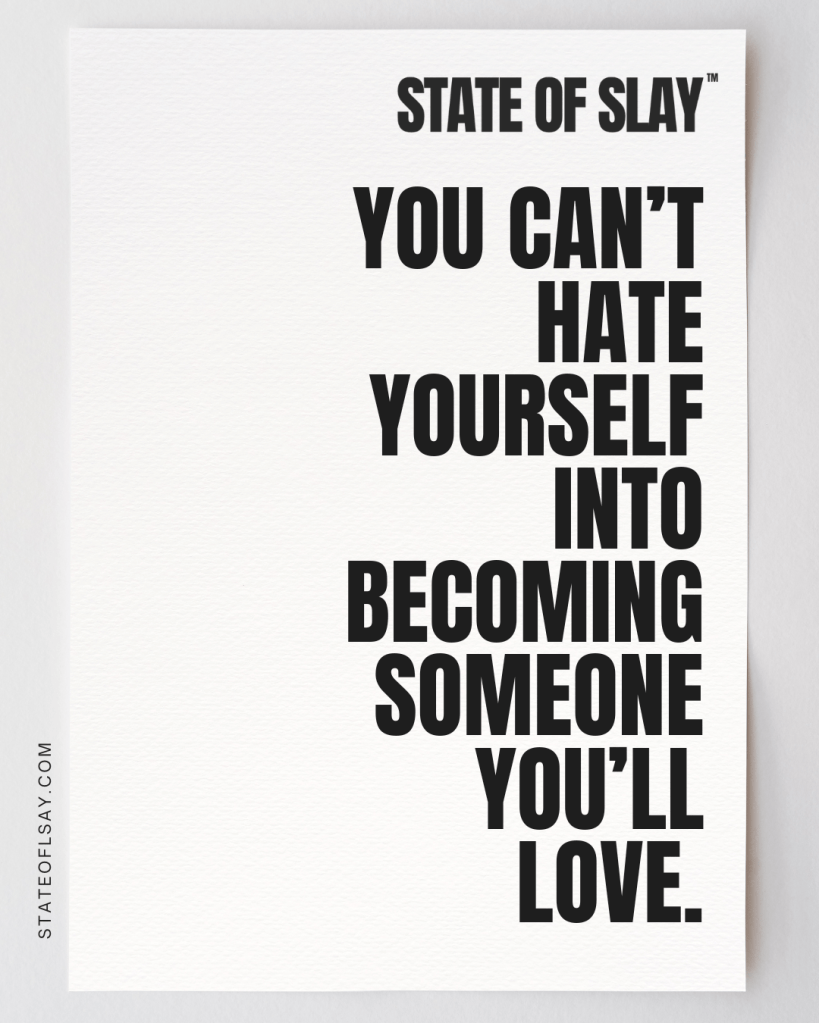
We can be remarkably patient with other people while giving ourselves almost none of the same grace.
We understand when someone else is struggling.
We remind them that change takes time.
We tell them one mistake doesn’t define them.
We encourage them to keep going when they stumble.
But when it’s us?
Suddenly the rules change.
We criticize the body we’re trying to care for.
We shame ourselves for choices we made when we didn’t know better.
We replay mistakes as evidence of everything that’s wrong with us.
We compare ourselves to who we think we should already be.
And somewhere along the way, we convince ourselves that being harder on ourselves will somehow make us better.
If I hate this part of myself enough, maybe I’ll finally change it.
If I criticize myself enough, maybe I’ll become more disciplined.
If I keep reminding myself of everything I’ve done wrong, maybe I won’t do it again.
But shame is a terrible architect.
It may motivate you for a moment, but it’s difficult to build a healthy relationship with yourself on a foundation of constant rejection.
Growth requires accountability.
It requires honesty.
Sometimes it requires admitting that you’ve hurt people, made poor choices, ignored what you knew, or stayed somewhere long after you should have left.
Self-love doesn’t mean pretending those things didn’t happen.
It means refusing to use them as weapons against yourself forever.
There is a difference between saying, I need to change this, and saying, There is something wrong with me.
One creates possibility.
The other turns growth into punishment.
You are allowed to want more for yourself without despising who you are today.
You can work on your habits without hating the person who developed them.
You can regret a decision without turning that regret into an identity.
You can recognize where you’ve fallen short while still believing you are worthy of patience, care, and another chance.
Because the person you’re trying so hard to become is still going to be you.
And if every step toward that person is fueled by rejection, there will always be another flaw to find, another standard to miss, another reason to postpone loving yourself.
Maybe the goal isn’t to finally become good enough to deserve your own love.
Maybe part of becoming who you want to be is learning to stop withholding it.
This is your reminder:
You don’t have to love everything about yourself to stop treating yourself like someone you’re trying to defeat.
When we’re hurting, we don’t always know how to heal.
We just know we want the pain to stop.
So we reach for things.
Relationships.
Food.
Alcohol.
Shopping.
Work.
Attention.
Isolation.
Distraction.
Anything that gives us a few minutes of relief from what feels unbearable.
Sometimes those choices help us get through the day.
Sometimes they become destructive.
And years later, when we’re healthier and have more perspective, we can look back at the person we were and feel ashamed of the ways we coped.
Why did I do that?
Why did I stay?
Why did I need that?
Why couldn’t I just deal with what I was feeling?
But you’re looking at an earlier version of yourself with knowledge that version didn’t have yet.
You are not a bad person for the ways you tried to kill your sadness.
You were a hurting person trying desperately to make the pain stop.
Prefer to listen? The Audio Blog version is available here.
SOMETIMES COPING IS JUST SURVIVAL IN DISGUISE
We don’t always recognize coping mechanisms while we’re using them.
At the time, they may simply feel like relief.
Something that makes the loneliness quieter.
Something that distracts us from the grief.
Something that makes us feel wanted.
Something that gives us somewhere to put all the feelings we don’t understand.
So we reach for it again.
And again.
That doesn’t mean every coping mechanism is healthy.
Some can hurt us.
Some can hurt other people.
Some can create consequences we’ll eventually have to face.
But understanding why you reached for something isn’t the same as excusing what happened.
Understanding helps you recognize what you were really trying to survive.
RELIEF AND HEALING ARE NOT THE SAME THING
When we’re hurting, we often search for relief before we understand healing.
Relief asks:
How can I stop feeling this right now?
Healing asks:
What is this pain trying to tell me?
Those questions can lead us in very different directions.
Relief can temporarily numb what hurts.
Healing asks us to understand it.
Feel it.
Process it.
And eventually move through it.
There is no shame in having reached for relief when you didn’t yet know how to heal.
But eventually, relief can no longer do the work that healing requires.
SADNESS CAN MAKE TEMPORARY THINGS FEEL LIKE ANSWERS
When something hurts deeply enough, almost anything that makes it hurt less can begin to look like a solution.
Attention can feel like love.
Distraction can feel like peace.
Numbing can feel like healing.
Being needed can feel like being valued.
A relationship can feel like rescue.
Isolation can feel like protection.
For a while, those things may even work.
That’s what makes unhealthy coping mechanisms so complicated.
They often help before they hurt.
Sometimes we don’t recognize the difference until much later.
That’s part of growing.
YOU DIDN’T HAVE THE TOOLS YOU HAVE NOW
It’s easy to look backward and imagine you should have known better.
But healing gives us tools we didn’t always possess.
Boundaries.
Self-awareness.
Perspective.
Emotional regulation.
The ability to recognize patterns.
The courage to ask for help.
You cannot expect a past version of yourself to use tools you hadn’t learned how to use yet.
You can wish you’d made different choices.
You can take responsibility for them.
You can repair what needs repairing.
But you don’t have to hate yourself for not knowing then what you know now.
SHAME WON’T HEAL WHAT SADNESS CREATED
Shame has a way of convincing us that our worst choices reveal our truest selves.
They don’t.
A decision is something you made.
A mistake is something you made.
A coping mechanism is something you used.
None of those things have to become who you are.
If you’ve grown enough to look back and recognize that something wasn’t healthy, that awareness matters.
It means you can see what you couldn’t see before.
Don’t use your growth as another reason to punish yourself.
Let it become evidence that you’ve changed.
UNDERSTANDING YOURSELF IS NOT MAKING EXCUSES
Sometimes we’re afraid to show compassion toward our past selves because we think it lets us off the hook.
It doesn’t.
You can understand why you behaved a certain way and still acknowledge the consequences.
You can say:
I was hurting.
And…
I hurt someone.
I didn’t know how to cope.
And…
I wish I had handled it differently.
I understand why I made that choice.
And…
I would make a different choice today.
Two truths can exist at the same time.
Accountability helps us grow.
Compassion allows us to grow without destroying ourselves along the way.
SOMETIMES WE TRY TO FILL WHAT ACTUALLY NEEDS TO BE FELT
There are some empty spaces we cannot fill.
We have to feel them.
Grief needs to be grieved.
Loneliness needs to be understood.
Loss needs to be acknowledged.
Pain needs somewhere safe to exist.
We can spend years pouring things into an emotional hole, hoping something will finally make us feel whole.
But healing often begins when we stop asking what we can put into the space and start asking why the space is there.
Sometimes the emptiness isn’t asking to be filled.
It’s asking to be heard.
YOU DON’T HAVE TO KEEP PUNISHING THE PERSON YOU USED TO BE
There is a strange cruelty in healing that we don’t talk about enough.
We become healthier…
And then use that health to judge the person we were when we weren’t.
We look backward with clarity and expect our former selves to have possessed it too.
But they didn’t.
They were living the experience you now have the privilege of understanding in hindsight.
That doesn’t mean everything they did was right.
It means they deserve context.
You can hold your past self accountable without putting them on trial for the rest of your life.
FORGIVE THE PERSON WHO WAS TRYING TO MAKE THE PAIN STOP
Think about who you were during one of your hardest seasons.
Not from where you stand today.
From where you stood then.
What did you know?
What hadn’t you learned yet?
What were you afraid of?
What were you desperately trying not to feel?
That person doesn’t need another judge.
They’ve probably had enough of those.
They need understanding.
They need forgiveness.
They need you to recognize that somehow, imperfectly, they kept going long enough for you to become who you are today.
YOU CAN LEARN A NEW WAY TO CARE FOR YOURSELF
Maybe you once tried to kill your sadness with relationships.
Work.
Food.
Alcohol.
Shopping.
Attention.
Isolation.
Or anything else that offered temporary escape.
You don’t have to be ashamed that something once helped you survive.
But you also don’t have to keep using a survival strategy after you’ve learned a healthier way to live.
Awareness gives you a choice.
And every healthier choice becomes another way of telling yourself:
I know how to care for you differently now.
You are not a bad person for the ways you tried to kill your sadness.
You were hurting.
You were learning.
You were trying to get through something with whatever tools you had at the time.
Now you know more.
Now you can choose differently.
And perhaps one of the greatest signs of healing is being able to look back at the person you once were without shame and say:
I understand why you did what you did.
But we don’t have to survive that way anymore.
SLAY REFLECTION
S — See Yourself With Compassion What past behavior have you been judging without considering what you were going through at the time?
L — Look Beneath the Behavior What sadness, pain, loneliness, or fear were you actually trying to escape?
A — Accept What You’ve Learned What do you understand about yourself today that you couldn’t understand during that difficult season?
Y — Your Next Step What healthier way can you care for yourself the next time you feel the urge to escape what you’re feeling?
CALL TO ACTION: JOIN THE CONVERSATION
I’d love to hear from you.
What have you learned to give yourself today that you once searched for somewhere else?
Share your story in the comments. Your experience may help someone else understand that they don’t have to be ashamed of the person they were while they were trying to survive.
And if you know someone who is struggling to forgive a past version of themselves, send this to them.
For most of my life, I believed there were things about me that were too dark, too shameful, too unforgivable to share. I told myself, no one could handle the truth about me.
So, I kept secrets. I smiled when I was breaking. I said, “I’m fine,” when I wasn’t. I built walls out of silence—strong, tall, and unshakeable.
But what I didn’t know back then was that silence doesn’t protect you. It poisons you.
The belief that “there’s nothing I say or do that is too bad to tell somebody” didn’t come to me easily. It came after years of hiding, years of shame, and years of trying to heal alone.
Shame Thrives in Silence
Shame wants to keep you quiet. It whispers that if anyone knew the truth, they’d leave. That you’d be judged. Rejected. Unlovable.
But here’s what I’ve learned: when you say the thing you’ve been afraid to say, you take away shame’s power.
I’ve watched people share their deepest secrets—addiction, abuse, betrayal, trauma—and instead of being met with disgust, they were met with compassion.
That’s the thing about truth—it connects us.
No matter how different our experiences are, the feelings underneath are universal. Fear. Regret. Guilt. Loneliness. And when we share those feelings, we remind each other we’re human.
The Lie of “Too Much”
Somewhere along the way, many of us learned that vulnerability equals weakness. That we should keep it together, hold it in, and never show the messy parts.
We learned to say, “It’s no big deal,” when it was. We learned to minimize our pain so others wouldn’t feel uncomfortable. We learned to smile instead of speak.
But here’s the truth: you are not “too much.” You are not too broken, too complicated, or too far gone.
The things you’re afraid to say out loud are often the things that will set you free.
When you find someone safe—a therapist, a friend, a sponsor, a mentor—and tell them what you’ve been holding, it stops controlling you.
You break the cycle of secrecy. You interrupt the story shame keeps replaying. You step into healing.
The Power of Being Heard
When I finally opened up about the things I thought were “too bad to tell anybody,” I was terrified. My voice shook. My stomach twisted. I almost didn’t go through with it.
But I did.
And when I did, something incredible happened—I didn’t fall apart. I was held.
That moment taught me something I’ll never forget:
The human heart is built to hold not only our own pain, but the pain of others too.
We are meant to carry one another.
Healing happens in connection. It happens when someone looks at you and says, “Me too.”
That simple acknowledgment is enough to make the walls you’ve built start to crumble.
You Are Not Your Mistakes
You are not the things you’ve done. You are not the worst decision you’ve made. You are not the shame someone else handed you.
We all make mistakes. We all have moments we wish we could rewrite. But those moments don’t define you—they refine you.
When you find the courage to speak your truth, you stop living in fear of being found out. You realize that nothing you’ve done disqualifies you from love, belonging, or forgiveness.
And the more honest you become, the freer you get.
Honesty is the antidote to shame.
How to Begin Speaking Your Truth
If you’ve spent your life believing there are things too bad to share, here’s where to start:
Find a safe person. This could be a trusted friend, a sponsor, or a counselor. Safety is key.
Start small. You don’t have to unload everything at once. Begin with what feels manageable.
Be honest with yourself first. Write it down, say it out loud to the mirror, or pray about it. Naming your truth gives it form.
Expect discomfort. Vulnerability is brave, and bravery rarely feels comfortable.
Stay open to compassion. People can surprise you. Let them.
The point isn’t to confess for pity—it’s to connect for healing.
Freedom Lives in the Light
Every time you tell the truth about your story, you let the light in.
You start to see that your worst moments were also your teachers. That the parts of you you’ve tried to bury have shaped your strength, empathy, and resilience.
And once you realize that, you can’t go back.
You can’t go back to pretending you’re fine. You can’t go back to silencing yourself. You can’t go back to believing you’re unworthy of love.
Because once you’ve been met with compassion where you expected judgment, you know the truth:
There is nothing you can say or do that is too bad to tell somebody.
Not because it wasn’t bad—but because you’re still worthy. Always have been. Always will be.
SLAY Reflection
What’s one truth you’ve been afraid to speak?
Who in your life feels safe enough to share it with?
How has silence kept you stuck?
What might freedom look like if you let someone in?
How can you show that same compassion to someone else today?
S – Speak your truth, even if your voice shakes L – Let go of the shame that keeps you small A – Allow yourself to be seen and supported Y – Yield to healing—connection over isolation
Call to Action: Join the Conversation
I’d love to hear from you. What truth did you finally speak—and how did it change you? Share your story in the comments. Let’s cheer each other on.
And if you know someone who’s carrying something they think is “too bad to tell anybody,” send this to them. Sometimes, all it takes is one brave share to set someone free.
I was reminded of this in a conversation yesterday, and remembered myself, it really resonated because I was once one of those hurt people who hurt people. I didn’t always intend to hurt people, and then other times, I did. When we are suffering, in pain, or mentally not at our best, our hurt trickles into every relationship and every interaction we have. Many times we tell ourselves that we are only hurting ourselves, but that is not true. Our actions affect everyone around us, even if it’s only for a few minutes. We all are responsible for what we say and do, and the energy we put out to those around us. As an adult, it is not OK to hide behind an event from our past or make excuses for behaving in a way that harms others. We all have a choice of how we act, react and respond to our set of circumstances and where we find ourselves. But realizing that the people who hurt are hurting themselves also gives us some perspective of what may be happening for someone who hurts us, and the realization that their hurt has nothing to do with us.
Walking in the dark for most of my life I walked with a lot of hurt, and I carried that hurt alone because I was not able to share my truth with others, as a result, it grew, it had power over me and as a result, I believed the lies it told me. I lived in fear, every day, and I didn’t trust anyone, so I was always looking for people to hurt me, and as a countermeasure, I would hurt back, or hurt before I could be hurt. This way of life left me feeling more and more isolated and guilty for hurting those I cared about. But the sick part of me loved this behavior, more I did it the more I was proud of it, I excused it away by saying it was my shield of armor, that it protected me, but what it was really doing was keeping me sick and far from those who cared about me. It also skewed my people picker, it clouded my vision of who was good for me and who I should invite into my life, I began to invite people in who might hurt me because that’s what I thought I deserved, or it gave me an easy target to hurt when I felt compelled to do so, or, I thought I would teach them a lesson. It wasn’t until I surrendered and asked for help, and began this new way of life I live today that I realized all of the damage I had done to others, and to myself. Once I was able to clean up my side of the street and find acceptance and forgiveness for myself I was able to humbly go and make any repairs I could to those I had harmed, and each of those experiences for me were steps that helped me grow and demonstrated to me the power of our words and actions. And now, having lived my life in the light I have been able to find compassion for those, who, like myself in the past, hurt others, I don’t give them a free pass because of it, but I am able to understand where they might be coming from as a way to maybe connect to them through the pain I once lived in, rather than judging them and condemning them for it. Just like when we were kids, that bully in the playground is actually one the lowest self-esteem and likely in the most pain, it’s no different out in the world today, as adults we can do the same thing to mask our hurt.
Whether you are the individual who is hurt, or have been hurt by someone who is hurt, we have the responsibility to take care of ourselves and to behave in a way that does not harm others. There is no excuse to purposely harm someone else no matter how much pain we may be in, or what harm was done to us, we only create more hurt when we do, and, we hurt our own spirit in the process. Stop the cycle of hurt, whether it be to ourselves or those around us, and start to be a part of the solution. Spread love, compassion, understanding rather than hurt and see how that turns your own hurt around. SLAY on!
SLAY OF THE DAY: Do you let your hurt hurt others? How has your hurt hurt others in the past? How does it today? Do you use your hurt to justify hurting others? How do you do this? How does that make you feel? How would you rather feel? What is your hurt based on? Is that hurt valid in your life today or is it a hurt from your past that you should let go? What keeps you holding on? How does that hurt you today? Has your hurt allowed you to recognize the hurt in others? Does it allow you to find compassion for them? Does it allow you to connect with them? Does that connection diminish your own hurt? Find the root of your hurt and focus on healing that hurt, our hurt doesn’t go away by causing others to hurt, it just makes more hurt. Let go of what hurt you and turn that energy into healing energy, for yourself, and those who may be hurting around you.
Before walking this path I hid a lot of things. And, as my disease progressed so did the list of secrets I was keeping. I was ashamed at how I was living my life and worked hard to keep what was going on from the people in my life, and that required keeping many things to myself, which only added to my shame and guilt. When I decided to get help, I also made the decision to come clean with everyone about what had really been going on. It frightened me, but I couldn’t live under the weight of lies and secrets anymore, and once I had told everyone, I felt the weight of all of it get lifted, I still carried some guilt and shame, but the majority of it was gone, it had been said, it was out in the open, and all I had to focus on from there was getting well.
I was told, early on, how important it was to be honest, with myself and others. I was told that I was only as sick as my secrets. That resonated with me, as I used to think of my secrets as poison to my soul, even thinking about them all these years later I can feel a burning in my throat. And I felt, that when I was keeping a secret from you I was also keeping it from me, burying it deep down so that even I couldn’t see it, but I could feel it, rotting from the inside out. Part of my sickness is a disease of perception. My perception of things isn’t always as they truly are, and my head can skew things to fit a narrative it wants to tell me instead of seeing it for what it really is. Now, that has gotten much better over the years, but it can sometimes still happen, but what really flushes it out is telling on myself. Saying it out loud. Sometimes just the act of verbally saying it can put things back into perspective, and depending on who I am saying it to, they can also share theirs with me. A big part of my recovery has been to be accountable, to myself, and to others, and that leaves no room for secrets. I need to be transparent with those I love, and myself, to make sure my perspective hasn’t gotten me off course and I stay on the path I would like to be on. My ability to be honest is also what is going to keep me well and will give me the best chance when challenges or obstacles come my way. Especially during difficult times, it’s important to be as honest as I am capable of, and after almost 14 years of practice, I have gotten pretty good at telling on myself when I start to hold things back, or, I think I have a great idea that probably isn’t the best choice for me in the long run. If I say it out loud, it loses it’s power over me, and, I can hear truly how it sounds.
Many of us walk around with thoughts, ideas, or things we’ve done that we may not want to share out loud, but when we get in the habit of telling on ourselves we save ourselves from a lot of grief down the road, and maybe, a path that may not be so easy to come from. Be honest, with yourself, and those around you, no matter what speaking your truth is always better than living a life of lies, take it from this reformed liar, the truth will set you free. SLAY on!
SLAY OF THE DAY: Are you open and honest with yourself, or do you tell yourself stories to make things easier? What do you keep secrets about? Why? What secret are you keeping that may be keeping you sick, or holding you back? What stops you from telling someone? How can you find a way around that? Have you ever told on yourself? What was the secret or thought? How did it help you to say it out loud? What was the result of that? Find it in you to be honest SLAYER, tell on yourself when you are thinking of doing something that may not be in your best interest, or, may harm you, or someone else. No matter what, our well-being is contingent on our ability to be honest.
When I was deep in my illness, I walked around constantly wrapped in the shame and guilt quilt. I had draped it over myself so long it became familiar—almost “safe.” But it wasn’t protecting me. It was hiding me.
I carried guilt, shame, regret—and I let them keep me distant from the people I loved, from solutions that could have helped, and ultimately, from myself. I believed I didn’t deserve better. I believed the quilt was my identity.
When Shame Becomes an Identity
We’ve all done things we regret. We’ve made choices we’re not proud of, acted out of fear or desperation, or compromised who we were for what we thought we needed. That part is human.
What turns normal regret into something destructive is when we let shame and guilt become our identity. We wear them like badges. We drag them into new relationships, new jobs, new eras. We whisper:
“I’m a shame-person.” “I’m a guilty person.”
When you think that way, nothing positive can penetrate your armor. The quilt blocks the light. It keeps out healing, connection, authenticity.
—
Why We Keep the Quilt On
There are many reasons we cling to the shame and guilt quilt:
Comfort in the familiar. Even if the quilt stifles you, at least you know it.
Belief in punishment. “I deserve this.”
Fear of change. Letting go means vulnerability.
Protection from hope. If you believe you’re unworthy, hope can feel dangerous.
For me, the quilt felt safer than the unknown. Better the pain I knew than having to trust someone else—or myself—to be different.
The Price of Carrying the Quilt
Pulling the quilt around your shoulders is exhausting. It weighs you down in unseen ways.
You avoid connection because you think you’re “too much” or “not enough.”
You hide portions of your life and truth, self-isolating in the name of “keeping up appearances.”
You stop believing you deserve healing, comfort, or unconditional love.
And still—you keep it on. Because the cost of letting it go seems higher than the cost of carrying it.
But here’s what I discovered: the cost of carrying it was far greater than the cost of releasing it.
Choosing to Shed the Quilt
The turning point for me was nearly my last. When I realized I had to step out from under that quilt—or I would lose everything that mattered.
It took:
Courage to acknowledge: “I’ve been hiding.”
Humility to ask for help.
Willingness to unwrap the quilt piece by piece, admitting mistakes, offering amends, offering self‐forgiveness.
One of the biggest revelations was this:
Forgiveness isn’t about excusing what happened—it’s about releasing what happened.
Once I forgave myself, the quilt began to fall. And with each piece I left behind, more light found me. More connection. More freedom.
What Happens When the Quilt Comes Off
When you let go of that old wrapping, a few things start to shift:
Your identity changes. You stop seeing yourself as the sum of your mistakes.
Your relationships open up. Others don’t have to tiptoe around your walls. You don’t have to hide.
Your decisions become driven by growth, not by fear of being found out.
Your mental & emotional energy frees up. You’re no longer spending 80 % of your day hiding what you’re trying to heal.
The quilt may have kept you “safe” from being seen—but spending life unseen is a cost you never wanted to pay.
How to Begin Removing Your Quilt
Acknowledge what you’ve carried. Sit with one piece of the quilt—guilt, shame, regret—and name it.
Write it out. Get the shame on paper. Speak out loud what you’ve been hiding.
Ask for help. You don’t have to do this alone. Connection replaces isolation.
Offer yourself forgiveness. “I saw, I felt, I made choices—and now I choose something different.”
Choose differently today. One small boundary, one honest conversation, one act of self-respect. The quilt loosens.
Celebrate unwrapping moments. Each time you live without the weight of a secret, light finds you.
SLAY Reflection
Do you feel like you’re still wrapped in a shame and guilt quilt?
How does carrying it help you—and how does it hurt you?
What would letting it go allow you to feel or do?
How would your day change if you didn’t have to hide parts of yourself?
What is one small step you can take today to un-wrap something you’ve been carrying?
S – See the quilt you’ve been wearing L – Let the light of truth and forgiveness in A – Align with your worth beyond your mistakes Y – Yield to freedom—un-wrap, un-hide, unleash the real you
Call to Action: Join the Conversation
I’d love to hear from you. What part of your shame and guilt quilt are you ready to set down—and what might you gain when you do? Share your story in the comments. Let’s walk out of the shadows—together.
And if you know someone who’s still carrying that quilt, send this to them. Sometimes, someone else saying: “You don’t have to keep carrying it,” is enough to help the process begin.