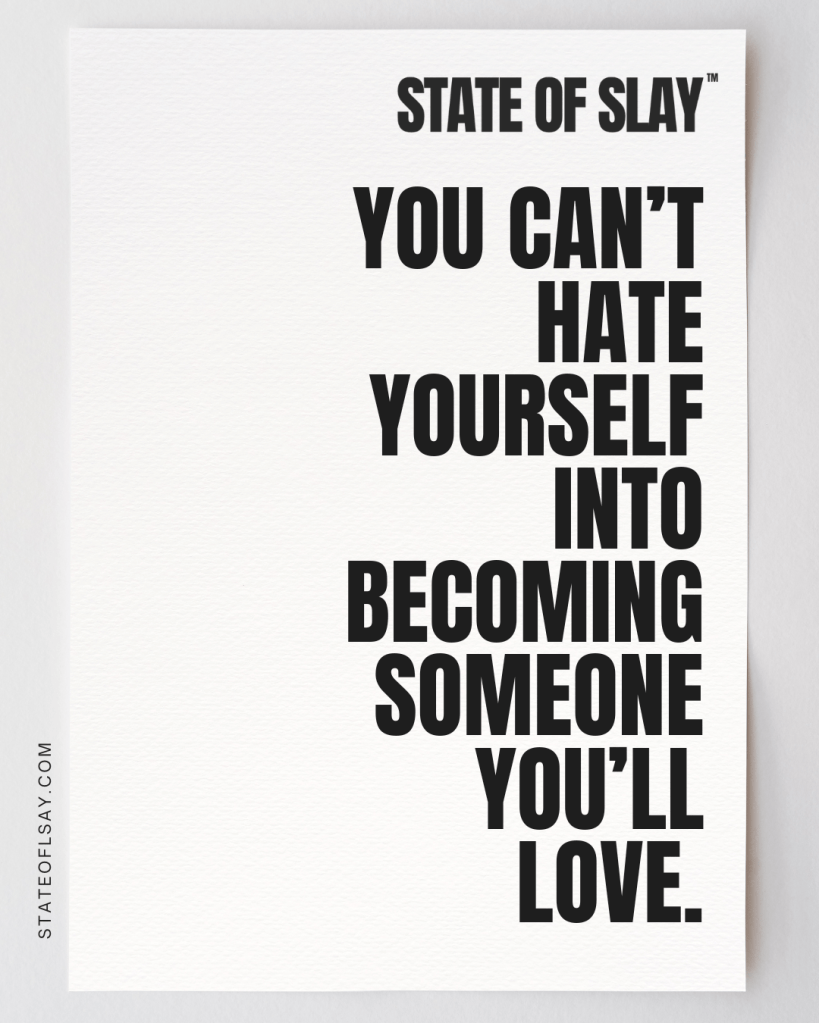
We can be remarkably patient with other people while giving ourselves almost none of the same grace.
We understand when someone else is struggling.
We remind them that change takes time.
We tell them one mistake doesn’t define them.
We encourage them to keep going when they stumble.
But when it’s us?
Suddenly the rules change.
We criticize the body we’re trying to care for.
We shame ourselves for choices we made when we didn’t know better.
We replay mistakes as evidence of everything that’s wrong with us.
We compare ourselves to who we think we should already be.
And somewhere along the way, we convince ourselves that being harder on ourselves will somehow make us better.
If I hate this part of myself enough, maybe I’ll finally change it.
If I criticize myself enough, maybe I’ll become more disciplined.
If I keep reminding myself of everything I’ve done wrong, maybe I won’t do it again.
But shame is a terrible architect.
It may motivate you for a moment, but it’s difficult to build a healthy relationship with yourself on a foundation of constant rejection.
Growth requires accountability.
It requires honesty.
Sometimes it requires admitting that you’ve hurt people, made poor choices, ignored what you knew, or stayed somewhere long after you should have left.
Self-love doesn’t mean pretending those things didn’t happen.
It means refusing to use them as weapons against yourself forever.
There is a difference between saying, I need to change this, and saying, There is something wrong with me.
One creates possibility.
The other turns growth into punishment.
You are allowed to want more for yourself without despising who you are today.
You can work on your habits without hating the person who developed them.
You can regret a decision without turning that regret into an identity.
You can recognize where you’ve fallen short while still believing you are worthy of patience, care, and another chance.
Because the person you’re trying so hard to become is still going to be you.
And if every step toward that person is fueled by rejection, there will always be another flaw to find, another standard to miss, another reason to postpone loving yourself.
Maybe the goal isn’t to finally become good enough to deserve your own love.
Maybe part of becoming who you want to be is learning to stop withholding it.
This is your reminder:
You don’t have to love everything about yourself to stop treating yourself like someone you’re trying to defeat.
When we’re hurting, we don’t always know how to heal.
We just know we want the pain to stop.
So we reach for things.
Relationships.
Food.
Alcohol.
Shopping.
Work.
Attention.
Isolation.
Distraction.
Anything that gives us a few minutes of relief from what feels unbearable.
Sometimes those choices help us get through the day.
Sometimes they become destructive.
And years later, when we’re healthier and have more perspective, we can look back at the person we were and feel ashamed of the ways we coped.
Why did I do that?
Why did I stay?
Why did I need that?
Why couldn’t I just deal with what I was feeling?
But you’re looking at an earlier version of yourself with knowledge that version didn’t have yet.
You are not a bad person for the ways you tried to kill your sadness.
You were a hurting person trying desperately to make the pain stop.
Prefer to listen? The Audio Blog version is available here.
SOMETIMES COPING IS JUST SURVIVAL IN DISGUISE
We don’t always recognize coping mechanisms while we’re using them.
At the time, they may simply feel like relief.
Something that makes the loneliness quieter.
Something that distracts us from the grief.
Something that makes us feel wanted.
Something that gives us somewhere to put all the feelings we don’t understand.
So we reach for it again.
And again.
That doesn’t mean every coping mechanism is healthy.
Some can hurt us.
Some can hurt other people.
Some can create consequences we’ll eventually have to face.
But understanding why you reached for something isn’t the same as excusing what happened.
Understanding helps you recognize what you were really trying to survive.
RELIEF AND HEALING ARE NOT THE SAME THING
When we’re hurting, we often search for relief before we understand healing.
Relief asks:
How can I stop feeling this right now?
Healing asks:
What is this pain trying to tell me?
Those questions can lead us in very different directions.
Relief can temporarily numb what hurts.
Healing asks us to understand it.
Feel it.
Process it.
And eventually move through it.
There is no shame in having reached for relief when you didn’t yet know how to heal.
But eventually, relief can no longer do the work that healing requires.
SADNESS CAN MAKE TEMPORARY THINGS FEEL LIKE ANSWERS
When something hurts deeply enough, almost anything that makes it hurt less can begin to look like a solution.
Attention can feel like love.
Distraction can feel like peace.
Numbing can feel like healing.
Being needed can feel like being valued.
A relationship can feel like rescue.
Isolation can feel like protection.
For a while, those things may even work.
That’s what makes unhealthy coping mechanisms so complicated.
They often help before they hurt.
Sometimes we don’t recognize the difference until much later.
That’s part of growing.
YOU DIDN’T HAVE THE TOOLS YOU HAVE NOW
It’s easy to look backward and imagine you should have known better.
But healing gives us tools we didn’t always possess.
Boundaries.
Self-awareness.
Perspective.
Emotional regulation.
The ability to recognize patterns.
The courage to ask for help.
You cannot expect a past version of yourself to use tools you hadn’t learned how to use yet.
You can wish you’d made different choices.
You can take responsibility for them.
You can repair what needs repairing.
But you don’t have to hate yourself for not knowing then what you know now.
SHAME WON’T HEAL WHAT SADNESS CREATED
Shame has a way of convincing us that our worst choices reveal our truest selves.
They don’t.
A decision is something you made.
A mistake is something you made.
A coping mechanism is something you used.
None of those things have to become who you are.
If you’ve grown enough to look back and recognize that something wasn’t healthy, that awareness matters.
It means you can see what you couldn’t see before.
Don’t use your growth as another reason to punish yourself.
Let it become evidence that you’ve changed.
UNDERSTANDING YOURSELF IS NOT MAKING EXCUSES
Sometimes we’re afraid to show compassion toward our past selves because we think it lets us off the hook.
It doesn’t.
You can understand why you behaved a certain way and still acknowledge the consequences.
You can say:
I was hurting.
And…
I hurt someone.
I didn’t know how to cope.
And…
I wish I had handled it differently.
I understand why I made that choice.
And…
I would make a different choice today.
Two truths can exist at the same time.
Accountability helps us grow.
Compassion allows us to grow without destroying ourselves along the way.
SOMETIMES WE TRY TO FILL WHAT ACTUALLY NEEDS TO BE FELT
There are some empty spaces we cannot fill.
We have to feel them.
Grief needs to be grieved.
Loneliness needs to be understood.
Loss needs to be acknowledged.
Pain needs somewhere safe to exist.
We can spend years pouring things into an emotional hole, hoping something will finally make us feel whole.
But healing often begins when we stop asking what we can put into the space and start asking why the space is there.
Sometimes the emptiness isn’t asking to be filled.
It’s asking to be heard.
YOU DON’T HAVE TO KEEP PUNISHING THE PERSON YOU USED TO BE
There is a strange cruelty in healing that we don’t talk about enough.
We become healthier…
And then use that health to judge the person we were when we weren’t.
We look backward with clarity and expect our former selves to have possessed it too.
But they didn’t.
They were living the experience you now have the privilege of understanding in hindsight.
That doesn’t mean everything they did was right.
It means they deserve context.
You can hold your past self accountable without putting them on trial for the rest of your life.
FORGIVE THE PERSON WHO WAS TRYING TO MAKE THE PAIN STOP
Think about who you were during one of your hardest seasons.
Not from where you stand today.
From where you stood then.
What did you know?
What hadn’t you learned yet?
What were you afraid of?
What were you desperately trying not to feel?
That person doesn’t need another judge.
They’ve probably had enough of those.
They need understanding.
They need forgiveness.
They need you to recognize that somehow, imperfectly, they kept going long enough for you to become who you are today.
YOU CAN LEARN A NEW WAY TO CARE FOR YOURSELF
Maybe you once tried to kill your sadness with relationships.
Work.
Food.
Alcohol.
Shopping.
Attention.
Isolation.
Or anything else that offered temporary escape.
You don’t have to be ashamed that something once helped you survive.
But you also don’t have to keep using a survival strategy after you’ve learned a healthier way to live.
Awareness gives you a choice.
And every healthier choice becomes another way of telling yourself:
I know how to care for you differently now.
You are not a bad person for the ways you tried to kill your sadness.
You were hurting.
You were learning.
You were trying to get through something with whatever tools you had at the time.
Now you know more.
Now you can choose differently.
And perhaps one of the greatest signs of healing is being able to look back at the person you once were without shame and say:
I understand why you did what you did.
But we don’t have to survive that way anymore.
SLAY REFLECTION
S — See Yourself With Compassion What past behavior have you been judging without considering what you were going through at the time?
L — Look Beneath the Behavior What sadness, pain, loneliness, or fear were you actually trying to escape?
A — Accept What You’ve Learned What do you understand about yourself today that you couldn’t understand during that difficult season?
Y — Your Next Step What healthier way can you care for yourself the next time you feel the urge to escape what you’re feeling?
CALL TO ACTION: JOIN THE CONVERSATION
I’d love to hear from you.
What have you learned to give yourself today that you once searched for somewhere else?
Share your story in the comments. Your experience may help someone else understand that they don’t have to be ashamed of the person they were while they were trying to survive.
And if you know someone who is struggling to forgive a past version of themselves, send this to them.
We all make mistakes. It’s how we grow. It’s how we learn. Sometimes we learn to do things differently, and sometimes we simply learn that mistakes are just part of the process—an oops, not an identity.
But there’s a dangerous turning point many of us reach: When we start to believe that we are the mistake.
That’s when mistakes stop being lessons and start becoming labels. And when we internalize our failures, we block our own growth.
Prefer to listen? The Audio Blog version is available here.
The Trap of Perfectionism
When I was living in the dark, I believed I was a mistake. Every time I messed up—even just a little—I used it as proof that I was broken, unworthy, or incapable.
I set impossibly high standards for myself, and when I didn’t meet them, I punished myself emotionally.
I beat myself up.
I questioned my worth.
I kept mental score of every misstep.
Perfection wasn’t just the goal—it was the requirement. And every time I fell short, I used it as another reason to feel like I had failed at life.
The Permission to Mess Up
Everything changed when I got help. I was told something I had never even considered: It’s okay to make mistakes. In fact, it’s encouraged.
Mistakes meant I was trying. Mistakes meant I was doing something new. Mistakes meant I was taking action—even if the outcome didn’t go as planned.
That shift in thinking opened the door to something I hadn’t felt in a long time: freedom.
I stopped needing to be perfect and started focusing on being present. I learned to ask, What can this mistake teach me? instead of, What does this say about me?
Listening to the Signs
Another thing I began to notice? I made more mistakes when I wasn’t taking care of myself.
If I was tired, overwhelmed, underfed, or overworked—my errors increased. And instead of blaming myself, I started seeing those slip-ups as signals.
Maybe I needed rest.
Maybe I needed better boundaries.
Maybe I needed to slow down.
Mistakes became more than just missteps—they became a check-in. An opportunity to notice where I might be neglecting my own needs.
Mistakes That Lead to Magic
Here’s the other thing: Some of my biggest mistakes? They’ve led me to some of the most beautiful parts of my life.
If I hadn’t taken the wrong turn, I wouldn’t have found the right path. If I hadn’t said yes when I probably should have said no, I wouldn’t have learned what a real yes feels like.
We don’t always know in the moment, but sometimes what we call a mistake is actually just a redirection. A plot twist with a purpose.
The Only Real Mistake?
The only mistake you can make is not taking action because you’re afraid of failing. Playing it safe. Holding back. Staying small. That’s where real regret grows.
Life isn’t about getting it right all the time. It’s about trying. Learning. Adjusting. And trying again.
Mistakes are just part of the road. They’re not roadblocks. They’re guides.
And they are never who you are.
SLAY Reflection: What Are You Learning?
Do you tend to beat yourself up when you make a mistake? What does your inner voice sound like in those moments?
Have any of your past mistakes led to something unexpectedly positive? What did you learn?
What can you do to be more forgiving of yourself when you mess up? What would you say to a friend in your position?
Are you holding back from taking action out of fear of making a mistake? What might shift if you gave yourself permission to just try?
How can you begin turning your mistakes into tools for learning instead of weapons for self-punishment? What would change if you saw them as stepping stones instead of stop signs?
Call to Action: Join the Conversation
I’d love to hear from you. What’s one mistake you’ve learned from—and how did it help you grow? Share your story in the comments. Let’s cheer each other on.
And if you know someone who’s being too hard on themselves, send this to them. Sometimes, all we need is a nudge.
Fourteen years ago today I surrendered. After years of suffering, I finally admitted defeat. And although that may sound like I failed in some way, I really won that day. I finally found the humility and courage to ask for help, and I had just enough hope to stand up and fight for myself. That hope was really dim, but it was there, and I held onto that little light inside of myself as I set foot on a new path, my hands may have been shaking, but my heart gave me just enough strength to keep stepping forward, even if those steps, to start, where small.
I learned, early on, that my secrets, those things I fought to hide, those things I thought would show you I was weak, unlovable and ugly, those things were the things that there going to connect me to those who would understand me, lift me up, and love me before I could love myself. What I thought was the ugliest part of me became my ally and admitting my faults was the key to finding self-forgiveness and strength. I would also learn that admitting my faults would not push those away who were true friends and family who wanted the best for me, but it would bring us closer together, it would bond us, open the door to understanding and create a support system for me that I still hold close today. It would also surround me with people like myself who were working to do the best they could with what they had, and had also made the choice to fight for their life. And, that’s truly what I was doing every day, and every day since then, chosen to fight for my life. That fight has become less strenuous over the years but still can be on certain days, but I know today that I never fight it alone, I have a whole army of warriors around me, and I need to, I know, from when I was living in the dark, that I can’t fight alone, and am not meant to, we have far more strength together, and when we are weak, tired or feel we can’t go on, we pick up those who are struggling until they are able to get up and continue their fight alongside us.
My gratitude for the last 14 years is immeasurable, as is my love for those who have walked this journey with me. Today, I walk in the light, because I choose to, and I let that light shine for others to see who may need that spark of hope like I did years ago. When we shine our light and fight to be our best selves, we give others permission to do so also, or perhaps offer a spark that sets them off on their own journey of recovery. That, I believe is why I am still here, to share a message of hope, of compassion and to connect with all of you from a place of vulnerability, transparency and healing, we all want the same thing, to be loved, to feel love, to feel we matter and are appreciated and heard, and I want to you to know, you are, I love you, and even if you don’t love yourself today, I still love you, perhaps even more, as I know that sometimes what we need to get started is someone else seeing us for who we are and loving us anyway. I hope one day you may find that you have always been worthy of love, especially those parts you think are unlovable. You are worth it, whatever it takes, find what works for you and fight, I am right there with you SLAYER.
SLAY OF THE DAY: Do you feel you’re worth fighting for? If not, why not? Is this something you think alone, or have you been told this? By whom? Why do you think they have said that? Why do you think it’s true? What if you didn’t believe them and fought for yourself anyway? What do you think would happen? What would you like to happen? It can. You hold the power to change, to seek help, to find those like yourself to support you, to share your journey with you. You have much more power than you think, but you have to believe you do, or at least have enough to get you started. That’s all it took for me, just enough strength to pick up the phone and share my truth, and that phone call started me on this path I walk today, and that path has given me a life beyond what I ever could have imagined. SLAY on!
I was new on this path, grappling with the weight of my past—the realization of where I had ended up, the choices I had made, and the harm I had done to myself. It felt almost too much to bear.
Then someone suggested something I’ll never forget:
Write a letter of forgiveness to your younger self.
Prefer to listen? The Audio Blog version is available here.
Facing the Hurt
That suggestion stopped me in my tracks. The thought of facing the harm I had done to that innocent, hopeful little girl inside me made my heart sink.
I could see her—vulnerable, full of dreams—and I had failed her. Time and time again, I had ignored her needs, tried to extinguish her light.
But I wasn’t at a point to resist anything that might help me heal. So, I picked up a pen.
I didn’t plan or overthink. I just started writing. I pictured her face and humbly asked for her forgiveness. I poured out all the ways I had let her down, all the times I ignored her worth.
The tears came, but the apology flowed.
I was told to leave nothing out—whatever I held back might keep me sick. So, I wrote it all. And then I read it aloud.
Hearing it, facing it, was hard. But that letter didn’t just end in apology. It ended in a promise: a vow to love her better, to make choices that nurtured her and honored her existence.
That letter became my compass.
Keeping the Promise
When the days were hard, when the negative self-talk got loud, it was easy to throw myself under the bus. But it was harder to throw that little girl under there with me after making her a promise.
Seeing her face in my mind pushed me to keep going. As I healed, I pictured her smiling, cheering me on.
Every milestone became a love letter back to her.
Later, I wrote another letter—to the version of me who didn’t know better, who lacked the tools or courage to navigate life in a healthy way. I apologized to her too. And in that apology, I made a commitment: to learn, to grow, to make amends by living in the light.
A Path to Freedom
These letters were powerful steps in my journey of forgiveness. They opened the door to forgiving not just myself, but others too.
But it all started with me.
We’ve all let our younger selves down. We’ve all made choices we regret, or harbored resentment for things we didn’t know or couldn’t handle at the time. Writing these letters, making those promises—they can set us free.
So get your pen, SLAYER. You may have a letter to write today.
SLAY on.
SLAY OF THE DAY: Reflect & Rise
Do you harbor resentment toward yourself for your past?
What do you resent?
Do you believe you knew better or should have done better? How?
Do you look back and feel like you failed your younger self? In what ways?
What can you do today to make amends for that?
How can you find forgiveness for yourself?
How can you protect and honor your younger self today?
Forgive yourself for what you didn’t know. Aim to do better today. And when the days get hard, fiercely protect that younger version of yourself—you deserve it.
Call to Action: Join the Conversation
I’d love to hear from you. What would you say in a letter to your younger self today?
Share your story in the comments. Let’s support each other’s healing journey.
And if you know someone who’s been hard on themselves, send this to them.
Sometimes, all it takes is knowing we’re not alone.