
A solitary person walking through bright mist, representing personal growth and moving beyond an older version of yourself

Slay Say

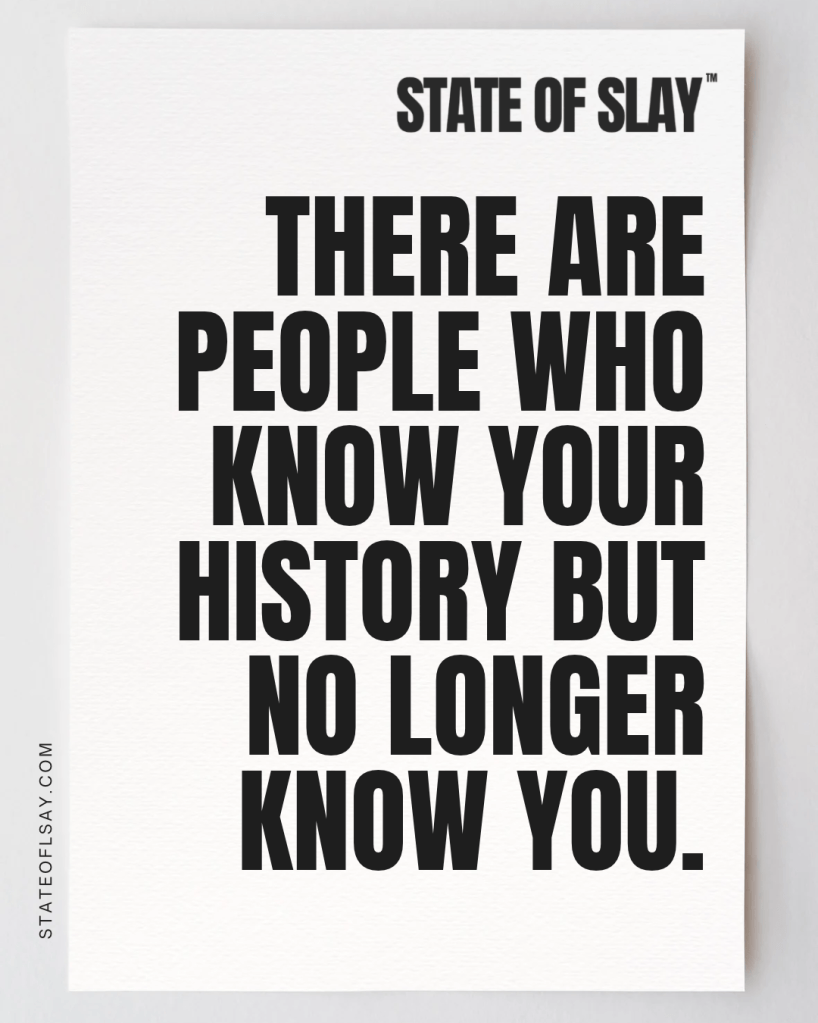
When Someone Knows Your Past Better Than Your Present

There are people who can tell stories about you that are completely true.

They remember what you used to believe.

What you tolerated.

What you wanted.

How you reacted.

The mistakes you made.

The choices you swore you’d never make again.

They may know entire chapters of your life by heart.

And still not know you anymore.

That can be a strange thing to accept.

Because history creates a certain kind of confidence. When someone has known us for years, especially through formative or difficult periods of our lives, it can feel as though they’ve earned permanent expertise on who we are.

But knowing someone for a long time isn’t the same as continuing to know them.

People change quietly.

We reconsider things.

We heal.

We develop boundaries.

We discover things about ourselves we didn’t understand before.

We stop wanting what we once desperately wanted.

We become less willing to tolerate things we once accepted.

Sometimes the changes are so gradual that the people around us adjust alongside them.

And sometimes they don’t.

Some people keep interacting with the version of us they remember.

They expect the same reactions.

Assign us the same motives.

Bring up old mistakes as evidence of current character.

They may even be surprised, or uncomfortable, when we behave differently than the person they have preserved in their memory.

And it can be tempting to defend ourselves.

To explain how much has changed.

To produce evidence.

To convince them that their information is out of date.

But you don’t owe everyone who knew an earlier version of you a guided tour of the person you’ve become.

Their memories can be accurate and still be outdated.

Both things can be true.

You may have been insecure then and confident now.

You may have been unreliable then and dependable now.

You may have needed approval then and trust yourself now.

You may have made choices you wouldn’t make today.

You may have been someone you’re not particularly proud of being.

Growth doesn’t require pretending those versions of us never existed.

In fact, owning them is part of growth.

But ownership isn’t the same as permanent residence.

Your past can belong to you without continuing to define you.

And someone else remembering who you were doesn’t obligate you to remain recognizable to them.

There will be people who understand your evolution because they’ve continued getting to know you.

There will be others who know your history but missed your becoming.

Let them remember.

You keep becoming.

This is your reminder:

Someone knowing who you were doesn’t give them permanent authority over who you are. Your history is part of your story, but it doesn’t get the final word.

Slay on.
A solitary figure standing near the water beneath a dark, cloudy sky, representing the process of letting go of old identities and becoming more fully yourself

Slay Slay

Becoming Yourself May Be More About Letting Go

We talk about growth as though we’re constantly under construction.

Become stronger.

Become wiser.

Become more confident.

Become the best version of yourself.

There’s always something else we’re supposed to add.

But what if some of the most important growth in our lives isn’t about adding anything at all?

What if it’s about taking things away?

Long before we’re old enough to consciously decide who we want to be, we start learning who it seems safest or easiest to become.

We learn which parts of ourselves get approval.

Which parts make other people uncomfortable.

Which version of us keeps the peace.

Which version gets praised.

Which version belongs.

So we adapt.

We may become agreeable because disagreement created conflict.

Independent because needing people led to disappointment.

Funny because making everyone laugh gave us a place in the room.

Successful because achievement made us feel worthy.

Easygoing because having needs felt like being difficult.

Strong because there never seemed to be room for anything else.

Those versions of us aren’t necessarily fake.

They may have helped us belong, cope, succeed, or survive.

But something helping us become who we needed to be then doesn’t mean it still belongs to who we are now.

And maybe that’s why growth can sometimes feel less like becoming and more like shedding.

We start letting go of the need to please everyone.

The instinct to apologize for taking up space.

The belief that our value comes from what we accomplish.

The habit of making ourselves smaller so someone else can feel bigger.

The responsibility we assumed for everyone else’s emotions.

The rules we inherited about who we were supposed to be.

And underneath all of those layers, we may discover something unexpected.

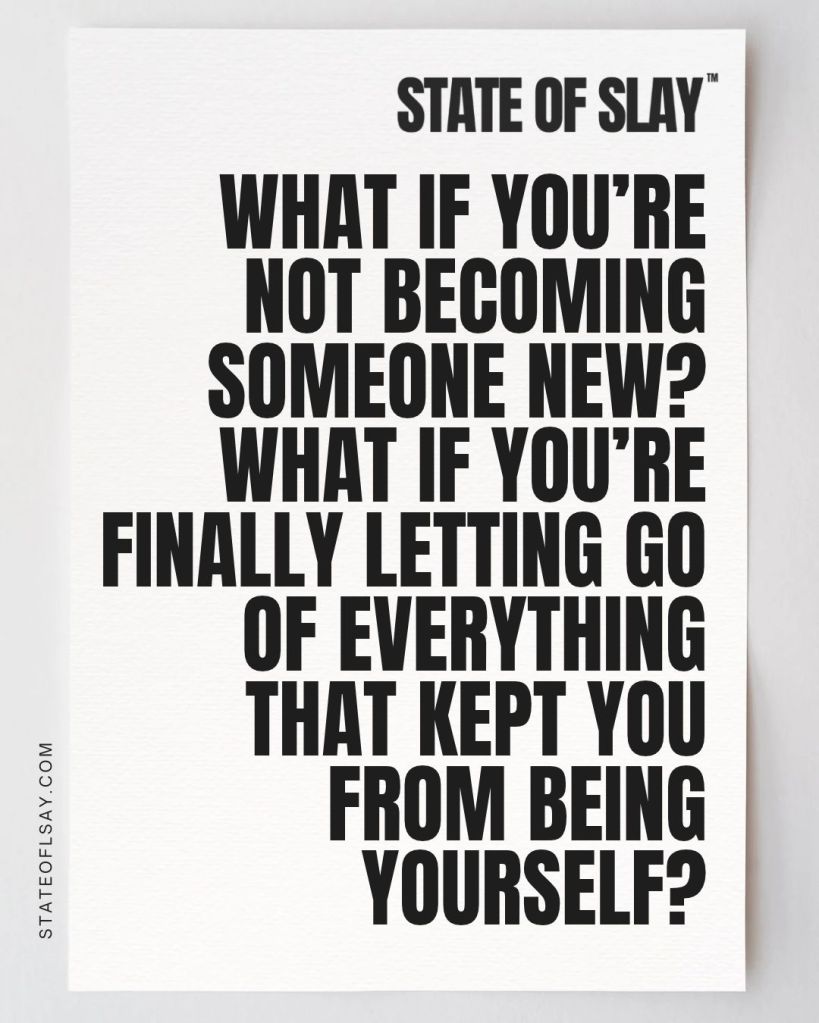
Not a new person.

Ourselves.

Maybe we don’t always need to reinvent ourselves.

Maybe we need to question some of the things we’ve mistaken for ourselves.

Because when you’ve been the dependable one for years, it can feel wrong to stop fixing everything.

When you’ve always been agreeable, disappointing someone can feel like you’ve become selfish.

When achievement has been your proof of worth, slowing down can make you wonder who you are without something to prove.

Letting go of an old identity can feel like losing part of yourself.

But sometimes what you’re losing isn’t yourself.

It’s the strategy you used to protect yourself.

There’s a difference.

Maybe becoming yourself isn’t one dramatic transformation.

Maybe it happens every time you realize:

I don’t actually want that.

I never really liked that.

I don’t need to explain this.

That isn’t mine to carry.

I don’t want to keep pretending this fits.

Little by little, we remove the things standing between who we learned to be and who we actually are.

Maybe the journey isn’t always about becoming more.

Maybe sometimes it’s about finally needing less between you and yourself.

This is your reminder:

Growth doesn’t always add something to you. Sometimes it reveals you by helping you release what was never really yours to carry in the first place.

Slay on.

Close-up of a man shouting toward the camera, representing how the loudest and most extreme voices can distort our perception of humanity

Slay Say

The Loudest Version of Humanity

Spend enough time online and it can start to feel like everyone is angry.

Everyone is fighting.

Everyone is offended.

Everyone is cruel.

Everyone has chosen a side, and apparently everyone would like you to choose one immediately.

Then you leave the house.

Someone holds the door for you.

A stranger compliments your shoes.

Someone lets you merge into traffic.

Two people laugh together in line at the grocery store.

A neighbor asks how you’re doing and actually waits for the answer.

And suddenly the world you’re standing in feels very different from the one you were just scrolling through.

WHAT GETS OUR ATTENTION ISN’T ALWAYS WHAT HAPPENS MOST

The loudest voices have always had an advantage.

Now they have algorithms.

Anger gets attention.

Conflict creates engagement.

Outrage keeps us watching.

The most shocking behavior gets shared precisely because it is shocking, but when we see enough of it, something strange can happen.

The unusual starts to feel usual.

We can watch hundreds of examples of people behaving terribly and begin to believe we’re witnessing a representative sample of humanity.

Meanwhile, millions of ordinary interactions happen every day without becoming content.

People help each other.

They show up.

They apologize.

They make someone laugh.

They care for their families.

They check on their friends.

They do small, decent things for strangers and never think to document them.

Ordinary kindness rarely goes viral because ordinary kindness isn’t particularly shocking.

But that doesn’t make it rare.

OUR BRAINS DON’T ALWAYS KNOW THE DIFFERENCE

When we repeatedly expose ourselves to something, it can begin to influence what we expect to find.

If most of the people we encounter through a screen are arguing, attacking, mocking, or behaving badly, it makes sense that we might begin expecting more of the same from the people around us.

We become suspicious.

More cynical.

Quicker to assume bad intentions.

Maybe even less willing to engage with people who seem different from us.

And then our expectation starts shaping our experience.

We enter the world braced for the version of humanity we’ve been consuming.

THIS ISN’T ABOUT PRETENDING EVERYTHING IS FINE

There are real problems in the world.

There is cruelty.

There is injustice.

There are people behaving in ways that deserve our attention, concern, and sometimes our outrage.

Looking away from those things isn’t optimism.

It’s avoidance.

But paying attention to what’s wrong doesn’t require us to believe that what’s wrong is all there is.

We can care deeply about the problems facing our communities and still notice the goodness happening inside them.

We can be informed without allowing the worst thing we saw today to become our definition of humanity.

We can hold people accountable without deciding people are hopeless.

GO MEET SOME HUMANS

Sometimes the best antidote to believing everyone is terrible is remarkably simple:

Go be around people.

Not profiles.

Not comment sections.

Not clips selected because they generated the strongest reaction.

People.

Talk to someone you wouldn’t normally talk to.

Look around when you’re standing in line instead of immediately reaching for your phone.

Notice the tiny exchanges happening around you.

You may discover something that rarely makes the headlines:

Most people are just living.

They’re working.

They’re worrying about people they love.

They’re trying to pay their bills.

They’re making mistakes.

They’re figuring things out.

They’re hoping tomorrow goes reasonably well.

They’re a lot more complicated than the categories we put them into online.

TURN DOWN THE VOLUME

The world doesn’t suddenly become perfect when we put down our phones.

But our perspective may become more proportionate.

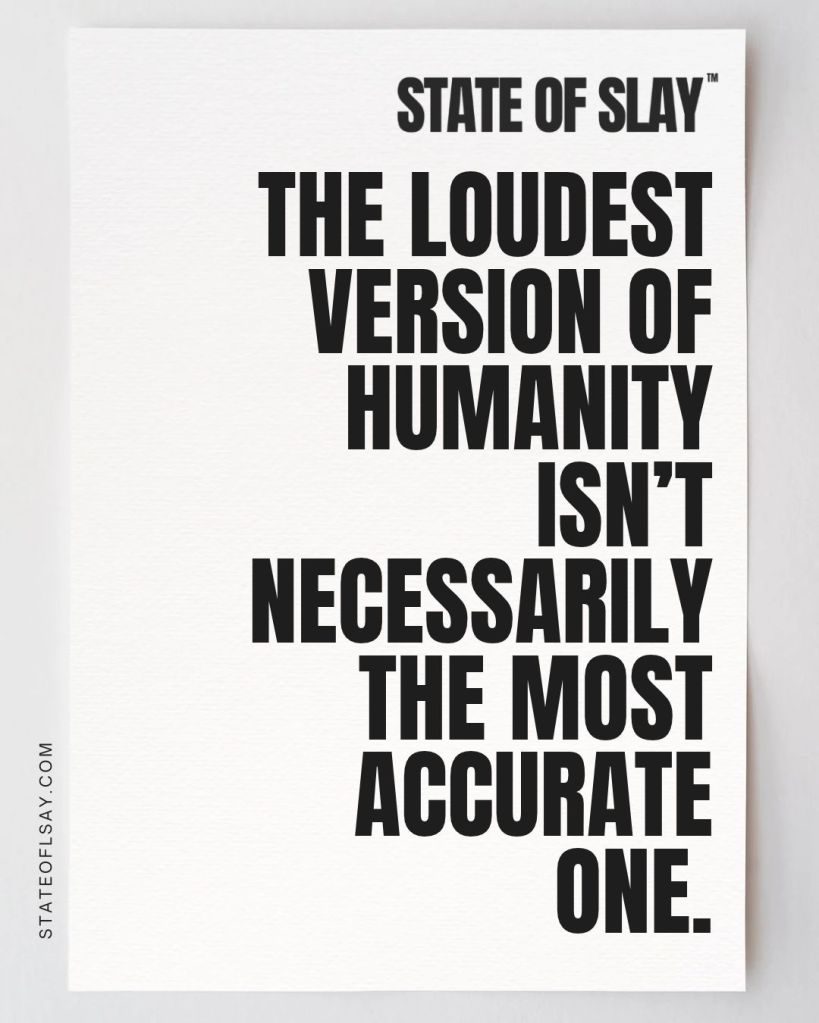
Because the loudest people aren’t necessarily the majority.

The angriest people aren’t necessarily the majority.

The cruelest people aren’t necessarily the majority.

They’re simply easier to hear.

This is your reminder:

Be careful what you allow to become your evidence for who people are. What gets amplified may tell you what captures attention, but it doesn’t always tell you what’s most common.

Slay on.

Woman looking to the side in a contemplative moment, representing uncertainty when facing a choice that could lead to change

Slay Say

When the Safer Choice Keeps You the Same

There’s a reason the familiar can be so difficult to leave.

We know how it works.

We know who we are inside of it.

We know what’s expected of us, what could go wrong, and how to navigate it when it does.

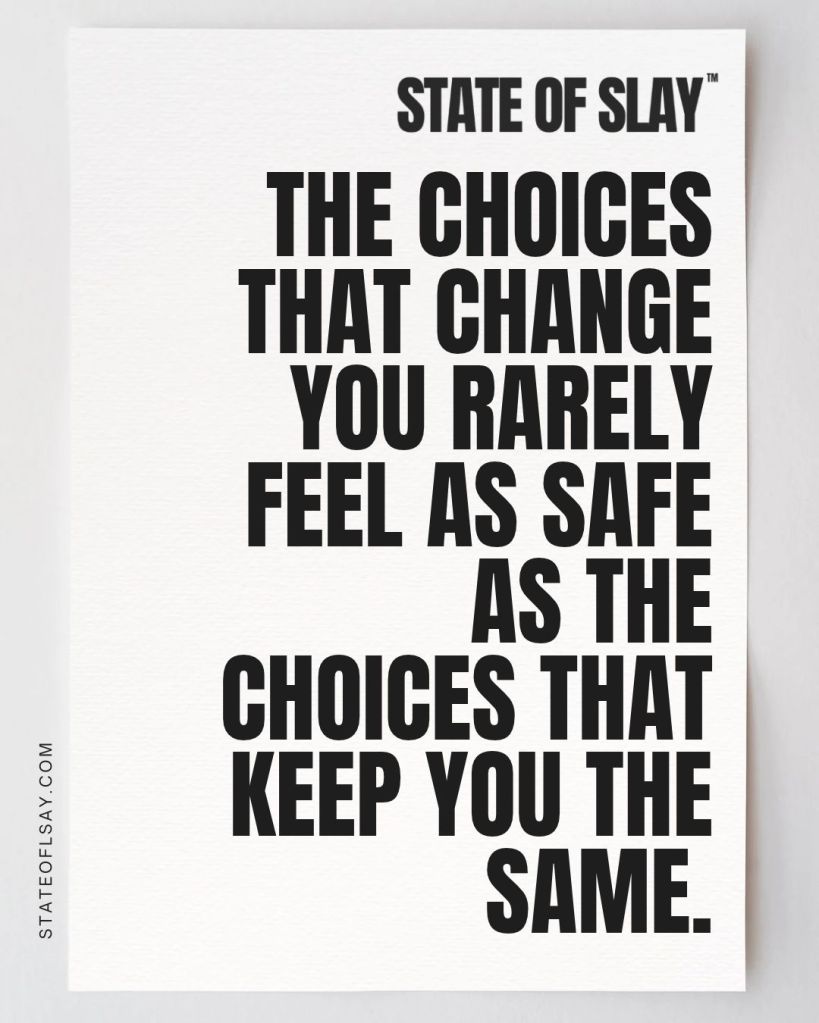
Even when we want something different, familiarity can make staying where we are feel like the smarter choice.

Because change asks us to exchange something we know for something we don’t.

And there are no guarantees waiting on the other side.

SAFE AND RIGHT AREN’T ALWAYS THE SAME THING

Fear exists for a reason.

Sometimes it warns us that something isn’t safe. Sometimes it tells us to slow down, pay attention, gather more information, or reconsider what we’re about to do.

But fear doesn’t only appear when something is wrong.

It also appears when something is unfamiliar.

Starting over can be scary.

Speaking up can be scary.

Taking an opportunity can be scary.

Walking into a room where we don’t know anyone can be scary.

Trying something we might fail at can be scary.

Even succeeding can be scary when success would require us to become more visible, take on more responsibility, or leave behind a version of life we already know how to live.

Fear can tell us that something is dangerous.

But sometimes fear is simply telling us that something is new.

THE COMFORT OF KNOWING WHAT HAPPENS NEXT

The safer choice often comes with something incredibly seductive:

Predictability.

We know what happens if we stay.

Maybe we don’t love it. Maybe we’ve even outgrown it. But we understand it.

The unknown offers no such reassurance.

We can make the brave decision and still fail.

We can take the opportunity and discover it wasn’t right for us.

We can make the change and miss what we left behind.

Growth doesn’t come with a guarantee that every risk will reward us.

What it offers is the possibility of discovering something we cannot discover by remaining exactly where we are.

YOU DON’T HAVE TO FEEL READY

We sometimes imagine that the right decision will eventually stop feeling frightening.

That if we think about it long enough, gather enough information, or wait until the timing is perfect, certainty will arrive and escort us comfortably into whatever comes next.

Sometimes it does.

Sometimes it doesn’t.

Sometimes we make important decisions while our confidence and our fear are sitting right beside each other.

Being afraid doesn’t automatically mean you aren’t ready.

Doubt doesn’t automatically mean you’re making the wrong choice.

And courage doesn’t require fear to leave before you move.

It requires us to decide how much authority fear gets to have.

WHAT DOES STAYING COST?

When we’re considering a frightening change, we naturally think about what could happen if we make it.

But there’s another question worth asking:

What happens if I don’t?

What does another year here look like?

What opportunities disappear if I keep waiting?

What part of myself never gets tested, developed, or discovered because I chose what I already knew I could handle?

There is risk in changing.

But staying the same has consequences, too.

They’re simply easier to overlook because they arrive quietly.

THE CHOICE THAT CHANGES YOU

Not every frightening choice is the right one.

Not every risk is worth taking.

And growth doesn’t require us to recklessly chase whatever scares us most.

But when fear is the only thing standing between us and something we genuinely want, it may be worth asking whether we’re protecting ourselves from danger…

or protecting ourselves from change.

Because the decisions that expand our lives often require us to enter territory where we don’t yet know exactly who we’ll be.

This is your reminder:

Feeling uncertain about what comes next doesn’t automatically mean you should stay where you are. Sometimes uncertainty is simply part of stepping beyond what you already know.

Slay on.

Person raising their arms in an overwhelmed moment, representing the exhaustion of treating everything that matters like an emergency

Slay Say

When Everything You Care About Feels Urgent

Not all exhaustion comes from doing things we don’t want to do.

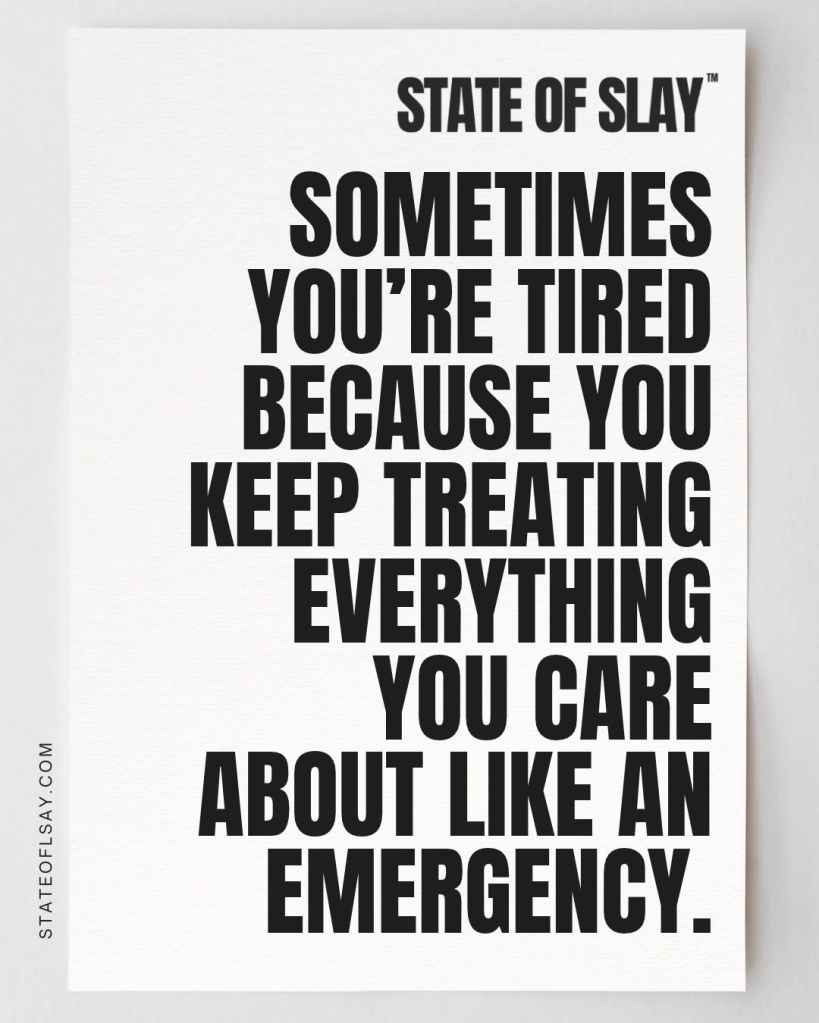
Sometimes we’re exhausted because we care so much about what we’re doing that everything connected to it starts to feel urgent.

The email needs an answer now.

The idea needs to be acted on before we lose momentum.

The problem needs to be solved before we can relax.

The person we love needs our help.

The project matters, so every detail matters.

The opportunity matters, so we’re afraid to step away from it.

Nothing is technically on fire, but our nervous system is running around with a tiny extinguisher anyway.

CARING CAN CREATE ITS OWN PRESSURE

When something matters to us, it naturally gets our attention.

But somewhere along the way, importance can quietly become urgency.

We start treating everything we care about as though delaying it, resting from it, or giving it less than our immediate attention means we aren’t committed enough.

So we stay available.

We keep checking.

We keep fixing.

We keep thinking about the thing even when we’re technically no longer working on the thing.

And eventually we wonder why we’re so tired when so much of what fills our lives is stuff we genuinely chose.

Because loving something doesn’t make it weightless.

IMPORTANT DOESN’T ALWAYS MEAN IMMEDIATE

One of the most useful distinctions we can make is between what matters and what requires our attention right now.

Those are not always the same thing.

Something can be deeply important and still wait until tomorrow.

A problem can need to be solved without needing to be solved tonight.

An opportunity can matter without requiring us to reorganize our entire life around it.

Someone can matter to us without having unlimited access to our time and energy.

And a goal can remain important even when we stop working toward it long enough to rest.

Urgency narrows our world.

Everything becomes about the next thing that needs to happen.

And when we live that way long enough, even the things we love can begin to feel like demands.

NOT EVERYTHING NEEDS YOUR EMERGENCY ENERGY

There are moments when urgency is real.

Deadlines exist. People need us. Problems sometimes genuinely require immediate attention.

But when everything receives emergency-level energy, eventually we lose the ability to distinguish an actual emergency from something that simply matters to us.

We become reactive instead of intentional.

And the strange thing is, we may tell ourselves that this intensity proves how much we care.

But caring doesn’t have to look like constant activation.

Commitment doesn’t require panic.

Responsibility doesn’t require perpetual availability.

And rest doesn’t mean something has become less important.

Sometimes it simply means we trust that what matters will still matter when we return to it.

LOWERING THE VOLUME

Maybe the question isn’t only, “What can I remove from my life?”

Maybe it’s also:

“What can stay in my life without being treated like an emergency?”

The work can stay.

The dream can stay.

The relationship can stay.

The responsibility can stay.

But perhaps some of the urgency can go.

Because sometimes we don’t need fewer things to care about.

We need to stop responding to everything we care about with the same intensity.

This is your reminder:

Something can matter deeply without requiring all of you, all at once. Protecting your energy doesn’t diminish your commitment to what you love.

Slay on.

Person standing alone at the end of a dark hallway, representing the uncertainty of an ending without answers

Slay Say

When the Ending Doesn’t Make Sense

Some endings come with answers.

You understand what happened.

You know why it happened.

Maybe you even agree that it needed to happen.

And then there are the endings that leave you with questions.

A relationship changes without the conversation you thought you deserved.

Someone walks away without really explaining why.

An opportunity disappears.

A friendship fades.

Something you believed in falls apart in a way that doesn’t seem to match everything that came before it.

So you try to understand.

You replay conversations.

Revisit moments.

Look for something you missed.

You wonder what you could have done differently.

What they were really thinking.

Whether there was a moment when everything changed and you simply didn’t recognize it.

Because somewhere along the way, we can start believing that if we could just understand the ending, we could finally accept it.

But understanding and accepting are not the same thing.

Sometimes there is no explanation that will make what happened feel reasonable.

Sometimes the person who could give us answers doesn’t have them.

Sometimes they have them and aren’t willing to share them.

And sometimes we get an explanation only to discover that it doesn’t bring the relief we imagined it would.

Because the answer doesn’t change the ending.

It doesn’t undo what happened.

It doesn’t restore what was lost.

And it doesn’t necessarily make the pieces fit together in a way that finally feels satisfying.

There comes a point when searching for understanding can become another way of staying attached.

We keep returning to the ending because we think there’s still something there for us to solve.

But maybe there isn’t.

Maybe the work is no longer figuring out why it happened.

Maybe the work is accepting that it did.

That doesn’t mean pretending it didn’t matter.

It doesn’t mean you weren’t entitled to answers.

And it doesn’t mean you have to decide that what happened was okay.

It simply means your ability to move forward doesn’t have to remain dependent on an explanation you may never receive.

Not every ending will give us closure.

Sometimes we have to stop asking the past to provide what we need in order to move beyond it.

This is your reminder:

You don’t need every answer to begin letting go. What you don’t understand doesn’t have to keep you from moving forward.

Slay on.

Black and white image of a woman standing beside a car on an open road, representing leaving old ways of thinking behind and moving toward a new life.

Slay Say

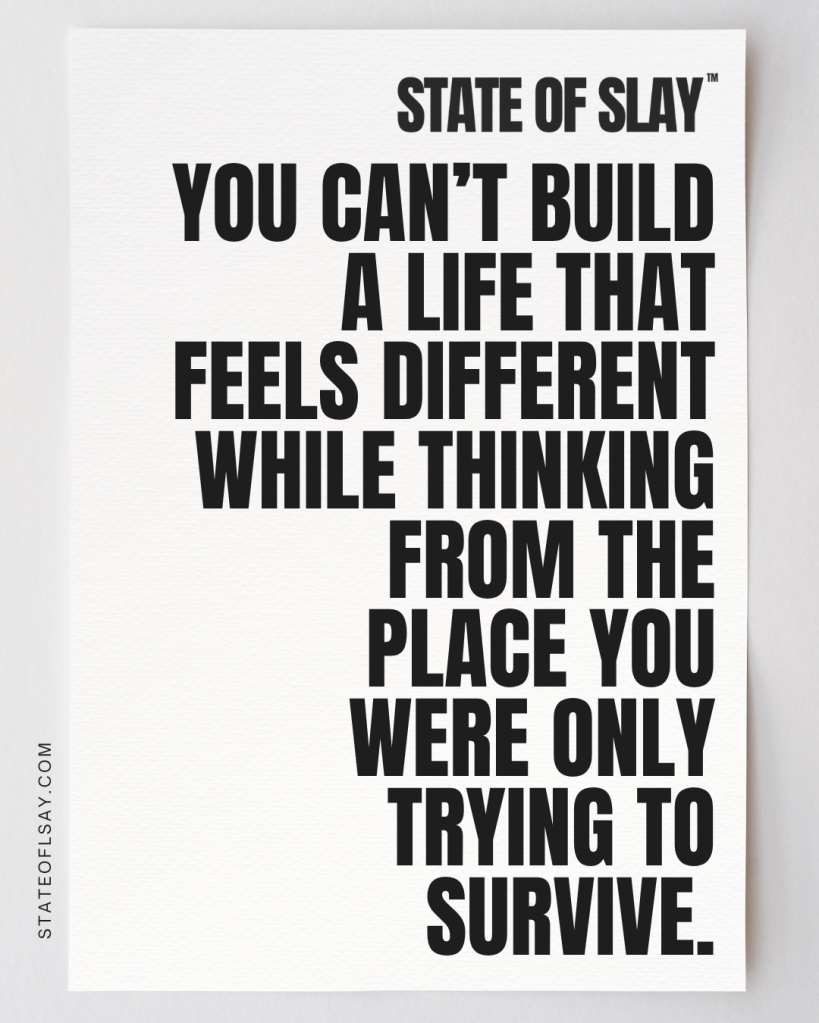
When Survival Starts Making the Decisions

Survival teaches us things.

Sometimes very useful things.

How to anticipate trouble.

How to protect ourselves.

How to need less.

How to stay alert.

How to keep moving when stopping doesn’t feel like an option.

How to prepare for disappointment before it has a chance to surprise us.

And when those ways of thinking help us through something difficult, they can become deeply ingrained.

We stop recognizing them as responses to what happened.

They simply become the way we live.

We expect people to leave, so we never fully depend on anyone.

We’ve experienced financial instability, so spending money on ourselves feels dangerous even when we can afford it.

We’ve been rejected, so we look for reasons not to try before someone else can tell us no.

We’ve had our trust broken, so uncertainty immediately feels like evidence that something is wrong.

We’ve learned that being useful keeps us valued, so rest makes us uncomfortable.

We’ve had to fight for everything, so ease makes us suspicious.

These responses make sense when you understand where they came from.

They may have protected you.

They may have helped you endure circumstances you couldn’t immediately change.

They may have been exactly what you needed then.

But survival is designed to get you through something.

It isn’t necessarily designed to show you how to live once you’re through it.

And that distinction matters.

Because sometimes our circumstances change before our thinking does.

The danger is gone, but we’re still bracing.

The relationship is safe, but we’re still waiting for betrayal.

There is enough, but we’re still behaving as though everything could disappear tomorrow.

An opportunity appears, but instead of asking what might be possible, we immediately calculate everything that could go wrong.

The life around us has changed.

But internally, we’re still responding to the old one.

That can make growth confusing.

You may genuinely want something different while repeatedly making choices that recreate what you already know.

Not because you’re incapable of change.

Because familiarity can feel safer than possibility, even when familiarity wasn’t particularly good.

Possibility asks something different from us.

It asks us to imagine outcomes we don’t have evidence for yet.

To trust people who haven’t hurt us.

To take chances without guarantees.

To believe that ease doesn’t always have a hidden cost.

To allow ourselves to want something instead of only calculating what will protect us.

That doesn’t mean abandoning everything your past taught you.

Some lessons deserve to come with you.

Discernment.

Boundaries.

Resilience.

The ability to recognize patterns.

Knowing when something doesn’t feel right.

Growth isn’t about becoming careless simply because you’re tired of being cautious.

It’s about learning the difference between wisdom and armor.

One helps you navigate what’s happening.

The other can keep you reacting to what already happened.

And sometimes the question isn’t whether you’re capable of creating the life you want.

It’s whether the rules you developed for surviving your old life are still quietly deciding what you believe is possible in the next one.

You don’t have to shame yourself for those rules.

They existed for a reason.

But you are allowed to examine them.

To ask whether they still belong here.

To discover that safety doesn’t always require vigilance.

That love doesn’t always require earning.

That opportunity doesn’t always end in disappointment.

That peace doesn’t mean something bad must be coming.

That you can make decisions based on where you want to go, not only on what you never want to experience again.

Your past can inform your future without continuing to design it.

This is your reminder:

You can honor what protected you without letting it decide what is possible for you now.

Slay on.

Black and white image of a woman looking at her reflection, representing personal growth, change, and evolving beyond an earlier version of yourself.

Slay Say

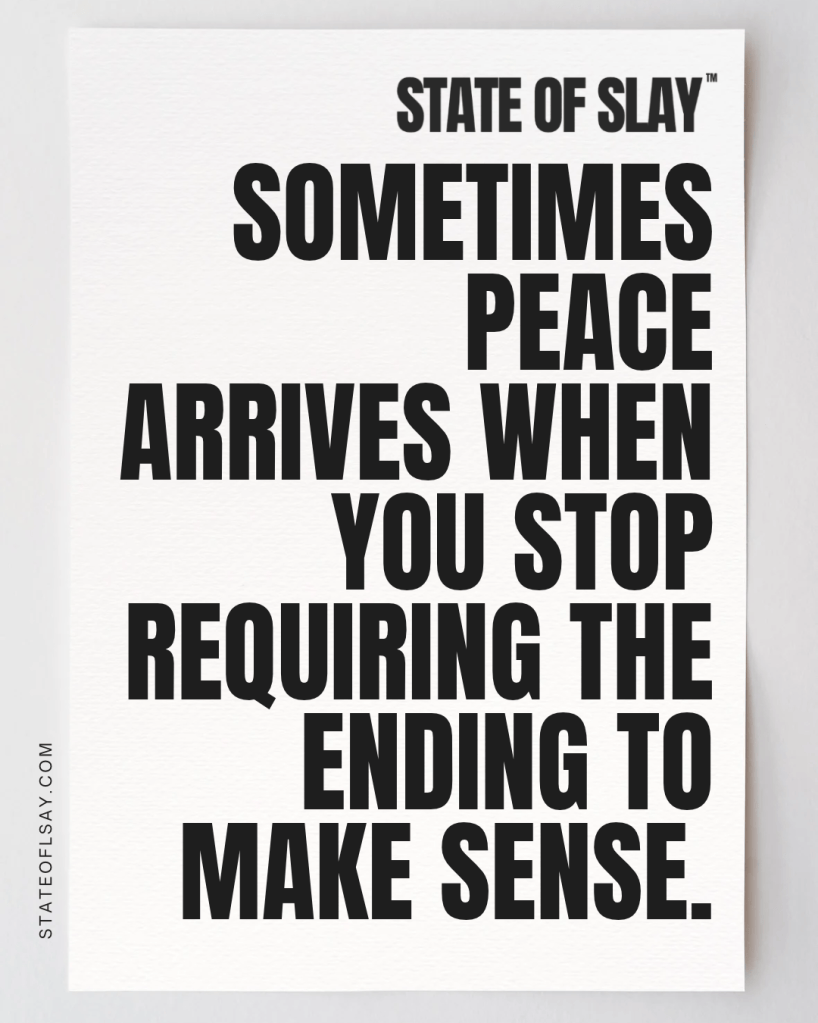
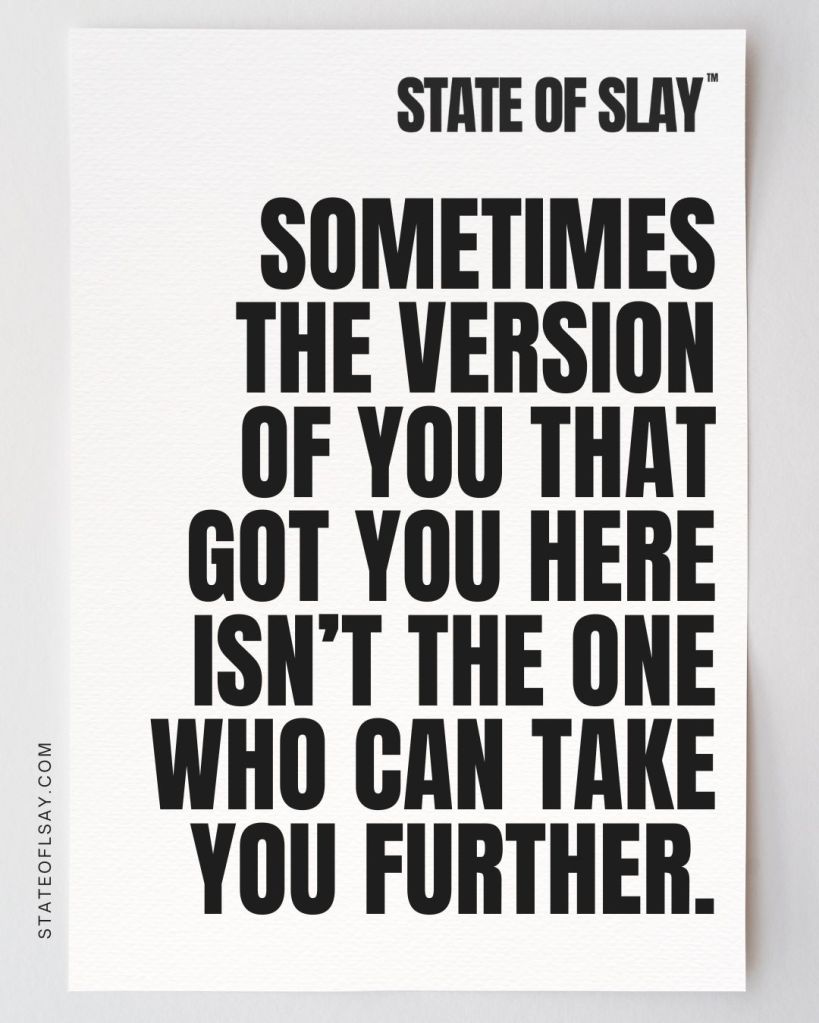
When Who You Were Can’t Take You Where You’re Going

Every version of you has had a job to do.

There was a version who learned how to survive.

One who became independent because relying on other people felt risky.

One who learned to keep the peace.

One who worked harder than everyone else because achievement became proof of worth.

One who stayed guarded because being vulnerable had once been expensive.

One who said yes because disappointing people felt worse than disappointing yourself.

Those versions of you weren’t mistakes.

They developed for reasons.

They helped you navigate the life you were living with the tools, understanding, and circumstances you had at the time.

Some of them got you through things you weren’t sure you could survive.

But something can save you in one chapter and limit you in the next.

The independence that once protected you can make it difficult to ask for help.

The walls that kept you safe can prevent anyone from getting close.

The drive that helped you succeed can make rest feel like failure.

The ability to keep everyone happy can leave you disconnected from what you actually want.

The habit of expecting the worst can protect you from disappointment while making it difficult to recognize when something good has arrived.

And that’s where growth gets complicated.

Because we become attached to the qualities that helped us get here.

We call them personality.

We say, That’s just who I am.

But sometimes what feels like identity is actually adaptation.

And eventually, life may ask something different from you.

Not because who you were was wrong.

Because where you’re going requires something new.

Maybe strength now means letting someone help you.

Maybe confidence means admitting you don’t know.

Maybe loyalty means choosing yourself.

Maybe courage means becoming visible after years of making yourself small.

Maybe success means building a life you actually enjoy instead of one that simply looks impressive.

Growth doesn’t always require becoming more.

Sometimes it requires releasing what you no longer need.

That can feel surprisingly uncomfortable.

There is familiarity in our old ways of being, even when they’re exhausting.

We know how to survive with them.

We know who we are inside them.

Changing means entering a space where the old rules no longer apply and the new ones haven’t become natural yet.

You may feel less capable for a while.

Less certain.

Less like yourself.

But perhaps that discomfort isn’t evidence that you’re losing yourself.

Perhaps you’re discovering which parts of you were built for a life you’re no longer living.

You don’t have to reject who you were to become who you’re becoming.

Thank that version of you.

Honor what they carried.

Recognize what they made possible.

Then allow them to put the bags down.

You can appreciate the person who got you this far without asking them to lead you forever.

Because the next chapter may require a version of you who trusts more, receives more, risks differently, speaks more clearly, rests without guilt, or finally chooses according to what you want now.

This is your reminder:

Growth sometimes means retiring the survival skills that have finished their job.

Slay on.

Black and white image of a person standing in an open doorway surrounded by darkness, representing choice, possibility, and discernment.

Slay Say

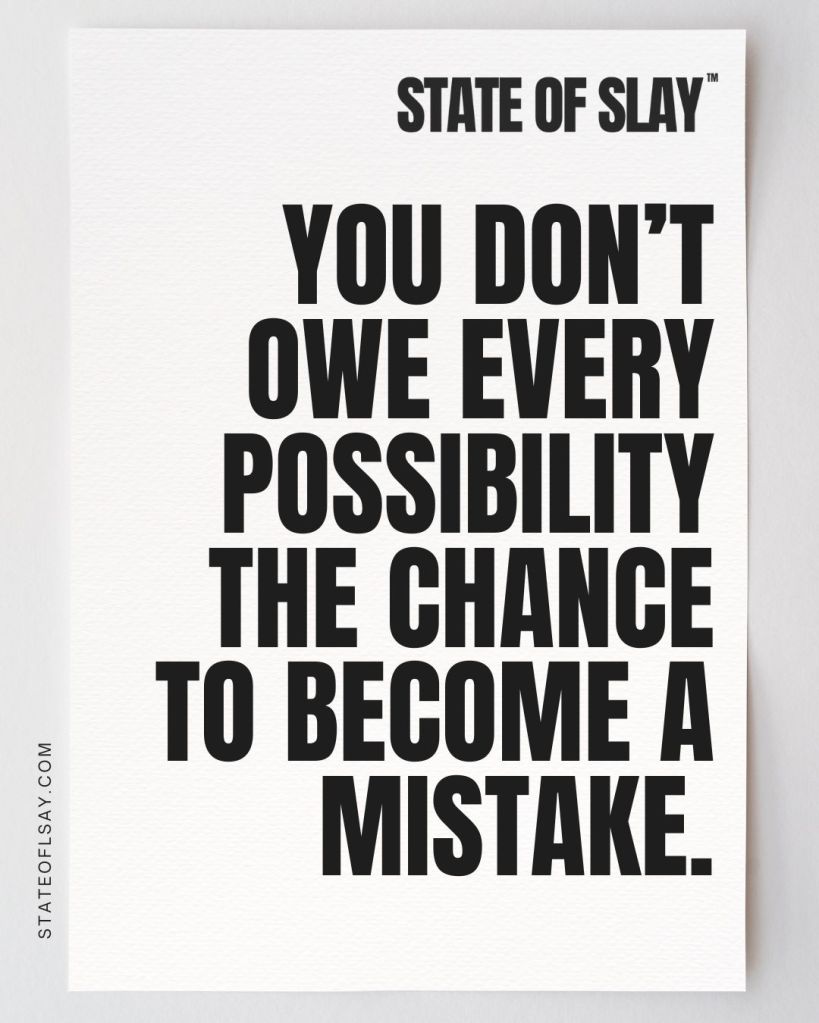
Not Every Door Needs to Be Opened

We’re often told to keep our options open.

Take the chance.

Say yes.

See what happens.

Give it a shot because you might regret it if you don’t.

And sometimes that advice is exactly what we need.

Fear can keep us standing safely outside experiences that could change our lives. Growth often requires uncertainty, and there are opportunities we would never discover if we waited until we knew exactly how everything would turn out.

But not every hesitation is fear.

Sometimes it’s discernment.

There are moments when we already have enough information to know that something probably isn’t right for us.

The relationship that requires you to overlook things you know matter to you.

The opportunity that looks impressive but asks you to sacrifice something you’re no longer willing to give up.

The person whose potential keeps tempting you to ignore their pattern.

The invitation you keep trying to get excited about because everyone else thinks you should be.

The situation you’ve already experienced in enough different forms to recognize where it leads.

You don’t always have to go all the way to the ending to know you don’t want the story.

That can be difficult to trust.

Especially if you’ve spent years believing that saying no means you’re closed-minded, afraid, negative, or unwilling to take risks.

So you override yourself.

You give things chances you never really wanted to give.

You stay curious long after your instincts have given you an answer.

You tell yourself you should at least try.

And sometimes you end up exactly where you suspected you would, wondering why you needed the experience to confirm what you already knew.

Experience is a powerful teacher.

But it isn’t the only teacher.

So is observation.

So is history.

So is self-awareness.

So is everything you learned the last time you ignored yourself.

Growth isn’t only becoming brave enough to take more chances.

Sometimes it’s becoming wise enough to know which chances are worth taking.

That doesn’t mean you’ll always get it right.

There will be opportunities you decline that might have turned into something wonderful.

There will be doors you walk past without ever knowing exactly what was behind them.

That’s part of making choices.

Every yes closes something.

Every no does too.

A meaningful life isn’t built by experiencing every possible version of it.

It’s built by learning which possibilities deserve your time, energy, trust, and attention.

You don’t have to date someone just because there might be something there.

You don’t have to accept an opportunity simply because it’s available.

You don’t have to revisit something you already know doesn’t work for you just to make absolutely certain.

And you don’t have to collect another scar to prove you learned from the last one.

Sometimes wisdom looks less dramatic than taking the leap.

Sometimes it looks like recognizing the edge and deciding you don’t need to jump from it.

This is your reminder:

You don’t have to experience every wrong choice firsthand to trust yourself enough to make a different one.

Slay on.

Black and white image of a woman lying awake in bed, reflecting on the difference between someone’s promises and their repeated behavior.

Slay Say

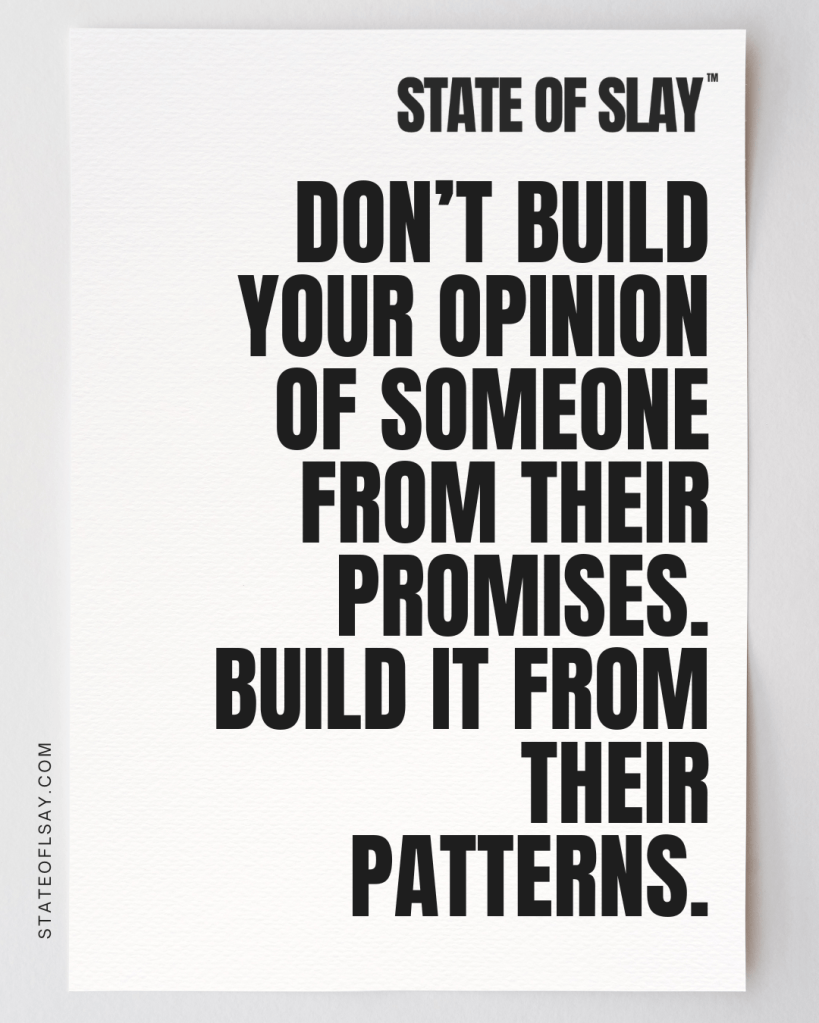
Patterns Tell the Truth

We tend to give words a lot of power.

Someone tells us they care.

They promise they’ll change.

They say they’ll show up next time.

They explain why this time was different.

They assure us that what happened isn’t really who they are.

And sometimes we want so badly to believe what we’re hearing that we allow the words to carry more weight than everything we’ve actually experienced.

Words matter.

Intentions matter.

Apologies matter.

But none of them exist in a vacuum.

Eventually, they have to meet behavior.

Because anyone can tell you what they value.

The question is whether they live according to those values when it’s inconvenient.

Anyone can promise to be there.

The question is whether they consistently show up.

Anyone can say they respect your boundaries.

The question is what happens when your boundary prevents them from getting what they want.

Anyone can apologize.

The question is whether the behavior that required the apology keeps happening.

This doesn’t mean judging someone by one bad day or one poor decision.

We are all capable of getting it wrong.

We disappoint people.

We react badly.

We say things we wish we could take back.

We make choices that don’t represent who we want to be.

A single mistake can be just that.

A mistake.

But repetition gives us different information.

When the same behavior keeps appearing, the same boundary keeps being crossed, the same promise keeps being broken, or the same apology keeps following the same action, you’re no longer looking at an isolated moment.

You’re looking at a pattern.

And patterns deserve your attention.

Sometimes we ignore them because the explanation sounds reasonable.

They were stressed.

They were scared.

They’ve been through a lot.

They didn’t mean it that way.

They’re working on themselves.

Maybe all of that is true.

Understanding why someone behaves a certain way can give us compassion for them.

It doesn’t require us to pretend their behavior isn’t affecting us.

There is an important difference between understanding someone and trusting them.

Understanding can come from knowing their story.

Trust has to come from experiencing their consistency.

And that takes time.

It’s also worth noticing the good patterns.

The person who quietly keeps their word.

The friend who checks in without being asked.

The partner whose actions make you feel secure without constantly having to reassure you that you should.

The person who respects your no even when they wanted a yes.

The one whose behavior consistently matches what they say matters to them.

Those patterns are information too.

We sometimes spend so much energy analyzing what people mean that we overlook what they repeatedly show us.

You don’t have to become suspicious of everyone.

You don’t have to assume every promise is empty or every mistake is evidence of someone’s character.

You simply have to let time provide information that words alone cannot.

Listen to what people tell you.

Then watch what they do.

When those two things consistently agree, trust has somewhere to grow.

And when they consistently don’t, you don’t have to keep choosing the version of someone described by their words over the version you keep experiencing.

This is your reminder:

Believe change when you can see it in the pattern, not just hear it in the promise.

Slay on.