

Person raising their arms in an overwhelmed moment, representing the exhaustion of treating everything that matters like an emergency

Slay Say

When Everything You Care About Feels Urgent

Not all exhaustion comes from doing things we don’t want to do.

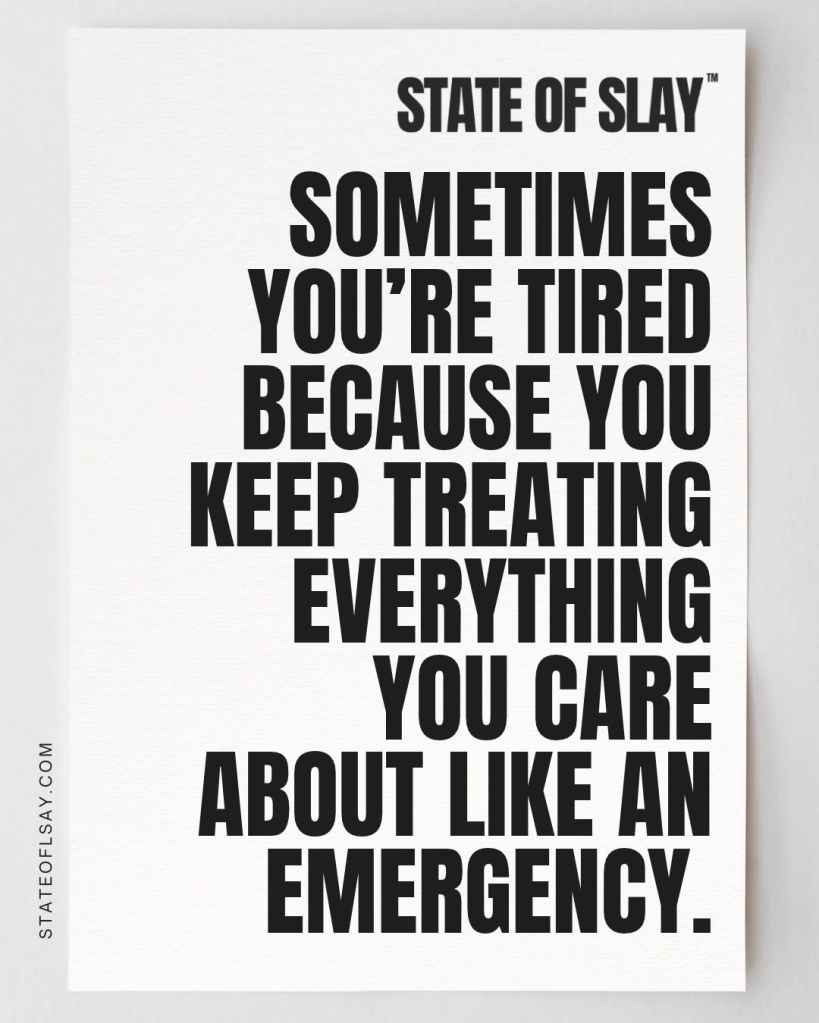
Sometimes we’re exhausted because we care so much about what we’re doing that everything connected to it starts to feel urgent.

The email needs an answer now.

The idea needs to be acted on before we lose momentum.

The problem needs to be solved before we can relax.

The person we love needs our help.

The project matters, so every detail matters.

The opportunity matters, so we’re afraid to step away from it.

Nothing is technically on fire, but our nervous system is running around with a tiny extinguisher anyway.

CARING CAN CREATE ITS OWN PRESSURE

When something matters to us, it naturally gets our attention.

But somewhere along the way, importance can quietly become urgency.

We start treating everything we care about as though delaying it, resting from it, or giving it less than our immediate attention means we aren’t committed enough.

So we stay available.

We keep checking.

We keep fixing.

We keep thinking about the thing even when we’re technically no longer working on the thing.

And eventually we wonder why we’re so tired when so much of what fills our lives is stuff we genuinely chose.

Because loving something doesn’t make it weightless.

IMPORTANT DOESN’T ALWAYS MEAN IMMEDIATE

One of the most useful distinctions we can make is between what matters and what requires our attention right now.

Those are not always the same thing.

Something can be deeply important and still wait until tomorrow.

A problem can need to be solved without needing to be solved tonight.

An opportunity can matter without requiring us to reorganize our entire life around it.

Someone can matter to us without having unlimited access to our time and energy.

And a goal can remain important even when we stop working toward it long enough to rest.

Urgency narrows our world.

Everything becomes about the next thing that needs to happen.

And when we live that way long enough, even the things we love can begin to feel like demands.

NOT EVERYTHING NEEDS YOUR EMERGENCY ENERGY

There are moments when urgency is real.

Deadlines exist. People need us. Problems sometimes genuinely require immediate attention.

But when everything receives emergency-level energy, eventually we lose the ability to distinguish an actual emergency from something that simply matters to us.

We become reactive instead of intentional.

And the strange thing is, we may tell ourselves that this intensity proves how much we care.

But caring doesn’t have to look like constant activation.

Commitment doesn’t require panic.

Responsibility doesn’t require perpetual availability.

And rest doesn’t mean something has become less important.

Sometimes it simply means we trust that what matters will still matter when we return to it.

LOWERING THE VOLUME

Maybe the question isn’t only, “What can I remove from my life?”

Maybe it’s also:

“What can stay in my life without being treated like an emergency?”

The work can stay.

The dream can stay.

The relationship can stay.

The responsibility can stay.

But perhaps some of the urgency can go.

Because sometimes we don’t need fewer things to care about.

We need to stop responding to everything we care about with the same intensity.

This is your reminder:

Something can matter deeply without requiring all of you, all at once. Protecting your energy doesn’t diminish your commitment to what you love.

Slay on.
Not Everything That Weighs You Down Is Yours To Carry

This week has been heavy.
Not just in the day-to-day busyness, but emotionally, mentally, spiritually.

And as I took a step back, I asked myself a question I’ve learned to come back to again and again:
Is all of this mine to carry?

The answer?
No.
But that hasn’t stopped me from dragging it around—tight-chested, overwhelmed, and bone-tired.

Like many of us, I juggle a lot every day.
And most of the time, I believe I can handle it all.
Until I can’t.
Until I hit a wall.
And when I do, I don’t always meet myself with grace.
Sometimes, I meet myself with frustration and shame.

Even when I know better, I still find myself slipping into old habits—trying to carry it all.
No one is asking me to.
Help is there if I reach for it.
But there I go, dragging the weight of the world across some invisible finish line I made up in my head.

It’s time to pause.
To take a breath—or a few—and ask myself what I’ve picked up along the way that never belonged to me in the first place.


Prefer to listen? The Audio Blog version is available here.


We Learn to Carry What We Don’t Need

Before recovery, I carried everything.
It never occurred to me that I could set anything down.

The emotional weight.
The resentment.
The guilt.
The responsibility for people and problems that were never mine to begin with.

I just kept going—until I couldn’t.

Eventually, I hit a wall.
Hard.
And that wall was the wake-up call I needed.
I couldn’t live that way anymore.
It was slowly destroying me.

So I asked for help.
Not just with what I was carrying—but with how I lived.


Learning to Let Go of What’s Not Yours

Through recovery, I discovered something profound:
A lot of what I was carrying wasn’t mine.

Some of it was inherited—passed down through family, expectations, trauma.
Some of it I volunteered to carry—because I wanted to feel helpful, needed, or in control.

And some of it… I carried on purpose to sabotage myself.
To stay small.
To stay exhausted.
To prove that I couldn’t do more, be more, live more.

That’s the hard truth.
Sometimes, we don’t just carry what’s not ours—we choose it.

But once I got honest with myself, I realized I had a choice.
To let go.
To say no.
To only carry what actually belonged to me.

And that changed everything.


What’s Yours—and What’s Not

There will always be people who would gladly let you carry their weight.
There will be moments when you try to carry someone else’s pain, fear, or responsibility—uninvited.

But that doesn’t mean you have to.

Being helpful doesn’t mean taking on someone else’s journey.
Being strong doesn’t mean carrying more than you should.
Being loving doesn’t mean sacrificing yourself.

We are responsible for ourselves.
For our peace.
For honoring what we need.

That starts with putting down what was never yours to carry in the first place.


SLAY Reflection: What Are You Carrying?

  1. Do you tend to carry more weight than you need to—physically, emotionally, or mentally?
    What does that weight feel like?
  2. What are you carrying that doesn’t actually belong to you?
    Who gave it to you—and why did you accept it?
  3. Are there responsibilities, emotions, or expectations you’ve taken on to feel valuable or in control?
    How are they serving you? How are they hurting you?
  4. What would it feel like to put that weight down—even just a little?
    What would change?
  5. What can you do today to lighten your load and honor your limits?
    Where can you say no, ask for help, or simply rest?

Call to Action: Join the Conversation

I’d love to hear from you.
What’s one burden you’ve been carrying that isn’t actually yours—and how are you learning to let it go?
Share your story in the comments. Let’s cheer each other on.

And if you know someone who’s overwhelmed by weight they were never meant to carry, send this to them.
Sometimes, all we need is a nudge.