
Person raising their arms in an overwhelmed moment, representing the exhaustion of treating everything that matters like an emergency

Slay Say

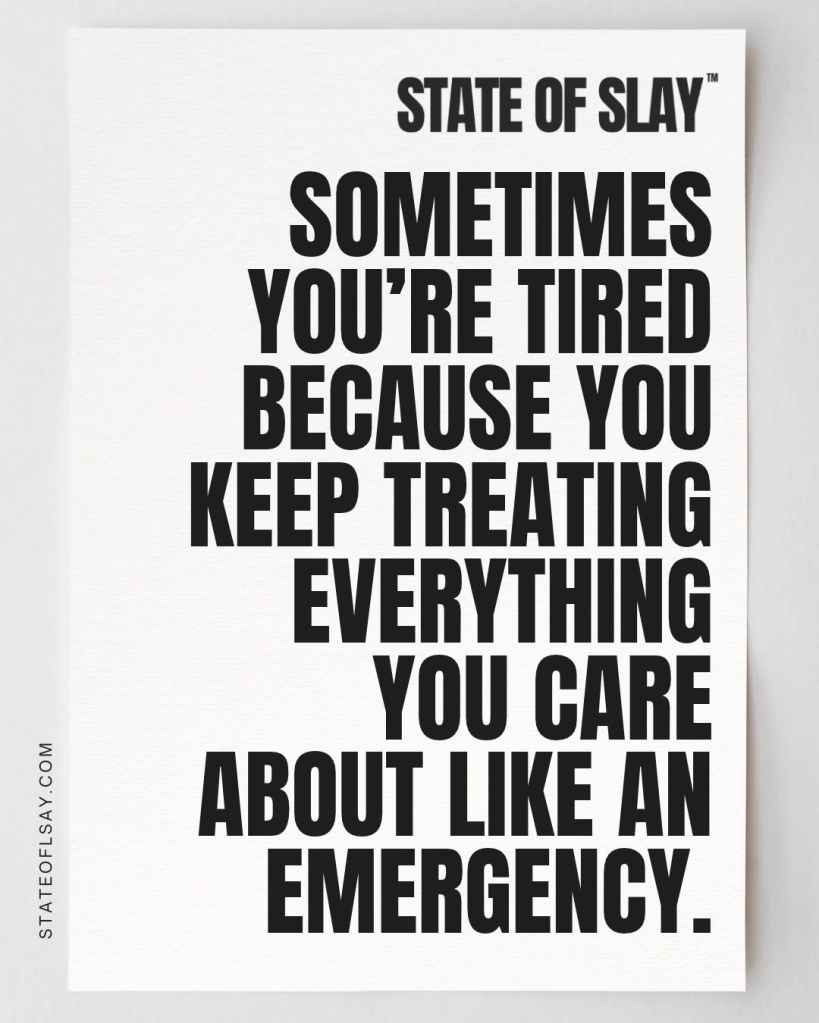
When Everything You Care About Feels Urgent

Not all exhaustion comes from doing things we don’t want to do.

Sometimes we’re exhausted because we care so much about what we’re doing that everything connected to it starts to feel urgent.

The email needs an answer now.

The idea needs to be acted on before we lose momentum.

The problem needs to be solved before we can relax.

The person we love needs our help.

The project matters, so every detail matters.

The opportunity matters, so we’re afraid to step away from it.

Nothing is technically on fire, but our nervous system is running around with a tiny extinguisher anyway.

CARING CAN CREATE ITS OWN PRESSURE

When something matters to us, it naturally gets our attention.

But somewhere along the way, importance can quietly become urgency.

We start treating everything we care about as though delaying it, resting from it, or giving it less than our immediate attention means we aren’t committed enough.

So we stay available.

We keep checking.

We keep fixing.

We keep thinking about the thing even when we’re technically no longer working on the thing.

And eventually we wonder why we’re so tired when so much of what fills our lives is stuff we genuinely chose.

Because loving something doesn’t make it weightless.

IMPORTANT DOESN’T ALWAYS MEAN IMMEDIATE

One of the most useful distinctions we can make is between what matters and what requires our attention right now.

Those are not always the same thing.

Something can be deeply important and still wait until tomorrow.

A problem can need to be solved without needing to be solved tonight.

An opportunity can matter without requiring us to reorganize our entire life around it.

Someone can matter to us without having unlimited access to our time and energy.

And a goal can remain important even when we stop working toward it long enough to rest.

Urgency narrows our world.

Everything becomes about the next thing that needs to happen.

And when we live that way long enough, even the things we love can begin to feel like demands.

NOT EVERYTHING NEEDS YOUR EMERGENCY ENERGY

There are moments when urgency is real.

Deadlines exist. People need us. Problems sometimes genuinely require immediate attention.

But when everything receives emergency-level energy, eventually we lose the ability to distinguish an actual emergency from something that simply matters to us.

We become reactive instead of intentional.

And the strange thing is, we may tell ourselves that this intensity proves how much we care.

But caring doesn’t have to look like constant activation.

Commitment doesn’t require panic.

Responsibility doesn’t require perpetual availability.

And rest doesn’t mean something has become less important.

Sometimes it simply means we trust that what matters will still matter when we return to it.

LOWERING THE VOLUME

Maybe the question isn’t only, “What can I remove from my life?”

Maybe it’s also:

“What can stay in my life without being treated like an emergency?”

The work can stay.

The dream can stay.

The relationship can stay.

The responsibility can stay.

But perhaps some of the urgency can go.

Because sometimes we don’t need fewer things to care about.

We need to stop responding to everything we care about with the same intensity.

This is your reminder:

Something can matter deeply without requiring all of you, all at once. Protecting your energy doesn’t diminish your commitment to what you love.

Slay on.
Slay Say

Good morning SLAYER! There is power in the pause.

New blog goes up Friday, until then… SLAY on!

State Of Slay Freedom To Pauseuntil then… SLAY on!


Not Making A Decision Is Making A Decision

All to often we feel pressured to make a decision, whether that pressure is coming from someone else, or we’re putting it on ourselves. I’ve mentioned before that life is not a game show, we don’t get bonus points for the fastest reactions or decisions, and yet, many, times we quickly make a decision and then wish he hadn’t later on.

It took me some time to loosen my decision making trigger finger. I had always prided myself on my fast reaction times and my ability to take action quickly, but my reactions in the moment at times were clouded by the feeling of urgency I had to act fast, and also by not giving myself enough time to learn all the facts before jumping in with both feet. I had to learn to pause, and I had to realize that making that decision to wait, and to not make a quick decision, was a decision. I used to think that anyone who didn’t move quickly was lazy, or indecisive, and, there may have been some that there, but as I learned to practice to pause I realized how much better a decision that was than to rush into something. Now, there are those who can use that to stall or procrastinate, so it does take being honest with yourself to know what the true nature of your pause is, but when done right it can drastically change the situations you find ourselves in.

When I rushed into things I often found myself in situations I really didn’t want to be in, or like, because I hadn’t taken the time to investigate exactly what I was deciding to do and what the result would, or could be. I also, many, times hadn’t asked myself, what I wanted out of making that decision, often I made decisions based on what they looked like to the outside world, or what I wanted out of it, but I never really thought about who I was or what I wanted in the long-run, usually, I just wanted to win, or, whatever my perceived idea of winning was. It wasn’t until I developed a relationship with myself, asking myself who I truly was, what I wanted, and what principles I was willing to live by that my decisions, and their reply time, started to change. I realized that, many times, I did need to do some further investigation before saying yes, or agreeing to be a part of something, and, there was nothing wrong with that. I started to care if a decision was ultimately going to make me feel bad, or derail me from this path I was working so hard to stay on, a path of well-being, of empowerment and self-love and care. All of my decisions had to reflect the person I was learning to be, the person I was proud to be, and the person I would like to be moving forward. That, was enough to slow me down. And, as I did, I started to trust myself more, after a lifetime of some bad decisions, making some new good ones allowed me to trust my judgment and myself to do the right thing for myself in that moment. And, that was another thing I had to learn, to not put so much weight on making the wrong decision because I was trying to second guess what someone else may do, or try to guess what the future may bring, I had to learn to take the information I had in front of me, right in the moment, check my ego at the door and ask others I trusted for input if I still felt unsure, and then make the best decision I could at that time. Whatever may come after that I would deal with then. That’s all any of us can really do.

When we feel pressured or rushed to make a decision often we make the wrong one. If you’re someone who often makes quick decisions in the moment, perhaps the best decision you can make is not making one in that moment, and take the time to give it some thought and look for direction. There’s no shame in saying you need some time, in fact, that may be the best decision of all. SLAY on!

SLAY OF THE DAY: Do you often weigh your options before making a decision, or quickly jump to take action? How had this helped you? How has this hurt you? Write down an example of a time when you made a decision too quickly and then regretted it later? If you had taken more time, how would that affected your decision? Why do you think you are quick to make decisions? What can you do to slow yourself down? No one can tell you what’s right for you except you, take the time you need to make decisions that will align with who you are and where you want to go.

S – self L – love A – appreciate Y – you