Give it a shot because you might regret it if you don’t.
And sometimes that advice is exactly what we need.
Fear can keep us standing safely outside experiences that could change our lives. Growth often requires uncertainty, and there are opportunities we would never discover if we waited until we knew exactly how everything would turn out.
But not every hesitation is fear.
Sometimes it’s discernment.
There are moments when we already have enough information to know that something probably isn’t right for us.
The relationship that requires you to overlook things you know matter to you.
The opportunity that looks impressive but asks you to sacrifice something you’re no longer willing to give up.
The person whose potential keeps tempting you to ignore their pattern.
The invitation you keep trying to get excited about because everyone else thinks you should be.
The situation you’ve already experienced in enough different forms to recognize where it leads.
You don’t always have to go all the way to the ending to know you don’t want the story.
That can be difficult to trust.
Especially if you’ve spent years believing that saying no means you’re closed-minded, afraid, negative, or unwilling to take risks.
So you override yourself.
You give things chances you never really wanted to give.
You stay curious long after your instincts have given you an answer.
You tell yourself you should at least try.
And sometimes you end up exactly where you suspected you would, wondering why you needed the experience to confirm what you already knew.
Experience is a powerful teacher.
But it isn’t the only teacher.
So is observation.
So is history.
So is self-awareness.
So is everything you learned the last time you ignored yourself.
Growth isn’t only becoming brave enough to take more chances.
Sometimes it’s becoming wise enough to know which chances are worth taking.
That doesn’t mean you’ll always get it right.
There will be opportunities you decline that might have turned into something wonderful.
There will be doors you walk past without ever knowing exactly what was behind them.
That’s part of making choices.
Every yes closes something.
Every no does too.
A meaningful life isn’t built by experiencing every possible version of it.
It’s built by learning which possibilities deserve your time, energy, trust, and attention.
You don’t have to date someone just because there might be something there.
You don’t have to accept an opportunity simply because it’s available.
You don’t have to revisit something you already know doesn’t work for you just to make absolutely certain.
And you don’t have to collect another scar to prove you learned from the last one.
Sometimes wisdom looks less dramatic than taking the leap.
Sometimes it looks like recognizing the edge and deciding you don’t need to jump from it.
This is your reminder:
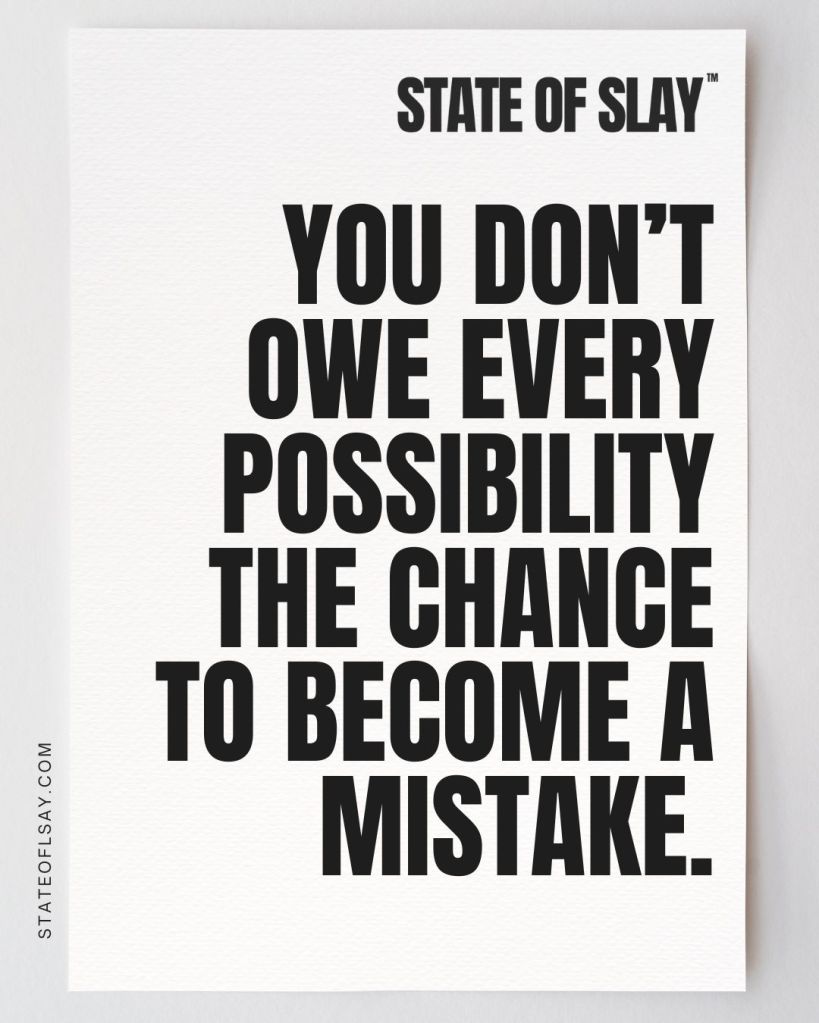
You don’t have to experience every wrong choice firsthand to trust yourself enough to make a different one.
They assure us that what happened isn’t really who they are.
And sometimes we want so badly to believe what we’re hearing that we allow the words to carry more weight than everything we’ve actually experienced.
Words matter.
Intentions matter.
Apologies matter.
But none of them exist in a vacuum.
Eventually, they have to meet behavior.
Because anyone can tell you what they value.
The question is whether they live according to those values when it’s inconvenient.
Anyone can promise to be there.
The question is whether they consistently show up.
Anyone can say they respect your boundaries.
The question is what happens when your boundary prevents them from getting what they want.
Anyone can apologize.
The question is whether the behavior that required the apology keeps happening.
This doesn’t mean judging someone by one bad day or one poor decision.
We are all capable of getting it wrong.
We disappoint people.
We react badly.
We say things we wish we could take back.
We make choices that don’t represent who we want to be.
A single mistake can be just that.
A mistake.
But repetition gives us different information.
When the same behavior keeps appearing, the same boundary keeps being crossed, the same promise keeps being broken, or the same apology keeps following the same action, you’re no longer looking at an isolated moment.
You’re looking at a pattern.
And patterns deserve your attention.
Sometimes we ignore them because the explanation sounds reasonable.
They were stressed.
They were scared.
They’ve been through a lot.
They didn’t mean it that way.
They’re working on themselves.
Maybe all of that is true.
Understanding why someone behaves a certain way can give us compassion for them.
It doesn’t require us to pretend their behavior isn’t affecting us.
There is an important difference between understanding someone and trusting them.
Understanding can come from knowing their story.
Trust has to come from experiencing their consistency.
And that takes time.
It’s also worth noticing the good patterns.
The person who quietly keeps their word.
The friend who checks in without being asked.
The partner whose actions make you feel secure without constantly having to reassure you that you should.
The person who respects your no even when they wanted a yes.
The one whose behavior consistently matches what they say matters to them.
Those patterns are information too.
We sometimes spend so much energy analyzing what people mean that we overlook what they repeatedly show us.
You don’t have to become suspicious of everyone.
You don’t have to assume every promise is empty or every mistake is evidence of someone’s character.
You simply have to let time provide information that words alone cannot.
Listen to what people tell you.
Then watch what they do.
When those two things consistently agree, trust has somewhere to grow.
And when they consistently don’t, you don’t have to keep choosing the version of someone described by their words over the version you keep experiencing.
This is your reminder:
Believe change when you can see it in the pattern, not just hear it in the promise.
Some people are very good at loving us when we’re struggling.
They show up when we’re hurting.
They listen when everything is falling apart.
They encourage us when we’ve lost confidence in ourselves.
They help us survive chapters we weren’t sure we would make it through.
And sometimes, those relationships become deeply important because of it.
But something interesting can happen when we begin to heal.
We stop needing the same reassurance.
We make different choices.
We establish boundaries where there used to be none.
We become more confident.
We start saying no.
We take chances.
We build lives that require us to become people we’ve never been before.
And suddenly, a relationship that felt perfectly comfortable during our struggle begins to feel different.
Not because anyone necessarily did something wrong.
Sometimes relationships are built around a particular dynamic.
One person needs.
The other feels needed.
One person struggles.
The other knows exactly how to support them.
One person doubts themselves.
The other becomes the voice reminding them who they are.
There can be genuine love inside that dynamic.
But healing changes roles.
When you begin trusting yourself, you may stop asking for permission.
When you become stronger, you may stop accepting behavior you once tolerated.
When your world expands, you may have less room for relationships that only worked when you stayed small.
And not everyone will know how to meet you there.
Some people will.
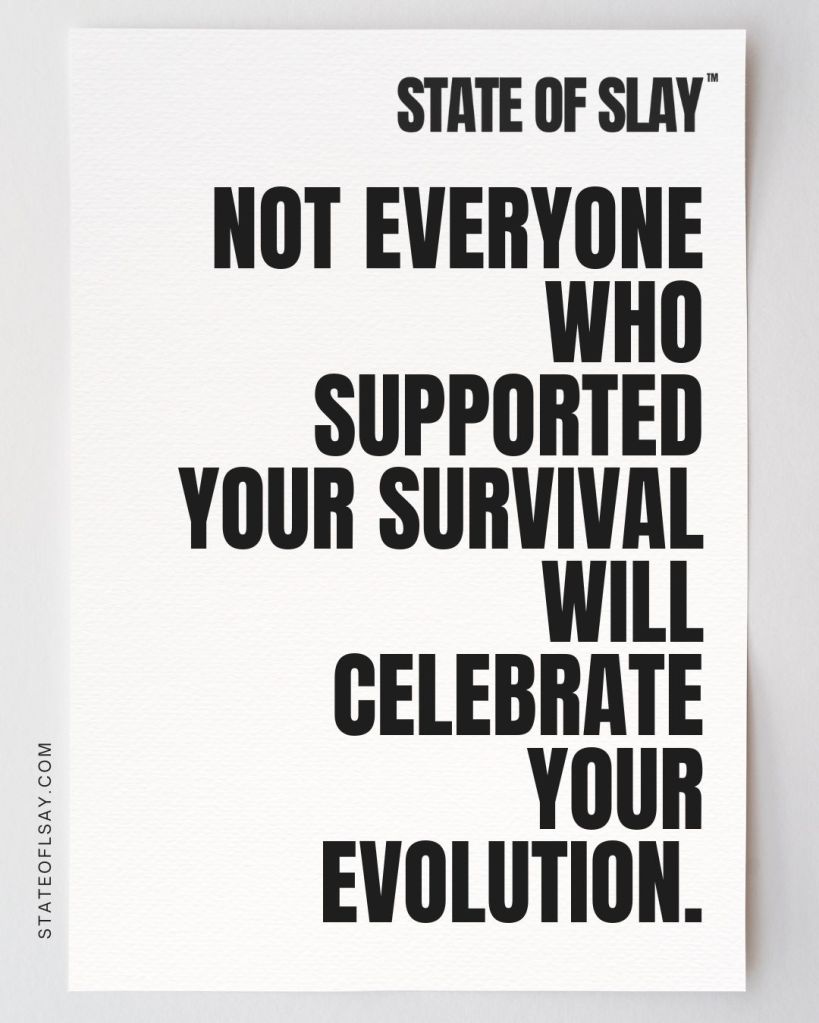
They’ll celebrate the confidence they once helped you find.
They’ll make room for the person you’re becoming.
They’ll allow the relationship to evolve instead of demanding that you return to an older version of yourself.
Others may resist the change.
Your boundaries may suddenly feel like rejection to them.
Your independence may feel like distance.
Your confidence may be interpreted as arrogance.
Your new priorities may be taken personally.
That doesn’t mean your growth is wrong.
And it doesn’t automatically mean they’re bad people.
Sometimes two people can care deeply about each other and still discover that the relationship they built belongs to a version of themselves that no longer exists.
That realization can hurt.
Especially when someone stood beside you during some of your hardest moments.
Gratitude can make us believe we owe people permanent access to us.
We don’t.
You can appreciate who someone was in your life without promising to remain who you were when you needed them.
You can honor what a relationship gave you without forcing it to survive every version of you.
And you can grieve someone who helped you through the darkness but couldn’t follow you into what came next.
This is your reminder:
The people meant to grow with you won’t require you to become smaller so the relationship can stay the same.
And once in the version where a particular person is there to see them.
The person who doubted you.
The person who underestimated you.
The person who walked away.
The person who made you question yourself.
Maybe you’ve imagined them seeing what you’ve accomplished.
Seeing how much you’ve changed.
Seeing that you survived without them.
Seeing that you became everything they didn’t believe you could become.
There is nothing unusual about wanting to be seen.
Recognition feels good.
But sometimes the desire to be seen becomes something else.
We start needing another person’s recognition to confirm something we already know.
And without realizing it, we make them the witness to our worth.
But a witness doesn’t make something true.
They only see what is already there.
Prefer to listen? The Audio Blog version is available here.
SOMETIMES WE DON’T WANT VALIDATION FROM EVERYONE
There may be a hundred people who believe in you.
And somehow, the opinion of the one person who doesn’t can become the loudest.
That’s because validation isn’t always about quantity.
Sometimes it’s about who we want it from.
We want the parent who rarely offered praise to finally say they’re proud of us.
We want the person who rejected us to realize they misjudged us.
We want the boss who overlooked us to see what we’ve accomplished somewhere else.
We want the friend who underestimated us to discover that we were capable all along.
We tell ourselves we don’t care.
And maybe most of the time we don’t.
But somewhere inside us can be a tiny courtroom where the case is still being argued.
See? I told you I could do it.
See? I wasn’t the problem.
See? I was worth believing in.
The problem is that the verdict we’re waiting for may never come.
And even if it does, it may not give us what we thought it would.
PROVING YOURSELF CAN KEEP YOU ATTACHED
We usually think of attachment as missing someone.
Wanting them back.
Thinking about the good times.
But there are other ways to remain attached to people.
Trying to prove them wrong is one of them.
You can leave someone physically and still organize part of your life around their opinion.
You can stop speaking to someone and still imagine their reaction to what you’re doing.
You can move forward while occasionally looking over your shoulder to see if they noticed.
That’s an invisible connection.
And sometimes it lasts much longer than the relationship itself.
There can even be motivation in it.
I’ll show them.
I’ll become successful.
I’ll get stronger.
I’ll build something better.
I’ll be happier without them.
That energy can move us for a while.
But eventually, it becomes exhausting to keep building a life with someone else’s disbelief sitting in the audience.
At some point, the life has to become yours.
BE CAREFUL WHO YOU ASK TO CONFIRM YOUR VALUE
Sometimes the person whose validation we want most is the person least qualified to give it.
Think about that.
We can spend years wanting recognition from someone who consistently failed to recognize us.
We want emotional understanding from someone who repeatedly dismissed our feelings.
We want accountability from someone who avoids looking at themselves.
We want encouragement from someone who felt threatened by our growth.
We want someone who couldn’t see our value then to finally confirm our value now.
Why?
Their inability to recognize something does not determine whether it exists.
You wouldn’t ask someone who can’t read music to tell you whether a symphony is good.
Yet emotionally, we sometimes hand the score to people who have never understood the language and wait anxiously for their review.
Not everyone is qualified to evaluate you.
And not every opinion deserves the authority you have given it.
GROWTH DOESN’T NEED AN AUDIENCE
Some of the most important changes you make will happen quietly.
There may be no dramatic reveal.
No applause.
No one saying, “Look how far you’ve come.”
Maybe you respond differently to something that once would have sent you spiraling.
Nobody notices.
Maybe you don’t send the message you would have sent a year ago.
Nobody knows.
Maybe you walk away from something you once would have chased.
Nobody sees.
Maybe you keep a promise to yourself.
Maybe you stop abandoning yourself to keep someone else comfortable.
Maybe you finally believe something about yourself that you’ve spent years needing other people to tell you.
These moments rarely look impressive from the outside.
But they can represent enormous change.
Growth isn’t less real because nobody witnessed the moment it happened.
Sometimes the quiet victories are the ones that change us most.
YOU DON’T NEED THEM TO REGRET LOSING YOU
There is a particular fantasy that can linger after rejection.
One day they’ll realize.
One day they’ll see what they lost.
One day they’ll regret how they treated me.
Maybe they will.
Maybe they won’t.
But if your healing depends on someone eventually regretting losing you, part of your worth is still waiting inside their realization.
You don’t need to become unforgettable to someone who didn’t know how to value you.
You don’t need them comparing everyone else to you.
You don’t need the apology years later.
You don’t need the message saying they made a mistake.
And you don’t need their regret to turn what happened into justice.
Sometimes people lose wonderful things and never understand what they lost.
That doesn’t make those things less wonderful.
Their regret is not the receipt for your value.
NOT EVERYTHING MEANINGFUL GETS APPLAUSE
We live in a world where so much of life is visible.
Accomplishments are announced.
Milestones are photographed.
Good deeds are shared.
Transformations have before-and-after pictures.
It can quietly teach us to associate significance with recognition.
But some of the most meaningful things you will ever do may receive almost none.
You may help someone who never tells you how much it mattered.
You may choose integrity when nobody would have known if you hadn’t.
You may start over without anyone understanding how much courage it required.
You may take care of yourself in ways that don’t produce anything impressive enough to announce.
You may do the right thing and receive absolutely nothing for it.
No praise.
No credit.
No acknowledgment.
That doesn’t reduce its value.
There is something powerful about becoming a person you respect even when nobody is watching.
Because then your choices aren’t performances.
They’re character.
YOU ARE ALLOWED TO OUTGROW THE NEED TO BE UNDERSTOOD
Sometimes we aren’t trying to prove our success.
We’re trying to prove our story.
We want someone to understand why we made the decision we made.
Why we left.
Why we changed.
Why something hurt us.
Why we couldn’t continue the way things were.
We think that if we could explain it perfectly enough, they would finally understand.
And then perhaps our decision would feel justified.
But there are people who will never understand a choice they would not have made themselves.
There are people who will interpret your boundary through the inconvenience it causes them.
There are people who benefited from the version of you that had fewer boundaries.
Their confusion doesn’t make your decision wrong.
You can understand your reasons without convincing everyone else of them.
Your life is not a case you have to win.
LET SOME PEOPLE HAVE THE WRONG VERSION OF YOU
This may be one of the harder things to accept.
Some people are going to misunderstand you.
Some will remember a version of you that no longer exists.
Some will tell a story about you that leaves out important pieces.
Some will believe they know why you did something when they don’t.
Some may never see how much you’ve changed.
And you may never get the opportunity to correct the record.
There is tremendous freedom in realizing that you don’t have to.
You cannot spend your life running from room to room correcting every conversation you’re not in.
You cannot manage every version of yourself that exists in someone else’s mind.
And you don’t need unanimous agreement to know who you are.
Let some people be wrong.
You have a life to live.
YOUR WORTH DOESN’T NEED A WITNESS
A witness can acknowledge something.
A witness can celebrate it.
A witness can appreciate it.
But a witness cannot create it.
Your growth happened whether the person who doubted you ever saw it.
Your healing matters whether the person who hurt you understands it.
Your success counts whether anyone who underestimated you is impressed.
Your boundary is valid whether someone agrees with it.
Your kindness matters even when nobody thanks you.
Your integrity matters even when nobody knows what it cost you.
And the person you are becoming does not require approval from the people who only knew who you used to be.
Maybe there will always be moments when we want someone to notice.
We’re human.
Being seen can be beautiful.
But being seen and being worthy are not the same thing.
You don’t have to turn your life into evidence.
You don’t have to make your happiness convincing.
You don’t have to become successful enough, healed enough, attractive enough, accomplished enough, or different enough to finally win someone’s approval.
You can stop presenting the evidence.
You can close the case.
Your life was never on trial.
SLAY REFLECTION
S — See Who You’re Still Trying to Convince Is there someone whose recognition, regret, approval, or understanding still feels unusually important to you?
L — Look at What You’re Trying to Prove What do you wish this person would finally understand about you? What would their acknowledgment seem to confirm?
A — Ask Who Gave Them That Authority Why does this person’s opinion carry so much weight? Are they actually qualified to determine the thing you’re asking them to validate?
Y — Your Life Is the Evidence Choose one thing you know to be true about yourself without requiring anyone else to confirm it. Let that knowledge be enough.
CALL TO ACTION: JOIN THE CONVERSATION
I’d love to hear from you.
Have you ever realized you were still trying to prove something to someone who was no longer part of your life?
What changed when you stopped needing them to see, understand, or acknowledge who you had become?
Share your thoughts in the comments. Your experience may help someone else realize that being overlooked, misunderstood, or underestimated doesn’t diminish what they know to be true about themselves.
And if you know someone who is still waiting for the wrong person to finally see their worth, send this to them.
Sometimes freedom begins when you stop waiting for someone else to confirm what you already know.
There is a strange comfort in knowing what comes next.
Even when what comes next isn’t particularly good for us.
We know this person will disappoint us.
We know this job will drain us.
We know this friendship will leave us feeling like an afterthought.
We know this habit will make us feel worse tomorrow.
And yet, there can be something strangely reassuring about returning to what we already know.
Because familiarity has its own kind of gravity.
We know the rules there.
We know who we are there.
We know how to survive there.
And sometimes we mistake that recognition for a sign that something belongs in our lives.
But familiar doesn’t mean right.
Sometimes it just means we’ve been there before.
Prefer to listen? The Audio Blog version is available here.
YOUR BRAIN LIKES TO KNOW WHAT COMES NEXT
We tend to think we make decisions based entirely on what we want.
But predictability has tremendous power.
When we know how something works, we don’t have to spend as much energy figuring it out.
Even an unpleasant pattern can offer that predictability.
You know which subjects not to bring up.
You know when someone is likely to withdraw.
You know how much of yourself to reveal.
You know when to apologize, smooth things over, work harder, stay quiet, or make yourself useful.
You may not be happy.
But you know the choreography.
That can create an illusion of comfort.
Not because the situation is actually comfortable, but because you have become skilled at navigating it.
There is an important difference between feeling safe and feeling competent at surviving something.
We don’t always recognize that difference.
WE CAN MISTAKE RECOGNITION FOR CONNECTION
Have you ever met someone and immediately felt like you had known them forever?
Sometimes that’s wonderful.
Sometimes it deserves a closer look.
Because what exactly are you recognizing?
Maybe you recognize their humor.
Their energy.
Their values.
Their openness.
But sometimes what feels instantly familiar is a dynamic you’ve experienced before.
Someone emotionally unavailable can feel compelling if you’ve spent much of your life trying to earn closeness.
Someone who needs constant help can feel strangely attractive if being needed has always made you feel valuable.
Someone unpredictable can create an intensity that feels like chemistry when what you are actually recognizing is uncertainty.
The feeling is real.
Our interpretation of the feeling isn’t always accurate.
“I know this feeling” can easily become “This must be right.”
Those are two very different statements.
SOMETIMES WE KNOW EXACTLY WHO TO BE IN THE WRONG PLACE
There is another reason familiar situations can be difficult to leave.
They give us a role.
Maybe you’re the fixer.
The peacemaker.
The responsible one.
The one who never needs anything.
The one who keeps everyone laughing.
The one who absorbs everyone else’s emotions.
The one who proves their worth by being indispensable.
You may have played that role for so long that it no longer feels like something you do.
It feels like who you are.
Then something changes.
You enter a relationship where nobody needs rescuing.
You find friends who don’t require you to perform for your place in the group.
You work somewhere that doesn’t expect you to sacrifice your life to prove your commitment.
Suddenly, an unexpected question appears:
Who am I if nobody needs me to be that person anymore?
Sometimes we miss the old dynamic not because it was good for us, but because we understood ourselves inside it.
HEALTHY CAN FEEL STRANGE AT FIRST
We often imagine that when something healthier enters our lives, we’ll immediately recognize it.
Finally.
This is what I’ve been waiting for.
Sometimes.
Other times, healthy feels surprisingly uncomfortable.
Consistency can make you suspicious when you are accustomed to unpredictability.
A relationship without constant conflict can feel strangely quiet.
Someone respecting your boundaries can initially feel like they don’t care enough to fight for access to you.
A friendship without competition can make you wonder what the other person really wants.
A workplace that doesn’t expect you to answer emails at all hours can leave you feeling guilty when you close the laptop.
Rest can feel irresponsible.
Peace can feel boring.
Receiving can feel selfish.
And none of those feelings necessarily mean something is wrong.
Sometimes they mean something is new.
DISCOMFORT ISN’T ALWAYS A WARNING
We are often encouraged to trust our feelings.
And we should listen to them.
But listening to a feeling doesn’t mean automatically obeying the conclusion we attach to it.
Discomfort can tell us something is wrong.
It can also tell us something is unfamiliar.
Those require very different responses.
If you’ve spent years saying yes when you wanted to say no, setting a boundary may feel terrible.
That doesn’t mean the boundary is wrong.
If you’re accustomed to explaining yourself until everyone approves of your decisions, saying, “This is what I’ve decided,” and leaving it there may feel almost unbearable.
That doesn’t mean you owe another explanation.
If you have always measured your value through productivity, taking an afternoon off may make you restless.
That doesn’t mean you should get back to work.
Sometimes discomfort is an alarm.
Sometimes it is simply the sensation of stepping outside an old pattern.
Learning to tell the difference is part of growth.
DISTANCE CAN EDIT OUR MEMORY
There is another trick our memory can play on us.
Once we get far enough away from something, we can begin remembering it selectively.
We remember the good conversations and forget how anxious we felt waiting for the next one.
We remember the laughter and forget how often we cried.
We remember belonging and forget how much of ourselves we had to edit to belong.
We remember what the job gave us and forget what it took from us.
We remember the comfort of the habit and minimize the consequences.
Distance can soften sharp edges.
That isn’t necessarily a bad thing. We don’t need to carry every painful detail forever.
But nostalgia is not always an accurate historian.
Missing something doesn’t automatically mean you should return to it.
Sometimes you miss something because it was important.
Sometimes because there were genuinely beautiful parts of it.
And sometimes because your mind knows exactly where everything is in that old room.
That still doesn’t mean you should move back in.
THE UNKNOWN DOESN’T HAVE A TRACK RECORD YET
There’s another unfair advantage the familiar has over the new.
The familiar has evidence.
You know what happened before.
The unknown has nothing.
You don’t know whether the new relationship will work.
You don’t know whether the career change will be worth it.
You don’t know whether you’ll find your people somewhere else.
You don’t know who you’ll become when you stop doing what you’ve always done.
So we sometimes compare the certainty of something mediocre with the uncertainty of something potentially better.
Of course, certainty can win that contest.
It arrives carrying receipts.
The unknown arrives empty-handed.
But uncertainty is not evidence that something will go badly.
It is simply the absence of evidence about what comes next.
There are possibilities we cannot discover while insisting that the future prove itself before we are willing to leave the past.
YOU MAY NEED TO GIVE GOOD THINGS TIME TO BECOME FAMILIAR
We talk a lot about letting go of what no longer serves us.
We talk less about what happens afterward.
Because there can be an awkward stretch between leaving an old pattern and feeling at home in a new one.
You may question yourself.
You may miss what you left.
You may wonder why something supposedly healthier doesn’t feel natural yet.
Maybe it isn’t supposed to.
You had years to learn the old pattern.
You knew its shortcuts, warning signs, hiding places, and exits.
You knew your lines.
Something new doesn’t have any of that history yet.
You are learning it.
And perhaps one of the most overlooked parts of changing your life is giving yourself enough time for healthier experiences to stop feeling foreign.
For peace to become recognizable.
For mutual support to become normal.
For boundaries to stop feeling mean.
For rest to stop feeling lazy.
For being loved without performing for it to stop making you wonder what the catch is.
Eventually, what once felt unfamiliar can become the new familiar.
FAMILIAR DOESN’T MEAN RIGHT
When you find yourself being pulled toward an old person, pattern, behavior, or version of yourself, it may be worth asking a different question.
Not:
Why do I still want this?
But:
What about this do I recognize?
Maybe you recognize being needed.
Maybe you recognize chasing approval.
Maybe you recognize instability.
Maybe you recognize overworking.
Maybe you recognize putting yourself last.
Maybe you simply recognize the person you used to be when you were there.
Recognition can be powerful.
But it isn’t destiny.
You are allowed to stop choosing something simply because you know how to survive it.
You are allowed to become unfamiliar with an old version of your life.
And you are allowed to feel awkward, uncertain, or even uncomfortable while something better slowly becomes recognizable.
Because sometimes the thing that feels strange isn’t wrong.
It’s just new.
And sometimes the thing that feels like home isn’t where you belong anymore.
SLAY REFLECTION
S — Spot the Familiar Where in your life are you repeatedly drawn toward a person, situation, habit, or dynamic that you already know doesn’t work for you?
L — Look Beneath the Feeling What feels familiar about it? Is it the person or situation itself, or the role you know how to play within it?
A — Allow the Unfamiliar Is there something healthier in your life that you may be resisting simply because it doesn’t feel natural yet?
Y — Your New Normal Choose one healthy experience you want to give yourself enough time to become familiar with instead of retreating to what you already know.
CALL TO ACTION: JOIN THE CONVERSATION
I’d love to hear from you.
Have you ever had something healthier feel uncomfortable at first because it was new?
Share your thoughts in the comments. Your experience may help someone else recognize when they’re choosing what they know instead of what they truly want.
And if you know someone who keeps finding their way back to the same people, patterns, or situations, send this to them.
Sometimes what feels like home is simply a place we’ve been before.
We spend a lot of energy fighting things we wish had less power over us.
Other people’s opinions.
Drama we never wanted to be part of.
Arguments that have already said everything there is to say.
Resentments we keep replaying.
People who know exactly how to get a reaction from us.
Even thoughts we’ve decided we don’t want to believe anymore.
We tell ourselves we’re trying to get rid of them.
But every time we revisit them, react to them, argue with them, or give them another hour of our attention, we’re keeping them alive.
Not everything needs a confrontation.
Not every comment needs a response.
Not every misunderstanding needs to be corrected.
Not every invitation into chaos needs to be accepted.
Sometimes we mistake engagement for control.
We think if we can explain ourselves one more time, prove our point, understand why something happened, or finally get the last word, we’ll be able to put it down.
But attention is energy.
And whatever continually receives yours gets space in your life.
That doesn’t mean ignoring problems that need to be addressed.
It means learning to recognize the difference between something that requires action and something that survives because you keep participating in it.
There is power in deciding you’re done.
Done checking.
Done explaining.
Done reacting.
Done giving something access to your peace simply because it knows how to get your attention.
You don’t always have to win the battle.
Sometimes you simply have to stop showing up for it.
This is your reminder:
Be intentional about what receives your energy. What you stop feeding eventually has to learn how to exist without you.
To know that the people around us see something good, valuable, lovable, or worthy when they look at us.
There is nothing wrong with that.
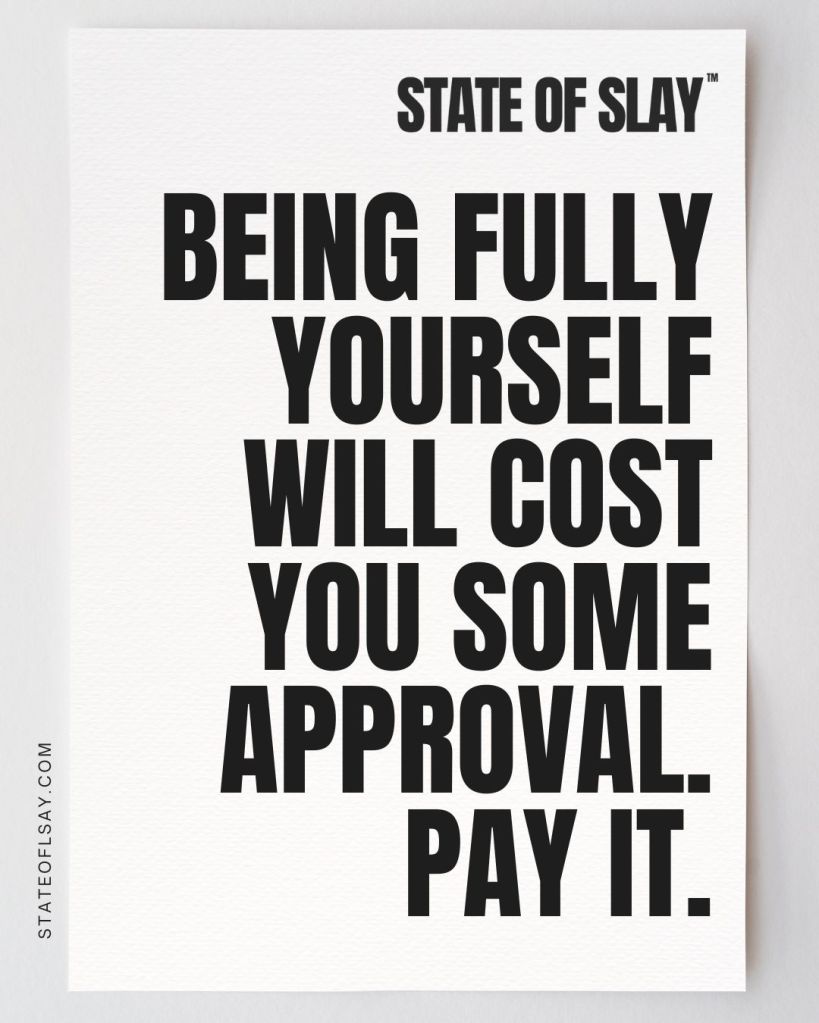
The problem begins when we start using other people’s opinions as evidence of who we are.
Someone approves of us, and we feel confident.
Someone criticizes us, and suddenly we question ourselves.
Someone misunderstands us, and we scramble to explain.
Someone rejects us, and we wonder what must be wrong with us.
Without realizing it, we can spend our lives looking into other people hoping to find our own reflection.
But other people’s opinions are not mirrors.
They are perspectives.
And if you want to know who you are, you have to stop looking for yourself in them.
Prefer to listen? The Audio Blog version is available here.
OTHER PEOPLE DON’T SEE YOU OBJECTIVELY
None of us sees another person exactly as they are.
We see people through the lens of who we are.
Our experiences.
Our beliefs.
Our expectations.
Our fears.
Our wounds.
Our preferences.
Our history.
Someone may think you’re selfish because you finally established a boundary.
Someone else may admire you for having the courage to establish it.
One person may find you intimidating.
Another may find you inspiring.
Someone may think you’re too much.
Someone else may wonder why you keep making yourself smaller.
Which one is the truth?
None of them entirely.
They’re seeing you through their own lens.
Their perception belongs to them.
Your identity belongs to you.
APPROVAL CAN BECOME AN ADDICTION
Approval feels good.
Being praised feels good.
Being liked feels good.
And there is nothing unhealthy about enjoying those things.
But when approval becomes necessary for us to feel secure, we begin organizing our lives around getting it.
We say yes when we want to say no.
We soften our opinions.
We hide parts of ourselves.
We change how we dress, speak, create, love, work, or dream based on how we think others will respond.
We become experts at reading the room while slowly losing the ability to read ourselves.
What do I actually want?
What do I believe?
What feels right to me?
Who am I when nobody is applauding?
Those questions become difficult to answer when we’ve spent too long allowing approval to answer them for us.
REJECTION DOESN’T DEFINE YOUR VALUE
When someone doesn’t choose us, it can feel deeply personal.
A relationship ends.
A friendship changes.
We don’t get the job.
Someone doesn’t like our work.
We’re excluded from something.
And suddenly rejection begins writing a story.
Maybe I’m not good enough.
Maybe I’m not talented enough.
Maybe I’m not attractive enough.
Maybe I’m too difficult.
Maybe I’m not worth choosing.
But rejection doesn’t have the authority to determine your value.
It tells you something about a particular relationship, opportunity, circumstance, or person’s preference.
That’s all.
You can be extraordinary and still not be right for everyone.
You can be deeply lovable and still not be loved well by a particular person.
You can be talented and still not get the opportunity.
You can be worthy and still not be chosen.
Someone else’s no is not a definition of you.
BEING MISUNDERSTOOD DOESN’T MEAN YOU’RE WRONG
One of the hardest things to tolerate is being misunderstood.
Especially when we know our intentions.
We want to explain.
Clarify.
Correct the record.
Make the other person finally see us accurately.
Sometimes that’s worthwhile.
But sometimes people have already decided who you are.
And no amount of explaining will change the version of you they’ve created.
At that point, continuing to defend yourself isn’t communication.
It’s an audition.
You’re trying to earn the role of “good person” in someone else’s story.
You don’t have to.
You can know your intentions without convincing everyone else of them.
You can know your heart without submitting it for public approval.
You can let someone misunderstand you and continue being who you know yourself to be.
NOT EVERY OPINION DESERVES EQUAL WEIGHT
There is a difference between being open to feedback and being governed by it.
Feedback can help us grow.
Sometimes other people see things we can’t.
They can challenge us.
Teach us.
Point out blind spots.
Help us become better versions of ourselves.
But wisdom means considering the source.
Does this person know me?
Do I respect how they live?
Do they want the best for me?
Is there truth in what they’re saying?
Are they offering insight, or projecting something that belongs to them?
You don’t have to accept every opinion simply because someone was willing to give it.
Not every voice deserves a seat at the table.
YOU WILL BE DIFFERENT PEOPLE TO DIFFERENT PEOPLE
There are people who remember a version of you that no longer exists.
People who met you during your worst season.
People who benefited from you having no boundaries.
People who loved the version of you who needed their approval.
People who will celebrate your growth.
And people who will resent it.
You may be the villain in someone’s story and the person who changed someone else’s life for the better.
You may be difficult to one person and exactly what another person needed.
You may be remembered unfairly.
You may be judged without context.
You may never get the opportunity to correct someone’s perception of you.
That’s part of being human.
You cannot manage every version of yourself that exists in someone else’s mind.
And trying will exhaust you.
YOU DON’T HAVE TO BECOME INDIFFERENT
The answer isn’t pretending you don’t care what anyone thinks.
Most of us care.
We care what the people we love think.
We care about being respected.
We care when we’re criticized.
We care when someone doesn’t like us.
We’re human.
The goal isn’t indifference.
It’s discernment.
You can hear someone’s opinion without handing them your identity.
You can consider criticism without automatically believing it.
You can appreciate praise without depending on it.
You can be hurt by rejection without allowing it to determine your worth.
Someone else’s opinion can be information.
It doesn’t have to become identity.
KNOW YOURSELF BEFORE THE WORLD TELLS YOU WHO TO BE
The stronger your relationship with yourself becomes, the less easily other people’s opinions can move you away from who you are.
Know what you value.
Know what you stand for.
Know what you need.
Know where you still have work to do.
Know what you’re proud of.
Know what you’re willing to change.
And know what you aren’t willing to sacrifice simply to make yourself easier for someone else to accept.
Self-awareness doesn’t mean believing you’re always right.
It means knowing yourself well enough to recognize the difference between useful feedback and someone else’s projection.
That kind of self-knowledge becomes an anchor.
The world can have opinions.
You don’t have to drift with every one of them.
STOP HANDING OTHER PEOPLE THE MIRROR
If you keep asking the world who you are, you’re going to receive thousands of different answers.
Too loud.
Too quiet.
Too ambitious.
Not ambitious enough.
Too emotional.
Too guarded.
Too independent.
Too needy.
Too much.
Not enough.
You could spend your entire life adjusting yourself to satisfy opinions that contradict one another.
Or you could put the mirror back in your own hands.
Look at yourself honestly.
Not through praise.
Not through criticism.
Not through rejection.
Not through applause.
Through your own eyes.
Know where you’ve grown.
Own where you’ve fallen short.
Recognize what you bring into the world.
And decide for yourself who you want to become.
YOU ARE THE ONE WHO HAS TO LIVE YOUR LIFE
At the end of the day, the people whose approval you’re chasing don’t have to live with your choices.
You do.
They don’t wake up inside your life.
You do.
They don’t carry your dreams.
Your regrets.
Your compromises.
Your unlived possibilities.
You do.
So listen to people you trust.
Stay teachable.
Be willing to examine yourself.
Apologize when you’re wrong.
Grow when you need to grow.
But don’t confuse humility with surrendering your sense of self.
Your life cannot become a group project where everyone else gets a vote on who you’re allowed to be.
Stop looking for yourself in other people’s opinions.
You were never hiding there.
SLAY REFLECTION
S — See Whose Opinion Has Too Much Power Whose approval or criticism has the ability to change the way you feel about yourself?
L — Look at What You Believe What do you know to be true about yourself regardless of whether someone else recognizes it?
A — Accept That You Won’t Be for Everyone Where could you give yourself permission to be misunderstood, disliked, or simply not someone’s preference without making it mean something about your worth?
Y — Your Next Step The next time someone’s opinion makes you question yourself, pause before accepting it as truth. Ask yourself: Is this something I need to learn from, or something I need to let belong to them?
CALL TO ACTION: JOIN THE CONVERSATION
I’d love to hear from you.
When have you allowed someone else’s opinion of you to become your opinion of yourself?
And what changed when you stopped?
Share your story in the comments. Your experience may help someone else realize they’ve been searching for themselves in the wrong place.
And if you know someone who needs this reminder, send this to them.
We have a habit of trying to find meaning in everything that hurts us.
What did this teach me?
How did this make me stronger?
What was I supposed to learn?
Sometimes there is an answer.
Sometimes an experience teaches us about boundaries.
About our own patterns.
About what we need.
About what we will never accept again.
But sometimes the lesson isn’t hidden somewhere inside the pain waiting to be discovered.
Sometimes someone simply showed you who they were.
They broke your trust.
They betrayed your confidence.
They treated your vulnerability carelessly.
And you don’t have to turn what they did into something beautiful in order to move forward from it.
You don’t have to be grateful for the wound because you eventually learned how to heal it.
You don’t have to convince yourself that everything happened for a reason.
And you don’t have to keep giving someone access to you simply because forgiveness feels more evolved than distance.
Forgiveness and trust are not the same thing.
Healing and reconciliation are not the same thing.
You can release anger without reopening the door.
You can wish someone well without inviting them back into your life.
And you can accept what happened without finding some profound purpose for why it had to happen.
Sometimes growth is simply recognizing that someone has shown you what they’re capable of and believing them.
Not with bitterness.
With clarity.
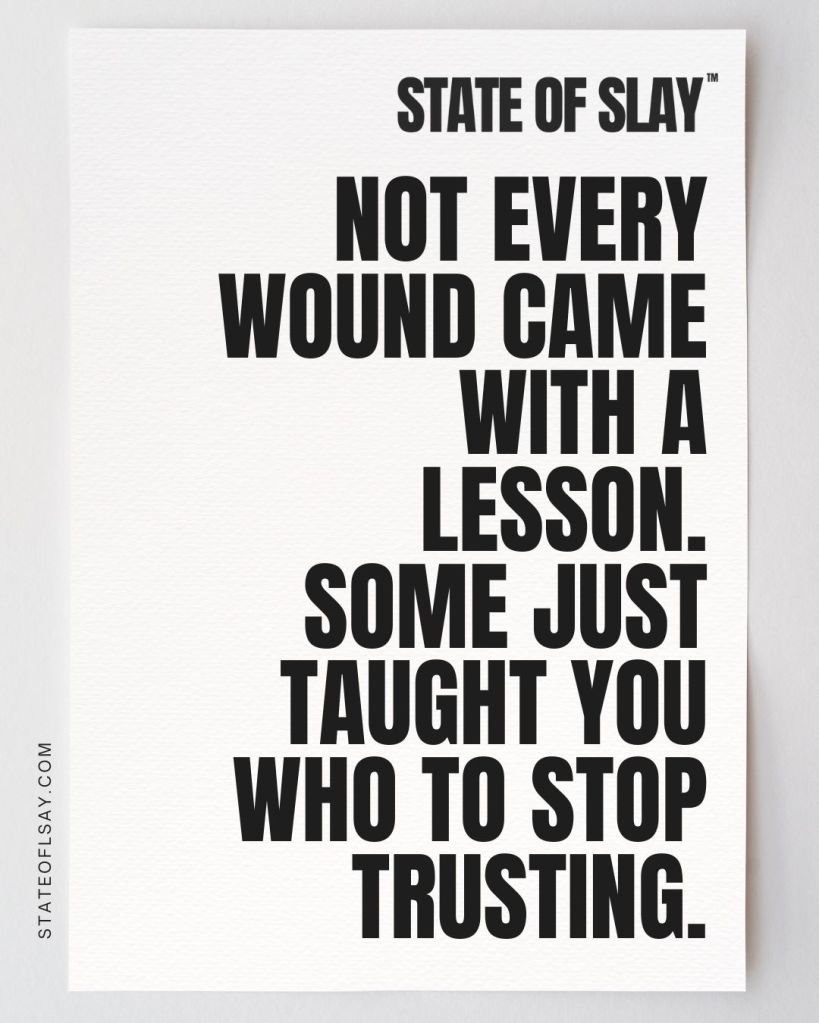
This is your reminder:You don’t have to find meaning in every wound. Sometimes healing is accepting what happened, trusting what it revealed, and choosing differently from here.