Give it a shot because you might regret it if you don’t.
And sometimes that advice is exactly what we need.
Fear can keep us standing safely outside experiences that could change our lives. Growth often requires uncertainty, and there are opportunities we would never discover if we waited until we knew exactly how everything would turn out.
But not every hesitation is fear.
Sometimes it’s discernment.
There are moments when we already have enough information to know that something probably isn’t right for us.
The relationship that requires you to overlook things you know matter to you.
The opportunity that looks impressive but asks you to sacrifice something you’re no longer willing to give up.
The person whose potential keeps tempting you to ignore their pattern.
The invitation you keep trying to get excited about because everyone else thinks you should be.
The situation you’ve already experienced in enough different forms to recognize where it leads.
You don’t always have to go all the way to the ending to know you don’t want the story.
That can be difficult to trust.
Especially if you’ve spent years believing that saying no means you’re closed-minded, afraid, negative, or unwilling to take risks.
So you override yourself.
You give things chances you never really wanted to give.
You stay curious long after your instincts have given you an answer.
You tell yourself you should at least try.
And sometimes you end up exactly where you suspected you would, wondering why you needed the experience to confirm what you already knew.
Experience is a powerful teacher.
But it isn’t the only teacher.
So is observation.
So is history.
So is self-awareness.
So is everything you learned the last time you ignored yourself.
Growth isn’t only becoming brave enough to take more chances.
Sometimes it’s becoming wise enough to know which chances are worth taking.
That doesn’t mean you’ll always get it right.
There will be opportunities you decline that might have turned into something wonderful.
There will be doors you walk past without ever knowing exactly what was behind them.
That’s part of making choices.
Every yes closes something.
Every no does too.
A meaningful life isn’t built by experiencing every possible version of it.
It’s built by learning which possibilities deserve your time, energy, trust, and attention.
You don’t have to date someone just because there might be something there.
You don’t have to accept an opportunity simply because it’s available.
You don’t have to revisit something you already know doesn’t work for you just to make absolutely certain.
And you don’t have to collect another scar to prove you learned from the last one.
Sometimes wisdom looks less dramatic than taking the leap.
Sometimes it looks like recognizing the edge and deciding you don’t need to jump from it.
This is your reminder:
You don’t have to experience every wrong choice firsthand to trust yourself enough to make a different one.
They assure us that what happened isn’t really who they are.
And sometimes we want so badly to believe what we’re hearing that we allow the words to carry more weight than everything we’ve actually experienced.
Words matter.
Intentions matter.
Apologies matter.
But none of them exist in a vacuum.
Eventually, they have to meet behavior.
Because anyone can tell you what they value.
The question is whether they live according to those values when it’s inconvenient.
Anyone can promise to be there.
The question is whether they consistently show up.
Anyone can say they respect your boundaries.
The question is what happens when your boundary prevents them from getting what they want.
Anyone can apologize.
The question is whether the behavior that required the apology keeps happening.
This doesn’t mean judging someone by one bad day or one poor decision.
We are all capable of getting it wrong.
We disappoint people.
We react badly.
We say things we wish we could take back.
We make choices that don’t represent who we want to be.
A single mistake can be just that.
A mistake.
But repetition gives us different information.
When the same behavior keeps appearing, the same boundary keeps being crossed, the same promise keeps being broken, or the same apology keeps following the same action, you’re no longer looking at an isolated moment.
You’re looking at a pattern.
And patterns deserve your attention.
Sometimes we ignore them because the explanation sounds reasonable.
They were stressed.
They were scared.
They’ve been through a lot.
They didn’t mean it that way.
They’re working on themselves.
Maybe all of that is true.
Understanding why someone behaves a certain way can give us compassion for them.
It doesn’t require us to pretend their behavior isn’t affecting us.
There is an important difference between understanding someone and trusting them.
Understanding can come from knowing their story.
Trust has to come from experiencing their consistency.
And that takes time.
It’s also worth noticing the good patterns.
The person who quietly keeps their word.
The friend who checks in without being asked.
The partner whose actions make you feel secure without constantly having to reassure you that you should.
The person who respects your no even when they wanted a yes.
The one whose behavior consistently matches what they say matters to them.
Those patterns are information too.
We sometimes spend so much energy analyzing what people mean that we overlook what they repeatedly show us.
You don’t have to become suspicious of everyone.
You don’t have to assume every promise is empty or every mistake is evidence of someone’s character.
You simply have to let time provide information that words alone cannot.
Listen to what people tell you.
Then watch what they do.
When those two things consistently agree, trust has somewhere to grow.
And when they consistently don’t, you don’t have to keep choosing the version of someone described by their words over the version you keep experiencing.
This is your reminder:
Believe change when you can see it in the pattern, not just hear it in the promise.
When we feel rejected, it can seem like proof that we weren’t wanted.
When we feel guilty, it can seem like proof that we did something wrong.
When we feel afraid, it can seem like proof that something bad is about to happen.
When we feel inadequate, it can seem like proof that we aren’t enough.
The emotion arrives, and almost instantly, our mind begins building a story around it.
I feel it, therefore it must be true.
But feelings and facts are not always the same thing.
Your feelings are real because you are experiencing them.
They deserve your attention. They can tell you something important about your fears, needs, history, expectations, wounds, hopes, and boundaries.
But a feeling isn’t necessarily an accurate description of what is happening.
Sometimes it is.
Sometimes it isn’t.
Learning the difference can change the way we understand ourselves.
Prefer to listen? The Audio Blog version is available here.
YOUR FEELINGS ARE REAL
There is an important distinction between saying a feeling may not be true and saying a feeling isn’t real.
If you’re hurt, you’re hurt.
If you’re afraid, you’re afraid.
If you’re angry, you’re angry.
You don’t need to argue yourself out of an emotion simply because someone else thinks you shouldn’t be having it.
Feelings are experiences, and experiences are real.
But the meaning we assign to those experiences is something different.
You can feel excluded without someone intentionally excluding you.
You can feel unloved while being deeply loved.
You can feel like a failure after making a perfectly ordinary mistake.
You can feel guilty for disappointing someone even though you made the healthiest decision available to you.
The feeling deserves compassion.
The conclusion deserves examination.
Those are two very different things.
FEELINGS ARE INFORMATION, NOT ALWAYS EVIDENCE
Think of a feeling as information arriving at your door.
It has something to tell you.
But that doesn’t mean you have to hand it the keys to the house.
Anxiety may tell you that something feels uncertain.
It doesn’t necessarily tell you that something terrible is going to happen.
Jealousy may tell you that you’re feeling insecure or afraid of losing something important.
It doesn’t necessarily tell you that someone has betrayed you.
Guilt may tell you that you’ve acted against your values.
But it can also appear because you’ve been conditioned to feel responsible for keeping everyone else happy.
Loneliness may tell you that you need connection.
It doesn’t tell you that nobody cares about you.
Feelings contain information.
The mistake we sometimes make is treating that information as a verdict.
OUR HISTORY CAN SPEAK IN THE PRESENT TENSE
Sometimes what we feel in the present was shaped long before the present moment arrived.
Maybe you’ve experienced abandonment.
Then someone you care about becomes quiet, distracted, or unavailable.
Suddenly, you feel that familiar drop in your stomach.
They’re leaving.
Nothing has actually happened yet.
But your body recognizes something.
Not necessarily the situation.
The pattern.
If you’ve spent years being criticized, a small piece of feedback may feel like a complete rejection of who you are.
If you’ve lived around unpredictable behavior, calm can sometimes feel suspicious.
If love once had to be earned, someone else’s disappointment may feel like a threat to the relationship.
Our history doesn’t disappear simply because the calendar moves forward.
Sometimes yesterday puts on today’s clothes.
And unless we stop to look closely, we may not recognize it.
YOUR MIND DOESN’T LIKE AN EMPTY SPACE
Human beings are meaning-makers.
When we don’t know why something happened, our minds tend to fill in the blank.
Someone doesn’t text back.
They’re upset with me.
A friend seems distant.
I did something wrong.
You don’t get the opportunity you wanted.
I’m not good enough.
Someone’s tone changes.
They’re angry.
You walk into a room and suddenly feel self-conscious.
Everyone is judging me.
Notice how quickly we can travel from observation to interpretation.
Something happened.
We felt something.
Then we created an explanation.
Sometimes that explanation is correct.
But sometimes we’ve turned a question mark into a period before we have enough information to finish the sentence.
GUILT DOESN’T ALWAYS MEAN YOU DID SOMETHING WRONG
This one can be especially difficult.
Many of us were taught, directly or indirectly, that being good meant being accommodating.
Don’t disappoint people.
Don’t upset anyone.
Don’t be difficult.
Don’t say no.
Don’t make someone uncomfortable.
So when we finally set a boundary, leave an unhealthy situation, decline a request, or choose ourselves, guilt can show up immediately.
And because guilt usually accompanies wrongdoing, we assume:
If I feel guilty, I must have done something wrong.
But sometimes guilt is simply what change feels like when you’re accustomed to abandoning yourself.
You can feel guilty and still have made the right decision.
You can disappoint someone without mistreating them.
You can choose not to carry something that was never yours to carry.
The presence of guilt doesn’t automatically mean the absence of integrity.
FEAR CAN CONFUSE NEW WITH DANGEROUS
Fear is designed to protect us.
That’s part of what makes it so persuasive.
When fear speaks, we tend to listen.
But fear doesn’t only respond to danger.
It also responds to uncertainty.
Starting over can feel frightening.
Being vulnerable can feel frightening.
Leaving something familiar can feel frightening.
Trying something you’ve never done before can feel frightening.
Even being treated well can feel unsettling if you’re accustomed to relationships where you had to constantly earn affection, anticipate moods, or protect yourself.
Your nervous system doesn’t have a crystal ball.
It recognizes patterns.
Sometimes it raises the alarm because something is dangerous.
Sometimes it raises the alarm because something is different.
Wisdom is learning not to confuse the two.
NOT EVERY THOUGHT ATTACHED TO A FEELING DESERVES TO STAY
Feelings are fast.
They arrive before we’ve had time to investigate them.
And they often bring thoughts along for the ride.
I’m embarrassed, so everyone must think I’m ridiculous.
I’m lonely, so I must be unwanted.
I’m overwhelmed, so I must be incapable.
I’m jealous, so there must be something to worry about.
I’m scared, so I shouldn’t do it.
I’m hurt, so they must have intended to hurt me.
That last part is where we can get ourselves into trouble.
We don’t have to reject the feeling.
We can question the story attached to it.
What actually happened?
What do I know?
What am I assuming?
Is there another explanation?
Have I felt this way in situations like this before?
Am I responding only to what is happening now, or to what this reminds me of?
Those questions don’t silence emotion.
They give it context.
YOU DON’T HAVE TO ACT ON EVERYTHING YOU FEEL
A feeling can be urgent without requiring immediate action.
That’s a powerful distinction.
You can be angry without sending the text.
You can feel rejected without withdrawing from the relationship.
You can feel anxious without cancelling the opportunity.
You can feel jealous without making an accusation.
You can feel insecure without asking someone else to prove your worth.
You can feel afraid without automatically turning around.
Sometimes the healthiest thing we can do with an emotion is simply allow it to exist for a moment.
Feel it.
Name it.
Listen to it.
Then decide what, if anything, it actually requires from you.
There is space between feeling and action.
A lot of our growth happens there.
TWO THINGS CAN BE TRUE AT ONCE
You can know someone loves you and still feel insecure.
You can know you made the right decision and still feel sad about it.
You can be proud of yourself and still feel afraid.
You can know you’re capable and still have moments when you doubt yourself.
You can know a relationship needed to end and still miss the person.
You can know you’re worthy and still have days when you don’t feel particularly worthy.
One truth doesn’t erase the other.
We get into trouble when we believe uncomfortable feelings invalidate everything else we know.
They don’t.
A difficult feeling doesn’t necessarily mean you’re moving in the wrong direction.
Sometimes it simply means you’re human while moving through something difficult.
A FEELING CAN BE REAL WITHOUT BEING TRUE
Emotional maturity isn’t learning how to stop feeling.
It’s learning how to feel without automatically believing every conclusion your emotions offer you.
Your feelings deserve to be heard.
They don’t always deserve to be obeyed.
Sometimes they are telling you exactly what you need to know.
Sometimes they’re showing you where something still hurts.
Sometimes they’re responding to an old experience.
Sometimes they’re reacting to uncertainty.
Sometimes they’re asking you to slow down long enough to separate what happened from what you fear it means.
You don’t have to invalidate yourself to question your interpretation.
You can say:
This feeling is real.
I am allowed to feel it.
And I am going to find out whether the story I’m telling myself about it is true.
That isn’t denying your emotions.
It’s learning to listen to them without handing them the microphone, the gavel, and the final word.
SLAY REFLECTION
S — Separate the feeling from the story Think about something you’re feeling strongly right now. What is the emotion, and what story have you attached to it?
L — Look at what you actually know What facts support the story you’re telling yourself? What parts are assumptions, fears, or interpretations?
A — Ask what the feeling may be showing you Does this emotion belong entirely to the present situation, or does something about it feel familiar from your past?
Y — You choose what happens next Before reacting, give yourself space to decide whether this feeling requires action, reflection, a conversation, a boundary, or simply time to pass.
CALL TO ACTION: JOIN THE CONVERSATION
I’d love to hear from you.
Have you ever had a feeling that seemed completely true in the moment, only to discover later that the story you attached to it wasn’t accurate?
Or have you ever felt guilty, afraid, rejected, or inadequate even when the facts were telling you something very different?
Share your thoughts in the comments. Your experience may help someone else realize that questioning the story behind a feeling doesn’t mean dismissing the feeling itself.
And if you know someone who tends to believe everything their emotions tell them, send this to them.
Sometimes the feeling is real, but the story still needs a second look.
We spend a lot of energy fighting things we wish had less power over us.
Other people’s opinions.
Drama we never wanted to be part of.
Arguments that have already said everything there is to say.
Resentments we keep replaying.
People who know exactly how to get a reaction from us.
Even thoughts we’ve decided we don’t want to believe anymore.
We tell ourselves we’re trying to get rid of them.
But every time we revisit them, react to them, argue with them, or give them another hour of our attention, we’re keeping them alive.
Not everything needs a confrontation.
Not every comment needs a response.
Not every misunderstanding needs to be corrected.
Not every invitation into chaos needs to be accepted.
Sometimes we mistake engagement for control.
We think if we can explain ourselves one more time, prove our point, understand why something happened, or finally get the last word, we’ll be able to put it down.
But attention is energy.
And whatever continually receives yours gets space in your life.
That doesn’t mean ignoring problems that need to be addressed.
It means learning to recognize the difference between something that requires action and something that survives because you keep participating in it.
There is power in deciding you’re done.
Done checking.
Done explaining.
Done reacting.
Done giving something access to your peace simply because it knows how to get your attention.
You don’t always have to win the battle.
Sometimes you simply have to stop showing up for it.
This is your reminder:
Be intentional about what receives your energy. What you stop feeding eventually has to learn how to exist without you.
When the Story You Wanted Isn’t the Story You’re Living
Sometimes we don’t hold on because something is good for us.
We hold on because of what we believed it could become.
The relationship we imagined.
The future we pictured.
The apology we thought would come.
The person we kept believing someone could be.
And hope can be powerful.
But hope can also keep us invested in a version of reality that exists only in our minds.
We explain away what doesn’t fit the story.
We focus on potential instead of patterns.
We give more weight to promises than actions.
We keep waiting for tomorrow to prove that what we’re experiencing today isn’t really the truth.
Because accepting reality can mean grieving more than what we’re losing.
We may also have to grieve everything we thought was coming.
And that can hurt.
But there comes a point when protecting the illusion costs more than facing the truth.
Seeing something clearly doesn’t mean you were foolish for believing in it.
It doesn’t mean the love wasn’t real.
It doesn’t mean the dream wasn’t beautiful.
It simply means you’ve stopped asking reality to become something it has repeatedly shown you it isn’t.
There is freedom in that.
Because once you stop investing your energy in maintaining the story you wanted, you can begin making decisions based on the life you actually have.
You can stop waiting.
Stop explaining.
Stop bargaining with what you already know.
And finally begin moving toward something that doesn’t require you to look away from the truth in order to believe in it.
This is your reminder:
Sometimes the truth hurts because it closes the door on what you hoped could be. But accepting what is gives you the freedom to stop living for what never was.
We have a habit of trying to find meaning in everything that hurts us.
What did this teach me?
How did this make me stronger?
What was I supposed to learn?
Sometimes there is an answer.
Sometimes an experience teaches us about boundaries.
About our own patterns.
About what we need.
About what we will never accept again.
But sometimes the lesson isn’t hidden somewhere inside the pain waiting to be discovered.
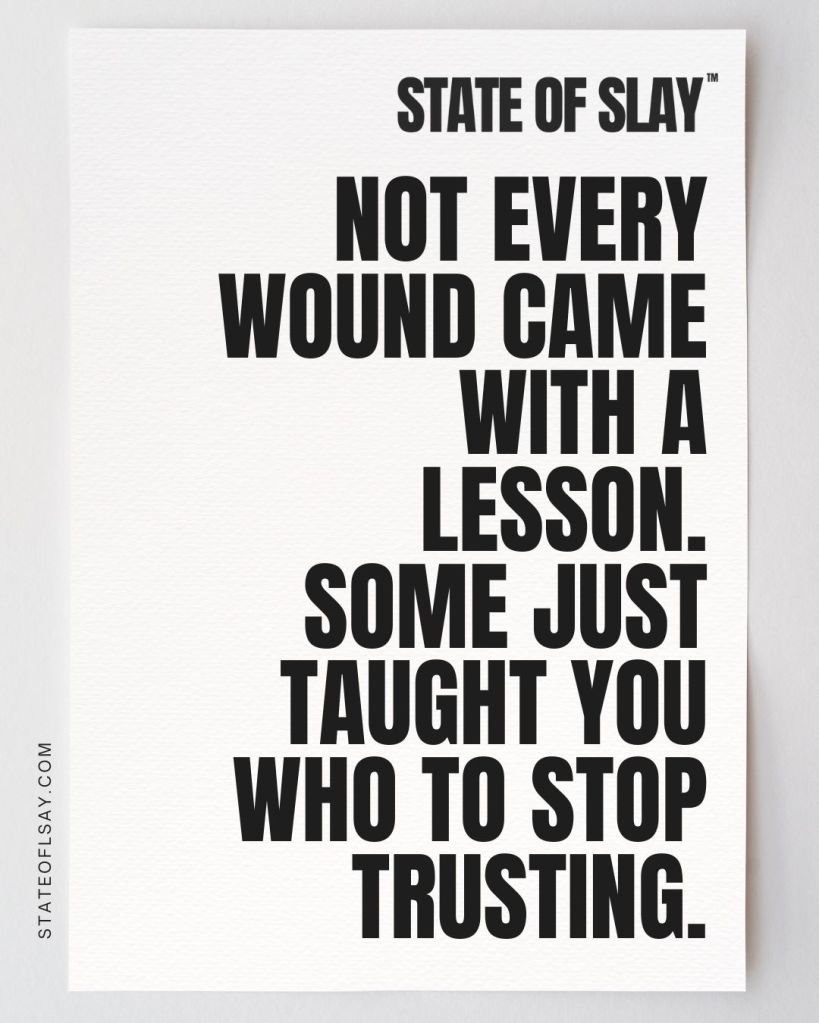
Sometimes someone simply showed you who they were.
They broke your trust.
They betrayed your confidence.
They treated your vulnerability carelessly.
And you don’t have to turn what they did into something beautiful in order to move forward from it.
You don’t have to be grateful for the wound because you eventually learned how to heal it.
You don’t have to convince yourself that everything happened for a reason.
And you don’t have to keep giving someone access to you simply because forgiveness feels more evolved than distance.
Forgiveness and trust are not the same thing.
Healing and reconciliation are not the same thing.
You can release anger without reopening the door.
You can wish someone well without inviting them back into your life.
And you can accept what happened without finding some profound purpose for why it had to happen.
Sometimes growth is simply recognizing that someone has shown you what they’re capable of and believing them.
Not with bitterness.
With clarity.
This is your reminder:You don’t have to find meaning in every wound. Sometimes healing is accepting what happened, trusting what it revealed, and choosing differently from here.