
Black and white image of a woman lying awake in bed, reflecting on the difference between someone’s promises and their repeated behavior.

Slay Say

Patterns Tell the Truth

We tend to give words a lot of power.

Someone tells us they care.

They promise they’ll change.

They say they’ll show up next time.

They explain why this time was different.

They assure us that what happened isn’t really who they are.

And sometimes we want so badly to believe what we’re hearing that we allow the words to carry more weight than everything we’ve actually experienced.

Words matter.

Intentions matter.

Apologies matter.

But none of them exist in a vacuum.

Eventually, they have to meet behavior.

Because anyone can tell you what they value.

The question is whether they live according to those values when it’s inconvenient.

Anyone can promise to be there.

The question is whether they consistently show up.

Anyone can say they respect your boundaries.

The question is what happens when your boundary prevents them from getting what they want.

Anyone can apologize.

The question is whether the behavior that required the apology keeps happening.

This doesn’t mean judging someone by one bad day or one poor decision.

We are all capable of getting it wrong.

We disappoint people.

We react badly.

We say things we wish we could take back.

We make choices that don’t represent who we want to be.

A single mistake can be just that.

A mistake.

But repetition gives us different information.

When the same behavior keeps appearing, the same boundary keeps being crossed, the same promise keeps being broken, or the same apology keeps following the same action, you’re no longer looking at an isolated moment.

You’re looking at a pattern.

And patterns deserve your attention.

Sometimes we ignore them because the explanation sounds reasonable.

They were stressed.

They were scared.

They’ve been through a lot.

They didn’t mean it that way.

They’re working on themselves.

Maybe all of that is true.

Understanding why someone behaves a certain way can give us compassion for them.

It doesn’t require us to pretend their behavior isn’t affecting us.

There is an important difference between understanding someone and trusting them.

Understanding can come from knowing their story.

Trust has to come from experiencing their consistency.

And that takes time.

It’s also worth noticing the good patterns.

The person who quietly keeps their word.

The friend who checks in without being asked.

The partner whose actions make you feel secure without constantly having to reassure you that you should.

The person who respects your no even when they wanted a yes.

The one whose behavior consistently matches what they say matters to them.

Those patterns are information too.

We sometimes spend so much energy analyzing what people mean that we overlook what they repeatedly show us.

You don’t have to become suspicious of everyone.

You don’t have to assume every promise is empty or every mistake is evidence of someone’s character.

You simply have to let time provide information that words alone cannot.

Listen to what people tell you.

Then watch what they do.

When those two things consistently agree, trust has somewhere to grow.

And when they consistently don’t, you don’t have to keep choosing the version of someone described by their words over the version you keep experiencing.

This is your reminder:

Believe change when you can see it in the pattern, not just hear it in the promise.

Slay on.

Slay Say

When It Costs Them Something

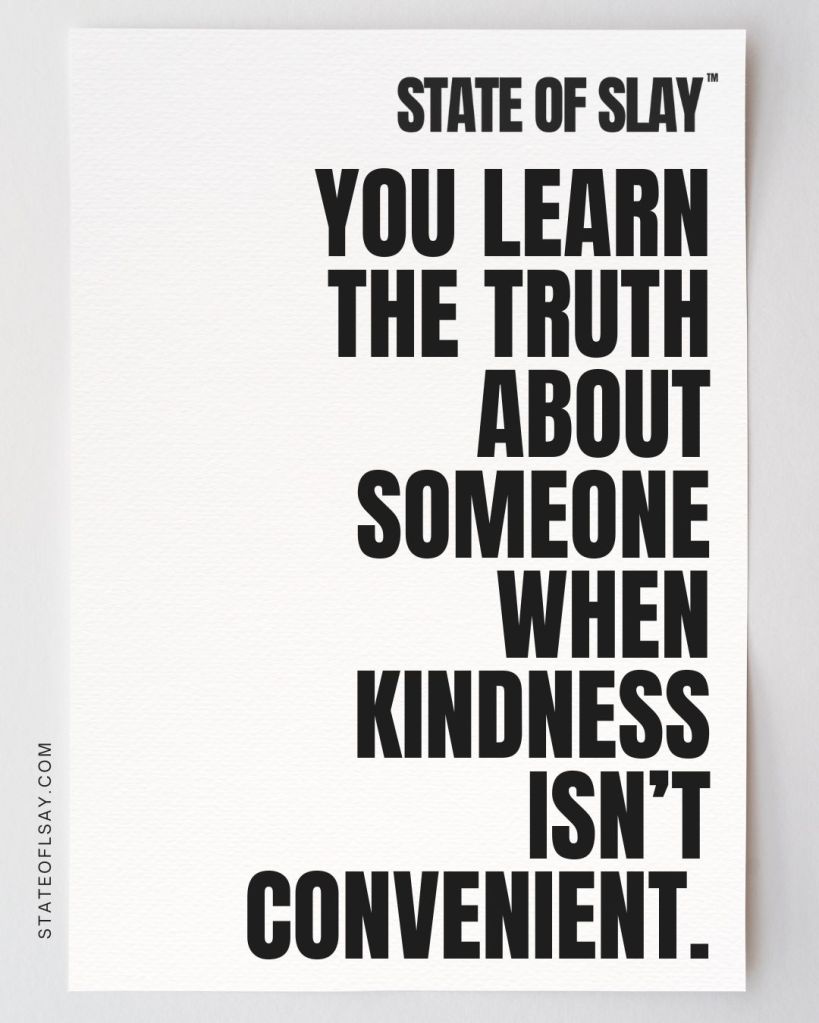
It is easy for people to be kind when it is convenient.

When it requires nothing.
When it does not cost them time, effort, or discomfort.
When it fits easily into their day and their priorities.

In those moments, kindness feels natural. Effortless. Expected.

But the real measure of someone’s character is not how they show up when things are easy.

It is how they show up when it is not.

When they are tired.
When it is inconvenient.
When being kind requires patience, understanding, or putting someone else before themselves.

That is where intention becomes clear.

Because kindness that only exists when it is easy is not a reflection of who someone is.

It is a reflection of what is comfortable.

True character shows up when it would be easier not to.

This is your reminder to pay attention to how people show up when it costs them something, not when it is easy.

Slay on.

What You Do When No One Is Watching

We all have moments where we wear different masks. There’s the version of us the world sees—and then there’s the version that shows up when no one else is around. Ideally, these two should be one and the same. We should move through life with consistency, acting with honor and integrity whether eyes are on us or not. But let’s be honest: that’s not always what happens.

For many years, I was someone who acted differently when I thought I could get away with it. I wore my victimhood like armor, and when life didn’t go my way, I convinced myself it owed me something in return.

I remember being at the grocery store once when the cashier forgot to ring up an item in my cart. I noticed—but I said nothing. Instead, I walked out with it and told myself it was a win. A moment of justice. But deep down, I knew better. I was raised to know right from wrong. And I knew I’d crossed a line.

That item may have been free, but the guilt wasn’t. I carried it around, letting it reinforce the story that I was a bad person. And the more I let myself slide in little ways when no one was watching, the harder it became to hold onto any sense of self-worth.

We think we’re slick. We think we’re getting away with something. But we’re not. Because even if no one else sees it, we do.


A Shift in Integrity

When I committed to recovery and started learning to love myself, I had to reckon with the person I was when no one was watching. I had to confront the choices I’d made in secret and the ways I’d let myself down. And I had to stop.

I made a promise to myself: I would always act as if someone was watching.

Because someone was. Me.

And that meant doing the right thing—even when it was hard, even when it was inconvenient, and even when no one would ever know. Especially then.

Today, doing the right thing fills me with peace. It lifts me up. It affirms the person I’m becoming. I no longer carry the weight of guilt for the sake of a cheap win. Instead, I carry the quiet confidence that comes from living in alignment with my values.

I was once told: if you do something kind and the person finds out, it doesn’t count. Because the good deed isn’t about credit. It’s about character.


The Power of Quiet Character

In a world that rewards appearances, doing the right thing quietly, consistently, and without applause is an act of rebellion. It’s also an act of self-love.

Every time you choose honesty over deception, compassion over ego, and integrity over the easy way out—you build a life rooted in trust.

The next time you find yourself in a moment of choice, ask: What would I do if someone I deeply respect were watching me right now?

Then act from that place.

Because the truth is, the person who matters most is watching. And they live inside of you.

SLAY on.


SLAY Reflection: Who Are You When It’s Just You?

  • Do you behave the same way when no one is watching? If not, why?
  • What’s the cost of getting away with something? How does it sit with you later?
  • What values matter most to you? Are you living in alignment with them?
  • What’s one recent moment where you could’ve acted differently—and chose integrity instead?
  • How do you feel when you do the right thing, even if no one notices? What does that say about the person you’re becoming?

Call to Action: Join the Conversation

I’d love to hear from you.
What does integrity look like in your everyday life—especially when no one else is watching?
Share your story in the comments. Let’s cheer each other on.

And if you know someone who’s trying to realign with their values, send this to them.
Sometimes, all we need is a quiet reminder of who we really are.

Slay Say

Good morning SLAYER! There are two kinds of days: good days, and character builders.

SLAY on!

Chapter 20