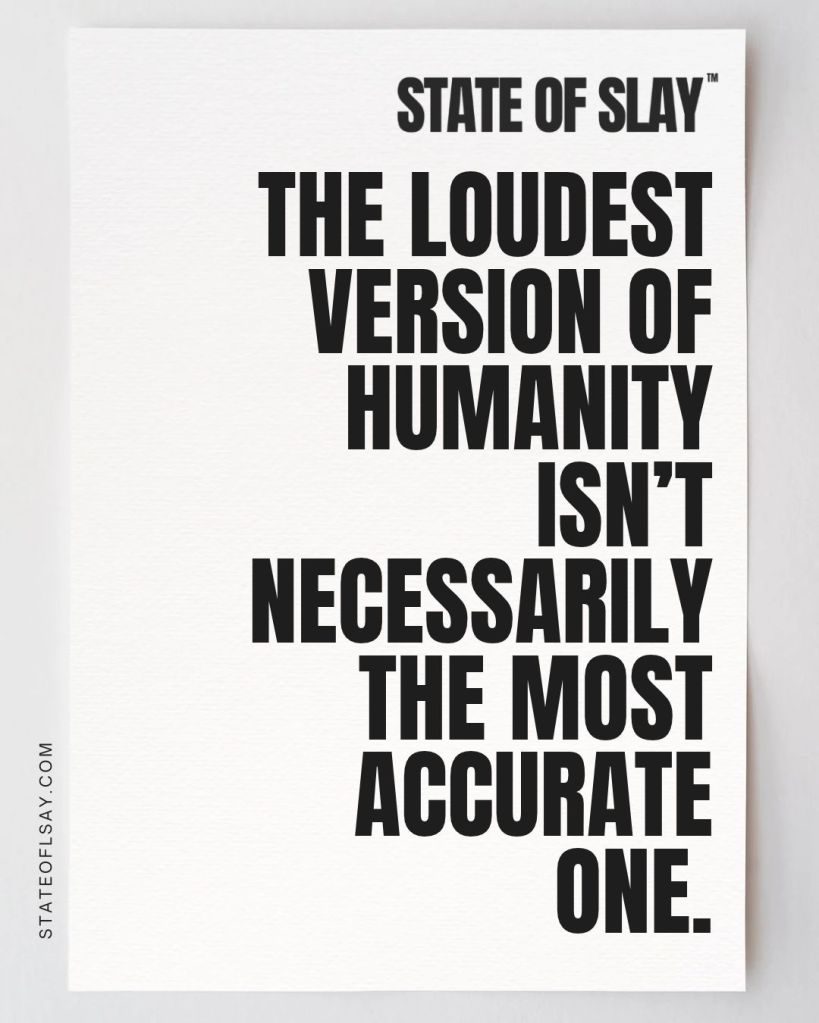

The Loudest Version of Humanity
Spend enough time online and it can start to feel like everyone is angry.
Everyone is fighting.
Everyone is offended.
Everyone is cruel.
Everyone has chosen a side, and apparently everyone would like you to choose one immediately.
Then you leave the house.
Someone holds the door for you.
A stranger compliments your shoes.
Someone lets you merge into traffic.
Two people laugh together in line at the grocery store.
A neighbor asks how you’re doing and actually waits for the answer.
And suddenly the world you’re standing in feels very different from the one you were just scrolling through.
WHAT GETS OUR ATTENTION ISN’T ALWAYS WHAT HAPPENS MOST
The loudest voices have always had an advantage.
Now they have algorithms.
Anger gets attention.
Conflict creates engagement.
Outrage keeps us watching.
The most shocking behavior gets shared precisely because it is shocking, but when we see enough of it, something strange can happen.
The unusual starts to feel usual.
We can watch hundreds of examples of people behaving terribly and begin to believe we’re witnessing a representative sample of humanity.
Meanwhile, millions of ordinary interactions happen every day without becoming content.
People help each other.
They show up.
They apologize.
They make someone laugh.
They care for their families.
They check on their friends.
They do small, decent things for strangers and never think to document them.
Ordinary kindness rarely goes viral because ordinary kindness isn’t particularly shocking.
But that doesn’t make it rare.
OUR BRAINS DON’T ALWAYS KNOW THE DIFFERENCE
When we repeatedly expose ourselves to something, it can begin to influence what we expect to find.
If most of the people we encounter through a screen are arguing, attacking, mocking, or behaving badly, it makes sense that we might begin expecting more of the same from the people around us.
We become suspicious.
More cynical.
Quicker to assume bad intentions.
Maybe even less willing to engage with people who seem different from us.
And then our expectation starts shaping our experience.
We enter the world braced for the version of humanity we’ve been consuming.
THIS ISN’T ABOUT PRETENDING EVERYTHING IS FINE
There are real problems in the world.
There is cruelty.
There is injustice.
There are people behaving in ways that deserve our attention, concern, and sometimes our outrage.
Looking away from those things isn’t optimism.
It’s avoidance.
But paying attention to what’s wrong doesn’t require us to believe that what’s wrong is all there is.
We can care deeply about the problems facing our communities and still notice the goodness happening inside them.
We can be informed without allowing the worst thing we saw today to become our definition of humanity.
We can hold people accountable without deciding people are hopeless.
GO MEET SOME HUMANS
Sometimes the best antidote to believing everyone is terrible is remarkably simple:
Go be around people.
Not profiles.
Not comment sections.
Not clips selected because they generated the strongest reaction.
People.
Talk to someone you wouldn’t normally talk to.
Look around when you’re standing in line instead of immediately reaching for your phone.
Notice the tiny exchanges happening around you.
You may discover something that rarely makes the headlines:
Most people are just living.
They’re working.
They’re worrying about people they love.
They’re trying to pay their bills.
They’re making mistakes.
They’re figuring things out.
They’re hoping tomorrow goes reasonably well.
They’re a lot more complicated than the categories we put them into online.
TURN DOWN THE VOLUME
The world doesn’t suddenly become perfect when we put down our phones.
But our perspective may become more proportionate.
Because the loudest people aren’t necessarily the majority.
The angriest people aren’t necessarily the majority.
The cruelest people aren’t necessarily the majority.
They’re simply easier to hear.
This is your reminder:
Be careful what you allow to become your evidence for who people are. What gets amplified may tell you what captures attention, but it doesn’t always tell you what’s most common.
Slay on.