We spend a lot of time trying to figure ourselves out.
Who am I?
What do I want?
What am I good at?
What are my weaknesses?
What makes me happy?
What doesn’t work for me?
Self-awareness matters. The better we understand ourselves, the easier it can be to make choices that actually fit who we are instead of living according to who everyone else expects us to be.
But there’s a strange thing that can happen along the way.
We can become so certain about who we are that we stop leaving room for who we might become.
The things we’ve learned about ourselves slowly become definitions.
Then the definitions become rules.
And eventually, without realizing it, knowing ourselves can become another way of limiting ourselves.
Prefer to listen? The Audio Blog version is available here.
SELF-AWARENESS ISN’T SUPPOSED TO BE A CAGE
There is power in being able to say, “I know myself.”
I know what matters to me.
I know what drains me.
I know what I value.
I know what I need.
But knowing yourself and deciding you have yourself completely figured out are two very different things.
One creates awareness.
The other can create boundaries around your identity that you never think to question.
“I’m shy.”
“I’m not creative.”
“I’m terrible with money.”
“I’m not athletic.”
“I don’t like change.”
“I’m not a relationship person.”
“I could never run a business.”
“I’ve always been the responsible one.”
Sometimes those statements are useful observations.
But sometimes they are old conclusions masquerading as permanent truths.
YOU MAY BE DESCRIBING SOMEONE YOU USED TO BE
Think about how many things you know about yourself because of experiences you had years ago.
Maybe you decided you weren’t good at public speaking because you froze during a presentation in school.
Maybe you decided you weren’t athletic because you hated gym class.
Maybe you decided you weren’t creative because someone else was better at drawing.
Maybe you decided you weren’t good at relationships because several of yours ended badly.
At the time, those conclusions may have made sense.
But you kept living.
You learned things.
You had experiences.
You developed skills.
You healed.
You changed.
And yet the description remained.
Sometimes the person we think we know so well is actually someone we haven’t been for years.
IDENTITY LIKES EVIDENCE
Once we believe something about ourselves, we tend to notice the things that support it.
If you believe you’re socially awkward, the conversation that goes badly may stay with you much longer than the five that went well.
If you believe you’re someone who always quits, you may remember every unfinished project while overlooking all the things you’ve stayed committed to.
If you believe you’re bad with money, one impulsive purchase can feel like proof, while months of responsible decisions barely register.
If you believe you’re terrible at setting boundaries, the one time you said yes when you wanted to say no can become evidence that nothing has changed.
We don’t always examine our identity objectively.
Sometimes we defend it.
Even when the identity isn’t particularly flattering.
Because there is something strangely comforting about being able to explain ourselves to ourselves.
At least we know who we are.
The problem is that when we become invested in a particular version of ourselves, we may unconsciously keep collecting evidence that allows that version to survive.
“THAT’S JUST WHO I AM” CAN END THE CONVERSATION TOO SOON
There are few sentences more effective at stopping growth than:
“That’s just who I am.”
Sometimes it’s true.
You don’t need to turn every preference into a personal development project.
You’re allowed to dislike things.
You’re allowed to have limits.
You’re allowed to know what works for you.
But “that’s just who I am” can also become an easy way to avoid asking whether something is actually part of our identity or simply something we’ve practiced for a very long time.
Maybe you aren’t “bad at confrontation.”
Maybe you’ve spent years avoiding it.
Maybe you aren’t “someone who can’t be alone.”
Maybe you haven’t learned how to be comfortable in your own company yet.
Maybe you aren’t “terrible with change.”
Maybe uncertainty makes you anxious, and you’ve built your life around avoiding that feeling.
There is a difference between describing yourself and sentencing yourself.
LABELS CAN HELP UNTIL THEY START MAKING DECISIONS FOR YOU
We have more language than ever for understanding ourselves.
Introvert.
Extrovert.
People pleaser.
Perfectionist.
Highly sensitive.
Overthinker.
Type A.
Avoidant.
Anxious.
Independent.
Empath.
Labels can be incredibly helpful when they give us language for something we’ve struggled to understand.
There can be relief in discovering, “There’s a reason I experience things this way.”
But a label should help you understand yourself.
It shouldn’t become your instruction manual.
There is a subtle difference between:
“I tend to be introverted.”
and
“I’m an introvert, so I would hate that.”
One describes a tendency.
The other may make the decision before you ever have the experience.
SOMETIMES WE BECOME LOYAL TO OUR OWN STORY
Changing your mind about yourself can feel surprisingly uncomfortable.
Because identity creates continuity.
It connects the person you were yesterday to the person you expect to be tomorrow.
So when you begin behaving differently, part of you may resist.
Someone who has always been independent may feel uncomfortable asking for help.
Someone who has always been the caretaker may feel selfish when they begin putting themselves first.
Someone who has always avoided attention may feel exposed when they begin allowing themselves to be seen.
Someone who has always been practical may feel irresponsible pursuing something uncertain.
Nothing may actually be wrong.
You may simply be behaving outside the boundaries of the person you have decided you are.
Sometimes growth feels unfamiliar because you are meeting a version of yourself you haven’t had enough time to recognize yet.
YOUR PREFERENCES ARE ALLOWED TO CHANGE TOO
Not every change in identity needs to be profound.
Sometimes you simply change your mind.
You discover you like something you once hated.
You become interested in something you once dismissed.
You want a life you once swore you would never want.
You stop wanting something you spent years pursuing.
You enjoy staying home when you used to want to be out every night.
You become adventurous after years of playing it safe.
You discover that solitude feels peaceful instead of lonely.
We sometimes treat consistency as proof of authenticity.
But being authentic doesn’t mean remaining identical.
It means being honest about who you are now.
You don’t owe lifelong loyalty to every preference you’ve ever had.
SELF-KNOWLEDGE SHOULD INCLUDE CURIOSITY
Maybe the healthiest version of knowing yourself still includes a question mark.
Instead of:
“I’m not good at that.”
Try:
“I haven’t been good at that.”
Instead of:
“I could never do that.”
Try:
“I’ve never done that.”
Instead of:
“That’s not me.”
Try:
“That hasn’t been me.”
Those small changes leave something important intact.
Possibility.
They acknowledge your history without requiring your future to repeat it.
You can know yourself deeply and still remain curious about yourself.
In fact, maybe real self-awareness requires both.
YOU ARE NOT A FINISHED PERSON
We often talk about “finding ourselves” as though somewhere inside us is a completed person waiting to be discovered.
But much of who we are is still being created.
Through experience.
Through failure.
Through love.
Through loss.
Through curiosity.
Through choices we haven’t made yet.
Through places we haven’t gone.
Through people we haven’t met.
Through things we haven’t tried.
There are parts of you that may only exist because of something that hasn’t happened yet.
That doesn’t mean you don’t know yourself.
It means there is still more of you to know.
KNOW YOURSELF, BUT KEEP THE DOOR OPEN
Self-awareness should help you move through life with greater clarity.
It shouldn’t shrink the number of lives you believe you’re capable of living.
Know your patterns.
Know your values.
Know your boundaries.
Know what brings you peace.
Know what you need.
But leave a little space around the edges.
For surprise.
For contradiction.
For growth.
For the possibility that something you once believed about yourself is no longer true.
For the possibility that you might enjoy something you thought you’d hate.
For the possibility that you might be capable of something you assumed you couldn’t do.
For the possibility that tomorrow’s version of you might make absolutely no sense to yesterday’s version.
You are allowed to know yourself without deciding you have yourself figured out.
Sometimes the most important thing you can discover about yourself is that you were wrong about who you thought you had to be.
SLAY REFLECTION
S — Spot the Definition What is something you regularly say about yourself as though it is an unquestionable fact?
L — Look at the Evidence Is that belief still supported by who you are today, or are you using old experiences to describe your current self?
A — Allow for Change Where could you replace “I am” with “I have been” and leave room for another possibility?
Y — Your Next Discovery Do one small thing this week that doesn’t fit the version of yourself you think you know. You don’t have to become someone new. Just give yourself the opportunity to discover something new about who you already are.
CALL TO ACTION: JOIN THE CONVERSATION
I’d love to hear from you.
What is something you believed about yourself for years that eventually turned out not to be true?
Maybe you discovered you were braver than you thought. More creative. More independent. More social. More capable of change. Or maybe you simply realized that something you had always described as “just who I am” wasn’t who you were anymore.
Share your thoughts in the comments. Your experience may help someone else question a definition of themselves they’ve been carrying for far too long.
And if you know someone who has been living inside an old description of themselves, send this to them.
Sometimes we don’t need to find ourselves.
Sometimes we need to give ourselves permission to keep discovering who we are.
When we feel rejected, it can seem like proof that we weren’t wanted.
When we feel guilty, it can seem like proof that we did something wrong.
When we feel afraid, it can seem like proof that something bad is about to happen.
When we feel inadequate, it can seem like proof that we aren’t enough.
The emotion arrives, and almost instantly, our mind begins building a story around it.
I feel it, therefore it must be true.
But feelings and facts are not always the same thing.
Your feelings are real because you are experiencing them.
They deserve your attention. They can tell you something important about your fears, needs, history, expectations, wounds, hopes, and boundaries.
But a feeling isn’t necessarily an accurate description of what is happening.
Sometimes it is.
Sometimes it isn’t.
Learning the difference can change the way we understand ourselves.
Prefer to listen? The Audio Blog version is available here.
YOUR FEELINGS ARE REAL
There is an important distinction between saying a feeling may not be true and saying a feeling isn’t real.
If you’re hurt, you’re hurt.
If you’re afraid, you’re afraid.
If you’re angry, you’re angry.
You don’t need to argue yourself out of an emotion simply because someone else thinks you shouldn’t be having it.
Feelings are experiences, and experiences are real.
But the meaning we assign to those experiences is something different.
You can feel excluded without someone intentionally excluding you.
You can feel unloved while being deeply loved.
You can feel like a failure after making a perfectly ordinary mistake.
You can feel guilty for disappointing someone even though you made the healthiest decision available to you.
The feeling deserves compassion.
The conclusion deserves examination.
Those are two very different things.
FEELINGS ARE INFORMATION, NOT ALWAYS EVIDENCE
Think of a feeling as information arriving at your door.
It has something to tell you.
But that doesn’t mean you have to hand it the keys to the house.
Anxiety may tell you that something feels uncertain.
It doesn’t necessarily tell you that something terrible is going to happen.
Jealousy may tell you that you’re feeling insecure or afraid of losing something important.
It doesn’t necessarily tell you that someone has betrayed you.
Guilt may tell you that you’ve acted against your values.
But it can also appear because you’ve been conditioned to feel responsible for keeping everyone else happy.
Loneliness may tell you that you need connection.
It doesn’t tell you that nobody cares about you.
Feelings contain information.
The mistake we sometimes make is treating that information as a verdict.
OUR HISTORY CAN SPEAK IN THE PRESENT TENSE
Sometimes what we feel in the present was shaped long before the present moment arrived.
Maybe you’ve experienced abandonment.
Then someone you care about becomes quiet, distracted, or unavailable.
Suddenly, you feel that familiar drop in your stomach.
They’re leaving.
Nothing has actually happened yet.
But your body recognizes something.
Not necessarily the situation.
The pattern.
If you’ve spent years being criticized, a small piece of feedback may feel like a complete rejection of who you are.
If you’ve lived around unpredictable behavior, calm can sometimes feel suspicious.
If love once had to be earned, someone else’s disappointment may feel like a threat to the relationship.
Our history doesn’t disappear simply because the calendar moves forward.
Sometimes yesterday puts on today’s clothes.
And unless we stop to look closely, we may not recognize it.
YOUR MIND DOESN’T LIKE AN EMPTY SPACE
Human beings are meaning-makers.
When we don’t know why something happened, our minds tend to fill in the blank.
Someone doesn’t text back.
They’re upset with me.
A friend seems distant.
I did something wrong.
You don’t get the opportunity you wanted.
I’m not good enough.
Someone’s tone changes.
They’re angry.
You walk into a room and suddenly feel self-conscious.
Everyone is judging me.
Notice how quickly we can travel from observation to interpretation.
Something happened.
We felt something.
Then we created an explanation.
Sometimes that explanation is correct.
But sometimes we’ve turned a question mark into a period before we have enough information to finish the sentence.
GUILT DOESN’T ALWAYS MEAN YOU DID SOMETHING WRONG
This one can be especially difficult.
Many of us were taught, directly or indirectly, that being good meant being accommodating.
Don’t disappoint people.
Don’t upset anyone.
Don’t be difficult.
Don’t say no.
Don’t make someone uncomfortable.
So when we finally set a boundary, leave an unhealthy situation, decline a request, or choose ourselves, guilt can show up immediately.
And because guilt usually accompanies wrongdoing, we assume:
If I feel guilty, I must have done something wrong.
But sometimes guilt is simply what change feels like when you’re accustomed to abandoning yourself.
You can feel guilty and still have made the right decision.
You can disappoint someone without mistreating them.
You can choose not to carry something that was never yours to carry.
The presence of guilt doesn’t automatically mean the absence of integrity.
FEAR CAN CONFUSE NEW WITH DANGEROUS
Fear is designed to protect us.
That’s part of what makes it so persuasive.
When fear speaks, we tend to listen.
But fear doesn’t only respond to danger.
It also responds to uncertainty.
Starting over can feel frightening.
Being vulnerable can feel frightening.
Leaving something familiar can feel frightening.
Trying something you’ve never done before can feel frightening.
Even being treated well can feel unsettling if you’re accustomed to relationships where you had to constantly earn affection, anticipate moods, or protect yourself.
Your nervous system doesn’t have a crystal ball.
It recognizes patterns.
Sometimes it raises the alarm because something is dangerous.
Sometimes it raises the alarm because something is different.
Wisdom is learning not to confuse the two.
NOT EVERY THOUGHT ATTACHED TO A FEELING DESERVES TO STAY
Feelings are fast.
They arrive before we’ve had time to investigate them.
And they often bring thoughts along for the ride.
I’m embarrassed, so everyone must think I’m ridiculous.
I’m lonely, so I must be unwanted.
I’m overwhelmed, so I must be incapable.
I’m jealous, so there must be something to worry about.
I’m scared, so I shouldn’t do it.
I’m hurt, so they must have intended to hurt me.
That last part is where we can get ourselves into trouble.
We don’t have to reject the feeling.
We can question the story attached to it.
What actually happened?
What do I know?
What am I assuming?
Is there another explanation?
Have I felt this way in situations like this before?
Am I responding only to what is happening now, or to what this reminds me of?
Those questions don’t silence emotion.
They give it context.
YOU DON’T HAVE TO ACT ON EVERYTHING YOU FEEL
A feeling can be urgent without requiring immediate action.
That’s a powerful distinction.
You can be angry without sending the text.
You can feel rejected without withdrawing from the relationship.
You can feel anxious without cancelling the opportunity.
You can feel jealous without making an accusation.
You can feel insecure without asking someone else to prove your worth.
You can feel afraid without automatically turning around.
Sometimes the healthiest thing we can do with an emotion is simply allow it to exist for a moment.
Feel it.
Name it.
Listen to it.
Then decide what, if anything, it actually requires from you.
There is space between feeling and action.
A lot of our growth happens there.
TWO THINGS CAN BE TRUE AT ONCE
You can know someone loves you and still feel insecure.
You can know you made the right decision and still feel sad about it.
You can be proud of yourself and still feel afraid.
You can know you’re capable and still have moments when you doubt yourself.
You can know a relationship needed to end and still miss the person.
You can know you’re worthy and still have days when you don’t feel particularly worthy.
One truth doesn’t erase the other.
We get into trouble when we believe uncomfortable feelings invalidate everything else we know.
They don’t.
A difficult feeling doesn’t necessarily mean you’re moving in the wrong direction.
Sometimes it simply means you’re human while moving through something difficult.
A FEELING CAN BE REAL WITHOUT BEING TRUE
Emotional maturity isn’t learning how to stop feeling.
It’s learning how to feel without automatically believing every conclusion your emotions offer you.
Your feelings deserve to be heard.
They don’t always deserve to be obeyed.
Sometimes they are telling you exactly what you need to know.
Sometimes they’re showing you where something still hurts.
Sometimes they’re responding to an old experience.
Sometimes they’re reacting to uncertainty.
Sometimes they’re asking you to slow down long enough to separate what happened from what you fear it means.
You don’t have to invalidate yourself to question your interpretation.
You can say:
This feeling is real.
I am allowed to feel it.
And I am going to find out whether the story I’m telling myself about it is true.
That isn’t denying your emotions.
It’s learning to listen to them without handing them the microphone, the gavel, and the final word.
SLAY REFLECTION
S — Separate the feeling from the story Think about something you’re feeling strongly right now. What is the emotion, and what story have you attached to it?
L — Look at what you actually know What facts support the story you’re telling yourself? What parts are assumptions, fears, or interpretations?
A — Ask what the feeling may be showing you Does this emotion belong entirely to the present situation, or does something about it feel familiar from your past?
Y — You choose what happens next Before reacting, give yourself space to decide whether this feeling requires action, reflection, a conversation, a boundary, or simply time to pass.
CALL TO ACTION: JOIN THE CONVERSATION
I’d love to hear from you.
Have you ever had a feeling that seemed completely true in the moment, only to discover later that the story you attached to it wasn’t accurate?
Or have you ever felt guilty, afraid, rejected, or inadequate even when the facts were telling you something very different?
Share your thoughts in the comments. Your experience may help someone else realize that questioning the story behind a feeling doesn’t mean dismissing the feeling itself.
And if you know someone who tends to believe everything their emotions tell them, send this to them.
Sometimes the feeling is real, but the story still needs a second look.
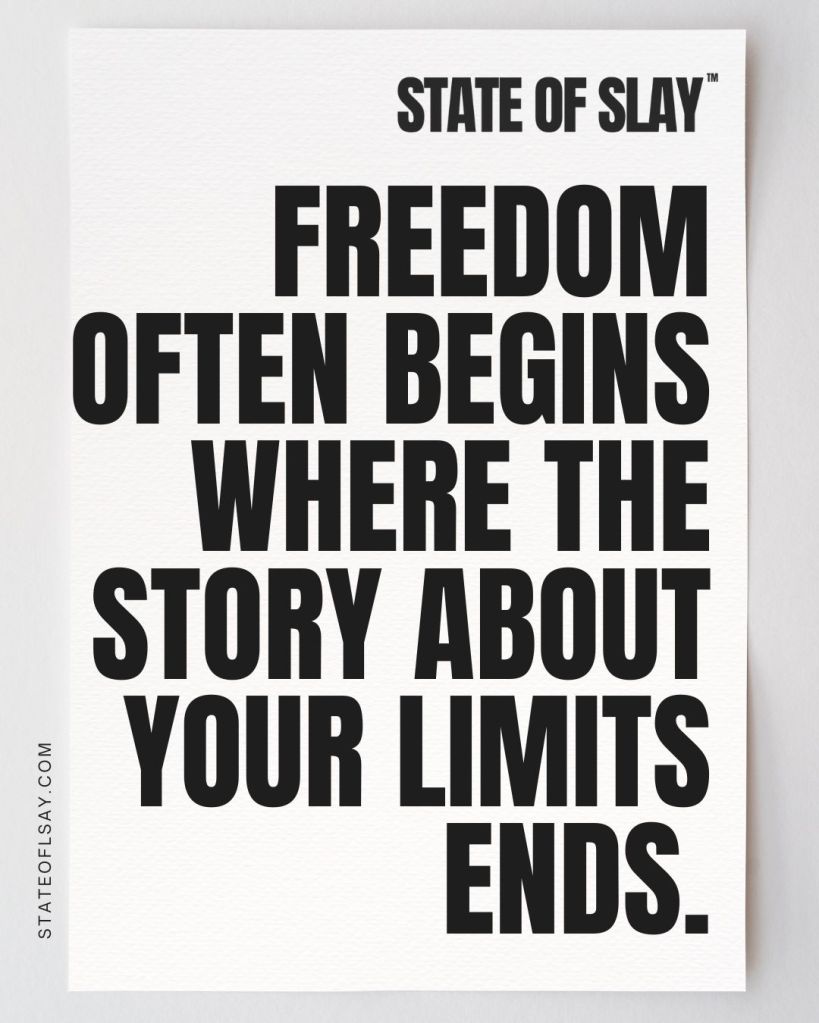
Sometimes what feels like a limitation is actually just a story we have been repeating for so long that it begins to feel permanent.
Many of the boundaries we believe in were shaped by old expectations, past experiences, or the voices of people who never imagined a different path for us. Over time, those ideas can quietly become rules we never agreed to but continue to live by.
Growth often begins the moment we question those assumptions. When we allow ourselves to look at life with a fresh perspective, we realize that what once looked like a fixed wall may have been a door we simply had not tried to open yet.
This is your reminder to reconsider the limits you may have accepted without question, and to explore what becomes possible when you give yourself permission to see beyond them.
We all want to believe we’re right. That the thoughts we have are the truth. That what we fear is valid. That what we suspect about others is accurate. And so, often without realizing it, we go looking for proof. Not for the truth—but for what we already believe.
That’s confirmation bias.
And it can quietly wreck everything from our relationships to our self-worth.
What Are You Trying to Prove?
Here’s the thing about the human brain: it’s not always looking for truth. It’s looking for evidence that confirms what it already believes.
If your brain believes you’re not good enough, it will dismiss compliments and zero in on criticism.
If your brain thinks no one can be trusted, it will interpret a delayed text or a short tone as betrayal.
If you believe someone doesn’t like you, you’ll search their face and their actions for the tiniest piece of proof—and you’ll find it, even if it isn’t real.
We all do it. It’s human.
But when we act on that bias instead of reality, we reinforce the story we already believe—and miss the opportunity for connection, growth, and healing.
When I Believed the Worst
For a long time, I believed I was unworthy. That no matter how hard I tried, it was never enough. That I would always be the one left behind.
So I looked for proof.
I clung to any sign of rejection. I dismissed care or kindness because I assumed it wouldn’t last. I assumed I was being judged, even when no one was paying attention to me.
I thought I was being self-aware. I thought I was protecting myself.
But what I was really doing was building a case against myself, collecting data that wasn’t even true. And every time I gave weight to a moment of perceived rejection, I was closing a door. I was missing a chance to see that maybe the story I was telling myself wasn’t the whole truth.
And if it wasn’t the truth? Maybe I wasn’t broken after all.
How to Break the Bias
Awareness is everything.
Next time you find yourself thinking, “See? I knew it,” pause.
Ask yourself:
What am I trying to prove right now? And is this actually true—or just familiar?
Confirmation bias feels like safety. It feels like control. But really, it’s just an old loop. One you can break.
Try asking someone you trust for a reality check. Or write down your belief and then list the evidence for and against it.
Better yet, ask yourself: Would I talk to someone I love the way I’m talking to myself right now?
SLAY Reflection
Ask yourself:
What beliefs do I keep trying to prove?
Where did those beliefs come from?
How is confirmation bias limiting my relationships?
Do I trust my thoughts more than I trust what’s real?
What would it feel like to look for evidence of the opposite being true?
S – L – A – Y
S:Spot the belief that keeps repeating. L:Listen for the moment you start searching for proof. A:Ask yourself what else could be true. Y:Yield to possibility. It’s where healing begins.
Call to Action: Join the Conversation I’d love to hear from you. What’s a belief you’ve spent a long time trying to prove—and what happened when you questioned it? Share your story in the comments. Let’s cheer each other on.
And if you know someone who’s stuck in a loop of self-doubt, send this to them. Sometimes, all we need is a nudge.
Before I began my recovery journey, I lived by stories that weren’t mine. I believed I was different. Less-than. Unworthy of good things. And I made decisions from that place—choosing people and situations that reinforced the story I was already telling myself.
Even the small things stuck. A dismissive comment. A look. A joke that hit too close to home. I internalized those moments and built my identity around them. And as I kept repeating those stories to myself, I gave them power. I let them define me.
When I finally sought help for my mental health, one of the first exercises I was given was to write down all the things I believed about myself. Most were negative. Then came the harder part: asking if those things were actually true.
It turned out, most of them weren’t. They were stories I had inherited. And I had the power to release them.
Telling a New Story
Doing the work—challenging those false beliefs—wasn’t easy. But with time, support, and a lot of self-reflection, I began to rewrite the script.
I started telling myself the truth.
That I’m capable. That I’m worthy. That I’m more than enough.
The stories from my past didn’t disappear. But they no longer control me. Today, I use them as tools. When those old narratives resurface, I pause. I ask myself: Is this true? Is this helping me grow? Is this a story I want to keep?
And if the answer is no, I let it go.
Instead, I choose to tell stories of healing. Of courage. Of growth. I choose relationships that reflect the truth of who I am, not the lies I once believed.
You get to choose your story, too.
SLAY on.
SLAY Reflection: What Story Are You Living?
Are you holding onto any stories from childhood that no longer serve you?
Who or what shaped those beliefs—and are they actually true?
What have those stories cost you in your adult life?
What’s one belief you could rewrite today?
What story would you rather live—and what’s one small step you can take toward it?
Call to Action: Join the Conversation
I’d love to hear from you. What’s one story from your past you’re ready to rewrite?
Share your story in the comments. Let’s cheer each other on.
And if you know someone who’s still living by an old story that isn’t serving them, send this to them.
Sometimes, all we need is a reminder that we’re the ones holding the pen.