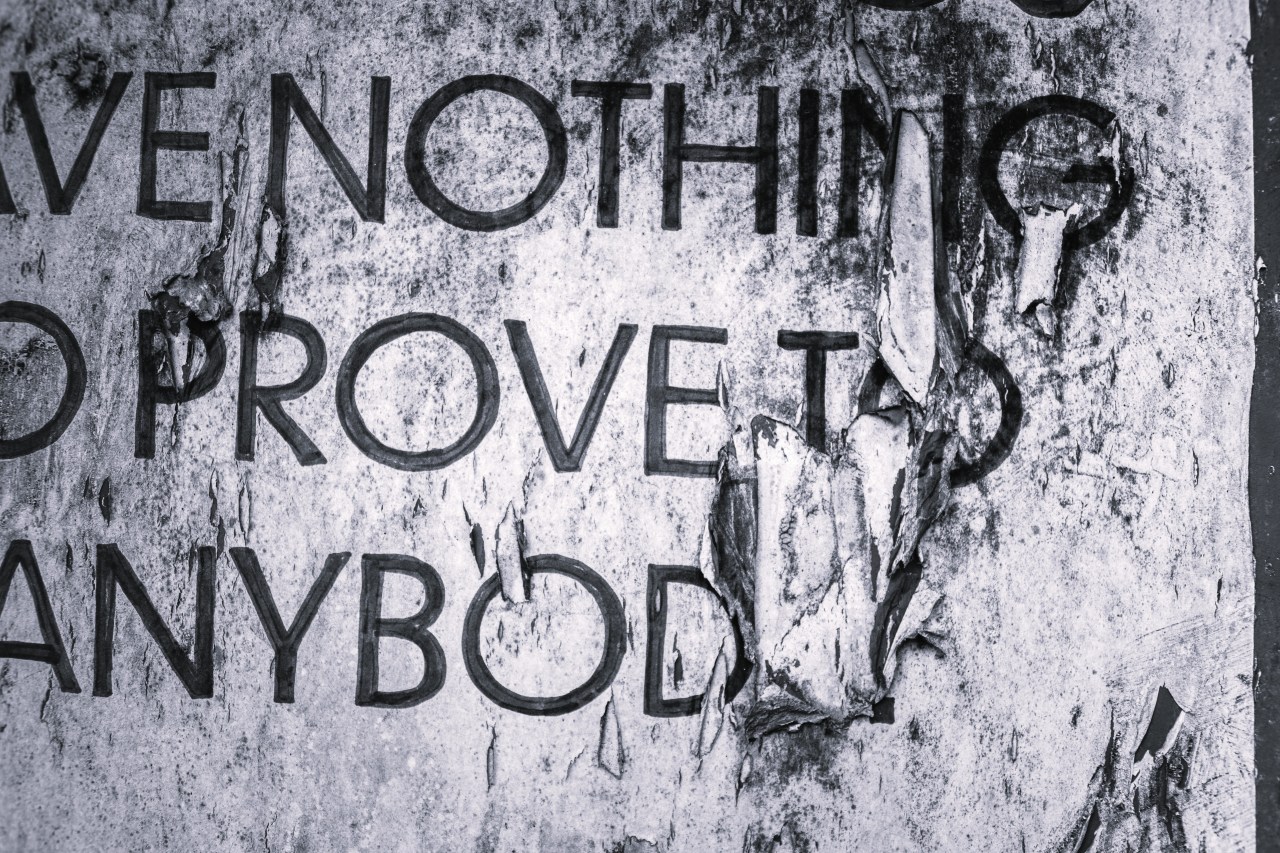
Silhouetted person raising a hand in a crowd, representing personal growth without the need for recognition or applause.

Your Worth Doesn’t Need a Witness

There are victories we imagine twice.

Once when they actually happen.

And once in the version where a particular person is there to see them.

The person who doubted you.

The person who underestimated you.

The person who walked away.

The person who made you question yourself.

Maybe you’ve imagined them seeing what you’ve accomplished.

Seeing how much you’ve changed.

Seeing that you survived without them.

Seeing that you became everything they didn’t believe you could become.

There is nothing unusual about wanting to be seen.

Recognition feels good.

But sometimes the desire to be seen becomes something else.

We start needing another person’s recognition to confirm something we already know.

And without realizing it, we make them the witness to our worth.

But a witness doesn’t make something true.

They only see what is already there.


Prefer to listen? The Audio Blog version is available here.


SOMETIMES WE DON’T WANT VALIDATION FROM EVERYONE

There may be a hundred people who believe in you.

And somehow, the opinion of the one person who doesn’t can become the loudest.

That’s because validation isn’t always about quantity.

Sometimes it’s about who we want it from.

We want the parent who rarely offered praise to finally say they’re proud of us.

We want the person who rejected us to realize they misjudged us.

We want the boss who overlooked us to see what we’ve accomplished somewhere else.

We want the friend who underestimated us to discover that we were capable all along.

We tell ourselves we don’t care.

And maybe most of the time we don’t.

But somewhere inside us can be a tiny courtroom where the case is still being argued.

See? I told you I could do it.

See? I wasn’t the problem.

See? I was worth believing in.

The problem is that the verdict we’re waiting for may never come.

And even if it does, it may not give us what we thought it would.


PROVING YOURSELF CAN KEEP YOU ATTACHED

We usually think of attachment as missing someone.

Wanting them back.

Thinking about the good times.

But there are other ways to remain attached to people.

Trying to prove them wrong is one of them.

You can leave someone physically and still organize part of your life around their opinion.

You can stop speaking to someone and still imagine their reaction to what you’re doing.

You can move forward while occasionally looking over your shoulder to see if they noticed.

That’s an invisible connection.

And sometimes it lasts much longer than the relationship itself.

There can even be motivation in it.

I’ll show them.

I’ll become successful.

I’ll get stronger.

I’ll build something better.

I’ll be happier without them.

That energy can move us for a while.

But eventually, it becomes exhausting to keep building a life with someone else’s disbelief sitting in the audience.

At some point, the life has to become yours.


BE CAREFUL WHO YOU ASK TO CONFIRM YOUR VALUE

Sometimes the person whose validation we want most is the person least qualified to give it.

Think about that.

We can spend years wanting recognition from someone who consistently failed to recognize us.

We want emotional understanding from someone who repeatedly dismissed our feelings.

We want accountability from someone who avoids looking at themselves.

We want encouragement from someone who felt threatened by our growth.

We want someone who couldn’t see our value then to finally confirm our value now.

Why?

Their inability to recognize something does not determine whether it exists.

You wouldn’t ask someone who can’t read music to tell you whether a symphony is good.

Yet emotionally, we sometimes hand the score to people who have never understood the language and wait anxiously for their review.

Not everyone is qualified to evaluate you.

And not every opinion deserves the authority you have given it.


GROWTH DOESN’T NEED AN AUDIENCE

Some of the most important changes you make will happen quietly.

There may be no dramatic reveal.

No applause.

No one saying, “Look how far you’ve come.”

Maybe you respond differently to something that once would have sent you spiraling.

Nobody notices.

Maybe you don’t send the message you would have sent a year ago.

Nobody knows.

Maybe you walk away from something you once would have chased.

Nobody sees.

Maybe you keep a promise to yourself.

Maybe you stop abandoning yourself to keep someone else comfortable.

Maybe you finally believe something about yourself that you’ve spent years needing other people to tell you.

These moments rarely look impressive from the outside.

But they can represent enormous change.

Growth isn’t less real because nobody witnessed the moment it happened.

Sometimes the quiet victories are the ones that change us most.


YOU DON’T NEED THEM TO REGRET LOSING YOU

There is a particular fantasy that can linger after rejection.

One day they’ll realize.

One day they’ll see what they lost.

One day they’ll regret how they treated me.

Maybe they will.

Maybe they won’t.

But if your healing depends on someone eventually regretting losing you, part of your worth is still waiting inside their realization.

You don’t need to become unforgettable to someone who didn’t know how to value you.

You don’t need them comparing everyone else to you.

You don’t need the apology years later.

You don’t need the message saying they made a mistake.

And you don’t need their regret to turn what happened into justice.

Sometimes people lose wonderful things and never understand what they lost.

That doesn’t make those things less wonderful.

Their regret is not the receipt for your value.


NOT EVERYTHING MEANINGFUL GETS APPLAUSE

We live in a world where so much of life is visible.

Accomplishments are announced.

Milestones are photographed.

Good deeds are shared.

Transformations have before-and-after pictures.

It can quietly teach us to associate significance with recognition.

But some of the most meaningful things you will ever do may receive almost none.

You may help someone who never tells you how much it mattered.

You may choose integrity when nobody would have known if you hadn’t.

You may start over without anyone understanding how much courage it required.

You may take care of yourself in ways that don’t produce anything impressive enough to announce.

You may do the right thing and receive absolutely nothing for it.

No praise.

No credit.

No acknowledgment.

That doesn’t reduce its value.

There is something powerful about becoming a person you respect even when nobody is watching.

Because then your choices aren’t performances.

They’re character.


YOU ARE ALLOWED TO OUTGROW THE NEED TO BE UNDERSTOOD

Sometimes we aren’t trying to prove our success.

We’re trying to prove our story.

We want someone to understand why we made the decision we made.

Why we left.

Why we changed.

Why something hurt us.

Why we couldn’t continue the way things were.

We think that if we could explain it perfectly enough, they would finally understand.

And then perhaps our decision would feel justified.

But there are people who will never understand a choice they would not have made themselves.

There are people who will interpret your boundary through the inconvenience it causes them.

There are people who benefited from the version of you that had fewer boundaries.

Their confusion doesn’t make your decision wrong.

You can understand your reasons without convincing everyone else of them.

Your life is not a case you have to win.


LET SOME PEOPLE HAVE THE WRONG VERSION OF YOU

This may be one of the harder things to accept.

Some people are going to misunderstand you.

Some will remember a version of you that no longer exists.

Some will tell a story about you that leaves out important pieces.

Some will believe they know why you did something when they don’t.

Some may never see how much you’ve changed.

And you may never get the opportunity to correct the record.

There is tremendous freedom in realizing that you don’t have to.

You cannot spend your life running from room to room correcting every conversation you’re not in.

You cannot manage every version of yourself that exists in someone else’s mind.

And you don’t need unanimous agreement to know who you are.

Let some people be wrong.

You have a life to live.


YOUR WORTH DOESN’T NEED A WITNESS

A witness can acknowledge something.

A witness can celebrate it.

A witness can appreciate it.

But a witness cannot create it.

Your growth happened whether the person who doubted you ever saw it.

Your healing matters whether the person who hurt you understands it.

Your success counts whether anyone who underestimated you is impressed.

Your boundary is valid whether someone agrees with it.

Your kindness matters even when nobody thanks you.

Your integrity matters even when nobody knows what it cost you.

And the person you are becoming does not require approval from the people who only knew who you used to be.

Maybe there will always be moments when we want someone to notice.

We’re human.

Being seen can be beautiful.

But being seen and being worthy are not the same thing.

You don’t have to turn your life into evidence.

You don’t have to make your happiness convincing.

You don’t have to become successful enough, healed enough, attractive enough, accomplished enough, or different enough to finally win someone’s approval.

You can stop presenting the evidence.

You can close the case.

Your life was never on trial.


SLAY REFLECTION

S — See Who You’re Still Trying to Convince
Is there someone whose recognition, regret, approval, or understanding still feels unusually important to you?

L — Look at What You’re Trying to Prove
What do you wish this person would finally understand about you? What would their acknowledgment seem to confirm?

A — Ask Who Gave Them That Authority
Why does this person’s opinion carry so much weight? Are they actually qualified to determine the thing you’re asking them to validate?

Y — Your Life Is the Evidence
Choose one thing you know to be true about yourself without requiring anyone else to confirm it. Let that knowledge be enough.


CALL TO ACTION: JOIN THE CONVERSATION

I’d love to hear from you.

Have you ever realized you were still trying to prove something to someone who was no longer part of your life?

What changed when you stopped needing them to see, understand, or acknowledge who you had become?

Share your thoughts in the comments. Your experience may help someone else realize that being overlooked, misunderstood, or underestimated doesn’t diminish what they know to be true about themselves.

And if you know someone who is still waiting for the wrong person to finally see their worth, send this to them.

Sometimes freedom begins when you stop waiting for someone else to confirm what you already know.

Black and white photo of a woman standing confidently by a window, representing authenticity, self-acceptance, and choosing to be yourself.

Slay Say

The Price of Being Yourself

There is a cost to becoming more honest about who you are.

Not everyone will like it.

Some people preferred you when you were easier to influence.

When you said yes more often.

When you kept your opinions to yourself.

When you adjusted your needs to make everyone else comfortable.

When belonging mattered more than being yourself.

And when you begin changing those things, you may notice something uncomfortable.

The more authentic you become, the less universally appealing you are.

That isn’t a failure.

It’s what happens when you stop shaping yourself around other people’s expectations.

We spend so much of our lives learning how to be accepted.

We read the room.

We soften our opinions.

We hide the parts of ourselves that might be misunderstood.

We become skilled at anticipating what other people want from us before we’ve even asked ourselves what we want.

And sometimes we get the approval we were looking for.

But it comes at a price.

Because approval doesn’t feel nearly as good when you know it was given to a version of yourself you had to create to receive it.

Authenticity changes the equation.

It asks you to risk being misunderstood.

To let someone disagree with you without immediately questioning yourself.

To accept that some people may walk away when you stop being who they expected you to be.

And to understand that losing approval is not the same as losing your worth.

You won’t be for everyone.

You were never supposed to be.

The goal isn’t to become someone nobody can criticize, reject, or misunderstand.

It’s to become someone you no longer have to abandon in order to belong.

This is your reminder:

The approval you lose by being yourself was never worth the parts of you it required you to hide.

Slay on.

Don’t Overvalue What You Are Not and Undervalue What You Are

Comparison has a remarkable way of distorting reality.

It convinces us that everyone else has something we don’t.

More talent.

More confidence.

More success.

More beauty.

More opportunities.

We become so focused on what we lack that we stop noticing everything we already possess.

Without realizing it, we begin overvaluing what we are not while undervaluing everything we are.

It is one of the quickest ways to become disconnected from your own worth.

Because the moment you define your value by someone else’s strengths, you become blind to your own.


Prefer to listen? The Audio Blog version is available here.


COMPARISON IS A DISTORTED MIRROR

Comparison rarely tells the whole story.

You compare your beginning to someone else’s middle.

Your behind-the-scenes to someone else’s highlight reel.

Your insecurities to someone else’s confidence.

But you never see the full picture.

You don’t see their fears.

Their sacrifices.

Their failures.

Their doubts.

You only see what is visible.

And from that limited view, you begin creating an unfair measurement of your own life.

Comparison isn’t just inaccurate.

It’s incomplete.


WE TEND TO CHASE WHAT WE DON’T HAVE

Human nature has a curious habit.

We often assign greater value to what feels just out of reach.

The promotion.

The relationship.

The recognition.

The lifestyle.

The talent someone else possesses.

We convince ourselves that if we could only become more like them, we’d finally feel enough.

But enoughness has never been found through imitation.

It is discovered through acceptance.


YOUR STRENGTHS FEEL ORDINARY TO YOU

One reason we undervalue ourselves is because we live with our gifts every day.

The things that come naturally rarely feel extraordinary.

The ability to encourage people.

To solve problems.

To make others laugh.

To remain calm under pressure.

To create.

To lead.

To listen.

Because they feel effortless, we assume they aren’t valuable.

Meanwhile, someone else is wishing they had those exact qualities.

Sometimes the gifts we overlook in ourselves are the ones the world appreciates most.


STOP MEASURING YOUR LIFE WITH SOMEONE ELSE’S RULER

Imagine trying to measure distance with a thermometer.

It would never work.

Not because the thermometer is broken.

Because it was never designed for that purpose.

We do something similar when we evaluate ourselves using someone else’s gifts.

If your value depends on becoming another person, you’ve chosen the wrong measuring tool.

The goal was never to become someone else.

The goal has always been to become more fully yourself.


WHAT MAKES YOU DIFFERENT IS OFTEN YOUR GREATEST STRENGTH

Many people spend years trying to hide the very qualities that make them unique.

They soften their personality.

Silence their opinions.

Downplay their passions.

Blend in.

They assume acceptance comes from becoming more like everyone else.

In reality, the people who leave the greatest impact are rarely the ones who fit perfectly into the crowd.

They’re the ones who finally stopped apologizing for who they were.


CONFIDENCE GROWS THROUGH APPRECIATION

Confidence isn’t built by pretending you have no weaknesses.

It’s built by recognizing that your strengths deserve just as much attention.

We often spend years trying to improve our flaws.

What if we invested equal energy into developing our gifts?

Imagine how different life would feel if you became as familiar with your strengths as you are with your shortcomings.

Confidence grows where appreciation lives.


YOU CAN ADMIRE WITHOUT DIMINISHING YOURSELF

There is nothing wrong with admiring someone else’s success.

Celebrate it.

Learn from it.

Be inspired by it.

Just don’t let admiration become self-rejection.

Someone else’s light does not make yours any dimmer.

In fact, one candle has never lost its flame by lighting another.

The world has room for more than one success story.

Including yours.


YOUR VALUE IS NOT A COMPETITION

Worth isn’t earned by outperforming everyone else.

It isn’t awarded to the smartest person.

The richest.

The funniest.

The most successful.

Human value has never been a competition.

Every person brings something different to the world.

Your contribution doesn’t have to look like anyone else’s to matter.

Different is not less.

It’s simply different.


BECOME MORE OF WHO YOU ALREADY ARE

Growth doesn’t require becoming someone new.

It asks you to become more fully who you’ve always been.

More courageous.

More authentic.

More compassionate.

More confident.

Not because you’re changing your identity.

Because you’re removing everything that has been hiding it.

Your greatest potential has never lived inside another person’s life.

It has always lived inside your own.


SEE YOURSELF CLEARLY

Imagine what would change if you spent less time wishing you were someone else and more time becoming the best version of yourself.

You would stop chasing borrowed dreams.

You would stop apologizing for your strengths.

You would stop overlooking the qualities that make you valuable.

Don’t overvalue what you are not.

Don’t undervalue what you are.

Because the person you’re trying so hard to become may never be as remarkable as the person you already are becoming.


SLAY REFLECTION

S — See Your Strengths
What qualities do you naturally possess that you tend to overlook because they come easily to you?

L — Let Go of Comparison
Where have you been measuring yourself against someone else’s journey instead of your own?

A — Appreciate What You Are
What is one strength you can intentionally acknowledge and develop this week?

Y — Your Next Step
Choose one thing you admire about someone else, then identify a unique quality in yourself that deserves the same appreciation.


CALL TO ACTION: JOIN THE CONVERSATION

I’d love to hear from you.

What is one quality you’ve spent too much time overlooking in yourself, and how would your life change if you finally gave it the value it deserves?

Share your story in the comments. Your perspective may remind someone else to see their own worth more clearly.

And if you know someone who needs this reminder, send this to them.

Sometimes, all we need is a nudge.

If You Are Constantly Trying to Prove Your Worth, You Have Already Forgotten Your Value

There was a time when I believed my worth had to be proven.

Through achievement. Through approval. Through being everything everyone needed me to be.

I thought if I worked harder, showed up more, gave more, did more, I would finally feel secure in who I was. That I would earn the validation I was searching for.

But no matter how much I did, it never felt like enough.

Because the problem was not my effort.

The problem was that I had forgotten something fundamental.

My value was never meant to be earned.


Prefer to listen? The Audio Blog version is available here.


Proving Yourself Is an Exhausting Cycle

When we believe our worth is something to be proven, we enter a loop that never truly ends.

We look for external confirmation that we are good enough. We measure ourselves by other people’s responses. We adjust our behavior to maintain approval.

And when that approval fades or shifts, we start over again.

It is exhausting.

Because external validation is unpredictable. It changes based on circumstances, opinions, and perspectives that are outside of our control.

If our sense of value depends on something unstable, we will always feel unstable too.


I Had to Face This in My Own Life

There were moments when I could clearly see how much I was performing for worth.

I said yes when I wanted to say no. I stretched myself thin trying to meet expectations that were not even mine. I shaped myself to fit environments where I did not truly belong.

And beneath all of that effort was a quiet belief.

If I just do enough, I will finally feel like I matter.

But that feeling never came from doing more.

It came from remembering who I was without needing to prove it.


Your Value Is Not Conditional

Your worth does not increase because someone recognizes it.

And it does not decrease because someone overlooks it.

Value is inherent.

It exists regardless of performance, productivity, or perception.

That can be difficult to accept in a world that often rewards output and comparison. But the truth remains.

You are not more valuable on your best day than you are on your hardest one.

When we understand that, the need to constantly prove ourselves begins to soften.


Overproving Often Hides Fear

Trying to prove your worth is often rooted in fear.

Fear of rejection. Fear of not being enough. Fear of being misunderstood or overlooked.

Those fears can drive us to overextend, overexplain, and overdeliver.

But when we operate from fear, our actions are not aligned with our true selves.

They are attempts to control how we are perceived.

And control over perception is never guaranteed.

What is guaranteed is how we treat ourselves.


Self-Worth Changes How You Show Up

When you begin to reconnect with your value, your behavior shifts.

You stop chasing approval and start choosing alignment. You stop overgiving and start giving intentionally. You stop shrinking and start standing in your truth.

This does not mean you stop caring about others.

It means you stop abandoning yourself to be accepted.

And that shift creates stronger, healthier relationships.

Because people connect more deeply with authenticity than performance.


Boundaries Reinforce Value

One of the clearest expressions of self-worth is boundaries.

When you know your value, you protect your time, your energy, and your emotional space.

You recognize when something is not aligned. You allow yourself to step back when needed. You understand that saying no is not rejection, it is clarity.

Boundaries are not about pushing people away.

They are about staying connected to yourself.

And when you stay connected to yourself, your value becomes steady rather than situational.


You Do Not Have to Perform to Belong

This is a powerful shift.

You do not need to earn your place by constantly proving your worth. You do not need to exhaust yourself to be accepted. You do not need to become someone else to be valued.

The right environments, the right people, and the right opportunities will not require you to perform for belonging.

They will recognize your value as it is.

And until you believe that, you may continue seeking validation in places that cannot give it to you.


Remember Who You Are

At some point, we all forget.

We forget our strength. Our resilience. Our inherent worth.

Life, experiences, and challenges can cloud that truth.

But it is still there.

Remembering your value is not about becoming someone new.

It is about reconnecting with who you have always been beneath the noise of expectation and comparison.

And once you remember, everything begins to shift.

You stop trying to prove your worth.

Because you finally know you already have it.


SLAY Reflection

S — See the Pattern
Where in your life do you feel the need to prove your worth?

L — Look Beneath It
What fear might be driving that need for validation?

A — Affirm Your Value
What is one truth about your worth that exists regardless of external approval?

Y — Your Next Step
What would change if you showed up today believing you were already enough?


Call to Action: Join the Conversation

I’d love to hear from you.
Have you ever realized you were trying to prove your worth, and what helped you shift out of that pattern?

Share your story in the comments. Let’s cheer each other on.

And if you know someone who needs this reminder, send this to them.
Sometimes, all we need is a nudge.