Silhouetted person raising a hand in a crowd, representing personal growth without the need for recognition or applause.

Your Worth Doesn’t Need a Witness

There are victories we imagine twice.

Once when they actually happen.

And once in the version where a particular person is there to see them.

The person who doubted you.

The person who underestimated you.

The person who walked away.

The person who made you question yourself.

Maybe you’ve imagined them seeing what you’ve accomplished.

Seeing how much you’ve changed.

Seeing that you survived without them.

Seeing that you became everything they didn’t believe you could become.

There is nothing unusual about wanting to be seen.

Recognition feels good.

But sometimes the desire to be seen becomes something else.

We start needing another person’s recognition to confirm something we already know.

And without realizing it, we make them the witness to our worth.

But a witness doesn’t make something true.

They only see what is already there.


Prefer to listen? The Audio Blog version is available here.


SOMETIMES WE DON’T WANT VALIDATION FROM EVERYONE

There may be a hundred people who believe in you.

And somehow, the opinion of the one person who doesn’t can become the loudest.

That’s because validation isn’t always about quantity.

Sometimes it’s about who we want it from.

We want the parent who rarely offered praise to finally say they’re proud of us.

We want the person who rejected us to realize they misjudged us.

We want the boss who overlooked us to see what we’ve accomplished somewhere else.

We want the friend who underestimated us to discover that we were capable all along.

We tell ourselves we don’t care.

And maybe most of the time we don’t.

But somewhere inside us can be a tiny courtroom where the case is still being argued.

See? I told you I could do it.

See? I wasn’t the problem.

See? I was worth believing in.

The problem is that the verdict we’re waiting for may never come.

And even if it does, it may not give us what we thought it would.


PROVING YOURSELF CAN KEEP YOU ATTACHED

We usually think of attachment as missing someone.

Wanting them back.

Thinking about the good times.

But there are other ways to remain attached to people.

Trying to prove them wrong is one of them.

You can leave someone physically and still organize part of your life around their opinion.

You can stop speaking to someone and still imagine their reaction to what you’re doing.

You can move forward while occasionally looking over your shoulder to see if they noticed.

That’s an invisible connection.

And sometimes it lasts much longer than the relationship itself.

There can even be motivation in it.

I’ll show them.

I’ll become successful.

I’ll get stronger.

I’ll build something better.

I’ll be happier without them.

That energy can move us for a while.

But eventually, it becomes exhausting to keep building a life with someone else’s disbelief sitting in the audience.

At some point, the life has to become yours.


BE CAREFUL WHO YOU ASK TO CONFIRM YOUR VALUE

Sometimes the person whose validation we want most is the person least qualified to give it.

Think about that.

We can spend years wanting recognition from someone who consistently failed to recognize us.

We want emotional understanding from someone who repeatedly dismissed our feelings.

We want accountability from someone who avoids looking at themselves.

We want encouragement from someone who felt threatened by our growth.

We want someone who couldn’t see our value then to finally confirm our value now.

Why?

Their inability to recognize something does not determine whether it exists.

You wouldn’t ask someone who can’t read music to tell you whether a symphony is good.

Yet emotionally, we sometimes hand the score to people who have never understood the language and wait anxiously for their review.

Not everyone is qualified to evaluate you.

And not every opinion deserves the authority you have given it.


GROWTH DOESN’T NEED AN AUDIENCE

Some of the most important changes you make will happen quietly.

There may be no dramatic reveal.

No applause.

No one saying, “Look how far you’ve come.”

Maybe you respond differently to something that once would have sent you spiraling.

Nobody notices.

Maybe you don’t send the message you would have sent a year ago.

Nobody knows.

Maybe you walk away from something you once would have chased.

Nobody sees.

Maybe you keep a promise to yourself.

Maybe you stop abandoning yourself to keep someone else comfortable.

Maybe you finally believe something about yourself that you’ve spent years needing other people to tell you.

These moments rarely look impressive from the outside.

But they can represent enormous change.

Growth isn’t less real because nobody witnessed the moment it happened.

Sometimes the quiet victories are the ones that change us most.


YOU DON’T NEED THEM TO REGRET LOSING YOU

There is a particular fantasy that can linger after rejection.

One day they’ll realize.

One day they’ll see what they lost.

One day they’ll regret how they treated me.

Maybe they will.

Maybe they won’t.

But if your healing depends on someone eventually regretting losing you, part of your worth is still waiting inside their realization.

You don’t need to become unforgettable to someone who didn’t know how to value you.

You don’t need them comparing everyone else to you.

You don’t need the apology years later.

You don’t need the message saying they made a mistake.

And you don’t need their regret to turn what happened into justice.

Sometimes people lose wonderful things and never understand what they lost.

That doesn’t make those things less wonderful.

Their regret is not the receipt for your value.


NOT EVERYTHING MEANINGFUL GETS APPLAUSE

We live in a world where so much of life is visible.

Accomplishments are announced.

Milestones are photographed.

Good deeds are shared.

Transformations have before-and-after pictures.

It can quietly teach us to associate significance with recognition.

But some of the most meaningful things you will ever do may receive almost none.

You may help someone who never tells you how much it mattered.

You may choose integrity when nobody would have known if you hadn’t.

You may start over without anyone understanding how much courage it required.

You may take care of yourself in ways that don’t produce anything impressive enough to announce.

You may do the right thing and receive absolutely nothing for it.

No praise.

No credit.

No acknowledgment.

That doesn’t reduce its value.

There is something powerful about becoming a person you respect even when nobody is watching.

Because then your choices aren’t performances.

They’re character.


YOU ARE ALLOWED TO OUTGROW THE NEED TO BE UNDERSTOOD

Sometimes we aren’t trying to prove our success.

We’re trying to prove our story.

We want someone to understand why we made the decision we made.

Why we left.

Why we changed.

Why something hurt us.

Why we couldn’t continue the way things were.

We think that if we could explain it perfectly enough, they would finally understand.

And then perhaps our decision would feel justified.

But there are people who will never understand a choice they would not have made themselves.

There are people who will interpret your boundary through the inconvenience it causes them.

There are people who benefited from the version of you that had fewer boundaries.

Their confusion doesn’t make your decision wrong.

You can understand your reasons without convincing everyone else of them.

Your life is not a case you have to win.


LET SOME PEOPLE HAVE THE WRONG VERSION OF YOU

This may be one of the harder things to accept.

Some people are going to misunderstand you.

Some will remember a version of you that no longer exists.

Some will tell a story about you that leaves out important pieces.

Some will believe they know why you did something when they don’t.

Some may never see how much you’ve changed.

And you may never get the opportunity to correct the record.

There is tremendous freedom in realizing that you don’t have to.

You cannot spend your life running from room to room correcting every conversation you’re not in.

You cannot manage every version of yourself that exists in someone else’s mind.

And you don’t need unanimous agreement to know who you are.

Let some people be wrong.

You have a life to live.


YOUR WORTH DOESN’T NEED A WITNESS

A witness can acknowledge something.

A witness can celebrate it.

A witness can appreciate it.

But a witness cannot create it.

Your growth happened whether the person who doubted you ever saw it.

Your healing matters whether the person who hurt you understands it.

Your success counts whether anyone who underestimated you is impressed.

Your boundary is valid whether someone agrees with it.

Your kindness matters even when nobody thanks you.

Your integrity matters even when nobody knows what it cost you.

And the person you are becoming does not require approval from the people who only knew who you used to be.

Maybe there will always be moments when we want someone to notice.

We’re human.

Being seen can be beautiful.

But being seen and being worthy are not the same thing.

You don’t have to turn your life into evidence.

You don’t have to make your happiness convincing.

You don’t have to become successful enough, healed enough, attractive enough, accomplished enough, or different enough to finally win someone’s approval.

You can stop presenting the evidence.

You can close the case.

Your life was never on trial.


SLAY REFLECTION

S — See Who You’re Still Trying to Convince
Is there someone whose recognition, regret, approval, or understanding still feels unusually important to you?

L — Look at What You’re Trying to Prove
What do you wish this person would finally understand about you? What would their acknowledgment seem to confirm?

A — Ask Who Gave Them That Authority
Why does this person’s opinion carry so much weight? Are they actually qualified to determine the thing you’re asking them to validate?

Y — Your Life Is the Evidence
Choose one thing you know to be true about yourself without requiring anyone else to confirm it. Let that knowledge be enough.


CALL TO ACTION: JOIN THE CONVERSATION

I’d love to hear from you.

Have you ever realized you were still trying to prove something to someone who was no longer part of your life?

What changed when you stopped needing them to see, understand, or acknowledge who you had become?

Share your thoughts in the comments. Your experience may help someone else realize that being overlooked, misunderstood, or underestimated doesn’t diminish what they know to be true about themselves.

And if you know someone who is still waiting for the wrong person to finally see their worth, send this to them.

Sometimes freedom begins when you stop waiting for someone else to confirm what you already know.

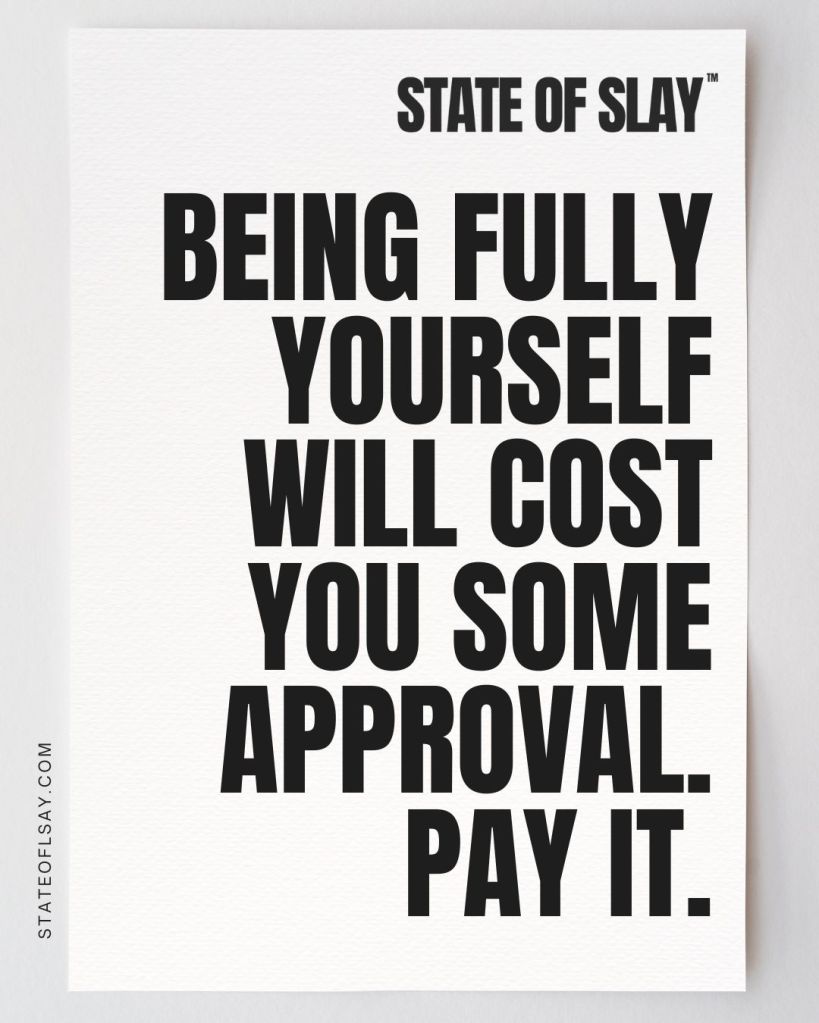
Black and white photo of a woman standing confidently by a window, representing authenticity, self-acceptance, and choosing to be yourself.

Slay Say

The Price of Being Yourself

There is a cost to becoming more honest about who you are.

Not everyone will like it.

Some people preferred you when you were easier to influence.

When you said yes more often.

When you kept your opinions to yourself.

When you adjusted your needs to make everyone else comfortable.

When belonging mattered more than being yourself.

And when you begin changing those things, you may notice something uncomfortable.

The more authentic you become, the less universally appealing you are.

That isn’t a failure.

It’s what happens when you stop shaping yourself around other people’s expectations.

We spend so much of our lives learning how to be accepted.

We read the room.

We soften our opinions.

We hide the parts of ourselves that might be misunderstood.

We become skilled at anticipating what other people want from us before we’ve even asked ourselves what we want.

And sometimes we get the approval we were looking for.

But it comes at a price.

Because approval doesn’t feel nearly as good when you know it was given to a version of yourself you had to create to receive it.

Authenticity changes the equation.

It asks you to risk being misunderstood.

To let someone disagree with you without immediately questioning yourself.

To accept that some people may walk away when you stop being who they expected you to be.

And to understand that losing approval is not the same as losing your worth.

You won’t be for everyone.

You were never supposed to be.

The goal isn’t to become someone nobody can criticize, reject, or misunderstand.

It’s to become someone you no longer have to abandon in order to belong.

This is your reminder:

The approval you lose by being yourself was never worth the parts of you it required you to hide.

Slay on.

Woman surrounded by others, representing the search for approval and validation from other people

Stop Looking for Yourself in Other People’s Opinions

We all want to be seen.

To be understood.

To be accepted.

To know that the people around us see something good, valuable, lovable, or worthy when they look at us.

There is nothing wrong with that.

The problem begins when we start using other people’s opinions as evidence of who we are.

Someone approves of us, and we feel confident.

Someone criticizes us, and suddenly we question ourselves.

Someone misunderstands us, and we scramble to explain.

Someone rejects us, and we wonder what must be wrong with us.

Without realizing it, we can spend our lives looking into other people hoping to find our own reflection.

But other people’s opinions are not mirrors.

They are perspectives.

And if you want to know who you are, you have to stop looking for yourself in them.


Prefer to listen? The Audio Blog version is available here.


OTHER PEOPLE DON’T SEE YOU OBJECTIVELY

None of us sees another person exactly as they are.

We see people through the lens of who we are.

Our experiences.

Our beliefs.

Our expectations.

Our fears.

Our wounds.

Our preferences.

Our history.

Someone may think you’re selfish because you finally established a boundary.

Someone else may admire you for having the courage to establish it.

One person may find you intimidating.

Another may find you inspiring.

Someone may think you’re too much.

Someone else may wonder why you keep making yourself smaller.

Which one is the truth?

None of them entirely.

They’re seeing you through their own lens.

Their perception belongs to them.

Your identity belongs to you.


APPROVAL CAN BECOME AN ADDICTION

Approval feels good.

Being praised feels good.

Being liked feels good.

And there is nothing unhealthy about enjoying those things.

But when approval becomes necessary for us to feel secure, we begin organizing our lives around getting it.

We say yes when we want to say no.

We soften our opinions.

We hide parts of ourselves.

We change how we dress, speak, create, love, work, or dream based on how we think others will respond.

We become experts at reading the room while slowly losing the ability to read ourselves.

What do I actually want?

What do I believe?

What feels right to me?

Who am I when nobody is applauding?

Those questions become difficult to answer when we’ve spent too long allowing approval to answer them for us.


REJECTION DOESN’T DEFINE YOUR VALUE

When someone doesn’t choose us, it can feel deeply personal.

A relationship ends.

A friendship changes.

We don’t get the job.

Someone doesn’t like our work.

We’re excluded from something.

And suddenly rejection begins writing a story.

Maybe I’m not good enough.

Maybe I’m not talented enough.

Maybe I’m not attractive enough.

Maybe I’m too difficult.

Maybe I’m not worth choosing.

But rejection doesn’t have the authority to determine your value.

It tells you something about a particular relationship, opportunity, circumstance, or person’s preference.

That’s all.

You can be extraordinary and still not be right for everyone.

You can be deeply lovable and still not be loved well by a particular person.

You can be talented and still not get the opportunity.

You can be worthy and still not be chosen.

Someone else’s no is not a definition of you.


BEING MISUNDERSTOOD DOESN’T MEAN YOU’RE WRONG

One of the hardest things to tolerate is being misunderstood.

Especially when we know our intentions.

We want to explain.

Clarify.

Correct the record.

Make the other person finally see us accurately.

Sometimes that’s worthwhile.

But sometimes people have already decided who you are.

And no amount of explaining will change the version of you they’ve created.

At that point, continuing to defend yourself isn’t communication.

It’s an audition.

You’re trying to earn the role of “good person” in someone else’s story.

You don’t have to.

You can know your intentions without convincing everyone else of them.

You can know your heart without submitting it for public approval.

You can let someone misunderstand you and continue being who you know yourself to be.


NOT EVERY OPINION DESERVES EQUAL WEIGHT

There is a difference between being open to feedback and being governed by it.

Feedback can help us grow.

Sometimes other people see things we can’t.

They can challenge us.

Teach us.

Point out blind spots.

Help us become better versions of ourselves.

But wisdom means considering the source.

Does this person know me?

Do I respect how they live?

Do they want the best for me?

Is there truth in what they’re saying?

Are they offering insight, or projecting something that belongs to them?

You don’t have to accept every opinion simply because someone was willing to give it.

Not every voice deserves a seat at the table.


YOU WILL BE DIFFERENT PEOPLE TO DIFFERENT PEOPLE

There are people who remember a version of you that no longer exists.

People who met you during your worst season.

People who benefited from you having no boundaries.

People who loved the version of you who needed their approval.

People who will celebrate your growth.

And people who will resent it.

You may be the villain in someone’s story and the person who changed someone else’s life for the better.

You may be difficult to one person and exactly what another person needed.

You may be remembered unfairly.

You may be judged without context.

You may never get the opportunity to correct someone’s perception of you.

That’s part of being human.

You cannot manage every version of yourself that exists in someone else’s mind.

And trying will exhaust you.


YOU DON’T HAVE TO BECOME INDIFFERENT

The answer isn’t pretending you don’t care what anyone thinks.

Most of us care.

We care what the people we love think.

We care about being respected.

We care when we’re criticized.

We care when someone doesn’t like us.

We’re human.

The goal isn’t indifference.

It’s discernment.

You can hear someone’s opinion without handing them your identity.

You can consider criticism without automatically believing it.

You can appreciate praise without depending on it.

You can be hurt by rejection without allowing it to determine your worth.

Someone else’s opinion can be information.

It doesn’t have to become identity.


KNOW YOURSELF BEFORE THE WORLD TELLS YOU WHO TO BE

The stronger your relationship with yourself becomes, the less easily other people’s opinions can move you away from who you are.

Know what you value.

Know what you stand for.

Know what you need.

Know where you still have work to do.

Know what you’re proud of.

Know what you’re willing to change.

And know what you aren’t willing to sacrifice simply to make yourself easier for someone else to accept.

Self-awareness doesn’t mean believing you’re always right.

It means knowing yourself well enough to recognize the difference between useful feedback and someone else’s projection.

That kind of self-knowledge becomes an anchor.

The world can have opinions.

You don’t have to drift with every one of them.


STOP HANDING OTHER PEOPLE THE MIRROR

If you keep asking the world who you are, you’re going to receive thousands of different answers.

Too loud.

Too quiet.

Too ambitious.

Not ambitious enough.

Too emotional.

Too guarded.

Too independent.

Too needy.

Too much.

Not enough.

You could spend your entire life adjusting yourself to satisfy opinions that contradict one another.

Or you could put the mirror back in your own hands.

Look at yourself honestly.

Not through praise.

Not through criticism.

Not through rejection.

Not through applause.

Through your own eyes.

Know where you’ve grown.

Own where you’ve fallen short.

Recognize what you bring into the world.

And decide for yourself who you want to become.


YOU ARE THE ONE WHO HAS TO LIVE YOUR LIFE

At the end of the day, the people whose approval you’re chasing don’t have to live with your choices.

You do.

They don’t wake up inside your life.

You do.

They don’t carry your dreams.

Your regrets.

Your compromises.

Your unlived possibilities.

You do.

So listen to people you trust.

Stay teachable.

Be willing to examine yourself.

Apologize when you’re wrong.

Grow when you need to grow.

But don’t confuse humility with surrendering your sense of self.

Your life cannot become a group project where everyone else gets a vote on who you’re allowed to be.

Stop looking for yourself in other people’s opinions.

You were never hiding there.


SLAY REFLECTION

S — See Whose Opinion Has Too Much Power
Whose approval or criticism has the ability to change the way you feel about yourself?

L — Look at What You Believe
What do you know to be true about yourself regardless of whether someone else recognizes it?

A — Accept That You Won’t Be for Everyone
Where could you give yourself permission to be misunderstood, disliked, or simply not someone’s preference without making it mean something about your worth?

Y — Your Next Step
The next time someone’s opinion makes you question yourself, pause before accepting it as truth. Ask yourself: Is this something I need to learn from, or something I need to let belong to them?


CALL TO ACTION: JOIN THE CONVERSATION

I’d love to hear from you.

When have you allowed someone else’s opinion of you to become your opinion of yourself?

And what changed when you stopped?

Share your story in the comments. Your experience may help someone else realize they’ve been searching for themselves in the wrong place.

And if you know someone who needs this reminder, send this to them.

Sometimes, all we need is a nudge.

Slay Say

The Cost of Waiting for Approval

Most of us don’t realize how often we’re waiting.

Waiting until someone believes in us.

Waiting until our decision makes sense to everyone else.

Waiting until we’re certain no one will question the path we’re about to take.

It sounds responsible.

Sometimes it even feels wise.

But if you spend your life waiting for permission, you’ll eventually find yourself living according to someone else’s comfort instead of your own convictions.

There will always be opinions.

People who don’t understand why you’re changing.

Why you’re leaving.

Why you’re beginning again.

Why you’re choosing a different life than the one they expected for you.

You don’t owe every decision an explanation.

You don’t need unanimous approval to know what’s right for your life.

The people who make the greatest impact aren’t the ones who are never questioned.

They’re the ones who stop letting other people’s expectations become the deciding vote.

This is your reminder that peace begins the moment your decisions no longer require someone else’s approval.

Slay on.

Give Yourself Permission to Be Disliked

Most people think freedom means having the ability to do whatever they want.

I think freedom is something much quieter.

Freedom is no longer needing permission from people who were never qualified to give it.

Freedom is making a decision without first imagining how everyone else will react.

Freedom is speaking honestly without rehearsing how to avoid criticism.

Freedom is understanding that someone can dislike your choice without making it the wrong choice.

And perhaps most importantly, freedom is giving yourself permission to be disliked.

For much of my life, I confused being liked with being successful.

If people approved of me, I felt secure.

If people were happy with me, I felt like I was doing something right.

If everyone got along, I felt at peace.

But eventually I realized that constantly seeking approval came with a hidden cost.

The more I tried to be liked by everyone, the less freedom I gave myself to be who I truly was.

And that is a price that is far too high.


Prefer to listen? The Audio Blog version is available here.


THE PRICE OF BEING LIKED IS OFTEN TOO HIGH

Most people do not realize how much they sacrifice in exchange for approval.

They sacrifice opinions.

Boundaries.

Dreams.

Opportunities.

Authenticity.

They stay quiet when they want to speak.

They stay small when they want to grow.

They remain where they are when every part of them knows it is time to move forward.

Not because it is what they want.

Because they fear what other people might think.

Every time you abandon yourself to keep someone else comfortable, the cost is your freedom.

And over time, those costs add up.


PEOPLE PLEASING LOOKS HARMLESS UNTIL IT ISN’T

Many people-pleasing behaviors are celebrated.

Being accommodating.

Being agreeable.

Being easygoing.

Being helpful.

None of those qualities are inherently bad.

The problem begins when they come at the expense of your own truth.

When your desire to be liked becomes stronger than your desire to be honest.

When maintaining approval becomes more important than maintaining integrity.

At that point, people pleasing stops being kindness.

It becomes self-abandonment.


SOME PEOPLE ONLY LIKE THE VERSION OF YOU THEY CAN CONTROL

This can be one of the hardest truths to accept.

Not everyone who likes you likes the real you.

Some people like the version of you that never says no.

The version that prioritizes their needs.

The version that avoids conflict.

The version that remains predictable and easy to manage.

The moment you begin setting boundaries, changing directions, or making decisions for yourself, their opinion of you may change.

Not because you became worse.

Because you became harder to control.

That is not a reason to stop growing.

It is often evidence that growth is happening.


APPROVAL IS A TERRIBLE COMPASS

Imagine trying to navigate your life based entirely on what other people approve of.

You would never take a meaningful risk.

You would never make a bold decision.

You would never challenge expectations.

You would never pursue a dream that made someone uncomfortable.

Every entrepreneur has been criticized.

Every artist has been doubted.

Every leader has disappointed someone.

Every person who has ever chosen authenticity over conformity has faced disapproval.

Approval is not a reliable guide.

It changes with the audience.

It changes with circumstances.

It changes with expectations.

Your values are a much better compass.


AUTHENTICITY AND UNIVERSAL APPROVAL CANNOT COEXIST

This realization can feel uncomfortable.

The more authentic you become, the more likely it is that some people will dislike you.

Not because you are doing something wrong.

Because authenticity creates clarity.

People see who you really are.

Some will resonate with that.

Some will not.

And that is perfectly normal.

What is not normal is expecting universal approval while living authentically.

The two cannot coexist.

At some point, you must decide which matters more.


DISAPPOINTMENT IS NOT THE SAME AS HARM

Many people struggle because they confuse disappointing someone with hurting them.

The two are not the same.

You can disappoint someone by setting a boundary.

You can disappoint someone by choosing a different path.

You can disappoint someone by prioritizing your well-being.

You can disappoint someone by refusing to live according to their expectations.

None of those things are inherently harmful.

They simply mean your choices no longer align with someone else’s preferences.

You are allowed to disappoint people.

You are not responsible for managing every expectation placed upon you.


CRITICISM IS OFTEN THE PRICE OF VISIBILITY

The more visible you become, the more opinions people will have.

This is true in business.

In relationships.

In leadership.

In creativity.

In personal growth.

Someone will always disagree.

Someone will always misunderstand.

Someone will always criticize.

That does not mean you should stop.

It means you are participating in life.

The goal is not to avoid criticism.

The goal is to avoid allowing criticism to determine your direction.


YOU DO NOT NEED TO ATTEND EVERY OPINION

One of the most freeing realizations is that you do not have to respond to every judgment.

You do not have to correct every misunderstanding.

You do not have to defend every choice.

You do not have to convince every critic.

People are allowed to have opinions.

And you are allowed to keep living your life anyway.

The moment you stop treating every opinion like a summons, you reclaim an incredible amount of energy.

Energy that can be invested into building the life you actually want.


FREEDOM IS AN INSIDE JOB

The moment you stop needing everyone to understand you, your world becomes larger.

The moment you stop needing everyone to approve of you, your choices become clearer.

The moment you stop needing everyone to like you, your life becomes your own.

Every time you choose authenticity over approval, you buy back a small piece of your freedom.

Every time you honor your truth instead of someone else’s expectations, you reclaim another piece.

And eventually, those pieces add up.

They become confidence.

They become self-trust.

They become peace.

Most importantly, they become a life that finally feels like yours.

Give yourself permission to be disliked.

Not because you want conflict.

Not because you do not care about others.

But because freedom is too valuable to trade for approval.

And the people who truly belong in your life will appreciate the real version of you far more than the performance.


SLAY REFLECTION

S — See the Fear
Where in your life are you holding back because you fear being disliked?

L — Look at the Cost
What opportunities, boundaries, or dreams have you sacrificed in exchange for approval?

A — Acknowledge the Truth
What decision do you already know is right for you, even if not everyone agrees?

Y — Your Next Step
What is one way you can choose authenticity over approval this week?


CALL TO ACTION: JOIN THE CONVERSATION

I’d love to hear from you.

Have you ever made a decision that disappointed others but ultimately gave you greater freedom?

Share your story in the comments. Let’s cheer each other on.

And if you know someone who might need this reminder, send this to them.

Sometimes, all we need is a nudge.