Silhouetted person raising a hand in a crowd, representing personal growth without the need for recognition or applause.

Your Worth Doesn’t Need a Witness

There are victories we imagine twice.

Once when they actually happen.

And once in the version where a particular person is there to see them.

The person who doubted you.

The person who underestimated you.

The person who walked away.

The person who made you question yourself.

Maybe you’ve imagined them seeing what you’ve accomplished.

Seeing how much you’ve changed.

Seeing that you survived without them.

Seeing that you became everything they didn’t believe you could become.

There is nothing unusual about wanting to be seen.

Recognition feels good.

But sometimes the desire to be seen becomes something else.

We start needing another person’s recognition to confirm something we already know.

And without realizing it, we make them the witness to our worth.

But a witness doesn’t make something true.

They only see what is already there.


Prefer to listen? The Audio Blog version is available here.


SOMETIMES WE DON’T WANT VALIDATION FROM EVERYONE

There may be a hundred people who believe in you.

And somehow, the opinion of the one person who doesn’t can become the loudest.

That’s because validation isn’t always about quantity.

Sometimes it’s about who we want it from.

We want the parent who rarely offered praise to finally say they’re proud of us.

We want the person who rejected us to realize they misjudged us.

We want the boss who overlooked us to see what we’ve accomplished somewhere else.

We want the friend who underestimated us to discover that we were capable all along.

We tell ourselves we don’t care.

And maybe most of the time we don’t.

But somewhere inside us can be a tiny courtroom where the case is still being argued.

See? I told you I could do it.

See? I wasn’t the problem.

See? I was worth believing in.

The problem is that the verdict we’re waiting for may never come.

And even if it does, it may not give us what we thought it would.


PROVING YOURSELF CAN KEEP YOU ATTACHED

We usually think of attachment as missing someone.

Wanting them back.

Thinking about the good times.

But there are other ways to remain attached to people.

Trying to prove them wrong is one of them.

You can leave someone physically and still organize part of your life around their opinion.

You can stop speaking to someone and still imagine their reaction to what you’re doing.

You can move forward while occasionally looking over your shoulder to see if they noticed.

That’s an invisible connection.

And sometimes it lasts much longer than the relationship itself.

There can even be motivation in it.

I’ll show them.

I’ll become successful.

I’ll get stronger.

I’ll build something better.

I’ll be happier without them.

That energy can move us for a while.

But eventually, it becomes exhausting to keep building a life with someone else’s disbelief sitting in the audience.

At some point, the life has to become yours.


BE CAREFUL WHO YOU ASK TO CONFIRM YOUR VALUE

Sometimes the person whose validation we want most is the person least qualified to give it.

Think about that.

We can spend years wanting recognition from someone who consistently failed to recognize us.

We want emotional understanding from someone who repeatedly dismissed our feelings.

We want accountability from someone who avoids looking at themselves.

We want encouragement from someone who felt threatened by our growth.

We want someone who couldn’t see our value then to finally confirm our value now.

Why?

Their inability to recognize something does not determine whether it exists.

You wouldn’t ask someone who can’t read music to tell you whether a symphony is good.

Yet emotionally, we sometimes hand the score to people who have never understood the language and wait anxiously for their review.

Not everyone is qualified to evaluate you.

And not every opinion deserves the authority you have given it.


GROWTH DOESN’T NEED AN AUDIENCE

Some of the most important changes you make will happen quietly.

There may be no dramatic reveal.

No applause.

No one saying, “Look how far you’ve come.”

Maybe you respond differently to something that once would have sent you spiraling.

Nobody notices.

Maybe you don’t send the message you would have sent a year ago.

Nobody knows.

Maybe you walk away from something you once would have chased.

Nobody sees.

Maybe you keep a promise to yourself.

Maybe you stop abandoning yourself to keep someone else comfortable.

Maybe you finally believe something about yourself that you’ve spent years needing other people to tell you.

These moments rarely look impressive from the outside.

But they can represent enormous change.

Growth isn’t less real because nobody witnessed the moment it happened.

Sometimes the quiet victories are the ones that change us most.


YOU DON’T NEED THEM TO REGRET LOSING YOU

There is a particular fantasy that can linger after rejection.

One day they’ll realize.

One day they’ll see what they lost.

One day they’ll regret how they treated me.

Maybe they will.

Maybe they won’t.

But if your healing depends on someone eventually regretting losing you, part of your worth is still waiting inside their realization.

You don’t need to become unforgettable to someone who didn’t know how to value you.

You don’t need them comparing everyone else to you.

You don’t need the apology years later.

You don’t need the message saying they made a mistake.

And you don’t need their regret to turn what happened into justice.

Sometimes people lose wonderful things and never understand what they lost.

That doesn’t make those things less wonderful.

Their regret is not the receipt for your value.


NOT EVERYTHING MEANINGFUL GETS APPLAUSE

We live in a world where so much of life is visible.

Accomplishments are announced.

Milestones are photographed.

Good deeds are shared.

Transformations have before-and-after pictures.

It can quietly teach us to associate significance with recognition.

But some of the most meaningful things you will ever do may receive almost none.

You may help someone who never tells you how much it mattered.

You may choose integrity when nobody would have known if you hadn’t.

You may start over without anyone understanding how much courage it required.

You may take care of yourself in ways that don’t produce anything impressive enough to announce.

You may do the right thing and receive absolutely nothing for it.

No praise.

No credit.

No acknowledgment.

That doesn’t reduce its value.

There is something powerful about becoming a person you respect even when nobody is watching.

Because then your choices aren’t performances.

They’re character.


YOU ARE ALLOWED TO OUTGROW THE NEED TO BE UNDERSTOOD

Sometimes we aren’t trying to prove our success.

We’re trying to prove our story.

We want someone to understand why we made the decision we made.

Why we left.

Why we changed.

Why something hurt us.

Why we couldn’t continue the way things were.

We think that if we could explain it perfectly enough, they would finally understand.

And then perhaps our decision would feel justified.

But there are people who will never understand a choice they would not have made themselves.

There are people who will interpret your boundary through the inconvenience it causes them.

There are people who benefited from the version of you that had fewer boundaries.

Their confusion doesn’t make your decision wrong.

You can understand your reasons without convincing everyone else of them.

Your life is not a case you have to win.


LET SOME PEOPLE HAVE THE WRONG VERSION OF YOU

This may be one of the harder things to accept.

Some people are going to misunderstand you.

Some will remember a version of you that no longer exists.

Some will tell a story about you that leaves out important pieces.

Some will believe they know why you did something when they don’t.

Some may never see how much you’ve changed.

And you may never get the opportunity to correct the record.

There is tremendous freedom in realizing that you don’t have to.

You cannot spend your life running from room to room correcting every conversation you’re not in.

You cannot manage every version of yourself that exists in someone else’s mind.

And you don’t need unanimous agreement to know who you are.

Let some people be wrong.

You have a life to live.


YOUR WORTH DOESN’T NEED A WITNESS

A witness can acknowledge something.

A witness can celebrate it.

A witness can appreciate it.

But a witness cannot create it.

Your growth happened whether the person who doubted you ever saw it.

Your healing matters whether the person who hurt you understands it.

Your success counts whether anyone who underestimated you is impressed.

Your boundary is valid whether someone agrees with it.

Your kindness matters even when nobody thanks you.

Your integrity matters even when nobody knows what it cost you.

And the person you are becoming does not require approval from the people who only knew who you used to be.

Maybe there will always be moments when we want someone to notice.

We’re human.

Being seen can be beautiful.

But being seen and being worthy are not the same thing.

You don’t have to turn your life into evidence.

You don’t have to make your happiness convincing.

You don’t have to become successful enough, healed enough, attractive enough, accomplished enough, or different enough to finally win someone’s approval.

You can stop presenting the evidence.

You can close the case.

Your life was never on trial.


SLAY REFLECTION

S — See Who You’re Still Trying to Convince
Is there someone whose recognition, regret, approval, or understanding still feels unusually important to you?

L — Look at What You’re Trying to Prove
What do you wish this person would finally understand about you? What would their acknowledgment seem to confirm?

A — Ask Who Gave Them That Authority
Why does this person’s opinion carry so much weight? Are they actually qualified to determine the thing you’re asking them to validate?

Y — Your Life Is the Evidence
Choose one thing you know to be true about yourself without requiring anyone else to confirm it. Let that knowledge be enough.


CALL TO ACTION: JOIN THE CONVERSATION

I’d love to hear from you.

Have you ever realized you were still trying to prove something to someone who was no longer part of your life?

What changed when you stopped needing them to see, understand, or acknowledge who you had become?

Share your thoughts in the comments. Your experience may help someone else realize that being overlooked, misunderstood, or underestimated doesn’t diminish what they know to be true about themselves.

And if you know someone who is still waiting for the wrong person to finally see their worth, send this to them.

Sometimes freedom begins when you stop waiting for someone else to confirm what you already know.


The Hardest Truth Is Usually the Right One

There is a reason we resist certain truths.

Not because they are false.

Because they are uncomfortable.

The truths that challenge us rarely arrive with a sense of relief.

They arrive with friction.

They ask us to let go of something.

A belief.

An expectation.

A relationship.

A version of ourselves.

And because of that, our first instinct is often not acceptance.

It is negotiation.

We argue with what we already know.

We search for different answers.

We look for evidence that supports the outcome we want instead of the reality we have.

But life has a way of bringing us back to the truth.

Again.

And again.

And again.

Until we are finally willing to face it.

The hardest truth is usually the right one.


Prefer to listen? The Audio Blog version is available here.


WE OFTEN KNOW LONG BEFORE WE ADMIT IT

One of the strangest things about being human is how often we already know.

We know when something feels off.

We know when a relationship has changed.

We know when we have outgrown a situation.

We know when a dream no longer fits.

We know when someone is showing us exactly who they are.

Yet we hesitate.

Not because we lack awareness.

Because awareness often demands action.

And action can be frightening.

So we stay.

We wait.

We hope.

We explain.

We rationalize.

All while quietly knowing.


WISHFUL THINKING CAN BE A POWERFUL DISTRACTION

Sometimes the greatest obstacle to clarity is not confusion.

It is hope placed in the wrong place.

Hope that someone will change.

Hope that circumstances will improve on their own.

Hope that if we wait long enough, reality will become something different.

Hope is beautiful when it inspires growth.

But hope can become dangerous when it prevents us from seeing what is already true.

There is a difference between believing in possibility and refusing to acknowledge reality.

The first creates progress.

The second creates suffering.


THE TRUTH USUALLY WHISPERS FIRST

Life rarely starts by shouting.

It starts with a whisper.

A feeling.

A hesitation.

A recurring thought.

A concern you cannot quite shake.

A quiet voice that says, “Pay attention.”

Most of us have experienced this.

That moment when something did not sit right.

That feeling in the pit of your stomach.

That persistent awareness that something was not adding up.

The problem is not that we fail to hear the whisper.

The problem is that we often spend too much time convincing ourselves to ignore it.


DENIAL FEELS SAFER THAN CHANGE

There is a reason people stay in situations they know are not working.

The familiar feels safer than the unknown.

Even when the familiar hurts.

Even when the familiar limits us.

Even when the familiar keeps us stuck.

Accepting a difficult truth often means stepping into uncertainty.

And uncertainty can be terrifying.

At least with denial, we know what tomorrow looks like.

But comfort and growth rarely occupy the same space.


I LEARNED THAT RESISTANCE IS A CLUE

For years, I thought resistance meant I was headed in the wrong direction.

Now I often see it differently.

Resistance is frequently a clue.

Not that something is wrong.

That something matters.

When we find ourselves defending a belief, excusing behavior, or repeatedly avoiding a reality, it is worth asking why.

What are we afraid will happen if we accept the truth?

What are we protecting?

What are we refusing to let go of?

Those questions often reveal more than the situation itself.


THE COST OF AVOIDING THE TRUTH IS HIGHER THAN THE TRUTH ITSELF

Most people focus on how painful the truth will be.

What they rarely consider is the cost of avoiding it.

Avoiding the truth steals time.

It drains energy.

It delays healing.

It keeps us attached to situations that no longer serve us.

The truth may hurt.

But avoidance creates its own kind of pain.

A slower pain.

A lingering pain.

A pain that grows every day we refuse to face what we already know.


CLARITY OFTEN FEELS LIKE LOSS BEFORE IT FEELS LIKE FREEDOM

This is where many people get stuck.

The moment they finally see clearly, they feel grief.

They lose the fantasy.

They lose the expectation.

They lose the future they imagined.

And that loss is real.

But what comes after is equally real.

Freedom.

Freedom from confusion.

Freedom from pretending.

Freedom from carrying the weight of uncertainty.

Clarity can feel painful in the beginning because it asks us to release what was never actually ours.


SELF-TRUST IS BUILT THROUGH HONESTY

Every time you acknowledge a difficult truth, you strengthen your relationship with yourself.

You prove that you are willing to listen.

You prove that you are willing to see clearly.

You prove that your intuition matters.

Self-trust is not built by always being right.

It is built by being honest.

Especially when honesty is uncomfortable.


THE RIGHT TRUTH WILL SET YOU FREE

Not immediately.

Not dramatically.

Not without emotion.

But eventually.

The right truth may break your heart.

It may challenge your plans.

It may force you to reconsider everything you thought you knew.

But it also creates space.

Space for growth.

Space for healing.

Space for something better aligned with who you are becoming.

That is why the hardest truth is often the right one.

Not because it is easy.

Because it leads somewhere worth going.


STOP NEGOTIATING WITH WHAT YOU ALREADY KNOW

If there is something you have been avoiding, consider this your invitation.

Not to judge yourself.

Not to force an answer.

But to listen.

To stop looking for a different truth.

To stop waiting for reality to become more convenient.

To stop negotiating with what you already know.

Because the truth you are resisting may be the very thing trying to set you free.

And the sooner you face it, the sooner your life can begin moving forward again.


SLAY REFLECTION

S — See the Truth
What reality have you been avoiding or negotiating with?

L — Look at the Resistance
What makes accepting that truth feel difficult?

A — Acknowledge the Cost
How has avoiding it affected your peace, energy, or growth?

Y — Your Next Step
What is one honest step you can take toward acceptance today?


CALL TO ACTION: JOIN THE CONVERSATION

I’d love to hear from you.

Have you ever discovered that the truth you resisted most was the one you needed most?

Share your story in the comments. Let’s cheer each other on.

And if you know someone who might need this reminder, send this to them.

Sometimes, all we need is a nudge.

Slay Say

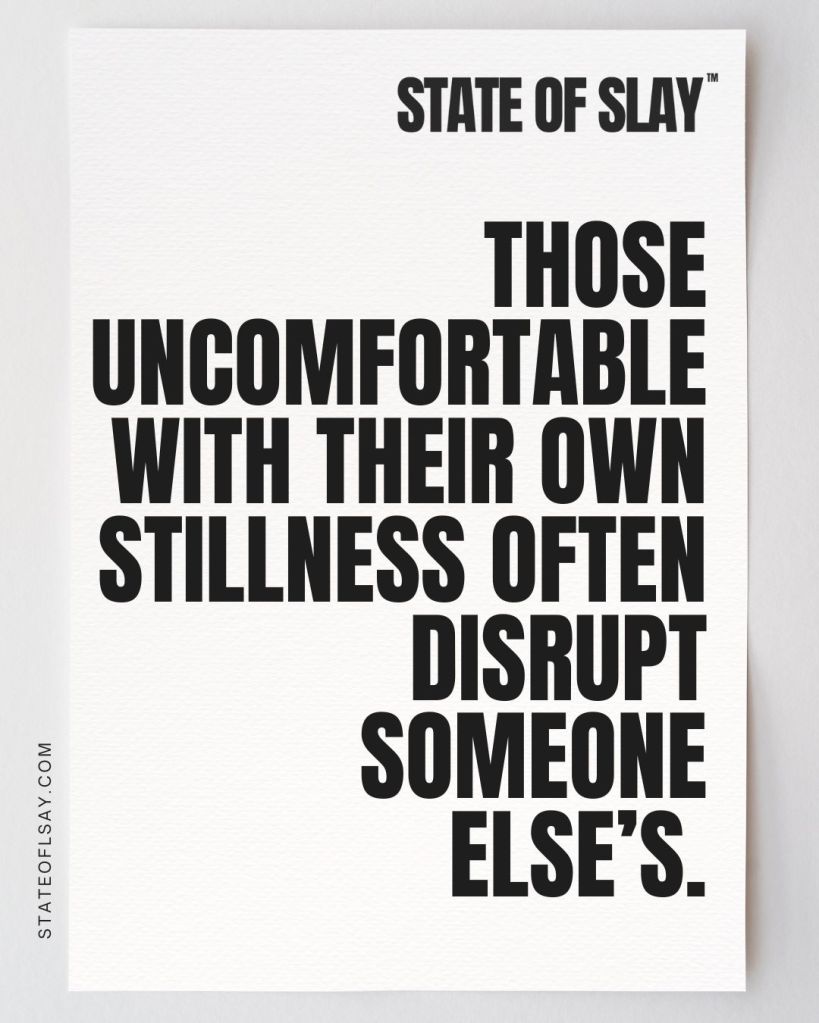
Not everyone knows how to sit with themselves.
Some people fill the silence with noise, distraction, or disruption — not because you invited it, but because your calm reminds them of what they avoid.

Peace can feel threatening to someone who hasn’t learned how to rest inside themselves.
So they poke.
They provoke.
They project.

This isn’t a reflection of your openness or your strength.
It’s a signal to protect your quiet.

Stillness is not weakness.
It’s discernment.
It’s clarity.
It’s a boundary you don’t have to explain.

This is your reminder:
You are allowed to keep your peace intact.
You don’t need to absorb someone else’s unrest to be compassionate.

Slay on.

You Can Forgive Someone Without Giving Them Access to You

Forgiveness is freedom, not a front-row pass

There’s a moment in healing that feels like a crossroads.
You’ve done the work.
You’ve cried the tears.
You’ve processed the pain.
And you finally arrive at forgiveness — not to excuse what was done, but to release what it did to you.

But then comes the question that catches so many of us off guard:

Does forgiving someone mean they get to come back?

For years, I thought the answer was yes.

I believed forgiveness meant reconciliation.
I believed healing meant returning to the way things were.
I believed I had to reopen the door simply because I had released the hurt.

But with time, experience, heartbreak, boundary-setting, and a few painfully earned lessons, I learned the truth:

You can forgive someone and still deny them access to you.
Forgiveness is a gift you give yourself.
Access is a privilege they have to earn.

Those two things are not the same.


Forgiveness Isn’t a Free Pass

Forgiveness is often misunderstood. Many people think it means:

  • “We’re good now.”
  • “It wasn’t that bad.”
  • “Let’s forget it happened.”
  • “The relationship should go back to normal.”

But forgiveness does not rewrite history. It does not minimize harm. It does not pretend you weren’t hurt.

Forgiveness simply means:
“I’m releasing the emotional hold this has on me.”

It’s internal.
It’s personal.
It’s sacred.

Forgiveness is about you finding peace — not about making someone else comfortable.

You can forgive someone and still say:

  • “I no longer trust you.”
  • “Your behavior hasn’t changed.”
  • “My boundaries matter.”
  • “This relationship is not safe for me.”
  • “I choose to love myself enough to step away.”

And every one of those statements can exist perfectly alongside forgiveness.


Access Requires Accountability

Here’s the part most people don’t understand:

Forgiveness is unconditional.
Access is not.

Access requires:

  • Changed behavior
  • Accountability
  • Consistency
  • Respect
  • Emotional safety
  • Mutual effort

If someone wants a place in your life, their actions should reflect it.
Their words should align with their behavior.
Their presence should feel safe, not draining.
Their energy should add, not take.

You don’t deny access out of spite.
You deny access because your peace is non-negotiable.

It is not punishment.
It is protection.

People who truly care about you will understand that.
People who don’t will call it “overreacting” or “holding a grudge,” simply because they no longer benefit from your openness.


Forgiveness Without Reconciliation Is Still Forgiveness

A lot of people grew up being taught that forgiveness meant you had to:

  • rebuild relationships
  • pretend nothing happened
  • stay connected
  • be endlessly available

But that version of forgiveness keeps you trapped.
It keeps you small.
It keeps you in cycles of harm.

Forgiveness without reconciliation is still forgiveness.
You can release resentment without reopening the door.
You can wish someone well from a distance.
You can send them love and keep them out of your life.

There is power in that duality:

“I forgive you.
And you still don’t get access to me.”

Both can be true.
Both can be healthy.
Both can be healing.


Protecting Your Peace Is an Act of Self-Respect

There comes a point where you stop asking:

“Do they deserve another chance?”

And start asking:

“Does this support my peace, my growth, and my well-being?”

Sometimes the answer is yes.
Sometimes it’s no.
Sometimes it’s “not right now.”

And sometimes it’s “never again.”

Choosing distance is not bitterness.
It’s clarity.
It’s self-respect.
It’s honoring the version of you who finally learned what they deserve.

There is nothing unkind about protecting your emotional, mental, or physical safety.
There is nothing cruel about refusing to reenter the same cycle.
There is nothing wrong with outgrowing people who continue to harm you — even if you love them.

Protecting your peace is not a betrayal of love —
it’s a commitment to yourself.


Rebuilding Is a Choice, Not an Obligation

Some people will change.
Some people will grow.
Some people will show up differently.

And if that happens — and if you want to rebuild — that choice is yours.

But rebuilding should never come from guilt.
Or pressure.
Or obligation.
Or fear of what other people will think.

A relationship can only be rebuilt on:

  • truth
  • accountability
  • honesty
  • change
  • mutual respect
  • time
  • consistency

Not empty promises or short-term effort.

You decide what access looks like.
You decide what level of connection you’re open to.
You decide whether the door is closed, cracked, or locked.

You don’t owe anyone an explanation.
Your healing is not a group decision.


Forgiveness Sets You Free — Not Them

One of the most liberating things you’ll ever learn is this:

Forgiveness is not for them.
It’s for you.

It frees your mind.
It clears your heart.
It releases the emotional weight tethering you to the past.

But it does not require:

  • returning
  • reconciling
  • reconnecting
  • reopening
  • reengaging

Your healing does not depend on the relationship surviving.
Some chapters end so you can reclaim your peace.
Some endings are the closure you’ve been searching for.
Some boundaries are the doorway to your freedom.

Allowing someone access again is an entirely separate choice — one they must earn, not one automatically granted because you chose your own healing.


SLAY Reflection

S — Sit With Your Truth

What relationship in your life have you maintained out of obligation rather than genuine safety or connection?

L — Look at the Pattern

Have you confused forgiveness with permission in the past? What did that lead to?

A — Align With Your Values

What boundaries need to be honored for you to feel emotionally safe again?

Y — Yield to Growth

How can you release the hurt while still protecting your peace moving forward?


Call to Action: Join the Conversation

I’d love to hear from you.
When have you forgiven someone but still chosen distance — and how did that decision support your healing?
Share your story in the comments. Let’s cheer each other on.

And if you know someone who’s working on releasing hurt without reopening old wounds, send this to them.
Sometimes, all we need is a nudge.

Just Because Someone Gave Up on You, Don’t Give Up on Yourself

There’s a particular kind of pain that comes when someone you believed in—someone you trusted—decides you’re no longer worth the effort. It might be a partner, a friend, a family member, or even an employer.

Sometimes they drift away quietly. Sometimes they slam the door. And sometimes, they make sure you hear exactly why you didn’t make the cut.

It’s human to internalize those moments. To question what’s wrong with you. To wonder if they saw something you didn’t. But here’s the truth—their decision to give up on you is about them, not you.


Prefer to listen? The Audio Blog version is available here.


Their Choice Is Not Your Worth

When someone gives up on you, it’s easy to translate that into, “I’m not enough.” But what they’re really saying is, “I’m not willing, able, or ready to invest in this anymore.”

That’s not the same thing as saying you have no value.

We often assume that other people’s actions are direct reflections of who we are. But in reality, they’re reflections of their capacity, their priorities, their fears, and their choices. Someone’s inability or unwillingness to see your worth does not erase your worth.

When we take someone else’s abandonment as proof that we should abandon ourselves, we hand over our power. And once that happens, their absence gets to dictate the rest of our story.

You don’t owe them that power.


Self-Trust Is Your Lifeline

When the dust settles, what you’re left with is you. And that’s where the real work begins.

Self-trust isn’t built in grand declarations—it’s built in small, consistent acts of showing up for yourself. It’s saying, “I still choose me, even when they didn’t.”

Here’s the thing: if you keep believing in yourself, you always have another chapter to write.

Yes, it hurts when someone walks away. But you’re still standing. You still have dreams, talents, and the ability to create a life you love. You still have the capacity to love yourself fiercely, even if others failed to.

The most powerful way to respond when someone gives up on you is to prove—to yourself—that you never will.


Let Their Exit Teach You, Not Break You

People leaving can be clarifying. Painful? Absolutely. But clarifying.

When someone exits your life, you get the chance to ask:

  • Was I shrinking myself to keep them close?
  • Did I rely on their validation more than my own?
  • Was I ignoring red flags because I didn’t want to lose them?

The end of a relationship, friendship, or opportunity can feel like a collapse—but it can also be a clearing. A chance to rebuild in a way that’s more aligned with who you are now.

Sometimes someone’s departure forces you to look at your own patterns, boundaries, and needs in a way you never would have otherwise.

If you use the pain as data, it can actually serve you.


Your Story Isn’t Over Because They Left

It’s tempting to see someone’s departure as the end of something essential—as if the part of you that existed with them can’t survive without them. But your life is bigger than their role in it.

Think of the people you haven’t even met yet. The experiences you haven’t had. The opportunities that wouldn’t have been possible if you stayed where you were.

The world is full of people who will believe in you. People who will stand beside you, support you, and challenge you to grow—not shrink.

But the most important believer you’ll ever have is the one staring back at you in the mirror.


Refuse to Abandon Yourself

Here’s the bottom line:

  • Someone else’s choice to walk away does not define you.
  • You are allowed to grieve, but you are not required to quit on yourself.
  • You can acknowledge the hurt without adopting it as your identity.

The real loss would be if you decided their decision was the final say in your worth.

Keep showing up. Keep writing your story. Keep choosing you—over and over again.

Because the day you give up on yourself is the day you stop being open to the possibilities that are still ahead.

And trust me… there are so many.


SLAY Reflection

  1. Who in your life has walked away, and how did it impact your self-belief?
  2. In what ways have you relied on others for validation?
  3. How can you build more self-trust right now?
  4. What lesson did you learn from someone leaving your life?
  5. What’s one action you can take this week to invest in yourself?

S – Stand in your worth, even when others don’t
L – Let go of those who cannot meet you where you are
A – Affirm your value daily, without waiting for outside approval
Y – Yield to growth, even when it comes through loss


Call to Action: Join the Conversation

I’d love to hear from you.
When someone gave up on you, what did you do to keep believing in yourself?
Share your story in the comments. Let’s cheer each other on.

And if you know someone who’s questioning their worth because someone walked away, send this to them.
Sometimes, all we need is a nudge.

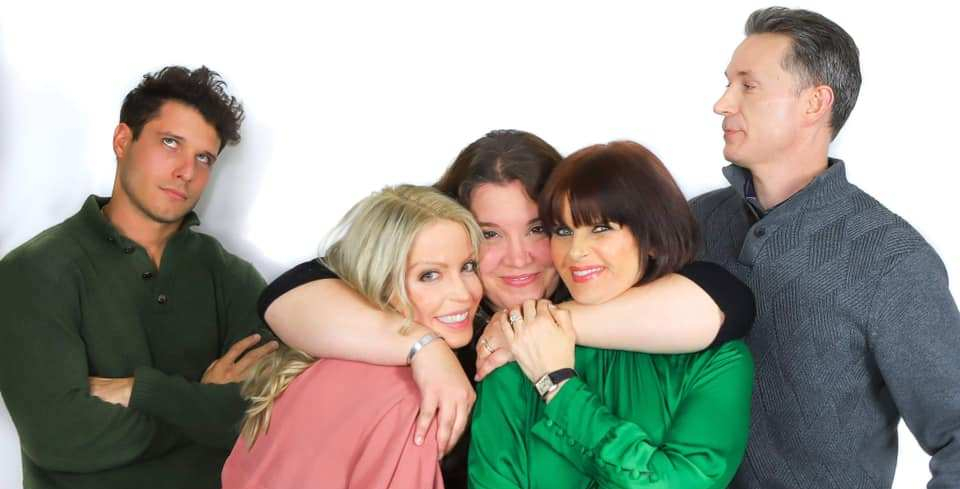
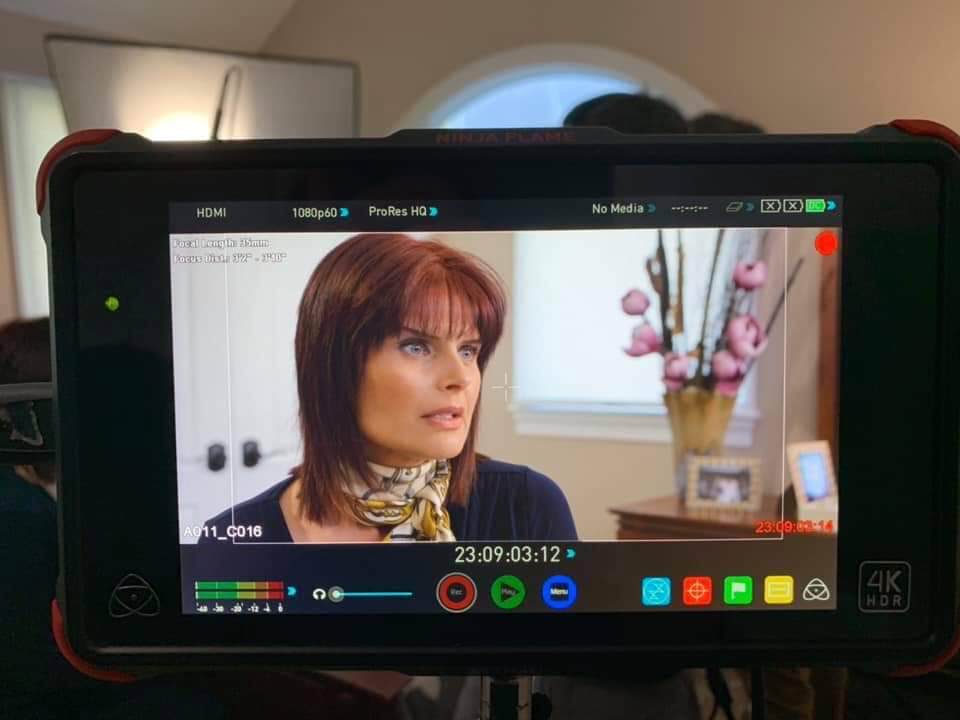
Slay With Me In Person At The Screening Of My New Film

As I mentioned on SLAY TALK LIVE today, you can join me and rest of the amazing cast and crew for a screening of my new Christmas film July 27th in Long Island, NY. You can buy tickets to just the screening or tickets for the screening and the after party to celebrate with all of us!

Here’s a sneak peek!

To buy tickets go to: IVY & MISTLETOE Tickets

FB_IMG_1555034175973

(Photos courtesy of Candice T. Cain of Gemelli Films)

AIR™ Share With Daphne

It was great to join Tricia Baker of Attitudes In Reverse® at Red Bank Regional High School to speak to the freshman on a recent break from filming in the New York area. I always look for opportunities to share my experience, strength and hope with those who may be struggling with mental health and suicide, and it was great to join Tricia and share my story.

Daphne made her first official AIR™ appearance and enjoyed meeting all the students and sharing therapy dog duties with Henry.

For more information on Attitudes In Reverse® and how you can help click this link: Attitudes In Reverse

Carrie Genzel with Daphne and Tricia Baker with Henry at Red Bank Regional High School
Actor/AIR Advisory Board Member Carrie Genzel Joins Tricia Baker at Red Bank Regional High School
When AIR Co-founder Tricia Baker recently presented Coming Up for AIR at Red Bank Regional High School, she brought a couple surprise treats for the students: actor/writer/ producer Carrie Genzel, who recently joined AIR’s Advisory Board, and her dog Daphne.
“I am grateful to Carrie for sharing her personal story of recovery. Young people need to understand that there is always hope for healing,” Tricia said.
“I had a great time joining in on Tricia’s programming at Red Bank Regional High School. It was great to share my story and message with the freshman class and bring Daphne in to meet and connect with the students afterwards. We both had a great afternoon,” Carrie said.
Carrie is most recognized for her work as “Skye Chandler” on All My Children, as well as two memorable Supernatural episodes, “Bugs” and “Just My Imagination.” Some of her credits also include Wizards of Waverly Place, Smallville, Watchmen and
Jennifer’s Body.

SLAY With Me In Person Next Weekend

Hello SLAYER! I will be making my first Official SUPERNATURAL Convention Appearance next weekend, September 21-23 in Indianapolis Indiana! Come out and SLAY along with me.

Photo Op and Autograph tickets are online, I will also be in the Vendor’s Room during scheduled times as well throughout the weekend.

For ticket and show information go to: SUPERNATURAL Indy

SLAY Indy

Slay With Me In Person

Hey SLAYER! You can SLAY with me in person this month at Modesto’s Classic Comic Con in Modesto, California October 27-29th.

Get your tickets here: Comic Con Tickets

SOS Modesto

Photographer: Bianca Dorso


Slay With Me In Person

I’ll be appearing at Modesto’s Classic Comic Con October 27-29th in sunny Modesto California.

Come out and SLAY with me in person!

Get your tickets here: Comic Con Tickets

SOS Modesto

(Photographer: Bianca Dorso)