Give Yourself Permission to Be Disliked

Most people think freedom means having the ability to do whatever they want.

I think freedom is something much quieter.

Freedom is no longer needing permission from people who were never qualified to give it.

Freedom is making a decision without first imagining how everyone else will react.

Freedom is speaking honestly without rehearsing how to avoid criticism.

Freedom is understanding that someone can dislike your choice without making it the wrong choice.

And perhaps most importantly, freedom is giving yourself permission to be disliked.

For much of my life, I confused being liked with being successful.

If people approved of me, I felt secure.

If people were happy with me, I felt like I was doing something right.

If everyone got along, I felt at peace.

But eventually I realized that constantly seeking approval came with a hidden cost.

The more I tried to be liked by everyone, the less freedom I gave myself to be who I truly was.

And that is a price that is far too high.


Prefer to listen? The Audio Blog version is available here.


THE PRICE OF BEING LIKED IS OFTEN TOO HIGH

Most people do not realize how much they sacrifice in exchange for approval.

They sacrifice opinions.

Boundaries.

Dreams.

Opportunities.

Authenticity.

They stay quiet when they want to speak.

They stay small when they want to grow.

They remain where they are when every part of them knows it is time to move forward.

Not because it is what they want.

Because they fear what other people might think.

Every time you abandon yourself to keep someone else comfortable, the cost is your freedom.

And over time, those costs add up.


PEOPLE PLEASING LOOKS HARMLESS UNTIL IT ISN’T

Many people-pleasing behaviors are celebrated.

Being accommodating.

Being agreeable.

Being easygoing.

Being helpful.

None of those qualities are inherently bad.

The problem begins when they come at the expense of your own truth.

When your desire to be liked becomes stronger than your desire to be honest.

When maintaining approval becomes more important than maintaining integrity.

At that point, people pleasing stops being kindness.

It becomes self-abandonment.


SOME PEOPLE ONLY LIKE THE VERSION OF YOU THEY CAN CONTROL

This can be one of the hardest truths to accept.

Not everyone who likes you likes the real you.

Some people like the version of you that never says no.

The version that prioritizes their needs.

The version that avoids conflict.

The version that remains predictable and easy to manage.

The moment you begin setting boundaries, changing directions, or making decisions for yourself, their opinion of you may change.

Not because you became worse.

Because you became harder to control.

That is not a reason to stop growing.

It is often evidence that growth is happening.


APPROVAL IS A TERRIBLE COMPASS

Imagine trying to navigate your life based entirely on what other people approve of.

You would never take a meaningful risk.

You would never make a bold decision.

You would never challenge expectations.

You would never pursue a dream that made someone uncomfortable.

Every entrepreneur has been criticized.

Every artist has been doubted.

Every leader has disappointed someone.

Every person who has ever chosen authenticity over conformity has faced disapproval.

Approval is not a reliable guide.

It changes with the audience.

It changes with circumstances.

It changes with expectations.

Your values are a much better compass.


AUTHENTICITY AND UNIVERSAL APPROVAL CANNOT COEXIST

This realization can feel uncomfortable.

The more authentic you become, the more likely it is that some people will dislike you.

Not because you are doing something wrong.

Because authenticity creates clarity.

People see who you really are.

Some will resonate with that.

Some will not.

And that is perfectly normal.

What is not normal is expecting universal approval while living authentically.

The two cannot coexist.

At some point, you must decide which matters more.


DISAPPOINTMENT IS NOT THE SAME AS HARM

Many people struggle because they confuse disappointing someone with hurting them.

The two are not the same.

You can disappoint someone by setting a boundary.

You can disappoint someone by choosing a different path.

You can disappoint someone by prioritizing your well-being.

You can disappoint someone by refusing to live according to their expectations.

None of those things are inherently harmful.

They simply mean your choices no longer align with someone else’s preferences.

You are allowed to disappoint people.

You are not responsible for managing every expectation placed upon you.


CRITICISM IS OFTEN THE PRICE OF VISIBILITY

The more visible you become, the more opinions people will have.

This is true in business.

In relationships.

In leadership.

In creativity.

In personal growth.

Someone will always disagree.

Someone will always misunderstand.

Someone will always criticize.

That does not mean you should stop.

It means you are participating in life.

The goal is not to avoid criticism.

The goal is to avoid allowing criticism to determine your direction.


YOU DO NOT NEED TO ATTEND EVERY OPINION

One of the most freeing realizations is that you do not have to respond to every judgment.

You do not have to correct every misunderstanding.

You do not have to defend every choice.

You do not have to convince every critic.

People are allowed to have opinions.

And you are allowed to keep living your life anyway.

The moment you stop treating every opinion like a summons, you reclaim an incredible amount of energy.

Energy that can be invested into building the life you actually want.


FREEDOM IS AN INSIDE JOB

The moment you stop needing everyone to understand you, your world becomes larger.

The moment you stop needing everyone to approve of you, your choices become clearer.

The moment you stop needing everyone to like you, your life becomes your own.

Every time you choose authenticity over approval, you buy back a small piece of your freedom.

Every time you honor your truth instead of someone else’s expectations, you reclaim another piece.

And eventually, those pieces add up.

They become confidence.

They become self-trust.

They become peace.

Most importantly, they become a life that finally feels like yours.

Give yourself permission to be disliked.

Not because you want conflict.

Not because you do not care about others.

But because freedom is too valuable to trade for approval.

And the people who truly belong in your life will appreciate the real version of you far more than the performance.


SLAY REFLECTION

S — See the Fear
Where in your life are you holding back because you fear being disliked?

L — Look at the Cost
What opportunities, boundaries, or dreams have you sacrificed in exchange for approval?

A — Acknowledge the Truth
What decision do you already know is right for you, even if not everyone agrees?

Y — Your Next Step
What is one way you can choose authenticity over approval this week?


CALL TO ACTION: JOIN THE CONVERSATION

I’d love to hear from you.

Have you ever made a decision that disappointed others but ultimately gave you greater freedom?

Share your story in the comments. Let’s cheer each other on.

And if you know someone who might need this reminder, send this to them.

Sometimes, all we need is a nudge.

Not Everyone Who Questions You Deserves an Answer

One of the most exhausting things we can do is feel obligated to explain ourselves to everyone who asks.

Why did you make that decision?

Why did you leave?

Why did you stay?

Why did you change?

Why do you believe that?

Why are you doing this now?

At first glance, those questions seem reasonable.

And sometimes they are.

Sometimes questions come from genuine curiosity.

Sometimes they come from a desire to understand.

Sometimes they come from care.

But not all questions are created equally.

Some questions are not invitations to understanding.

They are invitations to defend yourself.

And one of the most important lessons I have learned is this:

Not everyone who questions you deserves an answer.


Prefer to listen? The Audio Blog version is available here.


CURIOSITY AND JUDGMENT OFTEN SOUND THE SAME

This is where people get confused.

Both curiosity and judgment can arrive in the form of a question.

One seeks understanding.

The other seeks validation for an opinion that has already been formed.

The words may sound similar.

The energy behind them is not.

A curious person listens.

A judgmental person waits for their turn to disagree.

A curious person wants insight.

A judgmental person wants confirmation.

Learning to recognize the difference can save you a tremendous amount of emotional energy.


SOME PEOPLE ARE NOT ASKING TO LEARN

They are asking to challenge.

To criticize.

To discredit.

To create doubt.

To position themselves as right.

And if you have ever found yourself explaining the same thing repeatedly to someone who never seems satisfied, you have likely experienced this.

No explanation is enough.

No clarification is enough.

No amount of honesty changes the outcome.

Because the goal was never understanding.

The goal was opposition.


YOU DO NOT NEED TO DEFEND EVERY DECISION

One consequence of people-pleasing is believing that every choice requires justification.

That your boundaries require explanation.

That your growth requires approval.

That your decisions require consensus.

They do not.

You are allowed to make choices that other people do not understand.

You are allowed to change direction.

You are allowed to outgrow situations.

You are allowed to protect your peace.

Without presenting a detailed defense of your actions.


THE NEED TO EXPLAIN OFTEN COMES FROM FEAR

Fear of being misunderstood.

Fear of being judged.

Fear of disappointing people.

Fear of being seen as selfish, wrong, or unreasonable.

Those fears are deeply human.

But they can also become traps.

Because when we constantly seek permission to live our lives, we hand other people authority they were never meant to have.

And the more authority we hand away, the less connected we become to ourselves.


SOME QUESTIONS ARE DISGUISED DEMANDS

Not every question deserves an answer because not every question is actually a question.

Sometimes a question is a demand.

Explain yourself.

Justify yourself.

Convince me.

Prove it.

Make me comfortable with your decision.

But your responsibility is not to make everyone comfortable.

Your responsibility is to live honestly.

Those are not the same thing.


PEOPLE WHO RESPECT YOU WILL RESPECT YOUR ANSWER

One of the clearest signs of a healthy relationship is that people can accept an answer they do not necessarily agree with.

They may not understand your choice.

They may not have made the same decision.

But they respect your right to make it.

People who genuinely care about you do not require endless explanations.

They trust that you are capable of making decisions for yourself.

And that trust is a form of respect.


YOU ARE NOT RESPONSIBLE FOR EVERYONE’S OPINION

This truth took me a long time to learn.

No matter how clearly you explain yourself, some people will misunderstand.

Some people will disagree.

Some people will create a story that fits their own perspective.

And that is their right.

Just as it is your right to stop trying to manage it.

You cannot control how people interpret your life.

You can only control whether you live it authentically.


SILENCE IS SOMETIMES THE MOST POWERFUL ANSWER

We often think strength means having the perfect response.

The perfect explanation.

The perfect argument.

The perfect defense.

But sometimes strength looks very different.

Sometimes strength is choosing not to engage.

Not because you cannot answer.

Because you no longer feel obligated to.

That is not avoidance.

It is discernment.

Knowing where to best invest your energy.


NOT EVERY AUDIENCE DESERVES ACCESS

This may be one of the most important lessons of all.

Access is earned.

Not everyone deserves access to your thoughts.

Your motivations.

Your healing.

Your decisions.

Your dreams.

Some people will honor that information.

Others will weaponize it.

Wisdom is learning the difference.


SAVE YOUR ENERGY FOR PEOPLE WHO LISTEN

The goal is not to become closed off.

The goal is not to stop communicating.

The goal is to become selective.

To recognize the difference between conversations that create understanding and conversations that drain you.

To recognize who is listening.

And who is merely waiting for ammunition.

Your time is valuable.

Your energy is valuable.

Your peace is valuable.

Treat them accordingly.


YOU DO NOT OWE EVERYONE AN EXPLANATION

If someone asks a sincere question, answer if you choose.

If someone seeks understanding, offer it if it feels right.

But if someone is asking you to justify your existence, your boundaries, your growth, or your choices, remember this:

You are not obligated to participate.

Not everyone who questions you deserves an answer.

Some people deserve an explanation.

Some people deserve a conversation.

And some people deserve your silence.

Learning the difference is a form of freedom.


SLAY REFLECTION

S — See the Pattern
Is there someone in your life who repeatedly questions your choices without truly listening to your answers?

L — Look at the Motivation
Do their questions come from curiosity or judgment?

A — Acknowledge Your Right
What decision have you been over-explaining in an effort to gain understanding or approval?

Y — Your Next Step
How can you protect your energy while still communicating honestly?


CALL TO ACTION: JOIN THE CONVERSATION

I’d love to hear from you.

Have you ever realized that someone was questioning you not to understand you, but to challenge your right to choose?

Share your story in the comments. Let’s cheer each other on.

And if you know someone who might need this reminder, send this to them.

Sometimes, all we need is a nudge.

Slay Say

WHEN LOYALTY STARTS COSTING YOU YOUR PEACE

There is a difference between working through something and slowly losing yourself inside it.

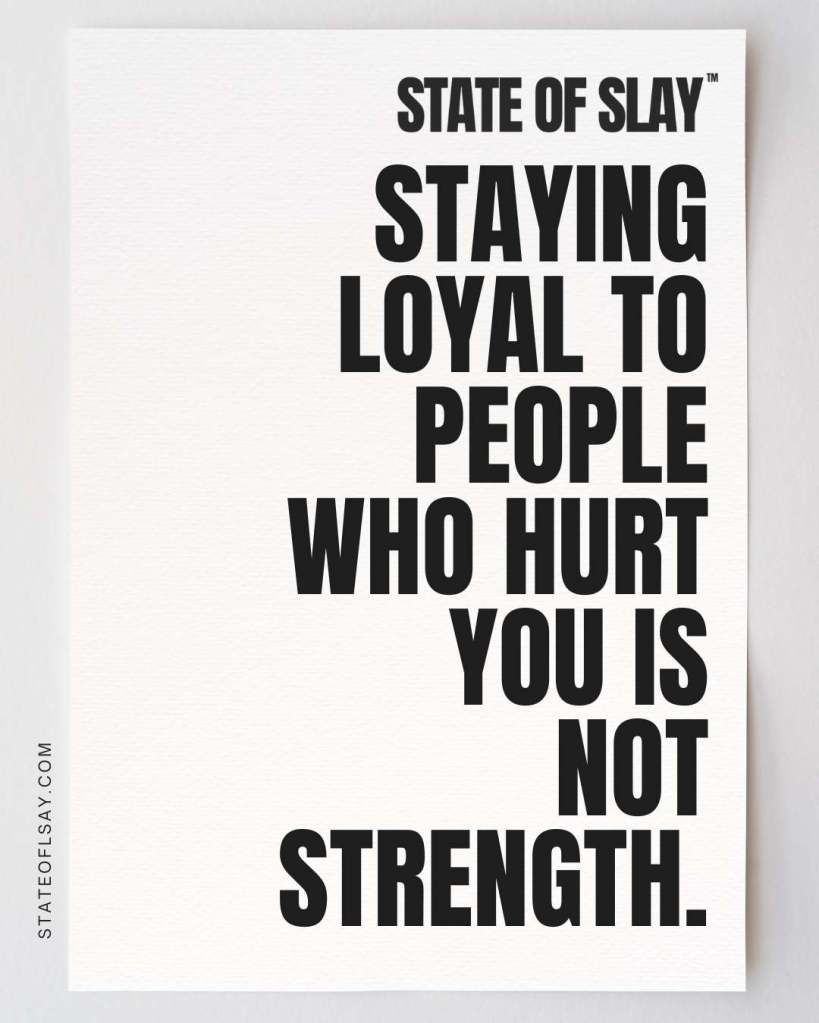
Some people will continue hurting you while expecting your understanding.

Crossing lines while asking for patience.
Taking from you while offering very little in return.

And because you care, you stay longer than you should.

You explain.
Forgive.
Give second chances that turn into fifth and sixth chances.

Because walking away can feel harsh.

Like maybe you did not try hard enough.
Like maybe leaving means you stopped caring.

But there comes a point where staying becomes the greater betrayal.

Not of them.

Of yourself.

Because love should not require you to constantly overlook your own hurt just to keep the connection alive.

The moment you start sacrificing your peace to maintain someone else’s access to you, something needs to change.

This is your reminder that protecting yourself is not cruelty. It is self-respect.

Slay on.

I Am No Longer Available for People or Things That Make Me Feel Bad

There was a time in my life when I stayed available to everything.

People who drained me.
Situations that unsettled me.
Conversations that left me questioning myself.
Expectations that did not belong to me.

I told myself it was kindness. Loyalty. Patience. Love.

But if I am honest, much of it was fear.

Fear of disappointing others.
Fear of conflict.
Fear of being misunderstood.
Fear of not being liked.

And while I was busy protecting everyone else’s comfort, I was slowly abandoning my own.

That realization changed everything.


Prefer to listen? The Audio Blog version is available here.


Learning That Availability Is a Choice

For a long time, I believed being a good person meant always being accessible. Always accommodating. Always understanding. Always giving the benefit of the doubt, even when my intuition was quietly telling me something was off.

I thought boundaries made me difficult.
I thought saying no made me selfish.
I thought protecting my energy made me cold.

Now I see it differently.

Availability is not a personality trait. It is a choice. And I get to decide where my energy goes.


Not Everything Deserves Access to You

This was a hard truth for me.

Just because someone wants your time does not mean they deserve it.
Just because something once fit your life does not mean it still does.
Just because you can tolerate something does not mean you should.

Growth has taught me that protecting my peace is not selfish. It is necessary.

When something consistently makes me feel small, anxious, depleted, or unsettled, I pay attention now. I no longer override those signals.

My nervous system is wise.
My intuition is wise.
My emotional well-being matters.


Choosing Peace Over Approval

There was a version of me that wanted everyone to understand me.

To approve of me.
To agree with me.
To be comfortable with my choices.

That version of me worked very hard. And she was very tired.

Today, I am less concerned with approval and more committed to alignment.

Peace feels better than permission.
Clarity feels better than constant compromise.
Authenticity feels better than acceptance built on pretending.

And the people meant for me respect that shift.


Walking Away Is Not Failure

One of the biggest lessons I have learned is that leaving something that harms you is not failure. It is wisdom.

It does not mean you did not try.
It does not mean you did not care.
It does not mean you gave up too easily.

Sometimes it means you finally chose yourself.

I used to stay far longer than I should have. In relationships. In environments. In conversations. In expectations.

Now I listen sooner.
I trust myself sooner.
I choose peace sooner.

That is growth.


What This Looks Like in Real Life

Being unavailable for what harms you does not always mean dramatic exits.

Sometimes it looks quiet.

Less explaining.
Less engaging.
Less overextending.
Less tolerating what feels wrong.

Sometimes it is simply choosing not to participate.

That quiet shift can be powerful.


This Is Not About Becoming Hard

Choosing peace does not make you cold.
Having boundaries does not make you unkind.
Protecting your energy does not make you distant.

If anything, it allows you to show up more fully where it matters.

When I stopped pouring energy into what drained me, I had more to give to what nourishes me. More presence. More patience. More authenticity.

That feels like love, not withdrawal.


Your Peace Is Worth Protecting

You do not have to justify wanting to feel safe in your own life.

You do not have to explain why something does not feel right.

You do not have to keep proving your worth by enduring discomfort.

You are allowed to choose environments, relationships, and commitments that support your well-being.

That is not selfish.

That is self-respect.


I Am No Longer Available

I am no longer available for constant tension.
For unnecessary drama.
For energy that feels heavy.
For situations that make me doubt myself.

I am available for growth.
For peace.
For honesty.
For relationships rooted in respect.

And most importantly, I am available for myself.


SLAY Reflection

Let us reflect SLAYER:

S: Where in your life do you feel drained or unsettled
L: What signs has your body or intuition been giving you
A: What is one boundary you could gently introduce
Y: How might your life shift if you prioritized peace over approval


Call to Action: Join the Conversation

I would love to hear from you.
What is one thing you are no longer available for in your life
Share your story in the comments. Let us cheer each other on.

And if you know someone learning to protect their peace, send this to them.
Sometimes all we need is a reminder that we are allowed to choose ourselves.

Slay Say

Not everyone knows how to sit with themselves.
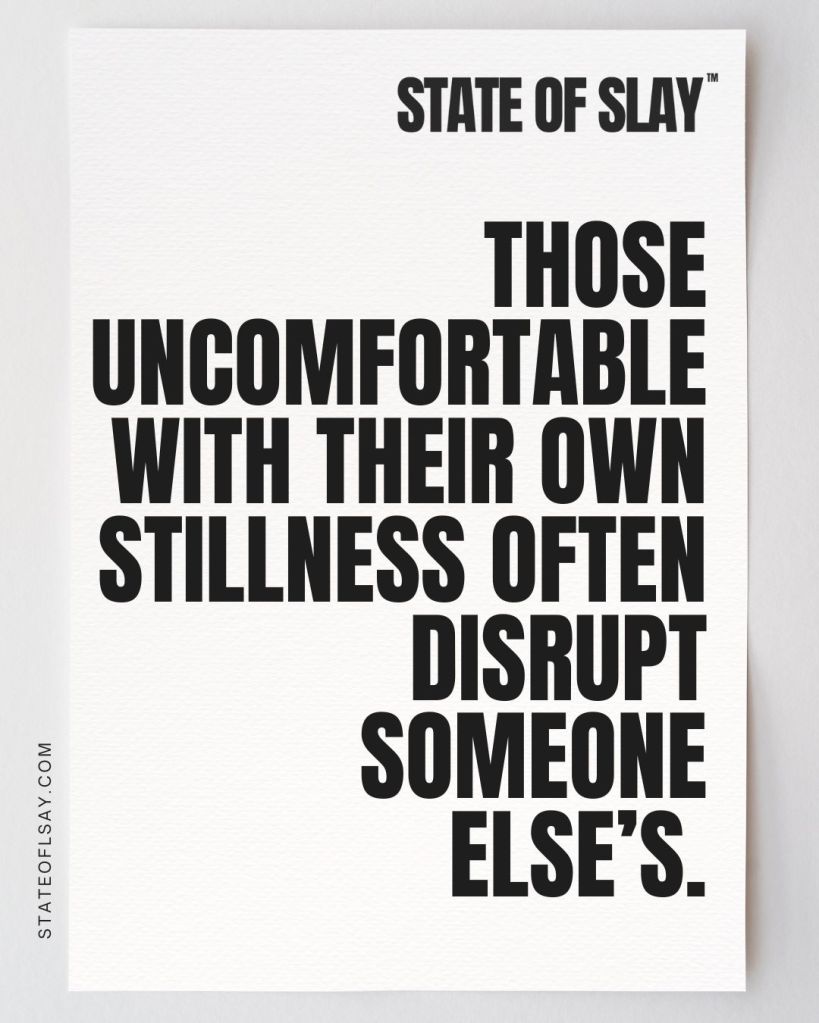
Some people fill the silence with noise, distraction, or disruption — not because you invited it, but because your calm reminds them of what they avoid.

Peace can feel threatening to someone who hasn’t learned how to rest inside themselves.
So they poke.
They provoke.
They project.

This isn’t a reflection of your openness or your strength.
It’s a signal to protect your quiet.

Stillness is not weakness.
It’s discernment.
It’s clarity.
It’s a boundary you don’t have to explain.

This is your reminder:
You are allowed to keep your peace intact.
You don’t need to absorb someone else’s unrest to be compassionate.

Slay on.

Peace Over People

There comes a point in life when you realize that protecting your peace isn’t selfish — it’s necessary.

For a long time, many of us are taught to prioritize relationships at all costs. To be accommodating. To be understanding. To be available. To keep the peace, even if it costs us our own.

But here’s the hard truth no one says out loud enough:
Not everyone deserves access to you.

And choosing peace over people doesn’t make you cold, unkind, or difficult.
It makes you honest.

Peace isn’t something you stumble into by accident. It’s something you choose — often after learning the hard way what happens when you don’t.


Prefer to listen? The Audio Blog version is available here.


When Choosing People Costs You Yourself

There was a time when I believed that loyalty meant endurance. That loving someone meant tolerating discomfort. That being a good person meant explaining myself, overextending, and shrinking to keep others comfortable.

So I stayed.
I justified.
I made excuses.
I carried emotional weight that wasn’t mine to hold.

And slowly, without realizing it, I lost my sense of peace.

I felt constantly on edge. I replayed conversations in my head. I walked on eggshells. I questioned myself more than I trusted myself. I told myself it was normal — that relationships were supposed to be hard.

But there’s a difference between growth-discomfort and peace-eroding chaos.

And when a connection consistently costs you your clarity, your safety, or your sense of self — it’s no longer love. It’s a liability.


Peace Is Not the Absence of Conflict It’s the Presence of Alignment

Peace isn’t about avoiding hard conversations or disagreements. It’s about alignment — with yourself, your values, and the way you want to live.

You can be in a room full of people and feel completely at peace.
And you can be deeply connected to someone and feel constantly unsettled.

That’s your body talking.

Peace feels like:

  • Calm instead of tension
  • Clarity instead of confusion
  • Safety instead of anxiety
  • Being yourself instead of performing

When someone disrupts that consistently, it’s not because you’re “too sensitive.” It’s because something isn’t aligned.

And alignment matters more than approval.


Choosing Peace Will Offend People Who Benefit From Your Silence

Let’s be honest — the moment you choose peace, some people will feel threatened.

Not because you changed for the worse.
But because you stopped abandoning yourself for their comfort.

People who benefited from your lack of boundaries will call you distant.
People who relied on your overgiving will call you selfish.
People who were comfortable with your silence will struggle when you find your voice.

That doesn’t mean you’re wrong.

It means the dynamic is changing — and not everyone will be willing or able to meet you where you are now.

Peace has a way of exposing relationships that were built on obligation instead of mutual respect.


You Are Allowed to Walk Away Without Explaining Everything

One of the most liberating truths you can accept is this:
You don’t owe everyone an explanation for choosing yourself.

Closure is not something other people give you — it’s something you choose. You don’t need permission to step back. You don’t need validation to detach. You don’t need agreement to move on.

Sometimes the explanation would only reopen wounds.
Sometimes the conversation would only invite manipulation.
Sometimes silence is the boundary.

Choosing peace means trusting yourself enough to walk away without rewriting the story to make it palatable for others.

You are not responsible for how people process your boundaries.


Peace Requires Boundaries Not Guilt

Peace doesn’t come from cutting everyone off. It comes from discerning who deserves closeness and who requires distance.

Boundaries are not walls — they are doors with locks.

They say:

  • This is how I expect to be treated
  • This is what I will no longer tolerate
  • This is what I need to feel safe and whole

Guilt often shows up when you first set boundaries, especially if you were conditioned to prioritize others’ needs over your own. But guilt is not a sign you’re doing something wrong — it’s a sign you’re doing something new.

And new doesn’t mean wrong.

Every time you honor your boundaries, you reinforce your self-respect. Every time you choose peace, you teach yourself that your well-being matters.


Not Everyone Is Meant to Come With You

This is one of the hardest parts of choosing peace: accepting that some people are seasonal.

They were meant for who you were — not who you’re becoming.

And holding onto them out of nostalgia, guilt, or fear will only keep you tethered to a version of yourself you’ve outgrown.

You can love people from a distance.
You can appreciate what was without forcing what no longer works.
You can wish someone well without inviting them back into your life.

Peace doesn’t require resentment.
It requires honesty.

And sometimes honesty means admitting that access to you is no longer healthy.


Peace Is a Daily Practice

Choosing peace isn’t a one-time decision — it’s a daily practice.

It’s asking yourself:

Does this situation drain me or ground me?
Does this relationship expand me or exhaust me?
Does this choice align with the life I’m trying to build?

Peace shows up in the small choices — who you respond to, what you tolerate, where you invest your energy.

The more you choose peace, the quieter your life becomes.
The quieter your life becomes, the clearer your truth gets.
And clarity changes everything.


You Are Not Losing People You Are Choosing Yourself

If choosing peace costs you people, let it.

You are not here to be consumed, drained, or diminished for the sake of connection. You are here to live fully, honestly, and safely in your own life.

Peace isn’t loneliness.
Peace is freedom.

And the people who are meant to walk beside you will never require you to betray yourself to keep them.

Choose peace — again and again.


SLAY Reflection

Let’s reflect, SLAYER:

S: Where in your life have you been choosing people over your own peace?
L: What relationships leave you feeling drained rather than grounded?
A: What boundary do you need to set to protect your emotional well-being?
Y: How would your life feel if peace became your priority instead of approval?


Call to Action: Join the Conversation

I’d love to hear from you.
What has choosing peace over people looked like in your life — or where do you feel called to make that shift now?
Share your story in the comments. Let’s cheer each other on.

And if you know someone who’s struggling to choose themselves, send this to them.
Sometimes, all we need is a nudge.

Whoever Is Trying to Bring You Down Is Already Below You

There’s a moment in all of our lives when someone’s words, opinions, or actions cut deeper than they should. Maybe it’s a comment meant to humble you. Maybe it’s a passive-aggressive dig from someone who smiles while sharpening their knives. Maybe it’s the subtle energy of someone hoping you fail just so they can feel better about themselves.

When someone tries to bring you down, it can feel personal — like an attack on your worth, your identity, or the progress you’ve fought hard to make.

But here’s the truth most of us forget when we’re in the sting of it:
People can only pull you down if they’re already standing below you.

People who are grounded in self-worth don’t try to diminish others. People who are fulfilled don’t tear at the edges of someone else’s joy. People who are secure don’t throw stones at anyone who dares to rise.

Their actions say nothing about your value and everything about where they’re standing.


When Someone Targets You, It’s Rarely About You

People who feel whole don’t spend their energy trying to make others feel small. They’re too busy growing, creating, loving, and becoming. When someone attempts to knock you down, what they’re really doing is revealing their own inner struggle.

It’s projection.
It’s insecurity.
It’s comparison dressed up as criticism.

The person trying to belittle you is not operating from power — they’re operating from fear. Fear that you’ll outgrow them. Fear that your success will expose their stagnation. Fear that your courage will confront the parts of themselves they’ve been avoiding.

When you understand this, their behavior no longer feels like a personal attack. It becomes information.

A clarity.
A boundary cue.
A reminder that their perspective isn’t a reflection of who you are — it’s a reflection of where they are.


You Don’t Have to Defend Your Light

When someone tries to dim you, the first instinct is often to defend yourself. To explain. To justify. To make them understand you. But people determined to misunderstand you will always find a way.

Your worth doesn’t increase or decrease based on who recognizes it.
Your light doesn’t owe anyone permission to shine.

Every time you rise, you will trigger something in someone who isn’t ready to rise with you. That isn’t your burden to carry. You don’t need to shrink to make anyone comfortable. You don’t need to contort yourself to be likable. You don’t need to prove anything to anyone who is committed to not seeing you.

Your only job is to keep growing into the fullest version of yourself.

And that version? She isn’t threatened by noise beneath her.


Growth Will Always Expose the Ones Rooted in Stagnation

As you heal, evolve, and expand, the contrast becomes louder. Some people will cheer. Some will drift away. And some will try to throw anchors at your ankles.

Instead of asking, “Why are they acting like this?” shift the question to:
“What is my growth revealing in them?”

Sometimes your happiness highlights their dissatisfaction.
Sometimes your confidence highlights their insecurity.
Sometimes your movement highlights their fear of changing.

And instead of rising with you, they reach for the only tool they know:
Pulling you down.

What they don’t realize is this — you’re not standing where you used to. You’ve climbed. You’ve earned your view. And anyone trying to drag you backward has already positioned themselves behind you to do it.

You don’t have to go down there with them.


Your Energy Is Too Expensive for Their Insecurity

You’ve worked too hard.
You’ve healed too much.
You’ve grown too far.
You’ve survived too many storms to let someone’s insecurity become your setback.

Their opinions don’t pay your bills.
Their validation doesn’t define your identity.
Their behavior doesn’t determine your destiny.

Distance is not disrespect.
Detachment is not coldness.
Boundaries are not punishment.

Boundaries are self-respect in action.
Choosing not to engage is strength.
Refusing to internalize someone else’s projections is wisdom.

When you stop responding to people who want to see you fall, you reclaim your power.
When you stop defending yourself to people who never intend to understand you, you reclaim your peace.
When you refuse to come down to where their insecurity lives, you reclaim your joy.

And the higher you rise, the quieter the noise becomes.


You Are Not Who They Think You Are — You’re Who You’re Becoming

Don’t let someone beneath you convince you to step off your path. Their words aren’t truth — they’re static. Their attempts to pull you down aren’t insight — they’re fear. Their behavior isn’t a reflection of your destiny — it’s a sign of their emotional altitude.

Keep going.
Keep rising.
Keep growing in the direction of your becoming.

Because here’s the power they forget you hold:

No one can bring you down when you’ve already decided to lift yourself higher.

You don’t need to match their energy.
You don’t need to sink to their level.
You don’t need to explain your rise.

Just keep climbing.
The view is not for them — it’s for you.


SLAY Reflection

Let’s reflect, SLAYER:

S: Who in your life has tried to bring you down, and what did their behavior reveal about their emotional state?
L: How have you dimmed yourself in the past to avoid triggering someone else’s insecurity?
A: What boundary do you need to set with someone who keeps trying to pull you backward?
Y: What would rising above their noise look like for you — and how would it feel to finally choose your own growth?


Call to Action: Join the Conversation

I’d love to hear from you.
When has someone tried to bring you down — and how did you rise above it?
Share your story in the comments. Let’s cheer each other on.

And if you know someone who’s wrestling with other people’s opinions, send this to them.
Sometimes, all we need is a nudge.

You Can Forgive Someone Without Giving Them Access to You

Forgiveness is freedom, not a front-row pass

There’s a moment in healing that feels like a crossroads.
You’ve done the work.
You’ve cried the tears.
You’ve processed the pain.
And you finally arrive at forgiveness — not to excuse what was done, but to release what it did to you.

But then comes the question that catches so many of us off guard:

Does forgiving someone mean they get to come back?

For years, I thought the answer was yes.

I believed forgiveness meant reconciliation.
I believed healing meant returning to the way things were.
I believed I had to reopen the door simply because I had released the hurt.

But with time, experience, heartbreak, boundary-setting, and a few painfully earned lessons, I learned the truth:

You can forgive someone and still deny them access to you.
Forgiveness is a gift you give yourself.
Access is a privilege they have to earn.

Those two things are not the same.


Forgiveness Isn’t a Free Pass

Forgiveness is often misunderstood. Many people think it means:

  • “We’re good now.”
  • “It wasn’t that bad.”
  • “Let’s forget it happened.”
  • “The relationship should go back to normal.”

But forgiveness does not rewrite history. It does not minimize harm. It does not pretend you weren’t hurt.

Forgiveness simply means:
“I’m releasing the emotional hold this has on me.”

It’s internal.
It’s personal.
It’s sacred.

Forgiveness is about you finding peace — not about making someone else comfortable.

You can forgive someone and still say:

  • “I no longer trust you.”
  • “Your behavior hasn’t changed.”
  • “My boundaries matter.”
  • “This relationship is not safe for me.”
  • “I choose to love myself enough to step away.”

And every one of those statements can exist perfectly alongside forgiveness.


Access Requires Accountability

Here’s the part most people don’t understand:

Forgiveness is unconditional.
Access is not.

Access requires:

  • Changed behavior
  • Accountability
  • Consistency
  • Respect
  • Emotional safety
  • Mutual effort

If someone wants a place in your life, their actions should reflect it.
Their words should align with their behavior.
Their presence should feel safe, not draining.
Their energy should add, not take.

You don’t deny access out of spite.
You deny access because your peace is non-negotiable.

It is not punishment.
It is protection.

People who truly care about you will understand that.
People who don’t will call it “overreacting” or “holding a grudge,” simply because they no longer benefit from your openness.


Forgiveness Without Reconciliation Is Still Forgiveness

A lot of people grew up being taught that forgiveness meant you had to:

  • rebuild relationships
  • pretend nothing happened
  • stay connected
  • be endlessly available

But that version of forgiveness keeps you trapped.
It keeps you small.
It keeps you in cycles of harm.

Forgiveness without reconciliation is still forgiveness.
You can release resentment without reopening the door.
You can wish someone well from a distance.
You can send them love and keep them out of your life.

There is power in that duality:

“I forgive you.
And you still don’t get access to me.”

Both can be true.
Both can be healthy.
Both can be healing.


Protecting Your Peace Is an Act of Self-Respect

There comes a point where you stop asking:

“Do they deserve another chance?”

And start asking:

“Does this support my peace, my growth, and my well-being?”

Sometimes the answer is yes.
Sometimes it’s no.
Sometimes it’s “not right now.”

And sometimes it’s “never again.”

Choosing distance is not bitterness.
It’s clarity.
It’s self-respect.
It’s honoring the version of you who finally learned what they deserve.

There is nothing unkind about protecting your emotional, mental, or physical safety.
There is nothing cruel about refusing to reenter the same cycle.
There is nothing wrong with outgrowing people who continue to harm you — even if you love them.

Protecting your peace is not a betrayal of love —
it’s a commitment to yourself.


Rebuilding Is a Choice, Not an Obligation

Some people will change.
Some people will grow.
Some people will show up differently.

And if that happens — and if you want to rebuild — that choice is yours.

But rebuilding should never come from guilt.
Or pressure.
Or obligation.
Or fear of what other people will think.

A relationship can only be rebuilt on:

  • truth
  • accountability
  • honesty
  • change
  • mutual respect
  • time
  • consistency

Not empty promises or short-term effort.

You decide what access looks like.
You decide what level of connection you’re open to.
You decide whether the door is closed, cracked, or locked.

You don’t owe anyone an explanation.
Your healing is not a group decision.


Forgiveness Sets You Free — Not Them

One of the most liberating things you’ll ever learn is this:

Forgiveness is not for them.
It’s for you.

It frees your mind.
It clears your heart.
It releases the emotional weight tethering you to the past.

But it does not require:

  • returning
  • reconciling
  • reconnecting
  • reopening
  • reengaging

Your healing does not depend on the relationship surviving.
Some chapters end so you can reclaim your peace.
Some endings are the closure you’ve been searching for.
Some boundaries are the doorway to your freedom.

Allowing someone access again is an entirely separate choice — one they must earn, not one automatically granted because you chose your own healing.


SLAY Reflection

S — Sit With Your Truth

What relationship in your life have you maintained out of obligation rather than genuine safety or connection?

L — Look at the Pattern

Have you confused forgiveness with permission in the past? What did that lead to?

A — Align With Your Values

What boundaries need to be honored for you to feel emotionally safe again?

Y — Yield to Growth

How can you release the hurt while still protecting your peace moving forward?


Call to Action: Join the Conversation

I’d love to hear from you.
When have you forgiven someone but still chosen distance — and how did that decision support your healing?
Share your story in the comments. Let’s cheer each other on.

And if you know someone who’s working on releasing hurt without reopening old wounds, send this to them.
Sometimes, all we need is a nudge.

Before You Argue, Ask Yourself: Is This Worth My Energy?

We’ve all been there. Someone says something that grates on us—maybe it’s dismissive, maybe it’s condescending, maybe it’s flat-out wrong. Our instinct is to jump in, argue, explain, and prove our point. But here’s the question that changes everything:

Is this person even mentally mature enough to grasp the concept of a different perspective?

Because if the answer is no, then your energy is too valuable to waste.


The Illusion of Winning Arguments

When I was younger, I thought “winning” an argument meant I had more power. I thought if I could just explain it better, the other person would finally get it, nod their head, and say: “Wow, you’re right.”

But it rarely worked out that way. Instead, the harder I pushed, the harder they dug in. Logic didn’t matter. Evidence didn’t matter. My passion and sincerity didn’t matter.

What I eventually realized is this: you can’t force someone to see what they’re not ready—or willing—to see.

And that’s not a reflection of your intelligence, compassion, or truth. That’s a reflection of their capacity.


Maturity Meets Perspective

Not everyone has the tools, the emotional maturity, or even the desire to understand perspectives outside their own. Some people are locked in fear. Some cling to control. Some confuse listening with weakness.

If you’re standing in your truth, speaking from love and alignment, but the other person is stuck in a loop of defensiveness, superiority, or chaos—you will never meet in the middle.

It’s like trying to explain color to someone who insists the world is only black and white. You’re not going to paint them into understanding.


Why We Still Try

So why do we still argue?

For me, it often came from a need to be seen. I wanted validation. I wanted acknowledgment. I wanted someone to finally say: “I understand you.”

But here’s the hard truth: arguing with someone who is unwilling or unable to meet you where you are doesn’t get you understanding—it gets you exhaustion.

When you argue with someone who isn’t open, you’re not exchanging ideas. You’re fighting for airtime in a room where the mic is already turned off.


Energy Economics: Protecting Your Investment

Think of your energy like currency. Every interaction is an investment. And not everyone can afford it.

When you spend your emotional energy trying to convince someone who has already decided not to hear you, you’re making a bad investment. You’re pouring into a void.

Instead, what if you chose to save that energy? What if you redirected it toward people and spaces where curiosity exists, where growth is possible, and where your perspective matters?

That’s when the return on your investment multiplies.


It’s Not About Being Right—It’s About Being Wise

There’s a subtle but powerful difference between wanting to be right and choosing to be wise.

  • Being right demands a fight.
  • Being wise recognizes when silence speaks louder.

You don’t need to prove your worth through debate. Your worth is not determined by someone else’s ability—or inability—to understand you.

Sometimes the most powerful move you can make is to walk away, not because you’ve lost, but because you’ve risen above.


What Walking Away Really Means

Walking away doesn’t mean you’re weak. It doesn’t mean you’re giving up. It doesn’t mean you don’t care.

It means you’ve chosen peace over chaos. It means you’ve recognized the limits of the conversation and your own boundaries. It means you know your energy is precious, and you’re no longer willing to spend it recklessly.

Walking away is not defeat—it’s discipline.


The Freedom in Letting Go

Here’s what happens when you stop arguing with people who aren’t ready to hear you:

  • Your nervous system calms down.
  • Your energy goes back into your own growth.
  • You stop rehearsing conversations that will never resolve.
  • You discover new connections with people who can meet you where you are.

And maybe most importantly: you remember that your peace is not up for negotiation.


Practical Steps: Before You Argue, Ask Yourself…

Next time you feel that urge to argue rising up, pause and ask:

  1. Is this person capable of seeing another perspective—or are they locked into proving their own?
  2. What is my goal here? To be understood? To change them? To feel heard?
  3. Will this conversation bring me peace—or drain me?
  4. If I walk away, what am I protecting? My truth? My peace? My energy?
  5. If I stay, what am I risking?

This quick gut-check can save you hours of stress and prevent you from spending energy you’ll regret.


Final Thought: Choose Peace Over Proving

At the end of the day, the people who are meant to walk beside you will want to hear your perspective. They’ll be curious. They’ll ask questions. They’ll listen, even if they don’t agree.

Those who aren’t capable of that? They’ll show you by their resistance, their defensiveness, their refusal to even try.

And in that moment, you have a choice. You can argue and deplete yourself. Or you can walk away, preserve your peace, and let your life—not your words—be the proof.

Because the truth is, peace doesn’t need a microphone. It just needs space.


SLAY Reflection

  1. Who in your life drains your energy by refusing to hear your perspective?
  2. What situations tempt you into arguments that never go anywhere?
  3. How does it feel in your body when you argue with someone who refuses to listen?
  4. How might your life change if you saved that energy for people who can understand you?
  5. What would it look like to choose peace over proving this week?

S – Stop wasting energy on those who won’t listen
L – Let your peace matter more than your pride
A – Ask yourself if the conversation is worth the investment
Y – Yield your energy toward those who value it


Call to Action: Join the Conversation

I’d love to hear from you.
When was the last time you chose peace over proving yourself—and what shifted for you?
Share your story in the comments. Let’s cheer each other on.

And if you know someone who’s exhausted from fighting battles that can’t be won, send this to them.
Sometimes, the most powerful reminder is: you don’t have to argue to be free.

Think of Your Energy Like It’s Expensive—Not Everyone Can Afford It

Recently, Taylor Swift sparked conversation when she said: “Think of your energy like it’s expensive. Not everyone can afford it.”

That hit me—and clearly, it hit a lot of people. Because the truth is, energy is expensive. Not in dollars and cents, but in time, effort, focus, and emotional bandwidth. Once it’s spent, you don’t get it back. And yet, so often, we give it away freely to people, situations, and environments that do nothing but drain us.

If your energy is expensive, why are you letting just anyone spend it?


Prefer to listen? The Audio Blog version is available here.


Energy as Currency

Imagine waking up every morning with a set amount of money in your pocket. That’s your energy for the day. You get to choose how to spend it—on your work, your relationships, your passions, your health. But if you hand it out without intention, you’ll end up broke by noon.

The same is true for your emotional and mental energy.
Every “yes” you say is a withdrawal. Every boundary you set is a deposit.

So when Taylor says not everyone can afford your energy, it’s a reminder to start asking yourself: Who am I allowing to spend my most valuable currency?


Why Protecting Your Energy Feels Hard

Here’s the catch: many of us were raised to believe that giving endlessly is the right thing to do. That being available, agreeable, and accommodating makes us “good.”

But constantly giving, without discernment, isn’t goodness—it’s depletion.

I know this firsthand. For years, I poured energy into people who didn’t pour anything back. I stayed in conversations that exhausted me, relationships that drained me, and obligations that left me resentful. And I told myself it was kindness, when really, it was self-neglect.

Protecting your energy isn’t selfish. It’s self-preservation.


You Teach People How to Value Your Energy

Here’s the truth: if you treat your energy like it’s cheap, other people will too.

Think about it—if you always answer the phone, always say yes, always overextend yourself, what are you teaching others? That your energy has no limits. That it doesn’t cost you anything to give.

But when you begin to value your energy, something shifts. Boundaries get stronger. Relationships get healthier. And the people who truly value you start to rise to the top.

You don’t have to cut people off with cruelty. But you do have to get clear: What is my energy worth, and who has earned the right to receive it?


How to Protect Your Expensive Energy

If your energy is a luxury item, then not everyone belongs in your store. Here’s how you start protecting it:

  1. Audit your energy spend.
    Notice where your energy goes every day. Who leaves you feeling drained? Who leaves you feeling alive?
  2. Set boundaries without apology.
    Remember—boundaries don’t burn bridges, they protect castles. Your energy is the castle.
  3. Stop over-explaining.
    “No” is a complete sentence. You don’t need to justify why someone can’t have unlimited access to you.
  4. Invest in what fuels you.
    Spend energy on relationships, passions, and practices that multiply your energy instead of depleting it.
  5. Rest like it’s your job.
    Because it is. Rest is the recharge that makes sure you have something to spend tomorrow.

The Shift from Pleasing to Protecting

When I stopped people-pleasing, I realized something powerful: not everyone was meant to have access to me. Some people liked the version of me who was always tired, always available, always giving. But that version wasn’t sustainable.

Now, when I say no, when I walk away, or when I don’t engage in drama—I’m not being cold. I’m protecting my most expensive resource: me.

And you can do the same.


Your Energy, Your Choice

At the end of the day, you decide who gets access to you. You decide how much of your energy goes where.

Some people simply cannot afford it—not because they’re “bad,” but because they haven’t earned it, they don’t value it, or they won’t respect it.

And that’s okay.

Because your energy doesn’t need to be affordable to everyone. It just needs to be invested wisely.

So the next time you feel guilty for saying no, or walking away, or setting a boundary, remind yourself:

You’re not rejecting them—you’re protecting you.


SLAY Reflection

  1. Who in your life consistently drains your energy without giving anything back?
  2. What areas of your life feel like “good investments” of your energy?
  3. Do you undervalue your energy by overcommitting or overexplaining?
  4. How can you start treating your energy like it’s expensive today?
  5. What boundary could you set this week to protect your peace?

  • S – Spend your energy where it’s respected
  • L – Let go of guilt when you say no
  • A – Align with people who energize you, not drain you
  • Y – Yield your time and focus to what truly matters

Call to Action: Join the Conversation

I’d love to hear from you.
Where in your life have you realized your energy is too expensive to waste?
Share your story in the comments. Let’s cheer each other on.

And if you know someone who’s learning to protect their peace, send this to them.
Sometimes, all we need is a reminder that we’re worth it.