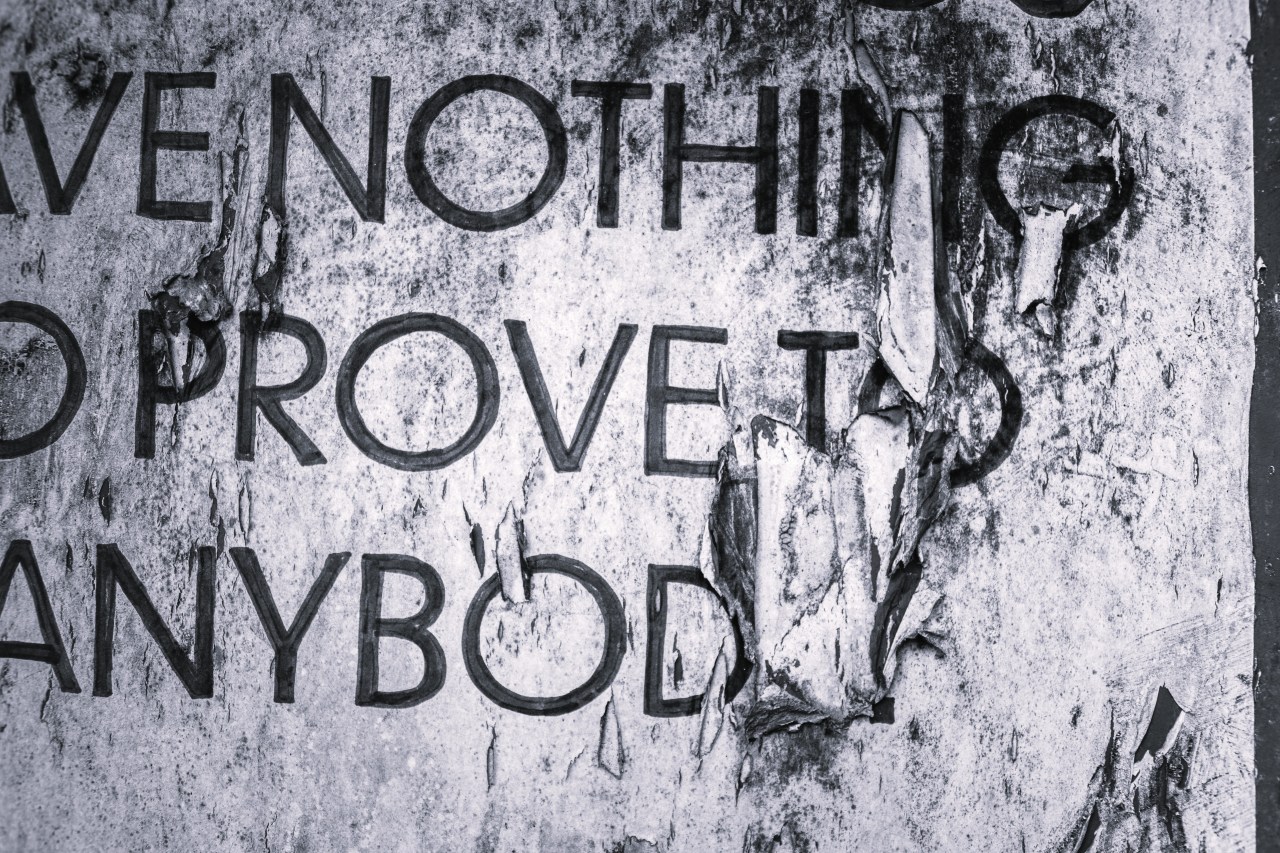
Stop Trying to Convince People Who Benefit From Your Doubt

There comes a point in many people’s lives when they realize they are exhausted.

Not because they’re carrying too much.

Because they are explaining too much.

Defending too much.

Justifying too much.

Convincing too much.

For years, I thought if I could just explain myself clearly enough, people would understand.

If I provided enough context, enough evidence, enough reasoning, eventually everyone would see where I was coming from.

But life taught me something different.

Not everyone wants understanding.

Some people prefer your uncertainty.

Some people prefer your hesitation.

Some people prefer the version of you that doubts yourself.

And the moment I understood that, everything changed.

Because you cannot convince someone to support your confidence if they benefit from your doubt.


Prefer to listen? The Audio Blog version is available here.


SOME PEOPLE PREFER THE VERSION OF YOU THAT QUESTIONS THEMSELF

The version of you that second-guesses every decision.

The version that asks for permission.

The version that constantly seeks reassurance.

The version that needs validation before taking action.

That version is predictable.

Manageable.

Influenceable.

And while healthy people want to see you grow beyond that version of yourself, not everyone does.

Some people become uncomfortable when you begin trusting your own judgment.

Not because your judgment is wrong.

Because your self-trust changes the relationship.


YOUR CONFIDENCE CHANGES THE POWER DYNAMIC

This is one of the most overlooked truths about personal growth.

When you begin trusting yourself, the dynamic changes.

You stop asking for approval.

You stop needing constant reassurance.

You stop looking to other people to tell you who you are.

And suddenly, people who were accustomed to having influence over your decisions find themselves with less control.

Some relationships adapt beautifully.

Others struggle.

Not because confidence is a problem.

Because confidence changes the balance.

And not everyone welcomes that change.


NOT EVERY QUESTION IS ASKED IN GOOD FAITH

At first, this can be difficult to recognize.

Questions sound innocent.

Why are you doing that?

Are you sure?

Have you thought this through?

Do you really think that’s a good idea?

Sometimes those questions come from care.

Sometimes they come from concern.

But sometimes they come from something else.

Sometimes they are designed to plant doubt.

Not to help you think.

To make you question yourself.

The difference often reveals itself in what happens after you answer.

A person seeking understanding listens.

A person invested in your uncertainty keeps moving the goalposts.

No answer is enough.

No explanation is sufficient.

No amount of clarity changes the conversation.

Because the goal was never clarity.


SELF-DOUBT MAKES YOU EASIER TO CONTROL

When you doubt yourself, you are more likely to seek external validation.

You ask other people what they think.

You wait for approval.

You hesitate before taking action.

You defer to louder voices.

And while that may seem harmless, it creates a dangerous habit.

You begin trusting other people’s opinions more than your own experience.

More than your own instincts.

More than your own wisdom.

Over time, that disconnect can become profound.

Because every time you ignore yourself, you weaken your relationship with yourself.


THE PEOPLE WHO LOVE YOU WANT YOU TO TRUST YOURSELF

Healthy people do not need your insecurity.

They do not require your uncertainty.

They do not benefit from your self-doubt.

In fact, they usually encourage the opposite.

They want to see you become more confident.

More capable.

More self-aware.

More independent.

The people who genuinely care about you understand that your growth is not a threat.

It is something to celebrate.

That distinction matters.

Because it helps you recognize who is supporting your evolution and who is resisting it.


YOU DO NOT NEED TO WIN THE ARGUMENT

One of the biggest mistakes people make is believing they can explain their way into acceptance.

If I just say it differently.

If I just provide more information.

If I just make them understand.

But some people already understand.

They simply disagree.

Or worse, they prefer the version of you that lacked confidence.

No amount of explanation changes that.

And once you realize this, something liberating happens.

You stop performing.

You stop defending.

You stop exhausting yourself trying to gain approval from people who have already decided how they feel.


STOP HANDING YOUR POWER TO THE JURY

Many people live as though their life is on trial.

Every decision gets presented to an invisible jury.

Friends.

Family.

Coworkers.

Former partners.

Strangers online.

Everyone gets a vote.

Everyone gets an opinion.

Everyone gets a chance to weigh in.

Everyone except the person actually living the life.

The truth is that most of those people will not live with the consequences of your decisions.

You will.

Which means their approval should never carry more weight than your own judgment.


SELF-TRUST IS BUILT ONE DECISION AT A TIME

Confidence is not something you magically wake up with.

It is built.

Decision by decision.

Boundary by boundary.

Truth by truth.

Every time you listen to yourself.

Every time you honor your values.

Every time you act in alignment with what you know is right for you.

You strengthen trust.

And the stronger that trust becomes, the less dependent you are on outside validation.

That is where real confidence comes from.

Not from convincing others.

From believing yourself.


FREEDOM BEGINS WHEN YOU STOP SEEKING PERMISSION

There is a unique kind of freedom that arrives when you stop needing everyone to agree.

When you stop asking people to validate your choices.

When you stop seeking approval from people who have no intention of giving it.

You realize that their acceptance was never the goal.

The goal was self-trust.

The goal was living authentically.

The goal was becoming the person you were meant to be.

And the people who genuinely support you will never require you to doubt yourself to make them comfortable.

Stop trying to convince people who benefit from your doubt.

Stop handing your confidence to people who have not earned that authority.

Stop asking for permission to trust yourself.

Because the moment you start believing your own wisdom, your life changes.

And self-trust is where freedom begins.


SLAY REFLECTION

S — See the Pattern
Who in your life seems most uncomfortable when you trust yourself?

L — Look at the Dynamic
How does your confidence change the relationship?

A — Acknowledge Your Authority
What decision have you been seeking validation for that you already know is right for you?

Y — Your Next Step
What is one area of your life where you can choose self-trust over outside approval this week?


CALL TO ACTION: JOIN THE CONVERSATION

I’d love to hear from you.

Have you ever realized that someone was more comfortable with your self-doubt than your confidence?

Share your story in the comments. Let’s cheer each other on.

And if you know someone who might need this reminder, send this to them.

Sometimes, all we need is a nudge.

Not Everyone Who Questions You Deserves an Answer

One of the most exhausting things we can do is feel obligated to explain ourselves to everyone who asks.

Why did you make that decision?

Why did you leave?

Why did you stay?

Why did you change?

Why do you believe that?

Why are you doing this now?

At first glance, those questions seem reasonable.

And sometimes they are.

Sometimes questions come from genuine curiosity.

Sometimes they come from a desire to understand.

Sometimes they come from care.

But not all questions are created equally.

Some questions are not invitations to understanding.

They are invitations to defend yourself.

And one of the most important lessons I have learned is this:

Not everyone who questions you deserves an answer.


Prefer to listen? The Audio Blog version is available here.


CURIOSITY AND JUDGMENT OFTEN SOUND THE SAME

This is where people get confused.

Both curiosity and judgment can arrive in the form of a question.

One seeks understanding.

The other seeks validation for an opinion that has already been formed.

The words may sound similar.

The energy behind them is not.

A curious person listens.

A judgmental person waits for their turn to disagree.

A curious person wants insight.

A judgmental person wants confirmation.

Learning to recognize the difference can save you a tremendous amount of emotional energy.


SOME PEOPLE ARE NOT ASKING TO LEARN

They are asking to challenge.

To criticize.

To discredit.

To create doubt.

To position themselves as right.

And if you have ever found yourself explaining the same thing repeatedly to someone who never seems satisfied, you have likely experienced this.

No explanation is enough.

No clarification is enough.

No amount of honesty changes the outcome.

Because the goal was never understanding.

The goal was opposition.


YOU DO NOT NEED TO DEFEND EVERY DECISION

One consequence of people-pleasing is believing that every choice requires justification.

That your boundaries require explanation.

That your growth requires approval.

That your decisions require consensus.

They do not.

You are allowed to make choices that other people do not understand.

You are allowed to change direction.

You are allowed to outgrow situations.

You are allowed to protect your peace.

Without presenting a detailed defense of your actions.


THE NEED TO EXPLAIN OFTEN COMES FROM FEAR

Fear of being misunderstood.

Fear of being judged.

Fear of disappointing people.

Fear of being seen as selfish, wrong, or unreasonable.

Those fears are deeply human.

But they can also become traps.

Because when we constantly seek permission to live our lives, we hand other people authority they were never meant to have.

And the more authority we hand away, the less connected we become to ourselves.


SOME QUESTIONS ARE DISGUISED DEMANDS

Not every question deserves an answer because not every question is actually a question.

Sometimes a question is a demand.

Explain yourself.

Justify yourself.

Convince me.

Prove it.

Make me comfortable with your decision.

But your responsibility is not to make everyone comfortable.

Your responsibility is to live honestly.

Those are not the same thing.


PEOPLE WHO RESPECT YOU WILL RESPECT YOUR ANSWER

One of the clearest signs of a healthy relationship is that people can accept an answer they do not necessarily agree with.

They may not understand your choice.

They may not have made the same decision.

But they respect your right to make it.

People who genuinely care about you do not require endless explanations.

They trust that you are capable of making decisions for yourself.

And that trust is a form of respect.


YOU ARE NOT RESPONSIBLE FOR EVERYONE’S OPINION

This truth took me a long time to learn.

No matter how clearly you explain yourself, some people will misunderstand.

Some people will disagree.

Some people will create a story that fits their own perspective.

And that is their right.

Just as it is your right to stop trying to manage it.

You cannot control how people interpret your life.

You can only control whether you live it authentically.


SILENCE IS SOMETIMES THE MOST POWERFUL ANSWER

We often think strength means having the perfect response.

The perfect explanation.

The perfect argument.

The perfect defense.

But sometimes strength looks very different.

Sometimes strength is choosing not to engage.

Not because you cannot answer.

Because you no longer feel obligated to.

That is not avoidance.

It is discernment.

Knowing where to best invest your energy.


NOT EVERY AUDIENCE DESERVES ACCESS

This may be one of the most important lessons of all.

Access is earned.

Not everyone deserves access to your thoughts.

Your motivations.

Your healing.

Your decisions.

Your dreams.

Some people will honor that information.

Others will weaponize it.

Wisdom is learning the difference.


SAVE YOUR ENERGY FOR PEOPLE WHO LISTEN

The goal is not to become closed off.

The goal is not to stop communicating.

The goal is to become selective.

To recognize the difference between conversations that create understanding and conversations that drain you.

To recognize who is listening.

And who is merely waiting for ammunition.

Your time is valuable.

Your energy is valuable.

Your peace is valuable.

Treat them accordingly.


YOU DO NOT OWE EVERYONE AN EXPLANATION

If someone asks a sincere question, answer if you choose.

If someone seeks understanding, offer it if it feels right.

But if someone is asking you to justify your existence, your boundaries, your growth, or your choices, remember this:

You are not obligated to participate.

Not everyone who questions you deserves an answer.

Some people deserve an explanation.

Some people deserve a conversation.

And some people deserve your silence.

Learning the difference is a form of freedom.


SLAY REFLECTION

S — See the Pattern
Is there someone in your life who repeatedly questions your choices without truly listening to your answers?

L — Look at the Motivation
Do their questions come from curiosity or judgment?

A — Acknowledge Your Right
What decision have you been over-explaining in an effort to gain understanding or approval?

Y — Your Next Step
How can you protect your energy while still communicating honestly?


CALL TO ACTION: JOIN THE CONVERSATION

I’d love to hear from you.

Have you ever realized that someone was questioning you not to understand you, but to challenge your right to choose?

Share your story in the comments. Let’s cheer each other on.

And if you know someone who might need this reminder, send this to them.

Sometimes, all we need is a nudge.

If You Are Constantly Trying to Prove Your Worth, You Have Already Forgotten Your Value

There was a time when I believed my worth had to be proven.

Through achievement. Through approval. Through being everything everyone needed me to be.

I thought if I worked harder, showed up more, gave more, did more, I would finally feel secure in who I was. That I would earn the validation I was searching for.

But no matter how much I did, it never felt like enough.

Because the problem was not my effort.

The problem was that I had forgotten something fundamental.

My value was never meant to be earned.


Prefer to listen? The Audio Blog version is available here.


Proving Yourself Is an Exhausting Cycle

When we believe our worth is something to be proven, we enter a loop that never truly ends.

We look for external confirmation that we are good enough. We measure ourselves by other people’s responses. We adjust our behavior to maintain approval.

And when that approval fades or shifts, we start over again.

It is exhausting.

Because external validation is unpredictable. It changes based on circumstances, opinions, and perspectives that are outside of our control.

If our sense of value depends on something unstable, we will always feel unstable too.


I Had to Face This in My Own Life

There were moments when I could clearly see how much I was performing for worth.

I said yes when I wanted to say no. I stretched myself thin trying to meet expectations that were not even mine. I shaped myself to fit environments where I did not truly belong.

And beneath all of that effort was a quiet belief.

If I just do enough, I will finally feel like I matter.

But that feeling never came from doing more.

It came from remembering who I was without needing to prove it.


Your Value Is Not Conditional

Your worth does not increase because someone recognizes it.

And it does not decrease because someone overlooks it.

Value is inherent.

It exists regardless of performance, productivity, or perception.

That can be difficult to accept in a world that often rewards output and comparison. But the truth remains.

You are not more valuable on your best day than you are on your hardest one.

When we understand that, the need to constantly prove ourselves begins to soften.


Overproving Often Hides Fear

Trying to prove your worth is often rooted in fear.

Fear of rejection. Fear of not being enough. Fear of being misunderstood or overlooked.

Those fears can drive us to overextend, overexplain, and overdeliver.

But when we operate from fear, our actions are not aligned with our true selves.

They are attempts to control how we are perceived.

And control over perception is never guaranteed.

What is guaranteed is how we treat ourselves.


Self-Worth Changes How You Show Up

When you begin to reconnect with your value, your behavior shifts.

You stop chasing approval and start choosing alignment. You stop overgiving and start giving intentionally. You stop shrinking and start standing in your truth.

This does not mean you stop caring about others.

It means you stop abandoning yourself to be accepted.

And that shift creates stronger, healthier relationships.

Because people connect more deeply with authenticity than performance.


Boundaries Reinforce Value

One of the clearest expressions of self-worth is boundaries.

When you know your value, you protect your time, your energy, and your emotional space.

You recognize when something is not aligned. You allow yourself to step back when needed. You understand that saying no is not rejection, it is clarity.

Boundaries are not about pushing people away.

They are about staying connected to yourself.

And when you stay connected to yourself, your value becomes steady rather than situational.


You Do Not Have to Perform to Belong

This is a powerful shift.

You do not need to earn your place by constantly proving your worth. You do not need to exhaust yourself to be accepted. You do not need to become someone else to be valued.

The right environments, the right people, and the right opportunities will not require you to perform for belonging.

They will recognize your value as it is.

And until you believe that, you may continue seeking validation in places that cannot give it to you.


Remember Who You Are

At some point, we all forget.

We forget our strength. Our resilience. Our inherent worth.

Life, experiences, and challenges can cloud that truth.

But it is still there.

Remembering your value is not about becoming someone new.

It is about reconnecting with who you have always been beneath the noise of expectation and comparison.

And once you remember, everything begins to shift.

You stop trying to prove your worth.

Because you finally know you already have it.


SLAY Reflection

S — See the Pattern
Where in your life do you feel the need to prove your worth?

L — Look Beneath It
What fear might be driving that need for validation?

A — Affirm Your Value
What is one truth about your worth that exists regardless of external approval?

Y — Your Next Step
What would change if you showed up today believing you were already enough?


Call to Action: Join the Conversation

I’d love to hear from you.
Have you ever realized you were trying to prove your worth, and what helped you shift out of that pattern?

Share your story in the comments. Let’s cheer each other on.

And if you know someone who needs this reminder, send this to them.
Sometimes, all we need is a nudge.