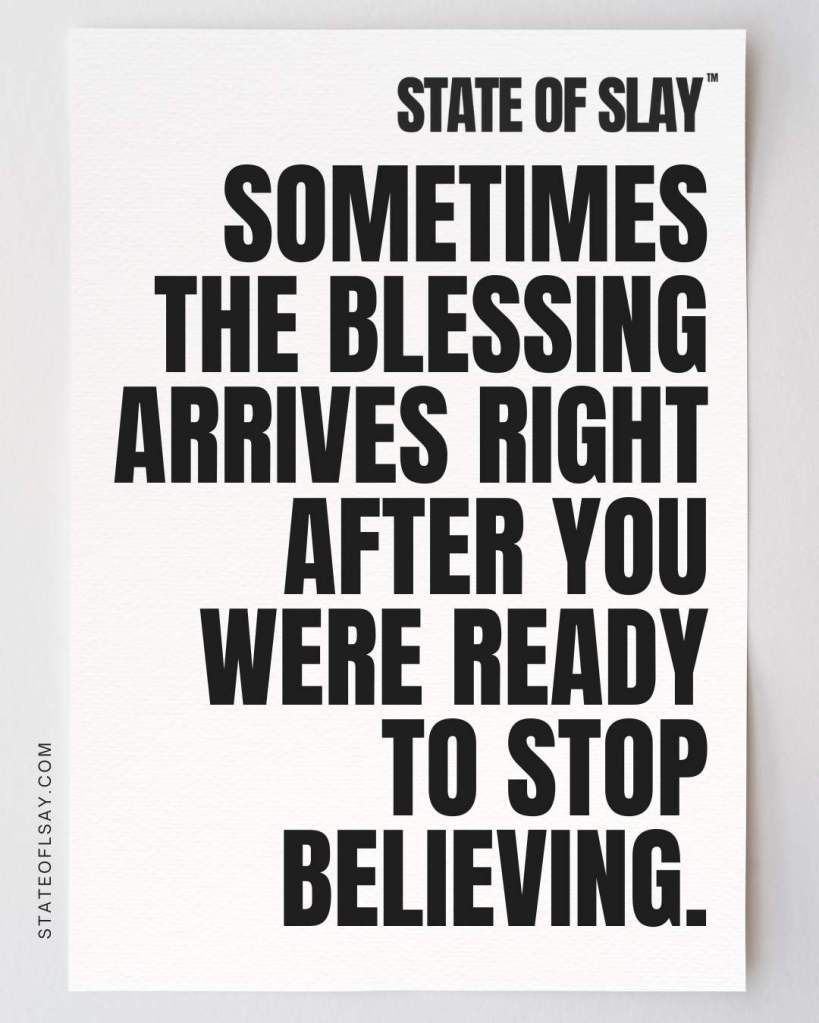

Why allowing ourselves to believe in better possibilities can be an act of courage.
Something happened recently that made me feel something I hadn’t genuinely felt in years.
Hope.
Not the kind of hope we offer ourselves when we’re trying to stay positive. Not the kind we manufacture because we know we’re supposed to believe things will get better.
I’m talking about that unmistakable feeling that something might actually be changing. That perhaps the future doesn’t have to look like the past. That possibilities we had almost stopped considering might not be so impossible after all.
And what struck me was how unfamiliar that feeling had become.
I hadn’t realized just how much I’d been protecting myself from disappointment until I experienced a moment that made me want to believe again.
It got me thinking about the courage it sometimes takes to allow ourselves to hope.
Because when you’ve been disappointed enough times, hope can begin to feel less like a comfort and more like a risk.
Prefer to listen? The Audio Blog version is available here.
WHEN HOPE STARTS TO FEEL DANGEROUS
We don’t usually think of hope as something that requires courage.
We associate courage with standing up for ourselves, confronting our fears, making difficult decisions, or walking away from situations that no longer serve us.
Hope seems softer than that.
But hope asks something of us that can feel surprisingly difficult.
It asks us to believe in a possibility that hasn’t happened yet.
And when life has repeatedly taught us that things don’t always work out, believing in something better can feel like setting ourselves up for another disappointment.
So we become careful.
We lower our expectations. We stop getting excited too soon. We remind ourselves not to get our hopes up.
Eventually, we may stop hoping altogether.
Not because we’ve stopped wanting things to improve, but because wanting something and believing it might happen are two very different experiences.
Sometimes we decide that expecting less is the safest way to hurt less.
And for a while, that can feel like wisdom.
WHEN DISAPPOINTMENT BECOMES OUR EXPECTATION
Disappointment has a way of changing how we approach the future.
One difficult experience doesn’t necessarily make us lose hope. But when disappointments accumulate, they can begin to influence what we believe is possible.
We start anticipating the next setback before we’ve had a chance to appreciate the current opportunity.
We look for reasons something won’t work rather than allowing ourselves to consider how it might.
And sometimes, even when something good happens, we’re reluctant to enjoy it because we’re already preparing for what might go wrong.
There’s a difference between learning from experience and allowing experience to determine every expectation we have.
The past can teach us to be more thoughtful, more discerning, and more prepared.
But it cannot tell us with certainty what the future holds.
Just because something hasn’t changed yet doesn’t mean it never will.
That’s an important distinction, especially when we’ve spent a long time waiting for things to get better.
SOMETIMES WE MISTAKE HOPELESSNESS FOR REALISM
There’s a particular kind of confidence that can come from expecting the worst.
If we assume things won’t improve, we don’t have to worry about being caught off guard when they don’t.
We can tell ourselves we saw it coming.
We can feel prepared.
We can even convince ourselves that people who remain hopeful simply don’t understand how the world works.
But pessimism isn’t automatically wisdom, just as optimism isn’t automatically foolishness.
Being realistic means acknowledging what we know, recognizing what we don’t, and allowing room for outcomes we cannot predict.
It doesn’t mean assuming that yesterday’s disappointments are tomorrow’s guarantees.
Sometimes what we call realism is actually fear wearing the clothes of experience.
We’ve been hurt, discouraged, or let down, and we’ve decided that the safest response is to stop expecting anything different.
But protecting ourselves from disappointment can come at a cost.
We may also begin protecting ourselves from possibility.
HOPE DOESN’T REQUIRE US TO IGNORE REALITY
One of the reasons I think people become uncomfortable with hope is that we often confuse it with blind optimism.
We imagine that being hopeful means believing everything will work out, refusing to acknowledge problems, or insisting on finding something positive in every difficult situation.
But that’s not what hope has to be.
We can recognize that something is broken and still believe it can be repaired.
We can acknowledge that progress is slow and still appreciate that progress is happening.
We can understand that one encouraging moment doesn’t erase years of difficulty.
Hope doesn’t require us to pretend the obstacles aren’t there.
It simply allows us to recognize that the obstacles may not be permanent.
And sometimes that’s enough.
We don’t need certainty to feel hopeful.
We don’t need guarantees.
We don’t even need to know exactly how things will improve.
We can simply allow ourselves to believe that improvement is possible.
Hope isn’t the refusal to see what’s wrong. It’s the willingness to imagine what could be right.
THE VULNERABILITY OF WANTING SOMETHING BETTER
There’s something deeply vulnerable about admitting that we want things to change.
Whether we’re hoping for a healthier relationship, a new opportunity, a personal breakthrough, or a better future, hope requires us to acknowledge that something matters to us.
And once we admit that something matters, we also acknowledge that losing it, or never experiencing it, could hurt.
That’s where the courage comes in.
It’s easier to say we don’t care.
It’s easier to dismiss possibilities before they have a chance to develop.
It’s easier to insist we aren’t expecting anything.
Because if we never admit what we’re hoping for, we can convince ourselves that disappointment won’t affect us.
But pretending we don’t care doesn’t necessarily make us care any less.
Sometimes it just makes us less willing to participate in the things that matter to us.
And there’s a difference between protecting our hearts and closing them.
WHEN SOMETHING REMINDS US THAT CHANGE IS POSSIBLE
Every once in a while, something happens that interrupts the story we’ve been telling ourselves.
It might be an unexpected opportunity.
A conversation that changes our perspective.
Someone showing up in a way we didn’t think they would.
A small victory after a long period of setbacks.
Or a moment when something that once seemed impossible suddenly feels within reach.
The circumstances themselves may not have changed very much.
There may still be enormous challenges ahead.
But something shifts in how we see those challenges.
We begin to imagine a different outcome.
And perhaps for the first time in a long time, the future feels a little less predetermined.
That’s what I experienced recently.
Nothing about that moment guaranteed what would happen next.
But it reminded me that change is possible, even when we’ve spent years wondering whether we’ll ever see it.
And I realized how much I’d missed that feeling.
Not certainty.
Not relief that everything was finally resolved.
Just hope.
WE DON’T HAVE TO WAIT UNTIL EVERYTHING IS FIXED
One of the traps we can fall into is believing that hope should be the reward for things getting better.
We’ll feel hopeful when the situation improves.
When the relationship changes.
When the opportunity arrives.
When the uncertainty disappears.
When we finally have proof that things are moving in the right direction.
But if we require certainty before allowing ourselves to hope, we may spend a very long time waiting.
Hope often arrives before the outcome.
Sometimes it arrives before we have much evidence that anything will change.
And that doesn’t make it foolish.
It makes it an expression of possibility rather than a prediction.
We can be hopeful without making promises to ourselves about what will happen.
We can celebrate progress without assuming the work is finished.
We can appreciate an encouraging moment without asking it to carry the weight of every disappointment that came before it.
Something good doesn’t have to solve everything to mean something.
We can let it matter.
HOPE AND ACTION BELONG TOGETHER
Of course, hope alone doesn’t change our circumstances.
We can hope for healthier relationships while continuing the same unhealthy patterns.
We can hope for new opportunities without taking steps toward them.
We can hope for a better future while avoiding the choices that might help create one.
Hope becomes more meaningful when we’re willing to participate in the possibilities we imagine.
It can motivate us to try again.
To speak up.
To make a different choice.
To become involved rather than remain on the sidelines.
To stop assuming our efforts won’t matter.
And sometimes the most important change hope creates is the way we approach our own lives.
When we believe that nothing can improve, it becomes harder to find a reason to try.
But when we allow ourselves to consider that something might improve, we may become more willing to contribute to that possibility.
Hope doesn’t replace action.
It can give us a reason to act.
LETTING YOURSELF FEEL GOOD ABOUT SOMETHING GOOD
I think this is something we sometimes forget.
We are allowed to feel encouraged.
We are allowed to celebrate a step forward, even when there’s still a long road ahead.
We are allowed to experience joy without immediately reminding ourselves of everything that could go wrong.
Being aware of the world’s problems doesn’t require us to deny ourselves moments of optimism.
And acknowledging progress doesn’t mean we’ve forgotten how much work remains.
Sometimes we become so accustomed to preparing for disappointment that we don’t know what to do when something gives us a reason to feel hopeful.
We question it.
We minimize it.
We remind ourselves not to get carried away.
But perhaps we don’t always need to rush in and manage our expectations.
Perhaps sometimes we can simply allow ourselves to enjoy the moment.
Not because we know what comes next.
But because this moment matters, too.
THE COURAGE TO BELIEVE AGAIN
I don’t know exactly what the future holds.
None of us do.
There will be setbacks. There will be disappointments. There will be moments when the progress we thought we were making feels painfully slow.
Hope doesn’t protect us from any of that.
But neither does hopelessness.
Expecting disappointment doesn’t prevent it from hurting.
Refusing to believe in something better doesn’t make uncertainty disappear.
It simply changes how we experience the time between now and whatever comes next.
And I’d rather not spend that time assuming that nothing good can happen.
I don’t want to confuse being prepared with being defeated.
I don’t want to become so practiced at expecting the worst that I lose the ability to recognize something better when it appears.
And I don’t want years of disappointment to convince me that hope is something I should be embarrassed to feel.
Because maybe courage isn’t always about being strong enough to face what frightens us.
Sometimes it’s about being willing to feel something that makes us vulnerable.
To believe again.
To care again.
To imagine something better, even when we know there’s no guarantee we’ll get it.
And maybe that’s what makes hope so powerful.
It doesn’t promise us that everything will be okay.
It reminds us that everything doesn’t have to stay the way it is.
SLAY REFLECTION
S — See Where You’ve Stopped Hoping
Is there an area of your life where you’ve stopped allowing yourself to imagine things improving? Have you genuinely accepted the situation, or have you simply become afraid of being disappointed again?
L — Look Beyond Your Past Experiences
Are you allowing previous disappointments to determine what you believe is possible today? What might change if you treated your past as information rather than a prediction?
A — Allow Yourself to Feel Encouraged
When something positive happens, do you let yourself appreciate it, or do you immediately start preparing for what might go wrong? Consider what it would feel like to enjoy progress without requiring a guarantee.
Y — Your Next Step Toward Possibility
What’s one small action you could take toward something you’ve almost stopped hoping for? You don’t have to know how everything will turn out. You only have to decide whether the possibility is worth exploring.
CALL TO ACTION: JOIN THE CONVERSATION
Have you ever experienced a moment when hope returned unexpectedly?
Maybe something happened that reminded you things could change. Maybe you received encouraging news after a long period of uncertainty. Or perhaps you simply woke up one day and realized you were ready to believe in something better again.
I’d love to hear about it.
Have you ever found yourself afraid to hope because you didn’t want to experience another disappointment? And what helped you begin to believe in possibility again?
Share your thoughts in the comments. Your experience might be exactly what someone else needs to hear, especially if they’re struggling to imagine a future that looks different from their present.
And if someone in your life has been carrying disappointment for a long time, consider sharing this article with them. Not to promise them that everything will work out, but to remind them that their story is still unfolding.
As for me, I’m allowing myself to feel hopeful.
I don’t know what happens next.
But for the first time in a long time, I’m looking forward to finding out.