
Black-and-white photograph of a person in a hoodie, gripping their hair with both hands, their face obscured by strands of hair.

We’ve Confused Being Loud With Being Important

Apparently, the squeaky wheel doesn’t just get the grease anymore.

It gets a podcast.

We’ve created a world where the loudest person in the room often gets the most attention, regardless of whether they have anything worthwhile to say.

And it’s easy to roll our eyes at the people who seem determined to turn every disagreement into a public spectacle.

But here’s something worth considering.

How often do we participate in the very behavior we’re criticizing?

How often do we feel compelled to correct someone, defend our position, or make absolutely certain our opinion has been heard?

And how often is it because we genuinely have something important to contribute?

Or because we simply can’t stand the thought of letting someone else have the last word?


Prefer to listen? The Audio Blog version is available here.


THE NEED TO BE HEARD

Most of us want to feel that our thoughts and opinions matter.

There’s nothing wrong with that.

But there’s a difference between wanting to be understood and needing everyone to agree with us.

Sometimes we enter a conversation hoping to exchange ideas.

Other times, whether we realize it or not, we’re looking for an audience.

We want confirmation that we’re right. We want someone to acknowledge our intelligence, our experience, or our perspective.

And when that doesn’t happen, we get louder.

We repeat ourselves. We explain things another way. We start gathering evidence for a case nobody asked us to present.

I’ve certainly caught myself doing it.

And at some point, it’s worth asking whether we’re still having a conversation or simply trying to win.

Because when being heard becomes more important than listening, communication stops being an exchange.

It becomes a competition.


NOT EVERY DISAGREEMENT REQUIRES A WINNER

Have you ever found yourself arguing about something that, five minutes earlier, you didn’t particularly care about?

But now you’re invested.

You’ve made your point. Someone challenged it. And suddenly, walking away feels like admitting defeat.

So you keep going.

Not necessarily because the issue matters.

But because your ego has decided it does.

And the longer the argument continues, the harder it becomes to let go.

We can become so attached to proving we’re right that we stop considering whether the conversation is even worth having.

Here’s a question I’ve learned to ask myself.

Am I trying to communicate something meaningful, or am I trying to satisfy my need to be right?

Because those two things can feel remarkably similar in the moment.

And recognizing the difference can save us an extraordinary amount of unnecessary conflict.


WE HELP CREATE THE NOISE WE COMPLAIN ABOUT

There’s another side to this.

We complain about the outrageous behavior that dominates social media, yet we often help keep it alive.

We share the ridiculous video because we can’t believe someone behaved that way.

We forward the offensive comment because everyone needs to see how awful it is.

We spend twenty minutes arguing with someone who clearly has no interest in understanding another perspective.

And then we wonder why we’re surrounded by so much nonsense.

Well, we keep inviting it in.

Now, I’m not suggesting we ignore harmful behavior or remain silent when something genuinely deserves to be challenged.

But not every foolish statement requires our personal intervention.

Not every argument needs another participant.

And not every person determined to provoke a reaction deserves the satisfaction of getting one.

Sometimes the most effective response is refusing to provide the attention someone is trying so desperately to get.

That’s not weakness.

That’s discernment.


YOU DON’T HAVE TO PROVE YOUR IMPORTANCE

I think one of the more uncomfortable things we can recognize about ourselves is how easily our need to feel important can influence our behavior.

We want our opinions respected.

We want our contributions acknowledged.

We want to know that what we have to say matters.

But sometimes we start measuring our worth by how much attention we receive.

And when that happens, we can find ourselves speaking when we should be listening, arguing when we could be learning, or demanding recognition when none is necessary.

I’ve come to understand that I don’t need to participate in every conversation to have something valuable to contribute.

I don’t need to correct every misconception.

And I certainly don’t need to win every argument.

There are times when speaking up is important, even when it’s uncomfortable or unpopular.

But there are also times when our desire to be heard has very little to do with the issue at hand.

And a great deal to do with us.


KNOW WHEN YOUR VOICE MATTERS

Being thoughtful doesn’t mean being silent.

It means recognizing the difference between speaking with purpose and speaking simply to be noticed.

It means listening long enough to consider that someone else might know something we don’t.

It means being willing to change our minds without treating it as a personal defeat.

And sometimes, it means recognizing that the conversation has stopped being productive and choosing to leave it there.

The next time you feel yourself getting louder, more defensive, or increasingly determined to have the last word, consider what’s actually driving that reaction.

Is there something important that needs to be said?

Or is there something inside you that needs to feel important?

Because those are two very different needs.

You don’t have to be the loudest person in the room to have something worth saying.

And you don’t have to have the last word to know your voice matters.


SLAY REFLECTION

S: When you feel compelled to make your point, are you trying to be understood or trying to prove you’re right?

L: How often do you listen with genuine curiosity rather than preparing your response?

A: Are you giving unnecessary attention to arguments or behavior you claim to dislike?

Y: What would change if you became more selective about when and why you choose to speak?


CALL TO ACTION: JOIN THE CONVERSATION

Have you ever caught yourself continuing an argument long after you realized it wasn’t worth having? Or recognized that your need to be heard was getting in the way of actually listening?

I’d love to hear your thoughts in the comments. Sometimes recognizing these habits in ourselves is the first opportunity we have to change them.

And if this article resonated with you, consider sharing it with someone who might recognize a little of themselves in these words. Sometimes a different perspective is all it takes to help us reconsider how we communicate, listen, and respond to others.

And sometimes, all we need is a nudge.

The Quality of Your Life Is Determined by the Quality of Your Questions

Every day, your mind asks thousands of questions.

Most of them happen so quickly you never notice them.

Why did they say that?

What if I fail?

Why does this always happen to me?

What if I’m not enough?

What if things never change?

The remarkable thing is that your brain doesn’t spend much time deciding whether those questions are helpful.

It simply starts looking for answers.

That’s how we’re wired.

Ask your mind a fearful question, and it will search for evidence to support your fear.

Ask it a hopeful question, and it will begin looking for possibilities instead.

The quality of your life isn’t determined solely by the answers you find.

It’s determined by the questions you choose to ask.


Prefer to listen? The Audio Blog version is available here.


YOUR MIND IS ALWAYS LOOKING FOR EVIDENCE

Think of your mind as a search engine.

Type in the question:

“Why am I such a failure?”

Without realizing it, your brain begins collecting evidence.

Past mistakes.

Embarrassing moments.

Missed opportunities.

It ignores much of the success you’ve had because that wasn’t the assignment.

Now ask a different question.

“What have I overcome that I once thought I couldn’t?”

Suddenly, your mind searches a completely different library.

It remembers challenges you survived.

Skills you developed.

Relationships you strengthened.

Growth you almost forgot.

The question changed.

So did the evidence.


SOME QUESTIONS KEEP YOU STUCK

There are questions that create movement.

And there are questions that create prisons.

Questions like…

Why me?

Why do I always attract the wrong people?

What’s wrong with me?

Why can’t I get anything right?

These questions feel productive because we’re thinking.

But many of them simply keep us circling the same emotional neighborhood.

Not every question deserves your attention.

Especially if it keeps leading you to the same dead end.


BETTER QUESTIONS CREATE BETTER POSSIBILITIES

This doesn’t mean pretending everything is fine.

It means becoming intentional about where your attention goes.

Instead of asking…

Why did this happen to me?

Try asking…

What can I learn from this?

Instead of…

Why don’t they appreciate me?

Ask…

Am I giving my energy to people who are capable of appreciating me?

Instead of…

What if I fail?

Ask…

What if I surprise myself?

One question searches for limitations.

The other searches for opportunities.


CURIOSITY IS MORE POWERFUL THAN JUDGMENT

Judgment closes the conversation.

Curiosity opens it.

When we judge ourselves, we stop exploring.

“I’m just bad at relationships.”

“I’m not creative.”

“I’ve always been anxious.”

Those become conclusions.

And conclusions rarely invite growth.

Curiosity asks something different.

What experiences shaped this belief?

Is this actually true?

What evidence might I be overlooking?

What would happen if I approached this differently?

Curiosity creates room for change.


THE QUESTIONS YOU ASK YOURSELF BECOME YOUR INNER VOICE

Many people believe their inner voice simply exists.

But much of it is built from repeated questions.

If every day you ask yourself whether you’re enough, your inner voice will eventually begin sounding like a constant performance review.

If every day you ask yourself how you can grow, your inner voice becomes something entirely different.

It becomes a coach instead of a critic.

The conversation you have with yourself quietly becomes the relationship you have with yourself.

Choose that conversation wisely.


SOMETIMES THE BEST QUESTION HAS NO IMMEDIATE ANSWER

Not every meaningful question can be answered today.

Some require patience.

Healing.

Experience.

Time.

Questions like…

Who am I becoming?

What truly matters to me?

What kind of life do I want to build?

Those answers unfold over years, not hours.

But asking them changes how you live long before you fully answer them.


YOUR QUESTIONS SHAPE YOUR DECISIONS

Every decision begins with a question.

Should I stay?

Should I leave?

Should I speak up?

Should I take the chance?

Should I forgive?

Should I let go?

The better the question, the wiser the decision.

Sometimes we become so focused on making the right choice that we forget to examine the question that led us there.

The quality of your decisions rarely exceeds the quality of the questions behind them.


LIFE CHANGES ONE QUESTION AT A TIME

Personal growth isn’t usually the result of one life-changing answer.

It’s the result of asking better questions over and over again.

Questions that challenge assumptions.

Questions that invite courage.

Questions that replace fear with curiosity.

Questions that move your attention away from blame and toward responsibility.

Every meaningful change in your life likely began with a simple question.

What if?

Why not?

Could there be another way?


ASK THE QUESTIONS THAT MOVE YOU FORWARD

You don’t need to have every answer today.

None of us do.

But you can become more intentional about the questions you’re asking yourself.

Ask questions that build wisdom instead of shame.

Questions that encourage growth instead of fear.

Questions that create possibility instead of limitation.

Because your mind will always search for answers.

The only question is whether it’s searching in the right direction.

The quality of your life is determined by the quality of your questions.

So ask yourself the kind of questions that help you become the person you’re capable of becoming.


SLAY REFLECTION

S — See Your Questions
What question do you ask yourself most often, and is it helping you move forward or keeping you stuck?

L — Look for a Better Question
How could you reframe one recurring question into something more empowering?

A — Ask With Intention
What question would encourage growth instead of reinforcing fear or self-doubt?

Y — Your Next Step
This week, notice one limiting question you ask yourself and intentionally replace it with one that opens the door to possibility.


CALL TO ACTION: JOIN THE CONVERSATION

I’d love to hear from you.

What is one question that changed the way you see yourself or your life?

Share your story in the comments. Your perspective may be exactly what someone else needs to hear today.

And if you know someone who could use this reminder, send this to them.

Sometimes, all we need is a better question.

Slay Say

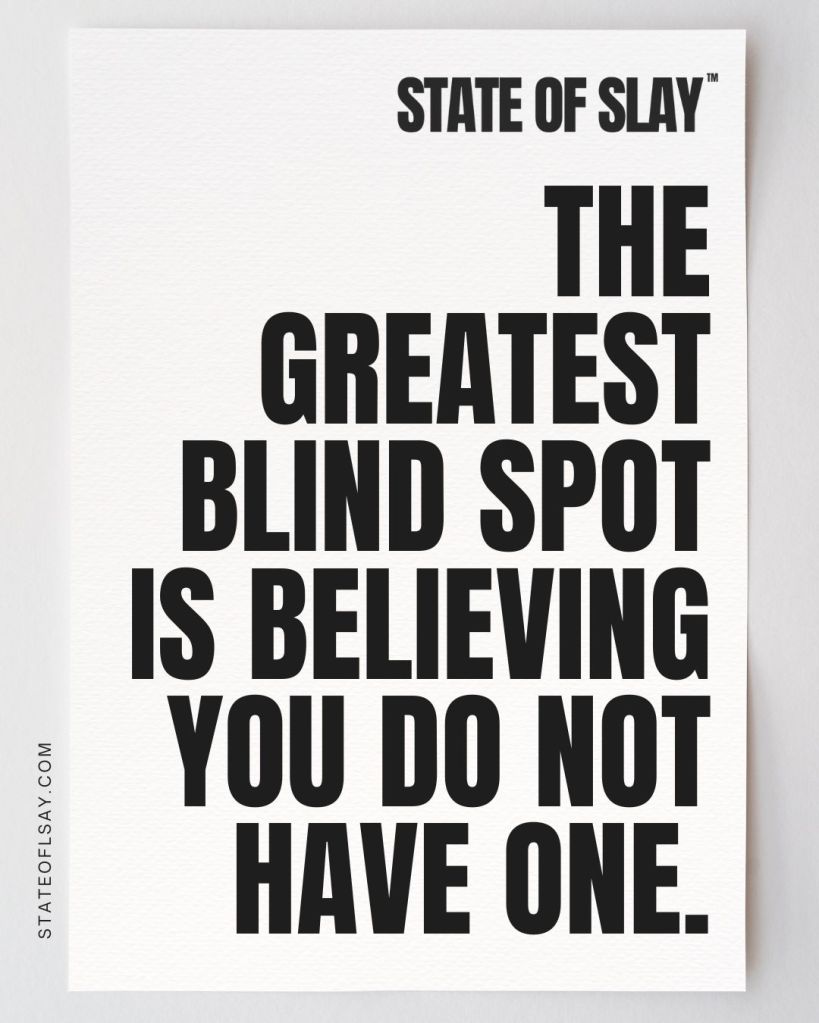
The Blind Spot We All Carry

Perspective is a powerful thing. It shapes how we interpret events, understand other people, and navigate the world around us.

But perspective can also quietly become a limitation when we begin to treat it as the complete picture rather than just one angle of a much larger reality.

Every person carries experiences, assumptions, and beliefs that influence how they see the world. Those influences are not inherently wrong, but they can become dangerous when we stop questioning them or refuse to consider that someone else may see something we cannot.

Growth often begins with humility. The willingness to pause, listen, and recognize that our view may not capture the full truth can open the door to deeper understanding and stronger relationships.

This is your reminder that wisdom is not found in believing we see everything clearly, but in recognizing that our vision will always have edges.

Slay on.