Black and white image of a woman standing beside a car on an open road, representing leaving old ways of thinking behind and moving toward a new life.

Slay Say

When Survival Starts Making the Decisions

Survival teaches us things.

Sometimes very useful things.

How to anticipate trouble.

How to protect ourselves.

How to need less.

How to stay alert.

How to keep moving when stopping doesn’t feel like an option.

How to prepare for disappointment before it has a chance to surprise us.

And when those ways of thinking help us through something difficult, they can become deeply ingrained.

We stop recognizing them as responses to what happened.

They simply become the way we live.

We expect people to leave, so we never fully depend on anyone.

We’ve experienced financial instability, so spending money on ourselves feels dangerous even when we can afford it.

We’ve been rejected, so we look for reasons not to try before someone else can tell us no.

We’ve had our trust broken, so uncertainty immediately feels like evidence that something is wrong.

We’ve learned that being useful keeps us valued, so rest makes us uncomfortable.

We’ve had to fight for everything, so ease makes us suspicious.

These responses make sense when you understand where they came from.

They may have protected you.

They may have helped you endure circumstances you couldn’t immediately change.

They may have been exactly what you needed then.

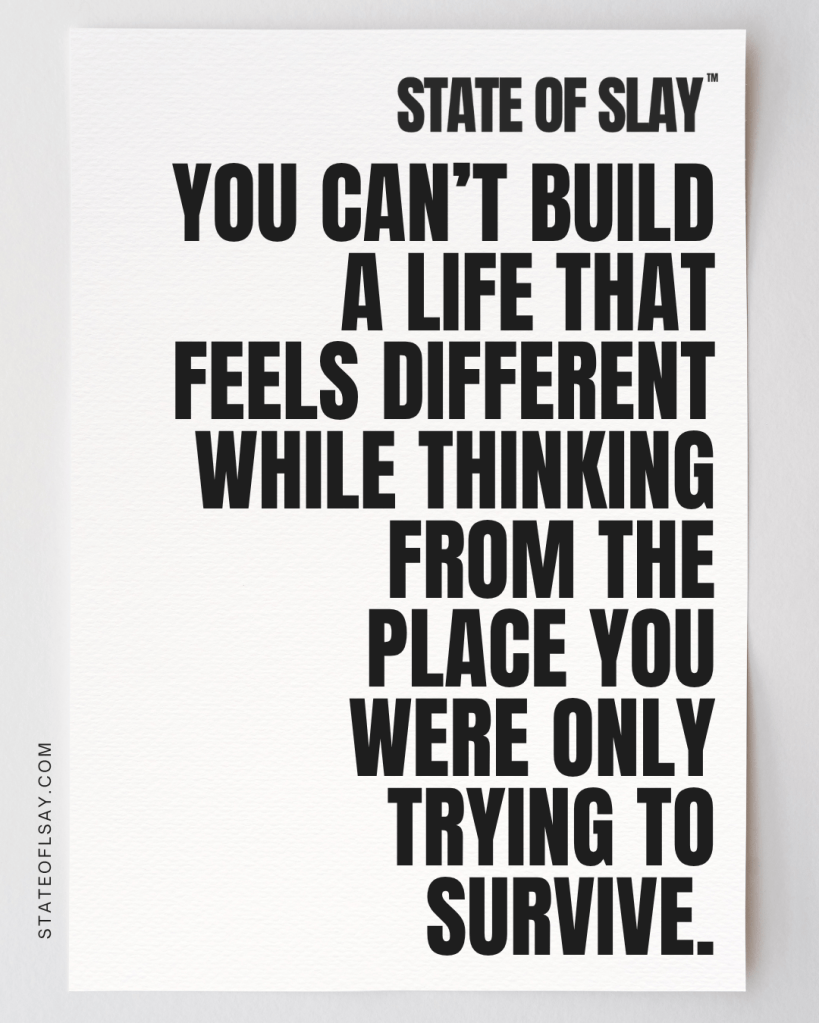
But survival is designed to get you through something.

It isn’t necessarily designed to show you how to live once you’re through it.

And that distinction matters.

Because sometimes our circumstances change before our thinking does.

The danger is gone, but we’re still bracing.

The relationship is safe, but we’re still waiting for betrayal.

There is enough, but we’re still behaving as though everything could disappear tomorrow.

An opportunity appears, but instead of asking what might be possible, we immediately calculate everything that could go wrong.

The life around us has changed.

But internally, we’re still responding to the old one.

That can make growth confusing.

You may genuinely want something different while repeatedly making choices that recreate what you already know.

Not because you’re incapable of change.

Because familiarity can feel safer than possibility, even when familiarity wasn’t particularly good.

Possibility asks something different from us.

It asks us to imagine outcomes we don’t have evidence for yet.

To trust people who haven’t hurt us.

To take chances without guarantees.

To believe that ease doesn’t always have a hidden cost.

To allow ourselves to want something instead of only calculating what will protect us.

That doesn’t mean abandoning everything your past taught you.

Some lessons deserve to come with you.

Discernment.

Boundaries.

Resilience.

The ability to recognize patterns.

Knowing when something doesn’t feel right.

Growth isn’t about becoming careless simply because you’re tired of being cautious.

It’s about learning the difference between wisdom and armor.

One helps you navigate what’s happening.

The other can keep you reacting to what already happened.

And sometimes the question isn’t whether you’re capable of creating the life you want.

It’s whether the rules you developed for surviving your old life are still quietly deciding what you believe is possible in the next one.

You don’t have to shame yourself for those rules.

They existed for a reason.

But you are allowed to examine them.

To ask whether they still belong here.

To discover that safety doesn’t always require vigilance.

That love doesn’t always require earning.

That opportunity doesn’t always end in disappointment.

That peace doesn’t mean something bad must be coming.

That you can make decisions based on where you want to go, not only on what you never want to experience again.

Your past can inform your future without continuing to design it.

This is your reminder:

You can honor what protected you without letting it decide what is possible for you now.

Slay on.
Black and white image of a woman looking at her reflection, representing personal growth, change, and evolving beyond an earlier version of yourself.

Slay Say

When Who You Were Can’t Take You Where You’re Going

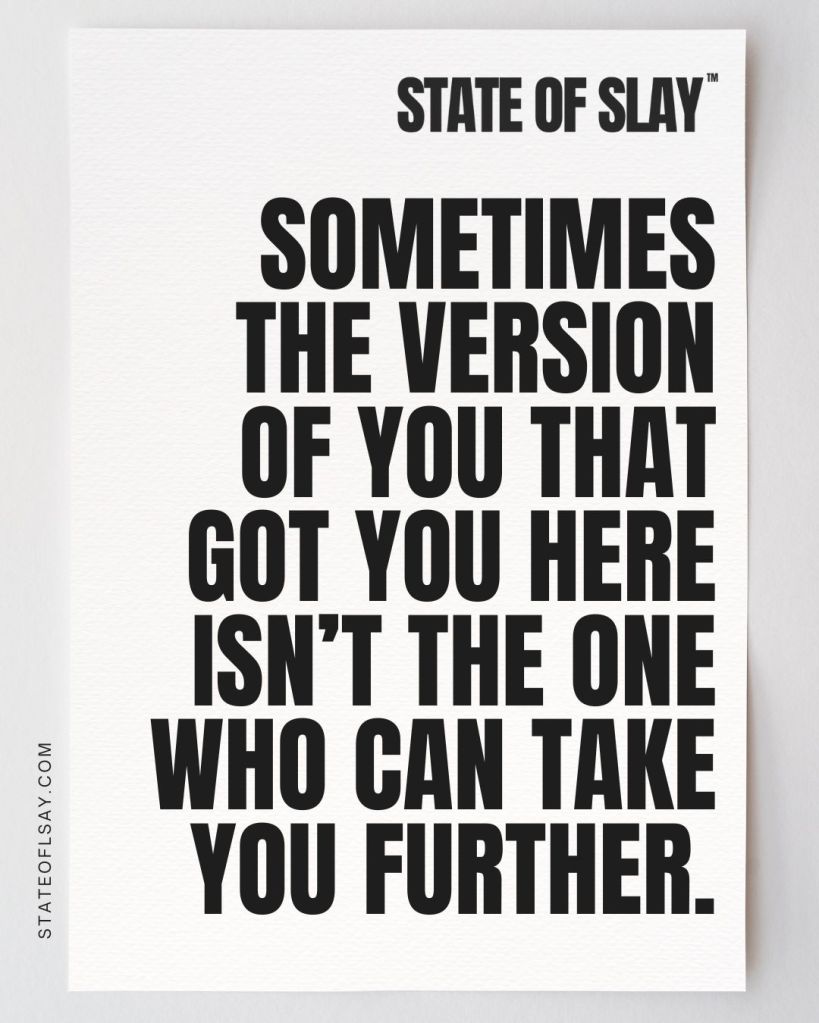
Every version of you has had a job to do.

There was a version who learned how to survive.

One who became independent because relying on other people felt risky.

One who learned to keep the peace.

One who worked harder than everyone else because achievement became proof of worth.

One who stayed guarded because being vulnerable had once been expensive.

One who said yes because disappointing people felt worse than disappointing yourself.

Those versions of you weren’t mistakes.

They developed for reasons.

They helped you navigate the life you were living with the tools, understanding, and circumstances you had at the time.

Some of them got you through things you weren’t sure you could survive.

But something can save you in one chapter and limit you in the next.

The independence that once protected you can make it difficult to ask for help.

The walls that kept you safe can prevent anyone from getting close.

The drive that helped you succeed can make rest feel like failure.

The ability to keep everyone happy can leave you disconnected from what you actually want.

The habit of expecting the worst can protect you from disappointment while making it difficult to recognize when something good has arrived.

And that’s where growth gets complicated.

Because we become attached to the qualities that helped us get here.

We call them personality.

We say, That’s just who I am.

But sometimes what feels like identity is actually adaptation.

And eventually, life may ask something different from you.

Not because who you were was wrong.

Because where you’re going requires something new.

Maybe strength now means letting someone help you.

Maybe confidence means admitting you don’t know.

Maybe loyalty means choosing yourself.

Maybe courage means becoming visible after years of making yourself small.

Maybe success means building a life you actually enjoy instead of one that simply looks impressive.

Growth doesn’t always require becoming more.

Sometimes it requires releasing what you no longer need.

That can feel surprisingly uncomfortable.

There is familiarity in our old ways of being, even when they’re exhausting.

We know how to survive with them.

We know who we are inside them.

Changing means entering a space where the old rules no longer apply and the new ones haven’t become natural yet.

You may feel less capable for a while.

Less certain.

Less like yourself.

But perhaps that discomfort isn’t evidence that you’re losing yourself.

Perhaps you’re discovering which parts of you were built for a life you’re no longer living.

You don’t have to reject who you were to become who you’re becoming.

Thank that version of you.

Honor what they carried.

Recognize what they made possible.

Then allow them to put the bags down.

You can appreciate the person who got you this far without asking them to lead you forever.

Because the next chapter may require a version of you who trusts more, receives more, risks differently, speaks more clearly, rests without guilt, or finally chooses according to what you want now.

This is your reminder:

Growth sometimes means retiring the survival skills that have finished their job.

Slay on.

Black and white photo of a person sitting by a window, representing growth, reflection, and moving on from the past.

Slay Say

When the Past Comes Knocking

Growth doesn’t always announce itself with a breakthrough.

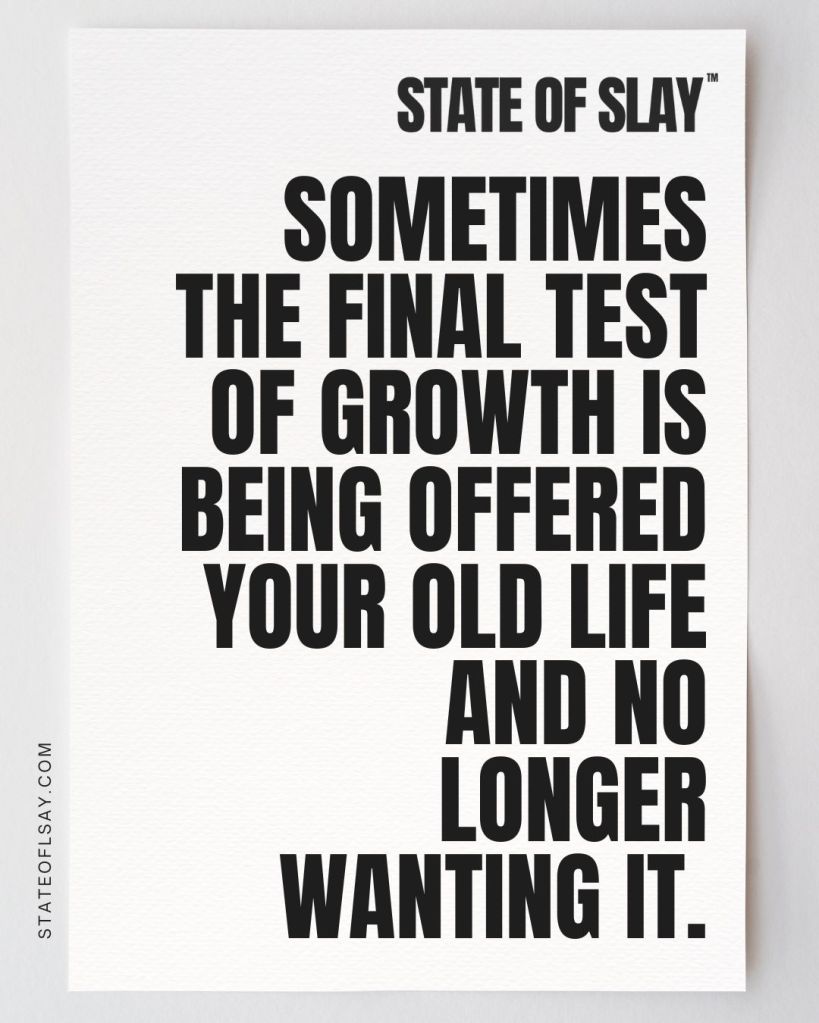
Sometimes it looks like being offered something you once desperately wanted…

and realizing you don’t want it anymore.

The relationship you once would have gone back to.

The friendship you kept trying to repair.

The opportunity you thought would finally validate you.

The habit that used to make everything feel easier.

The version of yourself that felt comfortable because you already knew how to be them.

There was a time when saying no to those things felt impossible.

Not necessarily because they were good for you, but because they were familiar.

And familiarity can be powerful.

It can make us forget how hard we worked to leave something behind.

It can soften the edges of memories.

It can convince us that going back would be easier than continuing forward.

But growth changes what feels like home.

The things you once chased can stop exciting you.

The behavior you once tolerated can become unacceptable.

The situations you once begged to return can come back around, only for you to realize you’ve become someone who no longer fits inside them.

That realization can be bittersweet.

Because outgrowing something doesn’t mean it never mattered.

It doesn’t mean you regret the person you were.

It simply means you’ve changed.

And one of the clearest signs of that change is when something that once had the power to pull you backward no longer has anything to offer the person you are today.

You don’t have to prove you’ve grown by fighting your past.

Sometimes you prove it simply by no longer being tempted to return to it.

This is your reminder:

Growth isn’t only measured by how far you’ve moved forward. Sometimes it’s recognizing that what once felt impossible to leave behind no longer feels difficult to walk away from.

Slay on.