

Black and white image of a woman standing alone with her back to the camera, representing self-acceptance, self-compassion, and personal growth.

Slay Say

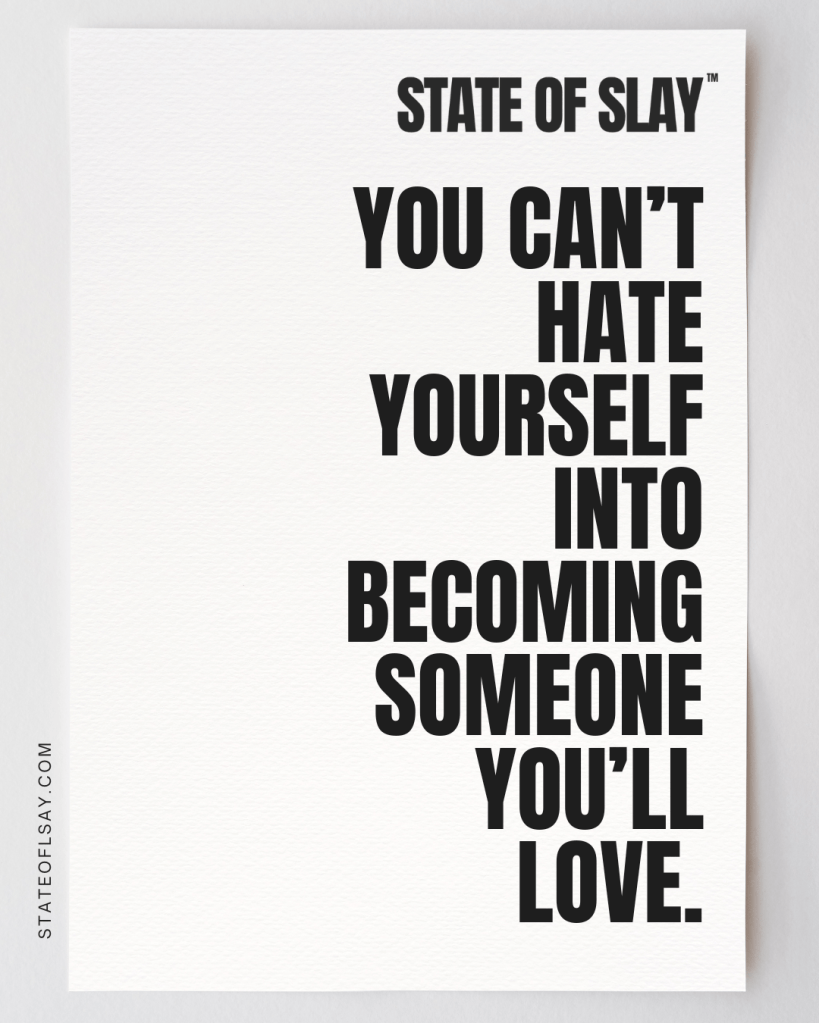
You Are Not the Enemy

We can be remarkably patient with other people while giving ourselves almost none of the same grace.

We understand when someone else is struggling.

We remind them that change takes time.

We tell them one mistake doesn’t define them.

We encourage them to keep going when they stumble.

But when it’s us?

Suddenly the rules change.

We criticize the body we’re trying to care for.

We shame ourselves for choices we made when we didn’t know better.

We replay mistakes as evidence of everything that’s wrong with us.

We compare ourselves to who we think we should already be.

And somewhere along the way, we convince ourselves that being harder on ourselves will somehow make us better.

If I hate this part of myself enough, maybe I’ll finally change it.

If I criticize myself enough, maybe I’ll become more disciplined.

If I keep reminding myself of everything I’ve done wrong, maybe I won’t do it again.

But shame is a terrible architect.

It may motivate you for a moment, but it’s difficult to build a healthy relationship with yourself on a foundation of constant rejection.

Growth requires accountability.

It requires honesty.

Sometimes it requires admitting that you’ve hurt people, made poor choices, ignored what you knew, or stayed somewhere long after you should have left.

Self-love doesn’t mean pretending those things didn’t happen.

It means refusing to use them as weapons against yourself forever.

There is a difference between saying, I need to change this, and saying, There is something wrong with me.

One creates possibility.

The other turns growth into punishment.

You are allowed to want more for yourself without despising who you are today.

You can work on your habits without hating the person who developed them.

You can regret a decision without turning that regret into an identity.

You can recognize where you’ve fallen short while still believing you are worthy of patience, care, and another chance.

Because the person you’re trying so hard to become is still going to be you.

And if every step toward that person is fueled by rejection, there will always be another flaw to find, another standard to miss, another reason to postpone loving yourself.

Maybe the goal isn’t to finally become good enough to deserve your own love.

Maybe part of becoming who you want to be is learning to stop withholding it.

This is your reminder:

You don’t have to love everything about yourself to stop treating yourself like someone you’re trying to defeat.

Slay on.
Name Your Brain

Ever catch yourself spiraling into self-doubt or reacting like the sky is falling… when it’s really not? You’re not alone. That voice in your head—the one that catastrophizes, criticizes, or convinces you you’re not enough—it has a mind of its own.

So what if you gave it a name?

That’s right. Name your brain. Give that voice a personality, an identity, a little flair. Why? Because separating you from your thoughts helps you manage them with more clarity—and maybe even a little compassion.


Why Naming Your Brain Works

When you name your brain, you create space between you and the mental noise. You stop treating every thought as truth and start seeing them for what they really are: patterns. Most of them were wired in long ago—through experiences, messaging, and survival mode. But they’re not your whole story.

Let’s say your brain loves worst-case scenarios. It goes from “I made a mistake” to “I’m going to lose everything” in under five seconds. Instead of spiraling with it, what if you said:

“Okay, here comes that same old voice again. We’ve heard this one before—and we’re not falling for it.”

Naming helps you shift from fear to awareness. You start to notice your patterns, question them, and choose a new response. It turns down the emotional intensity and gives you the power back.


What’s Your Brain’s Personality?

Start by observing. When stress hits, how does your brain talk to you?

  • Is it hypercritical? (“You’ll never get this right.”)
  • Dramatic? (“This is a disaster!”)
  • Perfectionist? (“Not good enough. Try harder.”)
  • People-pleaser? (“Don’t speak up. You’ll upset them.”)

Now give that voice a name and a persona. Think of it like casting a character. Your name can be oddly specific, or just descriptive—whatever helps you take the edge off and reclaim your power.

For me, naming my brain made me think of it in a different way—less like a runaway train and more like an annoying voice or committee that would show up and try to spoil my day. Giving it a name helped me keep it in perspective. It gave me something specific to talk back to—and even tell to take a hike.

I mean, I wouldn’t put up with someone else saying the kinds of things my brain sometimes did—so why would I take that abuse from myself?

These days, when that voice pops in, I can say: “I hear you, but we’re not doing that today.” And it really does help.


From Reaction to Redirection

Once your brain has a name, you can start redirecting instead of reacting.

“Thanks for your concern, but I’ve got this.”

“We’ve heard enough from that old voice—let’s listen to truth instead.”

You’re not ignoring your emotions—you’re choosing to respond differently. That’s the real flex. When you stop giving your inner critic the mic, you make space for the wiser, calmer, more grounded version of you to speak.


Naming Isn’t Silly—It’s Self-Awareness

This practice is rooted in mindfulness and psychology. Creating mental distance from unhelpful thoughts is a proven way to disrupt negative cycles and build emotional resilience.

It’s not about dismissing your feelings. It’s about shifting from “this is me” to “is this me—or is this an old pattern or story?” It’s about knowing your truth, staying present, and calling out those old thoughts—and showing them the door.

The name is just a tool to help you step into that choice. Again and again.


Who Do You Want Driving the Bus?

At the end of the day, your brain will keep doing what it’s always done—unless you take the wheel. When your old mental pattern starts driving toward chaos, anxiety, or shame, you get to say:

“Thanks for the warning, but I’m steering us in a different direction.”

Empowerment starts when you realize you are not your thoughts. You’re the observer. The narrator. The author. You can write a different story—and still let those old characters pop in from time to time, without giving them control.


SLAY Reflection

  1. What type of thoughts show up when you’re stressed, insecure, or overwhelmed?
  2. What name would you give the voice that fuels those thoughts?
  3. How does it feel to separate yourself from that voice?
  4. What kinds of things does your brain say that you no longer believe?
  5. How can you start responding with curiosity and compassion instead of judgment?

S-L-A-Y:

  • Separate yourself from your thoughts
  • Label the patterns
  • Acknowledge the impact
  • You are in charge of your response

Call to Action: Join the Conversation
I’d love to hear from you.
Have you ever given your brain a name? What would you call the voice that tries to take over?
Share your story in the comments. Let’s cheer each other on.

And if you know someone who’s stuck in a spiral of self-doubt, send this to them.
Sometimes, all we need is a nudge.