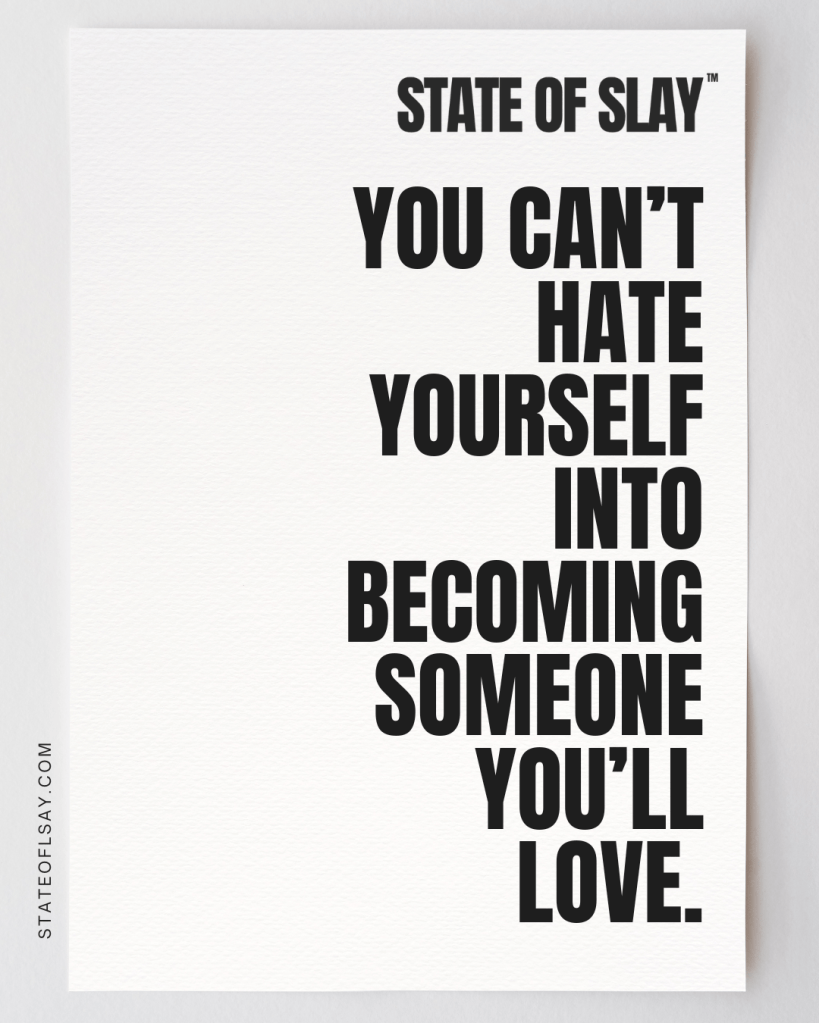
We can be remarkably patient with other people while giving ourselves almost none of the same grace.
We understand when someone else is struggling.
We remind them that change takes time.
We tell them one mistake doesn’t define them.
We encourage them to keep going when they stumble.
But when it’s us?
Suddenly the rules change.
We criticize the body we’re trying to care for.
We shame ourselves for choices we made when we didn’t know better.
We replay mistakes as evidence of everything that’s wrong with us.
We compare ourselves to who we think we should already be.
And somewhere along the way, we convince ourselves that being harder on ourselves will somehow make us better.
If I hate this part of myself enough, maybe I’ll finally change it.
If I criticize myself enough, maybe I’ll become more disciplined.
If I keep reminding myself of everything I’ve done wrong, maybe I won’t do it again.
But shame is a terrible architect.
It may motivate you for a moment, but it’s difficult to build a healthy relationship with yourself on a foundation of constant rejection.
Growth requires accountability.
It requires honesty.
Sometimes it requires admitting that you’ve hurt people, made poor choices, ignored what you knew, or stayed somewhere long after you should have left.
Self-love doesn’t mean pretending those things didn’t happen.
It means refusing to use them as weapons against yourself forever.
There is a difference between saying, I need to change this, and saying, There is something wrong with me.
One creates possibility.
The other turns growth into punishment.
You are allowed to want more for yourself without despising who you are today.
You can work on your habits without hating the person who developed them.
You can regret a decision without turning that regret into an identity.
You can recognize where you’ve fallen short while still believing you are worthy of patience, care, and another chance.
Because the person you’re trying so hard to become is still going to be you.
And if every step toward that person is fueled by rejection, there will always be another flaw to find, another standard to miss, another reason to postpone loving yourself.
Maybe the goal isn’t to finally become good enough to deserve your own love.
Maybe part of becoming who you want to be is learning to stop withholding it.
This is your reminder:
You don’t have to love everything about yourself to stop treating yourself like someone you’re trying to defeat.
When we’re hurting, we don’t always know how to heal.
We just know we want the pain to stop.
So we reach for things.
Relationships.
Food.
Alcohol.
Shopping.
Work.
Attention.
Isolation.
Distraction.
Anything that gives us a few minutes of relief from what feels unbearable.
Sometimes those choices help us get through the day.
Sometimes they become destructive.
And years later, when we’re healthier and have more perspective, we can look back at the person we were and feel ashamed of the ways we coped.
Why did I do that?
Why did I stay?
Why did I need that?
Why couldn’t I just deal with what I was feeling?
But you’re looking at an earlier version of yourself with knowledge that version didn’t have yet.
You are not a bad person for the ways you tried to kill your sadness.
You were a hurting person trying desperately to make the pain stop.
Prefer to listen? The Audio Blog version is available here.
SOMETIMES COPING IS JUST SURVIVAL IN DISGUISE
We don’t always recognize coping mechanisms while we’re using them.
At the time, they may simply feel like relief.
Something that makes the loneliness quieter.
Something that distracts us from the grief.
Something that makes us feel wanted.
Something that gives us somewhere to put all the feelings we don’t understand.
So we reach for it again.
And again.
That doesn’t mean every coping mechanism is healthy.
Some can hurt us.
Some can hurt other people.
Some can create consequences we’ll eventually have to face.
But understanding why you reached for something isn’t the same as excusing what happened.
Understanding helps you recognize what you were really trying to survive.
RELIEF AND HEALING ARE NOT THE SAME THING
When we’re hurting, we often search for relief before we understand healing.
Relief asks:
How can I stop feeling this right now?
Healing asks:
What is this pain trying to tell me?
Those questions can lead us in very different directions.
Relief can temporarily numb what hurts.
Healing asks us to understand it.
Feel it.
Process it.
And eventually move through it.
There is no shame in having reached for relief when you didn’t yet know how to heal.
But eventually, relief can no longer do the work that healing requires.
SADNESS CAN MAKE TEMPORARY THINGS FEEL LIKE ANSWERS
When something hurts deeply enough, almost anything that makes it hurt less can begin to look like a solution.
Attention can feel like love.
Distraction can feel like peace.
Numbing can feel like healing.
Being needed can feel like being valued.
A relationship can feel like rescue.
Isolation can feel like protection.
For a while, those things may even work.
That’s what makes unhealthy coping mechanisms so complicated.
They often help before they hurt.
Sometimes we don’t recognize the difference until much later.
That’s part of growing.
YOU DIDN’T HAVE THE TOOLS YOU HAVE NOW
It’s easy to look backward and imagine you should have known better.
But healing gives us tools we didn’t always possess.
Boundaries.
Self-awareness.
Perspective.
Emotional regulation.
The ability to recognize patterns.
The courage to ask for help.
You cannot expect a past version of yourself to use tools you hadn’t learned how to use yet.
You can wish you’d made different choices.
You can take responsibility for them.
You can repair what needs repairing.
But you don’t have to hate yourself for not knowing then what you know now.
SHAME WON’T HEAL WHAT SADNESS CREATED
Shame has a way of convincing us that our worst choices reveal our truest selves.
They don’t.
A decision is something you made.
A mistake is something you made.
A coping mechanism is something you used.
None of those things have to become who you are.
If you’ve grown enough to look back and recognize that something wasn’t healthy, that awareness matters.
It means you can see what you couldn’t see before.
Don’t use your growth as another reason to punish yourself.
Let it become evidence that you’ve changed.
UNDERSTANDING YOURSELF IS NOT MAKING EXCUSES
Sometimes we’re afraid to show compassion toward our past selves because we think it lets us off the hook.
It doesn’t.
You can understand why you behaved a certain way and still acknowledge the consequences.
You can say:
I was hurting.
And…
I hurt someone.
I didn’t know how to cope.
And…
I wish I had handled it differently.
I understand why I made that choice.
And…
I would make a different choice today.
Two truths can exist at the same time.
Accountability helps us grow.
Compassion allows us to grow without destroying ourselves along the way.
SOMETIMES WE TRY TO FILL WHAT ACTUALLY NEEDS TO BE FELT
There are some empty spaces we cannot fill.
We have to feel them.
Grief needs to be grieved.
Loneliness needs to be understood.
Loss needs to be acknowledged.
Pain needs somewhere safe to exist.
We can spend years pouring things into an emotional hole, hoping something will finally make us feel whole.
But healing often begins when we stop asking what we can put into the space and start asking why the space is there.
Sometimes the emptiness isn’t asking to be filled.
It’s asking to be heard.
YOU DON’T HAVE TO KEEP PUNISHING THE PERSON YOU USED TO BE
There is a strange cruelty in healing that we don’t talk about enough.
We become healthier…
And then use that health to judge the person we were when we weren’t.
We look backward with clarity and expect our former selves to have possessed it too.
But they didn’t.
They were living the experience you now have the privilege of understanding in hindsight.
That doesn’t mean everything they did was right.
It means they deserve context.
You can hold your past self accountable without putting them on trial for the rest of your life.
FORGIVE THE PERSON WHO WAS TRYING TO MAKE THE PAIN STOP
Think about who you were during one of your hardest seasons.
Not from where you stand today.
From where you stood then.
What did you know?
What hadn’t you learned yet?
What were you afraid of?
What were you desperately trying not to feel?
That person doesn’t need another judge.
They’ve probably had enough of those.
They need understanding.
They need forgiveness.
They need you to recognize that somehow, imperfectly, they kept going long enough for you to become who you are today.
YOU CAN LEARN A NEW WAY TO CARE FOR YOURSELF
Maybe you once tried to kill your sadness with relationships.
Work.
Food.
Alcohol.
Shopping.
Attention.
Isolation.
Or anything else that offered temporary escape.
You don’t have to be ashamed that something once helped you survive.
But you also don’t have to keep using a survival strategy after you’ve learned a healthier way to live.
Awareness gives you a choice.
And every healthier choice becomes another way of telling yourself:
I know how to care for you differently now.
You are not a bad person for the ways you tried to kill your sadness.
You were hurting.
You were learning.
You were trying to get through something with whatever tools you had at the time.
Now you know more.
Now you can choose differently.
And perhaps one of the greatest signs of healing is being able to look back at the person you once were without shame and say:
I understand why you did what you did.
But we don’t have to survive that way anymore.
SLAY REFLECTION
S — See Yourself With Compassion What past behavior have you been judging without considering what you were going through at the time?
L — Look Beneath the Behavior What sadness, pain, loneliness, or fear were you actually trying to escape?
A — Accept What You’ve Learned What do you understand about yourself today that you couldn’t understand during that difficult season?
Y — Your Next Step What healthier way can you care for yourself the next time you feel the urge to escape what you’re feeling?
CALL TO ACTION: JOIN THE CONVERSATION
I’d love to hear from you.
What have you learned to give yourself today that you once searched for somewhere else?
Share your story in the comments. Your experience may help someone else understand that they don’t have to be ashamed of the person they were while they were trying to survive.
And if you know someone who is struggling to forgive a past version of themselves, send this to them.
There’s a quiet kind of relief that comes when we finally stop trying to be perfect.
When we stop chasing the illusion that we must always have it together — always strong, always calm, always fine — and start allowing ourselves to be what we already are: human.
It sounds simple, doesn’t it? But for many of us, accepting our humanness feels like the hardest thing in the world.
We live in a culture that celebrates “doing” over “being.” We post our highlight reels but hide our heartbreaks. We praise resilience, but rarely talk about the cracks where that strength is tested.
But the truth is this: you don’t need to be flawless to be worthy of love. You just need to be real.
The Myth of Constant Strength
For years, I believed my worth was measured by how much I could carry without breaking. If I could just hold it together — through the pain, through the loss, through the pressure — then I was strong.
But that wasn’t strength. That was survival.
And survival mode doesn’t allow much room for self-compassion.
It teaches us to suppress what’s uncomfortable, to power through instead of pause, to mistake endurance for courage. But there comes a point when you can’t keep holding your breath through life.
You have to exhale. You have to fall apart a little. You have to allow yourself to feel.
Because it’s in those moments — the messy, unguarded, imperfect ones — that healing actually begins.
Being Human Means Being Messy
We will fail. We will get it wrong. We will say the wrong thing, love the wrong person, trust too quickly, or not enough.
We’ll lash out when we’re scared. We’ll close off when we’re hurt. We’ll regret the silence when we should’ve spoken up.
That’s part of being human.
But what makes us grow is not perfection — it’s awareness. It’s choosing to look at our reflection, not to criticize it, but to understand it.
The work of accepting our humanness begins when we stop asking, “What’s wrong with me?” and start asking, “What is this trying to show me?”
Every mistake, every heartbreak, every uncomfortable moment holds a lesson — not to shame us, but to shape us.
When we stop punishing ourselves for being human, we start to heal.
Perfection Is the Enemy of Peace
We chase perfection because we believe it will make us feel safe.
If we do everything right, no one will leave. If we’re always kind, no one will get angry. If we’re always strong, no one will see our pain.
But perfection isn’t safety — it’s self-abandonment.
Every time we deny our real feelings, we teach ourselves that we’re only lovable when we’re flawless. And that belief keeps us trapped.
You don’t need to earn your right to rest. You don’t need to earn your right to feel. You don’t need to earn your right to be you.
Your humanity is not something to hide — it’s something to honor.
Learning to Meet Yourself with Grace
When you can look at your reflection — tired, imperfect, flawed — and still say, “I love you,” that’s where peace begins.
Grace is not about letting yourself off the hook. It’s about letting yourself be on the hook for your growth without punishing yourself for being human.
It’s telling yourself: Yes, I could’ve done better — and I will. Yes, I hurt someone — and I’ll make it right. Yes, I fell — but I can get back up.
Healing doesn’t require perfection. It requires honesty.
The more honest you are with yourself, the softer life becomes. The more grace you extend inward, the easier it becomes to extend it outward.
That’s how compassion spreads — from the inside out.
The Power of Humility
Humility isn’t about shrinking yourself — it’s about remembering you’re part of something bigger.
When you can say, “I was wrong,” or “I didn’t know,” or “I’m still learning,” you open the door to growth.
When you can ask for help instead of pretending you have it all figured out, you make connection possible.
And when you can forgive yourself — truly forgive — you make peace possible.
That’s the gift of being human. We stumble, we learn, we grow, and then we help someone else do the same.
That’s not weakness. That’s evolution.
How to Practice Accepting Your Humanness
1. Acknowledge your imperfection. Say it out loud: “I’m human.” You’ll feel a wave of release. You don’t have to be everything for everyone.
2. Let yourself feel it all. Anger. Grief. Joy. Fear. Don’t label your emotions as good or bad — they’re messages, not mistakes.
3. Replace judgment with curiosity. Instead of “Why did I do that?” try “What was I feeling when I did that?” Compassion invites understanding.
4. Set down the need to perform. You don’t have to earn love by being perfect. Show up as you are — not as who you think you need to be.
5. Celebrate your humanity. You cry because you care. You ache because you’ve loved. You get back up because you still believe. That’s beautiful.
SLAY Reflection
What part of your humanness do you struggle to accept?
How does perfectionism show up in your daily life?
What’s one mistake from your past that taught you something valuable?
How can you speak to yourself with more compassion this week?
What would it feel like to love yourself as you are, right now?
S – Surrender the need to be perfect
L – Let yourself feel without judgment
A – Accept your flaws as part of your wholeness
Y – Yield to grace and choose love over shame
Call to Action: Join the Conversation
I’d love to hear from you. What’s one way you’re learning to accept your humanness? Share your story in the comments. Let’s cheer each other on.
And if you know someone who’s being too hard on themselves, send this to them. Sometimes, all we need is a reminder that being human is enough.
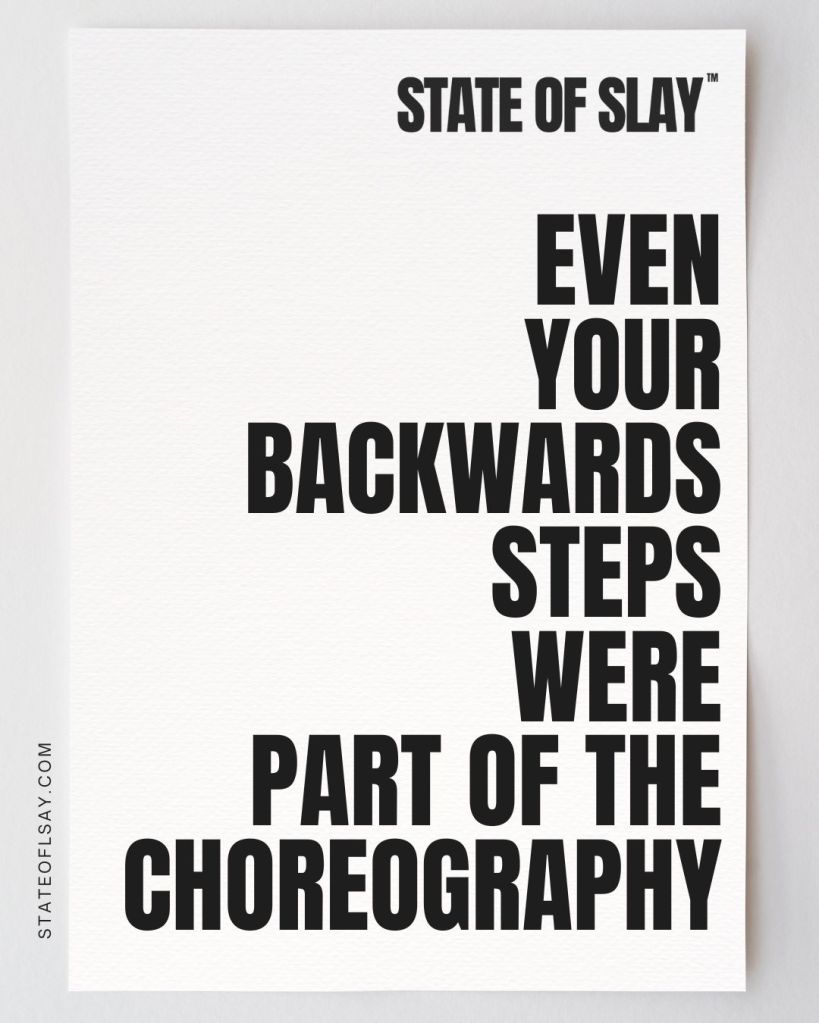
Growth doesn’t always move in a straight line. Sometimes you stumble. Sometimes you step back. But none of it means you’ve failed.
Every step—forward, backward, sideways—is still part of your rhythm. Still part of your story. Even the ones that felt offbeat taught you something about your strength, your timing, your heart.
So when you feel like you’ve lost your way, pause. Listen. The music is still playing. And the dance is still yours.
This is your reminder to give yourself grace in the messy middle.
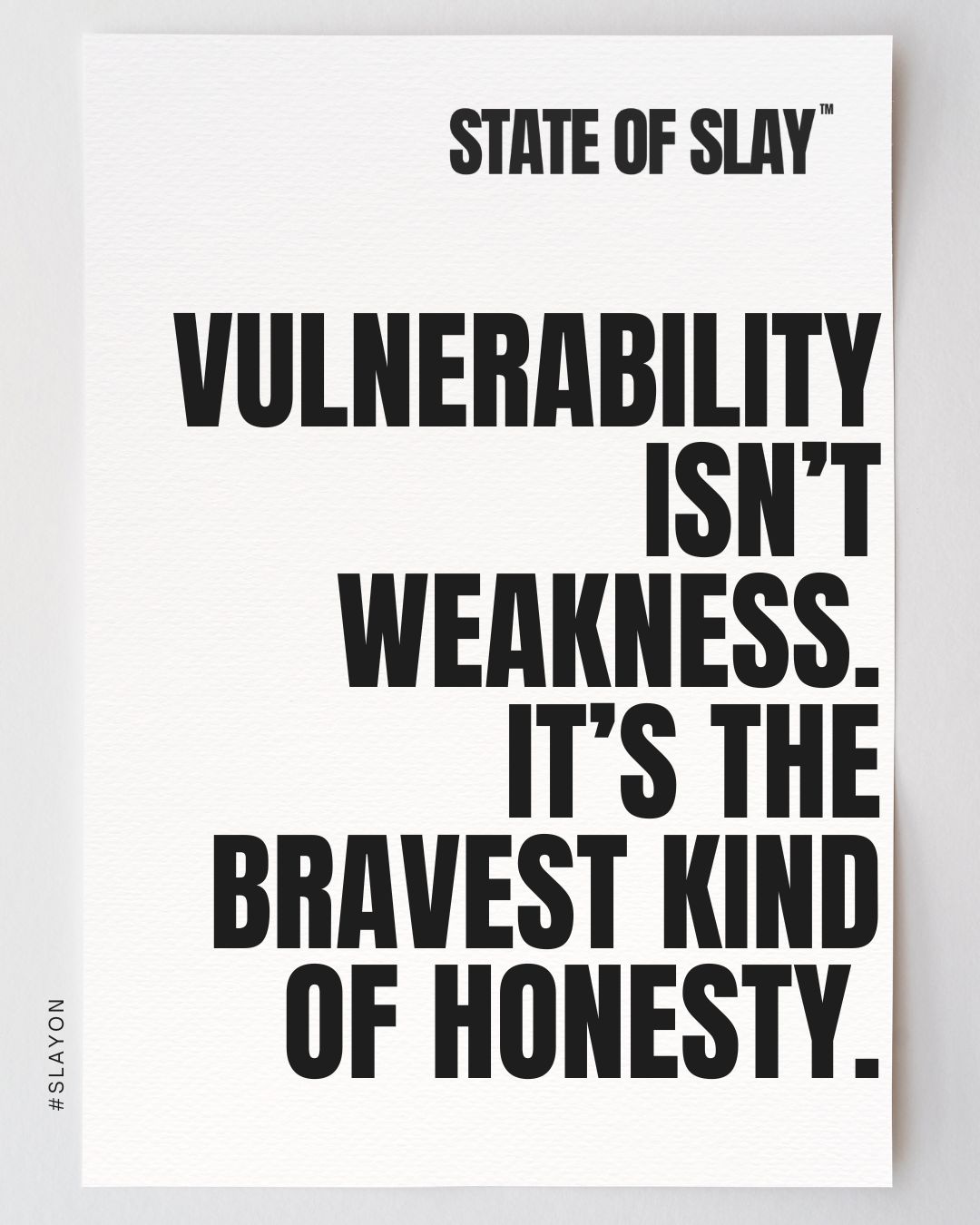
Being vulnerable isn’t easy. It means showing up without the filter, letting people see the real you — fears, flaws, feelings and all. But vulnerability is not a weakness. It’s courage in its rawest form.
When we choose honesty over perfection, we create real connection — with ourselves and with others. That’s where true growth happens.
Let this be your reminder: you don’t have to have it all together to be worthy of love, support, or success.
We hold ourselves to impossible standards, judge our every move, and then wonder why we feel stuck, small, and not good enough. We speak to ourselves in ways we’d never speak to someone else—calling ourselves idiots, failures, brain-dead, or worse.
And we may not even realize we’re doing it. That inner dialogue becomes so automatic, so embedded in our thinking, that the jabs feel normal. But they’re not. And worse—they’re harmful.
Those words don’t just disappear. They settle into our energy, into our nervous system, into the way we show up in the world. And over time, they become the very thing that holds us back from becoming who we are meant to be.
The Judgments That Keep Us Stuck
Before I began my journey in recovery, I judged myself constantly.
Nothing I did was ever “good enough.” Even when I succeeded, I’d discredit it—call it luck, minimize the achievement, or immediately nitpick what wasn’t perfect.
My expectations were so high, they were built to break me. And they did. Over and over.
The voice in my head wasn’t just critical—it was cruel. It kept me sick. It convinced me I’d never be enough. It told me to give up before I even tried. And I believed it. I lived inside that mental prison for years.
I’d get these little bursts of self-confidence, moments where I felt like maybe I could do something great. But the voice always returned—louder, meaner, and more persuasive. It was a cycle that drained me and kept me from healing.
The Turning Point: Choosing to Get Better
When I finally made the decision to seek help, one of the first things I had to face was my own thinking.
I had to get honest about the way I spoke to myself. And what I discovered? I had become my own worst bully.
If anyone else had said the things I said to myself, I never would have stood for it. So why was I allowing it to happen in my own mind?
That realization changed everything.
I began to:
Forgive myself for the judgment
Unlearn the habit of self-abuse
Practice self-compassion, even when it felt unfamiliar
Focus on progress, not perfection
And slowly, something started to shift. The voice got quieter. The harsh words faded. And I started to celebrate myself—for real.
Make Room for Grace
No one gets it right all the time. We all make mistakes. We all fall short sometimes.
But that doesn’t mean we’re failures. It means we’re human.
Mistakes are how we grow. They help us refine our goals, improve our preparation, and get clearer on what we really want.
And when you set realistic goals—ones that allow for learning, flexibility, and growth—you give yourself a chance to succeed. Even the smallest win becomes a reason to celebrate.
You Are a Work in Progress (And That’s a Good Thing)
You are not the voice in your head that tells you you’re not enough. You are not your mistakes. You are not your worst day.
You are a work in progress—a beautiful, evolving human being. And your job is not to be perfect. Your job is to keep going.
So speak to yourself with kindness. Encourage yourself like you would a best friend. Celebrate every step, every shift, every bit of progress.
You’re doing better than you think.
SLAY Reflection: How Do You Speak to You?
Do you judge yourself harshly? How does that show up in your thoughts or self-talk?
What do you tell yourself when you make a mistake or fall short? Would you say the same to someone you love?
How has your inner critic held you back? Where would you be if that voice got quieter?
What daily habit could help you be kinder to yourself? Affirmations, journaling, gratitude?
What can you do today to encourage and celebrate yourself? Start now—pick one thing you’re proud of and name it out loud.
Call to Action: Join the Conversation
I’d love to hear from you. What’s one negative thing you’ve told yourself that you’re ready to replace with kindness? Share your story in the comments. Let’s cheer each other on.
And if you know someone who’s struggling with self-judgment, send this to them. Sometimes, all we need is a nudge.
We all make mistakes. It’s how we grow. It’s how we learn. Sometimes we learn to do things differently, and sometimes we simply learn that mistakes are just part of the process—an oops, not an identity.
But there’s a dangerous turning point many of us reach: When we start to believe that we are the mistake.
That’s when mistakes stop being lessons and start becoming labels. And when we internalize our failures, we block our own growth.
Prefer to listen? The Audio Blog version is available here.
The Trap of Perfectionism
When I was living in the dark, I believed I was a mistake. Every time I messed up—even just a little—I used it as proof that I was broken, unworthy, or incapable.
I set impossibly high standards for myself, and when I didn’t meet them, I punished myself emotionally.
I beat myself up.
I questioned my worth.
I kept mental score of every misstep.
Perfection wasn’t just the goal—it was the requirement. And every time I fell short, I used it as another reason to feel like I had failed at life.
The Permission to Mess Up
Everything changed when I got help. I was told something I had never even considered: It’s okay to make mistakes. In fact, it’s encouraged.
Mistakes meant I was trying. Mistakes meant I was doing something new. Mistakes meant I was taking action—even if the outcome didn’t go as planned.
That shift in thinking opened the door to something I hadn’t felt in a long time: freedom.
I stopped needing to be perfect and started focusing on being present. I learned to ask, What can this mistake teach me? instead of, What does this say about me?
Listening to the Signs
Another thing I began to notice? I made more mistakes when I wasn’t taking care of myself.
If I was tired, overwhelmed, underfed, or overworked—my errors increased. And instead of blaming myself, I started seeing those slip-ups as signals.
Maybe I needed rest.
Maybe I needed better boundaries.
Maybe I needed to slow down.
Mistakes became more than just missteps—they became a check-in. An opportunity to notice where I might be neglecting my own needs.
Mistakes That Lead to Magic
Here’s the other thing: Some of my biggest mistakes? They’ve led me to some of the most beautiful parts of my life.
If I hadn’t taken the wrong turn, I wouldn’t have found the right path. If I hadn’t said yes when I probably should have said no, I wouldn’t have learned what a real yes feels like.
We don’t always know in the moment, but sometimes what we call a mistake is actually just a redirection. A plot twist with a purpose.
The Only Real Mistake?
The only mistake you can make is not taking action because you’re afraid of failing. Playing it safe. Holding back. Staying small. That’s where real regret grows.
Life isn’t about getting it right all the time. It’s about trying. Learning. Adjusting. And trying again.
Mistakes are just part of the road. They’re not roadblocks. They’re guides.
And they are never who you are.
SLAY Reflection: What Are You Learning?
Do you tend to beat yourself up when you make a mistake? What does your inner voice sound like in those moments?
Have any of your past mistakes led to something unexpectedly positive? What did you learn?
What can you do to be more forgiving of yourself when you mess up? What would you say to a friend in your position?
Are you holding back from taking action out of fear of making a mistake? What might shift if you gave yourself permission to just try?
How can you begin turning your mistakes into tools for learning instead of weapons for self-punishment? What would change if you saw them as stepping stones instead of stop signs?
Call to Action: Join the Conversation
I’d love to hear from you. What’s one mistake you’ve learned from—and how did it help you grow? Share your story in the comments. Let’s cheer each other on.
And if you know someone who’s being too hard on themselves, send this to them. Sometimes, all we need is a nudge.
Growing up, I never left any room for mistakes. I expected myself to do everything perfectly—and when I didn’t, I beat myself up. I carried these unrealistic expectations with me through childhood, my teenage years, and well into adulthood, never giving myself permission to simply be human. The result? A constant negative narrative playing on loop in my head, convincing me I wasn’t good enough. Every mistake felt like proof of failure, which I used as an excuse to abandon self-care, spiral into self-doubt, and reinforce the lie that I could never get better.
I see now that none of that thinking was true. I made it feel true by keeping my struggles to myself and believing the cruelest voices in my mind. I nearly rode that train all the way into the station—but thankfully, I got off before the final stop.
The truth is: our mistakes are where we learn the most. They shape our character. They build the resilience we need to accomplish the things that really matter. No one is meant to get it right every time. The growth is in the slip-ups. That’s why we need to embrace what I call the “Oops Factor.”
What Perfectionism Really Cost Me
Expecting myself to be perfect—even when I knew better—set me up to fail. I’d aim impossibly high and, when I missed the mark (which was inevitable), I’d use that as ammunition to tear myself down. Even when I succeeded, I picked apart the outcome. I never gave myself permission to feel proud. That made relationships harder too. I lived in fear that people would see me for the fraud I thought I was.
Eventually, I reached a breaking point and asked for help. In that process, I learned something life-changing: mistakes are a sign that I’m trying. They mean I’m pushing myself. And even when things don’t work out the way I hoped, there’s always a lesson or a growth opportunity—often the real reason I was on that path in the first place.
Over time, I’ve learned to trust that I’m exactly where I need to be. My job is to take the next right step. I can’t control the outcome—just the intention behind the action. And when I show up with that mindset? It’s always a win. Trying is the victory. There’s always something to gain.
Make Room for the Oops
We’re all allowed to make mistakes. In fact, we should be making them. That’s how we grow.
Start leaving space for the Oops Factor in your life. When something doesn’t go as planned, look for the lesson—or simply laugh it off. Don’t let the fear of messing up keep you from taking risks or being yourself. Let go of the pressure to be perfect and redefine what success looks like. Maybe, just maybe, being exactly who you are today is enough.
Mistakes don’t define you. But how you respond to them just might.
SLAY on!
SLAY OF THE DAY: Reflect & Rise
Do you expect yourself to be perfect?
How do you usually react when you make a mistake?
Does that response help you—or harm you?
What’s one belief about mistakes that you’re ready to let go of?
What’s one thing you’ve learned from a recent oops moment that helped you grow?
Give yourself permission to stumble. Learn, laugh, and get back up stronger.
Call to Action: Join the Conversation
I’d love to hear from you. What’s one way you can show yourself more grace when you make a mistake?
Share your story in the comments. Let’s cheer each other on.
And if you know someone who’s been stuck in a shame spiral, send this to them.
Sometimes, all we need is a little reminder that it’s okay to mess up.
Words can build bridges. Words can burn them down.
They can make someone feel seen, valued, loved—or they can tear open wounds that never fully heal. The truth is, words are some of the most powerful tools we have. And yet, many of us throw them around carelessly, forgetting that once spoken, they can’t be taken back.
We’re living in a world that feels more divided and reactive than ever. Which is why this matters so much: the way we speak—to others and to ourselves—matters.It always has. And it always will.
Prefer to listen? The Audio Blog version is available here.
The Language of My Past
Before I began walking this path, I used words as weapons. I used them to hurt, to manipulate, to control the narrative.
Even more painfully, I used them on myself. Quietly. Cruelly. I would tell myself I wasn’t good enough, that I didn’t deserve love, that I was destined to fail. And those words? They stuck. They festered. They kept me small.
I remember being told early in my recovery that I had a barbed tongue.At the time, I almost wore it like a badge of honor—proof I could defend myself in any verbal battle. But really, I was just scared. I was always in fear. And fear made me lash out. It made me forget that love—real love—starts with what we say when no one else is listening.
The Way You Speak to Yourself Shapes Everything
If you wouldn’t say it to someone you love, why say it to yourself?
That was the question that changed everything for me. Because the truth is, we’re always listening to our own inner dialogue. And when we speak harshly to ourselves, our body, heart, and mind all take that in.
So I started small. I started with one kind sentence a day. Sometimes I didn’t believe it. Sometimes it felt fake. But I kept going.
And eventually, those gentle words turned into something bigger: compassion. Forgiveness. Even love.
Speak Like It Matters—Because It Does
When I shifted the way I spoke to myself, something else changed: the way I spoke to others. And sometimes that was easier—giving kind words to others, even when I couldn’t give them to myself. But what I found is that the more kindness I gave away, the more I saw myself as someone capableof kindness. The cycle slowly started to shift.
Today, I try to ask myself before I speak: Will these words hurt or heal?
That one question has the power to change a conversation. A relationship. A life. Let your words be the ones that bring light—not pain.
SLAY on.
SLAY OF THE DAY: Reflect & Rise
Do you pause before you speak, or do your words just pour out?
Have your words ever hurt someone you love? What happened?
How do you speak to yourself—especially when you’re struggling?
Can you remember a time when your words helped someone heal?
What would change if you made kindness your default language?
Call to Action: Join the Conversation I’d love to hear from you. What’s one small way you can use your words today to heal instead of hurt—either for yourself or someone else? Share your story in the comments. Let’s cheer each other on.
And if you know someone who’s been hard on themselves lately, send this to them. Sometimes, the right words come at the right time—and change everything.