It Is OK to Be Fearless and Terrified at the Same Time is something I had to learn by living it.
Because for a long time, I believed courage meant not being afraid.
That if I felt fear, it meant I was not ready. Not strong enough. Not capable enough.
So I waited.
I waited to feel confident. I waited to feel certain. I waited for the fear to disappear before I made a move.
But what I learned is this.
Fear does not disappear before you act.
It comes with you.
Prefer to listen? The Audio Blog version is available here.
Fear and Courage Can Exist Together
We tend to think of fearlessness as the absence of fear.
But real fearlessness looks different.
It looks like showing up even when your heart is racing. Speaking even when your voice feels unsteady. Taking the step even when you are unsure of the outcome.
Fear and courage are not opposites.
They often exist in the same moment.
And when you understand that, something shifts.
You stop waiting for fear to leave.
And you start moving anyway.
I Had to Rethink What Strength Meant
There were moments in my life when I felt completely terrified.
Terrified to take risks. To speak up. To make changes that I knew I needed to make.
And in those moments, I questioned myself.
Why am I so afraid? Why does this feel so hard? What if I fail?
But looking back, those were often the moments that mattered most.
The moments where something inside me was pushing me forward, even as fear tried to hold me back.
That tension was not weakness.
It was growth.
Fear is information, Not a Stop Sign
Fear is not always something to avoid.
Sometimes it is simply information.
It tells you that you are stepping into something new. Something uncertain. Something that matters.
And while not all fear should be ignored, not all fear should be obeyed either.
Learning to tell the difference is powerful.
Because if you let fear make every decision, you will stay exactly where you are.
And growth rarely lives there.
You Do Not Have to Feel Ready
This was one of the biggest shifts for me.
I thought I needed to feel ready before I acted.
But readiness is not a feeling.
It is a decision.
You decide to show up. You decide to try. You decide to take the step, even when you are unsure.
And through that action, confidence begins to build.
Not before.
During.
Courage Builds Through Action
Every time you move forward while feeling afraid, you reinforce something important.
You can handle it.
You can move through discomfort. You can take risks. You can face uncertainty.
And each time you do, your trust in yourself grows.
Not because the fear disappears.
But because you prove to yourself that fear does not control you.
Growth Lives in That Tension
There is a space where fear and possibility meet.
A space where you feel both excited and uncertain. Hopeful and hesitant. Strong and vulnerable.
That space can feel uncomfortable.
But it is also where growth happens.
Because you are stretching beyond what is familiar.
You are stepping into something new.
And that requires both courage and vulnerability.
You Are Allowed to Feel Both
You do not have to choose between being fearless and being afraid.
You can be both.
You can feel terrified and still move forward. You can feel uncertain and still take action. You can feel doubt and still believe in yourself enough to try.
Those emotions do not cancel each other out.
They coexist.
And when you allow that, you remove the pressure to be perfect.
You simply show up as you are.
Keep Going Anyway
If you are waiting for the moment when fear disappears, you may be waiting longer than you think.
But if you are willing to move forward with it, everything changes.
Because the goal is not to eliminate fear.
It is to move through it.
To take the step. To say the thing. To try the thing. To trust yourself enough to see what happens next.
And that is where real courage lives.
SLAY Reflection
S — See the Fear What is something in your life that feels both exciting and terrifying right now?
L — Look at the Meaning What might that fear be telling you about what matters to you?
A — Accept the Feeling Can you allow yourself to feel afraid without letting it stop you?
Y — Your Next Step What is one action you can take even while feeling uncertain?
Call to Action: Join the Conversation
I’d love to hear from you. Have you ever done something that scared you and felt stronger because you did it anyway?
Share your story in the comments. Let’s cheer each other on.
And if you know someone who might need this reminder, send this to them. Sometimes, all we need is a nudge.
Awareness is powerful. It helps you recognize patterns, understand triggers, and see yourself more clearly. But awareness alone does not create transformation. Movement does.
Growth often happens when insight turns into small, consistent choices. When understanding becomes behavior. When intention becomes practice.
This is your reminder to let what you learn guide what you do.
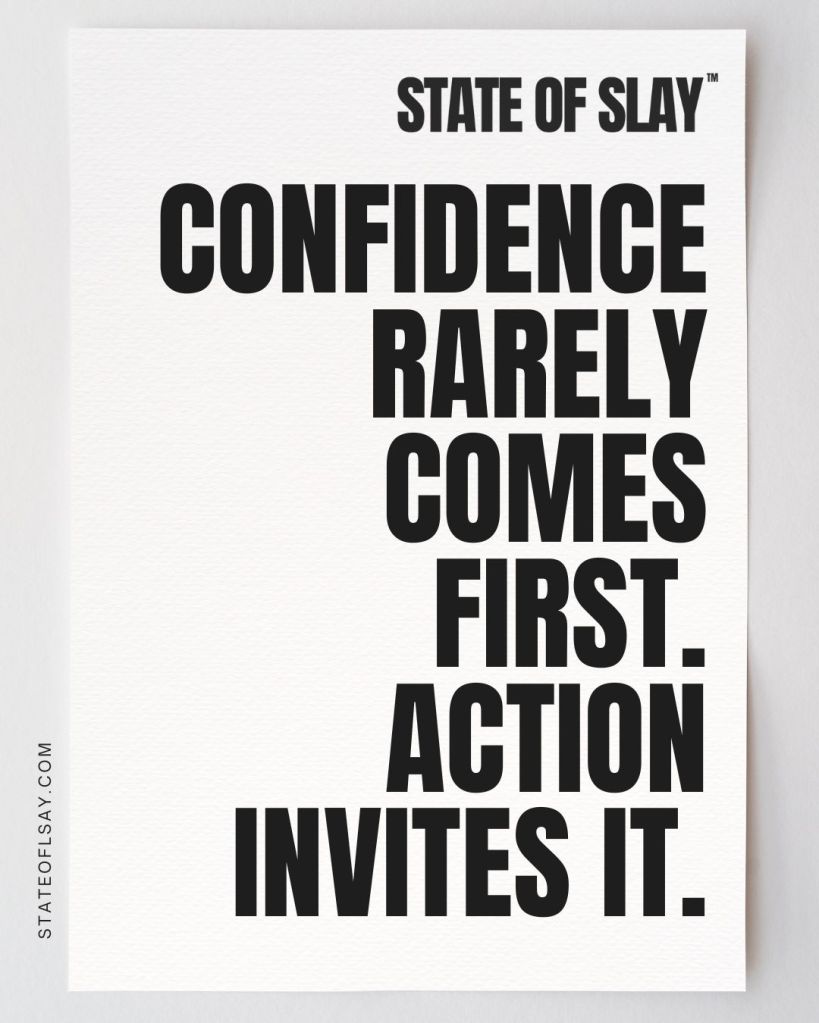
We often wait for confidence before taking action, believing readiness should come first. But growth rarely works that way. Momentum builds through experience, not hesitation.
The first step may feel uncertain. The early attempts may feel imperfect. That is not failure — it is part of becoming capable. Confidence tends to grow quietly alongside effort, not ahead of it.
This is your reminder to begin even when certainty is not fully there.
Standing still might feel safe, but it’s also where dreams go to die. Waiting for the perfect moment only delays the life that’s waiting for you to claim it.
Growth requires movement—sometimes messy, sometimes uncertain, but always forward. Each step, no matter how small, breaks the cycle of waiting and creates momentum.
If you’re longing for change, stop looking for it to arrive on its own. The shift begins with you—when you take action, however imperfect, toward what you want.
This is your reminder that movement is the bridge between who you are and who you’re becoming.
For most of us, there’s been a time when we’ve hit bottom. And for many of us, there have been many.
But just because you find yourself at a bottom doesn’t mean you have to stay there. In fact, sometimes hitting bottom can be the very thing that propels you upward—it can be a turning point, a wake-up call, a catalyst for change.
What matters most is that you recognize it as a bottom. And then decide you’re not going to live there.
You Don’t Have to Ride It All the Way to the Dump
Looking back, I had many bottoms before I hit the one that finally brought me to my knees.
There were so many moments I should have asked for help… So many warning signs I ignored… So many nights I let myself spiral deeper into darkness.
But the truth is: we’re ready when we’re ready.
And if we’re lucky, we get that one moment—the one where something shifts, where the fear becomes too loud to ignore, and we finally ask for help.
For me, that moment came from fear. Fear of where my mental illness had taken me. Fear of where it might take me next.
I don’t know why that particular night was different. There were many terrifying nights before it. But that night, I got scared enough to pick up the phone.
And in doing so, I opened the door to my own recovery.
The Power of Saying “Enough”
There’s a saying I love: “You don’t have to ride the truck all the way to the dump.”
You can get off at any time.
Even in the darkest place, even at your lowest, you have a choice. You always have the option to get off the path that’s dragging you down. But you have to believe that it’s possible. And you have to take action.
When I was deep in my illness, I felt powerless. Like I was strapped to a runaway train. But that wasn’t true.
I always had a ticket off that train. And the moment I picked up the phone and asked for help, I used it.
That one action—speaking my truth—shifted everything.
I didn’t have all the answers yet. I still had work to do. But the secret I had been carrying was out. The weight I had been holding got lighter. And for the first time, I realized I was in control of my recovery.
Recognizing the Bottom for What It Is
It’s so important to notice your bottoms. To recognize when you’ve fallen harder than usual. To acknowledge when you’re staying down longer than you want to.
Because that moment of awareness? That’s the moment you can begin to rise.
We all fall. We all struggle. But no one has to stay in the pit.
Freedom starts with acceptance. The willingness to see where you are—and the courage to choose something better.
A bottom doesn’t have to be the end of your story. It can be the beginning of your comeback.
From Rock Bottom to Rise
A bottom might just be the biggest blessing in disguise.
It might be the one thing that finally gets your attention. The one thing that cracks you open. The one thing that forces you to stop, reflect, and change direction.
You don’t have to stay down. You don’t have to prove anything to anyone by suffering longer.
Your story is still being written. And a bottom can be the moment you choose a new chapter.
Use it to rise. Use it to SLAY.
SLAY Reflection: What Is Your Bottom Telling You?
Has a past bottom ever helped you grow or pivot in a new direction? How can you use that lesson now?
Have you ever hit a bottom in your life? What were the signs? What did it feel like?
Have you hit multiple bottoms? What made the most recent one different?
Are you currently in a bottom? If so, what are you doing about it—or avoiding?
What’s holding you back from asking for help or making a change? What could shift if you took just one small step?
Call to Action: Join the Conversation
I’d love to hear from you. What helped you recognize a bottom in your life—and what did you do to rise from it? Share your story in the comments. Let’s cheer each other on.
And if you know someone who’s struggling to climb out of a hard place, send this to them. Sometimes, all we need is a nudge.
We all make mistakes. It’s how we grow. It’s how we learn. Sometimes we learn to do things differently, and sometimes we simply learn that mistakes are just part of the process—an oops, not an identity.
But there’s a dangerous turning point many of us reach: When we start to believe that we are the mistake.
That’s when mistakes stop being lessons and start becoming labels. And when we internalize our failures, we block our own growth.
Prefer to listen? The Audio Blog version is available here.
The Trap of Perfectionism
When I was living in the dark, I believed I was a mistake. Every time I messed up—even just a little—I used it as proof that I was broken, unworthy, or incapable.
I set impossibly high standards for myself, and when I didn’t meet them, I punished myself emotionally.
I beat myself up.
I questioned my worth.
I kept mental score of every misstep.
Perfection wasn’t just the goal—it was the requirement. And every time I fell short, I used it as another reason to feel like I had failed at life.
The Permission to Mess Up
Everything changed when I got help. I was told something I had never even considered: It’s okay to make mistakes. In fact, it’s encouraged.
Mistakes meant I was trying. Mistakes meant I was doing something new. Mistakes meant I was taking action—even if the outcome didn’t go as planned.
That shift in thinking opened the door to something I hadn’t felt in a long time: freedom.
I stopped needing to be perfect and started focusing on being present. I learned to ask, What can this mistake teach me? instead of, What does this say about me?
Listening to the Signs
Another thing I began to notice? I made more mistakes when I wasn’t taking care of myself.
If I was tired, overwhelmed, underfed, or overworked—my errors increased. And instead of blaming myself, I started seeing those slip-ups as signals.
Maybe I needed rest.
Maybe I needed better boundaries.
Maybe I needed to slow down.
Mistakes became more than just missteps—they became a check-in. An opportunity to notice where I might be neglecting my own needs.
Mistakes That Lead to Magic
Here’s the other thing: Some of my biggest mistakes? They’ve led me to some of the most beautiful parts of my life.
If I hadn’t taken the wrong turn, I wouldn’t have found the right path. If I hadn’t said yes when I probably should have said no, I wouldn’t have learned what a real yes feels like.
We don’t always know in the moment, but sometimes what we call a mistake is actually just a redirection. A plot twist with a purpose.
The Only Real Mistake?
The only mistake you can make is not taking action because you’re afraid of failing. Playing it safe. Holding back. Staying small. That’s where real regret grows.
Life isn’t about getting it right all the time. It’s about trying. Learning. Adjusting. And trying again.
Mistakes are just part of the road. They’re not roadblocks. They’re guides.
And they are never who you are.
SLAY Reflection: What Are You Learning?
Do you tend to beat yourself up when you make a mistake? What does your inner voice sound like in those moments?
Have any of your past mistakes led to something unexpectedly positive? What did you learn?
What can you do to be more forgiving of yourself when you mess up? What would you say to a friend in your position?
Are you holding back from taking action out of fear of making a mistake? What might shift if you gave yourself permission to just try?
How can you begin turning your mistakes into tools for learning instead of weapons for self-punishment? What would change if you saw them as stepping stones instead of stop signs?
Call to Action: Join the Conversation
I’d love to hear from you. What’s one mistake you’ve learned from—and how did it help you grow? Share your story in the comments. Let’s cheer each other on.
And if you know someone who’s being too hard on themselves, send this to them. Sometimes, all we need is a nudge.
Overthinking is something most of us know all too well. Whether we’re trying to talk ourselves into a decision we know deep down isn’t right, delaying a choice we don’t want to face, or spinning our wheels in solo analysis instead of asking for help—we waste a lot of time trying to force a result that usually isn’t meant for us.
I’ve done it more times than I can count. I would think a situation to death, trying to make it make sense or to justify an action I wanted to take. And almost always, that thinking led me in circles. No resolution. No peace. Just more confusion.
Thinking Isn’t the Problem—Overthinking Is
There’s value in pausing to make a thoughtful choice. But when that pause becomes paralysis? That’s usually a red flag.
In my past, I often sat in silence with my thoughts. I wouldn’t share them. I wouldn’t ask for help. I just stayed stuck—spinning in fear, doubt, and self-sabotage. My negative inner voice had full control, and the longer I stayed in my head, the more power I gave it. That thinking nearly cost me my life. Because at some point, I had to face the truth: my thinking alone wasn’t always trustworthy.
Recovery taught me something vital: just because I think it doesn’t make it true. And just because I want something to work, doesn’t mean it’s right.
Gut Check: What’s Really Going On?
When we find ourselves overthinking, it’s often because we’re trying to:
Force something that isn’t right
Avoid something we don’t want to face
Convince ourselves to go against our intuition
Sometimes, our mind will fight our gut. Our fear will argue with our truth. That’s why it’s so important to stay honest—and to talk it out with someone you trust.
You don’t have to think your way out of everything alone. Insight often comes when we open up, ask questions, and let others help us see clearly.
Action Beats Inaction
Long thinking is often a mask for fear. But taking action—even one small step—can break the loop.
If you’ve been stuck in thought, ask yourself:
What am I really afraid of?
What’s one action I can take to move forward?
Who can I talk to about this?
Not every decision needs weeks of thought. Sometimes, you already know the answer—you’re just scared to act on it.
Trust yourself enough to try. And if it’s the wrong move? You can course correct. But don’t let thinking be the reason you stay stuck.
SLAY on.
SLAY Reflection: What’s Keeping You Stuck?
Do you find yourself overthinking important decisions? What does that usually look like for you?
Have you talked yourself out of action before? Why?
What’s one decision you’ve been sitting on for too long?
What’s one step you can take today to move forward?
Who could you talk to for clarity or support?
Call to Action: Join the Conversation
I’d love to hear from you. What’s one decision you’re ready to stop overthinking and finally act on?
Share your story in the comments. Let’s cheer each other on.
And if you know someone who’s stuck in their head, send this to them.
Sometimes, all we need is a little clarity—and a nudge to begin.