Good morning SLAYER! The more we value things outside our control, the less control we have.
New blog goes up Tuesday, until then… SLAY on!


Good morning SLAYER! The more we value things outside our control, the less control we have.
New blog goes up Tuesday, until then… SLAY on!

Good morning SLAYER! Expecting things to change without putting in the effort is like waiting for a ship at the airport.
New blog goes up Tuesday, until then… SLAY on!
Good morning SLAYER! Never let your fear decide your fate.
New blog goes up Friday, until then… SLAY on!

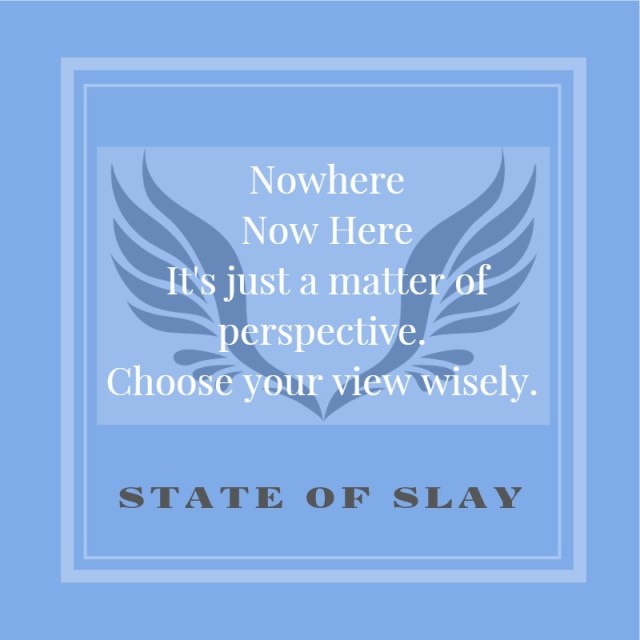
Good morning SLAYER! Everything we see is our perspective, not necessarily the truth.
SLAY on!

When I was suffering in my disease I didn’t tell anyone what as going on with me. I carried a lot of fear and shame for how I was living my life and thought that if I did tell someone the thoughts that ran through my head, and the things I was doing daily just to get by, that I would be locked up and labeled crazy. I had watched others in my life suffer with mental illness, and I was determined not to be like them, but determination wasn’t going to change the facts, I was in the throes of mental illness and I was loosing the battle.
I was fortunate that someone came into my life who had been where I was, someone who didn’t judge me or preach to me, he simply shared his story with me and lead by example. It took several months for that story to really resonate with me, but thankfully it did, and I recognized myself in that story and knew that that person was safe to reach out to and share my struggle with. It was that phone call that saved my life and started me on the path I live today, I have never looked back.
Why are we so afraid of the term mental illness? It wasn’t something I particularly liked as I set out on my path of recovery, but it put things in perspective for me. I had an illness. It wasn’t a lack of willpower or not being good enough that had caused me to get to such a bottom in my life that it brought me to my knees, and, nearly cost me my life, I was sick.
Mental illness covers a wide range of conditions that affect our mood, thinking or behavior. Some symptoms include:
Feeling sad or down
Confused thinking or reduced ability to concentrate
Excessive fears or worries, or extreme feelings of guilt
Extreme mood changes of highs and lows
Withdrawal from friends and activities
Significant tiredness, low energy or problems sleeping
Detachment from reality (delusions), paranoia or hallucinations
Inability to cope with daily problems or stress
Trouble understanding and relating to situations and to people
Alcohol or drug abuse
Major changes in eating habits
Sex drive changes
Excessive anger, hostility or violence
Suicidal thinking
I experienced all of these before reaching out for help. Sometimes symptoms of a mental health disorder appear as physical problems, such as stomach pain, back pain, headache, or other unexplained aches and pains. It’s cunning, baffling and powerful, and depending on what exactly you may be experiencing, it may also tell you you don’t have it. Mine certainly did, and on some days, still can.
But here’s what I’ve learned on this path of over 13 years. It can get better, and does if you seek help, and, are willing to be honest with yourself and others about what you are struggling with, if you are willing to do the work to get better, and can stop beating yourself up for something that is not your fault. We don’t criticize someone for being diagnosed with cancer, so why do we think we will be criticized for a mental health diagnoses? And if someone does criticize, it’s from their own fear or ignorance. There is nothing to be ashamed of. 43.8 million adults in the US deal with symptoms of mental illness everyday, and, with a diagnoses and proper self-care, many, like myself, lead happy and productive lives.
We need to change our perception of what mental illness means, and, what it does not mean. It does not make us weak, it does not make us less than, it does not make us losers, unable to cope, lazy, not equipped for life, it means we have certain obstacles we have to navigate around and we have to make sure we are doing what we need each day to keep ourselves in good health, mentally, physically and spiritually, that is all.
For those who dislike the label, labels do not define us, it is only a way to distinguish what is going on and what needs to be dealt with. For me, even though I didn’t like that label to start, it made what I was experiencing make sense, once I accepted that label I was able to do my homework and seek out the right kind of help I needed to get better, for me, shying away from that label would have only prolonged my suffering, and, in the end, may have kept me from getting well and which would have put my life in danger, the key to my getting well was being rigorously honest with myself and that meant I needed to accept the truth so that I could get better. I was told at the beginning of my journey that when I had the facts I was safe, even if they weren’t what I had wanted to hear, when I new what they were I could make sound decisions for my own well-being. The fact was, and is, I suffer from mental illness, except, I don’t suffer anymore, I thrive with it, overcome it and allow it to now connect me with others who may be struggling with it. Something that I once thought of as a curse is now the reason I started this blog, the reason it’s important to me to give back, to share my story because within that story and within my disease is hope, something I didn’t have when I was in denial about my mental illness.
No one wants to be different, no one wants to think of themselves as not capable, but suffering in silence is not the answer, not when there is an abundance of help out there, much of it free, to help you discover your best you, and to help you realize that a mental illness diagnoses is not anything to be ashamed about. May is mental health awareness month, a good time to look into what mental illness is and what it may mean to you, a great time to get honest and get some education around what might be troubling you or someone you love. SLAY on!
SLAY OF THE DAY: Do you have an issue with the term mental illness? If yes, why? Have you been diagnosed with a mental illness? Do you think you have symptoms of mental illness? What are they? Where can you go to seek help or guidance? Do you talk about your symptoms with others? If yes, who? If not, why not? Do you stand in your own way of getting help because of your how prejudice of what you think mental illness is or means? What if you looked into it anyway, let go of your fears or ideas of what you think it means and just look into the facts? Mental illness does not make you a bad person, 1 and 5 adults has some form of mental illness, you are not alone and you are not at fault, but you hold the key to finding relief and finding a way of life that allows you to be your best self.
S – self L – love A – appreciate Y – you

Feelings can help us, they can give us a sense of things, how we feel about someone, or something, but they can also deceive us, they can be tied up in old thinking, old behaviors, things that no longer serve us. When I was living in the dark, I didn’t want to feel anything, good, or bad. I just wanted to be numb,the bad feelings felt too bad, too much to handle, and I didn’t think I deserved the good ones, so I did what I could to not feel. I became so good at it, stuffing down my feelings and using outside things to shut them up, that I became dead inside. I told myself it was a way to protect myself, but I was slowly shutting myself down and, even though I couldn’t feel or hear them, all of those feelings were still there, including the ones that were hating myself for living the way I was.
When I sought help to get better, to learn to live in a healthier, honest way, those feelings all came at me like a tsunami. I used to wake up and hang on to my mattress thinking I would get blown off my bed from the sheer force of them if I didn’t hang on. I had to learn to process how I felt, to acknowledge those feelings, and to change the ones that no longer served me, or, perhaps never did. In this new way of life, I couldn’t hang on to my old ideas that had gotten me to a breaking point, I had to learn to let go and I had to learn to change what would stand in the way of my recovery.
My feelings can sometimes trick me, not as much today as they once did, but sometimes, those cunning little thoughts can make me think they’re valid to the situation I’m in, when really they’re dragging up old feelings from the past and trying to validate them in my present life. At the beginning, it was difficult to decipher if a feeling was how honestly felt in that moment, or my disease trying to pull me back. Staying present helped me filter through what was real and what was old and needed to go. Being honest with myself, asking myself how I really felt in that moment and why, what was making me feel that way, and if what was making me feel that way could actually make me feel that way or was it just my perception of what was going on based on the patterns of my life before. The waters sometimes got murky. But as I questioned it, things became clearer, for the most part, there are always some who are craftier about hiding themselves from the truth, but as I kept living in the truth, and looking at the facts, my feelings became clearer, and if I didn’t like how I felt, I learned how to change that feeling to something more constructive, or something positive, at the very least, something I could learn from, which, turned it into something positive.
We are not slaves to our feelings. We can use them to our advantage. We can let us show us what we like, what is good for us, who we should spend time with. We can let them warn us of repeating behaviors from our past, of people, places and things we probably not be around. We can learn to change them to fit in line with how we’re living our life today, or how we want to. Don’t like a feeling, change it. But only with healthy means.
For me if I’m feeling down, I ask myself why. I ask myself if this is a real, valid, feeling, based on facts, or if this is something imagined, or rooted in fear, once I get to the bottom of that feeling I can then work on changing it. I can do something positive for myself, which sometimes is as simple as going for a walk. The reason I might be feeling down is that I haven’t been getting out as much as I should, and those feelings may come from a need to get some fresh air. Sometimes, it’s as simple as that.
When feelings come up that make us feel uncomfortable there may be a reason for them, and once you find out why, or even if you haven’t and you just don’t want to stay in that place, find the counter action to change that feeling, once you’re in a better place, the reason you felt what you did, might become clear as day, and that gray day may just end by you liking what you feel. SLAY on.
SLAY OF THE DAY: Do you feel like you are a slave to your feelings? Do you feel like you have no control over them? How do they hold you back? How do you they help you? If they don’t, how can they? How can you use your feelings to guide you to where you are supposed to go, where you should be? How you can you use them to your advantage? How you can learn from them? How can you change them when they are not serving you? This all takes time SLAYER, it takes practice to acknowledge how you feel and learn why you do, but the more you look at the facts, what you know to be true, the easier it gets, and when things don’t seem right, they’re probably not, let your feelings guide you back to a place of self-love, of forgiveness, and the light, it’s from those places we learn to trust our feelings, and learn from them, instead of being enslaved by them.
S – self L – love A – appreciate Y – you

Before walking this path I was always proud of being a fighter. I would fight because I thought I was right. I would fight because I wanted to prove you were wrong. I would fight, just to fight. But what I didn’t realize is that I was fighting because I was in fear.
Looking back almost every decision I made was fear based, I never would have said that, in fact, I would have told you back then that I wasn’t afraid of anything. That was not the truth. My whole life I lived in fear. Fear you wouldn’t like me. Fear I wasn’t good enough. Fear I wasn’t smart enough. Fear of loosing what I have or not getting what I want. If there was something to fear I was fearing it. To mask that fear I would overcompensate and try to act strong, which many times caused me to pick fights to make myself feel better, or at least, smarter than you, and the lower I felt, and the lower my self-esteem was, the more aggressively I would fight, like somehow I could fight my way into feeling better, but I never did, it only made me feel worse over time. Oh sure, I might get a small hit of satisfaction from my “win,” but that would wear off and I was back to feeling bad again.
When I think back to those many years I lived in fear, most of my actions back then were the opposite of how I truly felt, as though I thought I could just force myself into feeling something different, but none of my actions were authentic to who I was or what was really going on.
Today, I don’t feel the need to lash out to those around me. I don’t have a need to be right, because I am comfortable in who I am today, I love who I am today, and, I am no longer motivated by fear. That’s not to say that I don’t have any fear about things in my life, but I don’t act out on it, and I know that if I did I would just have to apologize or make amends for it later, which doesn’t seem worth the fight, not today, and today I don’t need to find outside battles to try to fill an inside problem, I’ve learned to love myself and I’ve learned to fill myself with good things, with an abundance of self-love and all of the things that make my heart and soul shine, which is the antidote to fear. The counter action to fear is self-love, self-love conquers all, once you are able to find that the fear starts to fade away and those battles that used to seem so important, or even mandatory, are replaced with wanting to spread goodwill and to help those around us. So next time you’re get ready to fight, ask yourself, what am I so afraid of? SLAY on!
SLAY OF THE DAY: What are you most afraid of? When you’re in fear, do you act out? Do you try to hide your fear? Are you aware that you might be trying to hide your fear? Why do you think you have fear? Are those reasons based in fact? Or, are they based on stories you’ve been told about yourself, or, stories you’ve told yourself? What if you stopped telling those stories? Do love yourself today? If you do, what do you love about yourself? If not, why don’t you love yourself? Are those reasons legitimate today? Are these things you can change or improve on? What can you do today to focus on the good in you? When we focus on our good and share our good with others we start to lose our fears and when we lose our fears we lose our fight and need to be right. Let those moments when you want to fight be an indication that you are in fear and instead of putting on those gloves and stepping in the ring, ask yourself what you are most afraid of, the answer will likely lead you to the place you need the most love, heal that place, love yourself in that place, and don’t fear that place, that place is you, at your most beautiful vulnerable self, let go of that fear and let love in.
S – self L – love A – appreciate Y – you

Good morning SLAYER! You can only accept mistakes and flaws in others to the degree that you accept your own.
New blog goes up Tuesday, until then…SLAY on!


That may sound pretty harsh, but it’s not as harsh as it sounds. We all have busy lives, lives with many working components, we juggle many things each day and try to find our own sense of balance. And, just as we are doing that, so is everyone else. Each of us is doing the best we can with what we have. And, some days, we are feeling we’re short. If we need help we should ask for it, but that doesn’t mean the person we ask has to drop everything to run to our aid.
I used to pride myself on not asking for help, to fault, because I would get myself into situations, alone, that I wouldn’t have found myself had I just asked someone for a hand. But off I would go, stubborn, thinking I could do it without having to ask anyone to help me. When I started to walk on this path, and started practicing self-care and self-love, I was taught that it was OK to ask for help, I had to take a deep breath there, because that went against everything in me to do, but I set out to try to practice healthier behaviors and when I felt I should, I asked for help. Seeing as this was still new, and not quite having all the tools I have today, I had an expectation when I asked for help. I expected whomever I asked to jump to it and make themselves available right way when I asked, because, they should know it wasn’t easy for me to ask and to help me learn and grow they should show up and do their part. Wrong attitude. The second part of learning that new behavior was accepting what came back, and sometimes that was that they couldn’t help me right away, or, at all. The old me then would pipe up and say that that was why I never asked before, because no one was going to help anyway, but I had to get past that, ask if there was a good time for them to help, or if not, say it was OK and move to someone else, and when I say move on, meant it, and not linger in a resentment. All of that took time, and practicing doing it over and over. It mostly meant realizing that the people in my life where not there to serve or be at my beck and call, they also had lives and were just as busy I was, maybe even more so, and, they weren’t spending their days wondering what I was going to need or how they could help me. All fair.
We sometimes forget that, just like we’re busy, so are others, and even though something is very important to us it likely won’t have the same importance for someone else, just as what is important to them may not be important to us. But, as SLAYERS, we can show up where we can for others, and ask others to do the same when we need them, but also understand if they are not able to at that exact moment, they’re not out to sabotage you, they’re just taking care of their own needs and lives. It’s not an us vs. them situation, what it should be is us all living our lives and helping each other when we are able to, that way we are all growing and sharing when when we can and it’s coming from an organic loving place. When we are able to live that way we have less conflict and disappointment, and we are not only honoring who we are, but respecting those around us as they walk their journey and we walk ours. SLAY on!
SLAY OF THE DAY: Do you have trouble asking for help? What stops you? Have you had bad experiences in the past? Or were you taught, or told, you shouldn’t ask for help? Who told you that? Why did they tell you that? Was that based in fact or a story they told you, or maybe one you told yourself? What has been the result of asking for help in the past? Is there a way you can improve how you’re asking for help, or who you’re asking? List the ways how. Do you expect people to drop everything and help you immediately? Why do you think they should? Do you respect the people in your life and their time? If not, why not? You should SLAYER, each of us has their own lives to live, we are all busy, take into consideration someone else’s time, as you would expect them to take in consideration yours, and when someone isn’t available right away, ask them when they can be, or if they can at all, if they can’t, ask someone else, it’s not that they’re working against you, they’re just working for themselves at that time, and that doesn’t mean they won’t be there for you another time. One no isn’t the end of the world, it just means you are meant to ask someone else who is meant to help you in that time of need. So keep asking, you’ll find the right person.
S – self L – love A – appreciate Y – you
Before I stepped onto this path, I walked through a lot of pain.
Not gracefully.
Not reflectively.
More like a storm spinning out of control—reactive, destructive, and exhausting.
I told myself, and was often told by others, that the pain was making me stronger. That suffering was proof of growth. That endurance alone was somehow building character.
But looking back, I can see the truth much more clearly now:
The pain wasn’t strengthening me.
My response to it was weakening me.
And in many cases, I was the source of my own pain.
That realization wasn’t comfortable—but it was freeing. Because it showed me that growth was never about how much pain I endured. It was about what I did after the pain showed up.
Pain is part of being human.
We get hurt.
We get disappointed.
We get blindsided—sometimes by others, sometimes by life itself.
But pain alone doesn’t create growth.
Pain without awareness creates repetition.
Pain without reflection creates cycles.
Pain without honesty keeps us stuck.
What determines growth isn’t the pain itself—it’s whether we react from old wounds or respond with clarity.
And there is always a choice.
There’s a difference between reacting and responding.
Reaction is impulsive.
It’s emotional.
It’s driven by fear, old stories, and survival patterns.
Response is intentional.
It’s grounded.
It’s guided by truth instead of triggers.
When I reacted to pain, I made choices that caused more pain—burning bridges, sabotaging myself, repeating patterns I swore I wanted to escape.
When pain wasn’t self-inflicted, that was where growth became possible—if I was willing to respond instead of explode.
One of the most damaging stories we tell ourselves is that pain itself makes us stronger.
That belief often keeps us tolerating what we shouldn’t.
It keeps us in harmful relationships.
It keeps us justifying self-destructive behavior.
Pain doesn’t build strength.
Choices build strength.
The strength comes from what you learn.
From what you release.
From what you decide not to repeat.
The old narrative—that suffering proves worth or resilience—often keeps us returning to the same sources of harm, believing it’s “part of the process.”
It isn’t.
One of the core truths I return to again and again is this:
When we have the facts, we are safe.
Not the feelings.
Not the assumptions.
Not the stories shaped by past wounds.
The facts.
Looking at pain honestly—without embellishment, blame, or denial—allows us to understand its source. And once we understand the source, we gain power.
Power to choose differently.
Power to set boundaries.
Power to walk away instead of reenacting.
Pain becomes useful only when it’s investigated.
Here’s the part that changes everything:
We don’t control whether pain shows up—but we do control how much we let it stay.
We can:
Let it fester
Turn it into resentment
Use it for sympathy
Or learn from it and release it
Sometimes simply letting pain go is growth.
Not every wound needs a deep dive. Some lessons are learned by choosing not to engage again.
And when you’re living from self-love and honesty, destructive reactions stop feeling good. Self-sabotage loses its appeal.
Because why tear down something you’re finally learning to build?
Pain is meant to inform you—not define you.
It shows you where boundaries are needed.
It highlights what isn’t aligned.
It reveals patterns asking to be broken.
But pain is not meant to be lived in.
When you respond with curiosity instead of chaos, pain becomes data. And data leads to discernment. And discernment leads to peace.
That’s growth.
You may have never paused to ask yourself how you typically respond to pain.
So the next time it shows up, try this:
Strip away the story.
Remove the emotional overlay.
Look at the facts.
What actually happened?
What role did you play?
What part was within your control?
What can you learn?
When you do this, pain stops being something that happens to you—and becomes something that works for you.
The greatest gift pain can offer is information.
And information, used wisely, changes everything.
Let’s reflect, SLAYER:
S: What do you believe is the main source of pain in your life right now?
L: How much of that pain are you creating, allowing, or repeatedly engaging with?
A: When pain shows up, do you tend to react or respond—and how is that serving you?
Y: What could change if you chose to learn from pain instead of letting it control you?
I’d love to hear from you.
How has your response to pain shaped your growth—or where do you feel called to respond differently now?
Share your story in the comments. Let’s cheer each other on.
And if you know someone who’s stuck believing pain itself is the path, send this to them.
Sometimes, all we need is a nudge.
