Good morning SLAYER! When you speak your truth with compassion, your words have more power.
New blog goes up Sunday, until then…SLAY on!



Good morning SLAYER! When you speak your truth with compassion, your words have more power.
New blog goes up Sunday, until then…SLAY on!

I have never been accused of being subtle. My mind works at a fast pace and my mouth is just as fast, and at times, even faster, and can belt out quick comments or opinions as I move about my day. As I’ve walked along this path I have made a conscious effort to use a filter of compassion and understanding on my mouth, but sometimes the unfiltered truth comes out as I’m running out the door, or late because of someone else’s actions or out of my own frustration, and someone gets hurt. What I say typically is the truth, or the truth as I see it, but can probably be said in a softer and gentler way. It seems that the unfiltered truth often gets used on those I love the most, perhaps my immediate response to something I have already had a discussion about or think they should know. But what I should always know is that my words can hurt, and when I feel that rush of hitting my limit of the softer and gentler way, that’s likely when I should double-down on finding that filter instead of just letting the words fly out of my mouth.
Most people are open to hearing the truth, if it’s said in a way that they can receive it. People don’t hear us when we make them wrong. People don’t hear us when when we attack their weakness. People don’t hear us if we’re if we’re telling the truth by making ourselves sound better, or when we assume they don’t understand what we mean. They will typically always hear us when we speak from the heart. That in itself can be the challenge.
Patience is something I work on every day. I have gotten a lot better with it, but when my brain gets it’s gallop going and it’s heading toward the finish line, patience can fly right out the window, and anyone that slows me down or gets in my way sometimes gets trampled on. It’s in those times I need to speak the way I would want to be spoken to. Even if I may be in the right with the truth I am saying, I need to make sure I am carefully choosing my words and the delivery of how I’m saying it or I can be just as wrong. In fact, many times, the moment someone feels spoken down to, criticized or judged they will likely shut you out, and no amount of truth will be getting in once that happens.
We may be right, but it’s not just about being right, it’s about telling the truth in the right way, in a way that can be heard, and a way that you would want to hear it. It’s then, that a conversation can take place, and progress is able to happen in that area. Also, making sure that we’re not holding back our truth until we just can’t anymore and it just come blurting out. Saying it in the moment, or when it’s appropriate, and not just appropriate for us. When we hold back the truth that frustration, resentment or anger can grow and when it finally lands on our lips it can come across much harsher than it was every meant to be, so making sure we are speaking up when we should, so that fire doesn’t burn both of you later on. Work on speaking from your heart, and thinking of the other person as a part of yourself, from that place the truth is often a lot easier to digest. SLAY on!
SLAY OF THE DAY: Do you tend to be quite direct when speaking our truth? Do you speak your truth in the moment or wait until you can’t hold it in anymore? What is the result of that? How can you improve or shorten the time it takes for you to express your truth? Are people generally open to hearing your truth? If yes, why do you think that is? If no, why do you think that is? What can you do to change your delivery so people may be more receptive to the truth? How do you like to hear the truth? Do you like to hear the truth? Take into consideration how you best receive the truth and work on sending out the truth that way, there may always be someone who isn’t receptive to hearing it, but when we are able to to say it in a way that they don’t feel attacked, they may be better able to recieve what you say.
S – self L – love A – appreciate Y – you

Before I began this journey, I often did good deeds—but if I’m honest, many were tied to expectations. I sought recognition, appreciation, or something in return. My actions, though seemingly kind, were often self-serving.
When I stepped into recovery, I was met with unconditional support. People offered help without expecting anything back. It baffled me. I waited for the catch, but it never came. Instead, they simply said, “Pay it forward.”
At first, I didn’t grasp the depth of that phrase. But as I started to help others without expecting anything, I felt a shift. Supporting someone else lifted me, too. It reminded me that even in my lowest moments, I had something to offer.
Helping others became a cornerstone of my recovery. Not grand gestures, but simple acts: a smile, a kind word, a listening ear. These moments connected me to others and grounded me in my own healing.
I learned that when I offer support without strings attached, it not only aids someone else but also reinforces my own growth. It’s a two-way street of healing and connection.
True kindness doesn’t come with a scoreboard. When I stopped expecting reactions or rewards, my actions became more genuine. If someone didn’t respond as I’d hoped, I learned to let it go, sending them silent well-wishes instead.
This shift freed me from disappointment and allowed me to act from a place of authenticity and compassion.
Being a conduit of good doesn’t require monumental efforts. It’s in the everyday moments: holding the door, offering a compliment, or simply being present. These small acts can have profound effects on someone’s day—and on our own hearts.
SLAY OF THE DAY: Reflect & Rise
Do you look for ways to be a conduit of good in your daily life?
Have you experienced someone paying it forward for you? How did that make you feel?
What can you offer to someone today?
How does giving without expectation shift your perspective?
How can you cultivate compassion for others—and yourself?
Call to Action: Join the Conversation
I’d love to hear from you.
What’s one way you’ll be a conduit of good today?
Share your story in the comments. Let’s cheer each other on.
And if you know someone who might need a little hope, send this to them.
Sometimes, we just need a reminder that we matter.
Would you like me to create a WordPress excerpt and tags to go with this?
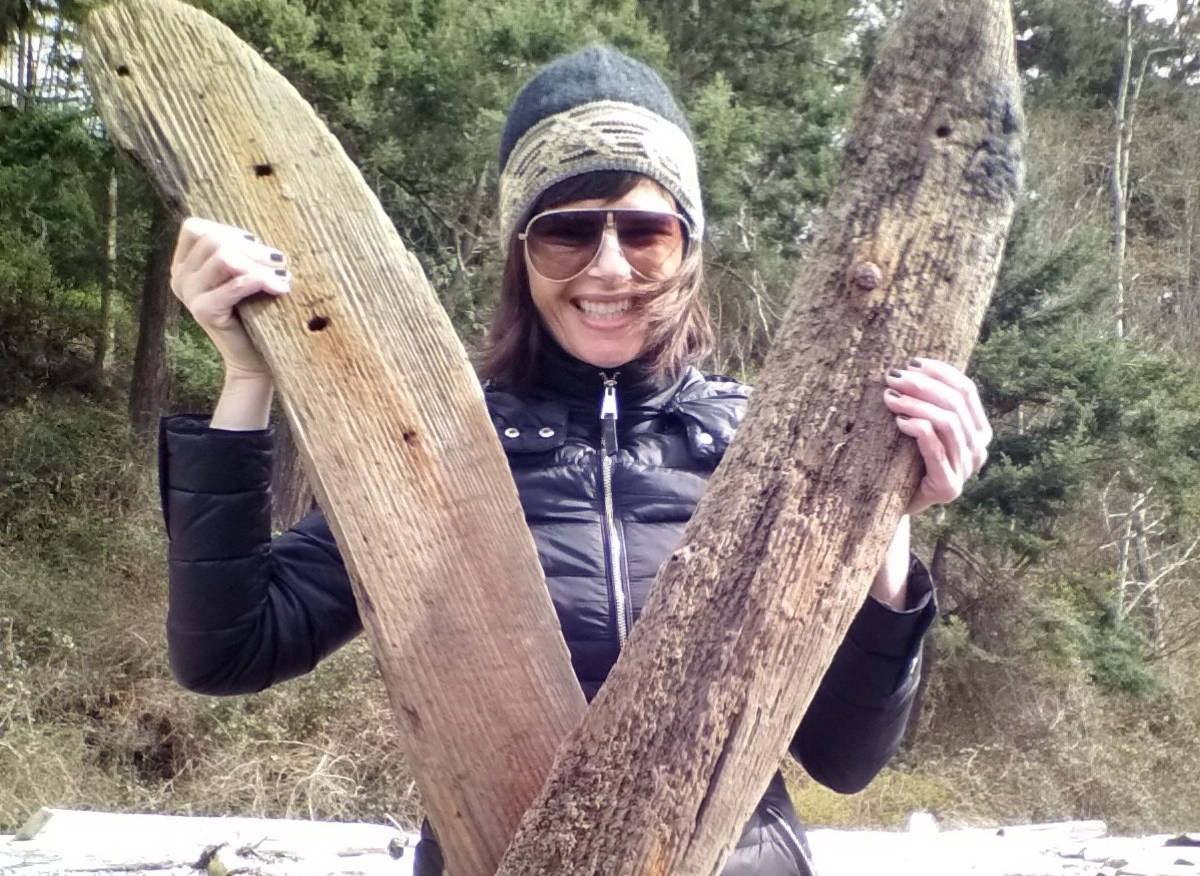
Typically those things we find irritating others, those things we judge, or dislike, are things we also have, or dislike about ourselves. We may not always recognize that, we may be in denial that we too exhibit the same behavior, quirk or flaw, but there’s a reason we’re zeroing in on someone else and picking out those things in them, we recognize ourselves there.
Before stepping on this path, and before doing the work to acknowledge my own issues, I often judged other people. I judged them for exhibiting the same behaviors as I was, even though I would never admit that I was behaving that way, or had the issues “they” had. I always had an opinion about what they should be doing, or how they could do it better. And when they failed, I thought, they’re not strong like I am. But what I wasn’t willing to see is that all of that judgment I placed on other people was to deflect my own behavior and actions. If I could put the focus on everyone else, shine a spotlight on their character defects or bad decisions, I could keep doing what I was doing in the dark without anyone noticing, or so I thought. I was noticing. Maybe not consciously, but subconsciously, there was no hiding from myself. And once I made the commitment to get honest, and get better, I realized what I had been doing most of my life, pointing out other people’s flaws and mistakes, I was guilty of doing all of the same things. That was a tough pill to swallow at first because I had stood with my head held high like I was better, smarter and healthier than those I judged, and in the end I was just as bad, maybe even worse, and that was a big piece of humble pie.
Today when I start to judge someone, and it happens, I pause, and I take a look at why I am feeling the need to tear someone else down, and what may be missing or needing work on my end? What do I need to look at, and am avoiding, that’s causing me to want to shine the spotlight on someone else, instead of looking at myself? It’s a good indicator that I have work to do. And, I can now use my acknowledgment of someone else’s stuff as a form of compassion, or understanding, because I likely share in that same behavior. I have been able to turn my judgment of others into something positive, for me, and as a way to connect to those around me.
What we find disturbing or irritating in others is typically what we find disturbing or irritating in ourselves. And that, is our problem. We are all responsible for ourselves and our own behavior, what someone else is doing is none of your business. It is not up to us to judge them or school them on how they should be living their lives, but we can certainly look at how we’re living ours when we find our focus shifts to someone else. Our focus on someone else’s behavior is the best indicator that we need to shift our focus back on us. SLAY on!
SLAY OF THE DAY: Do you tend to judge others for how they’re living their lives? Why do you think you do this? Do you try to give that person advice? How is that usually received? What behavior or character traits usually catch your eye as something that should be fixed? Do you see those same things in yourself? What can you do to place the focus back on yourself and away from judging someone else? What are some of the things that you pick out in others that you also have yourself? When you look at that list, how do you feel? What don’t you like about what’s written on that list? What can you do to fix that? We all have moments when we judge others. It’s what we do when we notice we’re doing that sets us apart. Use those moments to take a look at your own behavior and actions, use those urges to fix someone to fix yourself. Find away to let that stuff go.
S – self L – love A – appreciate Y – you

Might have made you think about that for a moment. It’s been regarded for some time that fear is not a base feeling or emotion. It is something we use to cover up feeling disregarded, unimportant, accused, guilty, untrustworthy, devalued, rejected, powerless, and unlovable. None of those feelings are good, and we certainly don’t want to feel any of those feelings, so many of us, will go to great lengths to cover them up, and anger is one heck of a smokescreen.
Anger can scare people away, get them off the scent of what’s really going on, especially when it seems to come out of nowhere, people can get jolted by, fearful of it, or match that emotion and get angry themselves, it can be contagious, and when everyone is angry the true source of the anger gets lost.
When I think back to who I used to be I got angry a lot. And, when I’m really looking at the source to my anger many times it was to hide what was really going on, because, I figured, no one really wants to deal with an angry person, so people will just leave me alone or just give me what I want so I would go away. That sounds really sad when I see it in black and white. But it’s the truth. I hid behind anger as a shield so I wouldn’t have to look at what was really going on. And what was really going on is that I wasn’t able, or willing, to look at my part in all of the things I was using anger to hide. I wanted to blame everybody else, any thing else, rather than even consider I may be causing myself most of my pain by the decisions and choices I was making. So when I got caught in a place where I had made a bad decision and felt embarrassed by the outcome, I would get mad, angry, to hide my own shame.
It’s funny because now that I no longer allow myself to do that, I see it in others. When someone gets mad or angry I begin to think what might be the actual issue, rather than just jump in and match their anger, or, feel hurt by their actions. Now, I’m human, so there are times I do get hurt in the moment, but I try to peel that back and look into what really may have been going on. It allows me to find some compassion for the other person, and, if they’re willing to talk, find out what the real issue is. For me today, if I suddenly flare up and feel angry, it is my job to look at what is really going on. Now that I no longer live my life in fear, many times it’s base is from a choice I’ve made, that I probably knew was not the best choice, but I made it anyway and now I’m suffering the result of that choice, so, I’m angry. But the right response to those situations should be, lesson learned, I’ll make the right choice next time. Allow myself to feel the frustration of that result, but not let it take over and have power over me letting it escalate to anger.
When we take away anger as a base feeling, it already seems to lessen it’s power and strength over us. And when we feel anger creep in, that’s another time to get out our SLAYER detective hats on and find out what’s really going on. What our anger really is is an opportunity to do better next time, it’s giving us information we need to avoid feeling that way again from the same source, and, we may feel it again from that same source a few times over, I know for me, it usually takes more than once before I get the hint, but, the point is we look for it and we try.
Take away anger’s power, look at it for what it truly is. Change what you can, and accept what you can not. Those are truly the only two antidotes for anger. SLAY on my friends!
SLAY OF THE DAY: Do you let anger get the best of you? Do you find yourself angry and don’t know why? Do you know why and are using anger to hide something? What do you typically use anger to hide? Why do you do that? Is there something you can do so you’re not making the same decisions that get you to anger? What can you change or do differently? When you feel angry, are you able to pinpoint the source of it? Think of the last time you were angry. What was the source of it? And, no, I don’t mean point fingers to someone or something else. What was your part? What can you change for the next time so you don’t find yourself in anger. Take responsibility for actions SLAYER, we all make mistakes, so admit them when you’ve made them, you’ll be surprised how many people will understand, and maybe even help you, when you are honest about who you are and what you’ve done. Anger doesn’t help anyone, and it keeps you in the same cycle you’ve always been in. Break the cycle, kick anger to the curb by changing your path, our actions, the choices you make, and take your power back from anger.
S – self L – love A – appreciate Y – you

There is no going back.
No rewinding. No editing. No alternate ending where we made the perfect choice every time. The past is fixed. It happened. And for a long time, I let mine define me.
Before I began this healing journey, I used my past as proof that I was a victim. I told those stories in ways that supported that narrative. Sometimes I wanted sympathy. Sometimes I wanted validation. Sometimes I wanted an excuse for behavior I knew was not aligned with who I truly wanted to be.
And here is the truth I eventually had to face.
In many of those situations, I had a role. Sometimes a small one. Sometimes a big one. But denying that kept me stuck. It kept me repeating patterns. It kept me living in yesterday instead of building today.
The moment I committed to honesty, especially with myself, everything began to shift.
Taking responsibility is not about blame. It is about freedom.
When I stopped pointing outward and started looking inward, I began to see patterns. Choices I had made. People I had allowed into my life. Boundaries I had not set. Truths I had ignored.
At first, that realization was uncomfortable. I had built an identity around being wronged. Letting go of that identity felt like losing something familiar.
But what I gained was far greater.
Clarity. Growth. Self respect. And the ability to change.
Once you see your patterns, you can interrupt them.
And that is where transformation begins.
I used to carry shame, anger, and frustration everywhere I went. Those emotions colored how I saw myself and others. They influenced my reactions. They shaped my expectations.
But when I started living more honestly, those emotions began to loosen their grip.
I learned to ask different questions:
What did I learn?
What would I do differently now?
What boundaries do I need moving forward?
What forgiveness is necessary for peace?
Sometimes forgiveness was for someone else. Sometimes it was for myself. Often it was both.
And slowly, the past stopped feeling like a prison and started feeling like a teacher.
One of the biggest gifts of reflection is recognition.
When you understand your patterns, familiar situations begin to feel different. You notice warning signs earlier. You pause before reacting. You make decisions with awareness instead of autopilot.
Early on, I often did not know what the “right” response was. So I learned something important.
Pause.
Life is not a game show. There is no prize for responding fastest. Taking time to think, to ask questions, or to seek guidance is not weakness. It is wisdom.
And with practice, better decisions become more natural.
That is growth in action.
You cannot rewrite the past, but you absolutely shape what comes next.
When we act with honesty, integrity, and awareness, the weight of past mistakes lightens. They stop defining us because we are no longer repeating them.
We admit when we are wrong. We make amends when possible. We learn. We adjust. We grow.
And suddenly, the past becomes context instead of identity.
That shift is powerful.
It creates space for self respect. Confidence. Peace.
Responsibility does not mean harsh self judgment.
Some experiences truly were outside our control. Some situations were painful, unfair, or confusing. Acknowledging that is part of healing too.
The key is balance.
Accountability where we had choice. Compassion where we did not.
Both are necessary for emotional freedom.
And both allow us to move forward without dragging the past behind us.
This might be the most important part.
You are not required to remain the person you were during your hardest seasons.
Growth means evolution. Awareness means change. Healing means forward movement.
Your past informs you.
It does not imprison you.
And every day offers a chance to choose differently.
Let’s reflect, SLAYER:
S: When you think about your past, what emotions come up most strongly?
L: What patterns or choices do you now recognize that you could approach differently today?
A: Where might forgiveness, either for yourself or someone else, create more peace in your life?
Y: What is one small action you can take today that reflects who you are becoming rather than who you were?
I’d love to hear from you.
How have you learned to reinterpret your past so it supports your growth instead of holding you back?
Share your story in the comments. Let’s cheer each other on.
And if you know someone who needs permission to move forward without being defined by yesterday, send this to them.
Sometimes, all we need is a nudge.

Good morning SLAYER! You are enough. You have always been enough. You will always be enough. You matter.
New blog goes up Tuesday, until then…SLAY on!
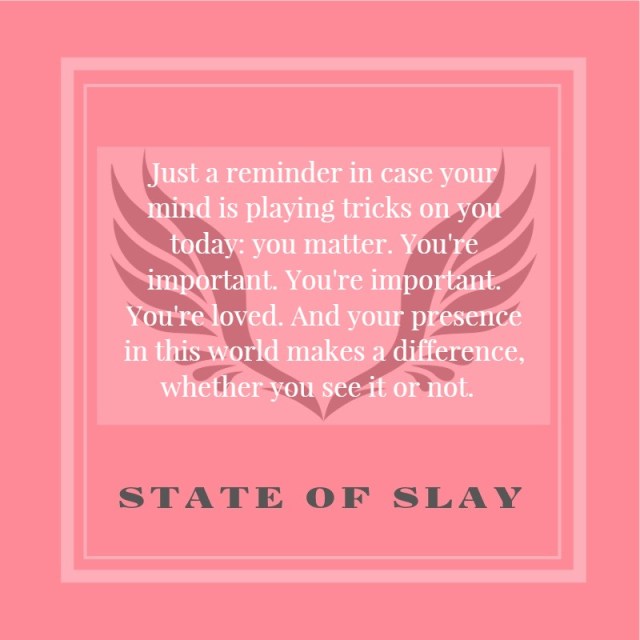

Good morning SLAYER! When things go wrong, don’t go with them.
New blog goes up Sunday, until then…SLAY on!
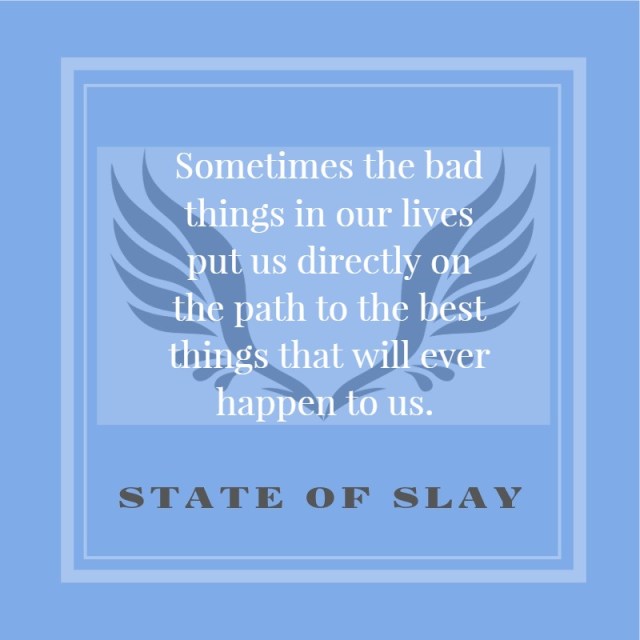

Good morning SLAYER! Always speak your truth, even if your voice shakes.
New blog goes up Friday, until then…SLAY on!
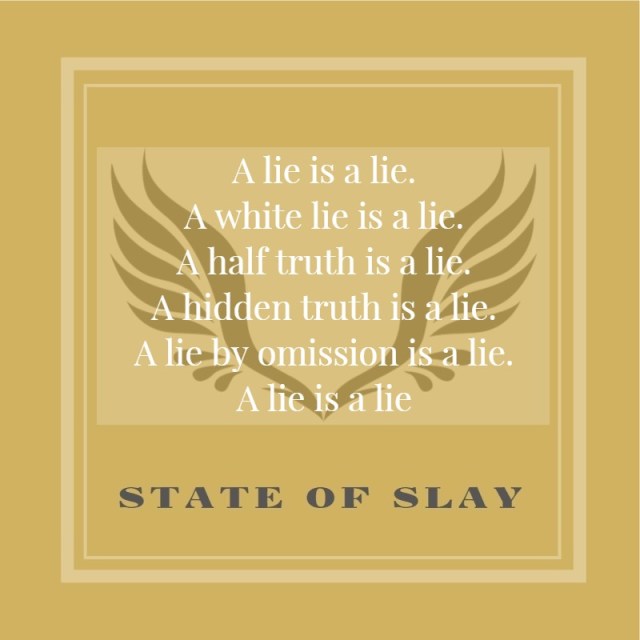

Well, unless you let it. Many of us have come from difficult, troubled, or tragic places, sometimes beyond our control, it’s easy to get labeled, or label ourselves as victims, or as those people from our past, but that’s not who we are.
I used to dwell on the past, use it as an excuse to for bad behavior, for not treating myself well, for doing self-destructive things, to me, and those around me. I told myself that it didn’t matter, that I was a bad person, and that I was entitled to it because of my past, I was wrong. Perpetuating that story or narrative only got me deeper into the darkness, and yes, there are times in our lives, or circumstances, that are beyond our control, but as an adult we at some point need to take responsibility for who we are and how we’re living our lives, and not use those things as a crutch to behave badly or to not do better for ourselves. We as adults have the power to change our stories, or to start new ones. To say that the past is the past and let it go, or move forward. Some things are easier than others to let go, but nothing is impossible. There may be circumstances that change us forever, but we then get to decide who we are in that new normal, and how we can make a difference, to ourselves, or others. I found a way to take seemingly negative events in my life and use them to connect with others, to share, to offer hope, those things, the past, now has positive purpose in my life, and because of that, all of that darkness is now surrounded by light.
No one gets to tell us who we are, or should be. Only we get to decide. And if someone is only willing to see us the way we were, or in a certain light that is not true to who we are today, then perhaps we need to let them go. It is also up to us who we share our lives with, and as we learn and try to live in the light it’s important to share our lives with those also doing the same, or, at least trying.
Using your past to hide is like continuing the abuse, the bad behavior, or reliving the difficult circumstance over and over again, only you are the one who’s doing it to yourself. To me, that makes it worse. It’s up to us to break the pattern, it’s up to us to say that’s not who we are, and it’s up to us to rise above and not let that define us. There may be residual effects from our past that we need to deal with in our day to day lives today, but we deal with them, we take them in stride, and not let them stop us from moving on, from living the life we want for ourselves today, from succeeding where we once may have failed. Everyone has obstacles to overcome, some more than others, but finding a way to work through them, work around them, or, incorporate them into the life we want is what sets us apart from those who stay stuck and never reach their full potential.
Let the past go, talk about it, work through it, tell yourself that you are not what has happened to you, or even what you may have done to yourself, not if you change that behavior today, and when you are able to do that there is no shame in where you’ve come from, because you are no longer that person, you are better, stronger, brighter, you are who you are truly meant to be, and to get there, it takes some falls, some lessons, and some forgiveness. Let go of what no longer serves you, look for opportunities to turn your past into a positive path for you to walk today, one that allows you to be your best self and allows you to let go of what no longer serves you. SLAY on!
SLAY OF THE DAY: Do you let your past define you? Do others label you based on your past? How does that make you feel? Or, are you the one who labels yourself? Why? How does that help you? How does that hurt you? What can you do today to overcome your past? Who in your life can help you do that? Who supports you in this effort? Who do you admire for rising above their past? What can you learn from them? What can you apply to your own life to do the same? SLAYER, we all have the opportunity to let go, make peace, or re-purpose those parts of our past that are not who we are today, so don’t let anyone, or yourself, hold you back from being your best you.
S – self L – love A – appreciate Y – you
