Let’s get one thing straight: your emotions aren’t flaws—they’re signals. And when you express them, especially the hard ones, you’re not being dramatic—you’re being brave.
I used to think otherwise. I believed showing emotion made me weak, messy, or a burden. So I swallowed my sadness. I masked my fear. I let anger lead because it felt powerful—until it didn’t.
What I didn’t realize then is what I know now:
Pretending you’re fine when you’re not doesn’t make you strong—it keeps you stuck.
Prefer to listen? The Audio Blog version is available here.
I Wasn’t Okay, and That’s Okay
Before I found this path, I believed the lie that being emotional meant I was broken. I wore “I’m fine” like armor. But underneath? I was drowning.
I thought if I kept it all inside, I’d stay in control. But all I did was isolate myself.
When I finally whispered, “I’m not okay,” I expected the world to crumble.
It didn’t.
Instead, it got quieter. Lighter. Kinder.
Speaking Truth Set Me Free
I started sharing more—first in small, scared ways. A tear I didn’t hide. A truth I told out loud. And I discovered something wild:
My emotions didn’t make me weak. They made me real.
And in being real, I connected.
People didn’t run. They leaned in.
They said, “Me too.”
Expression Became My Strength
Every time I gave my emotions a voice, I took my power back.
I wasn’t hiding.
I wasn’t shrinking.
I was healing.
I stopped believing the lie that vulnerability is a liability. I started believing this instead:
Telling the truth—even when your voice shakes—is the most powerful thing you can do.
Boundaries Matter. So Does Honesty.
Let me be clear: You don’t have to spill your soul to everyone. Not all feelings need a stage—but they do deserve space.
Even saying a simple, “I’m not okay right now” can be the start of something powerful.
Because emotional honesty doesn’t just free you—it invites others to show up too.
And that’s how we build the connection we crave.
SLAY Reflection
Ask yourself:
Are you hiding your feelings to appear “strong”?
What one emotion are you holding in right now?
What do you fear will happen if you express it?
What do you hope might happen if you do?
Who is one safe person you could open up to this week?
Your voice deserves to be heard—especially by you.
S – L – A – Y
S:Stop pretending you’re fine when you’re not. L:Listen to your emotions without judgment. A:Allow yourself to feel and share. Y:Yield to the healing power of emotional honesty.
Call to Action: Join the Conversation
I’d love to hear from you. What emotion have you been holding in—and what might change if you gave it a voice?
Share your story in the comments. Let’s cheer each other on.
And if you know someone who’s been holding it all in, send this to them.
Sometimes, all we need is a nudge.
I’ve been there. I mean, clowns are one thing—but for me, the pattern showed up in the people I kept allowing back into my life.
Before I began walking this healing path, I lived with a lot of magical thinking. I believed that if I hoped hard enough, people or situations would just… change. And each time they didn’t, I was left hurt, disappointed, and confused. Still, I’d go back—again and again—expecting a different outcome.
For a while, I told myself it was about giving people the benefit of the doubt. But if I’m being honest, some of it was rooted in a narrative I was used to telling: that I couldn’t trust people, that others would always let me down, that I was the victim. A lot of it, though, was simply expecting someone to show up differently than they ever had before—despite all the evidence to the contrary.
Prefer to listen? The Audio Blog version is available here.
When We Hope Instead of Accept
Even after I started healing, I still found myself getting hurt in these same dynamics. The difference was, I had more awareness. I knew I couldn’t expect people to be who I wantedthem to be. But because I was changing, because I was growing and showing up differently, I’d start to think—maybe they are too.
Spoiler: They weren’t.
At least not in the way I hoped. They were still who they had always been. And I was still getting hurt.
People show us who they are. We’re the ones who often refuse to believe them. We soften the truth, sugarcoat their behavior, make excuses. But deep down, we know what’s real. We just don’t always want to accept it.
Expecting Different From What’s Always Been
We can’t expect different from someone who’s always shown us the same. Yes, people canchange—Ihave changed—but we can’t expectit. We can share how something made us feel. We can suggest a different way of communicating. But at the end of the day, some people will always return to their default patterns. And that may not change—no matter how much we grow.
The only thing we can control is us:
Our boundaries
Our expectations
Our willingness to engage
We can’t keep going back to the same well and be surprised when it’s still empty. Eventually, it’s not about them. It’s about why we keep going back.
Lead by Example—And Accept What Is
The most powerful way to inspire change is by living it.
When we shift how we communicate, how we hold boundaries, how we show up—we naturally invite others to do the same. But even then, they may not follow. And we have to be okay with that.
Because we’re only responsible for our own energy. We can’t change someone else. We can only change how we engage with them—or choose not to.
This lesson didn’t sink in for me right away. I returned to the same dynamics more than once, hoping this time it would be different. Hoping the same people would finally see me, show up for me, offer something they’d never offered before.
And each time, I left disappointed.
Eventually, the mirror flipped. The problem wasn’t just them—it was me continuing to hope for something that had never been there.
The Truth Isn’t Always Harsh—But It Is Honest
It’s not always easy to accept the truth about someone, especially if that truth means letting go of what we wishthey could be.
Accepting someone for who they are doesn’t mean you hate them. It doesn’t even mean they’re a bad person. It just means they aren’t capable of offering you what you need.
And that might mean setting boundaries. It might mean pulling back. Or it might mean walking away entirely.
The truth is: you can’t blame the clown for acting like a clown if you keep showing up at the circus. You have the power to exit the tent.
Take people for who they are—not who you hope they’ll become—and honor yourself by accepting that truth.
SLAY Reflection: Your Turn to Get Honest
Take a moment to reflect with these questions:
Do you find yourself going back to the same people, expecting different results?
Is there someone in your life you’re still hoping will change, despite a long pattern of behavior?
What are you really seeking from them—support, love, validation? Have they ever truly given it?
What boundaries could you set to protect your peace, even if they don’t change?
What would it look like to stop hoping—and start accepting?
Call to Action: Join the Conversation
I’d love to hear from you. What’s one situation or relationship you’ve kept returning to, hoping it would change—and what finally helped you step away? Share your story in the comments. Let’s cheer each other on.
And if you know someone who’s stuck in a cycle of disappointment, send this to them. Sometimes, all we need is a nudge.
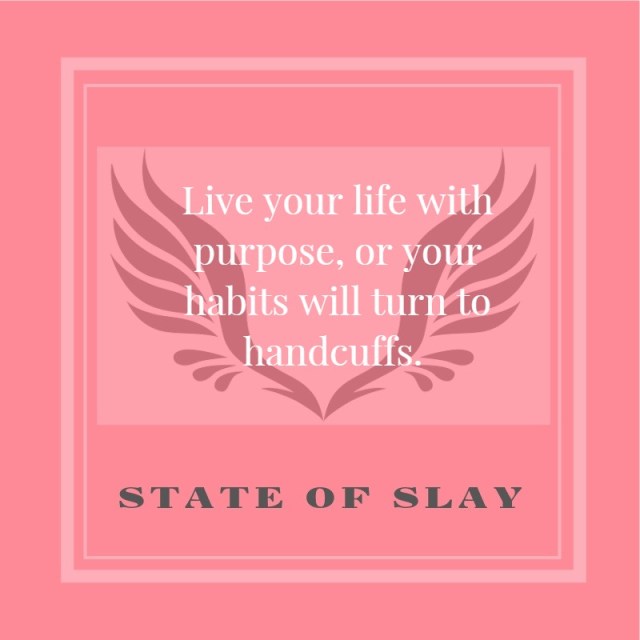
Before stepping on this path I lived out of habit. I was unhappy with the way I was living my life, but I did nothing to change it. Each day was like Groundhog Day, I just kept repeating the same behaviors and getting the same results, and yet, somehow, I hoped each that things would be different. They never were. Well, except they kept getting worse. My intent every day, back then, was to just disappear, to ignore the things I didn’t want to deal with and find ways to distract or numb myself so I wouldn’t feel. Now, I’m sure a few of you out there know ignoring something typically doesn’t make it go away. I had to learn to stop that cycle if I had any hope of getting better. Or even surviving the endless cycle I was in.
When I got on a path of recovery I realized I had a lot of habits I needed to break. I was told it takes 90 days to break a habit, I figured it probably took longer than that, but 90 days seemed like manageable number, so I set off, focusing on making positive changes to my life in those 90 days like my life depended on it, because it did. I did everything that was suggested, many things for the first time, or through anxiety or fear. But as I started to make better choices, and break those old habits, I started to feel better, it was tiny little steps at first, but they were there, and I could feel a shift. It wasn’t all easy going through the 90 days, the old me, and that negative self-talk in my head, wasn’t going to go down without a fight, and it got loud up there, but I learned to practice contrary action, to do the opposite of what my head was telling me and do what was right. Each time I did that, I not only took my power back but I took away the voice of that negative self-talk. I started to feel stronger, more confident and proud of taking my life back as I started to live with the intent of well-being, of peace and of better choices. It was within that space that I learned to love myself, something I had never done up until that point, because it was through those loving acts to myself that I found a love for myself, and on days when it slipped away I had the love and support of those around me to remind me how to find it.
It’s easy to live life as we always have, or as our parents have, or friends or co-workers have, but is that really in line with how you feel or what you want for yourself? Have you even asked yourself what you want? I know I had, but then never took the steps to go and get it. And sometimes it’s a matter of knowing what we want and not knowing how to get it, that also rang true for me, and the thought of not knowing can paralyze us and keep us where we are. My journey has taught me that if I take the first steps, the steps I may know, and I make my intent clear, that the next few steps will appear in front of me, or someone will who will show me the way. It’s the intent that sets us in motion and then from there we need to take action and build that momentum to where we want to go. And, we may get in our own way and try to convince ourselves what we want isn’t attainable for us, but it is, one step at a time. I know, because I did it, and I am no different than you are.
We all walk this road together, and it’s easy to follow the pack, but ask yourself where it is you want to go on your journey, and instead of just walking on the same path you always have, walk with intent of where you want to go next. SLAY on!
SLAY OF THE DAY: Do you live your life with intent or just do what you’ve always done? Have you asked yourself what you would like to do? Is that in line with how you’re living your life today? What steps can you take to live your life with intent? Where have you made mistakes in the past or gotten lazy in your resolve? What can you do to change that? Start each day with intent SLAYER, and if you’re unsure of what steps to take to get there, ask for help or look to someone who is living with intent that you may know for inspiration. We are not meant to stay stuck where we are, get yourself on a path that excites you and allows you to find and be your best you.
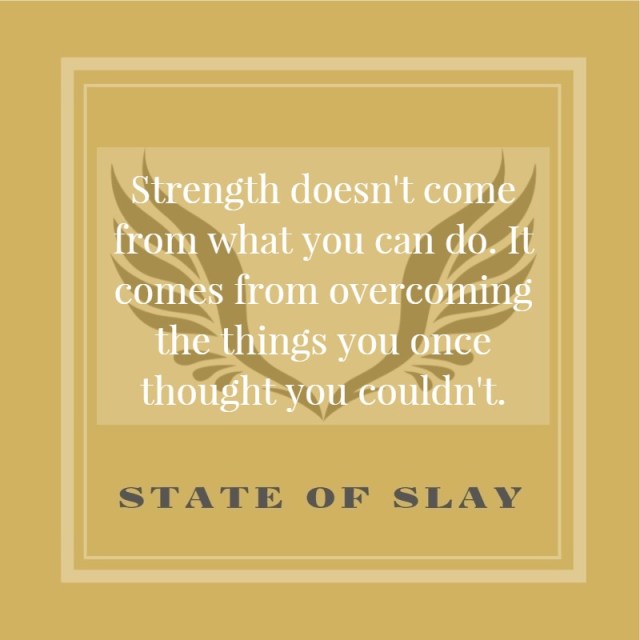
I never considered myself a weak person. I had overcome a lot and had always considered myself strong. But in certain areas my excuses were stronger. Even though I knew what I should be doing, and sometimes set out to do those things, sometimes my excuses would be stronger and I would stop, or I wouldn’t even start, convincing myself there was no point, it didn’t really matter, or it wasn’t worth the work anyway. It’s amazing what we can convince ourselves of, even when doing the work is the clear cut answer. A lot of the time, before I got well, those excuses usually got in the way of my health. It never failed, when I needed to take action for my own well-being that the excuses would take steroids and bulk up. And truthfully, the stronger they got, the weaker my resolve would be and in the end I did feel weak. When I got on the road to recovery I needed to pump my strength back up. I knew that it wasn’t going to be easy, but I needed to be stronger than the excuses my head was going to throw at me. I had to also learn that that struggle was the key to getting better.
We all have struggles and have certain areas where our excuses have been lifting weights and have the strength of a million men. But, that strength is only based on the power we give them. They have no strength alone. It is us that gives our excuses their power, which means that we also have the power to take it away. Now, that can be challenging, especially when we’ve allowed yourselves to be bullied by our excuses for a long time, or, have convinced yourselves we’re not worthy of anything better. We are. We just have to show those excuses who’s boss.
For me the key to getting my strength back came as I started to practice self-love and self-care, I practiced these things by practicing loving acts toward myself, by making a conscious effort to change my thinking to positive thoughts and choosing esteemable acts. As I started to change gears into a daily routine of what was best for me and my ongoing physical and mental health, my excuses started to lose their strength. They became weaker. My strength got stronger as I got better and started to leave behind my old destructive ways, and those excuses that I used to let stand in my way, no longer made sense to me. I was not only feeling stronger, but feeling better, and no excuse was going to take that away from me.
We don’t have to let excuses get in the way of what is best for us. We are the ones who can kick those excuses to the curb and get ourselves on track to our best selves. When we live in the now, when we think in terms of just doing next right thing and make a commitment to ourselves love ourselves enough to do what’s best for us, our strength beats out the strength of our excuses. Time to start showing those excuses who’s boss! SLAY on!
SLAY OF THE DAY: Do you let excuses bully you into not taking action? What do your excuses get in the way of most? Why do you think that is? How can you change that? What’s an example of something your excuses have taken from you, or prevented you from doing? How can you overcome those excuses the next time that same opportunity comes up? How do you think overcoming that excuse will benefit you? Why do you think those excuses come up for you? Well, it’s time they stop running the show. We get to decide what is best for us, and we can also tell, whatever might be standing in our way, to stand back, we’re running this show.