Slay Say

THE POWER OF PATIENCE

You don’t always need to explain yourself to be understood. True clarity isn’t forced—it unfolds with time.

When we rush to defend our side of the story, we often drain our energy trying to convince others who have already decided what they want to believe. That battle isn’t yours to fight.

Instead, let your actions, your consistency, and your integrity speak for you. Time has a way of revealing what words cannot.

This is your reminder that truth doesn’t need protection—it needs patience.

SLAY on!

Slay Say

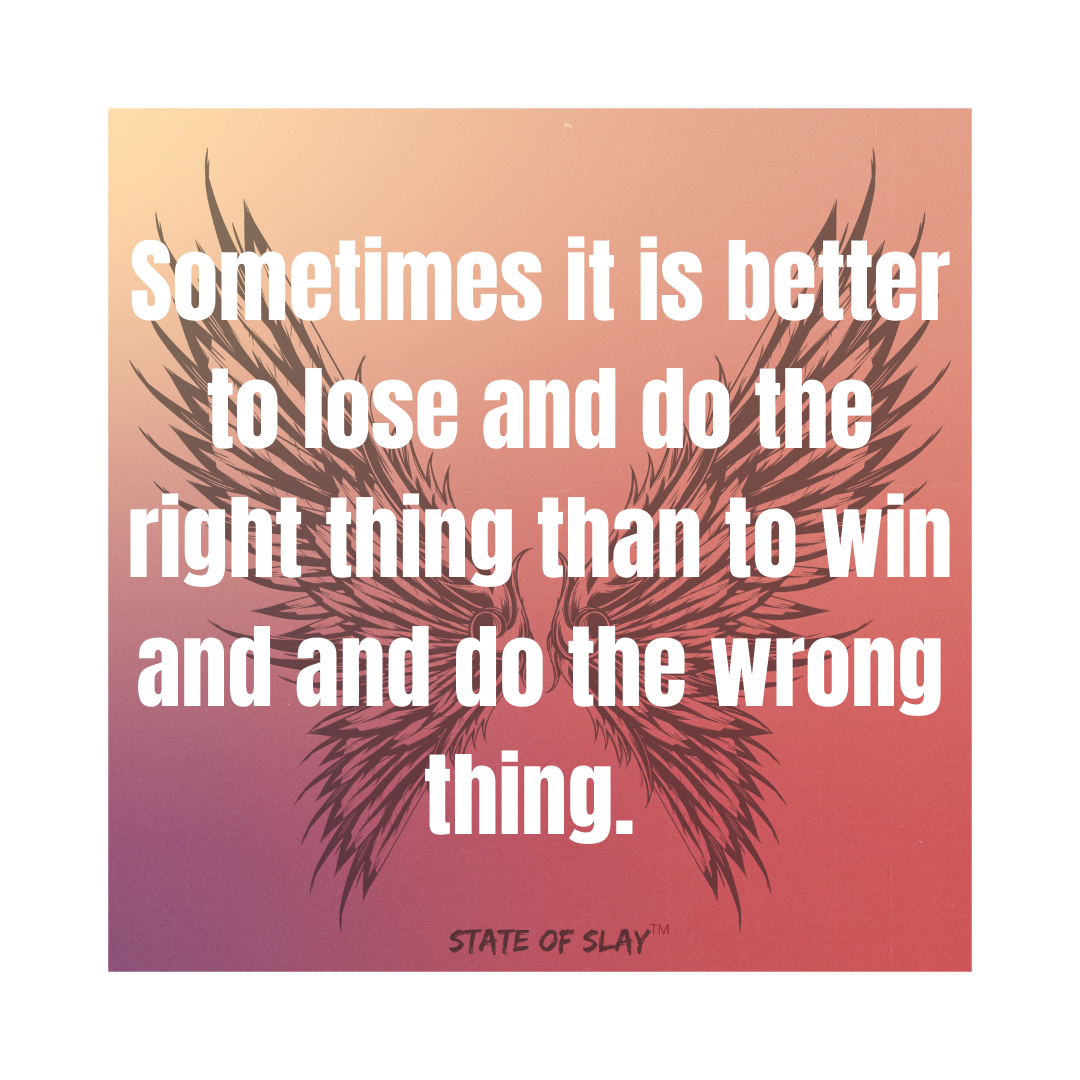
Good morning SLAYER! If you won by doing something wrong, was it really a win?

New blog goes up Friday, until then… SLAY on!
Lose and Win

Slay Say

Good morning SLAYER! Image is what people see and hear, integrity is who we really are.

SLAY on!
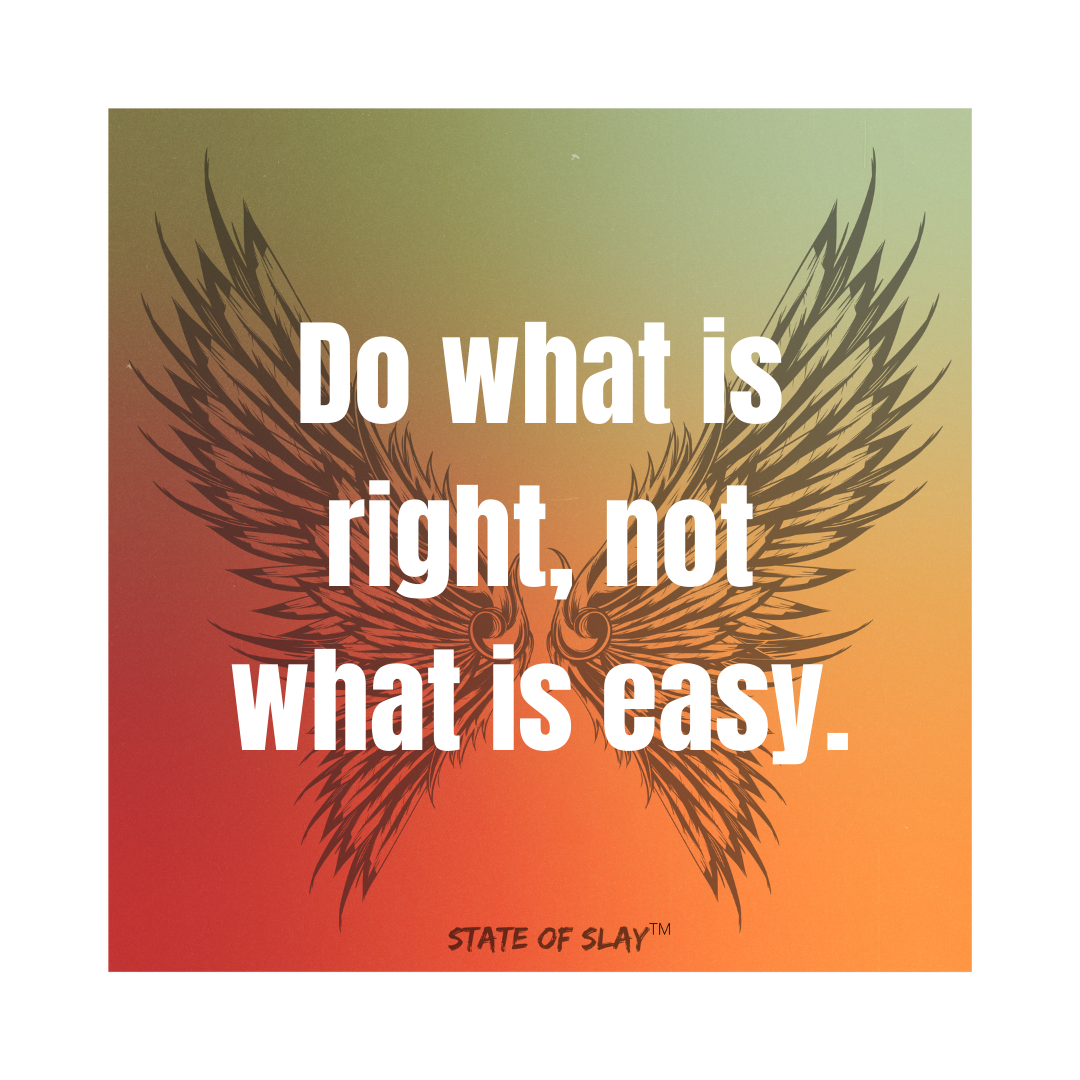
What Is Right

What You Do When No One Is Watching

We all have moments where we wear different masks. There’s the version of us the world sees—and then there’s the version that shows up when no one else is around. Ideally, these two should be one and the same. We should move through life with consistency, acting with honor and integrity whether eyes are on us or not. But let’s be honest: that’s not always what happens.

For many years, I was someone who acted differently when I thought I could get away with it. I wore my victimhood like armor, and when life didn’t go my way, I convinced myself it owed me something in return.

I remember being at the grocery store once when the cashier forgot to ring up an item in my cart. I noticed—but I said nothing. Instead, I walked out with it and told myself it was a win. A moment of justice. But deep down, I knew better. I was raised to know right from wrong. And I knew I’d crossed a line.

That item may have been free, but the guilt wasn’t. I carried it around, letting it reinforce the story that I was a bad person. And the more I let myself slide in little ways when no one was watching, the harder it became to hold onto any sense of self-worth.

We think we’re slick. We think we’re getting away with something. But we’re not. Because even if no one else sees it, we do.


A Shift in Integrity

When I committed to recovery and started learning to love myself, I had to reckon with the person I was when no one was watching. I had to confront the choices I’d made in secret and the ways I’d let myself down. And I had to stop.

I made a promise to myself: I would always act as if someone was watching.

Because someone was. Me.

And that meant doing the right thing—even when it was hard, even when it was inconvenient, and even when no one would ever know. Especially then.

Today, doing the right thing fills me with peace. It lifts me up. It affirms the person I’m becoming. I no longer carry the weight of guilt for the sake of a cheap win. Instead, I carry the quiet confidence that comes from living in alignment with my values.

I was once told: if you do something kind and the person finds out, it doesn’t count. Because the good deed isn’t about credit. It’s about character.


The Power of Quiet Character

In a world that rewards appearances, doing the right thing quietly, consistently, and without applause is an act of rebellion. It’s also an act of self-love.

Every time you choose honesty over deception, compassion over ego, and integrity over the easy way out—you build a life rooted in trust.

The next time you find yourself in a moment of choice, ask: What would I do if someone I deeply respect were watching me right now?

Then act from that place.

Because the truth is, the person who matters most is watching. And they live inside of you.

SLAY on.


SLAY Reflection: Who Are You When It’s Just You?

  • Do you behave the same way when no one is watching? If not, why?
  • What’s the cost of getting away with something? How does it sit with you later?
  • What values matter most to you? Are you living in alignment with them?
  • What’s one recent moment where you could’ve acted differently—and chose integrity instead?
  • How do you feel when you do the right thing, even if no one notices? What does that say about the person you’re becoming?

Call to Action: Join the Conversation

I’d love to hear from you.
What does integrity look like in your everyday life—especially when no one else is watching?
Share your story in the comments. Let’s cheer each other on.

And if you know someone who’s trying to realign with their values, send this to them.
Sometimes, all we need is a quiet reminder of who we really are.

Slay Say

Good morning SLAYER! Let’s root for each other, and watch each other grow.

New blog goes up Friday, until then… SLAY on!Support A Friend

Slay Say

Good morning SLAYER! Integrity is doing the right thing, even when no one is watching.

New blog goes up Tuesday, until then… SLAY on!

State Of Slay How You Treat People

Selfishness Leads To Suffering

We all want peace, fulfillment, and connection—but we can’t get there by putting ourselves first at the expense of others. I learned this the hard way.


When Selfishness Masquerades as Selflessness

Selfishness, by definition, is lacking consideration for others—being concerned chiefly with one’s own personal profit or pleasure. When I was living in my illness, I often operated from a selfish place, though I wouldn’t have admitted it. In fact, I convinced myself I was doing others a favor. But my motives were always self-serving, even if I masked them in acts of kindness. And when we act with impure intentions, even if we get what we wanted, it rarely feels good for long.

The truth? That kind of gratification is short-lived. It may look shiny on the outside, but the emptiness we feel afterward speaks volumes. Selfishness, no matter how cleverly disguised, leads to suffering. For me, it did—over and over again.


Getting Honest with Myself

The moment I decided to get help was the moment I was told I had to get honest—with others and with myself. That sent me into a full-blown anxiety spiral. Honesty meant confronting the wreckage I had left behind, facing the truth that much of my pain was self-inflicted.

But as I began doing the work, I realized something: by identifying where I had been selfish, I could finally stop carrying the weight of guilt and shame. I could make amends—sometimes directly, and sometimes through my actions moving forward. The idea of a “living amends” helped me break free from the belief that I was doomed to repeat my mistakes.

We’re only doomed to repeat what we refuse to acknowledge.


The Power of Motivation

One of the most valuable tools I’ve gained over the last 14 years is asking myself, What’s your motivation? Before I act, I pause. If I’m doing something with even a sliver of expectation, I check myself.

Real kindness, real service, comes with no strings attached. When our actions are rooted in the desire to simply do what’s right—or to make someone’s day a little brighter—we find peace. But when we act from a place of ego, validation-seeking, or self-interest, suffering follows.

That doesn’t mean every decision must be self-sacrificing. It means our actions should come from truth. When you’re honest about your intentions, you create room for growth, peace, and real connection.


You Don’t Have to Be Perfect—Just Honest

Even now, I sometimes catch myself slipping into old patterns. That’s okay. Awareness is everything. The difference today is that I know how to pause, reassess, and choose a different path. I don’t pretend I have it all figured out. I just stay willing to learn—and that willingness keeps me free.

We all have the capacity to reflect, correct, and grow. The work isn’t about perfection. It’s about integrity. When your heart is in the right place, it shows.

And when we each commit to doing what’s right—not just for ourselves, but for those around us—we rise. Together.

SLAY on.


SLAY Reflection

  1. What typically motivates your actions—selfless intention or personal gain?
  2. Have you ever justified a selfish act as something noble? How did that affect you?
  3. Can you recall a time when you acted with pure intention and it brought unexpected peace?
  4. What steps can you take to check your motives before making a decision?
  5. Are there areas in your life where you can practice more self-awareness and accountability?

S-L-A-Y:

  • Start being honest about your intentions.
  • Let go of manipulative patterns masked as kindness.
  • Act with integrity, even when no one’s watching.
  • You are worthy of peace—and it starts with truth.

Call to Action: Join the Conversation
I’d love to hear from you.
What helps you check your motives before taking action?
Share your story in the comments. Let’s cheer each other on.

And if you know someone who’s working on self-awareness and growth, send this to them.
Sometimes, all we need is a nudge.

You Don’t Have To Be A Bully To Win

Choosing Strength Without Losing Yourself

There’s a moment many of us can point to — where we made ourselves smaller so someone else could feel bigger. Where we let a louder voice drown out our quieter truth. Where we convinced ourselves that the only way to keep peace, keep harmony, keep connection… was to let someone else take the spotlight or the power.

I’ve been there more times than I can count.

And for a long stretch of my life, I believed a dangerous lie:
That the only way to win was to push, dominate, or overpower.
That the world rewarded sharp edges, not steady hearts.
That kindness was weakness, and compassion was a liability.

Except… every time I tried to step into that version of “strength,” I felt like I was abandoning myself. Winning didn’t feel like winning if I had to step out of integrity to get there. It felt hollow. It felt false. It felt like I was playing a role someone else demanded of me.

It took years to understand what I know now:

The loudest person in the room isn’t the strongest — just the loudest.
Real power doesn’t need to humiliate anyone to stand tall.
And you never have to be a bully to win.


The Myth of “Hardness” as Power

So many of us grew up observing people who led with fear, not respect. Maybe it was in our home, our school, our workplace, or even our friendships. People who believed intimidation equaled leadership. People who measured their worth through dominance. People who confused cruelty with competence.

Maybe those were the people who seemed to get rewarded. They got attention. They got results. They got their way.

And somewhere along the line, we internalized the belief that:

  • If we wanted to succeed, we had to be more like them.

  • If we stayed soft, we’d get run over.

  • If we stayed compassionate, we’d get crushed.

But here’s the truth we weren’t taught:

Strength without empathy is insecurity.
Confidence without humility is ego.
Power without kindness is fear dressed as control.

None of that is leadership.
None of that is winning.
None of that is sustainable.

Power built on intimidation crumbles the moment someone refuses to be intimidated.


Kindness Is Not Weakness — It’s Precision

People often misunderstand compassion. They confuse it with people-pleasing. They mistake boundaries for cruelty and softness for passivity.

But kindness is not a lack of backbone.
Kindness is not the absence of truth.
Kindness is not silence in the face of harm.

Kindness is precision.
It’s the ability to see clearly when others act from fear.
It’s the ability to hold your shape instead of collapsing into theirs.
It’s the bravery to choose integrity even when someone else chooses force.

Kindness is strength with the volume turned down — and the clarity turned up.

Winning with kindness means:

  • You don’t betray yourself.

  • You don’t hurt others to lift yourself higher.

  • You don’t weaponize your voice or your power.

  • You don’t step outside your values to gain validation.

It means you succeed as yourself, not as a costume someone else taught you to wear.


Standing Strong Without Striking Back

There is a quiet moment — the moment between hurt and response — where we decide who we want to be.

When someone else raises their voice, throws their weight around, or tries to provoke a reaction, you get to choose:

Do you match their energy?
Or do you rise above it?

Do you let their behavior define the moment?
Or do you let your integrity define you?

Choosing not to bully back is not weakness.
Choosing not to belittle is not submission.
Choosing not to retaliate is not letting them win.

It’s choosing peace over chaos.
It’s choosing self-respect over reactivity.
It’s choosing your future over a moment of validation.

Strength isn’t proven through force — it’s proven through discipline.


Winning By Staying in Integrity

Here’s what no one tells you:

When you stop engaging in someone else’s game, they lose control of the scoreboard.

Winning without bullying looks like:

  • Setting a boundary and sticking to it.

  • Walking away from disrespect instead of debating it.

  • Saying “No” without explanation or apology.

  • Refusing to match someone else’s cruelty.

  • Choosing peace even when chaos tempts you.

  • Being confident enough not to dominate.

  • Leading by example, not intimidation.

When you choose integrity, you reclaim the power they hoped you’d abandon.

When you choose grounding, you interrupt the cycle.

When you choose compassion — for yourself and others — you create a new standard of strength.

And when you stop trying to outperform someone’s ego, you start outperforming your own past.


You Win Every Time You Don’t Become What Hurt You

What if winning isn’t about beating someone else?

What if winning is:

  • Becoming who you needed when you were younger

  • Responding instead of reacting

  • Growing instead of repeating patterns

  • Standing tall without stepping on anyone

  • Being the person who breaks generational cycles

  • Choosing softness in a world that worships hardness

What if the real victory is becoming someone you’re proud of?

Because every time you refuse to become what tried to break you, you win.

Every time you choose compassion over ego, you win.

Every time you stay rooted instead of rattled, you win.

Every time you lead with integrity, you win.

You don’t have to be a bully to win.
You just have to be brave enough to stay yourself.


SLAY Reflection

Take a moment and check in with yourself. Let these questions guide what comes next:

S — Sit With Your Truth

Where in your life have you believed you had to act harder, sharper, or louder just to be heard?

L — Look at the Pattern

Who taught you that compassion was weakness? And were they actually strong — or simply scared?

A — Align With Your Values

How can you choose strength with kindness in the next conflict or challenge?

Y — Yield to Growth

What becomes possible when you stop fighting battles that require you to betray yourself?


Call to Action: Join the Conversation

I’d love to hear from you.
When have you chosen integrity over intimidation, and how did it change the outcome?
Share your story in the comments. Let’s cheer each other on.

And if you know someone who’s trying to find their power without losing their kindness, send this to them.
Sometimes, all we need is a nudge.

Slay Say

Good morning SLAYER! Why complicate something so simple.

New blog goes up Tuesday, until then…SLAY on!

State Of Slay Don't Say It

Results vs. Rewards

Before I started this journey, I was very rewards-oriented. If I did something nice for someone, I expected something in return—or at the very least, an acknowledgment of my good deed. And if I didn’t get that, I’d hold onto one heck of a resentment. I wouldn’t say anything about it until I could throw a zinger at them later—a quick-witted one-liner meant to sting.

I was good at those, too. I even prided myself on them.

I thought if I did the right thing, the universe owed me something good in return. But it rarely worked that way. Because when you go into a situation with an expectation, you’re not going in with a pure heart—or the right frame of mind.


Doing It for the Right Reasons

I’ve talked about this before: we should never enter into anything unless we want to do it—and don’t expect anything in return.

Oh, that’s right. That’s the only reason to do anything. Because you want to. Period.

It’s the only way to keep your intentions pure. It’s the only way not to be let down when your expectations aren’t met.

When I’m having a challenging day—or I’m just plain grumpy—it happens. I’ll do something nice for someone without them knowing. It could be paying for someone’s coffee or putting money in a meter that’s about to expire. It might be something bigger. But the point is, I do it without expecting a reward.

But here’s the twist: we do get something in return. A result. And a result is far more important than a reward.


Esteemable Acts Build Self-Esteem

Sure, it’s nice to get a reward. I think we can all agree. But if that’s your sole purpose for doing something, you’re going to be disappointed—often.

It’s the result of doing something that truly matters. When we do esteemable acts, we build self-esteem. We begin to like who we are, respect who we are, and learn to trust who we are.

I had to learn this when I made the choice to get better. I had to make a conscious decision to practice it each day.

It felt strange at first—to do something nice without the other person knowing. I was told that if they found out, it didn’t count and I’d have to find something else. So, I turned it into a little game. Like a positive secret.

I used the same cleverness I once used to manipulate people to figure out how to do something kind without them finding out it was me. It actually became fun. And the more I looked for those moments, the more I found them.

The result? My mind stayed positive because I was looking for positive things to do. And that kept me living in the light. No reward could do that for me. A reward might shine a light on me temporarily, but it wouldn’t keep the light on in my life day after day.


Choosing the Path of Growth

We live in a world that’s very reward-oriented. It’s easy to fall into the expectation of getting something for doing something.

But we SLAYERS are better than that.

We’re about growth, learning, and striving to do better. What we want are results.

Results that help us build a strong foundation. Results that keep us on the right path, doing the right things, and remembering why we’re doing them.

Esteemable acts build self-esteem. They help us shed the feeling of being “less-than” or deficient. They quiet those negative voices because we’re not just doing what’s best for us—we’re also considering those around us.

SLAY on.


SLAY OF THE DAY: Reflect & Rise

Do you do things and expect a reward? What happens if you don’t get one, or aren’t acknowledged for your good deed?

Do you feel negatively toward that person? What if you didn’t expect a reward? What if you just did good things to do them—without expecting anything in return?

I challenge you, SLAYER, to do three good things for three different people this week without them knowing. If they find out, it doesn’t count, and you’ll need to find something else.

Write down how you feel after doing them. Then write down how you feel compared to before you did them.

Keep going, SLAYER. When we look for the good, we find the good.


Call to Action: Join the Conversation

I’d love to hear from you.
What’s one small act of kindness you’re committing to this week—just because?
Share your thoughts and stories in the comments. Let’s inspire each other to keep growing.

And if you know someone who could use this message, share it with them.
Sometimes, the best rewards come from giving freely.