Slay Say

THE POWER OF PATIENCE

You don’t always need to explain yourself to be understood. True clarity isn’t forced—it unfolds with time.

When we rush to defend our side of the story, we often drain our energy trying to convince others who have already decided what they want to believe. That battle isn’t yours to fight.

Instead, let your actions, your consistency, and your integrity speak for you. Time has a way of revealing what words cannot.

This is your reminder that truth doesn’t need protection—it needs patience.

SLAY on!

Before You Argue, Ask Yourself: Is This Worth My Energy?

We’ve all been there. Someone says something that grates on us—maybe it’s dismissive, maybe it’s condescending, maybe it’s flat-out wrong. Our instinct is to jump in, argue, explain, and prove our point. But here’s the question that changes everything:

Is this person even mentally mature enough to grasp the concept of a different perspective?

Because if the answer is no, then your energy is too valuable to waste.


The Illusion of Winning Arguments

When I was younger, I thought “winning” an argument meant I had more power. I thought if I could just explain it better, the other person would finally get it, nod their head, and say: “Wow, you’re right.”

But it rarely worked out that way. Instead, the harder I pushed, the harder they dug in. Logic didn’t matter. Evidence didn’t matter. My passion and sincerity didn’t matter.

What I eventually realized is this: you can’t force someone to see what they’re not ready—or willing—to see.

And that’s not a reflection of your intelligence, compassion, or truth. That’s a reflection of their capacity.


Maturity Meets Perspective

Not everyone has the tools, the emotional maturity, or even the desire to understand perspectives outside their own. Some people are locked in fear. Some cling to control. Some confuse listening with weakness.

If you’re standing in your truth, speaking from love and alignment, but the other person is stuck in a loop of defensiveness, superiority, or chaos—you will never meet in the middle.

It’s like trying to explain color to someone who insists the world is only black and white. You’re not going to paint them into understanding.


Why We Still Try

So why do we still argue?

For me, it often came from a need to be seen. I wanted validation. I wanted acknowledgment. I wanted someone to finally say: “I understand you.”

But here’s the hard truth: arguing with someone who is unwilling or unable to meet you where you are doesn’t get you understanding—it gets you exhaustion.

When you argue with someone who isn’t open, you’re not exchanging ideas. You’re fighting for airtime in a room where the mic is already turned off.


Energy Economics: Protecting Your Investment

Think of your energy like currency. Every interaction is an investment. And not everyone can afford it.

When you spend your emotional energy trying to convince someone who has already decided not to hear you, you’re making a bad investment. You’re pouring into a void.

Instead, what if you chose to save that energy? What if you redirected it toward people and spaces where curiosity exists, where growth is possible, and where your perspective matters?

That’s when the return on your investment multiplies.


It’s Not About Being Right—It’s About Being Wise

There’s a subtle but powerful difference between wanting to be right and choosing to be wise.

  • Being right demands a fight.
  • Being wise recognizes when silence speaks louder.

You don’t need to prove your worth through debate. Your worth is not determined by someone else’s ability—or inability—to understand you.

Sometimes the most powerful move you can make is to walk away, not because you’ve lost, but because you’ve risen above.


What Walking Away Really Means

Walking away doesn’t mean you’re weak. It doesn’t mean you’re giving up. It doesn’t mean you don’t care.

It means you’ve chosen peace over chaos. It means you’ve recognized the limits of the conversation and your own boundaries. It means you know your energy is precious, and you’re no longer willing to spend it recklessly.

Walking away is not defeat—it’s discipline.


The Freedom in Letting Go

Here’s what happens when you stop arguing with people who aren’t ready to hear you:

  • Your nervous system calms down.
  • Your energy goes back into your own growth.
  • You stop rehearsing conversations that will never resolve.
  • You discover new connections with people who can meet you where you are.

And maybe most importantly: you remember that your peace is not up for negotiation.


Practical Steps: Before You Argue, Ask Yourself…

Next time you feel that urge to argue rising up, pause and ask:

  1. Is this person capable of seeing another perspective—or are they locked into proving their own?
  2. What is my goal here? To be understood? To change them? To feel heard?
  3. Will this conversation bring me peace—or drain me?
  4. If I walk away, what am I protecting? My truth? My peace? My energy?
  5. If I stay, what am I risking?

This quick gut-check can save you hours of stress and prevent you from spending energy you’ll regret.


Final Thought: Choose Peace Over Proving

At the end of the day, the people who are meant to walk beside you will want to hear your perspective. They’ll be curious. They’ll ask questions. They’ll listen, even if they don’t agree.

Those who aren’t capable of that? They’ll show you by their resistance, their defensiveness, their refusal to even try.

And in that moment, you have a choice. You can argue and deplete yourself. Or you can walk away, preserve your peace, and let your life—not your words—be the proof.

Because the truth is, peace doesn’t need a microphone. It just needs space.


SLAY Reflection

  1. Who in your life drains your energy by refusing to hear your perspective?
  2. What situations tempt you into arguments that never go anywhere?
  3. How does it feel in your body when you argue with someone who refuses to listen?
  4. How might your life change if you saved that energy for people who can understand you?
  5. What would it look like to choose peace over proving this week?

S – Stop wasting energy on those who won’t listen
L – Let your peace matter more than your pride
A – Ask yourself if the conversation is worth the investment
Y – Yield your energy toward those who value it


Call to Action: Join the Conversation

I’d love to hear from you.
When was the last time you chose peace over proving yourself—and what shifted for you?
Share your story in the comments. Let’s cheer each other on.

And if you know someone who’s exhausted from fighting battles that can’t be won, send this to them.
Sometimes, the most powerful reminder is: you don’t have to argue to be free.

Slay Say

FORWARD IS THE ONLY DIRECTION

Standing still might feel safe, but it’s also where dreams go to die. Waiting for the perfect moment only delays the life that’s waiting for you to claim it.

Growth requires movement—sometimes messy, sometimes uncertain, but always forward. Each step, no matter how small, breaks the cycle of waiting and creates momentum.

If you’re longing for change, stop looking for it to arrive on its own. The shift begins with you—when you take action, however imperfect, toward what you want.

This is your reminder that movement is the bridge between who you are and who you’re becoming.

SLAY on!

Slay Say

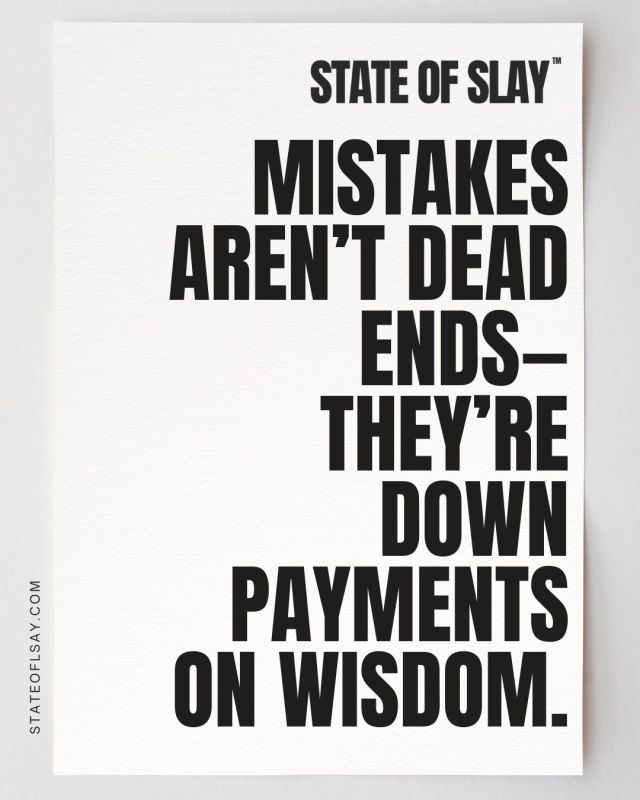
FALLING IS PART OF RISING

We often see failure as the enemy of success, when in reality, it’s the soil that growth springs from. Every mistake, stumble, or setback isn’t wasted—it plants something valuable inside you.

Those moments that feel like defeat are really shaping your resilience, sharpening your clarity, and preparing you for what comes next.

Instead of fearing failure, remember that it’s not the end of the journey. It’s simply one of the steps on the way up.

This is your reminder that setbacks are not roadblocks—they’re building blocks.

SLAY on!

Slay Say

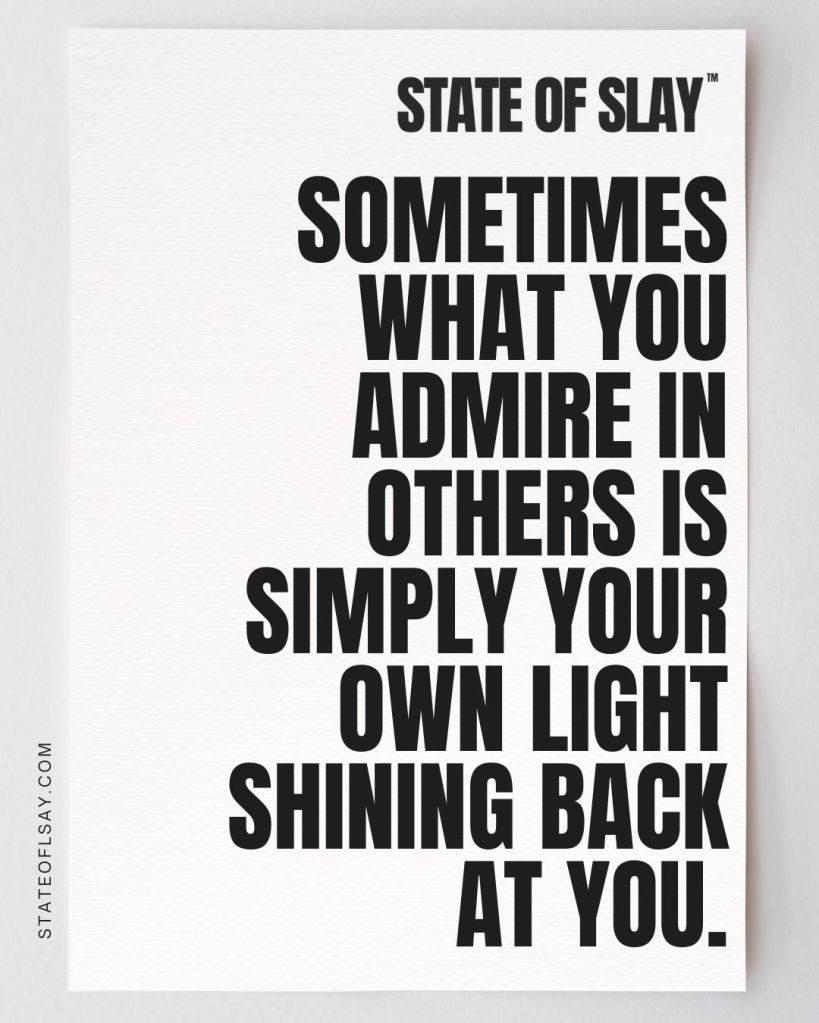
YOUR LIGHT REFLECTED

What we admire in others is often a mirror of what already lives within us. The kindness, courage, or strength you notice in someone else doesn’t just exist outside of you—it resonates because it’s also part of you.

Too often, we downplay our own gifts while lifting others up. But the truth is, the qualities you celebrate in them are not foreign—they are familiar. They’re reminders of your own capacity, your own light, your own power shining back at you.

Instead of seeing yourself as “less than,” see the reflection for what it is: proof that you, too, carry that same brilliance.

This is your reminder that what you see in others is also alive in you.

SLAY on!

Slay Say

The journey no one clapped for created the moment they celebrate

It’s easy to admire someone’s success without ever seeing the struggles that built it. People will clap for the glow, but they rarely acknowledge the fire it came from.

Behind every highlight is a hard-fought story—quiet battles, sleepless nights, doubts you had to silence, and resilience you had to grow. The truth is, the spotlight only shows the ending; it doesn’t reveal the shadows you walked through to get there.

Your journey matters, even if no one sees it. Every step, every scar, every setback you’ve overcome is part of the strength that makes your light shine.

This is your reminder to honor the path as much as the outcome.

SLAY on!

Temporary People Teach Us Permanent Lessons

We don’t always get to choose who comes into our lives—or how long they stay. Some people walk with us for a lifetime, others for only a season. And while temporary people may leave as quickly as they came, their impact often lingers.

Sometimes it’s beautiful. Sometimes it’s heartbreaking. But always—it’s instructive.

Because even the ones who don’t stay teach us something we carry forward. Temporary people leave permanent lessons.


Prefer to listen? The Audio Blog version is available here.


The Pain of Goodbyes and the Gift They Leave Behind

When someone exits your life, it can feel like rejection, abandonment, or loss. You may replay every moment, wondering what you could have done differently to make them stay. But here’s the truth: their leaving isn’t always about you.

Temporary people teach us boundaries. They teach us what we will and will not accept.
They teach us value. Sometimes by showing us what we deserve—and sometimes by showing us what we don’t.

Not all lessons are gentle. But every lesson has purpose.


What Temporary People Reflect Back to Us

Every person who crosses our path acts as a mirror. Some reflect our best qualities back at us—reminding us of the love, kindness, or courage we already hold. Others reflect the wounds we still carry, highlighting the work that’s left undone.

If you’ve ever noticed how one relationship reveals your need for boundaries, while another pushes you toward forgiveness, that’s no accident. Temporary people show us where we’re growing, and where we’re still stuck.

Even the ones who hurt us—sometimes especially the ones who hurt us—end up guiding us toward our truth.


Not Everyone Is Meant to Stay

We live in a culture that glorifies “forever.” Forever friends. Forever love. Forever loyalty. But life doesn’t always work that way.

The truth is, some people are only meant to walk us part of the way. They show up for a chapter, not the whole book. And that’s okay.

Because their role is not to stay—it’s to move us forward. To give us the lesson, the shift, the wake-up call we couldn’t have gotten any other way.

When we cling to people who were only meant to be temporary, we rob ourselves of the lesson. When we let them go with gratitude, we keep the gift they came to bring.


Choosing Growth Over Grief

It’s natural to grieve when someone leaves. But we don’t have to get stuck in the story of what “could have been.”

Instead, we can ask:
What did I learn from this connection?
How did this person shift me?
What strength did I discover because of them?

Sometimes the hardest people to release leave behind the clearest lessons. They teach us self-respect. They teach us resilience. They teach us that we can survive the leaving—and even thrive after it.

You may not have chosen their exit, but you can choose what you carry forward.


SLAY Reflection

  1. Who in your past was only meant to be temporary, but taught you something lasting?
  2. What lesson are you still carrying from a relationship that didn’t last?
  3. Do you find yourself holding on to people who were never meant to stay? Why?
  4. How does it feel to shift from grief to gratitude when you think of temporary people?
  5. What permanent strength or wisdom do you have today because someone left?

S – See the role they played in your growth
L – Let go of what wasn’t meant to last
A – Acknowledge the lessons they gave you
Y – Yield to gratitude instead of grief


Call to Action: Join the Conversation

I’d love to hear from you.
Who was a “temporary person” in your life, and what permanent lesson did they leave behind?
Share your story in the comments. Let’s cheer each other on.

And if you know someone struggling to let go of someone who was never meant to stay, send this to them.
Sometimes, all we need is a reminder that even endings carry gifts.

Slay Say

Stop pouring into empty cups—it’s time to honor your own.

We teach people how to treat us by what we allow, what we stop, and what we walk away from. If you keep making others a priority while they treat you as an afterthought, you’re not being kind—you’re abandoning yourself.The truth is, you don’t need to beg for a seat at a table where you’re only ever offered crumbs. You deserve to sit where your presence is seen, valued, and celebrated.

This isn’t about becoming hard or unkind. It’s about protecting your energy and making room for relationships that meet you with the same care you give so freely.

This is your reminder to stop pouring into places that never pour back.

Don’t give priority where you’re treated as an option.

SLAY on!

Empathy Without Boundaries Is Self-Destruction

Empathy is a beautiful gift—it allows us to connect, understand, and hold space for others in ways that make them feel seen and valued. But here’s the hard truth: without boundaries, empathy becomes a weapon turned inward. Instead of healing, it harms. Instead of connecting, it consumes.

Many of us who identify as “empaths” or deeply compassionate people have learned the hard way that pouring ourselves out for everyone else often leaves us running on empty. When we absorb other people’s pain without limit, when we rescue at our own expense, or when we carry burdens that don’t belong to us, we aren’t practicing empathy—we’re practicing self-destruction.

True empathy isn’t about losing yourself in someone else’s storm. It’s about holding space with compassion while knowing where you end and they begin. Boundaries are not walls; they are bridges of clarity that keep you safe while still allowing you to show up with love.


When Empathy Crosses the Line

It starts subtly. You say “yes” when you want to say “no.” You listen to someone’s problems at 2 a.m., even though you have to be up early for work. You absorb the emotions in a room until they feel like your own. And before long, your identity is tangled in other people’s struggles.

This isn’t empathy—it’s overextension. And over time, it erodes your mental health, your relationships, and your sense of self. Without boundaries, empathy mutates into people-pleasing, codependency, and burnout. It may look like kindness, but underneath it’s exhaustion and resentment.


Why Boundaries Save Empathy

Boundaries don’t make you less compassionate—they make your compassion sustainable. They protect your inner world so you can continue to give without losing yourself in the process.

Think of it this way: your empathy is a flame. Without boundaries, that flame burns everything in sight—including you. With boundaries, it becomes a steady light that warms without destroying.

When you set limits—saying no when you need to, protecting your energy, and remembering that someone else’s healing is not your responsibility—you create space for empathy that is genuine, not sacrificial.


My Own Turning Point

For years, I believed that to love meant to absorb. If someone was hurting, I carried it like it was my own. If someone was angry, I tried to fix it. If someone needed rescuing, I was already running into the fire.

But I learned the hard way that empathy without boundaries isn’t noble—it’s self-neglect. I was burning out, resentful, and wondering why I always felt unseen when I gave so much. The truth was, I wasn’t giving from love. I was giving from fear: fear of disappointing others, fear of being unlikable, fear of being seen as selfish.

When I finally learned that empathy needed boundaries, everything changed. I could still care, still show up, still love deeply—but without sacrificing my own well-being. I realized that the most powerful act of empathy sometimes is saying: “I love you, but that’s yours to carry, not mine.”


Choosing Sustainable Love

Empathy should not be self-destruction dressed up as kindness. Empathy with boundaries is love that endures—not just for others, but for yourself.

Boundaries aren’t cold, cruel, or selfish. They’re an act of love. They say: I care enough about myself to stay whole, and I care enough about you to show up from that wholeness instead of from depletion.

Remember, you can’t pour from an empty cup. Protect your flame, and your empathy will continue to shine without burning you out.


SLAY Reflection

Take a moment to pause and reflect:

  • SStop: When was the last time your empathy drained you instead of uplifted you?
  • LLook: Do you confuse empathy with rescuing, fixing, or absorbing other people’s pain?
  • AAsk: What boundaries do you need to put in place so your empathy feels safe and sustainable?
  • YYield: How can you release the responsibility for someone else’s emotions and return to your own?

Call to Action: Join the Conversation

I’d love to hear from you.
Have you ever confused empathy with self-sacrifice? What boundary could you set today that would protect your compassion without draining your energy?
Share your story in the comments. Let’s cheer each other on.

And if you know someone who is burning themselves out by carrying everyone else’s pain, send this to them.
Sometimes, all we need is a nudge.

Slay Say

The Weight Was Never Yours

We often clutch what was never meant for us—regrets, expectations, the heavy burdens of things we can’t control. Our minds replay them, our hearts ache with them, and we end up carrying weight that was never ours to hold. True strength is not in forcing yourself to bear it but in recognizing when to set it down. Release is not weakness—it’s freedom.

This is your reminder to…
Choose peace over pressure. Your heart deserves rest, not heaviness.

SLAY on!