Boundaries Don’t Burn Bridges, They Protect Castles

We often think of boundaries as walls—cold, hard, unmovable. Something that keeps people out. Something that severs ties. But boundaries aren’t built to burn bridges; they’re created to protect the castles we live in: our peace, our worth, our mental and emotional well-being.

Setting boundaries doesn’t make you selfish or difficult. It makes you safe. It makes you sovereign over your own life.


Castles Require Protection

Think about what a castle is: it’s a sanctuary. A stronghold. A place where something valuable lives. And yet, without a gate, without guards, without a moat, it’s just a target.

You are the castle.

Your energy, your time, your kindness, your heart—these are the treasures inside. Boundaries are how you decide who gets access, and under what conditions. They are not about shutting everyone out. They are about making sure that those who enter are willing to honor the space, not pillage it.

If someone sees your boundary as a betrayal, they were never meant to be in your castle to begin with.


Burning Bridges vs. Building Balance

There’s a big difference between cutting someone off out of spite and setting a boundary to preserve your well-being. But not everyone will see it that way—especially those who benefited from you not having boundaries before.

Let that be a red flag.

When someone is upset that you’re taking care of yourself, it says more about them than it does about you. Your healing will threaten the dynamics that were built on your silence, your sacrifice, and your people-pleasing. And when those dynamics shift, don’t be surprised if some bridges fall down on their own.

Let them.

Not every bridge is meant to last forever. Some were only built to teach you how not to be walked on.


Boundaries Are Not Barriers to Love

It can feel scary to draw the line—especially with people we care about. We worry they’ll see us differently. That we’ll lose them. That they’ll think we don’t love them anymore. But the truth is, love that can’t coexist with boundaries isn’t really love.

It’s control. It’s codependency. It’s convenience.

Love honors the sacred. And what could be more sacred than your well-being?

Setting a boundary is not an act of war. It’s an act of self-respect. It’s saying, “I care enough about myself to choose what I allow into my life.”

Those who love you well will walk through your gates, not try to climb your walls.


You Don’t Owe Anyone Access to Your Peace

Let that sink in.

You don’t owe explanations. You don’t owe justifications. You don’t owe your energy to people who constantly drain it. You don’t owe a single brick from your castle to anyone who hasn’t proven they know how to build.

It’s not easy to maintain boundaries, especially when guilt or fear creeps in. But remember this:

Every time you choose your peace over your people-pleasing, you reinforce the walls that keep your life safe and sacred.

Protect your castle. The right people will come with open hands, not demands.


SLAY Reflection

  1. Where in your life have you struggled to set boundaries?
  2. What have you been afraid might happen if you did?
  3. How does it feel when someone respects your boundaries without question?
  4. What does your “castle” need more protection from right now?
  5. How can you reinforce your emotional boundaries with love and clarity?

S – Stand strong in your worth
L – Let go of guilt around protecting your peace
A – Ask for what you need without apology
Y – Yield only to love that respects your lines


Call to Action: Join the Conversation

I’d love to hear from you.
What boundaries have helped protect your peace?
Share your story in the comments. Let’s cheer each other on.

And if you know someone who’s afraid to set boundaries, send this to them.
Sometimes, all we need is a nudge.

You Did Nothing Wrong By Asking To Be Treated Right

There was a time in my life when I second-guessed myself. I would speak up when something didn’t feel good, and then spiral afterward—replaying the moment in my head, wondering if I was overreacting, if I made things awkward, if I should have just stayed quiet.

But here’s the truth I wish I had known sooner:

You did nothing wrong by asking to be treated right.

There is nothing wrong with saying “that hurt my feelings” or “I don’t like how that made me feel.” There is nothing wrong with saying “I deserve better than this.” Because you do. You always have.

What is wrong is how often we’re taught to feel guilty for setting a boundary. We’re told we’re too sensitive, too difficult, too much. So we shrink. We tolerate. We accept less. And with each time we swallow our truth, we chip away at the trust we have with ourselves.

Over time, we begin to question whether we even deserve what we’re asking for. We start to silence ourselves before anyone else even has the chance to.

But the voice inside you that whispers, “this doesn’t feel right”—that voice is sacred. And it deserves to be heard.

We’re often praised for how much we can endure, how quiet we can stay, how agreeable we can be. But healing isn’t about being palatable. It’s about being real.

It’s about letting go of the version of you that never got to speak up, and becoming the version who knows how to say, “I’m not okay with this.”

Because you matter. What you feel matters. What you need matters.


It’s Not Asking for Too Much

It’s not just about the person on the other end of the conversation. It’s about you. Your self-worth. Your healing. Your nervous system. The way you allow yourself to take up space and take care of yourself.

Honoring how you feel isn’t selfish—it’s self-respect.

Asking to be treated with kindness, consistency, and care is not asking for too much. It’s asking for the bare minimum. And if someone can’t meet you there, that’s not your failure. That’s their limitation.

You don’t have to convince people to do the right thing. You just have to be willing to do the right thing for yourself.

Letting people know where your lines are isn’t pushing them away. It’s giving them a clear map of how to love you.

And if they walk away? Let them. Anyone who leaves because you asked for respect was never offering it to begin with.

Protecting your peace is not dramatic. It’s necessary. Saying “no more” is not cruelty. It’s clarity. And standing up for yourself is not a betrayal of others—it’s a commitment to yourself.

When you start honoring what you know to be true, you stop seeking validation from people who never had the capacity to see you clearly.


Trust What You Know

So if you’ve ever walked away from a conversation, a relationship, or a space because your boundaries weren’t honored—let me remind you:

You did not fail.
You did not overreact.
You did not do anything wrong.

You simply chose yourself.
And that is something to be proud of.

You’re not hard to love—just hard to manipulate. And anyone who’s confused by that difference was never meant to hold your heart.

Let your purpose lead. It knows the way.


SLAY Reflection

  1. Have you ever felt guilty for speaking up about how you were treated?
  2. Where in your life are you still tolerating what doesn’t feel good?
  3. What would change if you fully trusted your feelings and instincts?
  4. Who in your life consistently respects your boundaries?
  5. How might your life shift if you believed you weren’t “too much” for simply asking for respect?

S – Speak your truth without apology
L – Let your boundaries be your guide
A – Ask for what honors your worth
Y – Yield to self-respect over people-pleasing


Call to Action: Join the Conversation

I’d love to hear from you.
What’s something you’ve asked for that made you feel proud for standing up for yourself?
Share your story in the comments. Let’s cheer each other on.

And if you know someone who’s second-guessing themselves for speaking up, send this to them.
Sometimes, all we need is a nudge.
Slay Say

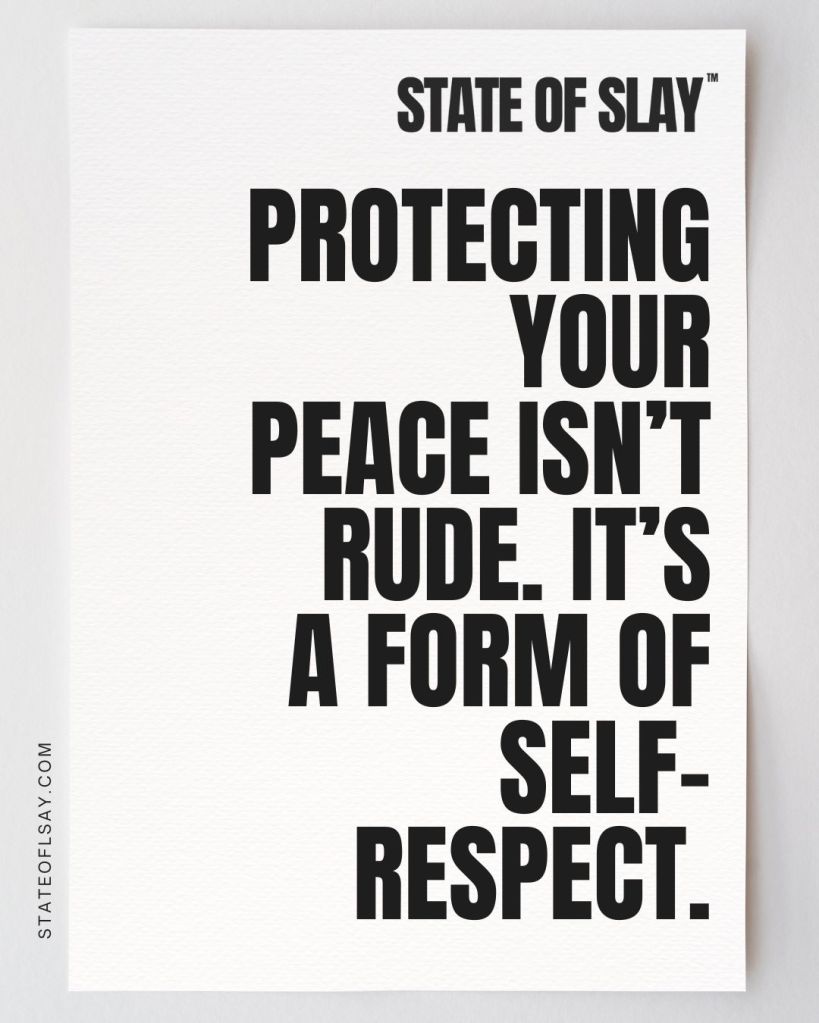
Your time, energy, and attention are not on-demand services.

We live in a world that glorifies being constantly accessible—always replying, always saying yes, always available.
But that kind of constant output doesn’t make you kind, it makes you exhausted.
Protecting your peace means knowing when to pause, say no, or simply not respond.
Your availability doesn’t define your worth.
Your boundaries define your self-respect.

This is your reminder that you don’t need to be everywhere for everyone.
You just need to be present for yourself.

SLAY on!

Invest In Yourself

When people talk about investments, they usually mean stocks, property, or retirement accounts. But there’s one investment that’s even more critical: you.

Your well-being—mental, emotional, and physical—is the foundation for everything else in your life. When you prioritize yourself, everything else gets better: your relationships, your career, your creativity, your peace of mind. Yet, so many of us wait until we’re completely burned out, overwhelmed, or spiraling to give ourselves the care we need.

It doesn’t have to be that way. It shouldn’t be that way.


Why Investing in Yourself Matters

The truth is, you can’t pour from an empty cup. If you’re constantly giving to others without replenishing yourself, you’re operating from depletion. Eventually, something gives.

Investing in yourself doesn’t mean spa days and bubble baths—though those are lovely. It means making consistent choices that nurture your well-being. It means saying no when something compromises your peace. It means taking the time to listen to your own needs, even if others don’t understand.

For me, investing in myself looked like finally saying yes to therapy. It looked like turning down invitations that drained me, and instead spending quiet time journaling, walking, or simply being. It looked like learning how to support myself the way I’d supported everyone else for years.

It was uncomfortable at first. I worried I was being selfish. But I realized: prioritizing yourself is not selfish—it’s survival. And over time, I saw how much better I could show up for others when I was also showing up for myself.


The ROI of Self-Investment

When you invest in yourself, you start to:

  • Build resilience
  • Strengthen your boundaries
  • Increase your capacity for joy
  • Reconnect with your purpose
  • Attract healthier relationships

And perhaps most importantly, you start to trust yourself more deeply. You become someone you can rely on. That’s powerful.


Start Where You Are

You don’t need to overhaul your life overnight. Start with one intentional choice a day. One small way to say, “I matter.” Maybe it’s drinking a full glass of water first thing in the morning. Maybe it’s taking five minutes to breathe. Maybe it’s setting a boundary you’ve been avoiding.

Whatever it is, let that choice be an act of self-respect.

Because when you invest in your well-being, you’re not just surviving—you’re building a life that supports you.


SLAY Reflection

  1. What does investing in yourself mean to you personally?
  2. What small act of self-care can you commit to today?
  3. Do you feel guilty prioritizing your well-being? Why?
  4. How might your relationships shift if you were more centered and grounded?
  5. What would change if you treated your mental health like a top priority?

S-L-A-Y:

  • Say yes to what nourishes you
  • Let go of guilt and shame
  • Act with intention, not obligation
  • You are worth the effort

Call to Action: Join the Conversation
I’d love to hear from you.
What’s one way you can invest in your well-being this week?
Share your story in the comments. Let’s cheer each other on.

And if you know someone who’s always giving but rarely giving to themselves, send this to them.
Sometimes, all we need is a nudge.

Sometimes Happy Is a Feeling, Sometimes Happy Is a Choice

Let’s be honest: some days happiness wraps around you like a warm blanket. Other days, it’s a threadbare flag you have to raise yourself, even when the wind isn’t blowing.

Sometimes, happy arrives uninvited. A smile you didn’t expect. A moment of peace. Laughter that catches you by surprise. These are the days when joy feels natural. Effortless. When your heart feels light and your worries take a back seat. These are the days you wish you could bottle.

But what about the other days? The days when you wake up heavy, when your body aches with exhaustion, when your mind is cluttered and your heart is a storm cloud? What then?

That’s when happy becomes a choice. And yes, sometimes, it’s the hardest choice you can make.


Feel It When It Comes

We all have seasons where happiness seems to bloom everywhere—inside us and around us. These are the easy days. The ones where gratitude feels automatic, and your smile is real. And when those moments show up?

Let them.

Don’t question the joy. Don’t wait for the other shoe to drop. Let yourself feel good without guilt. You don’t have to earn happiness for it to be valid. It’s not a reward, it’s a gift. And you are allowed to receive it, just because you exist.

Too many of us hesitate to feel joy because we’re afraid it won’t last. But here’s the truth: happiness isn’t permanent, but it is powerful. And when it comes naturally, lean in. Let it soak into your skin.


Choose It When It Feels Out of Reach

And then there are the other days.

The days when happy feels like a stranger.

That’s when you make the choice to reach for it anyway. You choose to smile. To take a walk. To text a friend. To wash your hair. To play a song that makes you sway just a little. To say thank you, even when you’re not quite feeling it.

This isn’t toxic positivity. This is resilience. This is saying, “I know I feel low, but I’m going to plant the seeds of joy anyway.” And over time, those seeds bloom.

Happiness isn’t about denying what hurts. It’s about refusing to let the hurt define the whole day.


You Are Allowed to Want More

Here’s a powerful truth: you don’t have to settle. Not for a life that keeps you stuck. Not for a mindset that keeps you small. You are allowed to chase joy. To design a life that feels good on the inside, not just one that looks good from the outside.

And when you can’t find it? You can choose it. You can create it.

Even if that looks like a slow morning with coffee and quiet.

You are not failing if you have to fight for your happiness. That’s not weakness. That’s strength.


Some Days It’s Both

Sometimes happy is a breeze. Sometimes it’s a battle.

And sometimes, it’s a little bit of both.

Either way, you have the power to feel it, create it, or reach for it. You don’t have to wait for life to feel perfect before you allow yourself to be happy. Let it show up in small ways. Invite it in. And when it comes, don’t push it away.

You are allowed to feel good. You are allowed to choose good. You are allowed to live a life that includes joy.

Even on the hard days.


SLAY Reflection

  1. When was the last time you felt joy without effort? What triggered it?
  2. Do you feel guilty when you’re happy? Why?
  3. What’s one small way you could choose joy today?
  4. How can you remind yourself that happiness isn’t a reward?
  5. What would your day look like if you let joy take up more space?

S-L-A-Y:

  • See where joy naturally shows up in your day
  • Let yourself lean into those moments
  • Acknowledge the hard feelings, but don’t stay stuck in them
  • You have the power to choose happiness, even in small ways

Call to Action: Join the Conversation
I’d love to hear from you.
What does choosing happiness look like for you right now?
Share your story in the comments. Let’s cheer each other on.

And if you know someone who’s struggling to feel joy, send this to them.
Sometimes, all we need is a reminder.

Let Them

This one hits close to home.
Because for a long time, I didn’t know how to let people be who they are.
I was always trying to manage, to steer, to shape the outcome I wanted.
Even when it was wrapped in good intentions, it was still control.

The truth is, trying to change someone—whether it’s their behavior, their choices, or how they show up—only leaves you drained, resentful, and disappointed.
Why? Because it’s not your job.
It never was.

The moment I truly understood that…
The moment I stopped trying to micromanage other people’s lives, reactions, or growth…
Was the moment I started finding peace.


The Mindset Shift That Changed Everything

Let them.

Let them say what they want.
Let them make their choices.
Let them believe what they believe.
Let them walk away—or come back—or stay exactly the same.

Because it’s not your responsibility to make someone become who you want them to be.
And it’s not your failure when they don’t.

The need to control others is often rooted in fear.
Fear of abandonment.
Fear of chaos.
Fear that if someone doesn’t change, you won’t be okay.

But guess what?
You will be okay.
Because your peace, your healing, your worth—none of it depends on someone else getting it right.


Expectations Are Heavy

Most of us don’t realize how much energy we spend trying to get someone to meet our expectations.
We want them to act differently, to love better, to show up the way we imagined they would.

And when they don’t?
We get frustrated.
We get hurt.
We spiral.

But here’s the uncomfortable truth:
They never agreed to those expectations.

They’re being who they are.
And we’re the ones trying to rewrite their character in our story.

What if instead of trying to change them—we just let them?


Letting Go Is a Boundary

“Let them” isn’t passive.
It’s powerful.

It’s not about giving up.
It’s about letting go of what was never yours to hold in the first place.

Let them be who they are—so you can stay rooted in who you are.

It’s a boundary.
A decision to protect your energy by not chasing down someone else’s growth.

When you stop investing in the outcome you wish for and start accepting the truth of what is, you reclaim your power.

You also make space for people who can meet you where you are.
Who choose to show up.
Who don’t need to be changed, convinced, or coerced.


Peace Lives in Acceptance

Let them believe the lie.
Let them ghost you.
Let them not understand your heart.
Let them leave the group chat.
Let them love someone else.
Let them misunderstand you.
Let them think they’re right.
Let them talk behind your back.

And while they do?

Let yourself grow.
Let yourself feel.
Let yourself heal.
Let yourself move on.
Let yourself love without attachment.
Let yourself stay soft and strong at the same time.

You are not here to force alignment.
You are here to be aligned—with yourself.


SLAY Reflection: Where Are You Holding On Too Tightly?

  1. Who in your life are you trying to manage, fix, or control?
    What are you hoping to change—and why?
  2. How has that effort affected your peace, energy, or self-worth?
    What are you losing in the process?
  3. What would it look like to “let them” be exactly who they are?
    What fear comes up when you consider that?
  4. How can you create a boundary that protects your energy without trying to change theirs?
    What could you gain by stepping back?
  5. What’s one relationship or situation where “letting them” would bring you more emotional freedom?
    How can you start that shift today?

Call to Action: Join the Conversation

I’d love to hear from you.
What’s one way you’ve learned to let someone be who they are—and how did that shift your peace?
Share your story in the comments. Let’s cheer each other on.

And if you know someone who’s holding on too tightly, send this to them.
Sometimes, all we need is a nudge.

Slay Say

Good morning SLAYER! The potential for greatness lives within each of us. 

New blog goes up Tuesday, until then… SLAY on!

Slay Say

Good morning SLAYER! When we are at our lowest point we are open to the greatest change. 

New blog goes up Sunday, until then… SLAY on!

Slay Say

Good morning SLAYER! Grow through what you go through.

SLAY on!

Slay Say

Good morning SLAYER! Making mistakes is better than faking perfections. 

New blog goes up Tuesday, until then… SLAY on!