You Can’t Speak Butterfly Language to Caterpillar People

There comes a moment in growth—real, soul-deep growth—where you start to see things differently. You think differently. Feel differently. You’ve been through the fire, and now you move lighter, clearer, freer. But what happens when the people around you haven’t caught up?

What happens when they’re still speaking caterpillar, and you’ve turned into a butterfly?

It’s one of the hardest parts of healing. You want to be understood, to be supported, to be met with the same energy you now bring to the table. But not everyone will get it. Not everyone is meant to. Some people are still living in the version of you that fit them. And that version? The one who shrunk, people-pleased, kept the peace, and didn’t make waves? That’s who they miss.

But you don’t owe anyone a version of yourself that you’ve outgrown.


Don’t Waste Your Wings Explaining Yourself to Those Who Refuse to Fly

The more you evolve, the less you’ll feel the need to explain yourself. That’s not arrogance—it’s alignment.

You’re not obligated to shrink your truth to make someone else comfortable. You’re not here to convince them of your growth, your healing, or your worth. If someone is committed to misunderstanding you, no amount of butterfly talk will make them listen.

They don’t speak your language. They haven’t earned the right to interpret your transformation.

So instead of wasting your energy justifying your boundaries, your peace, your purpose—protect that energy. You’ve worked too hard to unlearn survival mode only to get pulled back into it trying to prove you’ve changed.

Let your life speak for itself. Let your peace do the talking.


You’re Not Better—You’re Just Becoming

Growth doesn’t make you superior. It makes you aware. And with awareness comes choice.

You don’t have to cut people off with cruelty. But you also don’t have to carry the weight of relationships that ask you to deny your truth. Just because you love someone doesn’t mean you can grow beside them.

Some people will stay rooted in fear, gossip, chaos, control. They’ll look at your wings and call them dramatic. Call them selfish. Call them fake. That’s okay.

Let them.

You don’t need their permission to evolve. Your transformation isn’t up for debate.


Fly Anyway

If you’ve been dimming your shine to stay digestible—stop.

If you’ve been translating your truth into someone else’s comfort—stop.

If you’ve been waiting for them to catch up—you don’t have to anymore.

Butterflies don’t explain how they became butterflies. They just fly.

You’re allowed to protect your peace without guilt. You’re allowed to walk away from dynamics that drain you. You’re allowed to outgrow places, people, and patterns that no longer serve you—even if they once did.

That’s not disloyal. That’s evolution.

So the next time someone tries to pull you back into the old version of yourself, remember: you’re not who you used to be. And that’s a good thing.

You’re speaking butterfly now. Not everyone is meant to understand.


SLAY Reflection

  1. Who in your life still expects you to be the person you’ve outgrown?
  2. What version of yourself are you most proud of leaving behind?
  3. Do you feel the need to explain your healing journey to others?
  4. How does it feel when someone doesn’t “get” your growth?
  5. What’s one way you can protect your peace this week—without apology?

S – Speak your truth without over-explaining
L – Let go of needing approval for your evolution
A – Align with people who see and support the real you
Y – Yield to your transformation, even if it’s misunderstood


Call to Action: Join the Conversation

I’d love to hear from you.
Who have you had to stop explaining yourself to—and how did it free you?
Share your story in the comments. Let’s cheer each other on.

And if you know someone who’s trying to fly while others are pulling them down, send this to them.
Sometimes, all we need is a nudge.

Slay Say

Your time, energy, and attention are not on-demand services.

We live in a world that glorifies being constantly accessible—always replying, always saying yes, always available.
But that kind of constant output doesn’t make you kind, it makes you exhausted.
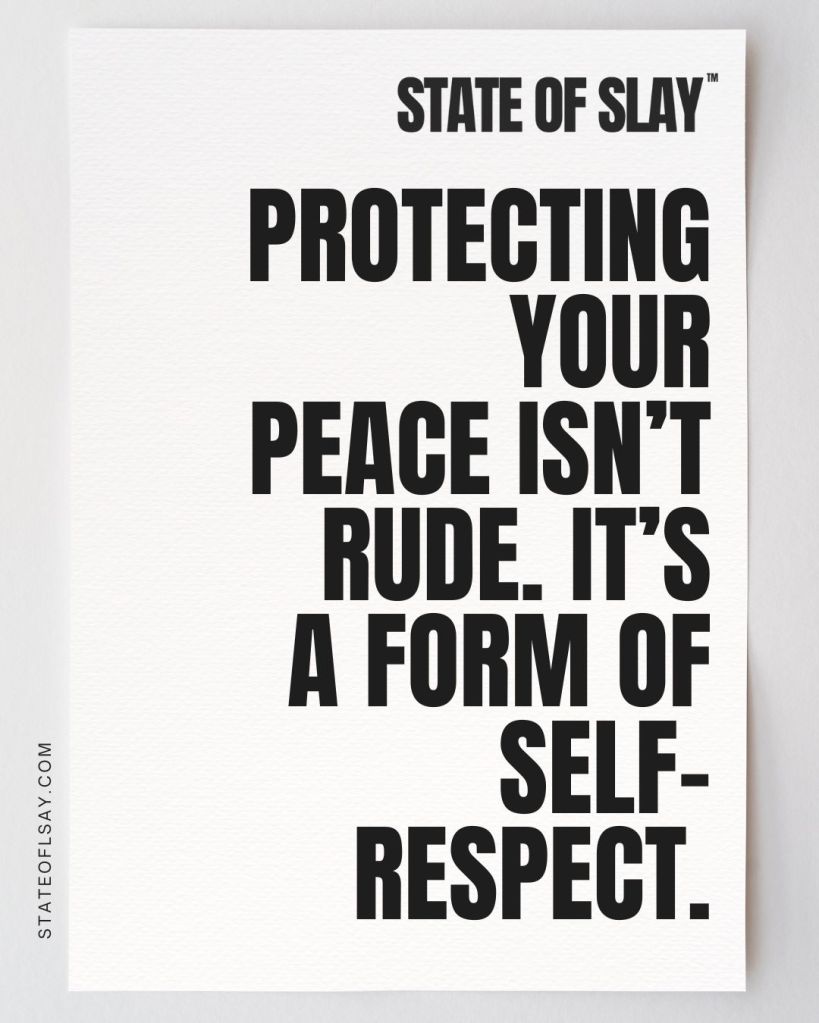
Protecting your peace means knowing when to pause, say no, or simply not respond.
Your availability doesn’t define your worth.
Your boundaries define your self-respect.

This is your reminder that you don’t need to be everywhere for everyone.
You just need to be present for yourself.

SLAY on!

No One Can Drive You Crazy Unless You Give Them The Keys

We’ve all had those moments—when someone gets under our skin, disrupts our peace, and throws our entire day off course. Sometimes, it’s a conversation. Other times, it’s a repeated behavior. And before we know it, we’re consumed—playing it over and over in our minds, stewing in frustration, resentment, or defeat.

But here’s the truth:
They only have that power if we hand them the keys.

For a long time, I didn’t see that.
I thought I was just a victim of circumstance, or worse—other people.
But what I was really doing was giving away control.
Letting someone else take the wheel.
And then wondering why I kept crashing.


The Cost of Handing Over the Wheel

In my past, I gave away the keys to my peace all the time.

Sometimes it was people-pleasing—I didn’t want anyone to be upset with me, so I’d go along with something even when it didn’t feel right.
Other times, I hoped that if I just tolerated enough, something good would eventually come of it.
And then there were times I gave away control so I could keep telling the same story: that I was the victim.
That life happened to me.
That I had no power.

It kept me sick.
It kept me stuck.
And it kept me in relationships, situations, and patterns that were not good for me.


Recovery Handed Me Back the Keys

When I began my recovery journey, one of the first things I had to do was take radical responsibility for my own life.

That meant owning my choices.
Being honest with myself about my part.
And realizing that I could no longer blame other people for how I felt, what I did, or what direction my life was going in.

It was sobering at first.
But also liberating.
Because if I had the power to give the keys away…
I also had the power to take them back.


Who’s Driving?

Here’s what I’ve learned:
You can’t complain about where your life is going if you’ve let someone else steer.

Yes—people may have opinions.
Yes—they might try to sway you.
But at the end of the day, you are the one in the driver’s seat.

You decide what’s best for you.
You set the course.
And if someone keeps reaching for the wheel?
It might be time to rethink whether they belong in your vehicle at all.


Emotional Hijacking

Letting someone else “drive” doesn’t always look like direct control.
Sometimes, it’s letting a comment ruin your whole day.
Or replaying an argument in your mind on loop.
Or getting pulled into drama that has nothing to do with you.

These are all ways we give our power away.
All ways we hand over the keys—without even realizing it.

Today, I choose to drive.
Even when the road gets bumpy.
Even when I make a wrong turn.
Because it’s my journey, and I’d rather learn from my own mistakes than crash because someone else took the wheel.


SLAY Reflection: Who’s Driving Your Life?

  1. Do you let others emotionally hijack your peace?
    What triggers this—and how often does it happen?

  2. Have you given someone the power to influence your thoughts, decisions, or direction?
    How does that make you feel?

  3. Are you holding onto resentment or trying to control situations that no longer involve you?
    What would happen if you let that go?

  4. Is there someone in your life who repeatedly tries to take the wheel?
    Is that a healthy relationship—or something that needs to shift?

  5. What can you do today to take your power back and stay in the driver’s seat?
    What boundary needs to be drawn—or reinforced?


Call to Action: Join the Conversation

I’d love to hear from you.
Have you ever handed someone else the keys to your peace—and what did it take to take them back?
Share your story in the comments. Let’s cheer each other on.

And if you know someone who’s giving away their power, send this to them.
Sometimes, all we need is a nudge.

Not Everything That Weighs You Down Is Yours To Carry

This week has been heavy.
Not just in the day-to-day busyness, but emotionally, mentally, spiritually.

And as I took a step back, I asked myself a question I’ve learned to come back to again and again:
Is all of this mine to carry?

The answer?
No.
But that hasn’t stopped me from dragging it around—tight-chested, overwhelmed, and bone-tired.

Like many of us, I juggle a lot every day.
And most of the time, I believe I can handle it all.
Until I can’t.
Until I hit a wall.
And when I do, I don’t always meet myself with grace.
Sometimes, I meet myself with frustration and shame.

Even when I know better, I still find myself slipping into old habits—trying to carry it all.
No one is asking me to.
Help is there if I reach for it.
But there I go, dragging the weight of the world across some invisible finish line I made up in my head.

It’s time to pause.
To take a breath—or a few—and ask myself what I’ve picked up along the way that never belonged to me in the first place.


We Learn to Carry What We Don’t Need

Before recovery, I carried everything.
It never occurred to me that I could set anything down.

The emotional weight.
The resentment.
The guilt.
The responsibility for people and problems that were never mine to begin with.

I just kept going—until I couldn’t.

Eventually, I hit a wall.
Hard.
And that wall was the wake-up call I needed.
I couldn’t live that way anymore.
It was slowly destroying me.

So I asked for help.
Not just with what I was carrying—but with how I lived.


Learning to Let Go of What’s Not Yours

Through recovery, I discovered something profound:
A lot of what I was carrying wasn’t mine.

Some of it was inherited—passed down through family, expectations, trauma.
Some of it I volunteered to carry—because I wanted to feel helpful, needed, or in control.

And some of it… I carried on purpose to sabotage myself.
To stay small.
To stay exhausted.
To prove that I couldn’t do more, be more, live more.

That’s the hard truth.
Sometimes, we don’t just carry what’s not ours—we choose it.

But once I got honest with myself, I realized I had a choice.
To let go.
To say no.
To only carry what actually belonged to me.

And that changed everything.


What’s Yours—and What’s Not

There will always be people who would gladly let you carry their weight.
There will be moments when you try to carry someone else’s pain, fear, or responsibility—uninvited.

But that doesn’t mean you have to.

Being helpful doesn’t mean taking on someone else’s journey.
Being strong doesn’t mean carrying more than you should.
Being loving doesn’t mean sacrificing yourself.

We are responsible for ourselves.
For our peace.
For honoring what we need.

That starts with putting down what was never yours to carry in the first place.


SLAY Reflection: What Are You Carrying?

  1. Do you tend to carry more weight than you need to—physically, emotionally, or mentally?
    What does that weight feel like?

  2. What are you carrying that doesn’t actually belong to you?
    Who gave it to you—and why did you accept it?

  3. Are there responsibilities, emotions, or expectations you’ve taken on to feel valuable or in control?
    How are they serving you? How are they hurting you?

  4. What would it feel like to put that weight down—even just a little?
    What would change?

  5. What can you do today to lighten your load and honor your limits?
    Where can you say no, ask for help, or simply rest?


Call to Action: Join the Conversation

I’d love to hear from you.
What’s one burden you’ve been carrying that isn’t actually yours—and how are you learning to let it go?
Share your story in the comments. Let’s cheer each other on.

And if you know someone who’s overwhelmed by weight they were never meant to carry, send this to them.
Sometimes, all we need is a nudge.

Giving Love To Get Love

We often hear that love is meant to be unconditional—yet many of us struggle to live that truth. Giving love can feel risky. What if it’s not returned? What if it’s overlooked? But here’s the hard truth: when we give love with the expectation of getting it back, we cancel out the purity of the love we are offering.

Love that comes with strings attached isn’t love at all—it’s manipulation in disguise.


The Motives Behind Our Love

If you’ve ever caught yourself giving love to gain approval, recognition, or affection, you’re not alone. Many of us fall into people-pleasing or approval-seeking patterns without realizing it. But true love is not a transaction.

When you give love only to get it back, you’re no longer operating from the heart. You’re playing a game of give-and-take that diminishes both your sense of worth and the authenticity of the connection. Love is love, period. Anything else is a tactic—not truth.


Learning to Check Your Heart

I’ve been there. I’ve given love with the secret hope of getting something in return: validation, security, even power. It took honesty and accountability for me to see that this wasn’t really love—it was ego.

Early in my recovery, I was told something that stopped me in my tracks: “Don’t give love if you expect anything in return.” At first, that sounded impossible. How could I give without hoping for even a little acknowledgment? But the more I practiced it, the more I understood: love without expectation is the only love that strengthens both the giver and the receiver.

And here’s the surprising part—when love did come back to me, it felt even more powerful. Because I knew it wasn’t coerced or earned—it was freely given, just as mine was.


The Freedom of Pure Love

We all have motives. That doesn’t automatically make our love wrong. But when love becomes a tool for control—when it’s about getting rather than giving—it loses its meaning. It won’t fill the void we’re trying to fix.

The truth is, love doesn’t need to be returned to be valuable. Every time you give love without expectation, you affirm your own worth. You remind yourself that your heart is strong enough to love without conditions. And when love does return, it’s not a reward—it’s a gift.


SLAY Reflection

  • Do you give love without expecting it in return—or do you secretly hope for something back?

  • When you’ve given love with motives, how did it feel different from giving freely?

  • What happens to your sense of self when you love without conditions?

  • Can you recall a time you received love that was given without expectation? How did it impact you?

  • How can you begin practicing unconditional love today, even in small ways?


S – Stop and check your intentions before giving love.
L – Let go of the scorecard. Love isn’t a tally sheet.
A – Accept that love is enough on its own.
Y – Yield to the freedom that comes from giving without strings.


Call to Action: Join the Conversation
I’d love to hear from you.
Have you ever caught yourself giving love to get something back? What shifted when you began to love without expectation?
Share your story in the comments. Let’s cheer each other on.

Sometimes You Face Difficulties Because You’re Doing Something Right

Sometimes we assume that if we’re facing difficulties we’re doing something wrong, but many times it’s a sign we’re doing something right, and, maybe different from what we’ve always done in the past. We tend to be creatures of habit, we do what we’ve been taught, what we’ve been shown, and many times, what may seem like the easiest way out, but those ways may not be taking us to where we need to be, or where we should be. Which brings up their own set of difficulties. But those difficulties are within our control. We can make different choices. The right choices, for us. And even though those new choices may bring up their own set of difficulties, they are easier, and healthier to work through, because we are being authentic to who we are and what we need.

We should never apologize, or shy away from what is best for us. For me, before stepping on this path, I often tried to take the easier, softer route, in terms of finding a solution in which meant the least amount of conflict, or attention. I often didn’t get what I wanted, or if I did, would have to manipulate or lie to work around the work I wasn’t doing, which in reality was only making more work for myself instead of doing what was right for me in the first place. A lot of times this falls into people-pleasing, putting others’ wants and needs ahead of our own, or being afraid to ask for what we want for fear of the response. So we do what is best for someone else, or what will cause the least amount of waves, and settle for that solution, only to become angry, anxious or depressed about the situation we then find ourselves in. We continue this behavior until it becomes unbearable, at which point we may start to find outside fixes to cope with where we find ourselves, or, hopefully, start making some better choices. For me, I opted for the outside fixes first. I found ways to numb myself, to quiet the voices in my head that were telling me I wasn’t making the right choices, that I wasn’t supposed to be where I was, I thought if I could just get them to quiet down I could be OK where I was, but I couldn’t be, because I wasn’t supposed to be there.

We can only hide from the truth for so long, and some of us spend most of your lives hiding in those places, maybe even our whole lives, but we know when it’s not right, when we’re not in a place that allows us to be ourselves, to shine, to grow and be accepted for who we are, and encouraged to be who we should be. So when we start to make the right decisions, maybe for the first time, those difficulties that come up are showing us we’re on the right track, and, that we’re walking where we’ve never walked before. The difficulties that come up on that path feel difficult because we’ve never been there, but are not nearly as difficult as the ones we’ve lived with when we weren’t being truthful with ourselves. Walkthrough these new difficulties, because we are meant to, because they are just fear of letting go of what we’ve had, where we’ve been, and the uncertainty of finally living a life that serves us and allows us to be our best selves. If we are being truthful about who we are, what we need and want, we should have no fear, just follow the road we find ahead of ourselves, and keep making the next right decision for us and the life we want for ourselves. Of course that doesn’t mean we don’t care how our decisions affect the other people in our lives, but if we’ve chosen the right people, they will want the best for us and may even encourage us to walk through those difficulties we may find on this new path. Or, they may not be OK with the changes and that tells us that we need to move forward without them, or, just in a different way.

Only we can decide what is best for us. Only we can do the work to have the life we want, the way we want it. And only we can walk through the difficulties or fears we may encounter on that road to the place that’s been waiting for us. Suit up SLAYER, step on that path, there are plenty of us walking beside you to help you through those rough spots. SLAY on!

SLAY OF THE DAY: Do you always follow the path that reflects your true self? If not, why not? How have you not been true to yourself in the past? What has been the result? Write down some times that you were true to yourself? What was the result? How did you feel? Why do you not do what’s best for you and your growth all the time? What stops you? How does this hurt you? What if you stopped doing that? What if you started making decisions and taking action that did put you on the right path? What if you tried to do something different today, something that honored you? Start there SLAYER, and see how you feel. See if you can’t start making more of those decisions and choices to start honoring who you are and what you want in your life. Do it SLAYER, we’ll all be right there with you, cheering you on.

S – self L – love A – appreciate Y – you

Don’t Co- Sign Someone Else’s Bullsh*t

We’ve all done it.
Gone along with something we didn’t believe in.
Put our needs aside to fix someone else’s mess.
Jumped into a problem that wasn’t ours to solve.

And let’s be honest—sometimes, we did it because it made us feel needed.
Valued.
Important.

But here’s the truth: you are not responsible for cleaning up someone else’s willful choices.

When someone makes a bad decision—especially if it’s part of a pattern—and ends up in crisis, it is not your job to bail them out.
And rushing to do so over and over?
That’s not kindness.
That’s co-signing their bullsh*t.


The Emotional Vampire Tactic

I’ve written before about Emotional Vampiresthose who feed off our time, energy, and attention.
And one of the tactics they use is convincing you to validate their chaos.

They want you to:

  • Validate their story

  • Co-sign their drama

  • Confirm their narrative that they’re always the victim

You are not required to be a supporting character in someone else’s self-destructive script.

Yes, we all need help sometimes.
And yes, it’s okay to ask for it.
But there’s a massive difference between someone reaching out for support and someone handing you a flaming mess they created—and expecting you to carry it while they sit back and light another match.


Been There, Done That

Before I walked this path, I was very familiar with this dynamic—because I was the one doing it.

I would avoid reality, avoid responsibility, and let things spiral until they became unmanageable. Then I’d panic, cry, and call for help.
And when someone came running? I felt a high.
A quick, fleeting sense of love and validation.

But it never lasted.
Because deep down, I knew I had created the crisis.
And I wasn’t learning anything from it—except how to get better at playing the victim.

That cycle drained me. And it wore out the people around me.
I’m grateful I don’t live that way anymore.
And when I see it in others now, I recognize it for what it is:
a trap.
For them—and for me.


Help Should Be a Two-Way Street

Being supportive doesn’t mean sacrificing yourself.

You can help someone—as long as they’re helping themselves.
If they’re taking action, being honest, and working toward change, that’s one thing.

But if they keep coming back with the same drama, expecting you to fix it while they do nothing?
That’s not support.
That’s codependency.

And here’s the hard truth:
Helping someone who isn’t helping themselves doesn’t help anyone.

If they’re repeating the same mistakes…
If they’re ignoring their own well-being…
If they’re draining your energy without ever filling their own cup…
You don’t have to step in.

Sometimes the most loving thing you can do is step back.


Stand Tall, Not in the Mess

Next time someone comes calling, ask yourself:

  • Are they asking for help—or a savior?

  • Is this a one-time situation—or a repeated pattern?

  • Are you working with them—or doing all the heavy lifting yourself?

If the facts don’t add up…
If your energy is being drained…
If your needs are constantly pushed aside for theirs…

That’s your answer.

You were not put on this earth to fix people who have no intention of changing.
You’re here to build and protect a life that’s worth living—and that includes knowing when to say no.

So the next time someone tries to pull you into their storm, remember:
You can love someone and still choose yourself.
You can care deeply and still walk away from the chaos.


SLAY Reflection: Are You Co-Signing the Chaos?

  1. Do you have people in your life who always seem to be in crisis?
    How often do they turn to you to fix it?

  2. Are you helping—or doing all the work for them?
    What toll does that take on you?

  3. Have you been in this dynamic more than once with the same person?
    Why do you think it keeps happening?

  4. What would it look like to support someone without sacrificing yourself?
    Can you draw that boundary?

  5. What’s one step you can take today to protect your energy and stop co-signing someone else’s drama?
    What would choosing yourself look like in this situation?


Call to Action: Join the Conversation

I’d love to hear from you.
What’s one situation where you realized helping someone was actually hurting you—and how did you take your power back?
Share your story in the comments. Let’s cheer each other on.

And if you know someone who’s stuck playing the fixer, send this to them.
Sometimes, all we need is a nudge.