Sometimes Happy Is a Feeling, Sometimes Happy Is a Choice

Let’s be honest: some days happiness wraps around you like a warm blanket. Other days, it’s a threadbare flag you have to raise yourself, even when the wind isn’t blowing.

Sometimes, happy arrives uninvited. A smile you didn’t expect. A moment of peace. Laughter that catches you by surprise. These are the days when joy feels natural. Effortless. When your heart feels light and your worries take a back seat. These are the days you wish you could bottle.

But what about the other days? The days when you wake up heavy, when your body aches with exhaustion, when your mind is cluttered and your heart is a storm cloud? What then?

That’s when happy becomes a choice. And yes, sometimes, it’s the hardest choice you can make.


Feel It When It Comes

We all have seasons where happiness seems to bloom everywhere—inside us and around us. These are the easy days. The ones where gratitude feels automatic, and your smile is real. And when those moments show up?

Let them.

Don’t question the joy. Don’t wait for the other shoe to drop. Let yourself feel good without guilt. You don’t have to earn happiness for it to be valid. It’s not a reward, it’s a gift. And you are allowed to receive it, just because you exist.

Too many of us hesitate to feel joy because we’re afraid it won’t last. But here’s the truth: happiness isn’t permanent, but it is powerful. And when it comes naturally, lean in. Let it soak into your skin.


Choose It When It Feels Out of Reach

And then there are the other days.

The days when happy feels like a stranger.

That’s when you make the choice to reach for it anyway. You choose to smile. To take a walk. To text a friend. To wash your hair. To play a song that makes you sway just a little. To say thank you, even when you’re not quite feeling it.

This isn’t toxic positivity. This is resilience. This is saying, “I know I feel low, but I’m going to plant the seeds of joy anyway.” And over time, those seeds bloom.

Happiness isn’t about denying what hurts. It’s about refusing to let the hurt define the whole day.


You Are Allowed to Want More

Here’s a powerful truth: you don’t have to settle. Not for a life that keeps you stuck. Not for a mindset that keeps you small. You are allowed to chase joy. To design a life that feels good on the inside, not just one that looks good from the outside.

And when you can’t find it? You can choose it. You can create it.

Even if that looks like a slow morning with coffee and quiet.

You are not failing if you have to fight for your happiness. That’s not weakness. That’s strength.


Some Days It’s Both

Sometimes happy is a breeze. Sometimes it’s a battle.

And sometimes, it’s a little bit of both.

Either way, you have the power to feel it, create it, or reach for it. You don’t have to wait for life to feel perfect before you allow yourself to be happy. Let it show up in small ways. Invite it in. And when it comes, don’t push it away.

You are allowed to feel good. You are allowed to choose good. You are allowed to live a life that includes joy.

Even on the hard days.


SLAY Reflection

  1. When was the last time you felt joy without effort? What triggered it?
  2. Do you feel guilty when you’re happy? Why?
  3. What’s one small way you could choose joy today?
  4. How can you remind yourself that happiness isn’t a reward?
  5. What would your day look like if you let joy take up more space?

S-L-A-Y:

  • See where joy naturally shows up in your day
  • Let yourself lean into those moments
  • Acknowledge the hard feelings, but don’t stay stuck in them
  • You have the power to choose happiness, even in small ways

Call to Action: Join the Conversation
I’d love to hear from you.
What does choosing happiness look like for you right now?
Share your story in the comments. Let’s cheer each other on.

And if you know someone who’s struggling to feel joy, send this to them.
Sometimes, all we need is a reminder.

Slay Say

Let the Shadows Fall Away

Not everyone is meant to walk beside you when you begin to shine.

As you step into your truth, the people who only saw your potential in pieces may start to fade. And that’s okay.
You weren’t made to shrink, edit, or filter who you are just to be accepted.

The more you show up fully—without apology—the more you create space for relationships rooted in real connection, not performance.

Let go of the need to be understood by everyone.
The right ones will never be afraid of your light.

SLAY ON.

Slay Say

Vulnerability is bravery in action

Being vulnerable isn’t easy. It means showing up without the filter, letting people see the real you — fears, flaws, feelings and all. But vulnerability is not a weakness. It’s courage in its rawest form.

When we choose honesty over perfection, we create real connection — with ourselves and with others. That’s where true growth happens.

Let this be your reminder: you don’t have to have it all together to be worthy of love, support, or success.

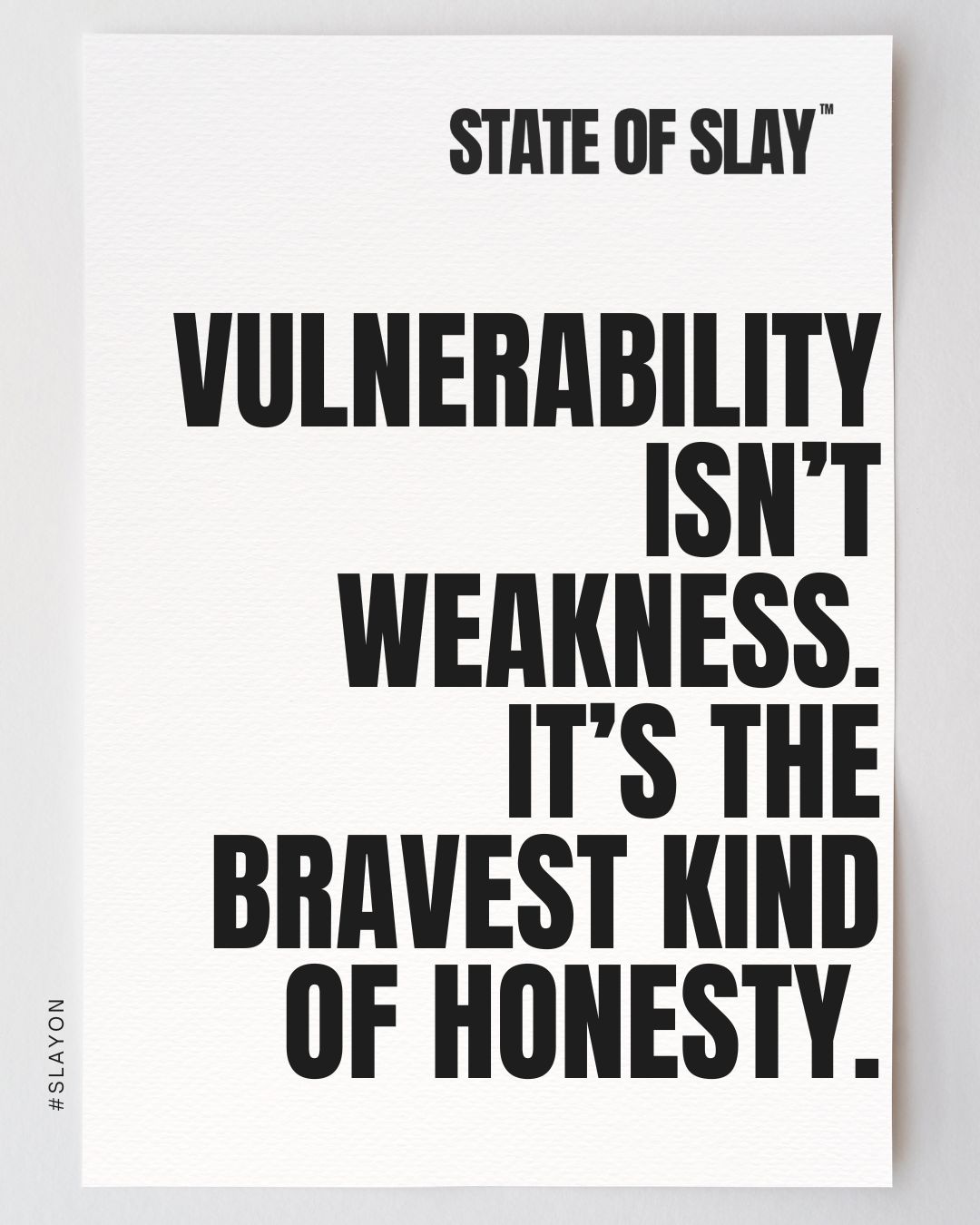
Quote in block letters saying: Vulnerability isn’t weakness. It’s the bravest kind of honesty.

No One Ever Injured Their Eyesight Looking At The Brightside

There is always a bright side. Sometimes, it may feel impossible to find—but it’s there if we look for it. Often, we don’t see it until later, when hindsight reveals that not getting what we thought we wanted brought something even better.

But here’s the thing: when we actively choose to seek out the good, the positive, the light—it trains our minds to keep looking. And eventually, it becomes second nature.

We are bombarded by fear and negativity every day. So why not choose the opposite? Why not be intentional about focusing on what’s working, what’s good, and what’s worth celebrating?


How I Found the Bright Side

Before I began walking this path, I lived in a negative world—one fueled by fear, shame, and pain.

The light didn’t last long in those days. I had fleeting moments of brightness, but the clouds of my own mind would roll in and dim it. I always defaulted to the worst-case scenario, and even when something good happened, I’d immediately brace for when it would be taken away.

My hope lived in superficial things—external markers I clung to like a lifeline. If something bright appeared, it was often a distraction rather than a shift. And because it wasn’t rooted in anything lasting, it never stuck around.

Recovery changed that. It taught me to start with gratitude. To look for moments of light. And when I couldn’t feel it? To write it down anyway. Even on my darkest days, I could find one thing. A kind word. A warm cup of coffee. A song I loved. Those small sparks reminded me that light is always there—we just have to invite it in.


Train Your Eyes to See the Light

Every day, we’re given a choice: focus on the fear or look for the light.

And as someone who has lived in both places, I can tell you—choosing the light is where everything changes.

It’s not about pretending things are perfect. It’s about deciding not to let the darkness win. It’s choosing to see that yes, things may be hard—but they’re not only hard.

The more we practice gratitude and look for the good, the more it shows up. That’s not magic—that’s mindset. And it’s powerful.

Be someone who looks for the bright side. And even better? Be someone who becomes the bright side for someone else.

Our light shines the brightest when we share it.

SLAY on.


SLAY Reflection: What Are You Choosing to See?

  • Do you tend to focus on the negative or look for the light? What habits shape that tendency?
  • Was there a time in your life when you struggled to find anything good? How did that affect your day-to-day experience?
  • What small moments of light have shown up for you recently? Did you notice them?
  • Has something you once saw as a disappointment turned out to be a blessing?
  • What could shift in your life if you committed to seeing the bright side—just once a day?

Call to Action: Join the Conversation

I’d love to hear from you.
What’s one way you’re choosing the bright side today—even when it would be easier to stay in the dark?
Share your story in the comments. Let’s cheer each other on.

And if you know someone who needs a little light right now, send this to them.
Sometimes, all we need is a reminder that it’s still there—waiting to be seen.

How Is Your Now?

Fear can show up in sneaky ways. It did just the other day—while talking with a group of women, someone brought up fear, and we all shifted in our seats.

There’s a lot of uncertainty in the world right now. And with uncertainty often comes fear. But most fear doesn’t live in the present—it lives in the past or the future. That’s what makes it so tricky. It takes us out of the only place where we have power: the now.

When I feel fear creeping in—and I have, especially recently—I bring myself back to the present. I ground myself in gratitude. I focus on my breath. I ask: How is my now?

Because right now, in this moment, I’m okay.


Living Outside the Now

Before I began walking this path, I didn’t live in the now. I lived everywhere but here. I obsessed over what had already happened or worried about what might come next. I was spinning—and because I wasn’t grounded in the present, I couldn’t take meaningful action.

My life became unmanageable. Fear ran the show. And instead of facing what was in front of me, I avoided it. I let things slide. I convinced myself that if I ignored the chaos long enough, it might resolve itself. Spoiler: it didn’t.

Eventually, the only way forward was through. I had to stop hiding from the now and start making peace with it. Slowly, the present stopped feeling like a battlefield and started becoming a place of peace—a space where I could reflect, reset, and realign.

The more I committed to living in the now, the less power fear had over me. It still visits, of course. But today, I don’t let it drive. I stay focused on the moment—and when I do, I can breathe again.


Return to What’s in Front of You

We don’t know what tomorrow holds. We can’t change what’s already happened. But we can choose how we show up today.

Even when life feels uncertain, we can find clarity by focusing on what’s in front of us. One step. One breath. One moment at a time.

This is how we quiet the fear. This is how we get grounded.

And if the now doesn’t feel great? That’s okay. The present is still the place where change can happen. We get to respond differently. We get to choose a new direction.

Ask yourself: How is my now? And if you don’t like the answer, know that this is the best place to begin again.

SLAY on.


SLAY Reflection: How Is Your Now?

  • Do you often get pulled into the past or future? How does that impact your emotional state?
  • What role does fear play in your life when you’re not present?
  • How do you feel when you manage to stay grounded in the now?
  • What tools or habits help you return to the present moment?
  • If today feels heavy, what’s one thing you can do right now to lighten the load?

Call to Action: Join the Conversation

I’d love to hear from you.
What’s one way you’re bringing yourself back to the now when fear tries to take over?
Share your story in the comments. Let’s cheer each other on.

And if you know someone who’s stuck in fear or uncertainty, send this to them.
Sometimes, all we need is a moment of presence to find our power again.

H.O.W.

Before I started this path, I wished for change daily. I hoped something—or someone—would swoop in and fix everything. But I wasn’t honest about what was really going on. I blamed others. I minimized my pain. I lived in denial.

What I didn’t realize was that my life wouldn’t get better just because I wanted it to. Wishing doesn’t work without action. And action requires honesty, openness, and willingness.

H.O.W. may sound simple, but when you’re living in darkness, it can feel impossible. Denial lies to you. It convinces you to bury the truth, avoid the mirror, and keep digging deeper into the hole.

But once I got desperate enough, I stopped digging. I looked up. I told the truth. And for the first time in a long time, I was willing to climb.


Change Starts with You

The day I got honest about the mess I’d made was the day everything started to shift.

I saw the wreckage I had caused—not just in my life, but in the lives of people who had tried to love me. I stopped blaming. I started owning. I opened myself to new ideas, new tools, new people who could guide me.

And I became willing—not just to admit my mistakes, but to fix them. That’s where real healing lives. That’s where the change I had longed for finally began to show up.

It wasn’t perfect. It wasn’t fast. But it was real.


Ask Yourself H.O.W.

When you’re ready to change but don’t know how, ask yourself:

  • Am I being honest about what’s really going on?
  • Am I open to doing things differently?
  • Am I willing to take uncomfortable—but necessary—action?

If the answer to any of those is no, you’re not stuck—you’re just not ready yet.

But if the answer is yes?

Get ready. Life is about to shift.

SLAY on.


SLAY Reflection: How Are You Showing Up for Change?

  • Do you wish for change in your life? What would it look like?
  • Are you being honest with yourself about where you are and what needs to shift?
  • How open are you to doing things in a new way?
  • What’s one thing you’re willing to try today—even if it’s uncomfortable?
  • Have you seen the power of H.O.W. in action before? What changed?

Call to Action: Join the Conversation

I’d love to hear from you.
What’s one way you can practice honesty, open-mindedness, or willingness this week?
Share your story in the comments. Let’s cheer each other on.

And if you know someone who’s ready for change but doesn’t know where to start, send this to them.
Sometimes, all we need is a roadmap—and a nudge.

The Oops Factor

Growing up, I never left any room for mistakes. I expected myself to do everything perfectly—and when I didn’t, I beat myself up. I carried these unrealistic expectations with me through childhood, my teenage years, and well into adulthood, never giving myself permission to simply be human. The result? A constant negative narrative playing on loop in my head, convincing me I wasn’t good enough. Every mistake felt like proof of failure, which I used as an excuse to abandon self-care, spiral into self-doubt, and reinforce the lie that I could never get better.

I see now that none of that thinking was true. I made it feel true by keeping my struggles to myself and believing the cruelest voices in my mind. I nearly rode that train all the way into the station—but thankfully, I got off before the final stop.

The truth is: our mistakes are where we learn the most. They shape our character. They build the resilience we need to accomplish the things that really matter. No one is meant to get it right every time. The growth is in the slip-ups. That’s why we need to embrace what I call the “Oops Factor.”


What Perfectionism Really Cost Me

Expecting myself to be perfect—even when I knew better—set me up to fail. I’d aim impossibly high and, when I missed the mark (which was inevitable), I’d use that as ammunition to tear myself down. Even when I succeeded, I picked apart the outcome. I never gave myself permission to feel proud. That made relationships harder too. I lived in fear that people would see me for the fraud I thought I was.

Eventually, I reached a breaking point and asked for help. In that process, I learned something life-changing: mistakes are a sign that I’m trying. They mean I’m pushing myself. And even when things don’t work out the way I hoped, there’s always a lesson or a growth opportunity—often the real reason I was on that path in the first place.

Over time, I’ve learned to trust that I’m exactly where I need to be. My job is to take the next right step. I can’t control the outcome—just the intention behind the action. And when I show up with that mindset? It’s always a win. Trying is the victory. There’s always something to gain.


Make Room for the Oops

We’re all allowed to make mistakes. In fact, we should be making them. That’s how we grow.

Start leaving space for the Oops Factor in your life. When something doesn’t go as planned, look for the lesson—or simply laugh it off. Don’t let the fear of messing up keep you from taking risks or being yourself. Let go of the pressure to be perfect and redefine what success looks like. Maybe, just maybe, being exactly who you are today is enough.

Mistakes don’t define you. But how you respond to them just might.

SLAY on!


SLAY OF THE DAY: Reflect & Rise

  • Do you expect yourself to be perfect?
  • How do you usually react when you make a mistake?
  • Does that response help you—or harm you?
  • What’s one belief about mistakes that you’re ready to let go of?
  • What’s one thing you’ve learned from a recent oops moment that helped you grow?

Give yourself permission to stumble. Learn, laugh, and get back up stronger.


Call to Action: Join the Conversation
I’d love to hear from you.
What’s one way you can show yourself more grace when you make a mistake?
Share your story in the comments. Let’s cheer each other on.

And if you know someone who’s been stuck in a shame spiral, send this to them.
Sometimes, all we need is a little reminder that it’s okay to mess up.

We Accept The Love We Think We Deserve

For most of my life, I believed I was unlovable.

Not just hard to love—unworthy of it.

I didn’t like myself, let alone love myself, so when someone claimed to love me, I didn’t trust it. If someone’s love felt genuine, it made me uncomfortable. I feared they’d eventually discover the “ugly truth,” so I kept one foot out the door—just in case. Even after I began to learn how to love myself, I still accepted love that was far below what I knew I deserved.

Because deep down, I didn’t believe I could ever have the kind of love I truly wanted.

That belief kept me stuck in relationships that weren’t healthy. They weren’t safe. And they weren’t loving. But it was only through experiencing pure loveone grounded in mutual respect, connection, and emotional honesty—that I finally learned what I truly deserved.

And more importantly, I believed I could have it.


Love Begins Within

It’s hard to receive real love when you don’t feel it for yourself.

Sure, there are times we begin to heal through the way someone else sees us. But more often than not, if we don’t believe we’re worthy, we’ll sabotage anything good that comes our way.

To let love in, love has to live inside us first.

If fear, shame, or self-hatred are taking up residence, there’s no room for love to grow. Love doesn’t thrive where it’s unwelcome. But when we begin to care for ourselves, nurture our hearts, and see our worth, love becomes a natural extension of that inner work.

It becomes the lens we filter everything through.

If what we say, do, or allow in our lives doesn’t align with love—it has to go.


What We Accept Reflects What We Believe

When we truly love ourselves, we become more compassionate toward others. Our energy shifts from scarcity to abundance. From needing love to sharing it.

And the more love we put out, the more love finds us.

That kind of love? It’s not desperate or dependent. It’s full. It’s expansive. It shows up with open hands, not clenched fists. And when it arrives, we can receive it—not because we’re perfect, but because we’ve finally stopped questioning whether we deserve it.

You do.


You Are Love

There are many paths to love.

Sometimes we have to hit rock bottom to find our way back to it. Other times, we’re inspired by love we witness in others. But the more we cultivate and share love, the more it grows—and the more it sustains us when life gets hard.

Because love is more powerful than fear, shame, or anything trying to hold us back.

You are love at your core. That has always been true—even if you forgot for a while.

Feed that love. Honor it. Share it with someone who needs it today.

SLAY on.


SLAY OF THE DAY: Reflect & Rise

  • Do you love yourself? Why or why not?

  • If you do, what do you love most about yourself?

  • If not, what beliefs stand in your way?

  • What’s one small, loving thing you can do for yourself today?

  • What kind of love are you accepting right now—and is it aligned with what you deserve?

Start by naming one reason you’re lovable. Hold it in your heart. Add to it every day until you believe it.


Call to Action: Join the Conversation
I’d love to hear from you.
What helped you finally believe you were worthy of real love?
Share your story in the comments. Let’s cheer each other on.

And if you know someone who’s settling for less than they deserve, send this to them.
Sometimes, all we need is a reminder of who we truly are.

Patience Is To Sit In Your Suffering

Patience is a skill I never had when I was living in the dark. I wanted what I wanted—and I wanted it now. If something took longer than I thought it should, I unraveled. I’d stew in my own anxiety, convinced that worrying over it somehow meant I was “doing something.” But it never helped. In fact, it only made things worse.

The reality is, I was causing myself more pain by holding on.

Suffering Is Optional (But It Doesn’t Feel That Way)

When I started my journey toward healing, I had to face a hard truth: patience isn’t passive. It’s active. It’s powerful. It’s choosing to sit still when every part of you wants to control, manipulate, and fast-forward the process.

I was taught something simple, yet profound—do the footwork and let go. And actually let go. Not say I would, then sit in agony while pretending to surrender. That took time. It still does. But every time I allowed myself to sit in discomfort, without reacting, something shifted.

Here’s what I learned: the suffering didn’t come from the waiting—it came from the clinging.

Letting Go of the Illusion of Control

So much of my anxiety came from the belief that I had to manage everything. I believed I had the best plan, the right answers, and the perfect timeline. But that was just my ego talking. And when I realized how wrong I’d been before—how lost and broken I felt trying to run the show—it humbled me.

I had to accept that I wasn’t the director of the universe. That my vision was limited. That maybe—just maybe—there was a bigger plan unfolding, and my job was to participate, not dictate.

That’s where the power of patience lives. Not in forcing, but in trusting. Not in pushing, but in practicing peace. And the more I practiced, the less I suffered.

Choosing Peace Over Pressure

Let’s be honest—letting go is not easy. Especially when we care deeply about the outcome. But once we start to realize that the suffering is self-inflicted—that it’s not coming from the waiting, but how we wait—it becomes easier to breathe through it.

The truth is, when we choose to surrender, we reclaim our power.

Patience doesn’t mean inaction. It means taking the action that’s yours, and then releasing what isn’t. It means being OK with not knowing, trusting that the right things will unfold in the right time. That may feel uncomfortable at first. But comfort isn’t the goal—freedom is.

And freedom comes when we stop clinging to control and let go of the suffering we’ve been dragging around.

SLAY on.


SLAY OF THE DAY: Reflect & Release

  • Do you try to force outcomes instead of letting things unfold?

  • What’s the cost of that tension—emotionally, mentally, physically?

  • How do you feel when you’re able to truly let go?

  • What fear is keeping you in the suffering?

  • What step can you take today to release control and choose peace?

Suffering shows us where we’re clinging. Let it be your invitation to let go.


Call to Action: Join the Conversation
I’d love to hear from you.
What’s one area of your life where you’re holding on instead of letting go?
Share your story in the comments. Let’s cheer each other on.

And if you know someone who’s struggling to sit in the waiting, send this to them.
Sometimes, all we need is permission to pause.

Don’t Forget To Check Your Odometer

Some of us move through life so fast we never catch up to ourselves—while others move forward without realizing just how far they’ve come. It’s always easier for someone else to notice the distance we’ve traveled before we do. We’re often too close to our own lives to see the growth clearly.

That’s where checking your odometer comes in.

We may not have a physical readout to track our personal mileage, but we do have markers—our habits, our choices, our relationships, and our emotional shifts. When we take the time to pause and reflect, we might just see that we’re not in the same place we were three months ago, a year ago, or even last week.

And if we are in the same place? That’s not shame. That’s information. A gentle cue that it might be time for new action.

How Far Have You Really Come?

Before I stepped on this path, I didn’t want to check the odometer. I didn’t want to be reminded that I wasn’t making progress—or worse, that I was moving in the wrong direction. I judged myself harshly and measured my worth based on where I thought I should be, instead of where I actually was.

I was living with blinders on—trapped in a cycle of self-criticism, isolation, and disconnection. It wasn’t until I asked for help that I started placing positive mile markers in my life. Each step forward, no matter how small, became something to build on. And even when I couldn’t see my own growth, the people around me could.

Their reflection helped me see the transformation happening inside of me—and over time, I started to believe it for myself.

Celebrate the Journey

You’ve come a long way. Even if you don’t feel like it, you have. Maybe you’ve let go of a toxic relationship. Maybe you’re managing your mental health better than you used to. Maybe you’re just waking up and trying—and that alone is progress worth celebrating.

Self-checks matter. They give us a chance to acknowledge our growth, recognize where we still want to go, and celebrate the resilience that brought us this far. And yes, even setbacks can be part of that progress—sometimes, they’re just a moment to pause and breathe before your next big leap.

You don’t need anyone’s permission to be proud of how far you’ve come. Own it.

You’re a survivor. A warrior. A kickass SLAYER.
Don’t forget that.
Don’t forget you.

SLAY on.


SLAY OF THE DAY: Reflect & Recalibrate

  • Do you notice the changes in yourself—or only when someone else points them out?

  • When others celebrate your growth, do you accept it? Or do you deflect?

  • How do you support and recognize growth in others? How would it feel to give yourself the same grace?

  • What’s one area where you’ve worked hard to grow? Write down the milestones that got you here.

  • Where are you today that felt impossible a year ago?

You’ve traveled further than you think. Don’t miss the view just because you forgot to check the odometer.


Call to Action: Join the Conversation
I’d love to hear from you.
What’s one win—big or small—you’ve had on your journey that you sometimes forget to celebrate?
Share your story in the comments. Let’s cheer each other on.

And if you know someone who doesn’t see how far they’ve come, send this to them.
Sometimes, all we need is a reminder.