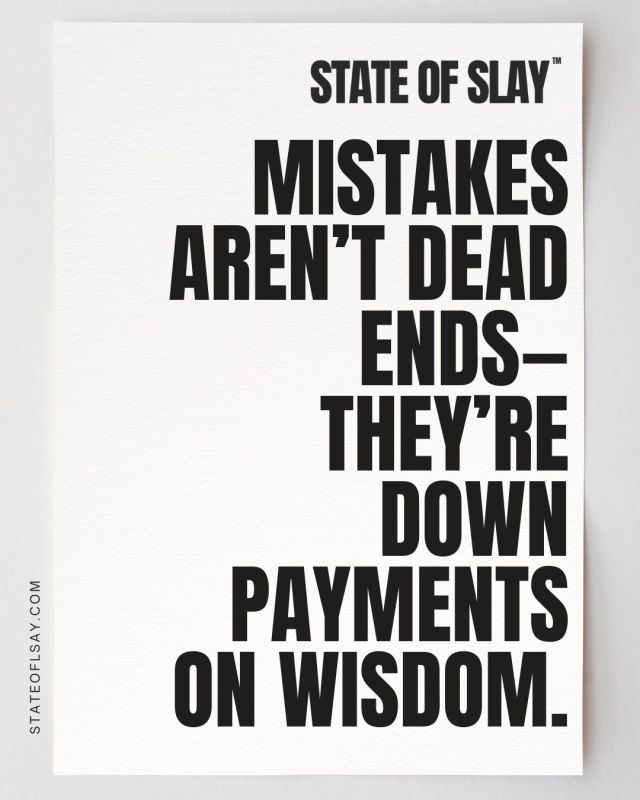
We often see failure as the enemy of success, when in reality, it’s the soil that growth springs from. Every mistake, stumble, or setback isn’t wasted—it plants something valuable inside you.
Those moments that feel like defeat are really shaping your resilience, sharpening your clarity, and preparing you for what comes next.
Instead of fearing failure, remember that it’s not the end of the journey. It’s simply one of the steps on the way up.
This is your reminder that setbacks are not roadblocks—they’re building blocks.
Recently, Taylor Swift sparked conversation when she said: “Think of your energy like it’s expensive. Not everyone can afford it.”
That hit me—and clearly, it hit a lot of people. Because the truth is, energy is expensive. Not in dollars and cents, but in time, effort, focus, and emotional bandwidth. Once it’s spent, you don’t get it back. And yet, so often, we give it away freely to people, situations, and environments that do nothing but drain us.
If your energy is expensive, why are you letting just anyone spend it?
Prefer to listen? The Audio Blog version is available here.
Energy as Currency
Imagine waking up every morning with a set amount of money in your pocket. That’s your energy for the day. You get to choose how to spend it—on your work, your relationships, your passions, your health. But if you hand it out without intention, you’ll end up broke by noon.
The same is true for your emotional and mental energy. Every “yes” you say is a withdrawal. Every boundary you set is a deposit.
So when Taylor says not everyone can afford your energy, it’s a reminder to start asking yourself: Who am I allowing to spend my most valuable currency?
Why Protecting Your Energy Feels Hard
Here’s the catch: many of us were raised to believe that giving endlessly is the right thing to do. That being available, agreeable, and accommodating makes us “good.”
But constantly giving, without discernment, isn’t goodness—it’s depletion.
I know this firsthand. For years, I poured energy into people who didn’t pour anything back. I stayed in conversations that exhausted me, relationships that drained me, and obligations that left me resentful. And I told myself it was kindness, when really, it was self-neglect.
Protecting your energy isn’t selfish. It’s self-preservation.
You Teach People How to Value Your Energy
Here’s the truth: if you treat your energy like it’s cheap, other people will too.
Think about it—if you always answer the phone, always say yes, always overextend yourself, what are you teaching others? That your energy has no limits. That it doesn’t cost you anything to give.
But when you begin to value your energy, something shifts. Boundaries get stronger. Relationships get healthier. And the people who truly value you start to rise to the top.
You don’t have to cut people off with cruelty. But you do have to get clear: What is my energy worth, and who has earned the right to receive it?
How to Protect Your Expensive Energy
If your energy is a luxury item, then not everyone belongs in your store. Here’s how you start protecting it:
Audit your energy spend. Notice where your energy goes every day. Who leaves you feeling drained? Who leaves you feeling alive?
Set boundaries without apology. Remember—boundaries don’t burn bridges, they protect castles. Your energy is the castle.
Stop over-explaining. “No” is a complete sentence. You don’t need to justify why someone can’t have unlimited access to you.
Invest in what fuels you. Spend energy on relationships, passions, and practices that multiply your energy instead of depleting it.
Rest like it’s your job. Because it is. Rest is the recharge that makes sure you have something to spend tomorrow.
The Shift from Pleasing to Protecting
When I stopped people-pleasing, I realized something powerful: not everyone was meant to have access to me. Some people liked the version of me who was always tired, always available, always giving. But that version wasn’t sustainable.
Now, when I say no, when I walk away, or when I don’t engage in drama—I’m not being cold. I’m protecting my most expensive resource: me.
And you can do the same.
Your Energy, Your Choice
At the end of the day, you decide who gets access to you. You decide how much of your energy goes where.
Some people simply cannot afford it—not because they’re “bad,” but because they haven’t earned it, they don’t value it, or they won’t respect it.
And that’s okay.
Because your energy doesn’t need to be affordable to everyone. It just needs to be invested wisely.
So the next time you feel guilty for saying no, or walking away, or setting a boundary, remind yourself:
You’re not rejecting them—you’re protecting you.
SLAY Reflection
Who in your life consistently drains your energy without giving anything back?
What areas of your life feel like “good investments” of your energy?
Do you undervalue your energy by overcommitting or overexplaining?
How can you start treating your energy like it’s expensive today?
What boundary could you set this week to protect your peace?
S – Spend your energy where it’s respected
L – Let go of guilt when you say no
A – Align with people who energize you, not drain you
Y – Yield your time and focus to what truly matters
Call to Action: Join the Conversation
I’d love to hear from you. Where in your life have you realized your energy is too expensive to waste? Share your story in the comments. Let’s cheer each other on.
And if you know someone who’s learning to protect their peace, send this to them. Sometimes, all we need is a reminder that we’re worth it.
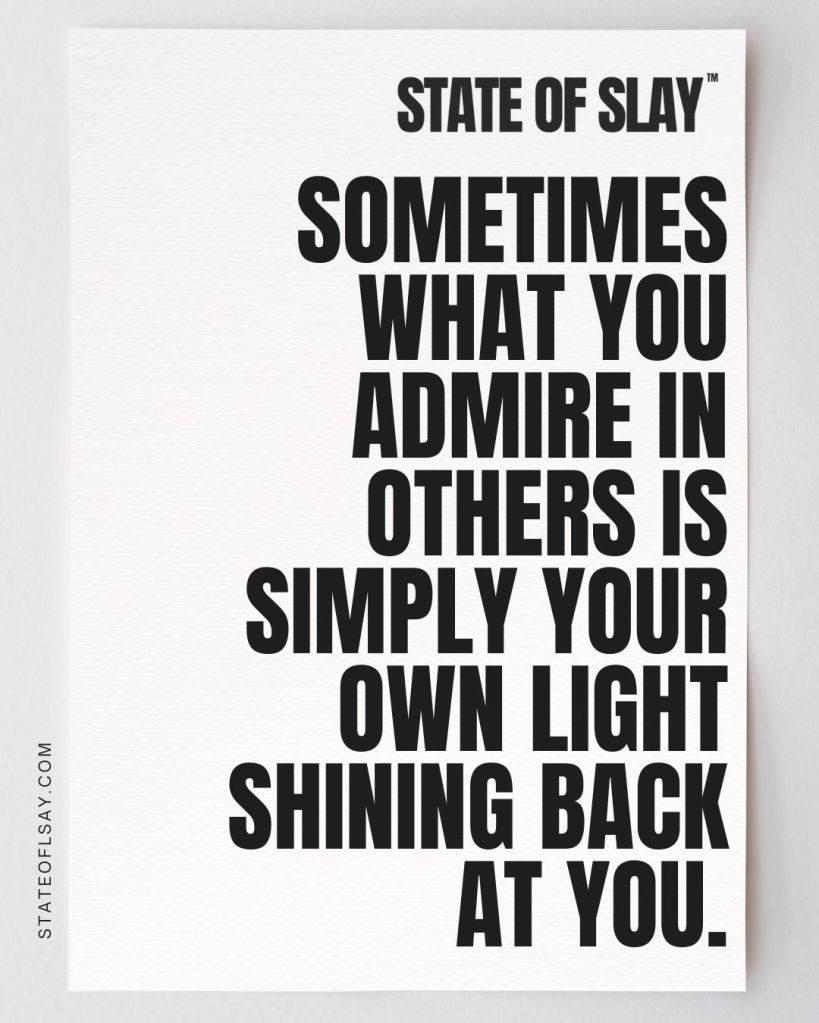
What we admire in others is often a mirror of what already lives within us. The kindness, courage, or strength you notice in someone else doesn’t just exist outside of you—it resonates because it’s also part of you.
Too often, we downplay our own gifts while lifting others up. But the truth is, the qualities you celebrate in them are not foreign—they are familiar. They’re reminders of your own capacity, your own light, your own power shining back at you.
Instead of seeing yourself as “less than,” see the reflection for what it is: proof that you, too, carry that same brilliance.
This is your reminder that what you see in others is also alive in you.
Fear has a way of creeping in when the lights are out—both literally and metaphorically. When we’re uncertain, overwhelmed, or vulnerable, our minds can convince us that the shadows hold monsters. And when we avoid shining a light on those fears—when we stuff them down, pretend they don’t exist, or try to outrun them—they only grow bigger, louder, and harder to face.
The truth? Fear feeds on silence and secrecy. When we leave it unchecked, it multiplies in the darkness of our minds. But when we turn on the light—through awareness, honesty, and courage—fear begins to shrink.
So if you think there’s a boogeyman around, it’s time to stop hiding under the covers. Flip the switch. Call it out. See it for what it is.
Darkness Is the Breeding Ground for Fear
Think about the last time you were afraid of something—really afraid. Chances are, it wasn’t the thing itself that scared you most. It was not knowing.
Not knowing what someone thought of you. Not knowing how a situation would turn out. Not knowing if you could survive the pain you were in.
The unknown is where fear lives. And the more we let our imagination run wild in that dark space, the more terrifying the “boogeyman” becomes.
But here’s the thing: most fears, when brought into the light, lose their power. Naming your fear is the first step in shrinking it. It’s not the monster under the bed—it’s your anxiety about failing, being rejected, or not being enough. Once you see it clearly, you can deal with it.
Shine the Light of Truth
When we start to shine a light on fear, it doesn’t mean the fear disappears overnight. But it does mean we stop letting it run the show.
For me, facing my fears meant getting rigorously honest with myself. I had to admit where I was scared and why. Sometimes it was rooted in old wounds or trauma. Sometimes it was tied to lies I had told myself for years. And sometimes, it was just the unknown of stepping into a new chapter.
The more light I brought in—the more I talked about my fears, wrote about them, or even prayed about them—the less they controlled me.
Fear thrives in the dark. Truth thrives in the light.
The Boogeyman Is Rarely What You Think
Most of the time, the “boogeyman” isn’t nearly as scary as we’ve built it up to be.
Maybe the conversation you’ve been avoiding brings clarity instead of rejection. Maybe the risk you’ve been afraid to take opens a door you never thought possible. Maybe the pain you’re carrying becomes lighter when you finally share it.
Fear wants you to stay in the dark. But your healing requires the light.
Flip the Switch
So how do you “turn on the light” when fear is looming?
Name it. Write down exactly what you’re afraid of. No filters.
Share it. Talk to someone you trust. Speaking fear out loud weakens it.
Challenge it. Ask yourself: is this fear based in fact, or in old stories?
Take one small action. Even the smallest step forward shines light into the dark.
The boogeyman can’t survive in the light.
So next time you feel fear creeping in, don’t stay stuck in the dark. Reach for the switch. Bring it into the open. Remind yourself: you are braver than the shadows.
SLAY Reflection
What fear have you been keeping in the dark?
How does avoiding it give it more power?
What would shining a light on it look like for you?
Can you trace your fear back to old wounds or beliefs?
What’s one small action you can take today to face it?
S – Stop letting fear grow in silence L – Let the light of truth guide you A – Acknowledge your fears instead of hiding them Y – Yield to courage, not the shadows
Call to Action: Join the Conversation
I’d love to hear from you. What fear did you finally bring into the light—and how did it change things for you? Share your story in the comments. Let’s cheer each other on.
And if you know someone who’s hiding from their “boogeyman,” send this to them. Sometimes, all we need is a light to remind us we’re not alone.
The journey no one clapped for created the moment they celebrate
It’s easy to admire someone’s success without ever seeing the struggles that built it. People will clap for the glow, but they rarely acknowledge the fire it came from.
Behind every highlight is a hard-fought story—quiet battles, sleepless nights, doubts you had to silence, and resilience you had to grow. The truth is, the spotlight only shows the ending; it doesn’t reveal the shadows you walked through to get there.
Your journey matters, even if no one sees it. Every step, every scar, every setback you’ve overcome is part of the strength that makes your light shine.
This is your reminder to honor the path as much as the outcome.
We don’t always get to choose who comes into our lives—or how long they stay. Some people walk with us for a lifetime, others for only a season. And while temporary people may leave as quickly as they came, their impact often lingers.
Sometimes it’s beautiful. Sometimes it’s heartbreaking. But always—it’s instructive.
Because even the ones who don’t stay teach us something we carry forward. Temporary people leave permanent lessons.
Prefer to listen? The Audio Blog version is available here.
The Pain of Goodbyes and the Gift They Leave Behind
When someone exits your life, it can feel like rejection, abandonment, or loss. You may replay every moment, wondering what you could have done differently to make them stay. But here’s the truth: their leaving isn’t always about you.
Temporary people teach us boundaries. They teach us what we will and will not accept. They teach us value. Sometimes by showing us what we deserve—and sometimes by showing us what we don’t.
Not all lessons are gentle. But every lesson has purpose.
What Temporary People Reflect Back to Us
Every person who crosses our path acts as a mirror. Some reflect our best qualities back at us—reminding us of the love, kindness, or courage we already hold. Others reflect the wounds we still carry, highlighting the work that’s left undone.
If you’ve ever noticed how one relationship reveals your need for boundaries, while another pushes you toward forgiveness, that’s no accident. Temporary people show us where we’re growing, and where we’re still stuck.
Even the ones who hurt us—sometimes especially the ones who hurt us—end up guiding us toward our truth.
Not Everyone Is Meant to Stay
We live in a culture that glorifies “forever.” Forever friends. Forever love. Forever loyalty. But life doesn’t always work that way.
The truth is, some people are only meant to walk us part of the way. They show up for a chapter, not the whole book. And that’s okay.
Because their role is not to stay—it’s to move us forward. To give us the lesson, the shift, the wake-up call we couldn’t have gotten any other way.
When we cling to people who were only meant to be temporary, we rob ourselves of the lesson. When we let them go with gratitude, we keep the gift they came to bring.
Choosing Growth Over Grief
It’s natural to grieve when someone leaves. But we don’t have to get stuck in the story of what “could have been.”
Instead, we can ask: What did I learn from this connection? How did this person shift me? What strength did I discover because of them?
Sometimes the hardest people to release leave behind the clearest lessons. They teach us self-respect. They teach us resilience. They teach us that we can survive the leaving—and even thrive after it.
You may not have chosen their exit, but you can choose what you carry forward.
SLAY Reflection
Who in your past was only meant to be temporary, but taught you something lasting?
What lesson are you still carrying from a relationship that didn’t last?
Do you find yourself holding on to people who were never meant to stay? Why?
How does it feel to shift from grief to gratitude when you think of temporary people?
What permanent strength or wisdom do you have today because someone left?
S – See the role they played in your growth L – Let go of what wasn’t meant to last A – Acknowledge the lessons they gave you Y – Yield to gratitude instead of grief
Call to Action: Join the Conversation
I’d love to hear from you. Who was a “temporary person” in your life, and what permanent lesson did they leave behind? Share your story in the comments. Let’s cheer each other on.
And if you know someone struggling to let go of someone who was never meant to stay, send this to them. Sometimes, all we need is a reminder that even endings carry gifts.
Stop pouring into empty cups—it’s time to honor your own.
We teach people how to treat us by what we allow, what we stop, and what we walk away from. If you keep making others a priority while they treat you as an afterthought, you’re not being kind—you’re abandoning yourself.The truth is, you don’t need to beg for a seat at a table where you’re only ever offered crumbs. You deserve to sit where your presence is seen, valued, and celebrated.
This isn’t about becoming hard or unkind. It’s about protecting your energy and making room for relationships that meet you with the same care you give so freely.
This is your reminder to stop pouring into places that never pour back.
Don’t give priority where you’re treated as an option.
Empathy is a beautiful gift—it allows us to connect, understand, and hold space for others in ways that make them feel seen and valued. But here’s the hard truth: without boundaries, empathy becomes a weapon turned inward. Instead of healing, it harms. Instead of connecting, it consumes.
Many of us who identify as “empaths” or deeply compassionate people have learned the hard way that pouring ourselves out for everyone else often leaves us running on empty. When we absorb other people’s pain without limit, when we rescue at our own expense, or when we carry burdens that don’t belong to us, we aren’t practicing empathy—we’re practicing self-destruction.
True empathy isn’t about losing yourself in someone else’s storm. It’s about holding space with compassion while knowing where you end and they begin. Boundaries are not walls; they are bridges of clarity that keep you safe while still allowing you to show up with love.
When Empathy Crosses the Line
It starts subtly. You say “yes” when you want to say “no.” You listen to someone’s problems at 2 a.m., even though you have to be up early for work. You absorb the emotions in a room until they feel like your own. And before long, your identity is tangled in other people’s struggles.
This isn’t empathy—it’s overextension. And over time, it erodes your mental health, your relationships, and your sense of self. Without boundaries, empathy mutates into people-pleasing, codependency, and burnout. It may look like kindness, but underneath it’s exhaustion and resentment.
Why Boundaries Save Empathy
Boundaries don’t make you less compassionate—they make your compassion sustainable. They protect your inner world so you can continue to give without losing yourself in the process.
Think of it this way: your empathy is a flame. Without boundaries, that flame burns everything in sight—including you. With boundaries, it becomes a steady light that warms without destroying.
When you set limits—saying no when you need to, protecting your energy, and remembering that someone else’s healing is not your responsibility—you create space for empathy that is genuine, not sacrificial.
My Own Turning Point
For years, I believed that to love meant to absorb. If someone was hurting, I carried it like it was my own. If someone was angry, I tried to fix it. If someone needed rescuing, I was already running into the fire.
But I learned the hard way that empathy without boundaries isn’t noble—it’s self-neglect. I was burning out, resentful, and wondering why I always felt unseen when I gave so much. The truth was, I wasn’t giving from love. I was giving from fear: fear of disappointing others, fear of being unlikable, fear of being seen as selfish.
When I finally learned that empathy needed boundaries, everything changed. I could still care, still show up, still love deeply—but without sacrificing my own well-being. I realized that the most powerful act of empathy sometimes is saying: “I love you, but that’s yours to carry, not mine.”
Choosing Sustainable Love
Empathy should not be self-destruction dressed up as kindness. Empathy with boundaries is love that endures—not just for others, but for yourself.
Boundaries aren’t cold, cruel, or selfish. They’re an act of love. They say: I care enough about myself to stay whole, and I care enough about you to show up from that wholeness instead of from depletion.
Remember, you can’t pour from an empty cup. Protect your flame, and your empathy will continue to shine without burning you out.
SLAY Reflection
Take a moment to pause and reflect:
S – Stop: When was the last time your empathy drained you instead of uplifted you?
L – Look: Do you confuse empathy with rescuing, fixing, or absorbing other people’s pain?
A – Ask: What boundaries do you need to put in place so your empathy feels safe and sustainable?
Y – Yield: How can you release the responsibility for someone else’s emotions and return to your own?
Call to Action: Join the Conversation
I’d love to hear from you. Have you ever confused empathy with self-sacrifice? What boundary could you set today that would protect your compassion without draining your energy? Share your story in the comments. Let’s cheer each other on.
And if you know someone who is burning themselves out by carrying everyone else’s pain, send this to them. Sometimes, all we need is a nudge.
We often clutch what was never meant for us—regrets, expectations, the heavy burdens of things we can’t control. Our minds replay them, our hearts ache with them, and we end up carrying weight that was never ours to hold. True strength is not in forcing yourself to bear it but in recognizing when to set it down. Release is not weakness—it’s freedom.
This is your reminder to… Choose peace over pressure. Your heart deserves rest, not heaviness.
There’s a particular kind of pain that comes when someone you believed in—someone you trusted—decides you’re no longer worth the effort. It might be a partner, a friend, a family member, or even an employer.
Sometimes they drift away quietly. Sometimes they slam the door. And sometimes, they make sure you hear exactly why you didn’t make the cut.
It’s human to internalize those moments. To question what’s wrong with you. To wonder if they saw something you didn’t. But here’s the truth—their decision to give up on you is about them, not you.
Prefer to listen? The Audio Blog version is available here.
Their Choice Is Not Your Worth
When someone gives up on you, it’s easy to translate that into, “I’m not enough.” But what they’re really saying is, “I’m not willing, able, or ready to invest in this anymore.”
That’s not the same thing as saying you have no value.
We often assume that other people’s actions are direct reflections of who we are. But in reality, they’re reflections of their capacity, their priorities, their fears, and their choices. Someone’s inability or unwillingness to see your worth does not erase your worth.
When we take someone else’s abandonment as proof that we should abandon ourselves, we hand over our power. And once that happens, their absence gets to dictate the rest of our story.
You don’t owe them that power.
Self-Trust Is Your Lifeline
When the dust settles, what you’re left with is you. And that’s where the real work begins.
Self-trust isn’t built in grand declarations—it’s built in small, consistent acts of showing up for yourself. It’s saying, “I still choose me, even when they didn’t.”
Here’s the thing: if you keep believing in yourself, you always have another chapter to write.
Yes, it hurts when someone walks away. But you’re still standing. You still have dreams, talents, and the ability to create a life you love. You still have the capacity to love yourself fiercely, even if others failed to.
The most powerful way to respond when someone gives up on you is to prove—to yourself—that you never will.
Let Their Exit Teach You, Not Break You
People leaving can be clarifying. Painful? Absolutely. But clarifying.
When someone exits your life, you get the chance to ask:
Was I shrinking myself to keep them close?
Did I rely on their validation more than my own?
Was I ignoring red flags because I didn’t want to lose them?
The end of a relationship, friendship, or opportunity can feel like a collapse—but it can also be a clearing. A chance to rebuild in a way that’s more aligned with who you are now.
Sometimes someone’s departure forces you to look at your own patterns, boundaries, and needs in a way you never would have otherwise.
If you use the pain as data, it can actually serve you.
Your Story Isn’t Over Because They Left
It’s tempting to see someone’s departure as the end of something essential—as if the part of you that existed with them can’t survive without them. But your life is bigger than their role in it.
Think of the people you haven’t even met yet. The experiences you haven’t had. The opportunities that wouldn’t have been possible if you stayed where you were.
The world is full of people who will believe in you. People who will stand beside you, support you, and challenge you to grow—not shrink.
But the most important believer you’ll ever have is the one staring back at you in the mirror.
Refuse to Abandon Yourself
Here’s the bottom line:
Someone else’s choice to walk away does not define you.
You are allowed to grieve, but you are not required to quit on yourself.
You can acknowledge the hurt without adopting it as your identity.
The real loss would be if you decided their decision was the final say in your worth.
Keep showing up. Keep writing your story. Keep choosing you—over and over again.
Because the day you give up on yourself is the day you stop being open to the possibilities that are still ahead.
And trust me… there are so many.
SLAY Reflection
Who in your life has walked away, and how did it impact your self-belief?
In what ways have you relied on others for validation?
How can you build more self-trust right now?
What lesson did you learn from someone leaving your life?
What’s one action you can take this week to invest in yourself?
S – Stand in your worth, even when others don’t L – Let go of those who cannot meet you where you are A – Affirm your value daily, without waiting for outside approval Y – Yield to growth, even when it comes through loss
Call to Action: Join the Conversation
I’d love to hear from you. When someone gave up on you, what did you do to keep believing in yourself? Share your story in the comments. Let’s cheer each other on.
And if you know someone who’s questioning their worth because someone walked away, send this to them. Sometimes, all we need is a nudge.