Slay Say

What Silence Reveals

When someone stops showing up,
you don’t need to chase explanations.

Their absence already speaks the truth—
about effort, about care, about connection.

Closure isn’t always a conversation.
Sometimes it’s the quiet realization
that you no longer need to wait for what isn’t arriving.

This is your reminder to take people at their actions,
not their intentions.

Slay On!

Slay Say

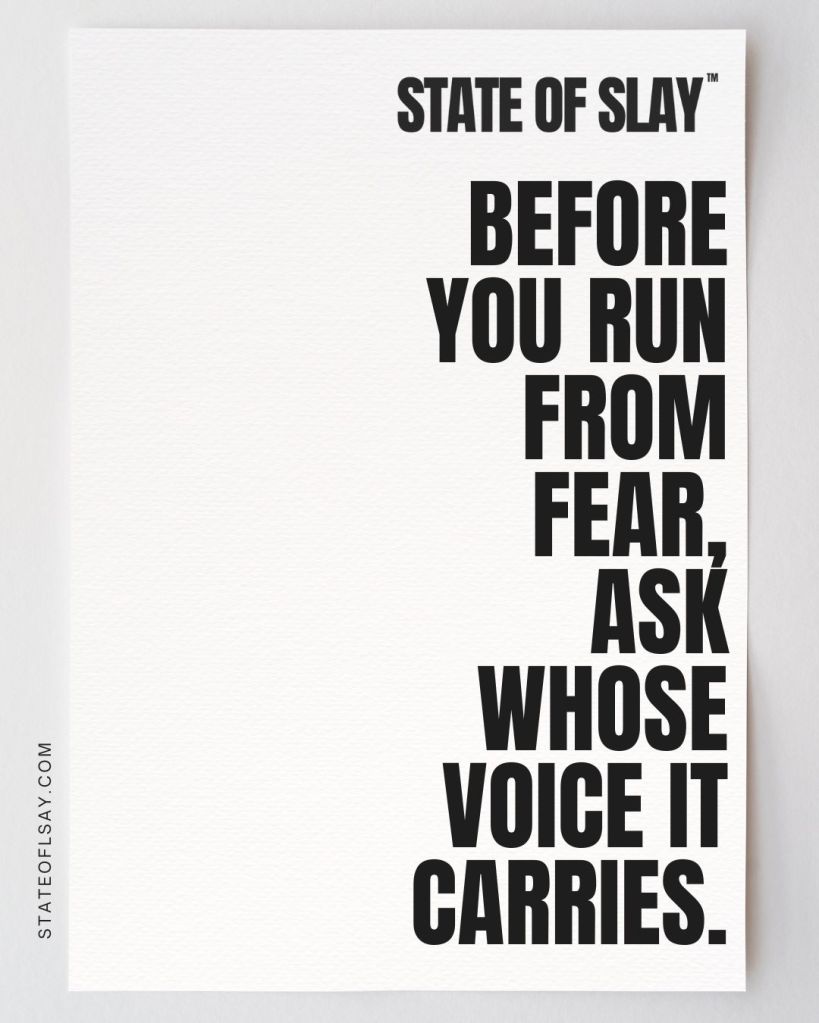
The Echo of Fear

Not every fear belongs to this moment.

Some are inherited through old pain—
the kind that lingers long after the wound has healed.
They whisper familiar stories,
convincing you you’re in danger when you’re simply remembering.

Growth asks for discernment.
To pause before reacting.
To recognize when your heart is protecting you from ghosts instead of threats.

This is your reminder to breathe before you run—
to listen long enough to know if what you’re hearing
is truth… or just an echo.

Slay On!

Pursue Yourself and the Path Will Appear

If you’ve ever felt lost, stuck, or unsure of what direction to take in life—you’re not alone. There are moments when the map feels blank, when every option looks uncertain, and when “figuring it out” feels impossible.

But here’s the truth: you don’t have to know your destination to start moving forward.

When you pursue yourself—your healing, your peace, your growth—the path meant for you begins to reveal itself.


You Are the Compass

So many of us chase what we think will make us happy: success, validation, love, security. We look for purpose in jobs, people, or achievements, hoping something external will give us direction.

But purpose doesn’t exist out there. It begins within.

When you take the time to know yourself—to really listen, explore, and nurture who you are—you start to see what lights you up, what drains you, and what truly feels aligned.

That awareness is your internal compass. The more you pursue yourself, the clearer your direction becomes.

You can’t follow the wrong path if you’re following your truth.


Stop Searching, Start Becoming

When you stop frantically searching for the next step and start becoming the person you’re meant to be, your life naturally begins to align.

Every lesson, loss, and detour starts to make sense. The puzzle pieces of your story start fitting together—not because you forced them, but because you became ready for them.

You don’t need to chase opportunities when you become the kind of person who attracts them.

You don’t need to beg for love when you embody the kind of love that draws it in.

And you don’t need to have every answer when you’re living as the most authentic version of yourself.


The Power of Stillness

Sometimes the reason we can’t find our path is because we’re too busy running. We fill our calendars, our minds, and our hearts with noise—hoping to outrun uncertainty.

But clarity comes in stillness.

When you pause long enough to hear your own thoughts, you’ll discover that your intuition has been whispering the answers all along.

What if the purpose you’ve been searching for has been waiting for you to slow down and listen?


Be Patient with Becoming

Growth doesn’t follow a timeline. It doesn’t unfold on demand. It happens quietly, in the background, while you’re learning, falling, healing, and trying again.

When you invest in knowing yourself—through journaling, therapy, reflection, or prayer—you begin to uncover the layers of who you are beneath the expectations and fears.

And one day, you’ll look back and realize: you’ve been walking your path all along.

You didn’t find it.
You became it.


SLAY Reflection

  1. Where in your life do you feel lost or unsure right now?
  2. How often do you pause to ask yourself what you really want—not what’s expected of you?
  3. What parts of yourself have you been neglecting while searching for purpose?
  4. What does pursuing yourself look like in this season of your life?
  5. How might the right path reveal itself if you stop forcing and start trusting?

S – Slow down enough to hear your inner voice
L – Let go of the need to know every step ahead
A – Align with what feels true to you right now
Y – Yield to your own evolution and trust the journey


Call to Action: Join the Conversation

I’d love to hear from you.
What shifted when you stopped chasing and started pursuing yourself?
Share your story in the comments. Let’s cheer each other on.

And if you know someone who feels lost or uncertain about their direction, send this to them.
Sometimes, all we need is permission to slow down and listen.

Tell Your Brain the Kind of Day You’re Going to Have

Have you ever noticed how your mornings set the tone for everything that follows? The moment you wake up, before your feet even hit the floor, your brain is already scanning for cues about what kind of day it’s going to be. And here’s the truth: what you tell your brain, your brain will look for.

That means if you wake up thinking, Ugh, this is going to be a hard day, your brain will search for every piece of evidence to confirm it. If you start the day with, I’m choosing peace today, your brain will find moments to validate that choice.

Your mindset is like a compass—point it in one direction, and your day will naturally start aligning with it. The question is, are you pointing it toward chaos or calm? Toward frustration or gratitude? Toward fear or courage?


Your Brain Believes What You Feed It

Here’s what’s fascinating: our brains are designed with something called the reticular activating system (RAS). It acts like a filter, deciding what gets your attention. When you tell your brain to focus on something—whether consciously or unconsciously—it scans your environment to find it.

Think of it like when you buy a new car, and suddenly you start seeing that same make and model everywhere. It’s not that the cars weren’t there before—it’s that your brain is now wired to notice them.

Your thoughts work the same way.

If you tell yourself, This meeting is going to be a disaster, your brain will notice every sigh, every side-eye, and every awkward silence. If you tell yourself, I can handle this with grace, your brain will pick up on the support, the nods, the opportunities to speak with confidence.

This is why starting your day with intentional thoughts is so powerful. Your brain is always listening.


The Power of Morning Scripts

The way you script your morning can shift everything. Here are some examples:

  • Instead of: Today’s going to be so stressful.
    Try: Today I’m choosing peace, no matter what comes my way.
  • Instead of: I’m so tired, this day is going to drag.
    Try: I have enough energy to handle what matters most today.
  • Instead of: Nobody respects me at work.
    Try: I respect myself, and I show up in a way that earns respect.

These aren’t empty affirmations. They are instructions for your brain. And when your brain has instructions, it follows them.


Frustration, Stress, and the Choice We Overlook

Life is going to throw things at you—that’s not optional. Someone cuts you off in traffic, a coworker sends a passive-aggressive email, your plans get derailed.

But here’s the key: those external things don’t decide the quality of your day. You do.

The outside world can invite you to be upset, but you are the one who accepts or declines that invitation.

When you catch yourself spiraling into negativity, pause and ask:
What did I just tell my brain about this moment? Did I tell it to look for the worst, or did I give it something else to notice?

It’s in those pauses that power lives.


Rewiring Takes Practice

If you’ve spent years waking up dreading the day or rehearsing worst-case scenarios, it’s going to take practice to redirect that thought pattern. And that’s okay.

Every time you catch yourself choosing the old script—This is going to be awful—and instead replace it with a new one—I’ve handled worse, and I will handle this too—you are literally rewiring your brain.

The more you do it, the easier it gets. Eventually, your default setting changes. Instead of your brain scanning for stress, it starts scanning for strength. Instead of looking for failure, it starts looking for possibility.


Tell Your Brain Where to Go

Think of your brain like a GPS. If you program it with the wrong address, you’ll end up somewhere you don’t want to be. But when you give it the right directions, it will get you closer to where you want to go.

So before you argue with someone, before you step into that meeting, before you check your email—set the address.

Tell your brain:

  • I’m going to stay calm.
  • I’m going to choose compassion.
  • I’m going to focus on solutions, not problems.

And watch how your day reroutes to align with it.


SLAY Reflection

  1. What’s the first thought you usually have when you wake up? Does it serve you or sabotage you?
  2. How often do you give your brain negative instructions without realizing it?
  3. What would it feel like to intentionally start your day with a thought that empowers you?
  4. When was the last time you caught yourself spiraling, and what did you do to redirect it?
  5. What’s one phrase you can start telling yourself tomorrow morning to shift your entire day?

S – Script your mornings with intentional thoughts
L – Let your brain look for evidence that supports your peace
A – Align your mindset with the day you want to create
Y – Yield to positivity and refuse to accept the invitation to chaos


Call to Action: Join the Conversation

I’d love to hear from you.
What’s the phrase you tell yourself that shifts the entire direction of your day?
Share your story in the comments. Let’s cheer each other on.

And if you know someone who’s stuck in negative loops, send this to them.
Sometimes, all we need is a reminder that our brains believe what we tell them.

Frustration Is an Invitation You Don’t Have to Accept

We all know the feeling—traffic that doesn’t move, a conversation that goes sideways, a plan that unravels in real time. Frustration builds, and before you know it, you’re simmering in anger, irritation, or resentment.

But here’s the truth that changed everything for me: frustration is always self-induced.

The outside world can invite us to be upset, yes—but we are the ones who accept the invitation.

When I first heard this idea, I bristled. Surely the rude driver, the unfair boss, the inattentive friend—they were the source of my frustration. But as I dug deeper, I realized the common denominator in every moment of anger was me. I was the one choosing to hold onto the irritation, the one letting it hijack my energy, the one letting the external world dictate my internal peace.

And that was the moment I understood: I can’t always control what happens, but I can always control whether or not I RSVP to frustration’s invitation.


The Hidden Cost of Accepting the Invitation

Frustration feels powerful in the moment. It gives us something to cling to, a sense of being “right,” or even righteous. But that power is fleeting, and the cost is high.

Every time we accept frustration’s invitation, we:

  • Drain our energy on things that don’t serve us.
  • Poison our mood, often for hours or days after the fact.
  • Damage relationships by reacting instead of responding.
  • Distract ourselves from solutions by obsessing over problems.

When I look back at my own life, I see how many days I lost this way—days spent stewing instead of living, days consumed by anger that did nothing but make me miserable. And all of it was preventable.

The truth? Frustration doesn’t come from what happened. It comes from the story we tell ourselves about what happened.


Pause Before You RSVP

The good news is that frustration is optional. Just because you’re invited doesn’t mean you have to attend.

Here’s what I practice today:

  1. Notice the rise. That heat in my chest, that quickening of my thoughts—I know frustration is knocking.
  2. Ask: Is this worth my peace? Nine times out of ten, the answer is no.
  3. Choose my response. Instead of spiraling, I take a breath. Sometimes I literally step away. Sometimes I laugh at how small the trigger really is. Sometimes I pray.
  4. Reframe. Instead of “Why is this happening to me?” I ask, “What is this showing me?” That shift turns frustration into information.

When I don’t RSVP to the invitation, I keep my power. I keep my peace. And I remember: the world doesn’t get to run my emotions—I do.


Frustration Reveals What We Value

Here’s the part most people miss: frustration isn’t all bad. It’s actually a teacher, if we’re willing to listen.

Frustration shows us what matters to us, what we expect, what boundaries may need adjusting. For example:

  • If traffic frustrates me, maybe it’s not about the cars—it’s about my lack of preparation or my need for control.
  • If someone interrupts me and I feel rage, maybe it’s pointing me to a wound around not feeling heard.
  • If I’m furious that a plan changed, maybe it’s about my deeper need for certainty and security.

When I stop blaming the outside world and start looking inward, frustration becomes less of a punishment and more of a flashlight.

It shines a light on the gap between my expectations and reality—and that’s where my work begins.


Choosing Peace Over Frustration

It’s not about denying your feelings. It’s about remembering that frustration is optional. You always have another choice:

  • You can let go. Not everything deserves a reaction.
  • You can laugh. Humor disarms frustration in a heartbeat.
  • You can learn. Ask what this moment is teaching you.
  • You can move on. Protect your energy by refusing to give it away.

When I practice this, I notice how much lighter my days feel. I have more energy for the things that actually matter. And maybe most importantly, I stop letting other people’s behavior write the story of my day.

Because at the end of the day, frustration is a story. And you get to decide whether or not you keep telling it.


Frustration Will Knock Again—Be Ready

Don’t get me wrong—I still get frustrated. I’m human. But now, instead of automatically reacting, I pause and ask myself:

Am I about to accept an invitation to frustration? Or am I going to choose peace instead?

That moment of awareness has changed my life. It’s not always easy, but it’s always worth it.

Frustration may knock, but peace is the one I let in.


SLAY Reflection

  1. What situations frustrate you most often?
  2. What expectations lie beneath that frustration?
  3. Can you trace your frustration back to an old story, wound, or belief?
  4. How does your day feel different when you choose not to engage with frustration?
  5. What’s one way you can practice pausing before accepting frustration’s “invitation” this week?

S – Stop and notice when frustration rises
L – Let go of the need to control what you can’t
A – Align your response with peace, not anger
Y – Yield to wisdom, not to the story frustration tells


Call to Action: Join the Conversation

I’d love to hear from you.
What’s one frustration you’ve learned to stop accepting—and how did it free you?
Share your story in the comments. Let’s cheer each other on.

And if you know someone who feels constantly hijacked by frustration, send this to them.
Sometimes, all we need is a reminder that peace is always a choice.

Love on a Leash

There’s a kind of love that doesn’t feel like love at all. It looks the part—smiles, sweet words, even grand gestures—but underneath, it’s tethered to expectations, rules, and unspoken conditions. It’s love, but only if. That’s love on a leash.

Love on a leash says: “I’ll love you if you behave a certain way.” Or worse, “I’ll love you when you’re less of this and more of that.” Sometimes, the leash comes from others. But just as often? We hold the leash ourselves.

We believe we must be a specific version of ourselves to be lovable. We shrink. We twist. We contort our identities to avoid rejection, or worse—abandonment. We believe we’re only worthy of love if we’re easy to handle, always agreeable, or constantly achieving.

And over time? That leash tightens. We stop reaching. We stop expressing. We stop showing up as who we really are.


I Know That Leash All Too Well

I’ve felt it—the pull of wanting to be loved so badly that I’d trade my truth for someone else’s comfort. The tension of walking on eggshells just to keep the peace. The guilt that rises when I try to set a boundary, even a healthy one, because I fear I’ll lose the connection if I do.

But here’s what I’ve learned:

Any love that demands you abandon yourself isn’t love. It’s control.

Love shouldn’t feel like a leash. It should feel like a safe place to land.


Real Love Doesn’t Require a Performance

Authentic love sees the real you. It invites all your parts—your fire and your softness, your growth and your mess. It doesn’t flinch at your vulnerability. It honors it.

And the same goes for how we love ourselves.

When we hold ourselves to impossible standards, we put our own hearts on a leash. We tell ourselves we’ll be worthy when we’re thinner, calmer, more successful, more perfect.

But we’re worthy now. We’ve always been.

You don’t have to earn love by becoming someone else. You get to be loved for who you are.


Releasing the Leash

Letting go of love with conditions means facing our fears. It means risking disapproval. It means standing in our truth, even if someone walks away.

But it also means freedom.

It means deeper connection, greater peace, and the kind of joy that only comes from being fully known and still fully accepted.

It starts with you. How you love yourself. How you speak to yourself. What you tolerate—from others and from your own inner voice.

And maybe most importantly? It starts with the unlearning of what love was never supposed to be.

You don’t have to stay tethered. The leash can come off.

And when it does?

You’ll remember: real love doesn’t confine—it expands.


SLAY Reflection

Ask yourself:

  • Have you ever felt like love came with conditions?
  • Who’s holding the leash—someone else, or you?
  • What stories about love and worth are you still carrying?
  • How can you begin showing yourself more unconditional acceptance?
  • What kind of love do you want to give—and receive—from this point forward?

S – L – A – Y

S: Spot the conditions—where do you feel limited in love? L: Let go of outdated beliefs about what makes you lovable.
A: Affirm your worth without needing to prove it.
Y: Yield to relationships that offer real connection—not just compliance.


Call to Action: Join the Conversation
I’d love to hear from you.
Have you ever experienced love on a leash—and what helped you take it off?
Share your story in the comments. Let’s cheer each other on.

And if you know someone who’s struggling to feel seen for who they truly are, send this to them.
Sometimes, all we need is a nudge.

Slay Say

Letting Go to Let Yourself In

It’s easy to carry the weight of old stories, the ones that say you can’t, or you’re not enough.
But today, release those stories.

Clear the space for your truth, for the voice that’s been waiting to be heard.
When you let go of what no longer serves you, you make room for what’s real, what’s possible.

This is a reminder to free yourself from the chains of yesterday and step into your truth.

Your truth is waiting.

SLAY ON.

Release the weight of old stories and embrace your truth. Let go of the beliefs and narratives that no longer serve you, and create space for a life rooted in authenticity. This is a reminder to take one small step today toward letting go, and give yourself permission to live fully in your truth.

Slay Say

Stop Seeking Healing from the Hurt

True healing doesn’t come from the people who caused the pain.

It comes when you stop looking for closure, validation, or understanding from those who never had the capacity to give it.

Let this be a reminder to reclaim your power—and choose peace on your own terms.

Today I Will Not Stress Over Things I Cannot Control

Easier said than done, right?
Especially now.
It feels like everything—from the world at large to our daily lives—is spiraling beyond our control.

And it’s true: most of life really is outside of our hands.
No matter how hard we try to will something into existence or change an outcome, some things just are.
But here’s the truth I’ve come to live by:
I may not be able to control what happens around me—but I can control how I respond to it.
And that’s where the power is.


The Illusion of Control

When I was living in the dark, I was consumed by control.
Trying to manage everything and everyone.
Manipulating, bargaining, obsessing—believing that if I could just control the situation, I could finally feel safe.

But no matter how hard I tried, life had other plans.
It didn’t care how hard I worked to bend it to my will.
And I exhausted myself trying.

The more I tried to control, the more unmanageable everything became.
It didn’t just wear me out—it wore me down.
My mental health suffered.
My self-worth took a hit.
And I lost myself in the process.


Letting Go Was the Turning Point

When I finally made the decision to change my life, I was told something that made me flinch:
You have to accept that you can’t control everything.”

That one sentence lit up every fear I had.
I didn’t want to hear it.
But I needed to.

Because as terrifying as letting go felt, holding on was doing more damage.

So I started small.
I worked on myself.
I practiced gratitude.
I focused on the good.
And I gave back where I could.

Slowly, the need to control started to loosen its grip.
And I began to feel something I hadn’t felt in a long time: peace.


The Freedom in Acceptance

Letting go doesn’t mean giving up.
It means accepting reality as it is—and choosing to move forward anyway.
It means doing what you can, where you are, with what you have.

It means focusing on your choices, your behavior, your energy—not the chaos around you.

And when you feel that old need for control creeping in?
Put the focus back on yourself.
Or do something kind for someone else.
It’s a powerful reset.

Because the truth is, trying to control what’s out of your hands only ends up controlling you.


What I Can Do Today

There are still plenty of things I can’t control—and many of them deeply disturb me.
But I’ve learned that obsessing over what I can’t change doesn’t help.

What does help?
Doing what I can.

I show up for myself.
I show up for others.
I make better choices.
And I leave the rest.

Because acceptance isn’t giving up—it’s breaking free.


SLAY Reflection: Where Are You Holding On Too Tight?

  1. Do you stress over things that are out of your control?
    What are they—and how do they affect your peace?

  2. How has your need for control shaped your relationships, habits, or mental health?
    What patterns do you see?

  3. What’s one area of your life where you could let go a little more today?
    How would that feel?

  4. What are you really afraid of when you try to control everything?
    Is it fear of failure? Rejection? Uncertainty?

  5. What would shift if you focused on your response, rather than the outcome?
    Where can you put your energy to use in a healthier way?


Call to Action: Join the Conversation

I’d love to hear from you.
What’s one thing you’re ready to stop stressing over because you’ve realized it’s out of your control?
Share your story in the comments. Let’s cheer each other on.

And if you know someone who’s stuck in the loop of control and frustration, send this to them.
Sometimes, all we need is a nudge.

Your Mind Replays What Your Heart Cannot Delete

We’ve all been there—tossing and turning, unable to fall asleep, replaying a conversation or event from the past. Wishing we had responded differently. Wondering why it still hurts. Telling ourselves to let it go—but we can’t.

Our mind replays what our heart hasn’t yet released.

It’s like our brain is trying to rewrite the story to heal us, but instead, the loop only deepens the ache. Until we learn to extract the lesson, offer ourselves grace, and let go of what we can’t change, we keep ourselves stuck in the pain of yesterday.


Before the Release: The Cycle of Replay

Before walking this path, I never let anything go.

I was a walking vessel of resentment. Conversations looped in my head for days, weeks—sometimes years. I’d even replay them out loud, alone in my room, beating myself up for not saying the “right” thing or for freezing in the moment.

The weight of those replays followed me into new relationships and opportunities like a ball and chain. Every fresh connection felt like a repeat of the old one. I filtered every interaction through the pain and fear I hadn’t dealt with. Eventually, I started to isolate—bitterly and often.

And yes, my heart hurt. A lot. But what I didn’t realize was that I was choosing to stay in that hurt every time I pressed play again.


Rewriting the Loop

It wasn’t until I began prioritizing my peace—my healing—that I realized how much control I had.

Letting go didn’t mean letting someone else off the hook. It meant letting me off the hook. No longer dragging around conversations that had already ended or wounds that no longer served me.

I began to ask: What can I take from this? What’s mine to own? And what do I need to release?

Sometimes, yes, the harm done wasn’t my fault. But the replay? That was on me.

By valuing my peace over my pain, I slowly turned the volume down on the noise—and finally found some quiet.


You Can Mute the Past

We may not be able to delete every painful moment from our hearts—but we can learn to mute the noise. To press stop on the loop. To extract the wisdom and throw out the rest.

Because the longer we replay what hurt us, the longer we stay hurt.

Let it teach you. Then let it go.

SLAY on.


SLAY Reflection: Are You Replaying or Releasing?

  • Do you find yourself mentally revisiting the same events or conversations? Why?
  • How does that impact your mood, energy, and relationships?
  • What would change if you gave yourself permission to let it go?
  • What can you learn from that moment instead of reliving it?
  • How might your life shift if you muted the loop—and chose peace instead?

Call to Action: Join the Conversation

I’d love to hear from you.
What’s one loop you’re ready to stop replaying—and what’s one way you’ll start letting it go?
Share your story in the comments. Let’s cheer each other on.

And if you know someone who’s stuck in replay mode, send this to them.
Sometimes, all we need is a new way to rewrite the story.