Slay Say

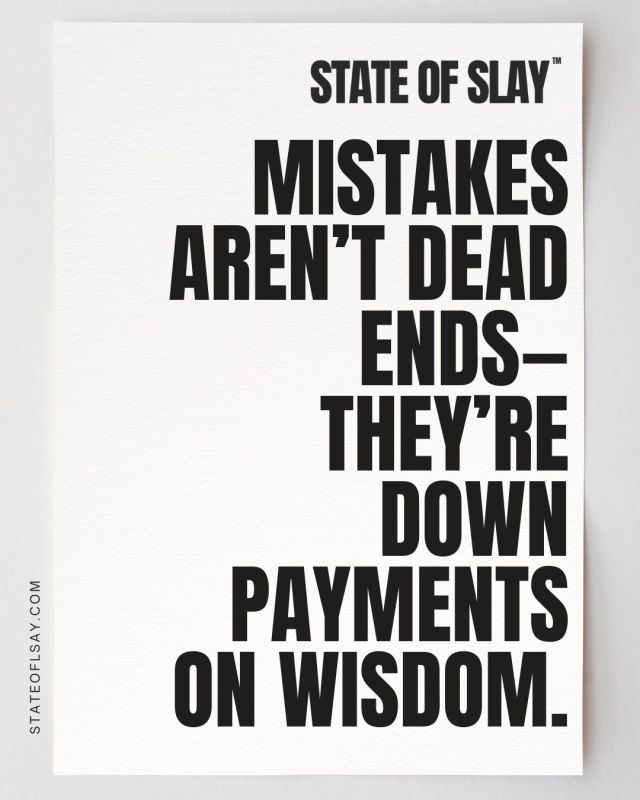
FALLING IS PART OF RISING

We often see failure as the enemy of success, when in reality, it’s the soil that growth springs from. Every mistake, stumble, or setback isn’t wasted—it plants something valuable inside you.

Those moments that feel like defeat are really shaping your resilience, sharpening your clarity, and preparing you for what comes next.

Instead of fearing failure, remember that it’s not the end of the journey. It’s simply one of the steps on the way up.

This is your reminder that setbacks are not roadblocks—they’re building blocks.

SLAY on!

Slay Say

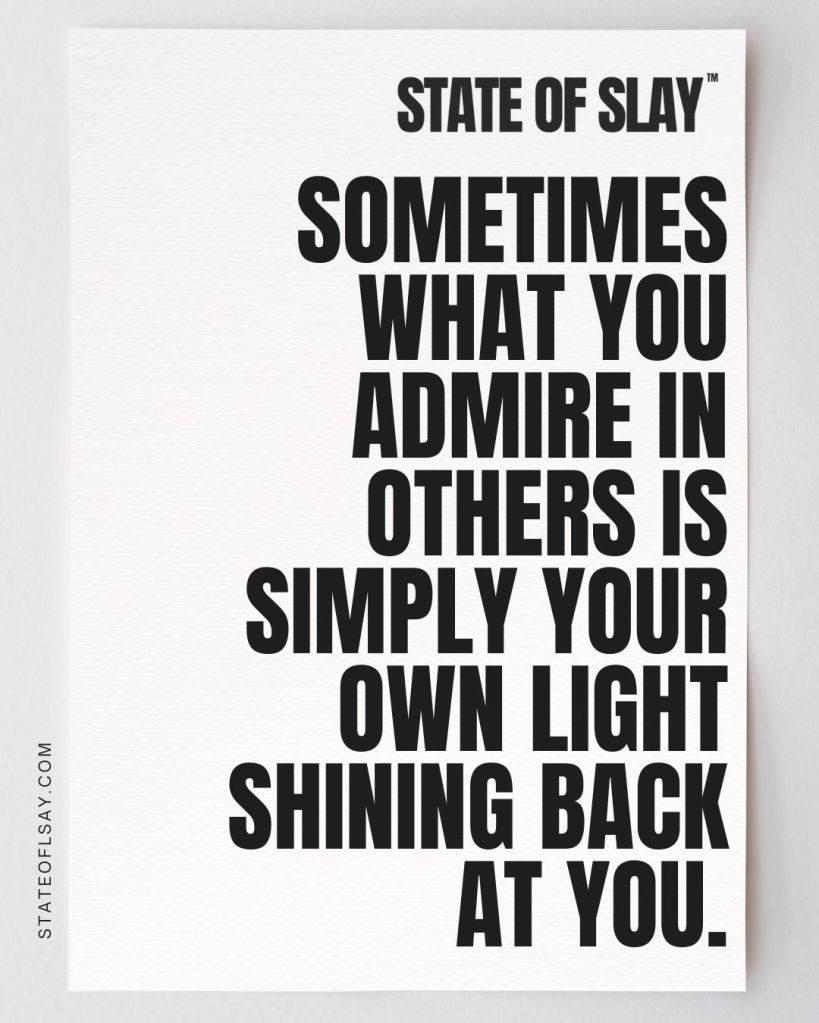
YOUR LIGHT REFLECTED

What we admire in others is often a mirror of what already lives within us. The kindness, courage, or strength you notice in someone else doesn’t just exist outside of you—it resonates because it’s also part of you.

Too often, we downplay our own gifts while lifting others up. But the truth is, the qualities you celebrate in them are not foreign—they are familiar. They’re reminders of your own capacity, your own light, your own power shining back at you.

Instead of seeing yourself as “less than,” see the reflection for what it is: proof that you, too, carry that same brilliance.

This is your reminder that what you see in others is also alive in you.

SLAY on!

The Boogeyman Only Lives in the Dark

Fear has a way of creeping in when the lights are out—both literally and metaphorically. When we’re uncertain, overwhelmed, or vulnerable, our minds can convince us that the shadows hold monsters. And when we avoid shining a light on those fears—when we stuff them down, pretend they don’t exist, or try to outrun them—they only grow bigger, louder, and harder to face.

The truth? Fear feeds on silence and secrecy. When we leave it unchecked, it multiplies in the darkness of our minds. But when we turn on the light—through awareness, honesty, and courage—fear begins to shrink.

So if you think there’s a boogeyman around, it’s time to stop hiding under the covers. Flip the switch. Call it out. See it for what it is.


Darkness Is the Breeding Ground for Fear

Think about the last time you were afraid of something—really afraid. Chances are, it wasn’t the thing itself that scared you most. It was not knowing.

Not knowing what someone thought of you.
Not knowing how a situation would turn out.
Not knowing if you could survive the pain you were in.

The unknown is where fear lives. And the more we let our imagination run wild in that dark space, the more terrifying the “boogeyman” becomes.

But here’s the thing: most fears, when brought into the light, lose their power. Naming your fear is the first step in shrinking it. It’s not the monster under the bed—it’s your anxiety about failing, being rejected, or not being enough. Once you see it clearly, you can deal with it.


Shine the Light of Truth

When we start to shine a light on fear, it doesn’t mean the fear disappears overnight. But it does mean we stop letting it run the show.

For me, facing my fears meant getting rigorously honest with myself. I had to admit where I was scared and why. Sometimes it was rooted in old wounds or trauma. Sometimes it was tied to lies I had told myself for years. And sometimes, it was just the unknown of stepping into a new chapter.

The more light I brought in—the more I talked about my fears, wrote about them, or even prayed about them—the less they controlled me.

Fear thrives in the dark. Truth thrives in the light.


The Boogeyman Is Rarely What You Think

Most of the time, the “boogeyman” isn’t nearly as scary as we’ve built it up to be.

Maybe the conversation you’ve been avoiding brings clarity instead of rejection.
Maybe the risk you’ve been afraid to take opens a door you never thought possible.
Maybe the pain you’re carrying becomes lighter when you finally share it.

Fear wants you to stay in the dark. But your healing requires the light.


Flip the Switch

So how do you “turn on the light” when fear is looming?

  • Name it. Write down exactly what you’re afraid of. No filters.
  • Share it. Talk to someone you trust. Speaking fear out loud weakens it.
  • Challenge it. Ask yourself: is this fear based in fact, or in old stories?
  • Take one small action. Even the smallest step forward shines light into the dark.

The boogeyman can’t survive in the light.

So next time you feel fear creeping in, don’t stay stuck in the dark. Reach for the switch. Bring it into the open. Remind yourself: you are braver than the shadows.


SLAY Reflection

  1. What fear have you been keeping in the dark?
  2. How does avoiding it give it more power?
  3. What would shining a light on it look like for you?
  4. Can you trace your fear back to old wounds or beliefs?
  5. What’s one small action you can take today to face it?

S – Stop letting fear grow in silence
L – Let the light of truth guide you
A – Acknowledge your fears instead of hiding them
Y – Yield to courage, not the shadows


Call to Action: Join the Conversation

I’d love to hear from you.
What fear did you finally bring into the light—and how did it change things for you?
Share your story in the comments. Let’s cheer each other on.

And if you know someone who’s hiding from their “boogeyman,” send this to them.
Sometimes, all we need is a light to remind us we’re not alone.

Slay Say

The journey no one clapped for created the moment they celebrate

It’s easy to admire someone’s success without ever seeing the struggles that built it. People will clap for the glow, but they rarely acknowledge the fire it came from.

Behind every highlight is a hard-fought story—quiet battles, sleepless nights, doubts you had to silence, and resilience you had to grow. The truth is, the spotlight only shows the ending; it doesn’t reveal the shadows you walked through to get there.

Your journey matters, even if no one sees it. Every step, every scar, every setback you’ve overcome is part of the strength that makes your light shine.

This is your reminder to honor the path as much as the outcome.

SLAY on!

Temporary People Teach Us Permanent Lessons

We don’t always get to choose who comes into our lives—or how long they stay. Some people walk with us for a lifetime, others for only a season. And while temporary people may leave as quickly as they came, their impact often lingers.

Sometimes it’s beautiful. Sometimes it’s heartbreaking. But always—it’s instructive.

Because even the ones who don’t stay teach us something we carry forward. Temporary people leave permanent lessons.


Prefer to listen? The Audio Blog version is available here.


The Pain of Goodbyes and the Gift They Leave Behind

When someone exits your life, it can feel like rejection, abandonment, or loss. You may replay every moment, wondering what you could have done differently to make them stay. But here’s the truth: their leaving isn’t always about you.

Temporary people teach us boundaries. They teach us what we will and will not accept.
They teach us value. Sometimes by showing us what we deserve—and sometimes by showing us what we don’t.

Not all lessons are gentle. But every lesson has purpose.


What Temporary People Reflect Back to Us

Every person who crosses our path acts as a mirror. Some reflect our best qualities back at us—reminding us of the love, kindness, or courage we already hold. Others reflect the wounds we still carry, highlighting the work that’s left undone.

If you’ve ever noticed how one relationship reveals your need for boundaries, while another pushes you toward forgiveness, that’s no accident. Temporary people show us where we’re growing, and where we’re still stuck.

Even the ones who hurt us—sometimes especially the ones who hurt us—end up guiding us toward our truth.


Not Everyone Is Meant to Stay

We live in a culture that glorifies “forever.” Forever friends. Forever love. Forever loyalty. But life doesn’t always work that way.

The truth is, some people are only meant to walk us part of the way. They show up for a chapter, not the whole book. And that’s okay.

Because their role is not to stay—it’s to move us forward. To give us the lesson, the shift, the wake-up call we couldn’t have gotten any other way.

When we cling to people who were only meant to be temporary, we rob ourselves of the lesson. When we let them go with gratitude, we keep the gift they came to bring.


Choosing Growth Over Grief

It’s natural to grieve when someone leaves. But we don’t have to get stuck in the story of what “could have been.”

Instead, we can ask:
What did I learn from this connection?
How did this person shift me?
What strength did I discover because of them?

Sometimes the hardest people to release leave behind the clearest lessons. They teach us self-respect. They teach us resilience. They teach us that we can survive the leaving—and even thrive after it.

You may not have chosen their exit, but you can choose what you carry forward.


SLAY Reflection

  1. Who in your past was only meant to be temporary, but taught you something lasting?
  2. What lesson are you still carrying from a relationship that didn’t last?
  3. Do you find yourself holding on to people who were never meant to stay? Why?
  4. How does it feel to shift from grief to gratitude when you think of temporary people?
  5. What permanent strength or wisdom do you have today because someone left?

S – See the role they played in your growth
L – Let go of what wasn’t meant to last
A – Acknowledge the lessons they gave you
Y – Yield to gratitude instead of grief


Call to Action: Join the Conversation

I’d love to hear from you.
Who was a “temporary person” in your life, and what permanent lesson did they leave behind?
Share your story in the comments. Let’s cheer each other on.

And if you know someone struggling to let go of someone who was never meant to stay, send this to them.
Sometimes, all we need is a reminder that even endings carry gifts.

You Can’t Speak Butterfly Language to Caterpillar People

There comes a moment in growth—real, soul-deep growth—where you start to see things differently. You think differently. Feel differently. You’ve been through the fire, and now you move lighter, clearer, freer. But what happens when the people around you haven’t caught up?

What happens when they’re still speaking caterpillar, and you’ve turned into a butterfly?

It’s one of the hardest parts of healing. You want to be understood, to be supported, to be met with the same energy you now bring to the table. But not everyone will get it. Not everyone is meant to. Some people are still living in the version of you that fit them. And that version? The one who shrunk, people-pleased, kept the peace, and didn’t make waves? That’s who they miss.

But you don’t owe anyone a version of yourself that you’ve outgrown.


Don’t Waste Your Wings Explaining Yourself to Those Who Refuse to Fly

The more you evolve, the less you’ll feel the need to explain yourself. That’s not arrogance—it’s alignment.

You’re not obligated to shrink your truth to make someone else comfortable. You’re not here to convince them of your growth, your healing, or your worth. If someone is committed to misunderstanding you, no amount of butterfly talk will make them listen.

They don’t speak your language. They haven’t earned the right to interpret your transformation.

So instead of wasting your energy justifying your boundaries, your peace, your purpose—protect that energy. You’ve worked too hard to unlearn survival mode only to get pulled back into it trying to prove you’ve changed.

Let your life speak for itself. Let your peace do the talking.


You’re Not Better—You’re Just Becoming

Growth doesn’t make you superior. It makes you aware. And with awareness comes choice.

You don’t have to cut people off with cruelty. But you also don’t have to carry the weight of relationships that ask you to deny your truth. Just because you love someone doesn’t mean you can grow beside them.

Some people will stay rooted in fear, gossip, chaos, control. They’ll look at your wings and call them dramatic. Call them selfish. Call them fake. That’s okay.

Let them.

You don’t need their permission to evolve. Your transformation isn’t up for debate.


Fly Anyway

If you’ve been dimming your shine to stay digestible—stop.

If you’ve been translating your truth into someone else’s comfort—stop.

If you’ve been waiting for them to catch up—you don’t have to anymore.

Butterflies don’t explain how they became butterflies. They just fly.

You’re allowed to protect your peace without guilt. You’re allowed to walk away from dynamics that drain you. You’re allowed to outgrow places, people, and patterns that no longer serve you—even if they once did.

That’s not disloyal. That’s evolution.

So the next time someone tries to pull you back into the old version of yourself, remember: you’re not who you used to be. And that’s a good thing.

You’re speaking butterfly now. Not everyone is meant to understand.


SLAY Reflection

  1. Who in your life still expects you to be the person you’ve outgrown?
  2. What version of yourself are you most proud of leaving behind?
  3. Do you feel the need to explain your healing journey to others?
  4. How does it feel when someone doesn’t “get” your growth?
  5. What’s one way you can protect your peace this week—without apology?

S – Speak your truth without over-explaining
L – Let go of needing approval for your evolution
A – Align with people who see and support the real you
Y – Yield to your transformation, even if it’s misunderstood


Call to Action: Join the Conversation

I’d love to hear from you.
Who have you had to stop explaining yourself to—and how did it free you?
Share your story in the comments. Let’s cheer each other on.

And if you know someone who’s trying to fly while others are pulling them down, send this to them.
Sometimes, all we need is a nudge.

Slay Say

Some Wounds Aren’t Loud

Just because there wasn’t malice doesn’t mean there wasn’t damage.
The ripple of someone’s behavior can still cut deep—
even when their hands never meant to cause pain.

What matters is how you felt. What you carry.
Your truth still deserves recognition.

This is your reminder to honor what happened,
even if no one else saw it.

SLAY on!

Boundaries Don’t Burn Bridges, They Protect Castles

We often think of boundaries as walls—cold, hard, unmovable. Something that keeps people out. Something that severs ties. But boundaries aren’t built to burn bridges; they’re created to protect the castles we live in: our peace, our worth, our mental and emotional well-being.

Setting boundaries doesn’t make you selfish or difficult. It makes you safe. It makes you sovereign over your own life.


Castles Require Protection

Think about what a castle is: it’s a sanctuary. A stronghold. A place where something valuable lives. And yet, without a gate, without guards, without a moat, it’s just a target.

You are the castle.

Your energy, your time, your kindness, your heart—these are the treasures inside. Boundaries are how you decide who gets access, and under what conditions. They are not about shutting everyone out. They are about making sure that those who enter are willing to honor the space, not pillage it.

If someone sees your boundary as a betrayal, they were never meant to be in your castle to begin with.


Burning Bridges vs. Building Balance

There’s a big difference between cutting someone off out of spite and setting a boundary to preserve your well-being. But not everyone will see it that way—especially those who benefited from you not having boundaries before.

Let that be a red flag.

When someone is upset that you’re taking care of yourself, it says more about them than it does about you. Your healing will threaten the dynamics that were built on your silence, your sacrifice, and your people-pleasing. And when those dynamics shift, don’t be surprised if some bridges fall down on their own.

Let them.

Not every bridge is meant to last forever. Some were only built to teach you how not to be walked on.


Boundaries Are Not Barriers to Love

It can feel scary to draw the line—especially with people we care about. We worry they’ll see us differently. That we’ll lose them. That they’ll think we don’t love them anymore. But the truth is, love that can’t coexist with boundaries isn’t really love.

It’s control. It’s codependency. It’s convenience.

Love honors the sacred. And what could be more sacred than your well-being?

Setting a boundary is not an act of war. It’s an act of self-respect. It’s saying, “I care enough about myself to choose what I allow into my life.”

Those who love you well will walk through your gates, not try to climb your walls.


You Don’t Owe Anyone Access to Your Peace

Let that sink in.

You don’t owe explanations. You don’t owe justifications. You don’t owe your energy to people who constantly drain it. You don’t owe a single brick from your castle to anyone who hasn’t proven they know how to build.

It’s not easy to maintain boundaries, especially when guilt or fear creeps in. But remember this:

Every time you choose your peace over your people-pleasing, you reinforce the walls that keep your life safe and sacred.

Protect your castle. The right people will come with open hands, not demands.


SLAY Reflection

  1. Where in your life have you struggled to set boundaries?
  2. What have you been afraid might happen if you did?
  3. How does it feel when someone respects your boundaries without question?
  4. What does your “castle” need more protection from right now?
  5. How can you reinforce your emotional boundaries with love and clarity?

S – Stand strong in your worth
L – Let go of guilt around protecting your peace
A – Ask for what you need without apology
Y – Yield only to love that respects your lines


Call to Action: Join the Conversation

I’d love to hear from you.
What boundaries have helped protect your peace?
Share your story in the comments. Let’s cheer each other on.

And if you know someone who’s afraid to set boundaries, send this to them.
Sometimes, all we need is a nudge.

You Did Nothing Wrong By Asking To Be Treated Right

There was a time in my life when I second-guessed myself. I would speak up when something didn’t feel good, and then spiral afterward—replaying the moment in my head, wondering if I was overreacting, if I made things awkward, if I should have just stayed quiet.

But here’s the truth I wish I had known sooner:

You did nothing wrong by asking to be treated right.

There is nothing wrong with saying “that hurt my feelings” or “I don’t like how that made me feel.” There is nothing wrong with saying “I deserve better than this.” Because you do. You always have.

What is wrong is how often we’re taught to feel guilty for setting a boundary. We’re told we’re too sensitive, too difficult, too much. So we shrink. We tolerate. We accept less. And with each time we swallow our truth, we chip away at the trust we have with ourselves.

Over time, we begin to question whether we even deserve what we’re asking for. We start to silence ourselves before anyone else even has the chance to.

But the voice inside you that whispers, “this doesn’t feel right”—that voice is sacred. And it deserves to be heard.

We’re often praised for how much we can endure, how quiet we can stay, how agreeable we can be. But healing isn’t about being palatable. It’s about being real.

It’s about letting go of the version of you that never got to speak up, and becoming the version who knows how to say, “I’m not okay with this.”

Because you matter. What you feel matters. What you need matters.


It’s Not Asking for Too Much

It’s not just about the person on the other end of the conversation. It’s about you. Your self-worth. Your healing. Your nervous system. The way you allow yourself to take up space and take care of yourself.

Honoring how you feel isn’t selfish—it’s self-respect.

Asking to be treated with kindness, consistency, and care is not asking for too much. It’s asking for the bare minimum. And if someone can’t meet you there, that’s not your failure. That’s their limitation.

You don’t have to convince people to do the right thing. You just have to be willing to do the right thing for yourself.

Letting people know where your lines are isn’t pushing them away. It’s giving them a clear map of how to love you.

And if they walk away? Let them. Anyone who leaves because you asked for respect was never offering it to begin with.

Protecting your peace is not dramatic. It’s necessary. Saying “no more” is not cruelty. It’s clarity. And standing up for yourself is not a betrayal of others—it’s a commitment to yourself.

When you start honoring what you know to be true, you stop seeking validation from people who never had the capacity to see you clearly.


Trust What You Know

So if you’ve ever walked away from a conversation, a relationship, or a space because your boundaries weren’t honored—let me remind you:

You did not fail.
You did not overreact.
You did not do anything wrong.

You simply chose yourself.
And that is something to be proud of.

You’re not hard to love—just hard to manipulate. And anyone who’s confused by that difference was never meant to hold your heart.

Let your purpose lead. It knows the way.


SLAY Reflection

  1. Have you ever felt guilty for speaking up about how you were treated?
  2. Where in your life are you still tolerating what doesn’t feel good?
  3. What would change if you fully trusted your feelings and instincts?
  4. Who in your life consistently respects your boundaries?
  5. How might your life shift if you believed you weren’t “too much” for simply asking for respect?

S – Speak your truth without apology
L – Let your boundaries be your guide
A – Ask for what honors your worth
Y – Yield to self-respect over people-pleasing


Call to Action: Join the Conversation

I’d love to hear from you.
What’s something you’ve asked for that made you feel proud for standing up for yourself?
Share your story in the comments. Let’s cheer each other on.

And if you know someone who’s second-guessing themselves for speaking up, send this to them.
Sometimes, all we need is a nudge.

Slay Say

NOT EVERYONE CLAPS WHEN YOU RISE

We don’t lose people when we grow—we reveal them.
Not everyone who starts the journey with you is meant to finish it beside you.
Your success may make others uncomfortable, but that doesn’t mean you should shrink.
Let go of the need for approval and keep climbing.
The ones who are meant to walk with you won’t fear your elevation—they’ll fuel it.

This is your reminder:
You don’t need universal applause to be on the right path.
Just the courage to keep going.

SLAY on!