Slay Say

Letting Go Is How You Rise

We hold on for many reasons—
habit, hope, fear, or the belief
that releasing something means we failed.

But letting go isn’t loss.
It’s liberation.
It’s choosing your peace over your patterns,
your growth over your grip,
your future over what’s familiar.

Every time you release what no longer supports you—
a belief, a memory, a relationship, a burden—
you create space for the strength
you didn’t know you were missing.

Letting go isn’t the end.
It’s who you become on the way up.

This is your reminder:
You rise every time you release.

Slay on!

When Someone’s Best Isn’t Enough

It’s one of the hardest truths to face: sometimes people’s best simply isn’t enough for us.

Not because they don’t care. Not because they’re bad people. But because what they’re capable of giving — emotionally, mentally, spiritually — falls short of what we need to feel seen, loved, or safe.

And that’s where the real heartbreak often lies — not in what was done to us, but in what wasn’t.


Redefining “Their Best”

When we say someone “did their best,” we often mean they tried. They gave what they had to give — based on their awareness, their upbringing, their capacity, their trauma, or their understanding of love.

But here’s the reality: trying doesn’t always meet our expectations.

Someone’s best effort might still look careless. Their version of love might still feel like neglect. Their attempt at honesty might still come across as half-truths and avoidance.

And that’s not because they didn’t try — it’s because their version of “best” comes from where they are, not where we hoped they’d be.

You can love someone deeply and still recognize that their best doesn’t align with your needs. That realization isn’t judgment — it’s clarity.


You Can Acknowledge Effort and Still Acknowledge the Pain

We often feel guilty admitting we’re hurt when someone “meant well.” But intention and impact are two very different things.

You can appreciate the effort and still acknowledge the wound.

You can say, “I know you did your best, but it still hurt me.”

Because emotional maturity isn’t about excusing behavior — it’s about accepting reality.

Sometimes, their best will never meet the version of love, care, or communication you need. And that doesn’t make you ungrateful — it makes you honest about what’s healthy for you.


Compassion Without Compromise

Here’s where the real growth happens: when you learn to hold compassion without self-betrayal.

You can have empathy for someone’s limitations and still set boundaries.

You can understand their story without living inside it.

You can see their pain and still choose to protect your peace.

Compassion says, “I see why you are the way you are.”
Boundaries say, “But I can’t let that continue to harm me.”

Both can exist together. That’s what it means to love without losing yourself.


Stop Waiting for Them to Change

So many of us stay in relationships — romantic, familial, or otherwise — waiting for people to finally give us the version of love we’ve been hoping for.

But sometimes, that version doesn’t exist for them.

If someone’s “best” is rooted in avoidance, control, or emotional unavailability, no amount of waiting will transform it. You can’t heal what someone refuses to see.

And your worth isn’t measured by how long you can endure someone’s limitations.

The truth is, you don’t need to be mad at them — you just need to stop expecting more from someone who’s shown you their limit.

Acceptance doesn’t mean you agree with their behavior. It means you finally believe it.


Letting Go of the Fantasy

Part of maturity is grieving the version of someone you hoped they’d become.

We hold onto potential because it gives us hope. But potential is not the same as partnership, love, or consistency.

When we fall in love with potential, we fall in love with who they could be, not who they are.

And that’s not fair to them — or to us.

Letting go means releasing the fantasy. It means saying, “I accept that this is your best, and I also accept that it’s not enough for me.”

That’s not cruelty. That’s self-respect.


When It’s Time to Choose You

You don’t have to hate someone to walk away.

You can love them, wish them healing, and still know that staying would mean betraying yourself.

Sometimes the most loving thing you can do — for both of you — is to stop expecting someone to meet you where they can’t.

Because every time you lower your standards to match someone’s capacity, you also lower your connection to your own worth.

Choosing yourself isn’t selfish. It’s sacred.

It’s not about giving up on people — it’s about not giving up on you.


How to Accept Someone’s Best — and Still Move Forward

1. Stop rewriting their story.
Believe what they’ve shown you, not what you’ve imagined.

2. Separate compassion from tolerance.
You can care about someone without accepting behavior that hurts you.

3. Grieve the loss of what could’ve been.
It’s okay to mourn the potential you saw — that’s part of healing.

4. Decide what “enough” means for you.
Clarity comes when you stop measuring your needs against someone else’s capacity.

5. Release with grace.
Closure doesn’t always come through a conversation. Sometimes it comes through peace.


SLAY Reflection

  1. Who in your life has given their best — and what did that reveal to you about your needs?
  2. Have you ever mistaken someone’s effort for alignment?
  3. What expectations are you holding onto that might be keeping you stuck?
  4. How can you offer compassion without losing your boundaries?
  5. What would choosing yourself look like right now?

  • S – See the difference between effort and alignment
  • L – Let go of what no longer meets your needs
  • A – Accept others without abandoning yourself
  • Y – Yield to peace, not potential

Call to Action: Join the Conversation

I’d love to hear from you.
Have you ever realized that someone’s best just wasn’t enough for you? How did you find peace with that truth?
Share your story in the comments. Let’s cheer each other on.

And if you know someone struggling to let go of unmet expectations, send this to them.
Sometimes, understanding that their best isn’t your best is the first step to freedom.


Revenge Through Radiance

There’s a kind of revenge that doesn’t come from words or payback — it comes from peace.

It’s the kind of revenge that doesn’t need to be seen or declared. It’s quiet. Intentional. Unbothered.

It’s choosing to heal instead of hurt. To rise instead of retaliate. To glow so brightly that the shadows of the past can’t touch you anymore.

That, SLAYER, is revenge through radiance.


The Temptation of Retaliation

When someone wrongs us, it’s natural to want them to feel what they made us feel. To prove they can’t get away with it. To even the score.

But here’s the truth: trying to hurt someone who hurt you only keeps you tethered to the pain they caused.

Retaliation feels powerful for a moment — but it drains you. It pulls you back into their energy, their story, their chaos.

And you’ve worked too hard to go back there.

True power isn’t in revenge. It’s in release.

Because when you stop fighting for closure and start choosing peace, you take your power back. You show them — and yourself — that their actions no longer define your energy.


The Glow-Up Is the Get-Back

Your healing, your joy, your success — that’s your revenge.

Not because you’re pretending it didn’t hurt, but because you refuse to let it keep you small.

When you choose to rise, to love again, to rebuild, to believe in yourself after someone tried to break you — that’s power. That’s grace. That’s radiance.

You’re no longer matching their energy. You’re elevating it.

So, go ahead — glow so hard they have to squint.

Because when you shine, you remind the world (and yourself) that light always wins.


Healing Is the Highest Form of Revenge

Healing doesn’t mean you excuse what happened. It means you refuse to let it continue controlling you.

Forgiveness doesn’t mean they deserve peace — it means you do.

When you start to heal, you start to see things differently. The same people who once triggered you lose their power. The same memories that once haunted you start to fade.

You begin to understand that closure doesn’t come from an apology — it comes from acceptance.

You can’t rewrite the past. But you can write a new story for yourself, one filled with light, purpose, and peace.

That’s the kind of revenge that lasts — because it’s built on your freedom.


Becoming Untouchable

There’s a moment in healing when you stop trying to prove your worth to those who never saw it — and start living like you’ve always known it.

That’s when you become untouchable.

Your peace unnerves people who thrive on chaos. Your confidence exposes their insecurity. Your light blinds the ones still living in the dark.

That’s not arrogance — that’s alignment.

You’re no longer responding to the old version of you who needed validation. You’re responding as the healed, grounded, radiant version who doesn’t chase what dims her light.

Your glow becomes your boundary.


How to Practice Revenge Through Radiance

1. Focus on your healing, not their reaction.
They don’t need to see your progress for it to be real. You don’t owe them proof.

2. Invest in your peace.
Silence, self-care, and solitude are weapons of peace. They restore your power.

3. Choose grace over gossip.
You don’t need to talk about them. Let your peace do the talking.

4. Redirect your energy.
Pour into your goals, your passions, your purpose. That’s where your glow begins.

5. Remember who you are.
They didn’t break you. They revealed where your strength lives.


SLAY Reflection

  1. Who or what have you been giving your energy to that no longer deserves it?
  2. What would it look like to choose peace instead of payback?
  3. How can you redirect that energy toward your growth or healing?
  4. When was the last time you felt radiant from within — not because of something external, but because of who you’ve become?
  5. What’s one action you can take today to shine instead of react?

  • S – Stop giving energy to what hurts you
  • L – Let your peace speak louder than your pain
  • A – Align your focus with your healing
  • Y – Yield to your glow — it’s your greatest power

Call to Action: Join the Conversation

I’d love to hear from you.
What does revenge through radiance mean to you?
Share your story in the comments. Let’s cheer each other on.

And if you know someone still fighting battles they could walk away from, send this to them.
Sometimes, the best revenge is peace — and a little extra glow.

Slay Say

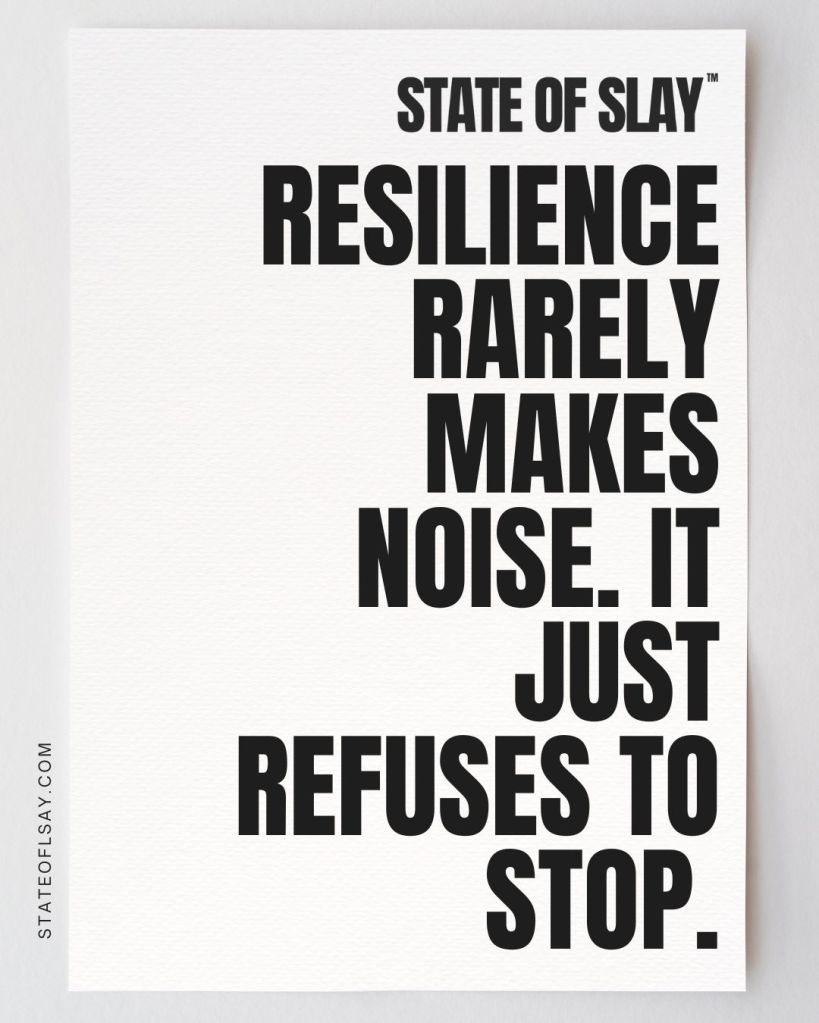
The Quiet Kind of Strength

Real resilience doesn’t demand attention.
It doesn’t need to announce itself or prove a point.

It’s the steady breath in the middle of the storm.
The quiet decision to try again.
The choice to keep moving, even when no one is watching.

Power isn’t always loud.
Sometimes it’s the whisper that says, not today.

You’ve survived moments you thought would break you—
not because you shouted through them,
but because you stayed.

This is your reminder that quiet strength
is still strength.

Slay on!

Slay Say

Where You Stand, You Belong

Imposter syndrome whispers that you’re lucky to be here—
but luck didn’t build the path beneath your feet.

You did.

Every risk you took, every doubt you silenced,
every time you showed up scared but still showed up—
that’s what opened the door.

You earned your place.
You belong in every space your growth has brought you to.

The room didn’t make you worthy.
Your courage did.

This is your reminder to stop questioning your seat at the table
and start owning the strength that got you there.

Slay on!

Slay Say

The Days That Test Your Kindness

It’s easy to be patient when life feels light.
But when you’re exhausted, overwhelmed, or heavy-hearted—
that’s when self-compassion becomes essential.

Low days don’t mean you’ve lost your strength.
They mean you’re human.

Grace isn’t something you earn;
it’s something you extend to yourself
when the world feels too loud
and your energy runs thin.

Rest. Recenter. Remember who you are
beyond what today feels like.

This is your reminder to treat yourself gently
while you find your way back to center.

Slay on.

Slay Say

The Echo of Fear

Not every fear belongs to this moment.

Some are inherited through old pain—
the kind that lingers long after the wound has healed.
They whisper familiar stories,
convincing you you’re in danger when you’re simply remembering.

Growth asks for discernment.
To pause before reacting.
To recognize when your heart is protecting you from ghosts instead of threats.

This is your reminder to breathe before you run—
to listen long enough to know if what you’re hearing
is truth… or just an echo.

Slay On!

Slay Say

Stand in Your Evolution

Not everyone will understand the changes you make when you choose peace, purpose, or healing.
That’s okay. You’re not meant to stay small just to keep others comfortable.

The people meant for your life will never shrink you to fit their version of who you were.
They’ll hold space for who you’re becoming.

This is your reminder to move boldly in the direction of your evolution—
and surround yourself with those who cheer for your becoming.

Slay On!

Slay Say

Unearth Your Thriving Self

There’s a version of you that doesn’t live in reaction, exhaustion, or fear.
It’s the version that breathes easier, moves with intention, and believes they deserve peace.

But to meet that version, you have to release the one that’s just getting by. The one that clings to old patterns, familiar chaos, and constant survival mode.

Thriving isn’t something you earn—it’s who you uncover when you stop settling for struggle as your normal.

This is your reminder that your next level of peace, purpose, and power is already within you—waiting to rise.

Slay On!

Slay Say

Rewrite Your Power

Healing isn’t about pretending the pain never happened. It’s about refusing to let it be the only story you tell.

When we stop replaying the moments that broke us and start focusing on the strength that carried us through, we shift from surviving to rising.

Each time you choose peace over the past, you rewrite your power.

This is your reminder that your story isn’t over—it’s evolving.
Let the next chapter be the one where you heal out loud.

Slay on!