Slay Say

Own Your Part Without Passing the Pain

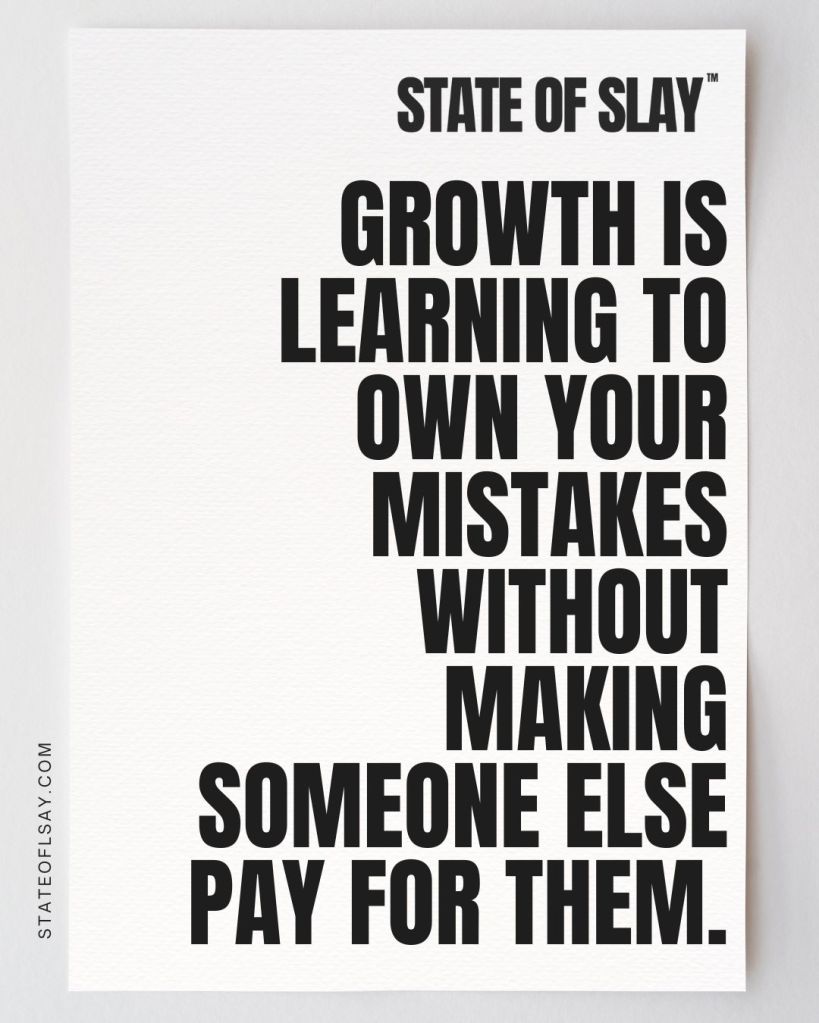
True growth isn’t about being perfect—it’s about being accountable. It’s recognizing when you’ve hurt someone and taking ownership of it without turning the spotlight or the blame back on them.

Maturity is the ability to sit with discomfort long enough to say, “I was wrong,” without needing to defend, deflect, or explain it away.

This is your reminder that healing doesn’t come from shifting the blame—it comes from standing in your truth with grace.

Slay On!

Before You Argue, Ask Yourself: Is This Worth My Energy?

We’ve all been there. Someone says something that grates on us—maybe it’s dismissive, maybe it’s condescending, maybe it’s flat-out wrong. Our instinct is to jump in, argue, explain, and prove our point. But here’s the question that changes everything:

Is this person even mentally mature enough to grasp the concept of a different perspective?

Because if the answer is no, then your energy is too valuable to waste.


The Illusion of Winning Arguments

When I was younger, I thought “winning” an argument meant I had more power. I thought if I could just explain it better, the other person would finally get it, nod their head, and say: “Wow, you’re right.”

But it rarely worked out that way. Instead, the harder I pushed, the harder they dug in. Logic didn’t matter. Evidence didn’t matter. My passion and sincerity didn’t matter.

What I eventually realized is this: you can’t force someone to see what they’re not ready—or willing—to see.

And that’s not a reflection of your intelligence, compassion, or truth. That’s a reflection of their capacity.


Maturity Meets Perspective

Not everyone has the tools, the emotional maturity, or even the desire to understand perspectives outside their own. Some people are locked in fear. Some cling to control. Some confuse listening with weakness.

If you’re standing in your truth, speaking from love and alignment, but the other person is stuck in a loop of defensiveness, superiority, or chaos—you will never meet in the middle.

It’s like trying to explain color to someone who insists the world is only black and white. You’re not going to paint them into understanding.


Why We Still Try

So why do we still argue?

For me, it often came from a need to be seen. I wanted validation. I wanted acknowledgment. I wanted someone to finally say: “I understand you.”

But here’s the hard truth: arguing with someone who is unwilling or unable to meet you where you are doesn’t get you understanding—it gets you exhaustion.

When you argue with someone who isn’t open, you’re not exchanging ideas. You’re fighting for airtime in a room where the mic is already turned off.


Energy Economics: Protecting Your Investment

Think of your energy like currency. Every interaction is an investment. And not everyone can afford it.

When you spend your emotional energy trying to convince someone who has already decided not to hear you, you’re making a bad investment. You’re pouring into a void.

Instead, what if you chose to save that energy? What if you redirected it toward people and spaces where curiosity exists, where growth is possible, and where your perspective matters?

That’s when the return on your investment multiplies.


It’s Not About Being Right—It’s About Being Wise

There’s a subtle but powerful difference between wanting to be right and choosing to be wise.

  • Being right demands a fight.
  • Being wise recognizes when silence speaks louder.

You don’t need to prove your worth through debate. Your worth is not determined by someone else’s ability—or inability—to understand you.

Sometimes the most powerful move you can make is to walk away, not because you’ve lost, but because you’ve risen above.


What Walking Away Really Means

Walking away doesn’t mean you’re weak. It doesn’t mean you’re giving up. It doesn’t mean you don’t care.

It means you’ve chosen peace over chaos. It means you’ve recognized the limits of the conversation and your own boundaries. It means you know your energy is precious, and you’re no longer willing to spend it recklessly.

Walking away is not defeat—it’s discipline.


The Freedom in Letting Go

Here’s what happens when you stop arguing with people who aren’t ready to hear you:

  • Your nervous system calms down.
  • Your energy goes back into your own growth.
  • You stop rehearsing conversations that will never resolve.
  • You discover new connections with people who can meet you where you are.

And maybe most importantly: you remember that your peace is not up for negotiation.


Practical Steps: Before You Argue, Ask Yourself…

Next time you feel that urge to argue rising up, pause and ask:

  1. Is this person capable of seeing another perspective—or are they locked into proving their own?
  2. What is my goal here? To be understood? To change them? To feel heard?
  3. Will this conversation bring me peace—or drain me?
  4. If I walk away, what am I protecting? My truth? My peace? My energy?
  5. If I stay, what am I risking?

This quick gut-check can save you hours of stress and prevent you from spending energy you’ll regret.


Final Thought: Choose Peace Over Proving

At the end of the day, the people who are meant to walk beside you will want to hear your perspective. They’ll be curious. They’ll ask questions. They’ll listen, even if they don’t agree.

Those who aren’t capable of that? They’ll show you by their resistance, their defensiveness, their refusal to even try.

And in that moment, you have a choice. You can argue and deplete yourself. Or you can walk away, preserve your peace, and let your life—not your words—be the proof.

Because the truth is, peace doesn’t need a microphone. It just needs space.


SLAY Reflection

  1. Who in your life drains your energy by refusing to hear your perspective?
  2. What situations tempt you into arguments that never go anywhere?
  3. How does it feel in your body when you argue with someone who refuses to listen?
  4. How might your life change if you saved that energy for people who can understand you?
  5. What would it look like to choose peace over proving this week?

S – Stop wasting energy on those who won’t listen
L – Let your peace matter more than your pride
A – Ask yourself if the conversation is worth the investment
Y – Yield your energy toward those who value it


Call to Action: Join the Conversation

I’d love to hear from you.
When was the last time you chose peace over proving yourself—and what shifted for you?
Share your story in the comments. Let’s cheer each other on.

And if you know someone who’s exhausted from fighting battles that can’t be won, send this to them.
Sometimes, the most powerful reminder is: you don’t have to argue to be free.

Think of Your Energy Like It’s Expensive—Not Everyone Can Afford It

Recently, Taylor Swift sparked conversation when she said: “Think of your energy like it’s expensive. Not everyone can afford it.”

That hit me—and clearly, it hit a lot of people. Because the truth is, energy is expensive. Not in dollars and cents, but in time, effort, focus, and emotional bandwidth. Once it’s spent, you don’t get it back. And yet, so often, we give it away freely to people, situations, and environments that do nothing but drain us.

If your energy is expensive, why are you letting just anyone spend it?


Energy as Currency

Imagine waking up every morning with a set amount of money in your pocket. That’s your energy for the day. You get to choose how to spend it—on your work, your relationships, your passions, your health. But if you hand it out without intention, you’ll end up broke by noon.

The same is true for your emotional and mental energy.
Every “yes” you say is a withdrawal. Every boundary you set is a deposit.

So when Taylor says not everyone can afford your energy, it’s a reminder to start asking yourself: Who am I allowing to spend my most valuable currency?


Why Protecting Your Energy Feels Hard

Here’s the catch: many of us were raised to believe that giving endlessly is the right thing to do. That being available, agreeable, and accommodating makes us “good.”

But constantly giving, without discernment, isn’t goodness—it’s depletion.

I know this firsthand. For years, I poured energy into people who didn’t pour anything back. I stayed in conversations that exhausted me, relationships that drained me, and obligations that left me resentful. And I told myself it was kindness, when really, it was self-neglect.

Protecting your energy isn’t selfish. It’s self-preservation.


You Teach People How to Value Your Energy

Here’s the truth: if you treat your energy like it’s cheap, other people will too.

Think about it—if you always answer the phone, always say yes, always overextend yourself, what are you teaching others? That your energy has no limits. That it doesn’t cost you anything to give.

But when you begin to value your energy, something shifts. Boundaries get stronger. Relationships get healthier. And the people who truly value you start to rise to the top.

You don’t have to cut people off with cruelty. But you do have to get clear: What is my energy worth, and who has earned the right to receive it?


How to Protect Your Expensive Energy

If your energy is a luxury item, then not everyone belongs in your store. Here’s how you start protecting it:

  1. Audit your energy spend.
    Notice where your energy goes every day. Who leaves you feeling drained? Who leaves you feeling alive?
  2. Set boundaries without apology.
    Remember—boundaries don’t burn bridges, they protect castles. Your energy is the castle.
  3. Stop over-explaining.
    “No” is a complete sentence. You don’t need to justify why someone can’t have unlimited access to you.
  4. Invest in what fuels you.
    Spend energy on relationships, passions, and practices that multiply your energy instead of depleting it.
  5. Rest like it’s your job.
    Because it is. Rest is the recharge that makes sure you have something to spend tomorrow.

The Shift from Pleasing to Protecting

When I stopped people-pleasing, I realized something powerful: not everyone was meant to have access to me. Some people liked the version of me who was always tired, always available, always giving. But that version wasn’t sustainable.

Now, when I say no, when I walk away, or when I don’t engage in drama—I’m not being cold. I’m protecting my most expensive resource: me.

And you can do the same.


Your Energy, Your Choice

At the end of the day, you decide who gets access to you. You decide how much of your energy goes where.

Some people simply cannot afford it—not because they’re “bad,” but because they haven’t earned it, they don’t value it, or they won’t respect it.

And that’s okay.

Because your energy doesn’t need to be affordable to everyone. It just needs to be invested wisely.

So the next time you feel guilty for saying no, or walking away, or setting a boundary, remind yourself:

You’re not rejecting them—you’re protecting you.


SLAY Reflection

  1. Who in your life consistently drains your energy without giving anything back?
  2. What areas of your life feel like “good investments” of your energy?
  3. Do you undervalue your energy by overcommitting or overexplaining?
  4. How can you start treating your energy like it’s expensive today?
  5. What boundary could you set this week to protect your peace?

  • S – Spend your energy where it’s respected
  • L – Let go of guilt when you say no
  • A – Align with people who energize you, not drain you
  • Y – Yield your time and focus to what truly matters

Call to Action: Join the Conversation

I’d love to hear from you.
Where in your life have you realized your energy is too expensive to waste?
Share your story in the comments. Let’s cheer each other on.

And if you know someone who’s learning to protect their peace, send this to them.
Sometimes, all we need is a reminder that we’re worth it.

Temporary People Teach Us Permanent Lessons

We don’t always get to choose who comes into our lives—or how long they stay. Some people walk with us for a lifetime, others for only a season. And while temporary people may leave as quickly as they came, their impact often lingers.

Sometimes it’s beautiful. Sometimes it’s heartbreaking. But always—it’s instructive.

Because even the ones who don’t stay teach us something we carry forward. Temporary people leave permanent lessons.


The Pain of Goodbyes and the Gift They Leave Behind

When someone exits your life, it can feel like rejection, abandonment, or loss. You may replay every moment, wondering what you could have done differently to make them stay. But here’s the truth: their leaving isn’t always about you.

Temporary people teach us boundaries. They teach us what we will and will not accept.
They teach us value. Sometimes by showing us what we deserve—and sometimes by showing us what we don’t.

Not all lessons are gentle. But every lesson has purpose.


What Temporary People Reflect Back to Us

Every person who crosses our path acts as a mirror. Some reflect our best qualities back at us—reminding us of the love, kindness, or courage we already hold. Others reflect the wounds we still carry, highlighting the work that’s left undone.

If you’ve ever noticed how one relationship reveals your need for boundaries, while another pushes you toward forgiveness, that’s no accident. Temporary people show us where we’re growing, and where we’re still stuck.

Even the ones who hurt us—sometimes especially the ones who hurt us—end up guiding us toward our truth.


Not Everyone Is Meant to Stay

We live in a culture that glorifies “forever.” Forever friends. Forever love. Forever loyalty. But life doesn’t always work that way.

The truth is, some people are only meant to walk us part of the way. They show up for a chapter, not the whole book. And that’s okay.

Because their role is not to stay—it’s to move us forward. To give us the lesson, the shift, the wake-up call we couldn’t have gotten any other way.

When we cling to people who were only meant to be temporary, we rob ourselves of the lesson. When we let them go with gratitude, we keep the gift they came to bring.


Choosing Growth Over Grief

It’s natural to grieve when someone leaves. But we don’t have to get stuck in the story of what “could have been.”

Instead, we can ask:
What did I learn from this connection?
How did this person shift me?
What strength did I discover because of them?

Sometimes the hardest people to release leave behind the clearest lessons. They teach us self-respect. They teach us resilience. They teach us that we can survive the leaving—and even thrive after it.

You may not have chosen their exit, but you can choose what you carry forward.


SLAY Reflection

  1. Who in your past was only meant to be temporary, but taught you something lasting?
  2. What lesson are you still carrying from a relationship that didn’t last?
  3. Do you find yourself holding on to people who were never meant to stay? Why?
  4. How does it feel to shift from grief to gratitude when you think of temporary people?
  5. What permanent strength or wisdom do you have today because someone left?

S – See the role they played in your growth
L – Let go of what wasn’t meant to last
A – Acknowledge the lessons they gave you
Y – Yield to gratitude instead of grief


Call to Action: Join the Conversation

I’d love to hear from you.
Who was a “temporary person” in your life, and what permanent lesson did they leave behind?
Share your story in the comments. Let’s cheer each other on.

And if you know someone struggling to let go of someone who was never meant to stay, send this to them.
Sometimes, all we need is a reminder that even endings carry gifts.

Slay Say

Stop pouring into empty cups—it’s time to honor your own.

We teach people how to treat us by what we allow, what we stop, and what we walk away from. If you keep making others a priority while they treat you as an afterthought, you’re not being kind—you’re abandoning yourself.The truth is, you don’t need to beg for a seat at a table where you’re only ever offered crumbs. You deserve to sit where your presence is seen, valued, and celebrated.

This isn’t about becoming hard or unkind. It’s about protecting your energy and making room for relationships that meet you with the same care you give so freely.

This is your reminder to stop pouring into places that never pour back.

Don’t give priority where you’re treated as an option.

SLAY on!

Empathy Without Boundaries Is Self-Destruction

Empathy is a beautiful gift—it allows us to connect, understand, and hold space for others in ways that make them feel seen and valued. But here’s the hard truth: without boundaries, empathy becomes a weapon turned inward. Instead of healing, it harms. Instead of connecting, it consumes.

Many of us who identify as “empaths” or deeply compassionate people have learned the hard way that pouring ourselves out for everyone else often leaves us running on empty. When we absorb other people’s pain without limit, when we rescue at our own expense, or when we carry burdens that don’t belong to us, we aren’t practicing empathy—we’re practicing self-destruction.

True empathy isn’t about losing yourself in someone else’s storm. It’s about holding space with compassion while knowing where you end and they begin. Boundaries are not walls; they are bridges of clarity that keep you safe while still allowing you to show up with love.


When Empathy Crosses the Line

It starts subtly. You say “yes” when you want to say “no.” You listen to someone’s problems at 2 a.m., even though you have to be up early for work. You absorb the emotions in a room until they feel like your own. And before long, your identity is tangled in other people’s struggles.

This isn’t empathy—it’s overextension. And over time, it erodes your mental health, your relationships, and your sense of self. Without boundaries, empathy mutates into people-pleasing, codependency, and burnout. It may look like kindness, but underneath it’s exhaustion and resentment.


Why Boundaries Save Empathy

Boundaries don’t make you less compassionate—they make your compassion sustainable. They protect your inner world so you can continue to give without losing yourself in the process.

Think of it this way: your empathy is a flame. Without boundaries, that flame burns everything in sight—including you. With boundaries, it becomes a steady light that warms without destroying.

When you set limits—saying no when you need to, protecting your energy, and remembering that someone else’s healing is not your responsibility—you create space for empathy that is genuine, not sacrificial.


My Own Turning Point

For years, I believed that to love meant to absorb. If someone was hurting, I carried it like it was my own. If someone was angry, I tried to fix it. If someone needed rescuing, I was already running into the fire.

But I learned the hard way that empathy without boundaries isn’t noble—it’s self-neglect. I was burning out, resentful, and wondering why I always felt unseen when I gave so much. The truth was, I wasn’t giving from love. I was giving from fear: fear of disappointing others, fear of being unlikable, fear of being seen as selfish.

When I finally learned that empathy needed boundaries, everything changed. I could still care, still show up, still love deeply—but without sacrificing my own well-being. I realized that the most powerful act of empathy sometimes is saying: “I love you, but that’s yours to carry, not mine.”


Choosing Sustainable Love

Empathy should not be self-destruction dressed up as kindness. Empathy with boundaries is love that endures—not just for others, but for yourself.

Boundaries aren’t cold, cruel, or selfish. They’re an act of love. They say: I care enough about myself to stay whole, and I care enough about you to show up from that wholeness instead of from depletion.

Remember, you can’t pour from an empty cup. Protect your flame, and your empathy will continue to shine without burning you out.


SLAY Reflection

Take a moment to pause and reflect:

  • SStop: When was the last time your empathy drained you instead of uplifted you?
  • LLook: Do you confuse empathy with rescuing, fixing, or absorbing other people’s pain?
  • AAsk: What boundaries do you need to put in place so your empathy feels safe and sustainable?
  • YYield: How can you release the responsibility for someone else’s emotions and return to your own?

Call to Action: Join the Conversation

I’d love to hear from you.
Have you ever confused empathy with self-sacrifice? What boundary could you set today that would protect your compassion without draining your energy?
Share your story in the comments. Let’s cheer each other on.

And if you know someone who is burning themselves out by carrying everyone else’s pain, send this to them.
Sometimes, all we need is a nudge.

Just Because Someone Gave Up on You, Don’t Give Up on Yourself

There’s a particular kind of pain that comes when someone you believed in—someone you trusted—decides you’re no longer worth the effort. It might be a partner, a friend, a family member, or even an employer.

Sometimes they drift away quietly. Sometimes they slam the door. And sometimes, they make sure you hear exactly why you didn’t make the cut.

It’s human to internalize those moments. To question what’s wrong with you. To wonder if they saw something you didn’t. But here’s the truth—their decision to give up on you is about them, not you.


Their Choice Is Not Your Worth

When someone gives up on you, it’s easy to translate that into, “I’m not enough.” But what they’re really saying is, “I’m not willing, able, or ready to invest in this anymore.”

That’s not the same thing as saying you have no value.

We often assume that other people’s actions are direct reflections of who we are. But in reality, they’re reflections of their capacity, their priorities, their fears, and their choices. Someone’s inability or unwillingness to see your worth does not erase your worth.

When we take someone else’s abandonment as proof that we should abandon ourselves, we hand over our power. And once that happens, their absence gets to dictate the rest of our story.

You don’t owe them that power.


Self-Trust Is Your Lifeline

When the dust settles, what you’re left with is you. And that’s where the real work begins.

Self-trust isn’t built in grand declarations—it’s built in small, consistent acts of showing up for yourself. It’s saying, “I still choose me, even when they didn’t.”

Here’s the thing: if you keep believing in yourself, you always have another chapter to write.

Yes, it hurts when someone walks away. But you’re still standing. You still have dreams, talents, and the ability to create a life you love. You still have the capacity to love yourself fiercely, even if others failed to.

The most powerful way to respond when someone gives up on you is to prove—to yourself—that you never will.


Let Their Exit Teach You, Not Break You

People leaving can be clarifying. Painful? Absolutely. But clarifying.

When someone exits your life, you get the chance to ask:

  • Was I shrinking myself to keep them close?
  • Did I rely on their validation more than my own?
  • Was I ignoring red flags because I didn’t want to lose them?

The end of a relationship, friendship, or opportunity can feel like a collapse—but it can also be a clearing. A chance to rebuild in a way that’s more aligned with who you are now.

Sometimes someone’s departure forces you to look at your own patterns, boundaries, and needs in a way you never would have otherwise.

If you use the pain as data, it can actually serve you.


Your Story Isn’t Over Because They Left

It’s tempting to see someone’s departure as the end of something essential—as if the part of you that existed with them can’t survive without them. But your life is bigger than their role in it.

Think of the people you haven’t even met yet. The experiences you haven’t had. The opportunities that wouldn’t have been possible if you stayed where you were.

The world is full of people who will believe in you. People who will stand beside you, support you, and challenge you to grow—not shrink.

But the most important believer you’ll ever have is the one staring back at you in the mirror.


Refuse to Abandon Yourself

Here’s the bottom line:

  • Someone else’s choice to walk away does not define you.
  • You are allowed to grieve, but you are not required to quit on yourself.
  • You can acknowledge the hurt without adopting it as your identity.

The real loss would be if you decided their decision was the final say in your worth.

Keep showing up. Keep writing your story. Keep choosing you—over and over again.

Because the day you give up on yourself is the day you stop being open to the possibilities that are still ahead.

And trust me… there are so many.


SLAY Reflection

  1. Who in your life has walked away, and how did it impact your self-belief?
  2. In what ways have you relied on others for validation?
  3. How can you build more self-trust right now?
  4. What lesson did you learn from someone leaving your life?
  5. What’s one action you can take this week to invest in yourself?

S – Stand in your worth, even when others don’t
L – Let go of those who cannot meet you where you are
A – Affirm your value daily, without waiting for outside approval
Y – Yield to growth, even when it comes through loss


Call to Action: Join the Conversation

I’d love to hear from you.
When someone gave up on you, what did you do to keep believing in yourself?
Share your story in the comments. Let’s cheer each other on.

And if you know someone who’s questioning their worth because someone walked away, send this to them.
Sometimes, all we need is a nudge.

Put Your Own Mask On First

We hear it every time we board a plane: “In the event of a loss in cabin pressure, secure your own mask before assisting others.” It’s one of those instructions that seems counterintuitive—especially for the givers, the fixers, the caretakers among us. But when you stop to really think about it, it’s not just an airline safety rule—it’s a life lesson.

For a long time, I didn’t put on my own mask first. I’d jump in to help anyone else—whether they asked or not—believing it made me strong, loving, dependable. I was the one people could count on. But quietly, I was falling apart. I was suffocating. And I didn’t even realize it until I was gasping for air.


You Can’t Pour From an Empty Cup

We’ve all heard that saying, but how many of us actually live it?

If you’ve been conditioned to believe your worth is tied to your usefulness, rest might feel selfish. Saying no might feel wrong. Asking for space might trigger guilt. But here’s the truth: constantly abandoning yourself to show up for others isn’t noble—it’s a fast track to burnout, resentment, and disconnection.

When you give from depletion, your help comes with a cost. You’re exhausted. You’re short-fused. You’re giving, but secretly hoping for a thank you, some recognition, a return on your emotional investment. And when that doesn’t come? It hurts. Because beneath all that self-sacrifice, you’re still human.

Putting your own mask on first isn’t selfish—it’s survival. It’s sustainability. It’s strength. When you’re nourished, rested, grounded—you give from overflow, not from emptiness. And everyone benefits from that version of you.


Self-Care Isn’t a Luxury—It’s a Responsibility

Somewhere along the way, we started seeing self-care as optional—as a bubble bath or a bonus. But self-care is how you keep yourself whole. It’s how you stay aligned. It’s the system check that makes sure you’re not running on fumes.

It’s not always glamorous. Sometimes, self-care is a boundary. Sometimes it’s canceling plans. Sometimes it’s letting someone else figure it out, even when you could fix it. It’s trusting that people can handle their own discomfort—and that it’s not your job to keep everything calm.

The truth is, constantly putting others first is often rooted in fear: What if they get mad? What if they leave? What if they think I’m selfish?

But ask yourself this: If you keep abandoning yourself to meet everyone else’s needs, what are you teaching them? That your needs don’t matter. That you’ll always sacrifice yourself. That love looks like martyrdom.

It doesn’t.


Show Up for You—First

Putting your own mask on first means taking inventory of your energy. It means asking: Am I okay? What do I need right now? Am I being honest about my limits?

When you start showing up for yourself, everything shifts. Your relationships become more balanced. Your boundaries become clearer. You stop saying yes when you mean no. You stop fixing what isn’t yours. And you start building a life that includes you.

This doesn’t mean you stop helping others. It just means you stop bleeding out for them. You choose to care without collapsing. You choose to support without suffocating. You choose to love from wholeness—not from empty lungs.

You’re not here to save everyone. You’re here to be you. And that’s more than enough.

So the next time you feel that urge to abandon yourself to keep the peace, to overextend just to be liked, or to put everyone ahead of you—pause. Breathe. Reach for your own mask first.

That’s not weakness. That’s wisdom.


SLAY Reflection

  1. Do you feel guilty putting your needs before others? Why?
  2. What areas of your life have suffered because you’ve neglected yourself?
  3. When was the last time you truly paused and checked in with you?
  4. How would your life change if you consistently put your needs first?
  5. What’s one small act of self-care you can commit to today?

S – Stop and assess what you really need
L – Let go of guilt tied to prioritizing yourself
A – Allow yourself to rest, recharge, and reset
Y – Yield to your own healing so you can truly thrive


Call to Action: Join the Conversation

I’d love to hear from you.
What does putting your own mask on first look like for you—and how has it changed your life?
Share your story in the comments. Let’s cheer each other on.

And if you know someone who always puts themselves last, send this to them.
Sometimes, all we need is a nudge.

People-Pleasing Is Manipulation in Disguise

We often think of people-pleasing as a “nice” trait. We want to be liked, avoid conflict, and make others happy. But here’s the hard truth: people-pleasing is actually a form of manipulation.

I know that might sting. It did for me when I first realized it.

People-pleasing isn’t just about kindness—it’s about controlling how people see you. It’s about shaping their perception, keeping them happy so they won’t be upset with you, leave you, or think badly of you. And while it might look selfless on the surface, underneath it’s driven by fear and control.

When you live in that cycle, you’re not actually being authentic—you’re performing. And no performance lasts forever.


The Hidden Cost of Pleasing Everyone

For years, I lived in a world of quiet performance. I wanted everyone to like me. I thought if I kept everyone happy, no one could hurt me. I said yes when I wanted to say no. I laughed at things I didn’t find funny. I took on tasks I didn’t have time for. I agreed with opinions that didn’t reflect my own.

At the time, I thought I was being “easygoing” and “kind.” What I was really doing was trading my authenticity for approval.

Here’s the problem: people-pleasing keeps you stuck in a loop of resentment. You give and give to avoid conflict, but inside you feel empty, angry, and misunderstood. And the worst part? People aren’t seeing the real you—they’re seeing the version you think they want.

People-pleasing is not generosity. It’s fear in a nice outfit.


People-Pleasing Is About Control

When I finally started doing the work on myself, I realized that my need to please wasn’t selfless—it was controlling.

I wasn’t just helping others. I was managing their reactions to me. I was trying to avoid discomfort, dodge rejection, and secure love and approval without ever having to risk showing my true self.

Here’s the truth:

  • When you say yes but mean no, you’re lying.
  • When you overextend yourself to avoid someone’s disappointment, you’re manipulating their perception.
  • When you pretend to agree just to keep the peace, you’re abandoning yourself.

It’s hard to admit, but once I faced it, I felt…free. I wasn’t “nice.” I was scared. And I was hiding behind compliance to stay safe.


Breaking the Cycle

Learning to stop people-pleasing is like building a new muscle. At first, it feels foreign. It feels risky. It even feels mean—because you’re so used to putting everyone else first.

Here’s what helped me break free:

  1. Get Honest About Your Motives
    Before saying yes, ask yourself: Am I doing this out of love and choice, or fear and control?
  2. Sit with Discomfort
    Saying no, setting boundaries, or letting someone be upset with you will feel uncomfortable. Sit in it. That discomfort is your freedom forming.
  3. Reclaim Your Voice
    When you start telling the truth—“I can’t commit to that,” “I don’t feel comfortable,” or simply, “No”—you’ll feel your power return.
  4. Detach from Approval
    Not everyone will like you. Not everyone will understand you. But people who love the real you will stay, and those who only loved the performance will fade.

The Power of Authenticity

The shift from people-pleasing to authenticity changed my life.

When I stopped performing, I discovered who actually belonged in my life. I learned that relationships built on honesty are stronger than relationships built on compliance. And most importantly, I learned to trust myself again.

When you release the need to control how others see you, you also release the constant exhaustion of managing everyone else’s feelings. You step out of manipulation and into freedom.

So the next time you feel the pull to please, pause. Ask yourself: Am I doing this out of love, or out of fear? Am I honoring myself, or abandoning myself to keep the peace?

The real you is always worth showing. And the people who are meant for you will meet you there.

Choose truth over performance. Choose authenticity over approval. Choose you.


SLAY Reflection

  1. Do you often say yes when you mean no? Why?
  2. How does people-pleasing keep you in cycles of resentment?
  3. Can you recall a time you were honest about your boundaries? How did it feel?
  4. What relationships in your life are based on performance instead of authenticity?
  5. What’s one small step you can take today to stop people-pleasing and start honoring yourself?

S – Stop and notice when you’re abandoning yourself for approval
L – Let go of the need to manage how others see you
A – Align your choices with your truth, not your fear
Y – Yield to authenticity, even when it feels uncomfortable


Call to Action: Join the Conversation

I’d love to hear from you.
Where does people-pleasing still show up in your life, and how are you working to break free?
Share your story in the comments. Let’s cheer each other on.

And if you know someone who’s struggling with saying yes when they want to say no, send this to them.
Sometimes, all we need is permission to stop performing.

Their Storm, Not Your Forecast

There’s a strange pressure to get swept up in someone else’s chaos. To absorb their anger, defend against their projections, or even try to fix what they refuse to face. Especially if you’re a deeply empathetic person, it can be hard to remember:

Not every storm requires your umbrella.

Just because someone is bringing drama, blame, or emotional thunder into the room doesn’t mean you have to get soaked.

It might sound harsh, but not every meltdown, every mood, or every mess is yours to carry.

Let’s be real—some people thrive in the whirlwind. They create it. They stir up tension, throw lightning bolts, and wait to see who gets scorched. And if you’re not careful, you’ll mistake their storm for your reality.


You’re Not the Weather Channel

Here’s the thing: just because they’re forecasting doom doesn’t mean you have to build an ark. We can love people, support people, and still refuse to be pulled under by their emotional riptide.

Your peace isn’t up for negotiation.

One of the biggest lessons I’ve learned is this: if someone is committed to chaos, no amount of calm you bring will change them. You don’t have to match their energy, explain yourself endlessly, or prove your worth in the face of their projection.

Your job is to stay grounded in your truth.

People will accuse you of being cold, distant, or selfish when you refuse to engage in their drama. Let them. You’re not required to participate in every emotional argument you’re invited to.


Calm Isn’t Weak—It’s Wise

Some storms are loud. Others are subtle. But all of them share one trait: they pull you away from your center. When you stay calm in the face of emotional turbulence, you’re not being passive—you’re being powerful.

Calm is a boundary.

It says: “I’m not going to argue with someone who’s not listening. I’m not going to internalize someone else’s pain. I’m not going to let your storm become my identity.”

This doesn’t mean you don’t care. It means you care enough about yourself to know the difference between being present and being consumed.


Detach Without Guilt

If you’ve ever grown up in dysfunction, chaos might feel familiar—even comfortable. You may have learned to overfunction, to fix, to please, to manage the emotions of others so things wouldn’t blow up. But that’s not your role anymore.

You can walk away. You can say, “This isn’t mine.” You can let someone rage, spiral, or stew without stepping into the storm.

Because here’s the truth: the storm isn’t personal. Even if it’s aimed at you, it’s not really about you. It’s about their unhealed pain. Their fear. Their need for control.

You didn’t cause it, and you don’t have to catch it.


Protect Your Inner Weather

Boundaries aren’t walls, they’re windows. They let in light and fresh air, but they keep out the hail. When you feel that pull to jump into someone else’s chaos, pause and ask:

  • Is this really mine?
  • What happens if I don’t respond?
  • What would it look like to stay rooted in my calm?

Because that’s the goal: to be so in tune with your own emotional forecast that someone else’s storm can roll through without ever touching your peace.

Let them weather it. You’ve got sunshine to protect.


SLAY Reflection

  1. Have you ever mistaken someone else’s storm as your responsibility to fix?
  2. What patterns from your past make chaos feel familiar or expected?
  3. When was the last time you stayed calm in a moment of drama—and how did that feel?
  4. What’s one situation right now where you can say, “This isn’t mine”?
  5. How can you strengthen your boundaries to protect your inner peace?

S – Step away from unnecessary emotional storms
L – Let go of the need to fix what isn’t yours
A – Acknowledge your limits with compassion
Y – Yield to peace, not pressure


Call to Action: Join the Conversation

I’d love to hear from you.
What’s one way you’ve protected your peace by not engaging in someone else’s storm?
Share your story in the comments. Let’s cheer each other on.

And if you know someone who’s always caught in the swirl of someone else’s drama, send this to them.
Sometimes, all we need is a reminder that peace is a choice.