Slay Say

The journey no one clapped for created the moment they celebrate

It’s easy to admire someone’s success without ever seeing the struggles that built it. People will clap for the glow, but they rarely acknowledge the fire it came from.

Behind every highlight is a hard-fought story—quiet battles, sleepless nights, doubts you had to silence, and resilience you had to grow. The truth is, the spotlight only shows the ending; it doesn’t reveal the shadows you walked through to get there.

Your journey matters, even if no one sees it. Every step, every scar, every setback you’ve overcome is part of the strength that makes your light shine.

This is your reminder to honor the path as much as the outcome.

SLAY on!

Temporary People Teach Us Permanent Lessons

We don’t always get to choose who comes into our lives—or how long they stay. Some people walk with us for a lifetime, others for only a season. And while temporary people may leave as quickly as they came, their impact often lingers.

Sometimes it’s beautiful. Sometimes it’s heartbreaking. But always—it’s instructive.

Because even the ones who don’t stay teach us something we carry forward. Temporary people leave permanent lessons.


The Pain of Goodbyes and the Gift They Leave Behind

When someone exits your life, it can feel like rejection, abandonment, or loss. You may replay every moment, wondering what you could have done differently to make them stay. But here’s the truth: their leaving isn’t always about you.

Temporary people teach us boundaries. They teach us what we will and will not accept.
They teach us value. Sometimes by showing us what we deserve—and sometimes by showing us what we don’t.

Not all lessons are gentle. But every lesson has purpose.


What Temporary People Reflect Back to Us

Every person who crosses our path acts as a mirror. Some reflect our best qualities back at us—reminding us of the love, kindness, or courage we already hold. Others reflect the wounds we still carry, highlighting the work that’s left undone.

If you’ve ever noticed how one relationship reveals your need for boundaries, while another pushes you toward forgiveness, that’s no accident. Temporary people show us where we’re growing, and where we’re still stuck.

Even the ones who hurt us—sometimes especially the ones who hurt us—end up guiding us toward our truth.


Not Everyone Is Meant to Stay

We live in a culture that glorifies “forever.” Forever friends. Forever love. Forever loyalty. But life doesn’t always work that way.

The truth is, some people are only meant to walk us part of the way. They show up for a chapter, not the whole book. And that’s okay.

Because their role is not to stay—it’s to move us forward. To give us the lesson, the shift, the wake-up call we couldn’t have gotten any other way.

When we cling to people who were only meant to be temporary, we rob ourselves of the lesson. When we let them go with gratitude, we keep the gift they came to bring.


Choosing Growth Over Grief

It’s natural to grieve when someone leaves. But we don’t have to get stuck in the story of what “could have been.”

Instead, we can ask:
What did I learn from this connection?
How did this person shift me?
What strength did I discover because of them?

Sometimes the hardest people to release leave behind the clearest lessons. They teach us self-respect. They teach us resilience. They teach us that we can survive the leaving—and even thrive after it.

You may not have chosen their exit, but you can choose what you carry forward.


SLAY Reflection

  1. Who in your past was only meant to be temporary, but taught you something lasting?
  2. What lesson are you still carrying from a relationship that didn’t last?
  3. Do you find yourself holding on to people who were never meant to stay? Why?
  4. How does it feel to shift from grief to gratitude when you think of temporary people?
  5. What permanent strength or wisdom do you have today because someone left?

S – See the role they played in your growth
L – Let go of what wasn’t meant to last
A – Acknowledge the lessons they gave you
Y – Yield to gratitude instead of grief


Call to Action: Join the Conversation

I’d love to hear from you.
Who was a “temporary person” in your life, and what permanent lesson did they leave behind?
Share your story in the comments. Let’s cheer each other on.

And if you know someone struggling to let go of someone who was never meant to stay, send this to them.
Sometimes, all we need is a reminder that even endings carry gifts.

Learning to Love the Thing You Wish Hadn’t Happened

There are moments in life that split time in two.

There’s before it happened.
And there’s after it happened.

And sometimes, that “it” is something you would give anything to erase. A betrayal. A loss. A mistake. A failure. Something that shook you so deeply that, even years later, you still catch yourself saying, “If only that had never happened…”

I’ve been there. More than once.

For a long time, I believed the only way to be truly happy again was to go back—back to the way things were before the pain, before the fallout, before the day that changed everything. But the truth is, there is no going back. There’s only forward. And learning to move forward doesn’t mean pretending it didn’t hurt, or even pretending you’re glad it happened.

It means learning to love what it taught you.

It means finding peace in the fact that this unwanted thing—this thing you thought would break you—has also shaped you into the version of yourself you are now.


The Lie We Tell Ourselves About “If Only”

When something painful happens, our minds get stuck in loops. We replay conversations. We imagine different choices. We rewrite endings that never came.

It’s a way of bargaining with reality: If only it hadn’t happened, I’d be happier. If only it hadn’t happened, I’d be whole.

But here’s the truth no one wants to admit—those loops keep us chained to the very thing we want freedom from. Every time we run through the “if only” scenario, we hand over our present to a past we cannot change.

And if we’re not careful, we start defining ourselves by the wound instead of the healing.


What It Really Means to Love the Thing You Wish Hadn’t Happened

Loving what you wish hadn’t happened doesn’t mean excusing it, approving of it, or romanticizing pain. It’s not toxic positivity, and it’s not saying, “Everything happens for a reason” as a way to shut down your feelings.

It’s about recognizing that you did survive it. That it’s part of your story. And that by accepting it instead of resisting it, you can take back your power.

When you love what you wish hadn’t happened, you’re saying:

  • “I see what this taught me, even if I never wanted the lesson.”
  • “I won’t let this moment define my future in a way that keeps me small.”
  • “I can carry this with me without letting it weigh me down.”

That shift—acceptance over resistance—is where freedom begins.


Turning Pain Into Purpose

If I look back at my own life, the moments I once wished away have given me some of my greatest strengths.

The heartbreak that shattered me? It taught me how to listen to my intuition.

The loss that felt unbearable? It taught me to love harder and to cherish the present.

The mistake I swore I’d never recover from? It humbled me, made me more compassionate, and connected me to people I never would have met otherwise.

When you learn to love what you wish hadn’t happened, you’re essentially mining your pain for gold. You’re pulling the wisdom from the rubble. You’re saying, “If I have to carry this, I will make sure it makes me stronger.”


Choosing to See the Gift

This is the hardest part—seeing the gift in the thing you never wanted.

Sometimes the gift isn’t obvious. It’s not wrapped neatly with a bow. It might take years before you see how something awful set the stage for something better.

But I believe this: Every wound has the potential to be the very thing that builds your wings.

That doesn’t happen automatically. It happens when you choose to look for the lessons. When you decide that your story will not end in tragedy, but in transformation.


You Don’t Have to Like It to Learn From It

There’s a misconception that acceptance means approval. It doesn’t. You can still hate what happened. You can still grieve it, still wish it had been different.

Acceptance is simply saying, “It happened. I can’t change that. But I can choose how I live with it.”

And sometimes, “living with it” means integrating it into your story in a way that honors your growth instead of your grief.


From Scar to Strength

Your pain is not who you are.

It’s part of your story, but it’s not your identity. The thing you wish hadn’t happened might always sting a little, but with time, the sting fades, and the scar becomes proof—not of what hurt you, but of what couldn’t break you.

When you reach the point where you can love that scar, when you can look at it and think, That’s where I grew the most, you’ve taken back what was stolen from you.

That’s when the thing you once wished away becomes the thing that shaped you into the person you were always meant to be.


SLAY Reflection

  1. What’s one event in your life you still wish had never happened?
  2. How has holding onto resistance kept you tied to it?
  3. What’s one strength, lesson, or relationship you have today because of it?
  4. How would your life look if you could accept it fully?
  5. What’s one small step you can take this week toward making peace with it?

S – Stop replaying the “if only” loop
L – Look for the lessons, even if they’re small
A – Accept that it’s part of your story, not all of it
Y – Yield to the growth it’s given you


Call to Action: Join the Conversation

I’d love to hear from you.
What’s one thing you wish had never happened—and how has it unexpectedly shaped you for the better?
Share your story in the comments. Let’s cheer each other on.

And if you know someone who’s stuck wishing they could erase the past, send this to them.
Sometimes, all we need is a nudge.

Slay Say

NOT EVERY STORY IS MEANT TO STAY

Not every connection is meant to last—but every one leaves a mark.
The people who enter your life are not all forever people. Some are lessons, others reminders.
What matters most is how you choose to move forward from them.

This is your reminder to reflect on what you’ve learned, not just what you’ve lost.

SLAY on!

Slay Say

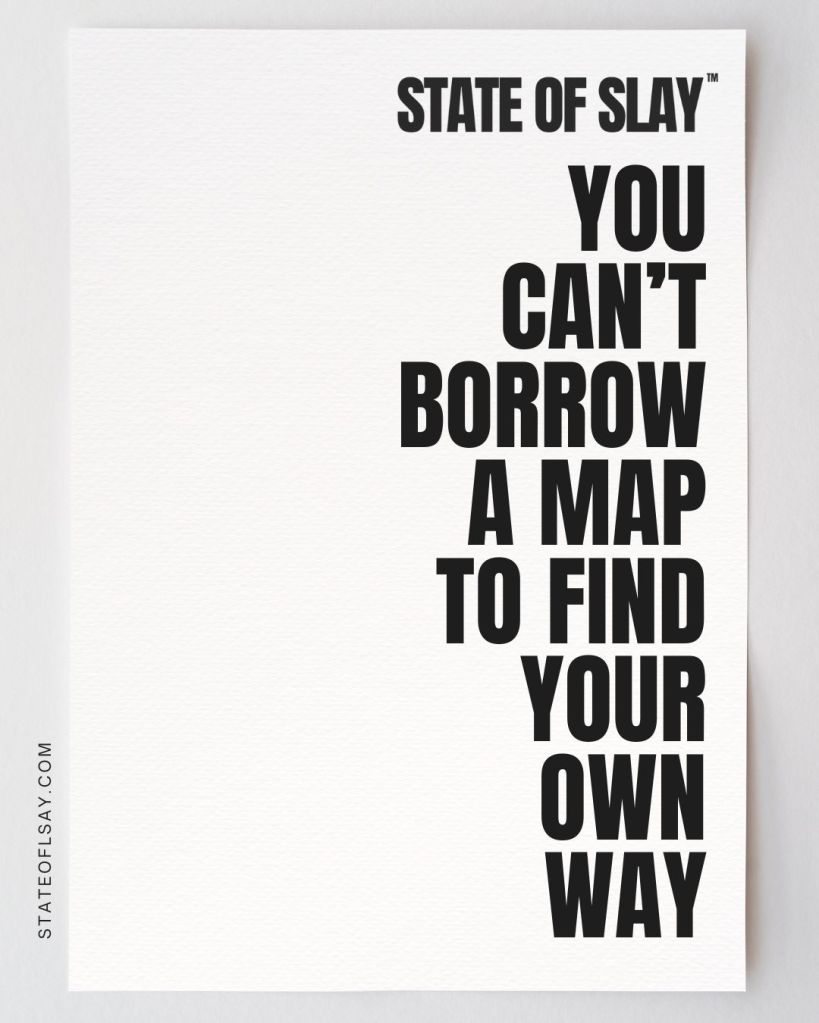
Follow Your Own Road

It’s tempting to look at someone else’s journey and think their path could be ours.
But the truth is, following someone else’s map won’t lead you to your destination.

Your journey is unique, filled with your own experiences, lessons, and growth.
Trust your steps, even when the road is unclear.
Embrace the detours and the unexpected turns—they’re all part of your personal map.

The path to self-discovery isn’t about following others; it’s about forging your own trail.
So, take a deep breath, trust yourself, and keep moving forward.
Your path is unfolding exactly as it should.

SLAY ON.

Your Best Yes Might Be the One That Scares You

It’s easy to say yes when you feel prepared, qualified, and ready.
But what about the yes that feels uncertain? The one that makes you pause and think, “Can I even do this?”

I’ve learned over the years that these are often the most important yeses—the ones that lead you somewhere you never expected, but exactly where you’re supposed to be.

For me, some of the best things in my life have happened because I said yes even when I wasn’t sure. Even when I doubted myself. Even when it was something I’d never done before.

Those yeses have taught me that courage often comes before confidence.


Saying Yes Before You Feel Ready (I Never Felt Ready Either)

If I had waited until I felt fully ready, I would have missed out on so many opportunities that shaped me.

There have been roles I’ve taken, projects I’ve joined, and events I’ve spoken at where my first instinct was, “Why me? I’ve never done this before.”
But then I’d hear this little voice reminding me:
“Just say yes. You’ll figure it out.”

And you know what? I always did. Maybe not perfectly. But growth never is.

Every time I said yes, I walked away with more than I expected—new skills, new friends, new perspectives.
You become ready by doing. Not by waiting.


The Unexpected Gifts of Taking a Chance

Some of my favorite experiences started with a hesitant yes.

  • Saying yes to a random opportunity led me to discover a new creative passion.
  • Saying yes to a conversation with someone I barely knew turned into a meaningful friendship.
  • Saying yes to a project that felt way out of my league ended up teaching me things I didn’t even know I was capable of.

If I had stayed in my comfort zone, I would have missed out on all of it.

What I’ve learned is that sometimes, that scary yes is simply the universe nudging you toward something bigger.


When Yes Isn’t About the Destination

One thing I’ve come to believe is this:
Not every yes is meant to be the grand finale.
Sometimes, it’s just meant to get you moving.

There have been plenty of times when saying yes didn’t lead me exactly where I thought it would.
But it got me out the door. It opened a new door. It connected me to people and places I wouldn’t have found otherwise.

Your yes doesn’t have to be perfect. It just has to be intentional.
You’re not committing to a lifetime. You’re committing to the next step.


Brave Yes vs. Reckless Yes: Here’s How I Tell the Difference

Let me be real—I’ve said yes to things for the wrong reasons too.
Guilt. People-pleasing. Fear of missing out.

Those yeses? They don’t feel good. They drain you.

But the brave yes?
That’s the one that feels a little scary but also exciting. The one that stretches you in the right way. The one your gut says “this could be good for me” even if your brain is panicking a little.

Now, I pause and ask myself:

  • Am I saying yes because I’m afraid of disappointing someone?
  • Or am I saying yes because it aligns with who I’m becoming?

That pause makes all the difference.


Growth Lives on the Other Side of Yes

Every time I’ve stepped into something new, even when it terrified me, I’ve grown.
Not just in skills or experiences, but in how I see myself.

By saying yes, I’ve learned to trust myself more.
To know that I can figure things out.
That even if I stumble, I’ll get back up stronger.

That’s what your best yes does—it helps you grow into the next version of you.


What’s Your Best Yes? Final Thoughts

Here’s what I want you to know:
You don’t have to feel fully ready to say yes.
You don’t have to know exactly how it will turn out.

Sometimes, your best yes is the one that simply gets you moving.
The one that introduces you to a new part of yourself.
The one that reminds you—you’re more capable than you think.

So, what’s the yes you’ve been hesitating on?
It might just be the beginning of something amazing.


Your Turn: Reflect & Take Action

Now it’s your turn. Take a moment and think about these questions:

  1. What opportunity have you been hesitating to say yes to because it feels outside your comfort zone?
    What’s really holding you back?
  2. Think of a time when you said yes even though you were unsure.
    What did you gain from that experience?
  3. What’s one small, brave yes you can give yourself this week?
    A chance to grow, connect, or simply show up differently.
  4. How do you personally tell the difference between a reckless yes and a brave yes?
    What does your body or intuition tell you?
  5. Who or what could benefit from you saying yes to yourself right now?
    Remember, your courage is contagious.

Call to Action: Join the Conversation

I’d love to hear from you.
What’s the yes you’re ready to say, even if it scares you?
Share your story in the comments. Let’s cheer each other on.

And if you know someone who’s standing on the edge of a yes, send this to them.
Sometimes, all we need is a nudge.

When Nothing Goes Right, Go Left

We’ve all been there.
Those seasons when it feels like nothing is working.
Every door feels closed, every step feels heavy, and no matter how hard we try, it all seems to fall apart.

We hit wall after wall.
We get frustrated.
We start to wonder if it’s even worth the fight.

But maybe—just maybe—those walls are redirections.
Maybe those detours are trying to protect us, shift us, or move us toward something better.
Sometimes, when nothing is going right, it’s not about giving up… it’s about going left.


When I Refused to Pivot

Before I began walking the path I’m on now, I was stubborn.
I didn’t believe I deserved good things, so when something didn’t go as planned, it only reinforced the belief that I was a failure.
A part of me almost wanted things to go wrong—because that matched the internal narrative I had created.

I worked hard, but the second I met resistance, I would retreat.
I’d give up.
And then I’d use that failure as proof that life was against me.

I didn’t see roadblocks as opportunities to pivot.
I saw them as confirmation that I was doomed to fail.
I was stuck in a cycle of all-or-nothing thinking, ruled by ego, fear, and a refusal to try things a new way.


Recovery Taught Me to Turn

Recovery didn’t just teach me how to live—it taught me how to redirect.

I’ve learned that just because a path is blocked doesn’t mean the dream is wrong.
Sometimes we’re meant to pursue it another way.
Sometimes we’re meant to walk away.
And sometimes, we’re simply being taught patience and trust.

What changed for me was the realization that I don’t know everything.
There is a whole world of wisdom, experience, and guidance that exists beyond what I’ve lived or read.
And when I stopped trying to force life to bend to my will—and instead became open to its direction—everything started to shift.

Those dead ends?
They were saving me.
Those “no’s”?
They were leading me to something even better.


Redirection Isn’t Rejection

When we cling to one way, one plan, or one outcome, we miss out on the magic of life’s detours.
The universe might have something better in store—something we never could have imagined.
But to receive it, we have to be willing to loosen our grip.
To trust.
To be humbled.
And to follow the signs when they point in a new direction.

Today, when I hit a wall, I don’t panic.
I pause.
I regroup.
And I look for a new opening.

The goal might still be the same—but the route can change.


Don’t Stop—Just Shift

If you’re feeling discouraged, if you’re facing what feels like a dead end, don’t give up.
Go left.

Try a new approach.
Ask for help.
Take a risk.
Open your mind to the possibility that there’s another way—maybe even a better way.

You’re not being punished.
You’re being redirected.
And that redirection just might lead you to everything you’ve been working for… and more.


SLAY Reflection: How Do You Respond to Redirection?

  1. Do you tend to feel defeated when things don’t go your way?
    What’s your default reaction when you hit a wall?

  2. Can you think of a time when a dead end led you to something even better?
    What did that teach you?

  3. Are there goals you’ve abandoned that might just need a new approach?
    What could you try differently?

  4. How often does your ego get in the way of your progress?
    Where could you surrender a little more?

  5. What would it look like to trust life’s redirections instead of resisting them?
    Where is life possibly nudging you now?


Call to Action: Join the Conversation

I’d love to hear from you.
What’s one detour in your life that ended up being a blessing in disguise?
Share your story in the comments. Let’s cheer each other on.

And if you know someone who’s feeling stuck or defeated, send this to them.
Sometimes, all we need is a nudge.

Choosing Between Character And Comfort

We’ve all heard it before: nothing grows in the comfort zone. And yet, how often do we stay there—stuck, cozy, and convinced that if we just wait long enough, life might change for us? Spoiler alert: it doesn’t. Growth, healing, and real transformation require us to choose character over comfort. Every single time.


When Comfort Becomes a Cage

Before I began this journey, I was driven in my career but paralyzed in my personal, mental, and spiritual life. I stuck with what I knew—old patterns, destructive habits, relationships that didn’t serve me—because it felt familiar. Comfortable, even.

But comfort can be deceiving. What I thought was a safe place was actually a cage I had built with my own hands. And the longer I stayed there, the darker it became. Things didn’t magically get better—they got worse. I wasn’t growing, I was withering. And still, I stayed, because discomfort felt scarier than decline.

Until it didn’t. Until staying stuck became scarier than change. That’s when I reached out from the darkness. That’s when I chose the light.


The Shift Toward Character

When I finally said yes to healing, I had to make peace with being uncomfortable. Growth didn’t feel good at first. It felt hard. But I kept showing up. I dug my heels in and used that stubbornness—the same stubbornness that once held me back—to push me forward.

Little by little, I shifted my focus from staying comfortable to building character. And you know what happened? That new discomfort became my new normal. And over time, it started to feel like home.

I began to recognize something important: when I feel uncomfortable now, it usually means I’m growing. Stretching. Evolving. That discomfort is a signal I’m doing something right, not wrong.

And when life feels too comfortable again? That’s when I check in with myself. Have I stopped stretching? Settled for less? Avoided the next step out of fear? If so, it’s time to move.


Growth Doesn’t Come From Playing Small

It’s easy to stay where we are—especially when we know it, even if it doesn’t serve us. But we are not meant to play small. We are meant to rise, expand, and become the fullest version of ourselves.

The discomfort you feel? That might be the edge of your breakthrough.

Choose character. Choose growth. Choose to step forward, even when it’s scary. Your potential is waiting for you outside the lines you’ve drawn.

SLAY on.


SLAY Reflection: Step Into the Uncomfortable

  • Are you stuck in your comfort zone? What signs are showing up for you?
  • How might staying comfortable be holding you back from the life you want?
  • What would it look like to choose growth, even if it feels hard?
  • What past experience taught you that discomfort leads to breakthrough?
  • What small, brave step can you take today to choose character over comfort?

Call to Action: Join the Conversation

I’d love to hear from you.
What’s one way you’re choosing growth over comfort right now?
Share your story in the comments. Let’s cheer each other on.

And if you know someone who’s stuck in a comfort zone, send this to them.
Sometimes, all we need is a nudge toward the edge of possibility.

A Pickle Can’t Go Back To Being A Cucumber

There were so many times—when I was living in my darkness—that I wished I could turn back time. Every day felt heavier. My shame grew deeper, my self-hatred stronger, and my life more out of control. I remember wondering how I ended up in such a place, feeling trapped and defeated. And instead of taking action, I relied on wishful thinking, hoping things would magically return to the way they once were.

But as they say: a pickle can’t go back to being a cucumber.


You Can’t Go Back

Life moves forward, whether we do or not. Time doesn’t stop just because we’re stuck. We can’t undo the past, and we can’t relive the glory days we once knew. No amount of hoping, wishing, or romanticizing will turn back the clock.

What we can do is choose to grow from where we are now. We can become the best version of who we are today. We might not be able to go back to who we were before, but we can become someone even stronger—someone wiser, more resilient, and more alive because of what we’ve walked through.

When I stopped trying to return to the past and started showing up for the present, everything changed. I started building the life I wanted—not by undoing what was, but by creating what could be.


From Regret to Renewal

In the beginning, I had to learn how to be okay with discomfort. Letting go of the past and embracing the present wasn’t easy. I had to shift my mindset, stop reliving old memories, and set new goals for myself. I had to trust that I could heal, evolve, and become someone I hadn’t even imagined yet.

And you know what? I did.

Today, I live in forward motion. I know I can’t be who I was before, but I can be someone better. I’ve learned to love the journey—even when it’s messy. Because forward is the direction of growth. It’s where joy, healing, and new beginnings live.

We don’t need to be cucumbers again. We just need to be the best damn pickles we can be.

SLAY on.


SLAY Reflection: Embrace the Now

  • Do you spend time wishing for the past? Why?
  • What are you holding onto that’s keeping you stuck?
  • What parts of your past could you reframe as lessons?
  • What can you do today to move forward—just one step?
  • How might your life change if you focused on who you’re becoming, not who you used to be?

Call to Action: Join the Conversation

I’d love to hear from you.
What’s one way you can let go of the past and move forward today?
Share your story in the comments. Let’s cheer each other on.

And if you know someone who keeps looking back, send this to them.
Sometimes, all we need is a reminder that the best is yet to come.

Start With Gratitude, End With Thank You

The Shift from Despair to Gratitude

There was a time when I woke up dreading the day ahead—angry that I had even woken up. I wasn’t looking for a new start. I wasn’t searching for light. I was living in a cycle of silent suffering, hoping that sleep would take me away from it all. But hoping isn’t a plan. Hoping isn’t healing.

It wasn’t until desperation pushed me to the edge that I found the courage to ask for help. That moment—the moment of deciding to share my truth—was my first act of gratitude, even if I didn’t see it that way at the time. It was gratitude for my own life, for a future I wasn’t sure I deserved but was willing to fight for.


Bookending the Day

When I reflect on how I stay positive—especially during challenging or uncertain times—I always come back to this: I begin and end my day with gratitude. It’s not complicated. Sometimes it’s a list. Sometimes it’s a pause and a silent thought. But it anchors me.

Throughout the day, life happens. Stress, frustration, and setbacks can pull me off course. But when I revisit my gratitude list—or take a small positive action—I’m reminded of what matters. At the end of the day, I say thank you. For everything. For the lessons, for the moments of peace, for the people, for the growth.


Living with Gratitude

Starting and ending the day with gratitude doesn’t guarantee a perfect day, but it sets the tone. It creates space for positivity. It invites me to see beyond the challenges.

When I wake up with dread, I pause and ask myself what I’m grateful for. Even on the toughest days, there’s something—a sliver of light, a moment of connection, a breath. And when I plan something to look forward to after a difficult task, it keeps me anchored in possibility.

Living a life of gratitude means being intentional. It means creating moments of thankfulness and allowing them to guide us. It’s not about ignoring hardship—it’s about finding resilience through gratitude.


SLAY OF THE DAY: Reflect & Rise

  • Do you tend to start your day in a positive or negative mood?

  • What triggers a negative start for you?

  • How can you turn it around?

  • Have you tried gratitude practices before? If so, what worked? What didn’t?

  • Do you allow a negative morning to affect your entire day?

  • How can you incorporate gratitude into your routine to shift your mindset?

  • Do you consciously end your day with thankfulness? Why or why not?


Call to Action: Join the Conversation

I’d love to hear from you.
What’s one thing you’re grateful for today?
Share it in the comments. Let’s uplift each other with gratitude.

And if you know someone struggling to find positivity, send this to them.
Sometimes, a simple “thank you” can be the spark they need.