Slay Say

Truth Over Tolerance

Not everyone will treat you with kindness—and that’s on them. Rudeness, cruelty, dismissal… those choices reflect what someone brings into the world, not what you deserve. You are not responsible for someone else’s inability to show respect or humanity. Recognize it for what it is—and don’t carry what isn’t yours.

This is your reminder:
You don’t have to internalize someone else’s limitations. Let their behavior reveal them, not define you.

SLAY on!

Slay Say

Let the Shadows Fall Away

Not everyone is meant to walk beside you when you begin to shine.

As you step into your truth, the people who only saw your potential in pieces may start to fade. And that’s okay.
You weren’t made to shrink, edit, or filter who you are just to be accepted.

The more you show up fully—without apology—the more you create space for relationships rooted in real connection, not performance.

Let go of the need to be understood by everyone.
The right ones will never be afraid of your light.

SLAY ON.

Find Your People, Find Your Truth

For most of my life, I felt like a chameleon. I’d shift and mold myself to fit the people I was around. I convinced myself that if I acted the way they wanted—or the way I thought they wanted—I’d finally belong. But deep down, it didn’t feel right. And often, I’d leave those interactions feeling drained and wondering, “What’s wrong with me?”

I’d watch others with envy. They seemed to flow effortlessly through social situations, forming connections with ease. I couldn’t understand why it felt so hard for me. Why did it feel like everyone else had the key to belonging, while I was stuck on the outside looking in? I’d analyze every interaction, wondering what I did wrong, why I couldn’t seem to fit.

The truth is, it wasn’t about being wrong. It was about being in the wrong rooms.


The Missing Piece: Discovering Self-Truth

It wasn’t until I began my journey of self-discovery that the truth hit me: there was nothing wrong with me. I just wasn’t with the right people. I wasn’t being true to myself, and I wasn’t choosing connections that were aligned with who I really was—because, if I’m honest, I didn’t even know who I really was.

I’d spent so long being a version of myself that I thought others wanted me to be, that I lost touch with my core. The parts of me that were silly, passionate, curious, and maybe a little bit weird were buried under layers of trying to fit in. I muted my personality. I downplayed my dreams. I laughed at jokes I didn’t find funny. I agreed with opinions I didn’t fully believe in. All because I thought that was the way to be accepted.

But acceptance built on pretending is fragile. It’s conditional. It’s a house of cards ready to collapse the moment you stop performing.

Those people I admired weren’t more skilled or more likable than me—they were just authentic. They were showing up as themselves, unfiltered and unafraid. I, on the other hand, was performing a version of me I thought was acceptable. And in doing so, I was hiding the parts of myself that actually made me unique and magnetic.


Why Authenticity Feels So Hard

For so many of us, the idea of being our true selves feels risky. Maybe we’ve been hurt in the past when we showed vulnerability. Maybe we’ve faced rejection, criticism, or ridicule. Maybe we grew up in environments where it wasn’t safe to be fully seen. Over time, we learn to armor up. We put on masks. We adapt.

But here’s the thing: that armor may protect us from pain, but it also shields us from connection. When we hide our truth, we also hide our light.

The reason social situations felt so hard for me wasn’t because I was broken or unlikable. It was because I wasn’t showing up as me. I was exhausted from pretending. And deep down, I felt the ache of knowing that I wasn’t being true to myself.


The Shift: Coming Home to Yourself

Everything changed when I started to get curious about who I really was. I asked myself hard questions:

  • What do I truly value?
  • What brings me joy?
  • What kind of people energize me instead of draining me?
  • What parts of myself have I been hiding, and why?

The answers were both surprising and freeing. I realized that the right people—the ones who would become my “chosen family”—weren’t the ones I had to impress. They were the ones who loved me for me. They were the ones who felt easy to be around, where conversations flowed, laughter was real, and silence was comfortable.

I stopped chasing approval from people who didn’t value my authenticity. I started prioritizing connections that felt reciprocal, nourishing, and aligned with my values. Slowly, my circle shifted. And with it, so did my confidence.


Finding Your People

Finding your people doesn’t happen overnight. It takes patience and courage. It requires being honest with yourself about the relationships in your life:

  • Are you giving more than you’re receiving?
  • Do you feel energized or depleted after spending time with them?
  • Do you feel safe enough to be fully yourself?

If the answer to any of those questions is “no,” it might be time to reevaluate.

Here’s what I’ve learned: the right people will get you. You won’t have to explain yourself or perform. They’ll love your quirks, celebrate your wins, and hold space for your struggles. They’ll lift you up, not tear you down.

And the beautiful thing is, when you start showing up as your true self, you naturally attract those people. Authenticity is magnetic. When you let your real light shine, it draws others who resonate with that light.


The Liberation of Letting Go

One of the hardest but most liberating steps is letting go of relationships that no longer serve you. It doesn’t mean those people are bad or wrong; it just means they’re not your people.

Letting go creates space—space for new connections, space for self-growth, and space for deeper alignment. It allows you to breathe easier, to trust more, and to open your heart to those who are meant to walk this journey with you.

I promise you this: when you find your people, you’ll look back and realize that you were never broken or wrong. You were simply waiting for the right connections to show you how beautiful and worthy you’ve always been.


Your Light Is Needed

Here’s what I want you to remember, SLAYER: you don’t have to dim your light to fit in. The world doesn’t need a watered-down version of you. It needs you—fully, unapologetically, courageously you.

When you find your people, everything clicks into place. Life feels easier. Conversations feel more meaningful. Connections deepen. And you start to trust yourself in ways you never thought possible.

Because finding your people isn’t just about them—it’s about you finding yourself. It’s about coming home to your truth and realizing that you were never meant to fit in. You were meant to stand out.


SLAY Reflection

Take a moment to reflect and journal on these questions, SLAYER:

  • S: Where in your life are you still trying to fit in instead of standing out?
  • L: What relationships make you feel most like yourself? How can you nurture those?
  • A: Who or what do you need to let go of to make space for the right people?
  • Y: What’s one brave step you can take today to embrace your authenticity and attract your true community?

Call to Action: Join the Conversation

I’d love to hear from you.
Have you found your people, or are you still searching?
Share your story in the comments. Let’s cheer each other on.

And if you know someone who’s struggling to find their place, send this to them.
Sometimes, all we need is a nudge.

Slay Say

Letting Go to Let Yourself In

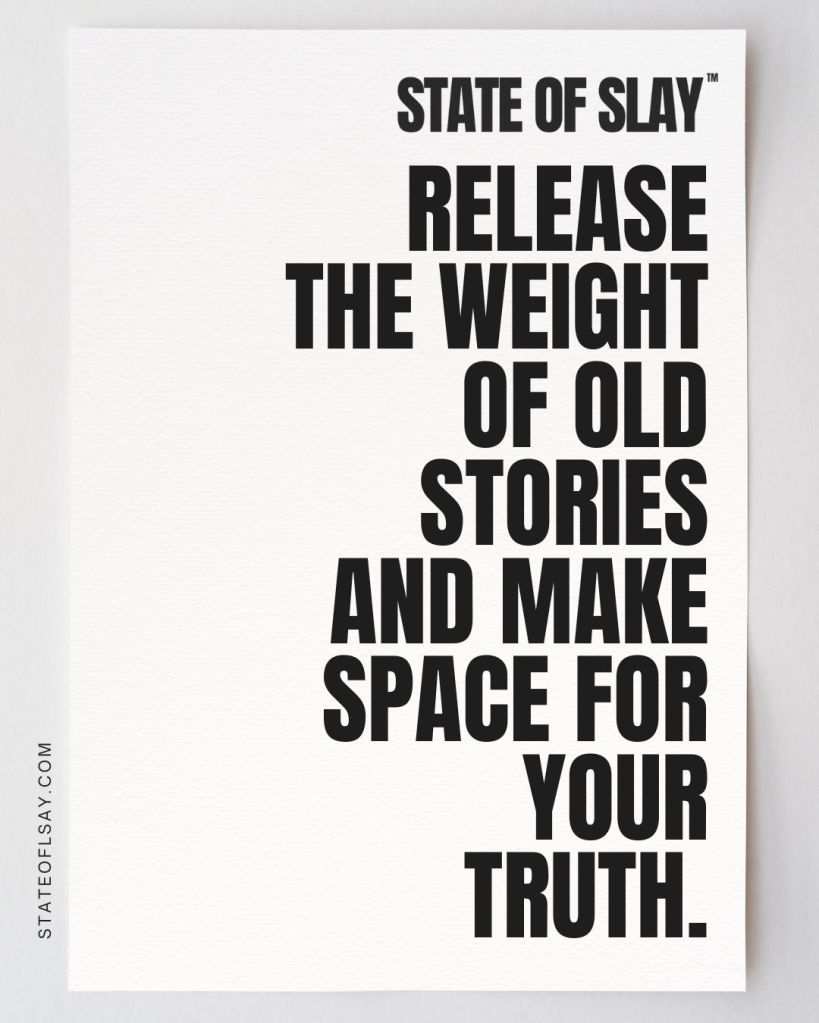
It’s easy to carry the weight of old stories, the ones that say you can’t, or you’re not enough.
But today, release those stories.

Clear the space for your truth, for the voice that’s been waiting to be heard.
When you let go of what no longer serves you, you make room for what’s real, what’s possible.

This is a reminder to free yourself from the chains of yesterday and step into your truth.

Your truth is waiting.

SLAY ON.

Release the weight of old stories and embrace your truth. Let go of the beliefs and narratives that no longer serve you, and create space for a life rooted in authenticity. This is a reminder to take one small step today toward letting go, and give yourself permission to live fully in your truth.

Let Them

This one hits close to home.
Because for a long time, I didn’t know how to let people be who they are.
I was always trying to manage, to steer, to shape the outcome I wanted.
Even when it was wrapped in good intentions, it was still control.

The truth is, trying to change someone—whether it’s their behavior, their choices, or how they show up—only leaves you drained, resentful, and disappointed.
Why? Because it’s not your job.
It never was.

The moment I truly understood that…
The moment I stopped trying to micromanage other people’s lives, reactions, or growth…
Was the moment I started finding peace.


The Mindset Shift That Changed Everything

Let them.

Let them say what they want.
Let them make their choices.
Let them believe what they believe.
Let them walk away—or come back—or stay exactly the same.

Because it’s not your responsibility to make someone become who you want them to be.
And it’s not your failure when they don’t.

The need to control others is often rooted in fear.
Fear of abandonment.
Fear of chaos.
Fear that if someone doesn’t change, you won’t be okay.

But guess what?
You will be okay.
Because your peace, your healing, your worth—none of it depends on someone else getting it right.


Expectations Are Heavy

Most of us don’t realize how much energy we spend trying to get someone to meet our expectations.
We want them to act differently, to love better, to show up the way we imagined they would.

And when they don’t?
We get frustrated.
We get hurt.
We spiral.

But here’s the uncomfortable truth:
They never agreed to those expectations.

They’re being who they are.
And we’re the ones trying to rewrite their character in our story.

What if instead of trying to change them—we just let them?


Letting Go Is a Boundary

“Let them” isn’t passive.
It’s powerful.

It’s not about giving up.
It’s about letting go of what was never yours to hold in the first place.

Let them be who they are—so you can stay rooted in who you are.

It’s a boundary.
A decision to protect your energy by not chasing down someone else’s growth.

When you stop investing in the outcome you wish for and start accepting the truth of what is, you reclaim your power.

You also make space for people who can meet you where you are.
Who choose to show up.
Who don’t need to be changed, convinced, or coerced.


Peace Lives in Acceptance

Let them believe the lie.
Let them ghost you.
Let them not understand your heart.
Let them leave the group chat.
Let them love someone else.
Let them misunderstand you.
Let them think they’re right.
Let them talk behind your back.

And while they do?

Let yourself grow.
Let yourself feel.
Let yourself heal.
Let yourself move on.
Let yourself love without attachment.
Let yourself stay soft and strong at the same time.

You are not here to force alignment.
You are here to be aligned—with yourself.


SLAY Reflection: Where Are You Holding On Too Tightly?

  1. Who in your life are you trying to manage, fix, or control?
    What are you hoping to change—and why?
  2. How has that effort affected your peace, energy, or self-worth?
    What are you losing in the process?
  3. What would it look like to “let them” be exactly who they are?
    What fear comes up when you consider that?
  4. How can you create a boundary that protects your energy without trying to change theirs?
    What could you gain by stepping back?
  5. What’s one relationship or situation where “letting them” would bring you more emotional freedom?
    How can you start that shift today?

Call to Action: Join the Conversation

I’d love to hear from you.
What’s one way you’ve learned to let someone be who they are—and how did that shift your peace?
Share your story in the comments. Let’s cheer each other on.

And if you know someone who’s holding on too tightly, send this to them.
Sometimes, all we need is a nudge.

Slay Say

Stop Seeking Healing from the Hurt

True healing doesn’t come from the people who caused the pain.

It comes when you stop looking for closure, validation, or understanding from those who never had the capacity to give it.

Let this be a reminder to reclaim your power—and choose peace on your own terms.

Live Between Always and Never

We often live life on autopilot.
We repeat the same routines, stick to the same beliefs, and follow the same patterns—not because they’re working, but because they’re familiar.

We tell ourselves this is just how we are.
We find comfort in the certainty of always and never.
But here’s the thing—certainty doesn’t always lead to progress.

I’ve written before about living in the gray, the in-between.
It’s in that space where change actually happens.
Where new ideas take root.
Where we make space for growth and possibility.

The middle is where transformation begins.


The Trap of Always and Never

Before I walked the path I’m on now, I was all about the extremes.
Always. Never.
I thought I knew what was best for me and I wasn’t interested in hearing otherwise.

I wasn’t happy—but I also wasn’t willing to change.

I stayed stuck. I stayed sick.
And I kept doing the same things over and over, expecting different results.

That wasn’t just frustrating—it was exhausting.
But it was also a product of my mindset.
I was clinging to always and never like a shield, and it was keeping me from moving forward.


The Power of Maybe

Everything began to shift when I allowed just a little room for maybe.

Maybe there’s another way.
Maybe I don’t know everything.
Maybe if I try something different, I’ll get a different result.

Recovery taught me that change only comes when you’re open to it.
I had to let go of the way I had always done things and be willing to try something new.

Was it uncomfortable? Yes.
Was it worth it? Absolutely.

Not everything I tried worked.
But trying was the point.
There were lessons in the failure—and confidence in the attempt.

Even now, I catch myself falling into that never mindset.
But I’ve learned to challenge it.
Because the best things in my life today?
They came from saying yes to something new.
From living in the middle.
From staying open.


Let Go of What’s Holding You Back

Stubbornness might feel like safety, but it often blocks growth.
It keeps us locked in patterns that no longer serve us.
It makes life smaller.

Living between always and never invites in the unknown—and yes, that can be scary.
But it also makes space for beauty, surprise, connection, and healing.

There’s a whole world you haven’t tried yet.
New waters to wade into.
New experiences that could change everything.

You’ll never know how warm the water is unless you take the first step in.


SLAY Reflection: Are You Open to the Middle?

  1. Do you tend to stick to the way you’ve always done things?
    What impact has that had on your life?
  2. Have you ever said no to something new—and later regretted it?
    What was the opportunity, and what did you learn?
  3. What parts of your life would you like to see change?
    Are you willing to try something different to make that happen?
  4. What are some small ways you could move away from always and never?
    How could you make room for maybe or I’ll try?
  5. What’s one thing you can say yes to today that pushes you out of your comfort zone?
    What could open up if you did?

Call to Action: Join the Conversation

I’d love to hear from you.
What’s one moment in your life when saying “maybe” instead of “never” led to something unexpected—or even life-changing?
Share your story in the comments. Let’s cheer each other on.

And if you know someone who’s stuck in patterns that aren’t serving them, send this to them.
Sometimes, all we need is a nudge.

A Permanent Solution To A Temporary Problem

When I was living in the dark, I believed every problem was forever.
Each issue felt massive, heavy, and permanent.
I didn’t think in steps—I thought in panic.
And when I finally acted, it was usually out of desperation instead of intention.

I didn’t face things as they came.
I waited.
I hoped things would magically resolve themselves.
And when they didn’t, I reacted impulsively.
The result?
I made permanent decisions for temporary problems.

Back then, I only had two tools in my emotional toolkit: fight or flight.
And neither got me where I wanted to go.


Living in Avoidance Creates Bigger Problems

I often felt overwhelmed just by life itself.
So when a real issue came up, it was too much.
I ignored it.
I pushed it aside.
And when it inevitably resurfaced—louder, heavier, messier—I made whatever decision would make it go away the fastest.

But the quickest choice isn’t always the right one.
And those choices came at a cost.

Doors closed.
Friendships ended.
I isolated myself even more.

It wasn’t because I was heartless or careless.
It was because I was exhausted, reactive, and afraid.
And I didn’t trust that I could handle hard things in a healthy way.


What Recovery Taught Me About Decisions

When I began my journey in recovery, one of the first things I heard was:
“Live life on life’s terms.”

That didn’t sound like fun.
But neither was the anxiety of constantly avoiding things, or the shame of regret from acting out of fear.

So I tried something new.

I started addressing things as they came up.
I got honest about what was happening.
I asked for help when I needed it.
And I made the best decision I could with the information I had.

Then—I let it go.

Even typing that?
It still feels like a deep exhale.


The Power of Responding, Not Reacting

Here’s what I learned:
When you meet problems in the moment, you keep them in their right size.

You don’t allow them to grow into something overwhelming.
You don’t back yourself into a corner.
You don’t hit the panic button and take drastic action that you’ll later wish you hadn’t.

You give yourself the chance to choose a solution, not a reaction.

Because the truth is, a lot of the things we avoid aren’t actually that big.
They only feel big because we’ve been sitting in fear, feeding them with delay.

But when you face a problem early and with intention, you take back your power.
You act instead of react.
And you protect your peace in the process.


You Deserve Better Than Regret

These days, it’s easy to feel like everything is too much.
But avoidance won’t make it easier.
And quick-fix decisions rarely leave us proud of how we showed up.

You don’t need to solve everything perfectly.
You just need to do the next right thing.
Address what needs your attention, make the best decision you can, and then—let it go.

Honor yourself enough to stop running from the things that need your care.
You are capable.
And you deserve peace, not permanent regret from a temporary storm.


SLAY Reflection: Are You Choosing Peace or Panic?

  1. Do you tend to ignore problems until they become bigger than they need to be?
    How has that affected your life?
  2. What emotions drive your decision-making—clarity or anxiety?
    What patterns do you notice?
  3. Have you ever made a permanent choice in a moment of panic?
    What did you learn from that experience?
  4. What would it feel like to address issues with intention instead of urgency?
    How could that shift your daily peace?
  5. What’s one problem you’ve been avoiding that you can face today—with care, calm, and clarity?
    What’s the next small step?

Call to Action: Join the Conversation

I’d love to hear from you.
What’s one moment where you learned the value of pausing instead of panicking—and how did it shape your choices going forward?
Share your story in the comments. Let’s cheer each other on.

And if you know someone who’s caught in reactive patterns, send this to them.
Sometimes, all we need is a nudge.

Examine What You Tolerate

I used to tolerate a lot.
From other people.
From myself.

I let things slide to avoid conflict.
I ignored red flags because I didn’t want to make waves—or because I was too emotionally and mentally exhausted to face the truth.
And so I allowed bad behavior to take up space in my life, even when it was actively hurting me.

But life isn’t meant to be tolerated.
It’s meant to be lived.
To be enjoyed.
To challenge us, to teach us, and to help us grow.

When we start making excuses for the people, places, and patterns in our lives just so we can “get through” them, we’re not being brave—we’re betraying ourselves.


Tolerating the Things That Keep Us Down

When I was living in the dark, I let most things go—unless I was looking for a fight.
And on the days I was angry at myself, I was often searching for someone else to blame.

I played the victim like it was my role in life.
I pointed fingers outward instead of inward.
And I tolerated behaviors in myself I knew deep down were harmful.

That was the first place I had to start when I began my recovery:
What was I tolerating in myself that was keeping me sick?


Justifying What Needs to Go

I had made excuse after excuse for the choices I was making.
One bad decision would snowball into another, and I would justify every one of them.

I ignored warning signs.
I surrounded myself with people and situations that reinforced my belief that I wasn’t worthy of more.
And I used those experiences as proof that I was a victim of life, rather than someone who had the power to change.

Even when good people showed up in my life, I didn’t know how to let them in.
I had grown more comfortable with pain than with peace.
And that realization was sobering.


From Tolerating to Choosing

As I got honest with myself, I began to see just how much of my pain I had been allowing.
And once I saw it, I couldn’t unsee it.

So I took a stand.

First with myself—by refusing to continue the behaviors that hurt me.
Then outward—by looking at every person, place, and pattern through the lens of self-love.

If it wasn’t helping me grow…
If it wasn’t rooted in respect, support, or truth…
It had to go.

Letting go wasn’t always easy.
But every goodbye made more space for peace.


The Practice of Daily Self-Respect

Even now, as life moves fast and new challenges arise, I have to keep checking in.
When I start tolerating things that don’t serve me, I feel it.
The darkness creeps back in.
The negative voices get louder.
And I know—it’s time to realign.

Self-love isn’t a one-time decision.
It’s a daily practice.
And part of that practice is examining what you’re tolerating—and having the courage to release what no longer honors you.


SLAY Reflection: What Are You Still Tolerating?

  1. What have you been tolerating in your life that feels heavy, harmful, or out of alignment?
    Why are you still holding onto it?
  2. How have your own actions contributed to the pain or frustration you feel?
    What patterns need to be disrupted?
  3. Are there people or relationships in your life that take more than they give?
    What would it feel like to set boundaries—or let them go?
  4. What excuses have you made for staying in situations that don’t serve you?
    Where did those excuses come from?
  5. What would change if you stopped tolerating what hurts you—and started choosing what heals you?
    What’s the first step?

Call to Action: Join the Conversation

I’d love to hear from you.
What’s one thing you’ve tolerated for too long—and how are you ready to honor yourself by letting it go?
Share your story in the comments. Let’s cheer each other on.

And if you know someone who’s carrying things they no longer have to, send this to them.
Sometimes, all we need is a nudge.

Today I Will Not Stress Over Things I Cannot Control

Easier said than done, right?
Especially now.
It feels like everything—from the world at large to our daily lives—is spiraling beyond our control.

And it’s true: most of life really is outside of our hands.
No matter how hard we try to will something into existence or change an outcome, some things just are.
But here’s the truth I’ve come to live by:
I may not be able to control what happens around me—but I can control how I respond to it.
And that’s where the power is.


The Illusion of Control

When I was living in the dark, I was consumed by control.
Trying to manage everything and everyone.
Manipulating, bargaining, obsessing—believing that if I could just control the situation, I could finally feel safe.

But no matter how hard I tried, life had other plans.
It didn’t care how hard I worked to bend it to my will.
And I exhausted myself trying.

The more I tried to control, the more unmanageable everything became.
It didn’t just wear me out—it wore me down.
My mental health suffered.
My self-worth took a hit.
And I lost myself in the process.


Letting Go Was the Turning Point

When I finally made the decision to change my life, I was told something that made me flinch:
You have to accept that you can’t control everything.”

That one sentence lit up every fear I had.
I didn’t want to hear it.
But I needed to.

Because as terrifying as letting go felt, holding on was doing more damage.

So I started small.
I worked on myself.
I practiced gratitude.
I focused on the good.
And I gave back where I could.

Slowly, the need to control started to loosen its grip.
And I began to feel something I hadn’t felt in a long time: peace.


The Freedom in Acceptance

Letting go doesn’t mean giving up.
It means accepting reality as it is—and choosing to move forward anyway.
It means doing what you can, where you are, with what you have.

It means focusing on your choices, your behavior, your energy—not the chaos around you.

And when you feel that old need for control creeping in?
Put the focus back on yourself.
Or do something kind for someone else.
It’s a powerful reset.

Because the truth is, trying to control what’s out of your hands only ends up controlling you.


What I Can Do Today

There are still plenty of things I can’t control—and many of them deeply disturb me.
But I’ve learned that obsessing over what I can’t change doesn’t help.

What does help?
Doing what I can.

I show up for myself.
I show up for others.
I make better choices.
And I leave the rest.

Because acceptance isn’t giving up—it’s breaking free.


SLAY Reflection: Where Are You Holding On Too Tight?

  1. Do you stress over things that are out of your control?
    What are they—and how do they affect your peace?

  2. How has your need for control shaped your relationships, habits, or mental health?
    What patterns do you see?

  3. What’s one area of your life where you could let go a little more today?
    How would that feel?

  4. What are you really afraid of when you try to control everything?
    Is it fear of failure? Rejection? Uncertainty?

  5. What would shift if you focused on your response, rather than the outcome?
    Where can you put your energy to use in a healthier way?


Call to Action: Join the Conversation

I’d love to hear from you.
What’s one thing you’re ready to stop stressing over because you’ve realized it’s out of your control?
Share your story in the comments. Let’s cheer each other on.

And if you know someone who’s stuck in the loop of control and frustration, send this to them.
Sometimes, all we need is a nudge.