Slay Say

Vulnerability is bravery in action

Being vulnerable isn’t easy. It means showing up without the filter, letting people see the real you — fears, flaws, feelings and all. But vulnerability is not a weakness. It’s courage in its rawest form.

When we choose honesty over perfection, we create real connection — with ourselves and with others. That’s where true growth happens.

Let this be your reminder: you don’t have to have it all together to be worthy of love, support, or success.

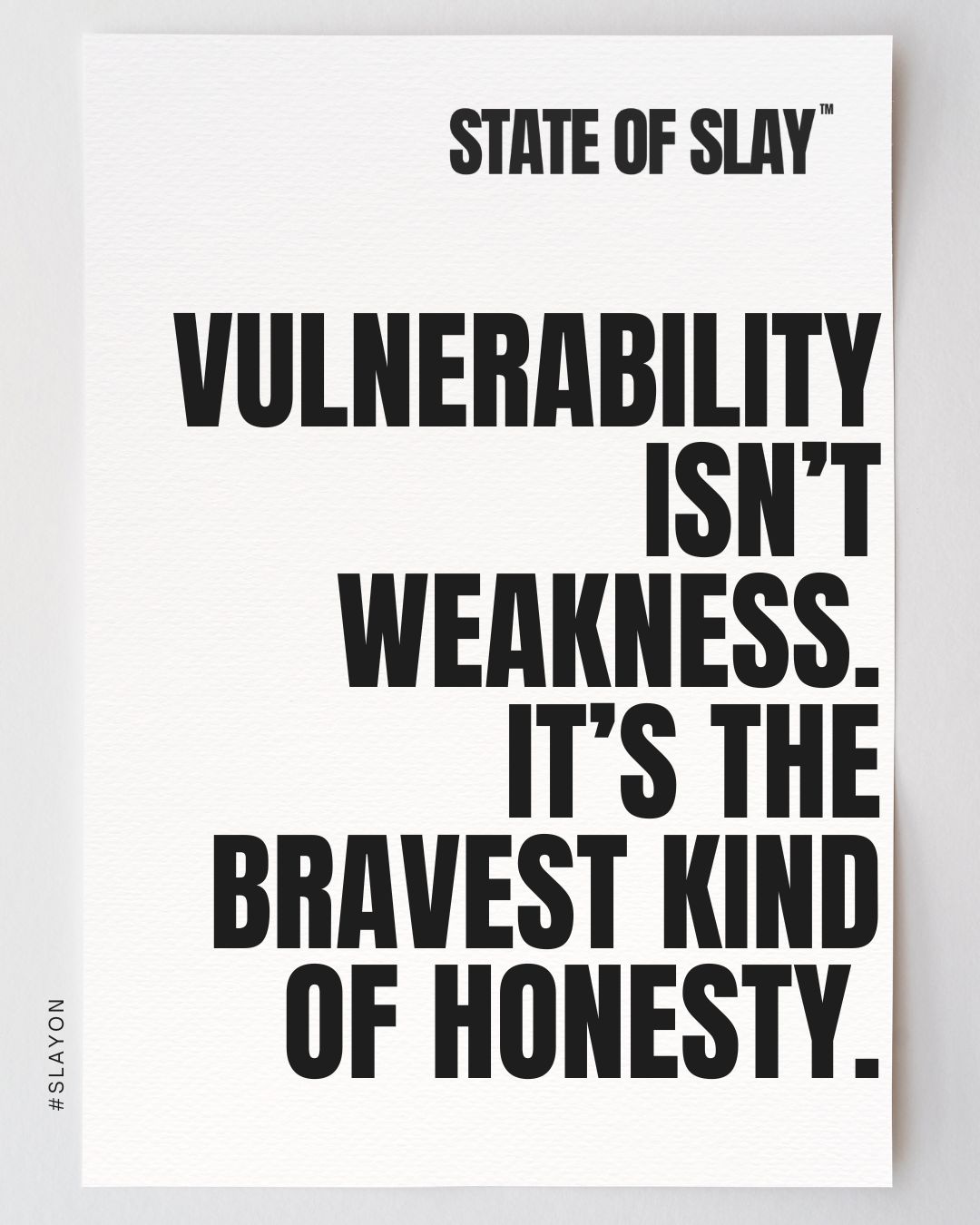
Quote in block letters saying: Vulnerability isn’t weakness. It’s the bravest kind of honesty.

Carrying A Message Of Hope

It wasn’t a dramatic moment. There were no grand speeches or earth-shattering revelations. Just a quiet, honest story from someone who had been through it, too. A simple retelling of a journey—his lowest lows and the moment he decided to ask for help.

That story gave me the courage to reach out. It was the first spark of hope that told me maybe I didn’t have to stay where I was. Maybe change was possible. Maybe I could begin again.

That is the power of carrying a message of hope. And it’s why I do what I do now.


We All Need a Spark

Hope doesn’t always come with fanfare. Often, it shows up in the form of a shared experience. In someone else’s voice. In a message that says, “You are not alone. I’ve been there, too.”

Especially in challenging times—when life feels uncertain or heavy—those stories matter more than ever. We may feel isolated, ashamed, or like our pain is too much of a burden to place on anyone else. But when someone dares to tell their truth, they give permission for others to speak theirs.

And sometimes, that’s all it takes to change a life.

We weren’t meant to do this alone. I know I couldn’t have walked this path without the people who were willing to share their light when mine had gone dim. Whether it was a friend, a professional, or someone who simply saw me and cared enough to reach out—each one helped carry me forward. Now I do the same.


Your Story Has Power

We often think our story isn’t worth sharing. That it’s too messy, too painful, or not inspirational enough. But that’s not true.

Your story—exactly as it is—might be the one someone else needs to hear. It might be the bridge that helps them cross from fear to courage, from shame to honesty, from isolation to connection. You don’t have to have it all figured out. You just have to be real.

Kindness counts. Connection heals. And hope spreads when we pass it on.


Simple Acts, Big Impact

During difficult seasons, I’ve learned to slow down, keep things simple, and focus on the people, practices, and projects that bring me joy. That is what fuels me.

Hope isn’t loud. Sometimes it’s a quiet hello. A knowing glance. A kind message. A reminder that someone cares.

Today, offer your story. Offer your presence. Offer your hope. You never know who needs it—including you.

SLAY on.


SLAY Reflection: Share the Light

  • Have you ever received hope from someone else’s story? What impact did it have on you?
  • Do you find it easy or difficult to share your truth with others? Why?
  • Is there someone in your life who could benefit from your experience?
  • What stops you from reaching out—and what could help you move through that fear?
  • How can you carry a message of hope in your own way, today?

Call to Action: Join the Conversation

I’d love to hear from you.
Who carried a message of hope to you—and how are you carrying it forward?
Share your story in the comments. Let’s cheer each other on.

And if you know someone who could use a little light, send this to them.
Sometimes, hope is hiding in someone else’s words.

At A Rare Loss For Words

It’s not often I’m at a loss for words. Ask anyone who knows me well, and they’ll tell you—I’ve always got something to say. But lately? Lately, I’ve felt more shaken. Disheartened. I’ve struggled to find the right words in the face of what feels like an unraveling of the world around me.

If you’ve been reading the blog or following State of Slay™ for a while, you know I try to focus on growth, light, and resilience. I look for the lesson. The shift. The silver lining. And I’ve been trying to do that even as it feels like the people and places around me are falling apart.

Yesterday, it hit hard. I sat in my car, parked outside a store, completely unable to get out. I was paralyzed by the weight of it all—the lies, the selfishness, the lack of empathy. I’ve been feeling it for a while now: the anxiety of living in a place that doesn’t feel safe, the exhaustion of building something meaningful in uncertain times, the strain of trying to uplift others when I’m struggling to hold myself up.

A friend recently said they missed my positive energy. I mentioned I’d been a little low, and they replied that they’d noticed—but didn’t ask why. Didn’t check in. I get it. We all have a lot going on. But if we lose that connection—if we stop checking in on each other—what do we have left?

I know how I’ve made it this far: community. Support. A deep belief that light exists, even when it’s dim. My flame may be flickering, but it’s not out. And I know where to look to ignite it again.


When Darkness Feeds Itself

Before recovery, I thrived in the dark. I fed off negativity. I surrounded myself with people who mirrored my pain—people who used me, hurt me, and validated my belief that I wasn’t worthy of love or light. I clung to the victim narrative because it was easier than owning my part.

That mindset? It’s poison. It makes you believe that happiness is something someone else gives you. But real happiness—the kind that lasts—comes from living with integrity. From taking responsibility for our actions, our energy, and our healing.

Recovery taught me that the road to peace is paved with truth. That my actions, not my intentions, define who I am. That I get to choose how I show up in the world. And that means something, especially in times like these.


Be the Person You’re Proud Of

We’re all going through something. Some days are heavier than others. But now more than ever, we need to lift each other up—not tear each other down. We need to ask the extra question, send the check-in text, give the benefit of the doubt.

We need to be someone we can be proud of.

A few months ago, I asked: When all of this is over, will you be proud of who you were?

If you hesitate to answer, it’s time to get honest.

Choose compassion. Choose kindness. Choose truth. Choose to be the light—even if your flame is just a spark right now.

SLAY on.


SLAY Reflection: Are You Someone You’d Be Proud Of?

  • Have you been living in integrity—with yourself and others?
  • Where have you fallen short? What can you do to make it right?
  • Are you showing up for others—or just for yourself?
  • What has your energy been like lately? How are you affecting the spaces you enter?
  • What’s one action you can take today to reconnect—with others and with yourself?

Call to Action: Join the Conversation

I’d love to hear from you.
What’s one thing you’ve done recently that made you proud—or one thing you want to do to course-correct?
Share your story in the comments. Let’s cheer each other on.

And if you know someone who’s feeling disconnected or dim, send this to them.
Sometimes, all we need is a little light to find our way back.

The Oops Factor

Growing up, I never left any room for mistakes. I expected myself to do everything perfectly—and when I didn’t, I beat myself up. I carried these unrealistic expectations with me through childhood, my teenage years, and well into adulthood, never giving myself permission to simply be human. The result? A constant negative narrative playing on loop in my head, convincing me I wasn’t good enough. Every mistake felt like proof of failure, which I used as an excuse to abandon self-care, spiral into self-doubt, and reinforce the lie that I could never get better.

I see now that none of that thinking was true. I made it feel true by keeping my struggles to myself and believing the cruelest voices in my mind. I nearly rode that train all the way into the station—but thankfully, I got off before the final stop.

The truth is: our mistakes are where we learn the most. They shape our character. They build the resilience we need to accomplish the things that really matter. No one is meant to get it right every time. The growth is in the slip-ups. That’s why we need to embrace what I call the “Oops Factor.”


What Perfectionism Really Cost Me

Expecting myself to be perfect—even when I knew better—set me up to fail. I’d aim impossibly high and, when I missed the mark (which was inevitable), I’d use that as ammunition to tear myself down. Even when I succeeded, I picked apart the outcome. I never gave myself permission to feel proud. That made relationships harder too. I lived in fear that people would see me for the fraud I thought I was.

Eventually, I reached a breaking point and asked for help. In that process, I learned something life-changing: mistakes are a sign that I’m trying. They mean I’m pushing myself. And even when things don’t work out the way I hoped, there’s always a lesson or a growth opportunity—often the real reason I was on that path in the first place.

Over time, I’ve learned to trust that I’m exactly where I need to be. My job is to take the next right step. I can’t control the outcome—just the intention behind the action. And when I show up with that mindset? It’s always a win. Trying is the victory. There’s always something to gain.


Make Room for the Oops

We’re all allowed to make mistakes. In fact, we should be making them. That’s how we grow.

Start leaving space for the Oops Factor in your life. When something doesn’t go as planned, look for the lesson—or simply laugh it off. Don’t let the fear of messing up keep you from taking risks or being yourself. Let go of the pressure to be perfect and redefine what success looks like. Maybe, just maybe, being exactly who you are today is enough.

Mistakes don’t define you. But how you respond to them just might.

SLAY on!


SLAY OF THE DAY: Reflect & Rise

  • Do you expect yourself to be perfect?
  • How do you usually react when you make a mistake?
  • Does that response help you—or harm you?
  • What’s one belief about mistakes that you’re ready to let go of?
  • What’s one thing you’ve learned from a recent oops moment that helped you grow?

Give yourself permission to stumble. Learn, laugh, and get back up stronger.


Call to Action: Join the Conversation
I’d love to hear from you.
What’s one way you can show yourself more grace when you make a mistake?
Share your story in the comments. Let’s cheer each other on.

And if you know someone who’s been stuck in a shame spiral, send this to them.
Sometimes, all we need is a little reminder that it’s okay to mess up.

The Language Of The Heart

I was talking with someone recently about truth—
that raw, honest place inside where there are no walls, no masks, no pretending.
That space where we allow ourselves to be vulnerable enough to let our truth speak to someone else’s truth.

That, to me, is the language of the heart:
one heart speaking to another.


Before I Could Speak From the Heart

Before walking this path, I didn’t speak that language. I couldn’t.
I was too afraid to let anyone see the real me.

I believed vulnerability was weakness.
I was convinced that if you saw who I really was, you’d run.
So I kept my heart closed. I played roles. I wore masks.
I hid behind a version of myself I thought the world would accept.

But all that hiding left me feeling even more isolated. Even more alone.
And the more I suppressed my truth, the more painful it became to carry it.

It took a long time to let that fear go.
To open the door—even just a crack—and let the truth come through.


Surrender Is Where It Began

I had to surrender.
Admit that my way wasn’t working.
That my silence, my pretending, my performance—it was keeping me stuck. Sick.

That surrender became a turning point.
The moment I let go of control was the moment I took my power back.

From there, I was told something that has stayed with me:
You have to be rigorously honest if you want to get better.

No more pretending. No more hiding. No more playing small.

And that honesty? It wasn’t just about speaking truth to others.
It was about telling the truth to myself. Every day. Even when it felt uncomfortable. Even when it was messy.


The Power of Speaking From the Heart

The more I spoke from the heart, the more comfortable I became living in that truth.
And the more honest I was, the deeper my connections became.

But I won’t lie—it wasn’t always easy.
There were still times I held things back, thinking I wasn’t ready to let them go.
But each time I did, I felt the disconnection.
The space it created. The wall it built between me and the people who loved me.

Now, I know better.
When I’m not honest, I lose those connections.
I lose myself.

Honesty—heart-led honesty—is what keeps me aligned, connected, and free.


Your Truth Is Beautiful

It can feel scary to speak from the heart. To show someone your truth.
But that is the place where our most beautiful, powerful self lives.

Even when our truth is sad. Or messy. Or uncertain.
If it’s honest, it’s real.

And when we speak from that place, we give others permission to do the same.

So open your heart.
Speak your truth.
Let your light guide you—and light the way for someone else.

SLAY on.


SLAY OF THE DAY: Reflect & Rise

Do you speak your truth—or do you hide behind what you think others want to hear?

  • What fears keep you from being fully seen?

  • Are those fears yours—or were they passed down to you?

  • How has sharing your truth helped you or someone else?

  • What would it look like to speak more from your heart—today?

The language of the heart is honest, raw, and real.
When we speak it, we don’t just heal ourselves—we create space for others to heal, too.


Call to Action: Join the Conversation

I’d love to hear from you.
What helps you speak the language of your heart?
Share your story in the comments. Let’s cheer each other on.

And if you know someone who’s been afraid to share their truth, send this to them.
Sometimes, all we need is permission to be real.

The Perceived Danger Of Loneliness

There’s a reason loneliness can feel like danger.

Centuries ago, being alone was a legitimate threat. If you were separated from your tribe, you were more vulnerable to predators and physical harm. That primal instinct still lives in us today—so when loneliness creeps in, it doesn’t always just feel sad. It can feel scary. Like we’re under attack. Like we’re in danger.

But the truth is, in most cases today, that danger is no longer external—it’s internal. And that’s why it can be so hard to recognize and even harder to break free from.


Loneliness Isn’t Just Isolation—It’s Fear

When I was living in the dark, I felt completely alone. And I did feel like I was in danger. The danger of being found out. The danger of being consumed by depression. The danger of not making it out alive. My thoughts became a battlefield, and my body was constantly in survival mode—tight, tense, panicked.

Some of that fear was justified. I was making choices that weren’t safe. But much of it was perceived—fed by my mindset and fueled by the lies I told myself about who I was and what I deserved.

And the lonelier I felt, the more danger I imagined. I convinced myself I was better off alone. That no one would understand. That I didn’t belong.
But that wasn’t true. That was just the fear talking.


The Way Out Is Connection

The moment things began to change was the moment I heard someone else’s story. Someone who had been where I was. Someone who understood the darkness. That tiny moment of connection cracked something open in me—and I found the courage to ask for help.

That help came in the form of community. Of people who weren’t perfect, but who were honest. Who shared their truths. Who didn’t try to fix me, but simply walked with me.

And that’s when the perceived danger began to dissolve. Because I wasn’t doing it alone anymore. I wasn’t in survival mode—I was in connection mode.
And connection, not isolation, is where healing begins.


You’re Not Alone (Even When It Feels Like You Are)

We are never as alone as we think we are. Even in our darkest moments. There is always someone out there who will understand—because they’ve been there too.

And when we share our truth, it connects us. It takes away the power of fear.
When we speak our loneliness out loud, we remind ourselves that we are human—and we give someone else permission to do the same.

You don’t have to suffer in silence. You don’t have to go it alone.
There is always a hand to reach for—and a voice waiting to say, “Me too.”

SLAY on.


SLAY OF THE DAY: Reflect & Rise

Do you associate loneliness with danger? And what does that danger feel like?

  • What thoughts or fears come up when you’re feeling lonely?

  • Do you tend to isolate or reach out?

  • Who can you confide in—right now, today?

  • Are you filling your loneliness with distractions or connection?

  • What’s one step you can take to reach out and remind yourself you are not alone?

Connection is the antidote to fear. And vulnerability is the path to healing.


Call to Action: Join the Conversation

I’d love to hear from you.
What has helped you move through loneliness into connection?
Share your story in the comments. Let’s cheer each other on.

And if you know someone who’s struggling in silence, send this to them.
Sometimes, the bravest thing we can do is remind someone they’re not alone.

A Little Honesty Goes A Long Way

Coming from a life of hiding my truth, living in fear of being found out, and wanting to appear to be more than I was, I understand dishonesty. I lived a dishonest life, even from myself, so how could I be honest with others? I lied even when I didn’t need to, unaware of the weight of those lies. My life became a tangled web until I couldn’t keep track of it all, and the only truth left was that everything was unmanageable, and I had fallen so far into darkness I wasn’t sure I could find my way out.

Thankfully, someone came into my life and shared his honesty with me. That act gave me hope.

When I began walking the path of recovery, I had to learn to be honest, starting with myself. I had to stop believing the lies that kept me sick and face the truth. I had to get rigorously honest if I wanted to build a new life from the foundation up. That foundation had to be honesty. So, I rolled up my sleeves and got to work.

Facing the truth wasn’t always easy. It meant looking at my past actions, what I’d said, the harm I’d done to myself and others. My lies always pointed fingers outward, but the truth—the honest truth—was that I played a role in my pain and chaos. Letting go of my fear of judgment, I began to speak my truth. Even though my head told me not to, I charged ahead anyway. And on the other end of that honesty, I found support. People didn’t reject me or push me away—they offered their hand, their understanding, and their ear. As I shared my truth, my guilt, anger, and fear started to melt away.

I was taught, and continue to learn, to be honest about my intentions, my time, and what I am truly willing and able to contribute. It was scary at first, but as I practiced it, the results were always better. That doesn’t mean there weren’t disappointments or frustrations, but they were far fewer than when I was saying what I thought others wanted to hear.

The truth is, most people want the truth—not some made-up story to save face. Being honest shows not only respect for yourself but also for others. It shows vulnerability and opens the door for collaboration, understanding, and solutions we might not have found on our own. When we are honest, we have nothing to hide. And when we’re not spending our energy hiding, we are free.

Sometimes, we enter situations with the best intentions and realize the reality doesn’t match. Instead of pretending or keeping up appearances, try being honest. You may find that instead of working against you, others will work with you toward a solution. Even if things don’t go the way you hoped, the act of being honest itself is a win because you are speaking your truth, instead of pretending to be something—or someone—you’re not.

Be honest about who you are, what you can offer, and what you can truly give. As they say, the truth will set you free. And that freedom? It’s all in your hands.

SLAY on.


SLAY OF THE DAY: Reflect & Rise

  • Do you tend to be honest with others? If not, why?

  • Are you honest with yourself? If not, why not?

  • Has dishonesty caused you trouble in the past? How might things have changed if you’d been honest?

  • What can you do today to be more honest, with yourself and others?

  • Are you afraid of honesty? Why?

  • How can you begin letting go of fear and speak your truth?


Call to Action: Join the Conversation
I’d love to hear from you.
What’s one truth you’re ready to speak today—about yourself or to someone else?
Share your story in the comments. Let’s cheer each other on.

And if you know someone struggling to be honest with themselves, send this to them.
Sometimes, all we need is permission to tell the truth.

Do You Like Yourself?

I used to say yes. To your face, I’d smile and say, “Of course I do!” But inside, the truth was always no.

From as far back as I can remember, I felt I wasn’t good enough. I thought I was weird, different, and if you knew who I really was, you wouldn’t like me. I set impossible standards for myself, and every time I couldn’t meet them, I’d beat myself up. Over the years, those unrealistic expectations grew bigger—and so did my self-hatred.

I had a constant, negative narrative running in my head, berating myself for not measuring up. My lack of self-love dragged me to darker places, until I stopped caring about my well-being. I took dangerous chances with my life, not because I wanted to die, but because I didn’t care if I lived.

It was only through a friend that I found the courage to reach out for help. That was the beginning of a new path—and the road from self-hatred to self-love was bumpy, messy, and full of stumbles. But it was worth every single one.


Starting with Forgiveness

When I began this journey, I couldn’t even look in the mirror and say, “I love you.” Just thinking about it makes me sad now. But I knew if I was ever going to like myself, I had to start by forgiving myself. And that wasn’t something I could do alone. I worked with a mental health professional and found support in groups of people walking the same path. Their guidance helped me move forward and start believing that I was worth forgiveness.


Gratitude and Giving Back

Gratitude was a key step. In the beginning, it felt nearly impossible, but I was encouraged to start with just one thing each day—one thing I was grateful for, and one thing I liked about myself. Some days I struggled to find even one, but I’d write it down and carry it in my pocket. Whenever I felt discouraged or fearful, I’d take it out and remind myself.

And then there was giving back. Early in my journey, I was shown that we always have something to give, even if we don’t think we do. Simply sharing our truth, asking someone how their day is, or offering a kind word can lift not just them, but also us. No matter how far down we may feel, someone else may feel even lower, and reaching out creates a connection.


Reflection in a Time of Pause

During this time of social distancing and isolation, when the world feels paused, we have an opportunity to ask ourselves: do I like who I am? If not, why? This is the perfect time to explore those feelings and make positive changes. And if we struggle to find things we like about ourselves, it’s okay to ask a trusted friend or family member what they see in us. Sometimes, seeing ourselves through their eyes helps us find the light.


SLAY OF THE DAY: Reflect & Rise

  • Would you say you like yourself? If not, why not?

  • If you do, what do you like about yourself?

  • Have you always liked yourself? If not, what changed?

  • If you don’t like yourself, was there a time when you did? What changed?

  • What can you do today to find something you like about yourself?

  • What are you grateful for today?

Focus on those things, SLAYER. Challenge yourself to discover more in the days to come. Ask others for their insights. Make sure the reasons you tell yourself don’t keep you stuck in negativity. And if they do, ask why you’re holding onto them. Learn to let them go, or forgive yourself for them. Self-love—or even just self-like—is waiting. Take that first step today.


Call to Action: Join the Conversation

I’d love to hear from you.
What’s one thing you like about yourself today?
Share it in the comments. Let’s cheer each other on.

And if you know someone who needs this message, send it to them.
Sometimes, a little reminder is all it takes to start a journey.

Name Your Fear

I spent years in the dark, without realizing that fear was driving nearly every decision I made.
I was afraid of not getting what I wanted.
Afraid of losing what I had.
Afraid of not being good enough.
Afraid of what others thought of me.
Afraid you already knew what a horrible person I was.

Fear whispered lies and distortions at every turn, clouding my judgment and leading me down a spiral of bad decisions. And once those decisions were made, fear crept in again—this time afraid I’d be found out for them.
I lived in constant irritability and discontent.


The Fog of Fear

Fear doesn’t always show up loud and obvious.
It disguises itself.
It justifies itself.
For me, it was like a low-lying fog—ever-present, making it hard to see the next steps.

When I committed to getting honest with myself, I began to confront my fears. At first, I wouldn’t have said I was afraid of much—except the trajectory of my disease. I knew if I didn’t face my fears, they’d consume me.
But naming them? That took time, and guidance from others.

I had to learn to trust—both the people supporting me and myself. When you live in fear, trust evaporates. You’re stuck in fight-or-flight, always waiting for the next trauma.
Learning to live with honesty and peace was a new concept.


Step by Step

I slowed down.
I started asking myself: What’s the next right thing?
And when I didn’t know, I asked for help.
I had to push through the fear of asking.

As I peeled back the layers of myself, the fears began to reveal themselves—each one an opportunity to heal. Slowly, those fears fell away, replaced by better decisions and a clearer sense of the life I wanted to create.

Letting go of fear also allowed me to share my true self without being paralyzed by the thought of being judged or “not enough.”
The same vulnerabilities that once kept me isolated became the bridges that connected me with others—and helped others still stuck in fear.


What Are You Really Afraid Of?

Right now, many of us live with fear—understandably so, given the world’s circumstances.
But how many of those fears are real?
How many are imagined?
How many can we actually name?

You can’t let go of fear you won’t name.

Find it.
Flush it out.
Let it go.

Because you deserve a life built on freedom, not fear.

SLAY on.


SLAY OF THE DAY: Reflect & Rise

  • Would you say you are someone who lives in fear?

  • What are you afraid of?

  • Do you know what you are afraid of?

  • Which fears are real, and which are imagined?

  • Where do those fears come from?

  • What steps can you take to let go of imagined fears?

  • How can you approach real fears in your life with clarity and strength?

  • How does holding onto fear help or hurt you?

Remember:
Some fear is healthy. It keeps us safe.
But most fear just holds us back.
Look at your fears today, Slayer.
Figure out why you’re holding on.
Don’t let fear rob you of your best life.


Call to Action: Join the Conversation

I’d love to hear from you.
What’s one fear you’re ready to name—and take a step toward letting go of today?
Share your thoughts in the comments. Let’s support each other’s journeys.

And if you know someone who might be feeling stuck in fear, send this to them.
Sometimes, naming a fear is the first step to reclaiming your power.

Sometimes It’s Not The Light That Guides Us But The Darkness That Pushes Us

We often hear that we should follow the light—look for hope, positivity, and healing to guide us forward. But what happens when the light feels too far away? When we can’t see it, let alone follow it?

There was a time in my life when the darkness wasn’t just around me—it was in me. It wrapped itself around everything I was and everything I believed about myself. It suffocated every flicker of light I had left. And the scariest part? I accepted it. I thought I belonged there. I convinced myself that if I just waited long enough, it would somehow resolve itself. But darkness doesn’t heal. It deepens—until you forget what light even looks like.


The Fear That Became Fuel

I’ve shared before that it was someone else’s story—someone brave enough to speak their truth—that gave me a tiny sliver of hope. Just enough to cling to. That story became my lifeline. I wasn’t ready to see my own light yet, but the fear of sinking further into that darkness became the fuel I needed to ask for help.

Sometimes, it’s not inspiration that gets us moving. It’s desperation. It’s the pain of staying the same. It’s the crushing weight of knowing if you don’t do something—anything—you might not make it. That fear can become a gift. A push. A nudge in a direction you’re not sure of, but one that takes you somewhere new. Somewhere better.

I often talk about seeking the light. But I know all too well that sometimes, the light isn’t what gets us started. Sometimes, the darkness is what pushes us toward the light we didn’t even know we were searching for.


The Lies Darkness Tells Us

Darkness is cunning. It doesn’t always show up like the monster under the bed. Sometimes it sounds like safety. Familiarity. Comfort. It whispers, “Stay here. At least here you know what to expect.”

But here’s the truth: darkness may feel familiar, but it is not safe. It convinces us we’re unworthy. It tells us we’re too broken to be seen, too far gone to be helped. It keeps us stuck with stories we’ve outgrown but don’t know how to let go of.

I used to think there was only one “right” way to heal. One perfect path forward. But that belief only kept me stuck longer. It wasn’t until I realized that healing isn’t a straight line—and it doesn’t always begin with light—that I gave myself permission to find my own way. Whether it’s a flicker of inspiration or a fire lit by fear, what matters is that you start.


The Gift of Desperation

They say necessity is the mother of invention, but I believe desperation is the spark of transformation. For me, it was the fear of staying in that deep, dark place that finally opened me up to something new. I call it the gift of desperation.

When what I was doing stopped working, I had to be willing to try something different—even if it scared me. Especially if it scared me. And that willingness, however small, cracked the door open to a new path.

It didn’t look like anyone else’s journey. It was messy. Uneven. Sometimes I was crawling more than walking. But I kept moving. I kept showing up. And little by little, I found my way out of the dark and into something resembling light.


Your Path Doesn’t Have to Look Like Anyone Else’s

There’s no single right way to heal, grow, or change. No template. No “should.” The truth is, we all have different catalysts. For some, it’s hope. For others, it’s heartbreak. For many of us, it’s both.

What matters is direction. If you’re moving toward a better version of yourself—whether by chasing the light or running from the dark—you’re on the right path.

The key is to remain open. To trust that no matter what’s behind you, what’s ahead can be better. And that willingness to shift—even if just a little—can create space for something powerful.


You Don’t Have to Stay Where You Started

If you’re in a dark place right now, I want you to know: you don’t have to stay there. The fact that you’re reading this means there’s still a flicker of light in you. Hold onto that. Feed it.

And if you can’t find your own light just yet, borrow someone else’s. Let their story, their voice, or even their presence guide you until you find your own strength. Sometimes the push of darkness is the very thing that leads us to the path we were meant to walk.

Always look for the light. But if you can’t see it yet, let the darkness give you the push you need for a better view.


SLAY Reflection

Take a moment to reflect, SLAYER:

  • S: Do you make changes by moving toward the light—or away from the darkness?

  • L: What moments in your life were driven by fear, and where did they lead you?

  • A: How can you reframe your current struggles as a push toward something better?

  • Y: What small shift can you make today to move forward, even if the light isn’t visible yet?


Call to Action: Join the Conversation

I’d love to hear from you.
Have you ever been pushed by darkness toward a better place?
Share your story in the comments. Let’s cheer each other on.

And if you know someone who’s feeling stuck in the dark, send this to them.
Sometimes, all we need is a nudge.