Slay Say

So much of what weighs on you happens quietly, internally.
The second-guessing.
The overthinking.
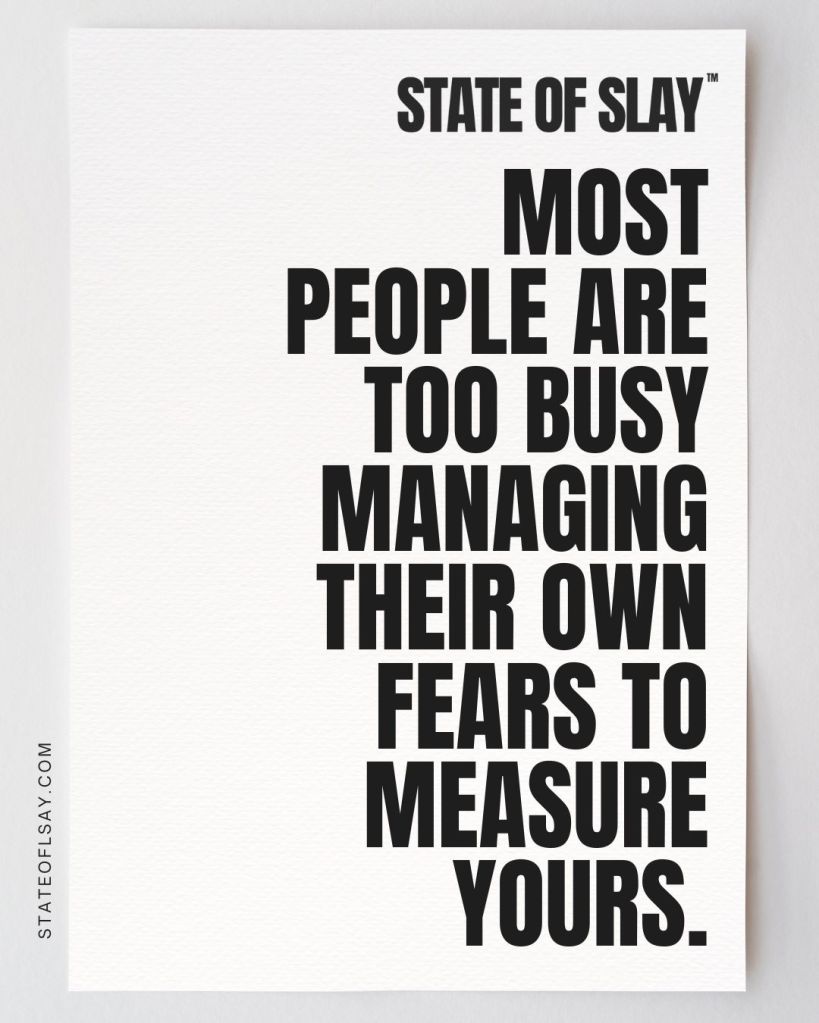
The fear that you’re being watched, measured, judged.

But most of that pressure isn’t real — it’s imagined.
It’s the mind looping through worries that no one else is replaying.
While you’re dissecting every move, most people are navigating their own uncertainties, carrying their own doubts, and trying to find their footing too.

You don’t need to be flawless to move forward.
You don’t need to shrink to stay safe.
You don’t need to carry a spotlight that isn’t actually on you.

Freedom begins when you stop living as if you’re being graded —
and start living as if you’re allowed to learn.

This is your reminder to release the unnecessary weight you’re carrying and move with more ease, more grace, and far less fear.

Slay on!

Survival Mode Is Meant to Save Your Life Not Become Your Life

There are seasons in life where survival mode is necessary. Where getting through the day is an act of bravery. Where your nervous system is on high alert, your heart is guarded, and your only goal is to make it to tomorrow.

Survival mode isn’t weakness.
It’s instinct.
It’s protection.
It’s your body and mind stepping in when things feel unsafe, overwhelming, or unbearable.

But survival mode was never meant to be permanent.

It’s meant to save your life, not define it.

And yet, so many of us stay there far longer than we should — not because we want to, but because it becomes familiar. Predictable. Safer than the unknown.

The danger isn’t entering survival mode.
The danger is building a life inside it.


When Survival Mode Becomes Your Default

Survival mode doesn’t always look dramatic. Sometimes it’s quiet. Functional. Even impressive from the outside.

You’re productive but disconnected.
Independent but exhausted.
Strong but numb.
Capable but constantly bracing for impact.

You tell yourself you’re fine because you’re still standing. Still working. Still showing up. But inside, everything feels tight. Restricted. On edge.

You’re not living — you’re managing.

When survival mode becomes your baseline, your nervous system forgets what safety feels like. Rest feels foreign. Joy feels suspicious. Peace feels temporary.

You stay alert because letting your guard down once cost you something.
And your body remembers.

But living in survival mode long-term comes at a price — emotionally, mentally, physically, and spiritually.


Survival Mode Kept You Alive Honor That

Before we talk about leaving survival mode, let’s be clear about something important:

Survival mode served a purpose.

It helped you endure what you couldn’t escape.
It helped you function when you couldn’t fall apart.
It helped you stay alive when the alternative felt unbearable.

There is no shame in that.

But honoring survival mode doesn’t mean staying there forever. Gratitude doesn’t require permanence. You can thank the coping mechanisms that carried you — without allowing them to cage you.

What once protected you may now be limiting you.
What once kept you safe may now be keeping you small.

And that doesn’t mean you failed — it means you’ve grown.


You Can’t Heal While You’re Still Bracing for Impact

Healing requires safety.
Growth requires space.
Peace requires permission.

Survival mode doesn’t allow for any of those things.

When you’re constantly preparing for the next threat, your body stays tense. Your mind stays guarded. Your heart stays armored. There’s no room to soften — and without softness, healing can’t land.

You might notice this showing up as:

  • Difficulty relaxing even when things are good
  • Feeling guilty for resting
  • Expecting something bad to happen when things feel calm
  • Struggling to trust happiness or stability
  • Staying busy to avoid feeling

This isn’t because you’re broken.
It’s because your system learned that staying alert was safer than being open.

But what kept you alive is not what will help you thrive.


Leaving Survival Mode Can Feel Scarier Than Staying

Here’s the part no one talks about enough:
Leaving survival mode can feel terrifying.

When survival has been your identity, peace can feel unfamiliar. Stillness can feel unsafe. And healing can bring up emotions you didn’t have time to feel when you were just trying to survive.

Survival mode is exhausting — but it’s predictable.
Healing is freeing — but it’s unknown.

So you stay guarded.
You stay busy.
You stay “fine.”

Not because you don’t want more — but because more requires vulnerability.

And vulnerability feels risky when you’ve been hurt before.


You Are Allowed to Want More Than Survival

There comes a moment — sometimes quiet, sometimes loud — when something inside you says:
I don’t want to live like this anymore.

Not because life is falling apart.
But because you’re tired of holding it together.

That moment isn’t weakness.
It’s wisdom.

You are allowed to want ease.
You are allowed to want joy.
You are allowed to want a life that feels expansive instead of constricted.

Choosing to leave survival mode doesn’t mean you forget what you’ve been through. It means you refuse to let your past trauma dictate your future.

It means choosing regulation over reaction.
Presence over protection.
Living over enduring.


Healing Is Learning That You’re Safe Now

Leaving survival mode is a process — not a switch.

It looks like learning how to rest without guilt.
Learning how to feel without panicking.
Learning how to trust yourself again.

It means teaching your nervous system that the danger has passed — even when it doesn’t fully believe you yet.

You don’t rush it.
You don’t force it.
You gently remind yourself again and again:

I am safe now.
I don’t have to brace anymore.
I can exhale.

Healing is not about erasing what happened — it’s about expanding beyond it.


You Deserve a Life That Feels Like Living

Survival mode kept you breathing.
Healing lets you breathe deeply.

You weren’t meant to live clenched, guarded, and constantly on edge. You weren’t meant to mistake exhaustion for strength or numbness for stability.

You were meant to feel joy without fear.
To rest without apology.
To live without constantly scanning for danger.

Survival mode is a chapter — not the whole story.

And if you’re reading this, it might be time to turn the page.


SLAY Reflection

Let’s reflect, SLAYER:

S: Where in your life are you still operating from survival instead of safety?
L: What coping mechanisms once helped you survive but may now be limiting your growth?
A: What would it look like to give yourself permission to rest, soften, or receive support?
Y: How would your life feel if survival was no longer your default?


Call to Action: Join the Conversation

I’d love to hear from you.
Where do you notice survival mode showing up in your life and what would healing look like for you right now?
Share your story in the comments. Let’s cheer each other on.

And if you know someone who’s been surviving longer than they should have to, send this to them.
Sometimes, all we need is a nudge.

I Heal Out Loud Because I Nearly Died in Silence

Silence almost killed me.

For years, I bottled everything inside—pain, fear, shame, grief, anger—because I thought speaking it out loud would make me weak, unworthy, or too much. I believed that my feelings were a burden, that no one wanted to hear the truth, and that the safest way to exist was behind a mask.

But here’s the thing about silence: it doesn’t protect you—it suffocates you.

When we swallow our pain instead of releasing it, it eats away at us. The secrets, the shame, the unspoken words—they pile up until they feel unbearable. And for me, they almost were.

That’s why today, I heal out loud. Because staying silent nearly cost me everything.


The Danger of Silent Suffering

We live in a culture that often rewards keeping it together. Smile when you’re breaking inside. Say you’re fine when you’re anything but. Push through no matter how heavy the weight.

I wore that mask for years. I said yes when I wanted to say no. I smiled when I wanted to scream. I denied myself the very human right to feel, because I thought silence kept me safe.

But silence didn’t keep me safe—it made me sick. It fed my depression, deepened my shame, and convinced me that I was alone. And when you believe you’re alone, hopelessness creeps in. That’s a dangerous place to live.

Unspoken pain doesn’t disappear—it festers. And the more we bury it, the more it convinces us we don’t deserve light.


Why Healing Out Loud Matters

Healing out loud doesn’t mean sharing every detail of your life with the world. It doesn’t mean turning your pain into a performance.

It means refusing to carry it alone anymore. It means telling the truth—to yourself, to someone you trust, to a community that understands.

For me, healing out loud started with small steps: admitting to a friend that I wasn’t okay, reaching out for help, speaking the words I had locked away for so long. Each time I spoke, the silence lost some of its power.

When you voice your truth, you cut shame off at the knees. Shame can’t survive in the light.

And as I began to heal out loud, something unexpected happened: people leaned in. They said, “Me too.” They shared their own stories. They told me I wasn’t alone.


The Power of Vulnerability

We think silence makes us strong, but real strength comes from vulnerability.

It takes courage to say: I’m hurting. I’m scared. I need help.

And yet, that’s where transformation begins. Vulnerability is not weakness—it’s the bridge to connection, compassion, and healing.

I learned that my silence kept people out, but my vulnerability drew them close. It built trust. It created bonds rooted in honesty instead of performance. And it allowed me to step into the fullness of who I am—messy, imperfect, human, but alive.

Healing out loud is how we reclaim our power from the very things that tried to silence us.


From Surviving to Thriving

The shift from silent suffering to speaking my truth didn’t happen overnight. It was clumsy, scary, and uncomfortable. But every time I let the words out, I felt a little lighter.

And slowly, my healing turned into living.

I stopped existing just to survive the day. I started building a life rooted in truth, love, and connection. I surrounded myself with people who could hold space for my story without judgment. And I realized that sharing my voice not only saved me—it helped others too.

Because when you heal out loud, you give others permission to do the same. You become a mirror that reflects back courage, honesty, and hope.


Practical Ways to Heal Out Loud

If you’ve been living in silence, here are a few ways to begin:

  • Name it. Write down what hurts, what scares you, what you’ve been carrying. Naming it is the first step to releasing it.
  • Speak it to someone safe. Choose a trusted friend, mentor, therapist, or support group. Let your truth be heard by someone who can hold it with care.
  • Create a ritual of release. Journaling, prayer, meditation, or even saying your truth out loud in private can help shift it from inside to outside.
  • Set boundaries with silence. You don’t owe your story to everyone. Healing out loud means choosing where and when to share, with intention.
  • Celebrate your courage. Every time you speak instead of stuffing it down, acknowledge your strength. Healing is a practice, not a performance.

A New Way to Live

I heal out loud now, not because it’s easy, but because I know what silence nearly cost me. I know the danger of secrets. I know the weight of carrying pain alone.

Healing out loud doesn’t erase the scars. It transforms them into reminders of resilience, proof that you can walk through the fire and come out stronger.

Your voice matters. Your truth matters. You matter.

So, if you’ve been silenced by shame, fear, or judgment—let today be the day you begin to speak. Whisper if you have to. Write it if you can’t yet say it. Share it with one safe person.

Because silence takes life, but truth gives it back.


SLAY Reflection

  1. Where in your life have you been silencing your truth?
  2. How has that silence affected your health, relationships, or self-worth?
  3. Who is one safe person you could begin sharing your truth with?
  4. What fears come up when you imagine speaking out loud?
  5. What freedom might you find if you allowed yourself to heal out loud?

S – Speak your truth instead of burying it
L – Let others in who can hold space for your story
A – Acknowledge the courage it takes to be vulnerable
Y – Yield to healing by bringing light to your silence


Call to Action: Join the Conversation

I’d love to hear from you.
Have you ever found freedom in sharing what you once kept silent?
Share your story in the comments. Let’s cheer each other on.

And if you know someone who’s struggling in silence, send this to them.
Sometimes, hearing “me too” is what saves us.

Slay Say

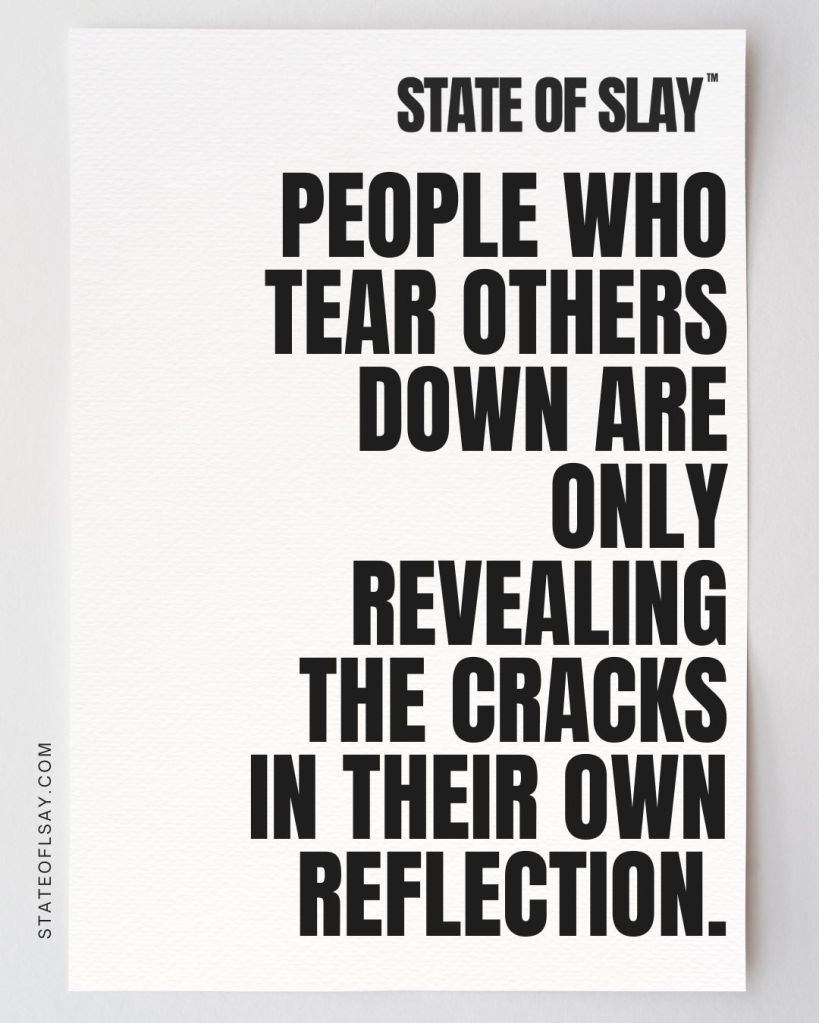
THE REFLECTION ISN’T YOURS

Unkindness is not a reflection of your worth, but of someone else’s struggle. People often project what they haven’t healed, and their cruelty is more about their unrest than your value.

When you remember this truth, you free yourself from carrying pain that was never yours to hold.

This is your reminder: you don’t need to absorb the darkness someone else hasn’t learned to face.

SLAY on!

The Boogeyman Only Lives in the Dark

Fear has a way of creeping in when the lights are out—both literally and metaphorically. When we’re uncertain, overwhelmed, or vulnerable, our minds can convince us that the shadows hold monsters. And when we avoid shining a light on those fears—when we stuff them down, pretend they don’t exist, or try to outrun them—they only grow bigger, louder, and harder to face.

The truth? Fear feeds on silence and secrecy. When we leave it unchecked, it multiplies in the darkness of our minds. But when we turn on the light—through awareness, honesty, and courage—fear begins to shrink.

So if you think there’s a boogeyman around, it’s time to stop hiding under the covers. Flip the switch. Call it out. See it for what it is.


Darkness Is the Breeding Ground for Fear

Think about the last time you were afraid of something—really afraid. Chances are, it wasn’t the thing itself that scared you most. It was not knowing.

Not knowing what someone thought of you.
Not knowing how a situation would turn out.
Not knowing if you could survive the pain you were in.

The unknown is where fear lives. And the more we let our imagination run wild in that dark space, the more terrifying the “boogeyman” becomes.

But here’s the thing: most fears, when brought into the light, lose their power. Naming your fear is the first step in shrinking it. It’s not the monster under the bed—it’s your anxiety about failing, being rejected, or not being enough. Once you see it clearly, you can deal with it.


Shine the Light of Truth

When we start to shine a light on fear, it doesn’t mean the fear disappears overnight. But it does mean we stop letting it run the show.

For me, facing my fears meant getting rigorously honest with myself. I had to admit where I was scared and why. Sometimes it was rooted in old wounds or trauma. Sometimes it was tied to lies I had told myself for years. And sometimes, it was just the unknown of stepping into a new chapter.

The more light I brought in—the more I talked about my fears, wrote about them, or even prayed about them—the less they controlled me.

Fear thrives in the dark. Truth thrives in the light.


The Boogeyman Is Rarely What You Think

Most of the time, the “boogeyman” isn’t nearly as scary as we’ve built it up to be.

Maybe the conversation you’ve been avoiding brings clarity instead of rejection.
Maybe the risk you’ve been afraid to take opens a door you never thought possible.
Maybe the pain you’re carrying becomes lighter when you finally share it.

Fear wants you to stay in the dark. But your healing requires the light.


Flip the Switch

So how do you “turn on the light” when fear is looming?

  • Name it. Write down exactly what you’re afraid of. No filters.
  • Share it. Talk to someone you trust. Speaking fear out loud weakens it.
  • Challenge it. Ask yourself: is this fear based in fact, or in old stories?
  • Take one small action. Even the smallest step forward shines light into the dark.

The boogeyman can’t survive in the light.

So next time you feel fear creeping in, don’t stay stuck in the dark. Reach for the switch. Bring it into the open. Remind yourself: you are braver than the shadows.


SLAY Reflection

  1. What fear have you been keeping in the dark?
  2. How does avoiding it give it more power?
  3. What would shining a light on it look like for you?
  4. Can you trace your fear back to old wounds or beliefs?
  5. What’s one small action you can take today to face it?

S – Stop letting fear grow in silence
L – Let the light of truth guide you
A – Acknowledge your fears instead of hiding them
Y – Yield to courage, not the shadows


Call to Action: Join the Conversation

I’d love to hear from you.
What fear did you finally bring into the light—and how did it change things for you?
Share your story in the comments. Let’s cheer each other on.

And if you know someone who’s hiding from their “boogeyman,” send this to them.
Sometimes, all we need is a light to remind us we’re not alone.

How Is Your Now?

Fear can show up in sneaky ways. It did just the other day—while talking with a group of women, someone brought up fear, and we all shifted in our seats.

There’s a lot of uncertainty in the world right now. And with uncertainty often comes fear. But most fear doesn’t live in the present—it lives in the past or the future. That’s what makes it so tricky. It takes us out of the only place where we have power: the now.

When I feel fear creeping in—and I have, especially recently—I bring myself back to the present. I ground myself in gratitude. I focus on my breath. I ask: How is my now?

Because right now, in this moment, I’m okay.


Living Outside the Now

Before I began walking this path, I didn’t live in the now. I lived everywhere but here. I obsessed over what had already happened or worried about what might come next. I was spinning—and because I wasn’t grounded in the present, I couldn’t take meaningful action.

My life became unmanageable. Fear ran the show. And instead of facing what was in front of me, I avoided it. I let things slide. I convinced myself that if I ignored the chaos long enough, it might resolve itself. Spoiler: it didn’t.

Eventually, the only way forward was through. I had to stop hiding from the now and start making peace with it. Slowly, the present stopped feeling like a battlefield and started becoming a place of peace—a space where I could reflect, reset, and realign.

The more I committed to living in the now, the less power fear had over me. It still visits, of course. But today, I don’t let it drive. I stay focused on the moment—and when I do, I can breathe again.


Return to What’s in Front of You

We don’t know what tomorrow holds. We can’t change what’s already happened. But we can choose how we show up today.

Even when life feels uncertain, we can find clarity by focusing on what’s in front of us. One step. One breath. One moment at a time.

This is how we quiet the fear. This is how we get grounded.

And if the now doesn’t feel great? That’s okay. The present is still the place where change can happen. We get to respond differently. We get to choose a new direction.

Ask yourself: How is my now? And if you don’t like the answer, know that this is the best place to begin again.

SLAY on.


SLAY Reflection: How Is Your Now?

  • Do you often get pulled into the past or future? How does that impact your emotional state?
  • What role does fear play in your life when you’re not present?
  • How do you feel when you manage to stay grounded in the now?
  • What tools or habits help you return to the present moment?
  • If today feels heavy, what’s one thing you can do right now to lighten the load?

Call to Action: Join the Conversation

I’d love to hear from you.
What’s one way you’re bringing yourself back to the now when fear tries to take over?
Share your story in the comments. Let’s cheer each other on.

And if you know someone who’s stuck in fear or uncertainty, send this to them.
Sometimes, all we need is a moment of presence to find our power again.

Be A Light, Not A Fixer

It’s in our nature to want to help—especially when someone we care about is struggling. We offer advice. We brainstorm solutions. We try to fix what’s broken. But more often than not, people don’t want to be fixed. They want to be seen. Heard. Accepted. And the greatest gift we can offer them isn’t a fix—it’s our light.


When Advice Isn’t What’s Needed

Before walking this path, I never wanted advice.

When someone tried to tell me how to live or what to do, I’d shut down. My ears would ring with resistance. I wasn’t ready to hear it—even when it came from love.

What did make a difference? Watching someone who had been where I was… live differently. Heal differently. Shine differently. Their life, not their advice, became the spark that lit something in me. It was their example—not their instruction—that showed me another way was possible.


We’re Not Here to Fix

Seeing someone in pain can awaken our need to act. We want to step in. To fix. To redirect. But when that urge becomes overwhelming or obsessive, it’s worth asking: What’s really going on inside me?

Being a fixer can sometimes be about control—about our discomfort with someone else’s struggle. But healing doesn’t work that way. It can’t be forced. It can only be chosen.

We’re most powerful when we walk the walk. When we focus on our own healing, our own growth, our own joy—and let that speak for itself.


Let Your Light Speak

Years ago, someone from my past reached out unexpectedly. We hadn’t always gotten along, and they’d never asked me for advice before. But something had shifted. They saw how I’d changed. How I was living. And they wanted to know how.

That conversation never would’ve happened if I’d tried to force a message down their throat. But because I simply lived my truth—and shared my light—they were able to find their own courage to ask for more.

Being a light isn’t about being perfect. It’s about being real. Radiating kindness. Living with integrity. And creating space where others can feel safe enough to begin their own healing.

So the next time you feel the pull to fix someone, pause. Instead, ask yourself how you can shine a little brighter today—and trust that your light is doing more than you think.

SLAY on.


SLAY Reflection: Are You a Fixer or a Light?

  • Do you often feel the urge to fix others? Where does that come from?
  • What usually happens when you try to solve someone else’s problems?
  • Have you been inspired by someone simply by the way they live? What stood out?
  • Are you open to letting others find their path in their own time?
  • How can you focus more on being an example rather than a solution?

Call to Action: Join the Conversation

I’d love to hear from you.
How have you learned to shine instead of fix?
Share your story in the comments. Let’s cheer each other on.

And if you know someone who’s feeling the weight of wanting to fix it all, send this to them.
Sometimes, all we need is a shift—from fixing to shining.

Our Dark Past Is The Greatest Possession We Have

There was a time when I thought my pain would consume me. Now, I know—it shaped me. Our darkest moments hold the power to help others find light. The only question is: are you willing to share them?


The Unimaginable Becomes a Gift

When I was deep in my darkest season, I couldn’t imagine ever looking back and seeing value in it. Survival itself felt uncertain. There was no part of me that thought these experiences would one day be considered my greatest possession. But that changed.

It wasn’t until I found recovery that I started to understand. I saw firsthand how someone else’s story could offer hope. One man’s courage to speak his truth gave me the strength to try and heal mine. His vulnerability saved my life. That was the beginning of everything.


The Power of Sharing Our Story

Early on, I didn’t believe my story held any value. I thought I needed to be “further along” to help someone else. But then, someone newer than me on this path looked at my progress with awe—and I realized we all have something to offer, no matter where we are.

Whether you’re in the thick of healing or years into your journey, someone else needs to hear what you’ve lived through. You don’t need a polished narrative or a perfect ending. Just your truth. That truth might be the very thing that keeps someone else going.


Letting Go of Shame

For a long time, I only shared the highlight reel. The idea of speaking about my pain? Terrifying. I feared judgment, labels, being seen as broken. But the truth is—I was already saying worse things to myself in silence. And pretending was exhausting.

Letting go of that fear and finally sharing my truth didn’t just help others—it saved me. The freedom that came from owning my past, rather than hiding it, was life-changing. The more I opened up, the more I connected. The more I connected, the less alone I felt.


Reclaiming the Narrative

Looking back, it’s almost shocking how much has changed. My darkest chapters no longer control me—they empower me. I’ve taken responsibility, found forgiveness, and made new choices. That transformation gave me back my power.

And maybe the most beautiful part? It allowed me to receive the light of others, too. I no longer walk alone. None of us have to. We can walk together—on our own paths, side by side—with the courage to show up exactly as we are.

There’s no greater victory than turning your pain into purpose. And no greater connection than meeting someone else in theirs.

SLAY on.


SLAY Reflection

  1. Have you found meaning in your darkest moments? What did they teach you?
  2. Is there a part of your story you’re still afraid to share? Why?
  3. Has someone else’s vulnerability ever helped you heal? What impact did it have?
  4. How can you begin to turn your past into a source of light for others?
  5. What would it feel like to release shame and step fully into your truth?

S-L-A-Y:

  • Speak your truth, even if your voice shakes.
  • Let your past be a bridge, not a burden.
  • Acknowledge your growth—and honor it.
  • You can help someone else heal by being real.

Call to Action: Join the Conversation
I’d love to hear from you.
How has your dark past shaped your present strength?
Share your story in the comments. Let’s cheer each other on.

And if you know someone who’s ready to turn their pain into power, send this to them.
Sometimes, all we need is a nudge.

Don’t Let Your Mind Bully Your Body

It was in my teens that I first remember turning against my body.

I had been a thin, athletic kid, comfortable in my skin — and then things started to change. My body began doing things I didn’t understand and didn’t want. It started drawing attention I didn’t ask for. And instead of curiosity, I felt betrayal.

I felt like my body had turned on me.

I already carried discomfort inside myself — parts of who I was that I kept hidden — and when my body began changing, it only amplified that discomfort. I started comparing myself to everyone around me. Measuring myself against them. Finding myself lacking in every direction.

Nothing ever felt good enough.

And that’s when the spiral began — not in my body, but in my mind.

My mind started bullying my body.


When Control Becomes the Goal

Looking back now, I can see it clearly.

What I was really afraid of wasn’t my body — it was not being in control.

There were so many things in my life I felt powerless over, and my changing body felt like the final betrayal. So I did what I thought would give me control back.

I tried to stop it.
Manipulate it.
Shrink it.
Silence it.

That path led to an eating disorder — one I was lucky to recover from.

It took years to heal. Years to rebuild trust with food. Years to rebuild trust with my body. And even now, there are still days I have to stay conscious and accountable with my thinking.

What makes me sad looking back isn’t my body — it’s the hatred I had for myself.

There was never anything wrong with my body.


The Voice Was the Real Problem

I see now that the damage wasn’t physical — it was mental.

The voice in my head was cruel.
Relentless.
Unforgiving.

The more I hated myself, the louder it got.

I wanted to disappear into the crowd.
Blend in.
Not be noticed.
Not be questioned.

So I tried to control myself into invisibility.

That voice told me I was the problem.
That my body was the problem.
That I had to fix it to be acceptable.

But the truth is: my body was never the enemy.

My mind was.


Learning a New Relationship

Today, I appreciate my body.

Not because it looks a certain way —
but because of what it does for me.

It carries me.
It heals.
It protects.
It supports my life.

And while I still have days where old thoughts creep in — because healing isn’t linear — I no longer live in war with myself.

I no longer punish my body for existing.

I no longer try to control it out of fear.

I no longer define my worth by how it looks.


Health Without Hate

There’s nothing wrong with wanting to feel healthy.
There’s nothing wrong with wanting to feel strong.
There’s nothing wrong with wanting to care for your body.

But when self care is driven by self hatred, it becomes harm.

We are not meant to all look the same.
We are not meant to fit one mold.
We are not meant to match one standard.

Different shapes.
Different sizes.
Different structures.
Different beauty.

Every body is valid.


Changing the Relationship, Not the Reflection

Healing doesn’t start in the mirror.

It starts in the mind.

In how we speak to ourselves.
In how we interpret our reflection.
In how we define worth.
In how we measure value.

Your body doesn’t need to be fixed.
It needs to be respected.


Your Body Is Not the Problem

Your body is not your failure.
Your body is not your enemy.
Your body is not your shame.

It’s your home.

And it deserves compassion — not cruelty.

Care — not control.
Respect — not punishment.
Safety — not shame.


SLAY Reflection

Let’s reflect, SLAYER:

S: What negative thoughts do you carry about your body?
L: Where did those beliefs come from?
A: What would change if you spoke to your body with compassion instead of criticism?
Y: How can you start practicing care instead of control today?


Call to Action: Join the Conversation

I’d love to hear from you.
What is one way you can start treating your body with more kindness today?
Share your story in the comments. Let’s cheer each other on.

And if you know someone who struggles with body shame, send this to them.
Sometimes, all we need is a nudge.
H.O.P.E. – Help Other People Everyday

There was a time in my life when I wasn’t sure I wanted to keep living.

I kept everything bottled inside — my fear, my pain, my confusion, and the constant battle in my head that told me I wasn’t enough. I carried that darkness quietly, pretending I could handle it alone, that asking for help was weakness.

But eventually I hit a moment I couldn’t escape:
I was scared of what I might do to myself just to quiet the pain.

It was in that darkest moment that something shifted.

A story came back to me — a story a friend had shared about his own struggle. At the time I heard it, it was just a story. A powerful one, sure, but still just something I listened to and admired from a distance.

Months later, on that frightening night, I recognized myself in the beginning of his story — the part where suffering feels endless and hopeless.

And that recognition changed everything.


Hope Isn’t Just a Feeling — It’s Something We Receive and Give

I often wonder how many times we underestimate the power of connection.

That story my friend shared didn’t cure me. It didn’t fix everything. But it showed up in the exact moment I needed it — and that was enough to keep me moving forward.

Not because the pain was gone…
But because I finally saw that I wasn’t alone.

That recognition — that someone else had walked through darkness and found light — gave me a reason to keep going. That was the beginning of my own journey back to life.

And because someone shared their truth, I found hope.


Showing Up Is the Smallest — Yet Most Powerful — Act of Service

Hope doesn’t always arrive in grand gestures.

Sometimes it shows up in the simplest things:

A smile.
A hello.
A listening ear.
A message that says, I see you.

When we simply show up, we affirm someone’s worth — even when they can’t feel it themselves.

You never know who’s watching quietly from the sidelines, waiting for proof that they matter. You never know whose heart is in the dark, searching for a light.

That’s why helping others — even in small ways — matters more than we can imagine.


What We Give May Be the Hope Someone Needs to Survive

One of the most humbling things I learned is that stories matter.

Not because they are polished or perfect —
but because they are real.

When I finally shared my own journey — not just the finished version but the messy, painful beginnings — something clicked. Other people saw themselves in it. They recognized their struggle in the cracks of my story. It reminded them that they, too, could keep going.

That’s the power of truth.

It connects us.
It heals us.
It saves lives.

And sometimes the hope we give to others becomes a source of strength for ourselves.


You Don’t Have to Fix Someone to Help Them

Helping others doesn’t always mean solving their problems.

Sometimes it means:

Showing up
Listening without judgment
Sharing your story
Being present
Being consistent
Offering compassion
Willingness to care even when it’s hard

Helping others is how we remind them —
and ourselves — that we matter.


Hope Isn’t About Perfection

Hope isn’t a destination.
It’s a presence.

It doesn’t mean everything is okay.
It doesn’t erase pain.
It doesn’t suddenly make life easy.

But it reminds us that we don’t have to walk through pain alone.

And that it’s okay to ask for help.
Not just once — many times.
Not just when it’s convenient — but when it’s hardest.

Because in asking for help, we make space for others to help us — and through that exchange, something powerful unfolds.


You Never Know Who Is Watching

There’s a truth we overlook:

When you help someone — even with the tiniest kindness — you never know how far that ripple goes.

Your story might be the reason someone keeps going.
Your presence might be the reason someone feels seen.
Your kindness might be the moment that lights someone’s path.

And sometimes — years later — that person you helped could tell someone else about it.

Hope multiplies.
It doesn’t stay in one heart.
It spreads.


SLAY Reflection

Let’s reflect, SLAYER:

S: Who in your life gave you hope when you needed it most?
L: How has someone else’s journey inspired your own healing?
A: What simple action can you take today to offer hope to another person?
Y: How might your vulnerability be a gift to someone else who feels alone?


Call to Action: Join the Conversation

I’d love to hear from you.
When has someone’s presence or story given you hope — and how did it change your journey?
Share your story in the comments. Let’s cheer each other on.

And if you know someone who might be struggling today, send this to them.
Sometimes, all we need is a reminder that hope exists.