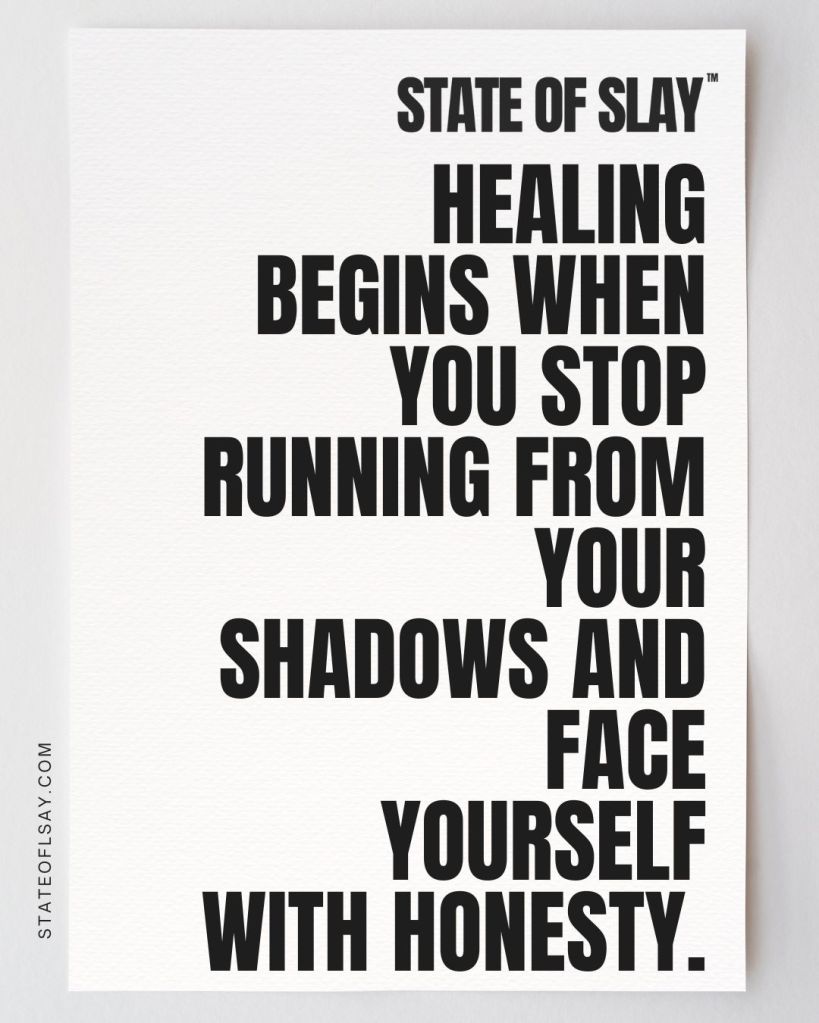
Self-Honesty

If we want to grow—really grow—there’s one non-negotiable step we can’t skip: self-honesty.
Not filtered. Not justified. Not softened for comfort. Just the raw, unfiltered truth.

For a long time, I didn’t even realize I wasn’t being honest with myself. I had an explanation for everything—why I did what I did, why it wasn’t my fault, and why I was still the one who got hurt. I wasn’t lying, I told myself—I was surviving. I genuinely believed that. I wasn’t aware of how deep my self-deception ran.

But here’s the thing about dishonesty: even when we fool others, we can never fully fool ourselves. Deep down, we know. And that knowing creates pain—a pain that grows louder the longer we run from it.


When the Lies Catch Up

Looking back, I realize how much effort it took to keep up the act. I was always spinning, justifying, defending, and denying. I wasn’t just lying to others—I was lying to myself. And even though I appeared to have control, my life was unraveling beneath the surface.

I had a story for everything, and in most versions, I was the victim. It worked—until it didn’t. Eventually, the weight of my own dishonesty caught up with me. I felt like I was being swallowed by guilt and shame, and I had to numb myself just to function.

But that small, persistent voice—the one that wouldn’t stay quiet—kept whispering the truth: You know better. You were meant for more than this.
And as much as I tried to silence that voice, it was the only part of me still fighting for the life I deserved.


The Moment That Changed Everything

The turning point came when I couldn’t run anymore. I hit a wall—a moment where the lies I’d told myself stopped working.

I was tired. I was broken. And for the first time, I was honest.

Not just with others, but with myself.

I admitted everything. The damage I’d caused. The pain I’d tried to outrun. The truth I’d buried under ego and fear. I reached out to the people I’d hurt. I owned my choices. And I made a plan to get help.

It wasn’t easy. But it was freeing.

Because the moment I took responsibility was the moment I took my power back.


The Truth Will Set You Free (But First, It’ll Break You Open)

Self-honesty is messy. It means looking at the parts of yourself you’ve tried to ignore. It means taking off the mask and seeing who’s really underneath.

And for many of us, it means accepting that we were the ones standing in our own way. That we made choices that hurt not just others, but ourselves.

But that’s also where freedom begins.

Once I saw how much of my pain was self-inflicted, I realized something powerful: If I created this mess, I can also create something better.

That truth was hard to swallow, but it was also hopeful. Because it meant I didn’t have to wait for anyone else to change. It was up to me. I had the power to break the cycle—and build something real in its place.


Self-Honesty is Self-Love in Action

We talk a lot about self-love. But the most loving thing we can do for ourselves is tell the truth—even when it’s hard. Especially when it’s hard.

Self-honesty isn’t about beating ourselves up. It’s about calling ourselves in, not calling ourselves out. It’s saying, “I know you made choices you’re not proud of. But you don’t have to keep living that story. You can change.”

And that’s what I did. I took ownership. I made amends. I learned from my mistakes. And I committed to a new way of living—one built on truth, not performance.

Was it easy? No.
Was it worth it? Absolutely.


You Can’t Heal What You Won’t Face

If something in your life isn’t working, ask yourself this:
Am I being honest about what’s really going on?

Not just honest with others. Honest with yourself.

Because if we want to live a life that feels good, not just good enough, we have to face the hard truths. We have to stop spinning stories and start taking responsibility.

It’s uncomfortable. It’s humbling. But it’s also the beginning of real change.

The life you want? It starts with telling the truth. To yourself. For yourself.


SLAY Reflection

Let’s reflect, SLAYER:

  • S: Where in your life have you been avoiding the truth?

  • L: What patterns or habits have you justified, even when you knew they were harmful?

  • A: What’s one honest conversation you need to have—with yourself or someone else?

  • Y: What would living in full self-honesty look like for you, and what would it free you to become?


Call to Action: Join the Conversation

I’d love to hear from you.
Where has self-honesty transformed your life—or where do you feel called to be more honest today?
Share your story in the comments. Let’s cheer each other on.

And if you know someone who’s struggling to face the truth, send this to them.
Sometimes, all we need is a nudge.

We Are Mirrors Of Each Other

We’re all mirrors for each other.
We have more in common than we think, and when we allow ourselves to look for the similarities instead of the differences, something powerful happens—we begin to see ourselves in others. And when we truly see ourselves, healing begins.

Before I started this path, I wasn’t open to that idea.
I judged others. I needed to feel better than the people around me, so I pointed out what separated us. I picked at their flaws to cover up my own. It made me feel superior—but it also kept me sick and isolated.

The truth?
I believed I was a piece of crap, but still thought I had a better solution than you did. That’s how twisted my thinking was.
It wasn’t until someone shared their story with me—raw and honest—that something shifted. I saw myself in them. For the first time, I recognized my reflection in someone else. And it changed everything.


Seeing the Truth in Someone Else

They had the same mental illness I did. They struggled the way I had. But they were getting help. They were doing the work.

In that moment, I couldn’t lie to myself anymore.
I wasn’t different.
I wasn’t better.
I was just like them.
And if they could find a way forward… maybe I could too.


The Power of Similarities

Early in recovery, I was told: Look for the similarities, not the differences.”
That became my mantra.

So I listened.
I really listened—to what people were saying, how they were living, what they were feeling. And the more I listened, the more I saw myself reflected in their stories. I began to connect.

But here’s the thing: you have to be willing to see it.
You have to let go of the need to feel different or better.
You have to get honest about who you are.

And sometimes that honesty is tough. Those mirrors don’t lie.
They show us the parts of ourselves we’ve been trying to hide.


Learning to Accept the Reflection

Looking in the mirror hasn’t always been easy.
There were times I saw things I didn’t like.
But I knew if I wanted to get better, I had to face it.

That meant living with rigorous honesty.
If I saw something in myself I didn’t like, I had to:

  • Address it
  • Change it
  • Or learn to accept it if I couldn’t

We all walk around with mirrors. Sometimes our reflection helps others. Sometimes someone else’s reflection helps us. Nothing is accidental. We cross paths with the people we’re meant to—people who inspire us, challenge us, or show us who we really are.

And if we’re paying attention, those reflections can save our lives.


From Shame to Shared Light

I no longer hide my reflection. I don’t carry shame about what I’ve lived through or how far I’ve come. My reflection is what connects me to others. And if someone else sees a piece of themselves in me? Even better.

Because just like someone else once helped me recognize myself, maybe my story—my mirror—can help someone else too.

I also pay attention to what I see in other people.
If I’m triggered, if something feels off or uncomfortable, I ask myself: What is this showing me about me?
Maybe it’s something I need to look at. Maybe it’s something I need to change. Maybe it’s something I need to love.

Recognizing myself in someone else’s reflection is what saved my life.
And it might just save yours—if you’re willing to look.


SLAY Reflection: What Do You See?

  1. Are you open to seeing the commonality in others?
    What might be keeping you from looking?
  2. Do you sometimes feel superior to others?
    Where did that come from—and how might it be holding you back?
  3. What reflections have others shown you about yourself lately?
    How did you respond to them?
  4. Are there parts of your reflection you’ve been avoiding?
    What’s one small step you can take toward healing or accepting it?
  5. Have you ever seen yourself in someone else—and felt less alone because of it?
    How did that moment change you?


    Call to Action: Join the Conversation

    I’d love to hear from you.
    Have you ever seen yourself in someone else’s story—and how did that moment change you?
    Share your story in the comments. Let’s cheer each other on.

    And if you know someone who needs a reminder that they’re not alone, send this to them.
    Sometimes, all we need is a nudge.
Keeping Your Side Of The Street Clean

It’s easy to look at someone else’s mess and call it out. But here’s the truth: we all have our own mess to manage. And if we’re being honest? It’s usually easier to spot someone else’s than to deal with our own.

Lately, I’ve been navigating a major life transition—a season full of change, compromise, and triggers. Most days, I can catch myself before reacting in old ways. But sometimes? I slip. I say or do something that’s not aligned with who I’m becoming. It doesn’t feel great. But I’ve learned something powerful: mistakes don’t define me—how I clean them up does.


Look Inward First

When you’ve made a mess, the first step is owning it. That means pausing long enough to acknowledge where you went wrong—not where someone else did.

Open, honest communication is essential. Admit your part without excuses. I’ve carried the weight of unacknowledged mistakes before, and it’s heavy. You end up walking through life with a dark cloud following you—not because of what someone else did, but because you haven’t owned your part.

Here’s what I’ve learned: most problems can be worked through with a sincere conversation. People are far more forgiving when they sense you’re being real with them.


Apologize. Make It Right.

Humility is not weakness—it’s wisdom.

If you’ve wronged someone, apologize clearly and directly. Skip the over-explaining or blame-shifting. They don’t need to hear all your reasons. They need to feel your sincerity.

Sometimes a heartfelt “I’m sorry” is enough. Other times, you may need to ask how to make it right. Be open to what they say. And remember, making things right isn’t about winning—it’s about restoring trust.

And if your instinct is to defend, justify, or co-blame? Pause. That’s not the work. Your side of the street is yours to clean. Period.


Make the Mess a Message

Mistakes are not dead ends—they’re spotlights on where we need to grow.

Rather than beating yourself up, get curious. What triggered that reaction? What could you do differently next time? Every misstep is a chance to shift your path.

I now try to see these moments not as failures but as feedback. They shine a light on areas I still need to work on, and that’s a gift. It helps me become more self-aware, more emotionally grounded, and more intentional in my relationships.

The goal isn’t to be perfect. It’s to be accountable. Honest. Clean.


Being a SLAYER Means Owning Your Part

At the end of the day, keeping your side of the street clean means taking responsibility for your actions, no matter what someone else does. It means not letting your ego steer the ship. It means choosing peace over pride.

We can’t control others. But we can control how we show up. And when we lead with integrity? That ripple changes everything.

Let your integrity speak louder than your mistakes. That’s how we Slay.


SLAY Reflection

  1. When was the last time you had to own a mistake?
  2. Did you take action to make it right—or avoid it?
  3. How do you typically react when you’ve messed up?
  4. Is there something on your side of the street that needs cleaning?
  5. What could change in your life if you started showing up with more ownership?

S-L-A-Y:

  • See your part clearly
  • Let go of blame and excuses
  • Act with humility and integrity
  • You’re responsible for your energy and actions

Call to Action: Join the Conversation
I’d love to hear from you.
What does keeping your side of the street clean look like for you?
Share your story in the comments. Let’s cheer each other on.

And if you know someone working on showing up better, send this to them.
Sometimes, all we need is a nudge.

Self-Righteous Anger

We’ve all been there.

That moment when you feel completely justified.
You warned them. You told them what would happen. And now—here you are, furious, ready to let loose with every ounce of frustration you’ve stored up.

You’re 100% right…
And still, something feels 100% wrong.

That’s the tricky thing about anger.
It might feel powerful in the moment—but often, it leaves you feeling more hollow than healed.


Our Reactions Are Our Responsibility

If you have a problem with someone, the truth is: that problem is yours to manage.

You decide:

  • Who you engage with

  • How far you let them in

  • What boundaries you set

There will always be people we have to interact with—coworkers, family members, even acquaintances we didn’t choose. But even in those cases, we are still the ones who determine how much access they have to our energy.

This blog connects back to so many past entries:

  • People Pickerchoosing aligned connections

  • Ask For What You Wantclearly stating your needs

  • Intentions: The Truthseekerstaying honest about your “why”

  • Finding Grace in the Gray Areaslearning to live in nuance

It all comes back to this: we are in charge of how we engage.


When We Engage to Feel Superior

Sometimes we step into situations knowing they won’t end well.

Why?
Because deep down, we’re looking for a reason to get angry.
To say “I told you so.”
To feel superior, righteous—even if it’s just for a moment.

Anger, in this form, is seductive.
It gives us a temporary hit of control, of power.
But it fades.
And once it does, we’re left with the truth: we used that anger to fill something inside us.
A need. A hurt. A void.

And it didn’t work.


Lashing Out Isn’t Leadership

When you feel like lashing out, when you feel morally superior, when you want to “teach someone a lesson”—pause.

Ask yourself:

  • Could I have avoided this situation?

  • Did I knowingly enter this dynamic?

  • Am I trying to justify my anger by proving someone wrong?

A lot of self-righteous anger comes from the need to control.
But here’s the hard truth: we can’t control anyone else.
We only control ourselves.

Trying to control others will always lead to the same outcome:

  • Disappointment

  • Resentment

  • Frustration

  • Anger

That’s not power.
That’s a cycle.


Break the Cycle with Compassion

The way out is through awareness, compassion, and boundaries.

We avoid self-righteous anger by:

  • Engaging with people who align with us

  • Setting boundaries with those who don’t

  • Letting go of the illusion that anger makes us strong

  • Staying open, flexible, and willing to grow

  • Being clear with others—and honest with ourselves

And most importantly: not exploding when someone behaves exactly as they always have.

Wishful thinking won’t change a pattern.
Anger won’t either.
But self-awareness will.


Anger Is a Signal, Not a Strategy

Righteous anger might feel satisfying in the moment.
But if the goal is to belittle someone, to control them, or to make yourself feel bigger—it’s not righteous. It’s a reaction.

And reactions are usually about us, not them.

As SLAYERS, we take responsibility for that.
We engage with kindness.
We communicate with clarity.
We protect our energy by refusing to get pulled into battles we don’t need to fight.

So if you’re angry—own it.
Sit with it.
Figure out where it’s coming from.

Then SLAY that dragon—and walk forward in peace.


SLAY Reflection: Are You Fueling the Fire?

  1. Do you knowingly get involved with people or situations that you expect will upset you?
    Why do you think you do that?

  2. Does your anger give you a sense of control or superiority?
    What do you think it’s really covering up?

  3. How does this behavior affect your relationships and your self-esteem?
    What’s the cost?

  4. What would change if you chose not to engage the next time anger arises?
    How could you protect your peace instead?

  5. What would your life look like if you honored your boundaries instead of your ego?
    Can you write down the benefits of releasing the need to be right?


Call to Action: Join the Conversation

I’d love to hear from you.
When was a time you caught yourself reacting from anger instead of truth—and what did you learn from it?
Share your story in the comments. Let’s cheer each other on.

And if you know someone who’s working on letting go of the need to be right, send this to them.
Sometimes, all we need is a nudge.