Group of women seated together in conversation, representing how repeated behavior can reveal important patterns in relationships.

Their Pattern Becomes Your Information

Most of us are willing to give people the benefit of the doubt.

Someone disappoints us, and we consider what they were going through.

Someone says something hurtful, and we accept that they were angry.

Someone breaks a promise, and we understand that life got complicated.

Someone disappears when we need them, and we tell ourselves they probably had their own problems.

There is nothing wrong with allowing people to be human.

People make mistakes.

They have bad days.

They get overwhelmed.

They fail to communicate.

They make choices they regret.

But there comes a point when what we’re looking at is no longer an isolated event.

It’s a pattern.

And patterns are information.

The difficult part is that we don’t always want the information they’re giving us.


Prefer to listen? The Audio Blog version is available here.


WE ARE VERY GOOD AT EXPLAINING THINGS AWAY

One disappointing moment is easy to explain.

So is a second.

Sometimes even a third.

They’re stressed.

They’re busy.

They didn’t mean it.

They’ve been through a lot.

This isn’t who they really are.

Any one of those things may be true.

The problem begins when we use explanations to keep ourselves from seeing repetition.

Because every incident comes with its own circumstances.

There is always a reason.

There is always context.

There is always another detail that makes this time seem different from the last time.

So instead of stepping back and looking at the whole picture, we keep examining each individual piece.

Eventually, we can become so focused on understanding why someone behaves a certain way that we stop noticing how consistently they behave that way.


AN EXPLANATION TELLS YOU WHY, A PATTERN TELLS YOU WHAT TO EXPECT

Understanding why someone behaves a certain way can help us have compassion.

Maybe they struggle with trust because they’ve been betrayed.

Maybe they shut down during conflict because that’s what they learned growing up.

Maybe they have difficulty showing affection.

Maybe they become defensive when they’re afraid.

Understanding those things can help us see another person more clearly.

But understanding the reason for a behavior doesn’t change the experience of living with it.

That’s an important distinction.

An explanation can tell you why something happened.

A pattern tells you what you can expect.

If someone repeatedly avoids difficult conversations, that is information.

If someone regularly makes promises and doesn’t keep them, that is information.

If someone repeatedly becomes cruel when they’re angry, that is information.

The reason may help you understand them.

The pattern helps you make decisions for yourself.


WORDS TELL YOU WHAT SOMEONE WANTS YOU TO KNOW

Actions tell you what they repeatedly choose.

We tend to give enormous weight to words.

I’ll do better.

It won’t happen again.

You know how much you mean to me.

I’m going to change.

And those words may be sincere when they’re spoken.

Someone can genuinely regret hurting you.

They can genuinely intend to change.

They can genuinely wish they had handled things differently.

But intention isn’t the same as change.

Change eventually becomes visible.

Not through a better explanation.

Not through a more emotional apology.

Not through another promise.

Through a different pattern.

When someone’s words and behavior keep telling you two different stories, pay attention to the story that keeps happening.


A PATTERN ISN’T ALWAYS SOMETHING BAD

We usually talk about patterns when something is wrong.

But patterns reveal the good, too.

Someone checks on you when they know you’re struggling.

Someone follows through when they say they’ll be there.

Someone respects your no without punishing you for it.

Someone celebrates your success without making it about themselves.

Someone tells you the truth even when it would be easier not to.

Someone makes a mistake, owns it, and behaves differently afterward.

That’s information.

Trust isn’t built from one grand gesture.

It’s built from patterns.

So is safety.

So is respect.

So is reliability.

The people who make us feel secure often aren’t doing anything dramatic.

They’re simply consistent.

Over time, their behavior tells us:

You don’t have to guess who I’m going to be with you.

There is something incredibly peaceful about that.


POTENTIAL CAN DISTRACT US FROM PATTERNS

Sometimes we don’t fall in love with what is happening.

We fall in love with what we believe could happen.

We see someone’s potential.

We see the person they could become.

The relationship they could create.

The life we could have together if a few things changed.

Potential is seductive because it keeps our attention on the future.

Patterns bring us back to the present.

Potential says:

Look at what this could become.

Patterns ask:

What has it actually been?

There is nothing wrong with believing people can grow.

They can.

People change every day.

But you don’t have to make decisions based on a version of someone who hasn’t arrived yet.

You are allowed to make decisions based on the person who keeps showing up now.


WE SOMETIMES KEEP RESETTING THE CLOCK

A painful pattern can continue for years when we keep treating every apology as a fresh beginning.

Something happens.

There is an argument.

There is an explanation.

There is an apology.

There is a promise.

We reset the clock.

Then it happens again.

And because the clock was reset, we experience it as another individual failure instead of another point on an existing line.

Forgiveness can be healthy.

Second chances can be beautiful.

People deserve room to grow.

But forgiveness doesn’t require amnesia.

You can forgive someone and still remember what experience has taught you.

Otherwise, every apology erases the very information you need to decide whether anything is actually changing.


COMPASSION DOESN’T REQUIRE CONFUSION

Sometimes we resist recognizing patterns because doing so feels unkind.

We know someone’s history.

We know what they’ve survived.

We understand their fears.

We see their wounds.

And because we understand them, we begin believing that acknowledging the effect of their behavior means we lack compassion.

It doesn’t.

You can understand why someone behaves the way they do and still recognize that their behavior hurts you.

You can have compassion for someone’s wounds without volunteering to be wounded by them.

You can hope someone heals without making your life dependent on whether they do.

Understanding someone should give you clarity.

It shouldn’t require you to ignore what you know.


PAY ATTENTION TO WHAT HAPPENS AFTER THE APOLOGY

Everyone gets things wrong.

So a mistake alone doesn’t tell us everything we need to know about someone.

What happens afterward often tells us much more.

Do they take responsibility?

Do they become defensive?

Do they blame you for their behavior?

Do they minimize what happened?

Do they listen?

Do they make an effort to repair the damage?

Most importantly, does anything actually change?

An apology can be meaningful.

But the strongest apology is often the pattern that doesn’t repeat.

That is how trust gets repaired.

Not because someone found the perfect words.

Because eventually their behavior made those words believable.


STOP ASKING THE SAME QUESTION

When someone repeatedly behaves in a way that hurts or disappoints us, we can spend enormous amounts of energy asking:

Why do they keep doing this?

Sometimes that’s worth understanding.

But eventually there may be a more useful question:

What am I going to do with what I now know?

That question changes where the power sits.

You cannot control whether someone becomes more dependable.

More honest.

More emotionally available.

More respectful.

More accountable.

But you can decide what their repeated behavior means for your participation.

Maybe you adjust your expectations.

Maybe you stop relying on them for something they’ve repeatedly shown you they cannot provide.

Maybe you create distance.

Maybe you have a conversation.

Maybe you leave.

Or maybe their pattern has shown you that this is someone you can trust more deeply.

The information doesn’t make the decision for you.

It simply gives you something real to make the decision from.


THEIR PATTERN BECOMES YOUR INFORMATION

Patterns don’t require us to judge someone as good or bad.

They help us understand what is consistently true.

Someone can be a good person and still be unreliable.

Someone can love you and still be unable to give you the kind of relationship you need.

Someone can mean well and repeatedly hurt you.

Someone can have a painful past and still be responsible for how they treat you in the present.

And someone can surprise you by consistently showing up in ways your past taught you not to expect.

Patterns aren’t verdicts.

They’re information.

And information gives us choices.

You don’t have to keep being shocked by behavior you’ve seen many times before.

You don’t have to keep turning repeated evidence into another mystery to solve.

You don’t have to stop caring about someone in order to start believing what their behavior has taught you.

Their pattern belongs to them.

What you do with that information belongs to you.


SLAY REFLECTION

S — Step back from the individual moment
Is there something you’ve been treating as a series of unrelated incidents that looks different when you view it as a pattern?

L — Look at actions alongside words
Where do someone’s actions consistently support what they tell you? Where do the two keep telling different stories?

A — Accept the information you already have
Is there a pattern you’ve been explaining away because accepting what it means would require you to make a difficult decision?

Y — Your next choice belongs to you
You cannot control someone else’s pattern, but you can decide what you do with the information it gives you. Choose one place where you can respond to what is actually happening instead of what you hope will eventually happen.


CALL TO ACTION: JOIN THE CONVERSATION

I’d love to hear from you.

Have you ever had a moment when you stopped looking at someone’s behavior as a series of isolated incidents and finally recognized the pattern?

What changed when you stopped asking why they kept doing it and started asking what you were going to do with what you knew?

Share your thoughts in the comments. Your experience may help someone else recognize that seeing a pattern isn’t about judging another person. Sometimes it’s simply about allowing yourself to use the information you’ve already been given.

And if you know someone who keeps giving the same behavior a new explanation, send this to them.

Sometimes clarity doesn’t come from discovering something new.

It comes from finally trusting what you’ve already seen.

Sometimes, all we need is a nudge.

Woman standing apart from a group of people, representing the difference between what feels familiar and what is right for us.

Familiar Doesn’t Mean Right

There is a strange comfort in knowing what comes next.

Even when what comes next isn’t particularly good for us.

We know this person will disappoint us.

We know this job will drain us.

We know this friendship will leave us feeling like an afterthought.

We know this habit will make us feel worse tomorrow.

And yet, there can be something strangely reassuring about returning to what we already know.

Because familiarity has its own kind of gravity.

We know the rules there.

We know who we are there.

We know how to survive there.

And sometimes we mistake that recognition for a sign that something belongs in our lives.

But familiar doesn’t mean right.

Sometimes it just means we’ve been there before.


Prefer to listen? The Audio Blog version is available here.


YOUR BRAIN LIKES TO KNOW WHAT COMES NEXT

We tend to think we make decisions based entirely on what we want.

But predictability has tremendous power.

When we know how something works, we don’t have to spend as much energy figuring it out.

Even an unpleasant pattern can offer that predictability.

You know which subjects not to bring up.

You know when someone is likely to withdraw.

You know how much of yourself to reveal.

You know when to apologize, smooth things over, work harder, stay quiet, or make yourself useful.

You may not be happy.

But you know the choreography.

That can create an illusion of comfort.

Not because the situation is actually comfortable, but because you have become skilled at navigating it.

There is an important difference between feeling safe and feeling competent at surviving something.

We don’t always recognize that difference.


WE CAN MISTAKE RECOGNITION FOR CONNECTION

Have you ever met someone and immediately felt like you had known them forever?

Sometimes that’s wonderful.

Sometimes it deserves a closer look.

Because what exactly are you recognizing?

Maybe you recognize their humor.

Their energy.

Their values.

Their openness.

But sometimes what feels instantly familiar is a dynamic you’ve experienced before.

Someone emotionally unavailable can feel compelling if you’ve spent much of your life trying to earn closeness.

Someone who needs constant help can feel strangely attractive if being needed has always made you feel valuable.

Someone unpredictable can create an intensity that feels like chemistry when what you are actually recognizing is uncertainty.

The feeling is real.

Our interpretation of the feeling isn’t always accurate.

“I know this feeling” can easily become “This must be right.”

Those are two very different statements.


SOMETIMES WE KNOW EXACTLY WHO TO BE IN THE WRONG PLACE

There is another reason familiar situations can be difficult to leave.

They give us a role.

Maybe you’re the fixer.

The peacemaker.

The responsible one.

The one who never needs anything.

The one who keeps everyone laughing.

The one who absorbs everyone else’s emotions.

The one who proves their worth by being indispensable.

You may have played that role for so long that it no longer feels like something you do.

It feels like who you are.

Then something changes.

You enter a relationship where nobody needs rescuing.

You find friends who don’t require you to perform for your place in the group.

You work somewhere that doesn’t expect you to sacrifice your life to prove your commitment.

Suddenly, an unexpected question appears:

Who am I if nobody needs me to be that person anymore?

Sometimes we miss the old dynamic not because it was good for us, but because we understood ourselves inside it.


HEALTHY CAN FEEL STRANGE AT FIRST

We often imagine that when something healthier enters our lives, we’ll immediately recognize it.

Finally.

This is what I’ve been waiting for.

Sometimes.

Other times, healthy feels surprisingly uncomfortable.

Consistency can make you suspicious when you are accustomed to unpredictability.

A relationship without constant conflict can feel strangely quiet.

Someone respecting your boundaries can initially feel like they don’t care enough to fight for access to you.

A friendship without competition can make you wonder what the other person really wants.

A workplace that doesn’t expect you to answer emails at all hours can leave you feeling guilty when you close the laptop.

Rest can feel irresponsible.

Peace can feel boring.

Receiving can feel selfish.

And none of those feelings necessarily mean something is wrong.

Sometimes they mean something is new.


DISCOMFORT ISN’T ALWAYS A WARNING

We are often encouraged to trust our feelings.

And we should listen to them.

But listening to a feeling doesn’t mean automatically obeying the conclusion we attach to it.

Discomfort can tell us something is wrong.

It can also tell us something is unfamiliar.

Those require very different responses.

If you’ve spent years saying yes when you wanted to say no, setting a boundary may feel terrible.

That doesn’t mean the boundary is wrong.

If you’re accustomed to explaining yourself until everyone approves of your decisions, saying, “This is what I’ve decided,” and leaving it there may feel almost unbearable.

That doesn’t mean you owe another explanation.

If you have always measured your value through productivity, taking an afternoon off may make you restless.

That doesn’t mean you should get back to work.

Sometimes discomfort is an alarm.

Sometimes it is simply the sensation of stepping outside an old pattern.

Learning to tell the difference is part of growth.


DISTANCE CAN EDIT OUR MEMORY

There is another trick our memory can play on us.

Once we get far enough away from something, we can begin remembering it selectively.

We remember the good conversations and forget how anxious we felt waiting for the next one.

We remember the laughter and forget how often we cried.

We remember belonging and forget how much of ourselves we had to edit to belong.

We remember what the job gave us and forget what it took from us.

We remember the comfort of the habit and minimize the consequences.

Distance can soften sharp edges.

That isn’t necessarily a bad thing. We don’t need to carry every painful detail forever.

But nostalgia is not always an accurate historian.

Missing something doesn’t automatically mean you should return to it.

Sometimes you miss something because it was important.

Sometimes because there were genuinely beautiful parts of it.

And sometimes because your mind knows exactly where everything is in that old room.

That still doesn’t mean you should move back in.


THE UNKNOWN DOESN’T HAVE A TRACK RECORD YET

There’s another unfair advantage the familiar has over the new.

The familiar has evidence.

You know what happened before.

The unknown has nothing.

You don’t know whether the new relationship will work.

You don’t know whether the career change will be worth it.

You don’t know whether you’ll find your people somewhere else.

You don’t know who you’ll become when you stop doing what you’ve always done.

So we sometimes compare the certainty of something mediocre with the uncertainty of something potentially better.

Of course, certainty can win that contest.

It arrives carrying receipts.

The unknown arrives empty-handed.

But uncertainty is not evidence that something will go badly.

It is simply the absence of evidence about what comes next.

There are possibilities we cannot discover while insisting that the future prove itself before we are willing to leave the past.


YOU MAY NEED TO GIVE GOOD THINGS TIME TO BECOME FAMILIAR

We talk a lot about letting go of what no longer serves us.

We talk less about what happens afterward.

Because there can be an awkward stretch between leaving an old pattern and feeling at home in a new one.

You may question yourself.

You may miss what you left.

You may wonder why something supposedly healthier doesn’t feel natural yet.

Maybe it isn’t supposed to.

You had years to learn the old pattern.

You knew its shortcuts, warning signs, hiding places, and exits.

You knew your lines.

Something new doesn’t have any of that history yet.

You are learning it.

And perhaps one of the most overlooked parts of changing your life is giving yourself enough time for healthier experiences to stop feeling foreign.

For peace to become recognizable.

For mutual support to become normal.

For boundaries to stop feeling mean.

For rest to stop feeling lazy.

For being loved without performing for it to stop making you wonder what the catch is.

Eventually, what once felt unfamiliar can become the new familiar.


FAMILIAR DOESN’T MEAN RIGHT

When you find yourself being pulled toward an old person, pattern, behavior, or version of yourself, it may be worth asking a different question.

Not:

Why do I still want this?

But:

What about this do I recognize?

Maybe you recognize being needed.

Maybe you recognize chasing approval.

Maybe you recognize instability.

Maybe you recognize overworking.

Maybe you recognize putting yourself last.

Maybe you simply recognize the person you used to be when you were there.

Recognition can be powerful.

But it isn’t destiny.

You are allowed to stop choosing something simply because you know how to survive it.

You are allowed to become unfamiliar with an old version of your life.

And you are allowed to feel awkward, uncertain, or even uncomfortable while something better slowly becomes recognizable.

Because sometimes the thing that feels strange isn’t wrong.

It’s just new.

And sometimes the thing that feels like home isn’t where you belong anymore.


SLAY REFLECTION

S — Spot the Familiar
Where in your life are you repeatedly drawn toward a person, situation, habit, or dynamic that you already know doesn’t work for you?

L — Look Beneath the Feeling
What feels familiar about it? Is it the person or situation itself, or the role you know how to play within it?

A — Allow the Unfamiliar
Is there something healthier in your life that you may be resisting simply because it doesn’t feel natural yet?

Y — Your New Normal
Choose one healthy experience you want to give yourself enough time to become familiar with instead of retreating to what you already know.


CALL TO ACTION: JOIN THE CONVERSATION

I’d love to hear from you.

Have you ever had something healthier feel uncomfortable at first because it was new?

Share your thoughts in the comments. Your experience may help someone else recognize when they’re choosing what they know instead of what they truly want.

And if you know someone who keeps finding their way back to the same people, patterns, or situations, send this to them.

Sometimes what feels like home is simply a place we’ve been before.

Slay Say

What Keeps Finding You

There are patterns that feel familiar, even when you wish they were not.

The same situations. The same types of people. The same outcomes that leave you asking why it keeps happening.

It is easy to see these moments as a coincidence or bad luck.

But often, they are not random.

They are reflections of something unresolved. Something unexamined. Something is asking for your attention in a way that becomes harder to ignore over time.

Avoidance can feel easier in the moment. It allows you to move on quickly, to shift your focus, or to tell yourself it was just one experience.

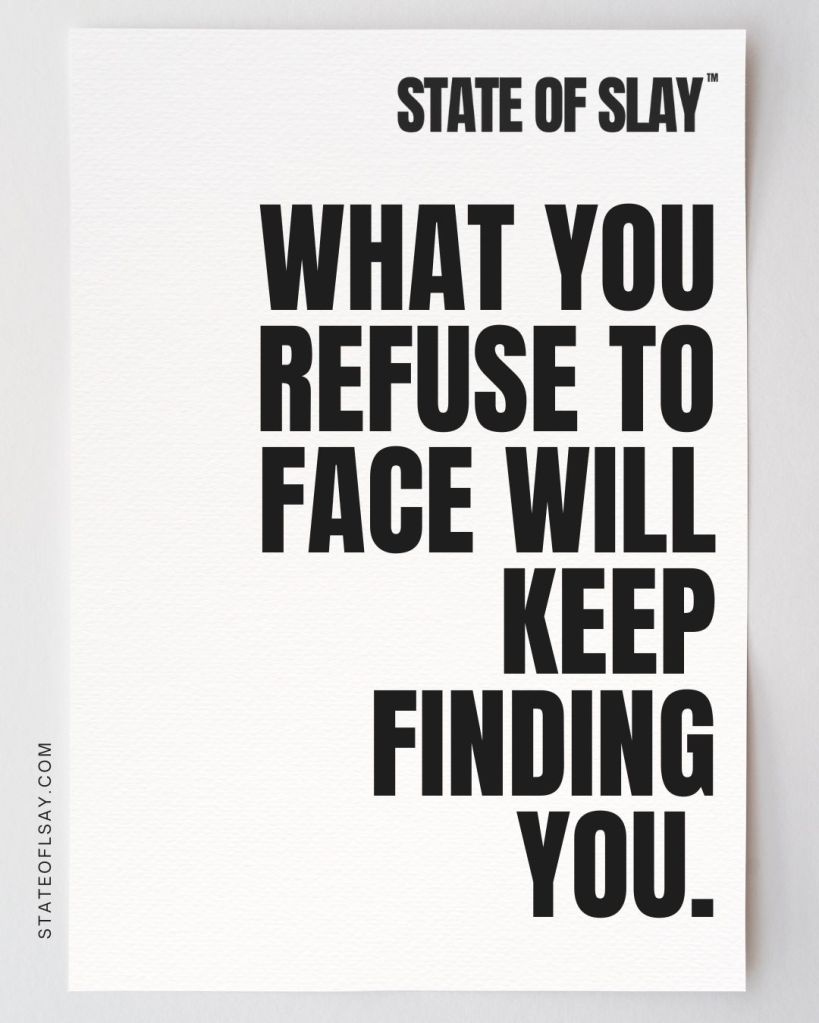
But what is not faced has a way of returning.

Not to punish you, but to give you another opportunity to see it clearly, understand it fully, and respond differently.

Growth begins when you pause long enough to recognize the pattern and ask what it is trying to show you.

Because once you understand it, you are no longer bound to repeat it.

This is your reminder to pay attention to what keeps showing up, not just what keeps going wrong.

Slay on.

You Attract What You Are, Not What You Want

How many times have you asked yourself,
Why do I keep attracting the same kinds of people?
Why do the same patterns keep showing up in my life?
Why does it feel like I’m stuck in a loop?

It’s easy to think we’re just unlucky—or cursed with bad timing or bad energy.
But the truth is often more revealing: we attract what we put out.

And sometimes, what we think we’re putting out…
isn’t what we’re actually radiating at all.


Prefer to listen? The Audio Blog version is available here.


What You Are Speaks Louder Than What You Want

We might see ourselves as kind, supportive, open-hearted people.
We might aspire to positivity, confidence, love, and light.
But if our actions and mindset don’t align with that energy…
we’ll keep attracting something very different.

What shows up in your life isn’t a reflection of your intentions.
It’s a reflection of your state of being.

That’s the hard truth. And also the empowering one.


My Experience: Living in the Dark

When I was deep in my illness, I often wondered why negativity seemed to follow me.
I’d joke that I must’ve done something awful in a past life.

But it wasn’t the universe punishing me—it was me.
It was my thoughts.
My energy.
My expectations.
And my refusal to face how much negativity I was quietly living in.

I tried to be a good person.
I wanted good things.
But my inner dialogue was toxic.
Even when something good would happen, I’d sabotage it with fear, doubt, or shame.

I didn’t feel like a negative person.
But I was living like one.
And the results matched that energy.


You Can’t Fool the Energy Around You

When I began my recovery, I started to see the pattern clearly.

If I expected the worst—I got it.
If I looked for the bad—I found it.
If I pretended to be positive—but was silently drowning in self-judgment—it didn’t matter.
Because energy doesn’t lie.

It wasn’t enough to want better.
I had to become better.

When I did the work—honest, vulnerable, sometimes painful work—things began to shift.

More light came into my life.
More supportive people.
More peace.

Did negativity disappear? Of course not.
But I stopped being drawn to it—and it stopped being drawn to me.


Live It to Attract It

We don’t attract what we hope for.
We attract who we are.

So if the patterns in your life aren’t what you want, don’t just ask, “Why does this keep happening?”
Ask:
“What energy am I really putting into the world?”
“Am I living the way I want to be loved, supported, and respected?”

Because life doesn’t respond to who you say you are.
It responds to how you live.

When you align your heart, mind, and actions with who you want to become—
That’s when the shift happens.
That’s when the energy changes.
And that’s when the right people and opportunities begin to show up.


SLAY Reflection: What Are You Attracting?

  1. Are you attracting people or situations that leave you feeling drained or dissatisfied?
    What patterns do you notice?
  2. What don’t you like about what’s showing up—and could it reflect something within you?
    How might your mindset or habits be contributing?
  3. Are you being honest with yourself about the energy you’re giving off?
    What might need to shift?
  4. What would it look like to live as the version of you you want to attract?
    What’s one step toward that today?
  5. How would your life change if you aligned your energy with your true values?
    What would start showing up?

Call to Action: Join the Conversation

I’d love to hear from you.
What’s one shift you’ve made that changed what you were attracting into your life—and how did it impact you?
Share your story in the comments. Let’s cheer each other on.

And if you know someone who keeps wondering why the same patterns keep repeating, send this to them.
Sometimes, all we need is a nudge.