Just Because Someone Gave Up on You, Don’t Give Up on Yourself

There’s a particular kind of pain that comes when someone you believed in—someone you trusted—decides you’re no longer worth the effort. It might be a partner, a friend, a family member, or even an employer.

Sometimes they drift away quietly. Sometimes they slam the door. And sometimes, they make sure you hear exactly why you didn’t make the cut.

It’s human to internalize those moments. To question what’s wrong with you. To wonder if they saw something you didn’t. But here’s the truth—their decision to give up on you is about them, not you.


Prefer to listen? The Audio Blog version is available here.


Their Choice Is Not Your Worth

When someone gives up on you, it’s easy to translate that into, “I’m not enough.” But what they’re really saying is, “I’m not willing, able, or ready to invest in this anymore.”

That’s not the same thing as saying you have no value.

We often assume that other people’s actions are direct reflections of who we are. But in reality, they’re reflections of their capacity, their priorities, their fears, and their choices. Someone’s inability or unwillingness to see your worth does not erase your worth.

When we take someone else’s abandonment as proof that we should abandon ourselves, we hand over our power. And once that happens, their absence gets to dictate the rest of our story.

You don’t owe them that power.


Self-Trust Is Your Lifeline

When the dust settles, what you’re left with is you. And that’s where the real work begins.

Self-trust isn’t built in grand declarations—it’s built in small, consistent acts of showing up for yourself. It’s saying, “I still choose me, even when they didn’t.”

Here’s the thing: if you keep believing in yourself, you always have another chapter to write.

Yes, it hurts when someone walks away. But you’re still standing. You still have dreams, talents, and the ability to create a life you love. You still have the capacity to love yourself fiercely, even if others failed to.

The most powerful way to respond when someone gives up on you is to prove—to yourself—that you never will.


Let Their Exit Teach You, Not Break You

People leaving can be clarifying. Painful? Absolutely. But clarifying.

When someone exits your life, you get the chance to ask:

  • Was I shrinking myself to keep them close?
  • Did I rely on their validation more than my own?
  • Was I ignoring red flags because I didn’t want to lose them?

The end of a relationship, friendship, or opportunity can feel like a collapse—but it can also be a clearing. A chance to rebuild in a way that’s more aligned with who you are now.

Sometimes someone’s departure forces you to look at your own patterns, boundaries, and needs in a way you never would have otherwise.

If you use the pain as data, it can actually serve you.


Your Story Isn’t Over Because They Left

It’s tempting to see someone’s departure as the end of something essential—as if the part of you that existed with them can’t survive without them. But your life is bigger than their role in it.

Think of the people you haven’t even met yet. The experiences you haven’t had. The opportunities that wouldn’t have been possible if you stayed where you were.

The world is full of people who will believe in you. People who will stand beside you, support you, and challenge you to grow—not shrink.

But the most important believer you’ll ever have is the one staring back at you in the mirror.


Refuse to Abandon Yourself

Here’s the bottom line:

  • Someone else’s choice to walk away does not define you.
  • You are allowed to grieve, but you are not required to quit on yourself.
  • You can acknowledge the hurt without adopting it as your identity.

The real loss would be if you decided their decision was the final say in your worth.

Keep showing up. Keep writing your story. Keep choosing you—over and over again.

Because the day you give up on yourself is the day you stop being open to the possibilities that are still ahead.

And trust me… there are so many.


SLAY Reflection

  1. Who in your life has walked away, and how did it impact your self-belief?
  2. In what ways have you relied on others for validation?
  3. How can you build more self-trust right now?
  4. What lesson did you learn from someone leaving your life?
  5. What’s one action you can take this week to invest in yourself?

S – Stand in your worth, even when others don’t
L – Let go of those who cannot meet you where you are
A – Affirm your value daily, without waiting for outside approval
Y – Yield to growth, even when it comes through loss


Call to Action: Join the Conversation

I’d love to hear from you.
When someone gave up on you, what did you do to keep believing in yourself?
Share your story in the comments. Let’s cheer each other on.

And if you know someone who’s questioning their worth because someone walked away, send this to them.
Sometimes, all we need is a nudge.

Learning to Love the Thing You Wish Hadn’t Happened

There are moments in life that split time in two.

There’s before it happened.
And there’s after it happened.

And sometimes, that “it” is something you would give anything to erase. A betrayal. A loss. A mistake. A failure. Something that shook you so deeply that, even years later, you still catch yourself saying, “If only that had never happened…”

I’ve been there. More than once.

For a long time, I believed the only way to be truly happy again was to go back—back to the way things were before the pain, before the fallout, before the day that changed everything. But the truth is, there is no going back. There’s only forward. And learning to move forward doesn’t mean pretending it didn’t hurt, or even pretending you’re glad it happened.

It means learning to love what it taught you.

It means finding peace in the fact that this unwanted thing—this thing you thought would break you—has also shaped you into the version of yourself you are now.


The Lie We Tell Ourselves About “If Only”

When something painful happens, our minds get stuck in loops. We replay conversations. We imagine different choices. We rewrite endings that never came.

It’s a way of bargaining with reality: If only it hadn’t happened, I’d be happier. If only it hadn’t happened, I’d be whole.

But here’s the truth no one wants to admit—those loops keep us chained to the very thing we want freedom from. Every time we run through the “if only” scenario, we hand over our present to a past we cannot change.

And if we’re not careful, we start defining ourselves by the wound instead of the healing.


What It Really Means to Love the Thing You Wish Hadn’t Happened

Loving what you wish hadn’t happened doesn’t mean excusing it, approving of it, or romanticizing pain. It’s not toxic positivity, and it’s not saying, “Everything happens for a reason” as a way to shut down your feelings.

It’s about recognizing that you did survive it. That it’s part of your story. And that by accepting it instead of resisting it, you can take back your power.

When you love what you wish hadn’t happened, you’re saying:

  • “I see what this taught me, even if I never wanted the lesson.”
  • “I won’t let this moment define my future in a way that keeps me small.”
  • “I can carry this with me without letting it weigh me down.”

That shift—acceptance over resistance—is where freedom begins.


Turning Pain Into Purpose

If I look back at my own life, the moments I once wished away have given me some of my greatest strengths.

The heartbreak that shattered me? It taught me how to listen to my intuition.

The loss that felt unbearable? It taught me to love harder and to cherish the present.

The mistake I swore I’d never recover from? It humbled me, made me more compassionate, and connected me to people I never would have met otherwise.

When you learn to love what you wish hadn’t happened, you’re essentially mining your pain for gold. You’re pulling the wisdom from the rubble. You’re saying, “If I have to carry this, I will make sure it makes me stronger.”


Choosing to See the Gift

This is the hardest part—seeing the gift in the thing you never wanted.

Sometimes the gift isn’t obvious. It’s not wrapped neatly with a bow. It might take years before you see how something awful set the stage for something better.

But I believe this: Every wound has the potential to be the very thing that builds your wings.

That doesn’t happen automatically. It happens when you choose to look for the lessons. When you decide that your story will not end in tragedy, but in transformation.


You Don’t Have to Like It to Learn From It

There’s a misconception that acceptance means approval. It doesn’t. You can still hate what happened. You can still grieve it, still wish it had been different.

Acceptance is simply saying, “It happened. I can’t change that. But I can choose how I live with it.”

And sometimes, “living with it” means integrating it into your story in a way that honors your growth instead of your grief.


From Scar to Strength

Your pain is not who you are.

It’s part of your story, but it’s not your identity. The thing you wish hadn’t happened might always sting a little, but with time, the sting fades, and the scar becomes proof—not of what hurt you, but of what couldn’t break you.

When you reach the point where you can love that scar, when you can look at it and think, That’s where I grew the most, you’ve taken back what was stolen from you.

That’s when the thing you once wished away becomes the thing that shaped you into the person you were always meant to be.


SLAY Reflection

  1. What’s one event in your life you still wish had never happened?
  2. How has holding onto resistance kept you tied to it?
  3. What’s one strength, lesson, or relationship you have today because of it?
  4. How would your life look if you could accept it fully?
  5. What’s one small step you can take this week toward making peace with it?

S – Stop replaying the “if only” loop
L – Look for the lessons, even if they’re small
A – Accept that it’s part of your story, not all of it
Y – Yield to the growth it’s given you


Call to Action: Join the Conversation

I’d love to hear from you.
What’s one thing you wish had never happened—and how has it unexpectedly shaped you for the better?
Share your story in the comments. Let’s cheer each other on.

And if you know someone who’s stuck wishing they could erase the past, send this to them.
Sometimes, all we need is a nudge.

Letting Go Doesn’t Mean Forgetting

There are moments in life that mark us so deeply, they carve their names into our memory. A love we lost. A chapter that closed too soon. A person who changed us forever. And when we talk about letting go, it can feel like we’re being asked to erase those parts of our story—to forget, to move on, to pretend it never meant as much as it did.

But letting go doesn’t mean forgetting. It means learning how to carry the past with you without letting it weigh you down.

There is a quiet kind of strength in remembering. In holding onto what once made your heart full, not to relive it or rewrite it—but to honor it. Letting go is not an erasure. It’s an act of transformation.


You Can Turn the Page Without Tearing It Out

I used to think that moving on meant forgetting. That in order to stop the ache, I had to pretend the past didn’t exist. But the truth is, the ache only grew louder when I tried to silence it.

Grief, loss, heartbreak—they don’t disappear just because we’re tired of feeling them. They soften when we allow them to be part of us. When we stop fighting them. When we let them shape us, instead of shame us.

The chapters that break us open are still part of our story. They don’t need to be rewritten. They need to be remembered. With tenderness. With clarity. With the understanding that they taught us something essential about who we are.

So no, you don’t need to forget. You just need to stop clutching the past so tightly that your hands aren’t free to receive what’s next.


Memory Is Not the Enemy

We’re told to move on. To get over it. To stop living in the past. And while yes, healing requires forward motion, it doesn’t require amnesia.

You can move forward and still feel. You can carry love and loss in the same breath.

Letting go is not about abandoning your memories. It’s about finding the strength to acknowledge them—even the painful ones—and still take the next step.

I had to learn how to hold space for both: the ache of what was, and the hope of what could be. And in doing that, I discovered something surprising:

The past doesn’t hold me hostage when I stop trying to run from it.

Instead, it becomes something I carry—not with regret, but with reverence.


Life Moves On, and So Can You

There’s a moment in every healing journey when you realize: you can miss what was, love who you were, and still choose to turn the page.

Letting go is not a betrayal of the past. It’s a commitment to your future.

You can bring everything you’ve learned with you. The beauty. The brokenness. The truth. All of it.

Letting go is about making peace with what no longer fits, not because it wasn’t real, but because you are growing.

So don’t rush to forget. Don’t erase what made you feel. Let the memories come. Let them stay. Just don’t let them stop you from living the life that’s waiting for you now.

Let your purpose lead. It knows the way.


SLAY Reflection

  1. Is there something in your past you’ve been trying to forget in order to move on?
  2. How might you carry it differently—with tenderness instead of pain?
  3. What have your most difficult moments taught you about yourself?
  4. Are you ready to stop running and start remembering?
  5. What would turning the page look like for you today?

S – Sit with your memories, even the hard ones
L – Let yourself feel without needing to fix
A – Accept what was, and honor how it shaped you
Y – Yield to growth—even when it hurts


Call to Action: Join the Conversation

I’d love to hear from you.
What is something from your past that you now carry with love instead of pain?
Share your story in the comments. Let’s cheer each other on.

And if you know someone who’s struggling to let go, send this to them.
Sometimes, all we need is a nudge.
Slay Say

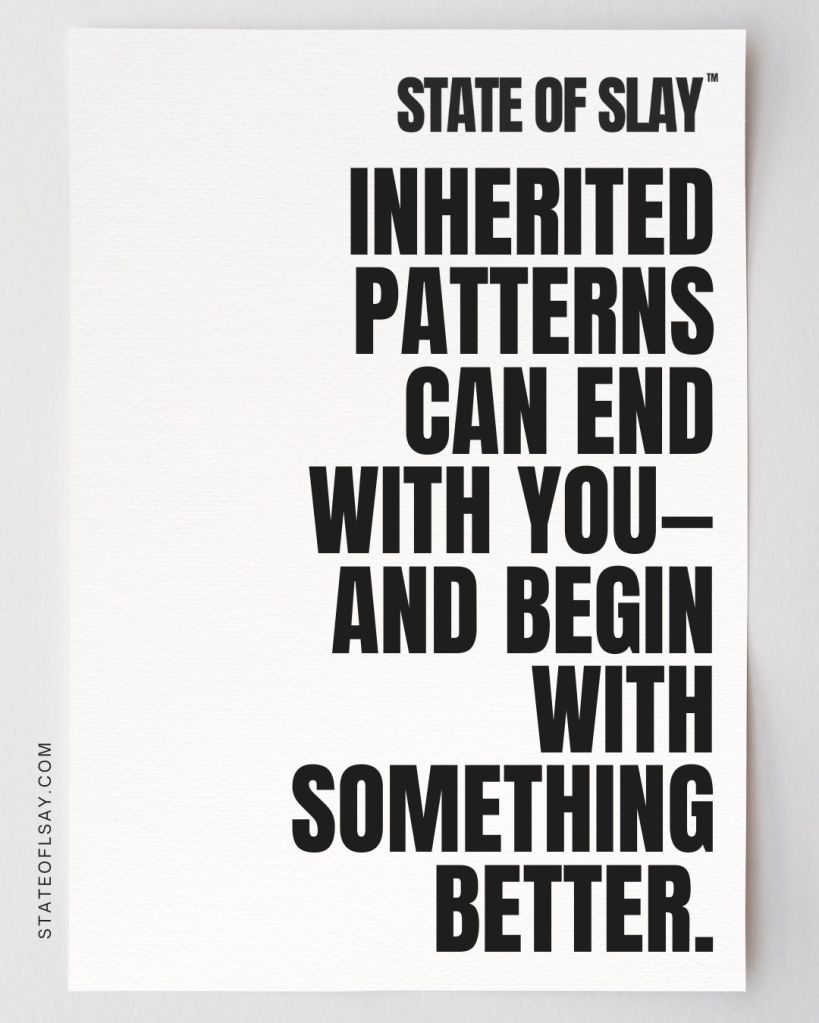
YOU GET TO BUILD SOMETHING NEW

Not everything passed down needs to be carried forward.
Cycles of hurt, silence, or survival may have paved your path—
but that doesn’t mean they have to shape your future.

You’re not here to repeat.
You’re here to restore.
To choose with intention.
To lead with clarity.
And to become the version of yourself your lineage didn’t know was possible.

This is your reminder to be the shift they never saw coming.

SLAY on!

Chase Purpose, Not People

There was a time in my life when I was constantly chasing people—their attention, their approval, their love.

I thought if I could earn it, maybe I’d finally feel like I was enough.

But no matter how much I gave, how much I bent, or how much of myself I lost in the process…
it never felt like enough.

Because it was never supposed to be.

I wasn’t meant to chase people.
I was meant to chase purpose.
And so were you.


When We Abandon Ourselves

When we get stuck in the cycle of proving our worth to others, we end up abandoning ourselves.

We ignore what lights us up.
We try to become what we think they want.
We twist. We shrink. We perform.

We lose the very parts of ourselves that were never meant to be hidden.

And the worst part?
The more we shape-shift to please, the more invisible we become—to others and to ourselves.


Purpose Doesn’t Need to Be Impressed

Purpose is steady.
It doesn’t need applause.
It doesn’t need permission.

It doesn’t ask you to chase it—only to follow.

When I started focusing on my purpose—my healing, my growth, my creativity, my peace—it all got clearer.

I could see what was aligned.
I could feel who was for me and who never was.
The people who truly belonged in my life didn’t need to be convinced. They didn’t need to be chased. They just showed up.

And not for what I could do for them.
But for who I was becoming.


Let Purpose Lead

The truth is:
You are never too much for the right people.
And you are never not enough for the path that was made for you.

So if you’re feeling left out, overlooked, or unseen—it might not be because something’s wrong with you.

It might be because you’re not meant to follow them.

You’re meant to follow you.

Let your purpose lead.
It knows the way.


SLAY Reflection

Do you ever find yourself chasing people instead of aligning with your purpose?
What does “chasing purpose” look like in your life right now?
Who in your life supports your growth without needing you to earn their love?
What’s one step you can take today to move closer to your purpose?
How might your life shift if you stopped proving yourself and started honoring yourself?

S — Show up for yourself
L — Let go of needing approval
A — Align with your purpose
Y — Yield to what feels right, not who feels familiar


Call to Action: Join the Conversation

I’d love to hear from you.
What’s something you’ve stopped chasing in order to start honoring your purpose?
Share your story in the comments. Let’s cheer each other on.

And if you know someone who’s trying to hold onto people instead of themselves, send this to them.
Sometimes, all we need is a nudge.

When a Child is Shamed for Feelings, They Don’t Stop Feeling—They Stop Trusting

There’s a heartbreaking truth many of us come to learn too late:

When a child is shamed for having feelings, they don’t stop feeling. They stop trusting.

They stop trusting their emotions. They stop trusting their voice. And eventually, they stop trusting themselves.

We often teach kids—intentionally or not—that certain feelings are too much, too messy, too inconvenient. That anger is bad. That sadness is weakness. That fear is overreacting. We hush them. We roll our eyes. We tell them to “get over it” or “calm down.” But what we’re really saying is: Your feelings don’t belong here.

And that message doesn’t just sting in the moment. It stays.


The Seeds of Self-Doubt

When we shame a child’s feelings, we’re not teaching emotional regulation—we’re teaching emotional suppression.

Instead of learning how to navigate their emotions, they learn to ignore them, question them, or feel guilt and embarrassment for even having them in the first place.

They start asking:

  • “Why am I so sensitive?”
  • “What’s wrong with me?”
  • “Why can’t I just be normal?”

These questions don’t come from nowhere. They come from a world that told them, early on, that their natural responses were somehow wrong.


Unlearning the Silence

As adults, many of us carry this conditioning into our relationships, our workplaces, and our inner dialogue. We still quiet our feelings. We second-guess our instincts. We feel shame for emotions that are perfectly human.

But here’s the thing: Our feelings don’t go away just because we learned to hide them.

They find other ways to come out—through anxiety, depression, emotional outbursts, or chronic people-pleasing. The body keeps the score. The heart remembers.

Healing begins when we give ourselves permission to feel again. To validate what was once invalidated. To trust that our emotions have something to teach us, not something to be ashamed of.


Reparenting Starts With Awareness

Maybe you were that child. Maybe you’re still carrying the weight of being told to “toughen up” or “stop crying.”

Or maybe you’ve caught yourself repeating those phrases to someone else—not out of cruelty, but because it’s what you were taught.

Here’s the good news: You can stop the cycle.

You can start by:

  • Saying “I hear you” instead of “you’re overreacting.”
  • Asking “What are you feeling?” instead of “What’s wrong with you?”
  • Letting your own emotions be seen, so others feel safe showing theirs.

You don’t need to have all the answers. You just need to be a safe place.


SLAY Reflection

Ask yourself:

  • Was I shamed for showing emotion as a child?
  • How did that shape the way I express or suppress feelings today?
  • Do I trust my emotional responses—or do I second-guess them?
  • How can I begin validating my emotions, rather than hiding or judging them?
  • What would it feel like to create space for someone else to share, without judgment?

S – L – A – Y

S: See where your emotional patterns began.
L: Listen to your inner voice with compassion.
A: Allow your feelings to surface without shame.
Y: Yield to the wisdom your emotions are offering.


Call to Action: Join the Conversation
I’d love to hear from you.
Were you taught to suppress your emotions as a child—and how has that shaped your journey?
Share your story in the comments. Let’s cheer each other on.

And if you know someone who’s learning to feel again, send this to them.
Sometimes, all we need is a nudge.

Slay Say

HEALING DOESN’T ALWAYS LOOK LIKE HARMONY

It can feel like you’re turning your back on everything familiar—but what if you’re turning the page instead?
Growth isn’t always gentle. Sometimes it’s loud. Sometimes it’s lonely. But choosing a new direction doesn’t mean rejecting your roots—it means rising from them.
You’re not abandoning your story.
You’re rewriting the ending.

SLAY on!

Authenticity Is a Higher Vibration Than Joy and Love

We spend so much of our lives chasing happiness, love, and the so-called “good vibes.” But what if the real key to alignment isn’t about always being joyful or even feeling loved? What if the most powerful shift we can make is to be authentic?

Because here’s the truth: authenticity is a higher vibration than joy and love.


Prefer to listen? The Audio Blog version is available here.


The Truth About Vibration

Energy doesn’t lie. And when you’re pretending, pleasing, or performing, your vibration lowers—even if you’re smiling through it.

Joy without truth is performative. Love without boundaries is self-abandonment.

Authenticity, however, is rooted in truth. It’s grounded in presence. It’s the real you. And when we operate from that space, we emit the clearest, most powerful frequency we have. We show up aligned—and everything around us responds to that.


Real Over Perfect

There was a time when I thought I had to look happy to be happy. Smile through the pain. Be grateful when I was struggling. Be kind even when I was breaking.

But fake it ‘til you make it can only take you so far.

The day I stopped trying to be perfect and started being real—everything changed. People connected more deeply with me. My relationships became healthier. I became healthier. Because I wasn’t trying to stay high-vibe. I was trying to stay real.

And that is the vibe the universe actually responds to.


How Authenticity Heals

When we give ourselves permission to be real, we invite others to do the same. We create safety. We foster trust. We show others what it looks like to live in truth, not performance.

Authenticity says:

  • I feel this, even if it’s messy.
  • I’m not perfect, and I don’t have to be.
  • I can still be lovable, even when I’m struggling.

And that is where true love and joy can actually take root. Not in the performance of being okay—but in the truth of being whole.


Authenticity Is a Practice

Being authentic doesn’t mean sharing everything or letting your emotions run unchecked. It means showing up honestly.

It means:

  • Saying no when you mean no.
  • Speaking up when something matters.
  • Honoring your feelings without needing to justify them.

It means being clear about who you are—and being okay with the fact that not everyone will get it. Because your alignment matters more than approval.


The Frequency of Truth

Your truth has its own frequency. When you live it, you attract what’s meant for you. You repel what isn’t. You stop chasing and start receiving.

Authenticity isn’t a trend. It’s a vibration.

And the more you live it, the more powerful you become. Not because you’re trying to be powerful—but because there’s nothing stronger than someone who is fully themselves.


SLAY Reflection

  1. Where in your life are you performing instead of being real?
  2. What does authenticity feel like in your body?
  3. What would it look like to choose authenticity over approval?
  4. Have you mistaken being “high vibe” with being emotionally bypassing?
  5. What part of your truth are you ready to reclaim?

S-L-A-Y:

  • Speak your truth, even when it shakes
  • Let go of the need to be liked
  • Align with your values, not someone else’s
  • You are your most powerful when you are real

Call to Action: Join the Conversation
I’d love to hear from you.
Where in your life are you ready to get real?
Share your story in the comments. Let’s cheer each other on.

And if you know someone who’s stuck in performance mode, send this to them.
Sometimes, all we need is a reminder.

Sometimes Happy Is a Feeling, Sometimes Happy Is a Choice

Let’s be honest: some days happiness wraps around you like a warm blanket. Other days, it’s a threadbare flag you have to raise yourself, even when the wind isn’t blowing.

Sometimes, happy arrives uninvited. A smile you didn’t expect. A moment of peace. Laughter that catches you by surprise. These are the days when joy feels natural. Effortless. When your heart feels light and your worries take a back seat. These are the days you wish you could bottle.

But what about the other days? The days when you wake up heavy, when your body aches with exhaustion, when your mind is cluttered and your heart is a storm cloud? What then?

That’s when happy becomes a choice. And yes, sometimes, it’s the hardest choice you can make.


Feel It When It Comes

We all have seasons where happiness seems to bloom everywhere—inside us and around us. These are the easy days. The ones where gratitude feels automatic, and your smile is real. And when those moments show up?

Let them.

Don’t question the joy. Don’t wait for the other shoe to drop. Let yourself feel good without guilt. You don’t have to earn happiness for it to be valid. It’s not a reward, it’s a gift. And you are allowed to receive it, just because you exist.

Too many of us hesitate to feel joy because we’re afraid it won’t last. But here’s the truth: happiness isn’t permanent, but it is powerful. And when it comes naturally, lean in. Let it soak into your skin.


Choose It When It Feels Out of Reach

And then there are the other days.

The days when happy feels like a stranger.

That’s when you make the choice to reach for it anyway. You choose to smile. To take a walk. To text a friend. To wash your hair. To play a song that makes you sway just a little. To say thank you, even when you’re not quite feeling it.

This isn’t toxic positivity. This is resilience. This is saying, “I know I feel low, but I’m going to plant the seeds of joy anyway.” And over time, those seeds bloom.

Happiness isn’t about denying what hurts. It’s about refusing to let the hurt define the whole day.


You Are Allowed to Want More

Here’s a powerful truth: you don’t have to settle. Not for a life that keeps you stuck. Not for a mindset that keeps you small. You are allowed to chase joy. To design a life that feels good on the inside, not just one that looks good from the outside.

And when you can’t find it? You can choose it. You can create it.

Even if that looks like a slow morning with coffee and quiet.

You are not failing if you have to fight for your happiness. That’s not weakness. That’s strength.


Some Days It’s Both

Sometimes happy is a breeze. Sometimes it’s a battle.

And sometimes, it’s a little bit of both.

Either way, you have the power to feel it, create it, or reach for it. You don’t have to wait for life to feel perfect before you allow yourself to be happy. Let it show up in small ways. Invite it in. And when it comes, don’t push it away.

You are allowed to feel good. You are allowed to choose good. You are allowed to live a life that includes joy.

Even on the hard days.


SLAY Reflection

  1. When was the last time you felt joy without effort? What triggered it?
  2. Do you feel guilty when you’re happy? Why?
  3. What’s one small way you could choose joy today?
  4. How can you remind yourself that happiness isn’t a reward?
  5. What would your day look like if you let joy take up more space?

S-L-A-Y:

  • See where joy naturally shows up in your day
  • Let yourself lean into those moments
  • Acknowledge the hard feelings, but don’t stay stuck in them
  • You have the power to choose happiness, even in small ways

Call to Action: Join the Conversation
I’d love to hear from you.
What does choosing happiness look like for you right now?
Share your story in the comments. Let’s cheer each other on.

And if you know someone who’s struggling to feel joy, send this to them.
Sometimes, all we need is a reminder.

To Become Who You Truly Are, You Have to Let Go of Who They Told You to Be

For much of my life, I tried to be who they told me to be.

The “they” was everywhere—teachers, parents, partners, bosses, social media, society. Each one had a version of me they preferred. I wore those versions like outfits, hoping one of them would finally feel like me. But deep down, I always knew: I was playing a part written by someone else.


When You Live for Them, You Lose Yourself

Every time I molded myself to fit their expectations, I lost another piece of who I was. I became quieter when they said I was too much. I smiled when I wanted to cry. I said yes when everything inside me screamed no.

I wanted to be accepted so badly, I started rejecting myself.

Eventually, I reached a breaking point. I was exhausted. Not from being myself, but from not being myself. I had no idea who I was anymore—but I knew I couldn’t keep pretending. That was the first step.


Forget Who They Told You to Be

To find my true self, I had to unlearn the lies I’d been told:

  • That I was too sensitive.
  • That I needed to tone it down.
  • That my worth depended on being agreeable, pretty, polite, perfect.

None of that was me. It was who they needed me to be so they could be comfortable.

But I wasn’t born to make other people comfortable.

So I started letting go. I peeled back the layers of conditioning, people-pleasing, and perfectionism—and underneath, I found someone real. Someone strong. Someone worth knowing.


Becoming You Is a Brave Act

Choosing to be yourself—your real self—isn’t always easy. It might upset people. It might confuse them. It might even mean walking away from relationships or roles that no longer fit.

But becoming who you truly are is the most powerful act of self-love there is.

Every time you choose authenticity over approval, you build a life that actually feels like yours. And trust me, there is nothing more freeing than that.

You don’t have to be who they told you to be. You get to decide who you are.


SLAY Reflection

  1. Who told you who you “should” be?
  2. What roles or expectations are you still carrying that don’t feel like your own?
  3. When have you felt most like yourself?
  4. What’s one way you can show up more authentically today?
  5. What would your life look like if you stopped living for their approval?

S-L-A-Y:

  • Shed the stories that don’t belong to you.
  • Live your truth—loudly and unapologetically.
  • Acknowledge who you’ve always been beneath the noise.
  • You are allowed to become someone they don’t recognize.

Call to Action: Join the Conversation
I’d love to hear from you.
What part of yourself are you reclaiming today?
Share your story in the comments. Let’s cheer each other on.

And if you know someone who’s stuck in a role they never chose, send this to them.
Sometimes, all we need is a nudge.