
You Can’t Speak Butterfly Language to Caterpillar People

There comes a moment in growth—real, soul-deep growth—where you start to see things differently. You think differently. Feel differently. You’ve been through the fire, and now you move lighter, clearer, freer. But what happens when the people around you haven’t caught up?

What happens when they’re still speaking caterpillar, and you’ve turned into a butterfly?

It’s one of the hardest parts of healing. You want to be understood, to be supported, to be met with the same energy you now bring to the table. But not everyone will get it. Not everyone is meant to. Some people are still living in the version of you that fit them. And that version? The one who shrunk, people-pleased, kept the peace, and didn’t make waves? That’s who they miss.

But you don’t owe anyone a version of yourself that you’ve outgrown.


Don’t Waste Your Wings Explaining Yourself to Those Who Refuse to Fly

The more you evolve, the less you’ll feel the need to explain yourself. That’s not arrogance—it’s alignment.

You’re not obligated to shrink your truth to make someone else comfortable. You’re not here to convince them of your growth, your healing, or your worth. If someone is committed to misunderstanding you, no amount of butterfly talk will make them listen.

They don’t speak your language. They haven’t earned the right to interpret your transformation.

So instead of wasting your energy justifying your boundaries, your peace, your purpose—protect that energy. You’ve worked too hard to unlearn survival mode only to get pulled back into it trying to prove you’ve changed.

Let your life speak for itself. Let your peace do the talking.


You’re Not Better—You’re Just Becoming

Growth doesn’t make you superior. It makes you aware. And with awareness comes choice.

You don’t have to cut people off with cruelty. But you also don’t have to carry the weight of relationships that ask you to deny your truth. Just because you love someone doesn’t mean you can grow beside them.

Some people will stay rooted in fear, gossip, chaos, control. They’ll look at your wings and call them dramatic. Call them selfish. Call them fake. That’s okay.

Let them.

You don’t need their permission to evolve. Your transformation isn’t up for debate.


Fly Anyway

If you’ve been dimming your shine to stay digestible—stop.

If you’ve been translating your truth into someone else’s comfort—stop.

If you’ve been waiting for them to catch up—you don’t have to anymore.

Butterflies don’t explain how they became butterflies. They just fly.

You’re allowed to protect your peace without guilt. You’re allowed to walk away from dynamics that drain you. You’re allowed to outgrow places, people, and patterns that no longer serve you—even if they once did.

That’s not disloyal. That’s evolution.

So the next time someone tries to pull you back into the old version of yourself, remember: you’re not who you used to be. And that’s a good thing.

You’re speaking butterfly now. Not everyone is meant to understand.


SLAY Reflection

  1. Who in your life still expects you to be the person you’ve outgrown?
  2. What version of yourself are you most proud of leaving behind?
  3. Do you feel the need to explain your healing journey to others?
  4. How does it feel when someone doesn’t “get” your growth?
  5. What’s one way you can protect your peace this week—without apology?

S – Speak your truth without over-explaining
L – Let go of needing approval for your evolution
A – Align with people who see and support the real you
Y – Yield to your transformation, even if it’s misunderstood


Call to Action: Join the Conversation

I’d love to hear from you.
Who have you had to stop explaining yourself to—and how did it free you?
Share your story in the comments. Let’s cheer each other on.

And if you know someone who’s trying to fly while others are pulling them down, send this to them.
Sometimes, all we need is a nudge.

Slay Say

Truth isn’t found in the height of a reaction, but in the clarity that comes after.

Feelings can be powerful storytellers—but not always reliable ones. They shout in moments of hurt, fear, or doubt, demanding you take action, say something, quit, or lash out. But when you give your emotions time to breathe, your wisdom steps forward. Your truth finds its voice. And your story becomes something you can stand by—without apology.

This is your reminder to pause before you print.

SLAY on!

Put Your Own Mask On First

We hear it every time we board a plane: “In the event of a loss in cabin pressure, secure your own mask before assisting others.” It’s one of those instructions that seems counterintuitive—especially for the givers, the fixers, the caretakers among us. But when you stop to really think about it, it’s not just an airline safety rule—it’s a life lesson.

For a long time, I didn’t put on my own mask first. I’d jump in to help anyone else—whether they asked or not—believing it made me strong, loving, dependable. I was the one people could count on. But quietly, I was falling apart. I was suffocating. And I didn’t even realize it until I was gasping for air.


You Can’t Pour From an Empty Cup

We’ve all heard that saying, but how many of us actually live it?

If you’ve been conditioned to believe your worth is tied to your usefulness, rest might feel selfish. Saying no might feel wrong. Asking for space might trigger guilt. But here’s the truth: constantly abandoning yourself to show up for others isn’t noble—it’s a fast track to burnout, resentment, and disconnection.

When you give from depletion, your help comes with a cost. You’re exhausted. You’re short-fused. You’re giving, but secretly hoping for a thank you, some recognition, a return on your emotional investment. And when that doesn’t come? It hurts. Because beneath all that self-sacrifice, you’re still human.

Putting your own mask on first isn’t selfish—it’s survival. It’s sustainability. It’s strength. When you’re nourished, rested, grounded—you give from overflow, not from emptiness. And everyone benefits from that version of you.


Self-Care Isn’t a Luxury—It’s a Responsibility

Somewhere along the way, we started seeing self-care as optional—as a bubble bath or a bonus. But self-care is how you keep yourself whole. It’s how you stay aligned. It’s the system check that makes sure you’re not running on fumes.

It’s not always glamorous. Sometimes, self-care is a boundary. Sometimes it’s canceling plans. Sometimes it’s letting someone else figure it out, even when you could fix it. It’s trusting that people can handle their own discomfort—and that it’s not your job to keep everything calm.

The truth is, constantly putting others first is often rooted in fear: What if they get mad? What if they leave? What if they think I’m selfish?

But ask yourself this: If you keep abandoning yourself to meet everyone else’s needs, what are you teaching them? That your needs don’t matter. That you’ll always sacrifice yourself. That love looks like martyrdom.

It doesn’t.


Show Up for You—First

Putting your own mask on first means taking inventory of your energy. It means asking: Am I okay? What do I need right now? Am I being honest about my limits?

When you start showing up for yourself, everything shifts. Your relationships become more balanced. Your boundaries become clearer. You stop saying yes when you mean no. You stop fixing what isn’t yours. And you start building a life that includes you.

This doesn’t mean you stop helping others. It just means you stop bleeding out for them. You choose to care without collapsing. You choose to support without suffocating. You choose to love from wholeness—not from empty lungs.

You’re not here to save everyone. You’re here to be you. And that’s more than enough.

So the next time you feel that urge to abandon yourself to keep the peace, to overextend just to be liked, or to put everyone ahead of you—pause. Breathe. Reach for your own mask first.

That’s not weakness. That’s wisdom.


SLAY Reflection

  1. Do you feel guilty putting your needs before others? Why?
  2. What areas of your life have suffered because you’ve neglected yourself?
  3. When was the last time you truly paused and checked in with you?
  4. How would your life change if you consistently put your needs first?
  5. What’s one small act of self-care you can commit to today?

S – Stop and assess what you really need
L – Let go of guilt tied to prioritizing yourself
A – Allow yourself to rest, recharge, and reset
Y – Yield to your own healing so you can truly thrive


Call to Action: Join the Conversation

I’d love to hear from you.
What does putting your own mask on first look like for you—and how has it changed your life?
Share your story in the comments. Let’s cheer each other on.

And if you know someone who always puts themselves last, send this to them.
Sometimes, all we need is a nudge.

Their Storm, Not Your Forecast

There’s a strange pressure to get swept up in someone else’s chaos. To absorb their anger, defend against their projections, or even try to fix what they refuse to face. Especially if you’re a deeply empathetic person, it can be hard to remember:

Not every storm requires your umbrella.

Just because someone is bringing drama, blame, or emotional thunder into the room doesn’t mean you have to get soaked.

It might sound harsh, but not every meltdown, every mood, or every mess is yours to carry.

Let’s be real—some people thrive in the whirlwind. They create it. They stir up tension, throw lightning bolts, and wait to see who gets scorched. And if you’re not careful, you’ll mistake their storm for your reality.


You’re Not the Weather Channel

Here’s the thing: just because they’re forecasting doom doesn’t mean you have to build an ark. We can love people, support people, and still refuse to be pulled under by their emotional riptide.

Your peace isn’t up for negotiation.

One of the biggest lessons I’ve learned is this: if someone is committed to chaos, no amount of calm you bring will change them. You don’t have to match their energy, explain yourself endlessly, or prove your worth in the face of their projection.

Your job is to stay grounded in your truth.

People will accuse you of being cold, distant, or selfish when you refuse to engage in their drama. Let them. You’re not required to participate in every emotional argument you’re invited to.


Calm Isn’t Weak—It’s Wise

Some storms are loud. Others are subtle. But all of them share one trait: they pull you away from your center. When you stay calm in the face of emotional turbulence, you’re not being passive—you’re being powerful.

Calm is a boundary.

It says: “I’m not going to argue with someone who’s not listening. I’m not going to internalize someone else’s pain. I’m not going to let your storm become my identity.”

This doesn’t mean you don’t care. It means you care enough about yourself to know the difference between being present and being consumed.


Detach Without Guilt

If you’ve ever grown up in dysfunction, chaos might feel familiar—even comfortable. You may have learned to overfunction, to fix, to please, to manage the emotions of others so things wouldn’t blow up. But that’s not your role anymore.

You can walk away. You can say, “This isn’t mine.” You can let someone rage, spiral, or stew without stepping into the storm.

Because here’s the truth: the storm isn’t personal. Even if it’s aimed at you, it’s not really about you. It’s about their unhealed pain. Their fear. Their need for control.

You didn’t cause it, and you don’t have to catch it.


Protect Your Inner Weather

Boundaries aren’t walls, they’re windows. They let in light and fresh air, but they keep out the hail. When you feel that pull to jump into someone else’s chaos, pause and ask:

  • Is this really mine?
  • What happens if I don’t respond?
  • What would it look like to stay rooted in my calm?

Because that’s the goal: to be so in tune with your own emotional forecast that someone else’s storm can roll through without ever touching your peace.

Let them weather it. You’ve got sunshine to protect.


SLAY Reflection

  1. Have you ever mistaken someone else’s storm as your responsibility to fix?
  2. What patterns from your past make chaos feel familiar or expected?
  3. When was the last time you stayed calm in a moment of drama—and how did that feel?
  4. What’s one situation right now where you can say, “This isn’t mine”?
  5. How can you strengthen your boundaries to protect your inner peace?

S – Step away from unnecessary emotional storms
L – Let go of the need to fix what isn’t yours
A – Acknowledge your limits with compassion
Y – Yield to peace, not pressure


Call to Action: Join the Conversation

I’d love to hear from you.
What’s one way you’ve protected your peace by not engaging in someone else’s storm?
Share your story in the comments. Let’s cheer each other on.

And if you know someone who’s always caught in the swirl of someone else’s drama, send this to them.
Sometimes, all we need is a reminder that peace is a choice.

Slay Say

TRUST THE DIRECTION, NOT THE DETOUR

Even when it feels unfamiliar…
Even when no one understands your choices…
Even when it’s hard to let go of who you were…

Keep going.

The point of growth isn’t staying the same.
It’s giving yourself permission to evolve.

You don’t need to prove your past to anyone.
What matters is who you’re becoming—and the life that’s waiting on the other side of your courage.

So if it’s time to close a chapter, do it.
Not out of regret. But because the next one deserves a fresh page.

SLAY on!

Boundaries Don’t Burn Bridges, They Protect Castles

We often think of boundaries as walls—cold, hard, unmovable. Something that keeps people out. Something that severs ties. But boundaries aren’t built to burn bridges; they’re created to protect the castles we live in: our peace, our worth, our mental and emotional well-being.

Setting boundaries doesn’t make you selfish or difficult. It makes you safe. It makes you sovereign over your own life.


Castles Require Protection

Think about what a castle is: it’s a sanctuary. A stronghold. A place where something valuable lives. And yet, without a gate, without guards, without a moat, it’s just a target.

You are the castle.

Your energy, your time, your kindness, your heart—these are the treasures inside. Boundaries are how you decide who gets access, and under what conditions. They are not about shutting everyone out. They are about making sure that those who enter are willing to honor the space, not pillage it.

If someone sees your boundary as a betrayal, they were never meant to be in your castle to begin with.


Burning Bridges vs. Building Balance

There’s a big difference between cutting someone off out of spite and setting a boundary to preserve your well-being. But not everyone will see it that way—especially those who benefited from you not having boundaries before.

Let that be a red flag.

When someone is upset that you’re taking care of yourself, it says more about them than it does about you. Your healing will threaten the dynamics that were built on your silence, your sacrifice, and your people-pleasing. And when those dynamics shift, don’t be surprised if some bridges fall down on their own.

Let them.

Not every bridge is meant to last forever. Some were only built to teach you how not to be walked on.


Boundaries Are Not Barriers to Love

It can feel scary to draw the line—especially with people we care about. We worry they’ll see us differently. That we’ll lose them. That they’ll think we don’t love them anymore. But the truth is, love that can’t coexist with boundaries isn’t really love.

It’s control. It’s codependency. It’s convenience.

Love honors the sacred. And what could be more sacred than your well-being?

Setting a boundary is not an act of war. It’s an act of self-respect. It’s saying, “I care enough about myself to choose what I allow into my life.”

Those who love you well will walk through your gates, not try to climb your walls.


You Don’t Owe Anyone Access to Your Peace

Let that sink in.

You don’t owe explanations. You don’t owe justifications. You don’t owe your energy to people who constantly drain it. You don’t owe a single brick from your castle to anyone who hasn’t proven they know how to build.

It’s not easy to maintain boundaries, especially when guilt or fear creeps in. But remember this:

Every time you choose your peace over your people-pleasing, you reinforce the walls that keep your life safe and sacred.

Protect your castle. The right people will come with open hands, not demands.


SLAY Reflection

  1. Where in your life have you struggled to set boundaries?
  2. What have you been afraid might happen if you did?
  3. How does it feel when someone respects your boundaries without question?
  4. What does your “castle” need more protection from right now?
  5. How can you reinforce your emotional boundaries with love and clarity?

S – Stand strong in your worth
L – Let go of guilt around protecting your peace
A – Ask for what you need without apology
Y – Yield only to love that respects your lines


Call to Action: Join the Conversation

I’d love to hear from you.
What boundaries have helped protect your peace?
Share your story in the comments. Let’s cheer each other on.

And if you know someone who’s afraid to set boundaries, send this to them.
Sometimes, all we need is a nudge.

Slay Say

You Don’t Need a Stage to Make an Impact

You may never know who’s watching, or whose life you’re silently shifting just by staying the course.
The most meaningful encouragement often doesn’t come with applause—it comes with resonance.

Your courage to keep going, even when no one’s looking, might be the very thing that gives someone else the strength to do the same.

This is your reminder to keep showing up—not for validation, but because your story holds power, even if it unfolds quietly.

SLAY on.

You Did Nothing Wrong By Asking To Be Treated Right

There was a time in my life when I second-guessed myself. I would speak up when something didn’t feel good, and then spiral afterward—replaying the moment in my head, wondering if I was overreacting, if I made things awkward, if I should have just stayed quiet.

But here’s the truth I wish I had known sooner:

You did nothing wrong by asking to be treated right.

There is nothing wrong with saying “that hurt my feelings” or “I don’t like how that made me feel.” There is nothing wrong with saying “I deserve better than this.” Because you do. You always have.

What is wrong is how often we’re taught to feel guilty for setting a boundary. We’re told we’re too sensitive, too difficult, too much. So we shrink. We tolerate. We accept less. And with each time we swallow our truth, we chip away at the trust we have with ourselves.

Over time, we begin to question whether we even deserve what we’re asking for. We start to silence ourselves before anyone else even has the chance to.

But the voice inside you that whispers, “this doesn’t feel right”—that voice is sacred. And it deserves to be heard.

We’re often praised for how much we can endure, how quiet we can stay, how agreeable we can be. But healing isn’t about being palatable. It’s about being real.

It’s about letting go of the version of you that never got to speak up, and becoming the version who knows how to say, “I’m not okay with this.”

Because you matter. What you feel matters. What you need matters.


It’s Not Asking for Too Much

It’s not just about the person on the other end of the conversation. It’s about you. Your self-worth. Your healing. Your nervous system. The way you allow yourself to take up space and take care of yourself.

Honoring how you feel isn’t selfish—it’s self-respect.

Asking to be treated with kindness, consistency, and care is not asking for too much. It’s asking for the bare minimum. And if someone can’t meet you there, that’s not your failure. That’s their limitation.

You don’t have to convince people to do the right thing. You just have to be willing to do the right thing for yourself.

Letting people know where your lines are isn’t pushing them away. It’s giving them a clear map of how to love you.

And if they walk away? Let them. Anyone who leaves because you asked for respect was never offering it to begin with.

Protecting your peace is not dramatic. It’s necessary. Saying “no more” is not cruelty. It’s clarity. And standing up for yourself is not a betrayal of others—it’s a commitment to yourself.

When you start honoring what you know to be true, you stop seeking validation from people who never had the capacity to see you clearly.


Trust What You Know

So if you’ve ever walked away from a conversation, a relationship, or a space because your boundaries weren’t honored—let me remind you:

You did not fail.
You did not overreact.
You did not do anything wrong.

You simply chose yourself.
And that is something to be proud of.

You’re not hard to love—just hard to manipulate. And anyone who’s confused by that difference was never meant to hold your heart.

Let your purpose lead. It knows the way.


SLAY Reflection

  1. Have you ever felt guilty for speaking up about how you were treated?
  2. Where in your life are you still tolerating what doesn’t feel good?
  3. What would change if you fully trusted your feelings and instincts?
  4. Who in your life consistently respects your boundaries?
  5. How might your life shift if you believed you weren’t “too much” for simply asking for respect?

S – Speak your truth without apology
L – Let your boundaries be your guide
A – Ask for what honors your worth
Y – Yield to self-respect over people-pleasing


Call to Action: Join the Conversation

I’d love to hear from you.
What’s something you’ve asked for that made you feel proud for standing up for yourself?
Share your story in the comments. Let’s cheer each other on.

And if you know someone who’s second-guessing themselves for speaking up, send this to them.
Sometimes, all we need is a nudge.

Slay Say

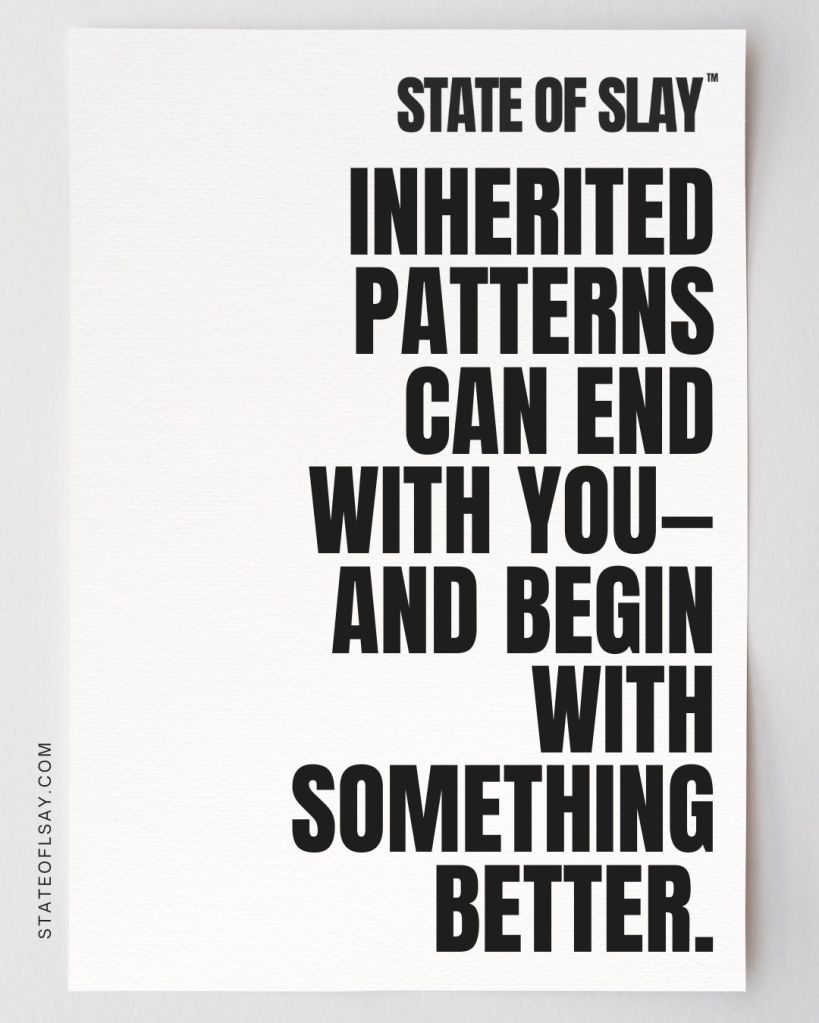
YOU GET TO BUILD SOMETHING NEW

Not everything passed down needs to be carried forward.
Cycles of hurt, silence, or survival may have paved your path—
but that doesn’t mean they have to shape your future.

You’re not here to repeat.
You’re here to restore.
To choose with intention.
To lead with clarity.
And to become the version of yourself your lineage didn’t know was possible.

This is your reminder to be the shift they never saw coming.

SLAY on!

Chase Purpose, Not People

There was a time in my life when I was constantly chasing people—their attention, their approval, their love.

I thought if I could earn it, maybe I’d finally feel like I was enough.

But no matter how much I gave, how much I bent, or how much of myself I lost in the process…
it never felt like enough.

Because it was never supposed to be.

I wasn’t meant to chase people.
I was meant to chase purpose.
And so were you.


When We Abandon Ourselves

When we get stuck in the cycle of proving our worth to others, we end up abandoning ourselves.

We ignore what lights us up.
We try to become what we think they want.
We twist. We shrink. We perform.

We lose the very parts of ourselves that were never meant to be hidden.

And the worst part?
The more we shape-shift to please, the more invisible we become—to others and to ourselves.


Purpose Doesn’t Need to Be Impressed

Purpose is steady.
It doesn’t need applause.
It doesn’t need permission.

It doesn’t ask you to chase it—only to follow.

When I started focusing on my purpose—my healing, my growth, my creativity, my peace—it all got clearer.

I could see what was aligned.
I could feel who was for me and who never was.
The people who truly belonged in my life didn’t need to be convinced. They didn’t need to be chased. They just showed up.

And not for what I could do for them.
But for who I was becoming.


Let Purpose Lead

The truth is:
You are never too much for the right people.
And you are never not enough for the path that was made for you.

So if you’re feeling left out, overlooked, or unseen—it might not be because something’s wrong with you.

It might be because you’re not meant to follow them.

You’re meant to follow you.

Let your purpose lead.
It knows the way.


SLAY Reflection

Do you ever find yourself chasing people instead of aligning with your purpose?
What does “chasing purpose” look like in your life right now?
Who in your life supports your growth without needing you to earn their love?
What’s one step you can take today to move closer to your purpose?
How might your life shift if you stopped proving yourself and started honoring yourself?

S — Show up for yourself
L — Let go of needing approval
A — Align with your purpose
Y — Yield to what feels right, not who feels familiar


Call to Action: Join the Conversation

I’d love to hear from you.
What’s something you’ve stopped chasing in order to start honoring your purpose?
Share your story in the comments. Let’s cheer each other on.

And if you know someone who’s trying to hold onto people instead of themselves, send this to them.
Sometimes, all we need is a nudge.