Slay Say

Honor What’s Meant to Stay

Some endings don’t come with closure.
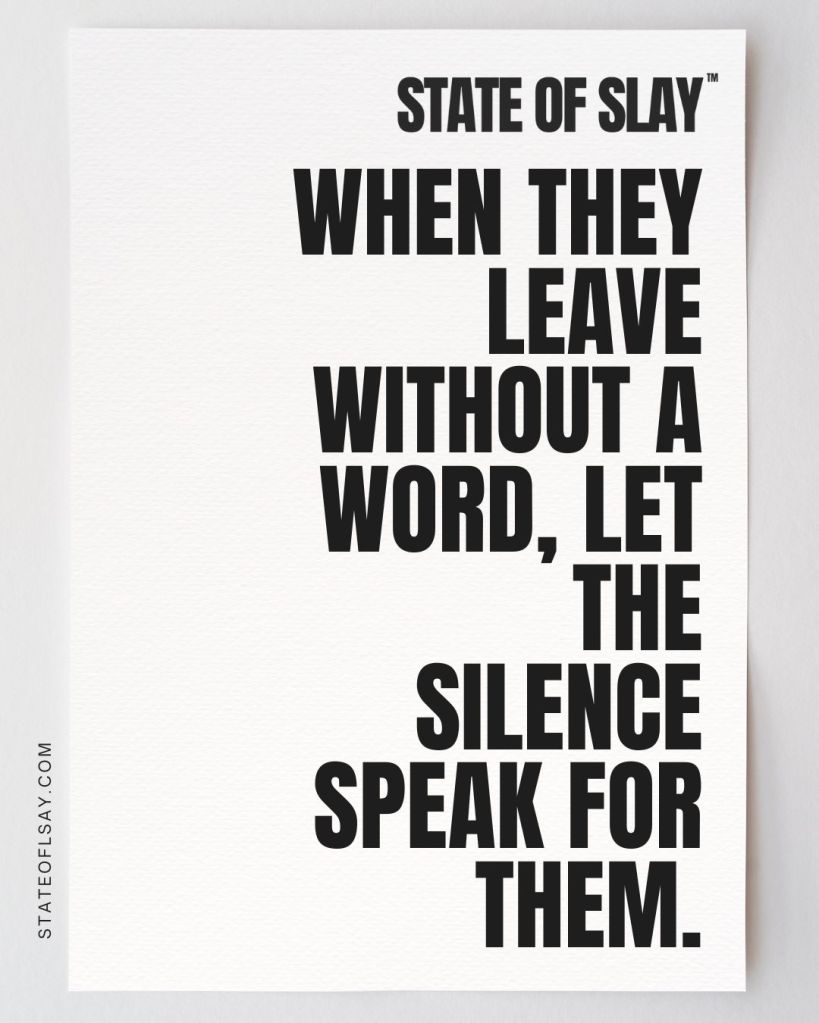
Some people simply slip out of your life
without explanation, apology, or accountability.

And as painful as that silence can be,
it’s also information.

Not everything is meant to be revived.
Not every connection deserves resuscitation.
Sometimes the leaving tells you
everything the staying never could.

Your peace is too precious
to pour into what no longer chooses you.
Let what buried itself remain buried.
Life has a way of removing what can’t grow with you.

This is your reminder:
Your energy belongs where it’s respected,
not where you’re chasing ghosts.

Slay On!

Slay Say

Stop pouring into empty cups—it’s time to honor your own.

We teach people how to treat us by what we allow, what we stop, and what we walk away from. If you keep making others a priority while they treat you as an afterthought, you’re not being kind—you’re abandoning yourself.The truth is, you don’t need to beg for a seat at a table where you’re only ever offered crumbs. You deserve to sit where your presence is seen, valued, and celebrated.

This isn’t about becoming hard or unkind. It’s about protecting your energy and making room for relationships that meet you with the same care you give so freely.

This is your reminder to stop pouring into places that never pour back.

Don’t give priority where you’re treated as an option.

SLAY on!

Slay Say

When Your Silence Speaks Louder Than Your Words

There are moments when staying quiet feels like the safer choice—avoiding conflict, sidestepping tension, or convincing yourself it’s “not your place.” But when you stay silent in the face of harm, injustice, or mistreatment, your silence doesn’t just go unnoticed. It’s often interpreted as acceptance.

Speaking up isn’t about confrontation—it’s about alignment. It’s about choosing integrity over comfort. Even when your voice shakes, it’s better to risk being misunderstood than to live with the weight of agreeing to something that goes against your values.

The truth is, your voice has power. And the moment you choose to use it—no matter how small or imperfect—you step out of passive agreement and into active self-respect.

This is your reminder to: speak up when something isn’t right, even if your voice is the only one in the room.

SLAY on!

Slay Say

Some Wounds Aren’t Loud

Just because there wasn’t malice doesn’t mean there wasn’t damage.
The ripple of someone’s behavior can still cut deep—
even when their hands never meant to cause pain.

What matters is how you felt. What you carry.
Your truth still deserves recognition.

This is your reminder to honor what happened,
even if no one else saw it.

SLAY on!

Their Storm, Not Your Forecast

There’s a strange pressure to get swept up in someone else’s chaos. To absorb their anger, defend against their projections, or even try to fix what they refuse to face. Especially if you’re a deeply empathetic person, it can be hard to remember:

Not every storm requires your umbrella.

Just because someone is bringing drama, blame, or emotional thunder into the room doesn’t mean you have to get soaked.

It might sound harsh, but not every meltdown, every mood, or every mess is yours to carry.

Let’s be real—some people thrive in the whirlwind. They create it. They stir up tension, throw lightning bolts, and wait to see who gets scorched. And if you’re not careful, you’ll mistake their storm for your reality.


You’re Not the Weather Channel

Here’s the thing: just because they’re forecasting doom doesn’t mean you have to build an ark. We can love people, support people, and still refuse to be pulled under by their emotional riptide.

Your peace isn’t up for negotiation.

One of the biggest lessons I’ve learned is this: if someone is committed to chaos, no amount of calm you bring will change them. You don’t have to match their energy, explain yourself endlessly, or prove your worth in the face of their projection.

Your job is to stay grounded in your truth.

People will accuse you of being cold, distant, or selfish when you refuse to engage in their drama. Let them. You’re not required to participate in every emotional argument you’re invited to.


Calm Isn’t Weak—It’s Wise

Some storms are loud. Others are subtle. But all of them share one trait: they pull you away from your center. When you stay calm in the face of emotional turbulence, you’re not being passive—you’re being powerful.

Calm is a boundary.

It says: “I’m not going to argue with someone who’s not listening. I’m not going to internalize someone else’s pain. I’m not going to let your storm become my identity.”

This doesn’t mean you don’t care. It means you care enough about yourself to know the difference between being present and being consumed.


Detach Without Guilt

If you’ve ever grown up in dysfunction, chaos might feel familiar—even comfortable. You may have learned to overfunction, to fix, to please, to manage the emotions of others so things wouldn’t blow up. But that’s not your role anymore.

You can walk away. You can say, “This isn’t mine.” You can let someone rage, spiral, or stew without stepping into the storm.

Because here’s the truth: the storm isn’t personal. Even if it’s aimed at you, it’s not really about you. It’s about their unhealed pain. Their fear. Their need for control.

You didn’t cause it, and you don’t have to catch it.


Protect Your Inner Weather

Boundaries aren’t walls, they’re windows. They let in light and fresh air, but they keep out the hail. When you feel that pull to jump into someone else’s chaos, pause and ask:

  • Is this really mine?
  • What happens if I don’t respond?
  • What would it look like to stay rooted in my calm?

Because that’s the goal: to be so in tune with your own emotional forecast that someone else’s storm can roll through without ever touching your peace.

Let them weather it. You’ve got sunshine to protect.


SLAY Reflection

  1. Have you ever mistaken someone else’s storm as your responsibility to fix?
  2. What patterns from your past make chaos feel familiar or expected?
  3. When was the last time you stayed calm in a moment of drama—and how did that feel?
  4. What’s one situation right now where you can say, “This isn’t mine”?
  5. How can you strengthen your boundaries to protect your inner peace?

S – Step away from unnecessary emotional storms
L – Let go of the need to fix what isn’t yours
A – Acknowledge your limits with compassion
Y – Yield to peace, not pressure


Call to Action: Join the Conversation

I’d love to hear from you.
What’s one way you’ve protected your peace by not engaging in someone else’s storm?
Share your story in the comments. Let’s cheer each other on.

And if you know someone who’s always caught in the swirl of someone else’s drama, send this to them.
Sometimes, all we need is a reminder that peace is a choice.

Slay Say

Your time, energy, and attention are not on-demand services.

We live in a world that glorifies being constantly accessible—always replying, always saying yes, always available.
But that kind of constant output doesn’t make you kind, it makes you exhausted.
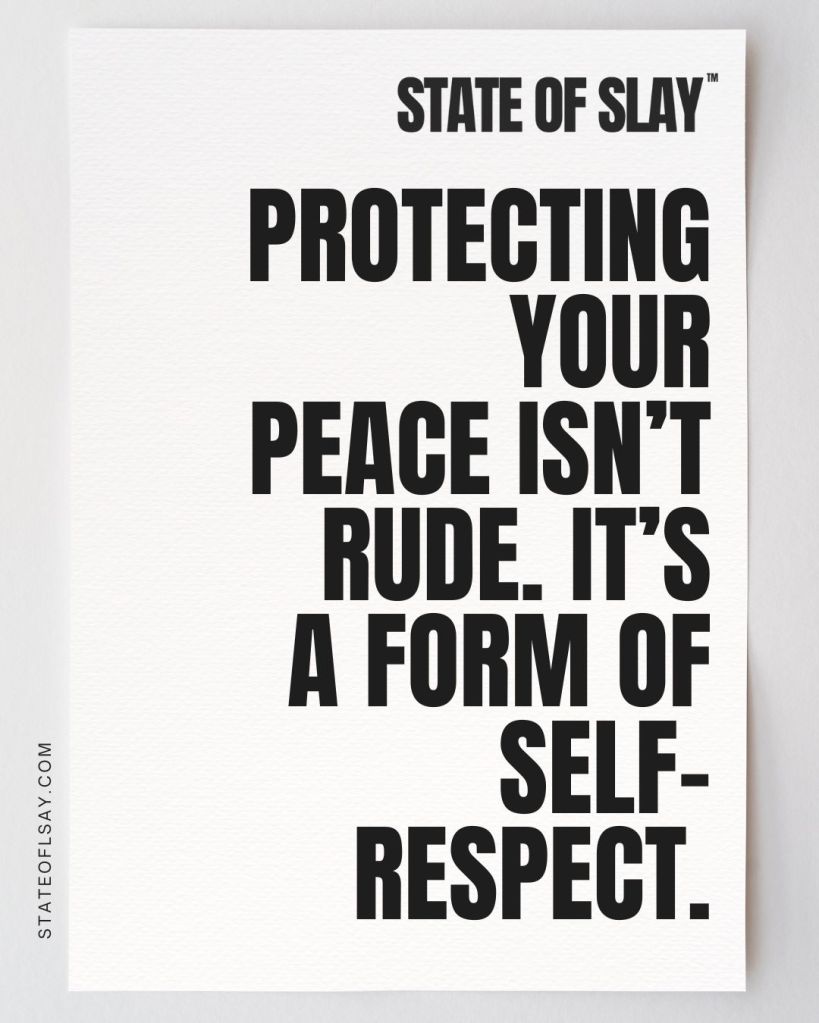
Protecting your peace means knowing when to pause, say no, or simply not respond.
Your availability doesn’t define your worth.
Your boundaries define your self-respect.

This is your reminder that you don’t need to be everywhere for everyone.
You just need to be present for yourself.

SLAY on!

Slay Say

Truth Over Tolerance

Not everyone will treat you with kindness—and that’s on them. Rudeness, cruelty, dismissal… those choices reflect what someone brings into the world, not what you deserve. You are not responsible for someone else’s inability to show respect or humanity. Recognize it for what it is—and don’t carry what isn’t yours.

This is your reminder:
You don’t have to internalize someone else’s limitations. Let their behavior reveal them, not define you.

SLAY on!

When You See Your Worth You Find It Harder To Stay Around Those Who Don’t

We are what we allow.

And when we allow people to treat us as if we’re not worthy—when we accept behavior that belittles us or dims our light—we start to believe we deserve it.

But our worth isn’t something other people get to define. It doesn’t come from approval, status, or success. It comes from within. From who we are, what we value, and how we show up in the world. True worth is self-sourced. And once we see it clearly, it becomes much harder to stay around people who don’t.


Before I Knew My Worth

When I was living in the dark, I didn’t believe I had any worth.

I made choices that reflected that belief. I tolerated disrespect. I spoke to myself with cruelty. I stayed in environments that diminished me. I confused success with self-worth and chased external validation to feel like I mattered. And when I didn’t get it, the old narrative played on a loop: You’re not good enough.

I lived like someone who had no value—because I didn’t believe I did.

It wasn’t until I stepped onto the path of recovery that I started to challenge that story. At first, I couldn’t even look in the mirror. I couldn’t say, “I love you” to myself. The words got stuck in my throat.

But slowly, with support from others who had been there, I started to find glimmers of self-worth. I made a list of what I liked about myself. On days when that felt impossible, I wrote down the opposite of the harsh thoughts I was thinking—and used that as my starting point.


Building from Within

I did the work. I stayed the course. And slowly, something shifted.

Acts of kindness, both given and received, started to restore me. I gave back where I could. I surrounded myself with people who saw me clearly. I honored the little girl inside me who had never felt safe, and promised her I wouldn’t abandon her again.

With each step, my self-worth grew.

And as it did, my tolerance shrank.

I no longer accepted treatment that chipped away at my light. I no longer stayed in rooms where I felt unseen. I started seeking out people who inspired me, who respected themselves, and who respected me too. Because once you see your own worth, you can’t unsee it—and you won’t settle for less.


Worth Doesn’t Wait for Permission

You don’t have to earn your worth. You don’t have to prove it. You just have to see it—and then live like it matters.

Surround yourself with people who reflect that truth back to you. And when you feel yourself dimming to fit into a space that doesn’t honor you, step back and ask: Is this what I deserve? Or am I shrinking to make someone else comfortable?

You have value just as you are. The right people will recognize it. But most importantly: you will.

SLAY on.


SLAY Reflection: Where Are You Honoring Your Worth?

  • Do you believe you have worth? If not, where did that belief come from?
  • Are you surrounding yourself with people who reflect your worth—or diminish it?
  • What’s one thing you love about yourself? Say it out loud. Write it down.
  • Have you ever tolerated behavior that made you feel small? Why?
  • What’s one way you can stand in your worth today?

Call to Action: Join the Conversation

I’d love to hear from you.
What’s one way you’ve reclaimed your worth—and how did it change what (or who) you allowed in your life?
Share your story in the comments. Let’s cheer each other on.

And if you know someone who’s forgotten how worthy they are, send this to them.
Sometimes, all we need is a reminder to rise.

Slay Say

Good morning SLAYER! Don’t be afraid of asking the questions, be afraid of not asking them.

New blog goes up Sunday, until then… SLAY on!

State Of Slay Being Brave Enough

When We Know The Answers We Are Safe

Before walking this path I was afraid of the truth. I was either to fearful to ask the questions I should have been asking or I let my ego tell me I already knew the answers before asking them. Either way, not asking the questions was unsafe. Most of the time I was too afraid to ask them because I always thought the worst, or had done something that someone may have found out, or just thought of myself as an unlovable and worried that others had figured that out too. I walked around with a lot of question marks, and a lot of knots in my stomach. My solution, back then, was magical thinking, that somehow I could just wish the answers I wanted into being, and I would look for tiny bits of evidence to back up the answers I wanted to believe were true until I could collect enough to almost convince myself they where, but really, I knew I was just seeing and hearing what I wanted to fit the narrative I wanted to tell. The truth scared me, probably because I wasn’t truthful back then, and it’s difficult to believe people are open and honest when you’re not with yourself, or asking for it from those around you.

When I made a commitment to get better I made a commitment to be rigorously honest with myself, and over time I began working with a counselor to help me put all the pieces together and help me get an accurate picture of my past, why I did the things I did, and who I actually was. When we talked about the people in my life and I didn’t have answers to the questions he was asking, those knots in my stomach would return and I would get nervous. I was asked why I wasn’t asking the questions I needed to know from those people, and I would retreat and say I didn’t know. The real answer finally came out, it was fear, I was afraid to ask people what their intentions where, who they were and who I was to them, I was afraid in the past because I, for the most part, wasn’t being honest or forthcoming about myself in those areas, so it made sense I had fear asking someone else to do the same. But what my counselor said to me, which I still live by today, is that when we know the answers we are safe, until we know what those answers are we are not safe because we don’t know the truth about the people in our lives. He had said that even if the answers are not what we want to hear, we then know the facts, and can make a decision about what is best for us. Once we have done that, we are safe. It made sense, but even though it made sense didn’t mean it was easy to put into practice at first, but the promise of safety got me motivated enough to start, and even though all of those answers weren’t what I wanted to hear, they allowed me to make decisions for myself that made me feel safe. And, I could then make informed decisions for myself that kept me safe and built up my self-respect and self-esteem.

Asking the questions we should be asking, especially when we invite someone new into our lives, isn’t’ always easy, but not asking, and not knowing, puts our well-being in jeopardy and may set ourselves up for heartache at our own hand. We can’t control if the answers we are getting are the truth, but sometimes just the act of asking will flush that truth out. Anyone worthy of being in our lives will be honest, and will appreciate our honesty in return, those who don’t may be giving you the answers you need just by their reaction. Never apologize for the answers you need to feel safe. SLAY on!

SLAY OF THE DAY: Do you ask the questions you should be asking to feel safe? If not, why not? What are you afraid of? List an example when you didn’t ask the questions you needed to and were hurt or disappointed as result. What can you do to make sure you’re asking the questions you need to? Don’t let fear stop you from taking the action you need to for your own emotional safety.

S – self L – love A – appreciate Y – you