Slay Say

The Story You Keep Telling Yourself

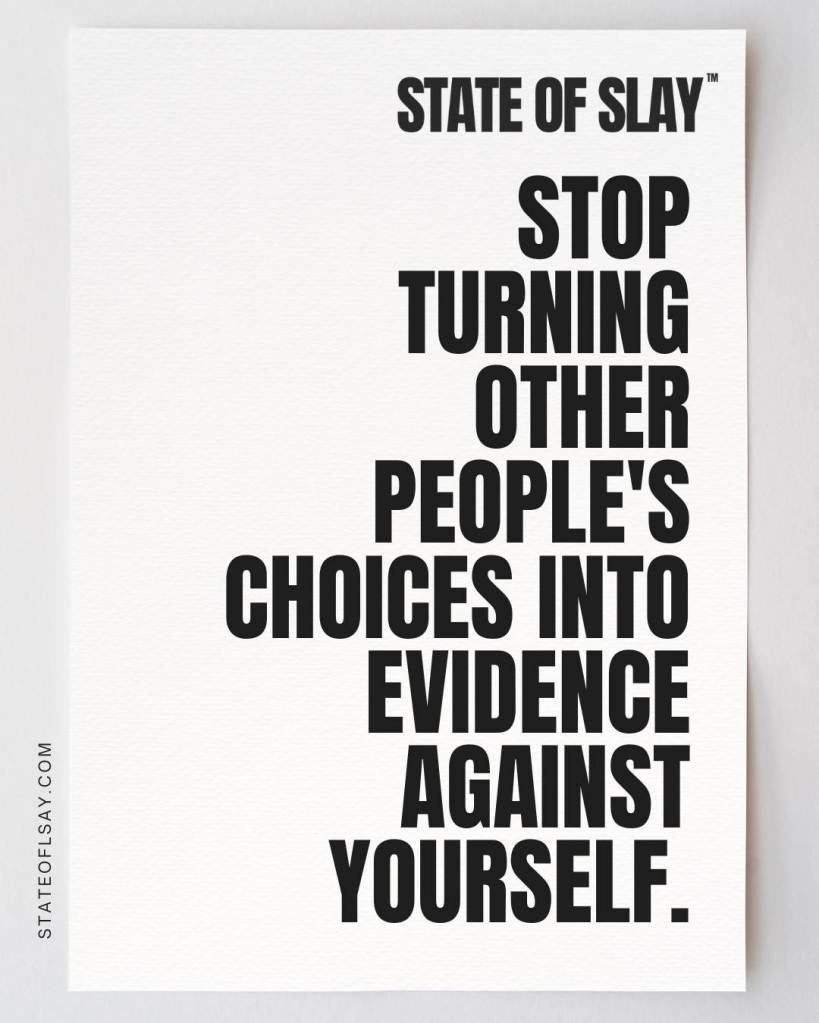
One of the most painful things people do after rejection, disappointment, or loss is turn someone else’s choice into a conclusion about themselves.

A relationship ends, and suddenly it becomes evidence that they were not enough.

A friendship changes, and it becomes proof that they are difficult to love.

An opportunity goes to someone else, and it becomes confirmation that they are not capable.

What started as an event slowly becomes an identity.

But there is a problem with that.

Most of the time, other people’s choices are influenced by things we cannot see.

Their fears.

Their priorities.

Their timing.

Their wounds.

Their circumstances.

Their own journey through life.

Yet we take those decisions and place ourselves at the center of them.

We assume their choice was a verdict.

A final ruling on our worth.

But another person’s decision is not always about you.

And even when it is, it is still only one person’s perspective.

Not the truth of who you are.

The danger is not the rejection itself.

The danger is the story you create afterward.

The belief that because someone left, you were not worth staying for.

The belief that because something ended, you were not enough.

The belief that because someone could not see your value, it must not exist.

Those stories have a way of causing far more damage than the original event ever did.

Healing begins when you stop treating other people’s choices as evidence against yourself.

Because your worth was never meant to be determined by someone else’s decision.

This is your reminder that another person’s choice is not a verdict on your value.

Slay on.

The Hardest Truth Is Usually the Right One

There is a reason we resist certain truths.

Not because they are false.

Because they are uncomfortable.

The truths that challenge us rarely arrive with a sense of relief.

They arrive with friction.

They ask us to let go of something.

A belief.

An expectation.

A relationship.

A version of ourselves.

And because of that, our first instinct is often not acceptance.

It is negotiation.

We argue with what we already know.

We search for different answers.

We look for evidence that supports the outcome we want instead of the reality we have.

But life has a way of bringing us back to the truth.

Again.

And again.

And again.

Until we are finally willing to face it.

The hardest truth is usually the right one.


Prefer to listen? The Audio Blog version is available here.


WE OFTEN KNOW LONG BEFORE WE ADMIT IT

One of the strangest things about being human is how often we already know.

We know when something feels off.

We know when a relationship has changed.

We know when we have outgrown a situation.

We know when a dream no longer fits.

We know when someone is showing us exactly who they are.

Yet we hesitate.

Not because we lack awareness.

Because awareness often demands action.

And action can be frightening.

So we stay.

We wait.

We hope.

We explain.

We rationalize.

All while quietly knowing.


WISHFUL THINKING CAN BE A POWERFUL DISTRACTION

Sometimes the greatest obstacle to clarity is not confusion.

It is hope placed in the wrong place.

Hope that someone will change.

Hope that circumstances will improve on their own.

Hope that if we wait long enough, reality will become something different.

Hope is beautiful when it inspires growth.

But hope can become dangerous when it prevents us from seeing what is already true.

There is a difference between believing in possibility and refusing to acknowledge reality.

The first creates progress.

The second creates suffering.


THE TRUTH USUALLY WHISPERS FIRST

Life rarely starts by shouting.

It starts with a whisper.

A feeling.

A hesitation.

A recurring thought.

A concern you cannot quite shake.

A quiet voice that says, “Pay attention.”

Most of us have experienced this.

That moment when something did not sit right.

That feeling in the pit of your stomach.

That persistent awareness that something was not adding up.

The problem is not that we fail to hear the whisper.

The problem is that we often spend too much time convincing ourselves to ignore it.


DENIAL FEELS SAFER THAN CHANGE

There is a reason people stay in situations they know are not working.

The familiar feels safer than the unknown.

Even when the familiar hurts.

Even when the familiar limits us.

Even when the familiar keeps us stuck.

Accepting a difficult truth often means stepping into uncertainty.

And uncertainty can be terrifying.

At least with denial, we know what tomorrow looks like.

But comfort and growth rarely occupy the same space.


I LEARNED THAT RESISTANCE IS A CLUE

For years, I thought resistance meant I was headed in the wrong direction.

Now I often see it differently.

Resistance is frequently a clue.

Not that something is wrong.

That something matters.

When we find ourselves defending a belief, excusing behavior, or repeatedly avoiding a reality, it is worth asking why.

What are we afraid will happen if we accept the truth?

What are we protecting?

What are we refusing to let go of?

Those questions often reveal more than the situation itself.


THE COST OF AVOIDING THE TRUTH IS HIGHER THAN THE TRUTH ITSELF

Most people focus on how painful the truth will be.

What they rarely consider is the cost of avoiding it.

Avoiding the truth steals time.

It drains energy.

It delays healing.

It keeps us attached to situations that no longer serve us.

The truth may hurt.

But avoidance creates its own kind of pain.

A slower pain.

A lingering pain.

A pain that grows every day we refuse to face what we already know.


CLARITY OFTEN FEELS LIKE LOSS BEFORE IT FEELS LIKE FREEDOM

This is where many people get stuck.

The moment they finally see clearly, they feel grief.

They lose the fantasy.

They lose the expectation.

They lose the future they imagined.

And that loss is real.

But what comes after is equally real.

Freedom.

Freedom from confusion.

Freedom from pretending.

Freedom from carrying the weight of uncertainty.

Clarity can feel painful in the beginning because it asks us to release what was never actually ours.


SELF-TRUST IS BUILT THROUGH HONESTY

Every time you acknowledge a difficult truth, you strengthen your relationship with yourself.

You prove that you are willing to listen.

You prove that you are willing to see clearly.

You prove that your intuition matters.

Self-trust is not built by always being right.

It is built by being honest.

Especially when honesty is uncomfortable.


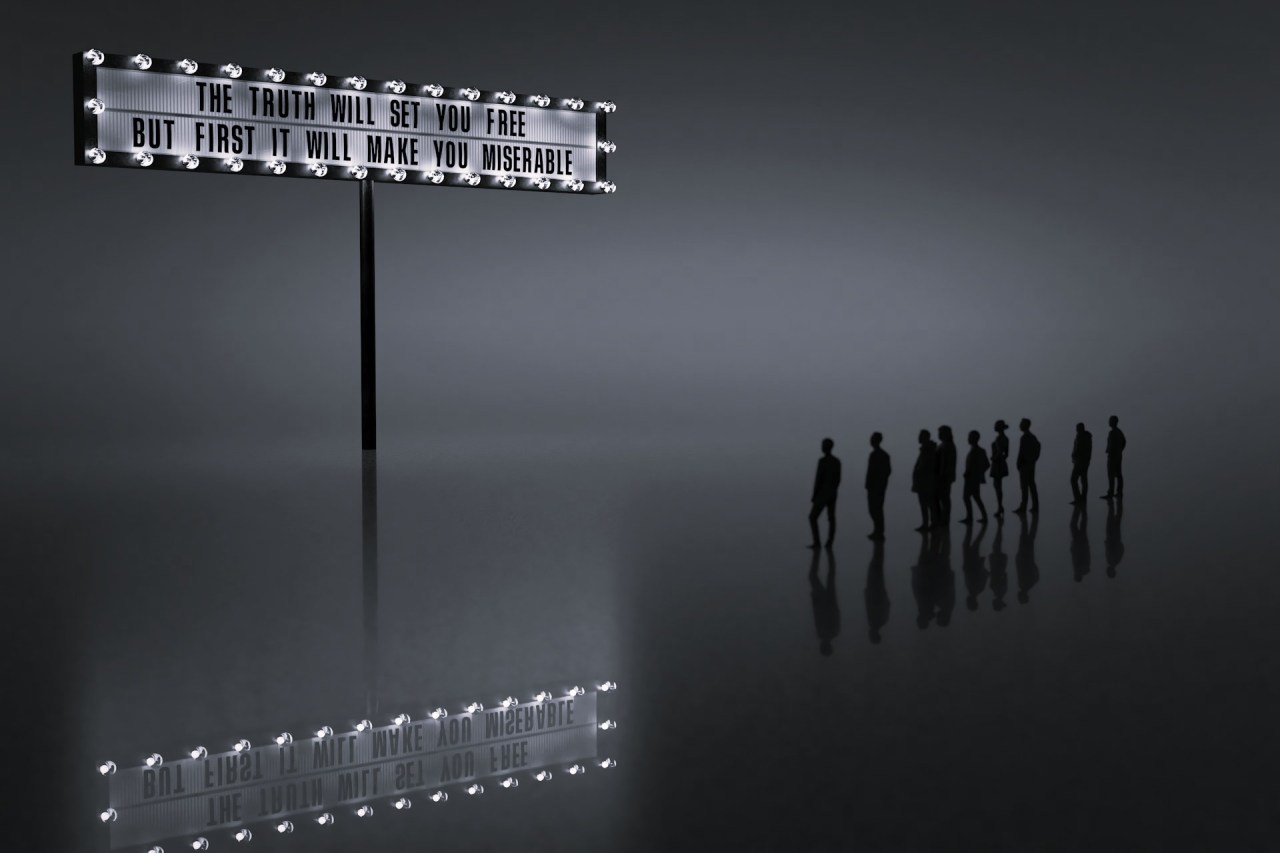
THE RIGHT TRUTH WILL SET YOU FREE

Not immediately.

Not dramatically.

Not without emotion.

But eventually.

The right truth may break your heart.

It may challenge your plans.

It may force you to reconsider everything you thought you knew.

But it also creates space.

Space for growth.

Space for healing.

Space for something better aligned with who you are becoming.

That is why the hardest truth is often the right one.

Not because it is easy.

Because it leads somewhere worth going.


STOP NEGOTIATING WITH WHAT YOU ALREADY KNOW

If there is something you have been avoiding, consider this your invitation.

Not to judge yourself.

Not to force an answer.

But to listen.

To stop looking for a different truth.

To stop waiting for reality to become more convenient.

To stop negotiating with what you already know.

Because the truth you are resisting may be the very thing trying to set you free.

And the sooner you face it, the sooner your life can begin moving forward again.


SLAY REFLECTION

S — See the Truth
What reality have you been avoiding or negotiating with?

L — Look at the Resistance
What makes accepting that truth feel difficult?

A — Acknowledge the Cost
How has avoiding it affected your peace, energy, or growth?

Y — Your Next Step
What is one honest step you can take toward acceptance today?


CALL TO ACTION: JOIN THE CONVERSATION

I’d love to hear from you.

Have you ever discovered that the truth you resisted most was the one you needed most?

Share your story in the comments. Let’s cheer each other on.

And if you know someone who might need this reminder, send this to them.

Sometimes, all we need is a nudge.

Slay Say

The Role You Never Auditioned For

Most people want to be understood.

They want to be seen as kind.

Reasonable.

Thoughtful.

They want their intentions to be recognized and their decisions to make sense to the people around them.

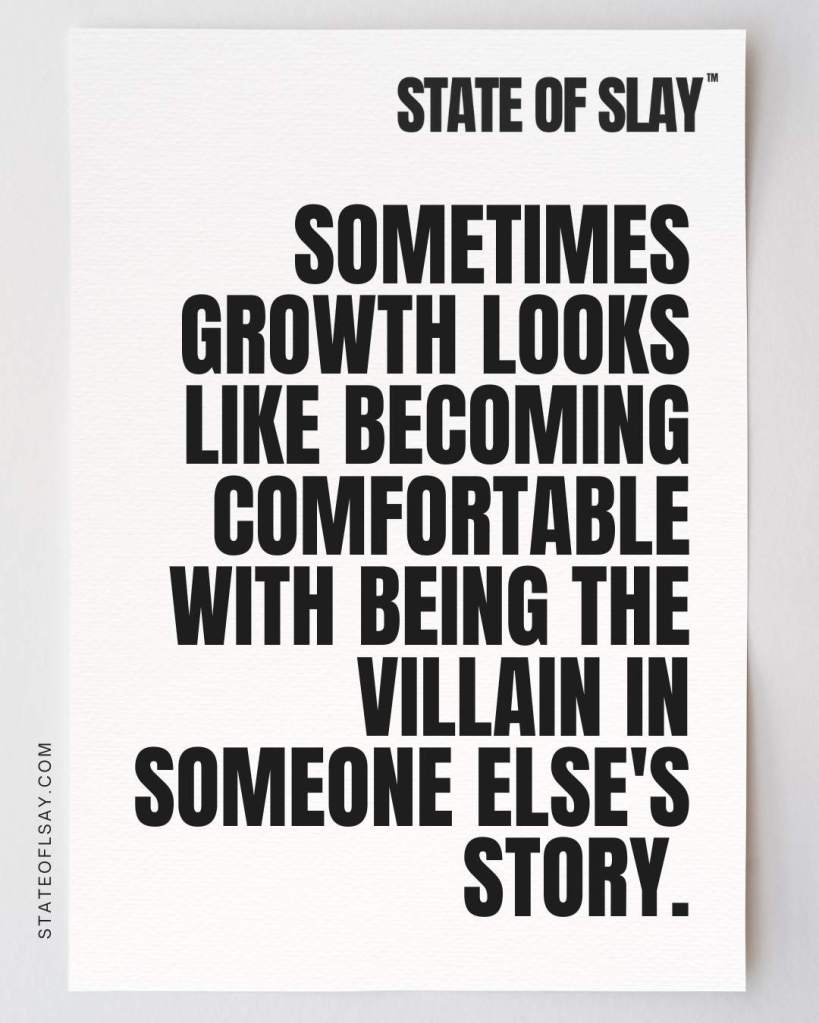
But growth has a way of complicating that.

Because the moment you start setting boundaries, changing patterns, or choosing yourself in ways you did not before, someone may not like it.

Not because you did something wrong.

Because the version of you they were comfortable with is no longer available.

The person who always said yes.

The person who put everyone else’s needs first.

The person who tolerated things they should not have tolerated.

The person who made life easier for everyone except themselves.

And when that version of you begins to change, not everyone will celebrate it.

Some people will see your boundary as rejection.

Your self-respect as selfishness.

Your growth as betrayal.

Not because it is.

But because it changes the role you once played in their story.

That can be uncomfortable.

Especially if you are someone who genuinely cares about people.

But part of maturity is understanding that being misunderstood does not automatically mean you are wrong.

And disappointing someone does not automatically mean you have failed them.

Sometimes growth requires making peace with the fact that not everyone will agree with your decisions.

Not everyone will understand your boundaries.

And not everyone will appreciate the person you are becoming.

That does not mean you stop growing.

It means you keep growing anyway.

This is your reminder that other people’s opinions of your growth do not determine its value.

Slay on.

Your Story Does Not Need Special Effects

Somewhere along the way, many of us began to believe that the truth was not enough.

Not enough attention.

Not enough admiration.

Not enough sympathy.

Not enough significance.

So we started adding special effects to our stories.

Sometimes it is a small exaggeration.

Sometimes it is a carefully edited version of events.

Sometimes it is a detail that gets stretched a little further each time it is told.

And sometimes it becomes something much bigger.

A false achievement.

An embellished hardship.

A narrative supported by evidence that is not entirely honest.

The strange thing is that most people do not do this to fool others.

They do it because somewhere deep down, they have started to believe that who they really are is not enough.

That their actual story needs help.

That the truth needs embellishment.

But the truth has a power that performance will never have.

And the moment you stop trusting your own story is the moment you begin losing touch with yourself.


Prefer to listen? The Audio Blog version is available here.


THE TRUTH DOES NOT NEED DECORATION

Authenticity has become a buzzword.

Everyone talks about it.

Everyone claims to value it.

But authenticity is often tested the moment the truth feels ordinary.

The moment the real story is less dramatic.

Less impressive.

Less likely to attract attention.

That is when integrity matters.

Because integrity is not about telling the truth when it benefits you.

It is about telling the truth when embellishment would make you look better.


WE LIVE IN A WORLD THAT REWARDS PERFORMANCE

Social media did not create this problem.

But it certainly amplified it.

Every day, we see curated versions of people’s lives.

Achievements.

Milestones.

Victories.

Moments designed to capture attention.

Over time, it becomes easy to believe that significance comes from standing out.

From having the most extraordinary story.

The most dramatic experience.

The most impressive accomplishment.

But significance and spectacle are not the same thing.

And one should never be confused with the other.


THE NEED TO EMBELLISH OFTEN COMES FROM INSECURITY

This is the part people rarely talk about.

Most exaggeration is not rooted in confidence.

It is rooted in doubt.

Doubt that the truth is enough.

Doubt that people will care.

Doubt that ordinary experiences have value.

So people begin adding layers.

Making things bigger.

More mysterious.

More impressive.

More tragic.

More remarkable.

Not because the truth lacks value.

Because they have forgotten its value.


THE COST OF A FALSE NARRATIVE

At first, embellishment may seem harmless.

A detail here.

An exaggeration there.

A slightly improved version of events.

But over time, something begins to happen.

The story becomes harder to maintain.

The gap between reality and presentation grows wider.

And eventually, the person telling the story has to keep serving the narrative instead of living the truth.

That is an exhausting way to live.

Because every false layer creates distance.

Distance from others.

Distance from reality.

And most importantly, distance from yourself.


THE MOST INTERESTING PEOPLE ARE OFTEN THE MOST HONEST

Think about the people you genuinely admire.

Not the ones who impress you.

The ones you trust.

The ones whose words carry weight.

The ones who feel real.

Chances are, what makes them compelling is not perfection.

It is honesty.

Their willingness to tell the truth.

Even when it makes them look vulnerable.

Even when it makes them look human.

Especially then.


YOUR STORY HAS VALUE WITHOUT EMBELLISHMENT

One of the greatest lies many people carry is the belief that their life is too ordinary.

Too simple.

Too unremarkable.

But every person carries experiences that shaped them.

Lessons that changed them.

Moments that challenged them.

Stories that matter.

You do not need extraordinary circumstances to have a meaningful life.

You only need the courage to own the life you have actually lived.


INTEGRITY IS AN INSIDE JOB

Integrity is not about public image.

It is not about reputation.

It is not about convincing other people that you are honest.

It is about knowing that the person you present to the world matches the person you are when no one is watching.

That alignment creates peace.

Because there is nothing to defend.

Nothing to maintain.

Nothing to remember.

Just the truth.


THE REAL STORY IS ENOUGH

The older I get, the more I appreciate honesty.

Not perfection.

Not performance.

Not spectacle.

Honesty.

The person who admits they do not know.

The person who shares what really happened.

The person who resists the temptation to make the story bigger than it was.

There is something deeply powerful about that.

Because the truth does not need special effects.

It does not need dramatic lighting.

It does not need a better ending.

It does not need embellishment.

It simply needs the courage to be told.


TRUST THE STORY THAT IS REAL

If you find yourself tempted to exaggerate, impress, or enhance the narrative, pause for a moment.

Ask yourself why.

Not with judgment.

With curiosity.

Because underneath that impulse may be a belief that deserves examination.

A belief that says your real story is not enough.

But it is.

Your life does not need embellishment to have meaning.

Your experiences do not need exaggeration to matter.

Your truth does not need special effects to be powerful.

The real story is enough.

And so are you.

SLAY on.


SLAY REFLECTION

S — See the Story
Have you ever felt pressure to make yourself seem more impressive, successful, or interesting than you really felt?

L — Look Beneath the Need
What belief might be driving that desire?

A — Acknowledge the Truth
What part of your real story have you overlooked or undervalued?

Y — Your Next Step
How can you practice greater authenticity in the way you share your experiences?


CALL TO ACTION: JOIN THE CONVERSATION

I’d love to hear from you.

Have you ever discovered that the most powerful version of a story was the honest one?

Share your story in the comments. Let’s cheer each other on.

And if you know someone who might need this reminder, send this to them.

Sometimes, all we need is a nudge.

Slay Say

The Conversation With Yesterday

One of the hardest things about growth is that it asks you to leave certain versions of yourself behind.

Not because they were wrong.

Not because they were failures.

But because they were built for a season that no longer exists.

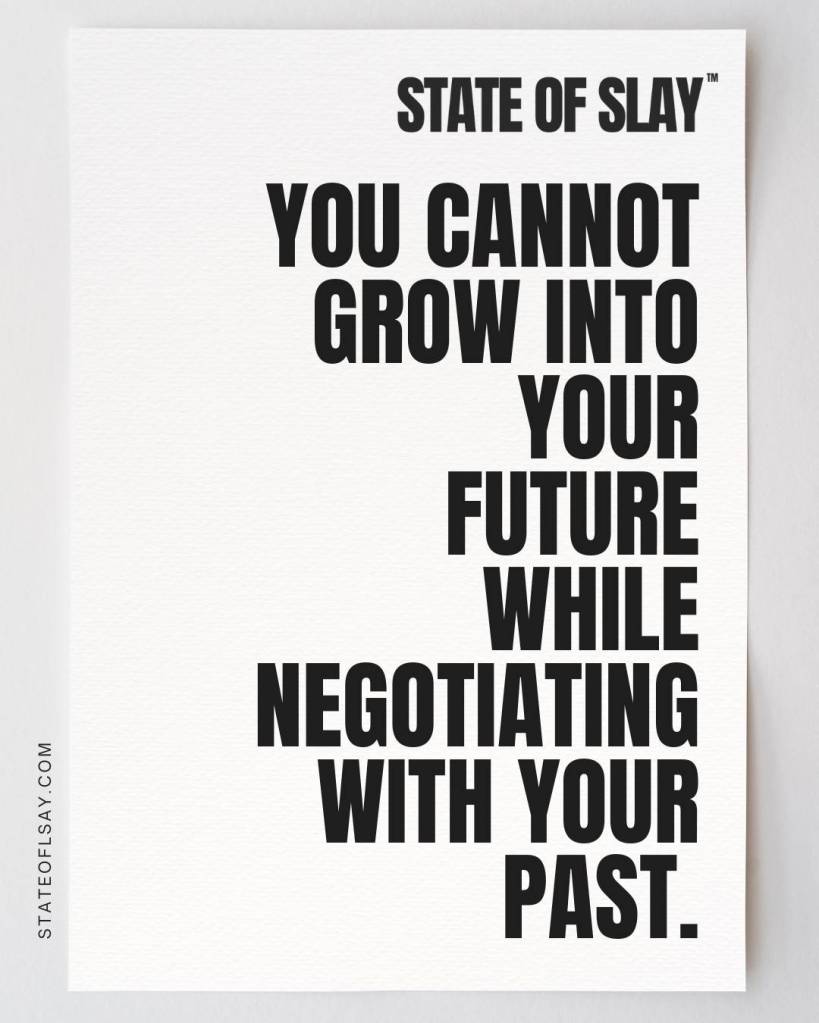
And yet, so many people spend years negotiating with their past.

Trying to hold onto old identities.

Old expectations.

Old beliefs about who they should be.

Part of them wants to move forward.

Another part keeps looking backward for permission.

Permission to change.

Permission to evolve.

Permission to become someone new.

But growth rarely works that way.

The future does not ask you to remain loyal to every version of yourself that came before.

It asks you to honor them, learn from them, and keep moving.

Because the person you were five years ago was operating with different experiences, different awareness, and different lessons.

You are not that person anymore.

And that is not something to mourn.

It is something to celebrate.

Every lesson you learned.

Every challenge you survived.

Every season you outgrew.

They all helped create the person standing here now.

The problem is not that people change.

The problem is that many people keep trying to fit their future into an identity they have already outgrown.

Growth requires trust.

Trust that who you are becoming deserves more space than who you used to be.

Trust that evolution is not betrayal.

Trust that your next chapter does not need approval from your last one.

This is your reminder that growth requires letting go of versions of yourself that no longer fit.

Slay on.

When You Change the Way You See Things, the Things You See Will Change

For a long time, I thought the problem was out there.

The circumstances. The people. The situations that kept showing up in my life.

If this changed, I would be happier. If that happened, I would feel better. If other people behaved differently, my life would improve.

And while there were certainly things outside of my control, I eventually realized something that changed everything.

The biggest shift did not happen when my circumstances changed.

It happened when my perspective did.

Because when you change the way you see things, the things you see begin to change.


Prefer to listen? The Audio Blog version is available here.


WE DO NOT SEE THE WORLD AS IT IS

We like to think we see things objectively.

But most of us do not.

We see life through our experiences, beliefs, fears, expectations, and assumptions.

Two people can experience the exact same event and walk away with completely different interpretations.

Not because the facts changed.

Because their perspective did.

And that perspective influences everything.

How we feel. How we react. What we notice. What we miss.


I HAD TO QUESTION MY OWN LENS

This was not easy.

Because it required me to stop assuming my perspective was the only perspective.

There were situations I felt certain about.

People I thought I understood.

Stories I told myself about why things happened.

And when I started looking closer, I realized that many of those stories were incomplete.

Not wrong.

Just incomplete.

I was seeing things through a lens shaped by my own experiences.


YOUR MIND LOOKS FOR EVIDENCE

One of the most fascinating things about the human mind is that it tends to find evidence for whatever it already believes.

If you believe people cannot be trusted, you will notice every example that supports that belief.

If you believe you are not good enough, your attention will gravitate toward mistakes and shortcomings.

If you believe opportunities do not exist for you, you will overlook the opportunities that are right in front of you.

Your focus shapes your reality.

Not because it changes the facts.

Because it changes what you notice.


I STARTED ASKING DIFFERENT QUESTIONS

Instead of asking, “Why does this always happen to me?” I started asking, “What am I supposed to learn from this?”

Instead of asking, “Why am I stuck?” I asked, “What am I not seeing?”

Instead of assuming I knew the whole story, I became curious.

And curiosity opened doors that certainty never could.

Because when you stop looking for confirmation, you start looking for understanding.


PERSPECTIVE CREATES POSSIBILITY

The moment you realize there may be another way to view something, possibility enters the room.

A setback becomes a lesson.

A rejection becomes a redirection.

A challenge becomes an opportunity to grow.

The circumstances may not change immediately.

But your relationship to them does.

And that changes everything.


WHAT YOU FOCUS ON EXPANDS

This does not mean pretending everything is positive.

It does not mean ignoring difficulties or denying reality.

It means recognizing that what you focus on tends to occupy more space in your life.

If you constantly focus on what is missing, life feels scarce.

If you focus on what is available, life feels more abundant.

The circumstances may be the same.

But the experience is completely different.


I LEARNED THAT MEANING MATTERS

Events themselves are often neutral.

What gives them power is the meaning we assign to them.

The story we tell ourselves about what happened.

The conclusions we draw.

The beliefs we reinforce.

And while we may not control every event that occurs in our lives, we do have influence over the meaning we give those events.

That is powerful.


CHANGING PERSPECTIVE IS NOT INSTANT

It is important to understand that this is a practice.

You do not wake up one day and suddenly see everything differently.

It happens gradually.

You challenge assumptions.

You question old beliefs.

You become willing to consider a different interpretation.

And little by little, your perspective expands.


NEW EYES CREATE NEW OPPORTUNITIES

When you change the way you see yourself, you begin to notice strengths you once overlooked.

When you change the way you see challenges, you begin to notice opportunities hidden within them.

When you change the way you see other people, you begin to notice understanding where there was once judgment.

The world itself may not have changed.

But your experience of it has.


THE SHIFT STARTS WITHIN

Most people spend their lives trying to change what is happening around them.

But some of the most profound transformations happen when we change what is happening within us.

When we become more aware.

More curious.

More willing to see differently.

That internal shift often creates external changes we never thought possible.


LOOK AGAIN

If something in your life feels stuck, frustrating, or painful, consider this.

What if there is another way to see it?

What if there is a lesson you have not noticed yet?

What if the thing that needs to change first is not the situation, but your perspective on it?

Because when you change the way you see things, the things you see will change.

And sometimes, that is where the real transformation begins.


SLAY REFLECTION

S — See the Story
What story are you currently telling yourself about a challenge in your life?

L — Look for Another Perspective
Is there another way to interpret the situation?

A — Acknowledge the Opportunity
What might you learn if you viewed it differently?

Y — Your Next Step
What is one area of your life where a shift in perspective could create a shift in experience?


CALL TO ACTION: JOIN THE CONVERSATION

I’d love to hear from you.

Has changing your perspective ever completely changed how you experienced a situation?

Share your story in the comments. Let’s cheer each other on.

And if you know someone who might need this reminder, send this to them.

Sometimes, all we need is a nudge.
Slay Say

When Enough Never Feels Like Enough

There is a difference between pursuing success and pursuing approval.

From the outside, they can look almost identical.

Both involve hard work.
Both involve growth.
Both involve reaching goals and striving for more.

But internally, they feel very different.

When success is rooted in purpose, achievement creates a sense of fulfillment. You can celebrate progress, appreciate how far you have come, and enjoy the life you are building.

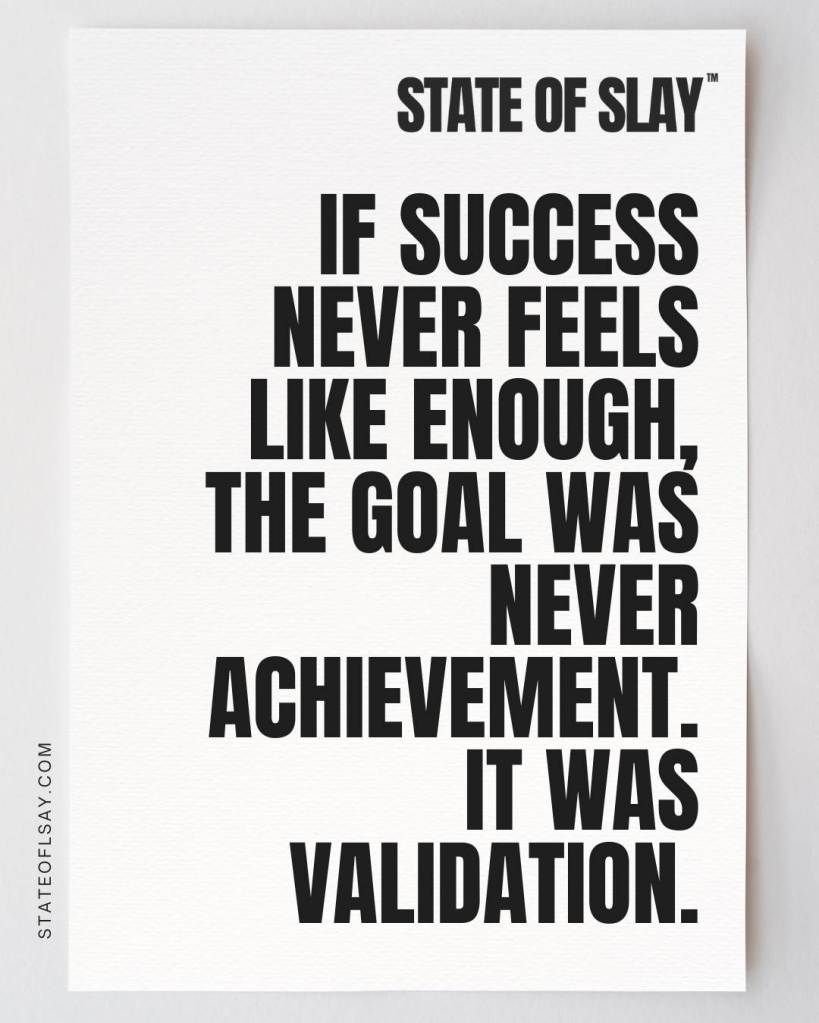
When success is rooted in validation, the feeling never lasts.

The goal is reached, and almost immediately, the finish line moves.

The accomplishment is achieved, and the focus shifts to the next thing that must be proven.

No matter how much is accomplished, there is always another benchmark waiting.

Not because you are ambitious.

Because part of you is still trying to earn something that achievement was never designed to provide.

Worth.

The problem is that external success cannot permanently solve an internal belief.

No amount of recognition can convince you that you are enough if you have not already begun to believe it yourself.

And that is why some of the most accomplished people still feel empty.

Not because they failed.

Because they were asking for achievement to do a job that was never meant to be done.

Success can enhance your life.

It cannot define your value.

That work belongs to you.

This is your reminder that your worth is not something you earn through accomplishment.

Slay on.

Everyone Feels Broken Sometimes

There was a time when I thought I was the only one struggling.

The only one who felt lost.

The only one who felt like everyone else had somehow figured out life, while I was quietly falling apart behind the scenes.

I would look around and see people succeeding, smiling, building careers, raising families, and moving through life with what appeared to be confidence and certainty.

Meanwhile, I felt broken.

Not all the time. But enough that I worried there was something fundamentally wrong with me.

What I have learned since then is something I wish I had understood much sooner.

Everyone feels broken sometimes.

Even the people who look like they have it all together.


Prefer to listen? The Audio Blog version is available here.


Broken Does Not Mean Defective

One of the biggest mistakes we make is believing that feeling broken means something is wrong with us.

It doesn’t.

Being human means experiencing loss, disappointment, heartbreak, uncertainty, grief, failure, and fear.

Those experiences leave marks.

They challenge us. They change us. They force us to grow in ways we never expected.

Feeling broken is often a natural response to carrying something heavy.

It is not proof that you are damaged beyond repair.


I Thought I Had to Hide It

For years, I worked hard to appear fine.

I thought strength meant keeping it together.

Keeping the smile on. Keeping the mask in place. Making sure no one knew how much I was struggling.

And from the outside, I probably looked okay.

But inside, I felt disconnected.

Because hiding your pain creates distance.

Not only between you and others, but between you and yourself.


We Compare Our Reality to Someone Else’s Highlight Reel

Part of the reason so many people feel alone in their struggles is because we rarely see the whole story.

We see accomplishments.

We see milestones.

We see curated snapshots of people’s lives.

What we don’t always see are the sleepless nights, the self-doubt, the setbacks, the anxiety, the grief, and the battles they fight privately.

So we assume we are the only ones struggling.

We are not.


Some Seasons Are Meant to Break You Open

This may be one of the hardest truths to accept.

Sometimes life breaks apart the things that no longer fit.

The beliefs that limit us.

The relationships that no longer serve us.

The identities we have outgrown.

And while it can feel like everything is falling apart, sometimes what is really happening is that something deeper is being rebuilt.

Not overnight.

But gradually.


I Stopped Trying to Be Unbreakable

There was a point where I realized I was exhausting myself trying to be strong all the time.

Trying to be the person who could handle everything.

The person who never needed help.

The person who always had the answers.

And eventually, I understood that real strength looks different.

Real strength is honesty.

Real strength is vulnerability.

Real strength is admitting when you are struggling and allowing yourself to be supported.


Broken Things Can Still Be Beautiful

One of the most healing shifts in perspective came when I stopped seeing my struggles as evidence that I was failing.

Instead, I started seeing them as evidence that I was living.

That I was trying.

That I was learning.

That I was growing.

Every scar told a story.

Every setback taught a lesson.

Every difficult season revealed something I needed to understand.


You Are Allowed to Not Have It All Together

There is so much pressure to have answers.

To be productive.

To stay positive.

To always be moving forward.

But the truth is, none of us have it all together all the time.

We all have moments where we question ourselves.

Moments where we feel overwhelmed.

Moments where we feel broken.

And those moments do not make us weak.

They make us human.


Healing Is Not a Straight Line

One of the reasons people become discouraged is because they expect healing to be linear.

They think once they start feeling better, they should stay better.

But growth does not work that way.

Some days you feel strong.

Some days you feel fragile.

Some days, you feel like you have made incredible progress.

And some days you feel like you are right back where you started.

You are not.

You are moving through the process.


Connection Begins With Honesty

The irony is that the things we are most afraid to share are often the things that connect us.

When we are honest about our struggles, other people recognize themselves in our story.

They realize they are not alone.

And so do we.

That is where connection lives.

Not in perfection.

But in truth.


You Are Not Alone in This

If you are feeling broken right now, I want you to remember something.

You are not the only one.

You are not failing.

You are not beyond hope.

You are a human being moving through a difficult season.

And difficult seasons do not last forever.

Keep going.

Keep showing up.

Keep being gentle with yourself.

Because the same heart that feels broken today is also capable of healing.


There Is Nothing Wrong With You

You do not need to be fixed.

You do not need to become someone else.

You do not need to pretend everything is okay.

You simply need to keep moving forward one step at a time.

Feeling broken is not a permanent identity.

It is a moment.

A season.

An experience.

And like every season before it, this one will pass.


SLAY Reflection

S — See the Struggle
What part of your life feels heavy or overwhelming right now?

L — Look With Compassion
How would you speak to a friend who was feeling the same way?

A — Acknowledge Your Humanity
Can you allow yourself to be imperfect without judging yourself for it?

Y — Your Next Step
What is one small act of kindness you can offer yourself today?


Call to Action: Join the Conversation

I’d love to hear from you.
Have you ever gone through a season where you felt broken, only to discover later that it was part of your growth?

Share your story in the comments. Let’s cheer each other on.

And if you know someone who might need this reminder, send this to them.

Sometimes, all we need is a nudge.
Slay Say

The Weight You Were Never Meant to Carry

So much of people’s exhaustion comes from trying to manage how they are perceived.

Trying to be liked.
Trying to avoid judgment.
Trying to explain themselves enough that no one forms the “wrong” opinion.

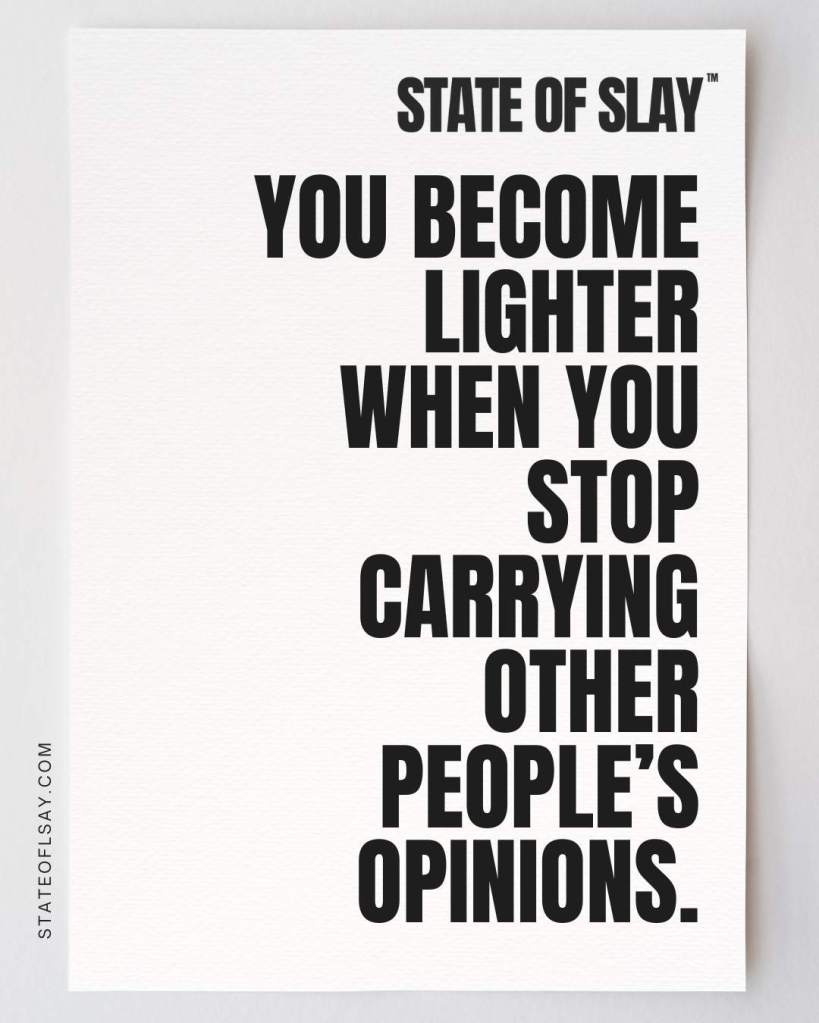
And without realizing it, they begin carrying the emotional weight of everyone else’s thoughts about them.

Every assumption.
Every criticism.
Every projection.

As if their worth becomes dependent on constantly correcting, convincing, or proving themselves to the world around them.

But eventually, something shifts.

You realize that no amount of overexplaining can fully control how another person chooses to see you.

And trying to carry every opinion people have about you only pulls you further away from peace.

Because some people will misunderstand you, no matter how honest you are.

Some will judge you through their own fears, experiences, insecurities, or expectations.

And none of that changes who you actually are.

There is a different kind of freedom that appears when you stop making everyone else’s perception your emotional responsibility.

Not because you stop caring completely.

Because you stop abandoning yourself, trying to manage things you were never meant to control.

And in that release, something inside you softens.

You breathe differently.
Move differently.
Feel lighter.

This is your reminder that your peace matters more than public approval.

It Is Not What You Do That Matters It Is Why You Do It

For a long time, I focused on appearances.

Doing the right thing. Saying the right thing. Looking like I had everything together.

And from the outside, much of it probably looked fine.

But internally, my motivations were not always healthy.

Sometimes I was helping because I wanted approval. Sometimes I was succeeding because I wanted validation. Sometimes I was overextending myself because I was afraid people would stop loving me if I said no.

The actions themselves may have looked positive.

But the reason behind them told a very different story.

And eventually, I realized something important.

It is not just what we do that shapes our lives.

It is why we do it.


Prefer to listen? The Audio Blog version is available here.


Motivation Changes Everything

Two people can make the exact same choice for completely different reasons.

One person helps because they genuinely care.

Another helps because they need to feel needed.

One person works hard because they feel inspired.

Another works hard because they believe their worth depends on achievement.

From the outside, the actions may look identical.

But internally, they create very different experiences.


I Had to Get Honest About My Why

This was uncomfortable for me at first.

Because it required me to stop focusing only on my behavior and start focusing on my intention.

Why was I saying yes when I wanted to say no?
Why was I constantly proving myself?
Why did I feel guilty resting?
Why did I need validation so badly?

Those questions forced me to look deeper.

And the answers were not always easy.


Good Actions Can Still Come From Fear

This was one of my biggest realizations.

Not every positive action comes from a healthy place.

Sometimes, people pleasing looks like kindness. Sometimes perfectionism looks like ambition. Sometimes overgiving looks like love.

But underneath those actions can be fear.

Fear of rejection. Fear of failure. Fear of not being enough.

And when fear becomes the motivation behind everything, even success can feel exhausting.


Your Why Shapes Your Experience

The reason behind your actions affects how those actions feel.

When your choices are rooted in alignment, they tend to create peace.

When they are rooted in fear, obligation, or insecurity, they tend to create pressure.

That is why two people can live seemingly similar lives but feel completely different internally.

Because motivation matters.


Awareness Creates Change

Once you become aware of your patterns, you begin to see things differently.

You start noticing where your choices come from.

Where you are acting from love and where you are acting from fear.

Where you are being authentic and where you are performing.

And that awareness creates the opportunity for change.


I Stopped Needing Everything to Look Perfect

There was a time when I cared deeply about how things appeared.

How people perceived me. Whether I looked successful. Whether I seemed strong.

But eventually, I realized that appearances mean very little if they are disconnected from truth.

Because no amount of external validation can quiet an internal disconnect.

And no version of success feels fulfilling if it is built on abandoning yourself.


Alignment Feels Different

When your actions align with your values, something shifts.

You stop forcing so much.

You stop performing.

You stop needing every decision to prove something about your worth.

And instead, your choices begin to feel more honest.

More grounded.

More peaceful.


You Do Not Need to Judge Yourself

Looking at your motivations is not about shame.

It is about understanding.

We all develop patterns based on our experiences, fears, and needs.

The goal is not perfection.

The goal is awareness.

Because once you understand why you do something, you gain the power to choose differently if needed.


Ask Yourself the Hard Questions

Sometimes growth is less about changing your behavior and more about understanding it.

Why are you chasing this goal?
Why are you staying in this situation?
Why are you saying yes?
Why are you afraid to stop?

Those answers can reveal a lot.

Not to criticize you.

But to help you become more aligned with yourself.


Intention Matters More Than Performance

At the end of the day, people may remember what you did.

But your inner life is shaped by why you did it.

Your peace. Your confidence. Your fulfillment.

Those things are deeply connected to intention.

And when your actions come from a place of honesty rather than fear, your life begins to feel different.

Not because everything becomes perfect.

But because it becomes real.


Choose From Alignment, Not Fear

You do not have to overhaul your entire life overnight.

You just have to start paying attention.

To what motivates you. To what drains you. To what feels aligned and what feels performative.

Because your why matters.

It shapes your relationships. Your goals. Your decisions. Your sense of self.

And the more honest you become about your motivations, the more authentic your life becomes.


SLAY Reflection

S — See the Pattern
What is one area of your life where you may need to look deeper at your motivation?

L — Look Beneath the Action
Are your choices coming from alignment or fear?

A — Acknowledge the Truth
What might change if you became more honest about your why?

Y — Your Next Step
What is one decision you can make today from a more authentic place?


Call to Action: Join the Conversation

I’d love to hear from you.
Have you ever realized that your motivation behind something mattered more than the action itself?

Share your story in the comments. Let’s cheer each other on.

And if you know someone who might need this reminder, send this to them.
Sometimes, all we need is a nudge.