Slay Say

Truth Without Testing

We often accept the thoughts we think every day as truth—without ever asking where they came from or if they’re even real.
But your dominant assumptions are more than thoughts.
They’re blueprints, quietly sculpting how you see yourself… and how you show up in the world.

If you never stop to question the story, you might keep building a life on someone else’s beliefs.
This is your reminder to pause, get curious, and challenge what you’ve been living on autopilot.

Your mind is listening.
Make sure it’s following a truth that’s actually yours.

SLAY on!

Find Your People, Find Your Truth

For most of my life, I felt like a chameleon. I’d shift and mold myself to fit the people I was around. I convinced myself that if I acted the way they wanted—or the way I thought they wanted—I’d finally belong. But deep down, it didn’t feel right. And often, I’d leave those interactions feeling drained and wondering, “What’s wrong with me?”

I’d watch others with envy. They seemed to flow effortlessly through social situations, forming connections with ease. I couldn’t understand why it felt so hard for me. Why did it feel like everyone else had the key to belonging, while I was stuck on the outside looking in? I’d analyze every interaction, wondering what I did wrong, why I couldn’t seem to fit.

The truth is, it wasn’t about being wrong. It was about being in the wrong rooms.


The Missing Piece: Discovering Self-Truth

It wasn’t until I began my journey of self-discovery that the truth hit me: there was nothing wrong with me. I just wasn’t with the right people. I wasn’t being true to myself, and I wasn’t choosing connections that were aligned with who I really was—because, if I’m honest, I didn’t even know who I really was.

I’d spent so long being a version of myself that I thought others wanted me to be, that I lost touch with my core. The parts of me that were silly, passionate, curious, and maybe a little bit weird were buried under layers of trying to fit in. I muted my personality. I downplayed my dreams. I laughed at jokes I didn’t find funny. I agreed with opinions I didn’t fully believe in. All because I thought that was the way to be accepted.

But acceptance built on pretending is fragile. It’s conditional. It’s a house of cards ready to collapse the moment you stop performing.

Those people I admired weren’t more skilled or more likable than me—they were just authentic. They were showing up as themselves, unfiltered and unafraid. I, on the other hand, was performing a version of me I thought was acceptable. And in doing so, I was hiding the parts of myself that actually made me unique and magnetic.


Why Authenticity Feels So Hard

For so many of us, the idea of being our true selves feels risky. Maybe we’ve been hurt in the past when we showed vulnerability. Maybe we’ve faced rejection, criticism, or ridicule. Maybe we grew up in environments where it wasn’t safe to be fully seen. Over time, we learn to armor up. We put on masks. We adapt.

But here’s the thing: that armor may protect us from pain, but it also shields us from connection. When we hide our truth, we also hide our light.

The reason social situations felt so hard for me wasn’t because I was broken or unlikable. It was because I wasn’t showing up as me. I was exhausted from pretending. And deep down, I felt the ache of knowing that I wasn’t being true to myself.


The Shift: Coming Home to Yourself

Everything changed when I started to get curious about who I really was. I asked myself hard questions:

  • What do I truly value?
  • What brings me joy?
  • What kind of people energize me instead of draining me?
  • What parts of myself have I been hiding, and why?

The answers were both surprising and freeing. I realized that the right people—the ones who would become my “chosen family”—weren’t the ones I had to impress. They were the ones who loved me for me. They were the ones who felt easy to be around, where conversations flowed, laughter was real, and silence was comfortable.

I stopped chasing approval from people who didn’t value my authenticity. I started prioritizing connections that felt reciprocal, nourishing, and aligned with my values. Slowly, my circle shifted. And with it, so did my confidence.


Finding Your People

Finding your people doesn’t happen overnight. It takes patience and courage. It requires being honest with yourself about the relationships in your life:

  • Are you giving more than you’re receiving?
  • Do you feel energized or depleted after spending time with them?
  • Do you feel safe enough to be fully yourself?

If the answer to any of those questions is “no,” it might be time to reevaluate.

Here’s what I’ve learned: the right people will get you. You won’t have to explain yourself or perform. They’ll love your quirks, celebrate your wins, and hold space for your struggles. They’ll lift you up, not tear you down.

And the beautiful thing is, when you start showing up as your true self, you naturally attract those people. Authenticity is magnetic. When you let your real light shine, it draws others who resonate with that light.


The Liberation of Letting Go

One of the hardest but most liberating steps is letting go of relationships that no longer serve you. It doesn’t mean those people are bad or wrong; it just means they’re not your people.

Letting go creates space—space for new connections, space for self-growth, and space for deeper alignment. It allows you to breathe easier, to trust more, and to open your heart to those who are meant to walk this journey with you.

I promise you this: when you find your people, you’ll look back and realize that you were never broken or wrong. You were simply waiting for the right connections to show you how beautiful and worthy you’ve always been.


Your Light Is Needed

Here’s what I want you to remember, SLAYER: you don’t have to dim your light to fit in. The world doesn’t need a watered-down version of you. It needs you—fully, unapologetically, courageously you.

When you find your people, everything clicks into place. Life feels easier. Conversations feel more meaningful. Connections deepen. And you start to trust yourself in ways you never thought possible.

Because finding your people isn’t just about them—it’s about you finding yourself. It’s about coming home to your truth and realizing that you were never meant to fit in. You were meant to stand out.


SLAY Reflection

Take a moment to reflect and journal on these questions, SLAYER:

  • S: Where in your life are you still trying to fit in instead of standing out?
  • L: What relationships make you feel most like yourself? How can you nurture those?
  • A: Who or what do you need to let go of to make space for the right people?
  • Y: What’s one brave step you can take today to embrace your authenticity and attract your true community?

Call to Action: Join the Conversation

I’d love to hear from you.
Have you found your people, or are you still searching?
Share your story in the comments. Let’s cheer each other on.

And if you know someone who’s struggling to find their place, send this to them.
Sometimes, all we need is a nudge.

Slay Say

The Path Is Through the Dark

Some days the light feels far away. You’re tired, uncertain, questioning whether you have it in you to keep going. But this is when the shift begins—not by chasing the light, but by standing still in the dark and facing what’s there.

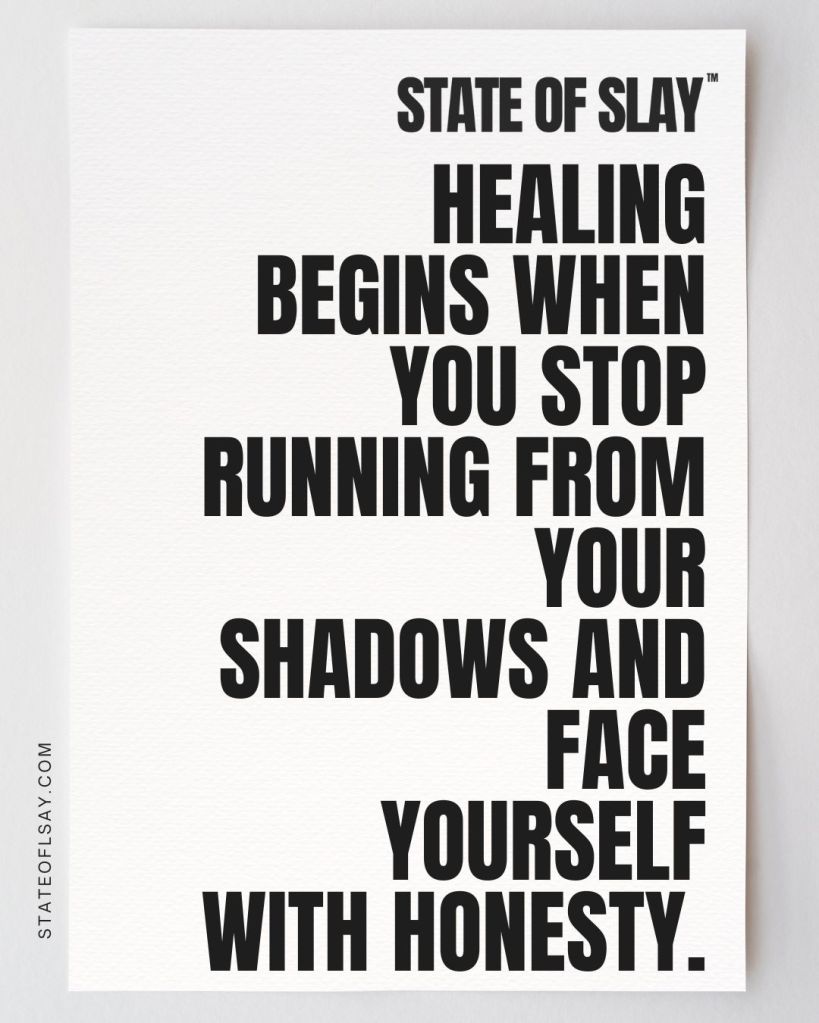
Healing doesn’t just happen in the light—it begins the moment you stop running from your shadows and decide to meet yourself in the dark.

You won’t find the light by avoiding the dark. You’ll find it by healing your way through it. The light isn’t the starting point—it’s the result. It’s the reward. The proof that you met yourself, did the work, and rose from what tried to hold you down.

This is your reminder to meet yourself where you are—your healing is the key to the light.

A black and white quote that says: "Healing begins when you stop running from your shadows and face yourself with honesty."

Sometimes It’s Not The Light That Guides Us But The Darkness That Pushes Us

We often hear that we should follow the light—look for hope, positivity, and healing to guide us forward. But what happens when the light feels too far away? When we can’t see it, let alone follow it?

There was a time in my life when the darkness wasn’t just around me—it was in me. It wrapped itself around everything I was and everything I believed about myself. It suffocated every flicker of light I had left. And the scariest part? I accepted it. I thought I belonged there. I convinced myself that if I just waited long enough, it would somehow resolve itself. But darkness doesn’t heal. It deepens—until you forget what light even looks like.


The Fear That Became Fuel

I’ve shared before that it was someone else’s story—someone brave enough to speak their truth—that gave me a tiny sliver of hope. Just enough to cling to. That story became my lifeline. I wasn’t ready to see my own light yet, but the fear of sinking further into that darkness became the fuel I needed to ask for help.

Sometimes, it’s not inspiration that gets us moving. It’s desperation. It’s the pain of staying the same. It’s the crushing weight of knowing if you don’t do something—anything—you might not make it. That fear can become a gift. A push. A nudge in a direction you’re not sure of, but one that takes you somewhere new. Somewhere better.

I often talk about seeking the light. But I know all too well that sometimes, the light isn’t what gets us started. Sometimes, the darkness is what pushes us toward the light we didn’t even know we were searching for.


The Lies Darkness Tells Us

Darkness is cunning. It doesn’t always show up like the monster under the bed. Sometimes it sounds like safety. Familiarity. Comfort. It whispers, “Stay here. At least here you know what to expect.”

But here’s the truth: darkness may feel familiar, but it is not safe. It convinces us we’re unworthy. It tells us we’re too broken to be seen, too far gone to be helped. It keeps us stuck with stories we’ve outgrown but don’t know how to let go of.

I used to think there was only one “right” way to heal. One perfect path forward. But that belief only kept me stuck longer. It wasn’t until I realized that healing isn’t a straight line—and it doesn’t always begin with light—that I gave myself permission to find my own way. Whether it’s a flicker of inspiration or a fire lit by fear, what matters is that you start.


The Gift of Desperation

They say necessity is the mother of invention, but I believe desperation is the spark of transformation. For me, it was the fear of staying in that deep, dark place that finally opened me up to something new. I call it the gift of desperation.

When what I was doing stopped working, I had to be willing to try something different—even if it scared me. Especially if it scared me. And that willingness, however small, cracked the door open to a new path.

It didn’t look like anyone else’s journey. It was messy. Uneven. Sometimes I was crawling more than walking. But I kept moving. I kept showing up. And little by little, I found my way out of the dark and into something resembling light.


Your Path Doesn’t Have to Look Like Anyone Else’s

There’s no single right way to heal, grow, or change. No template. No “should.” The truth is, we all have different catalysts. For some, it’s hope. For others, it’s heartbreak. For many of us, it’s both.

What matters is direction. If you’re moving toward a better version of yourself—whether by chasing the light or running from the dark—you’re on the right path.

The key is to remain open. To trust that no matter what’s behind you, what’s ahead can be better. And that willingness to shift—even if just a little—can create space for something powerful.


You Don’t Have to Stay Where You Started

If you’re in a dark place right now, I want you to know: you don’t have to stay there. The fact that you’re reading this means there’s still a flicker of light in you. Hold onto that. Feed it.

And if you can’t find your own light just yet, borrow someone else’s. Let their story, their voice, or even their presence guide you until you find your own strength. Sometimes the push of darkness is the very thing that leads us to the path we were meant to walk.

Always look for the light. But if you can’t see it yet, let the darkness give you the push you need for a better view.


SLAY Reflection

Take a moment to reflect, SLAYER:

  • S: Do you make changes by moving toward the light—or away from the darkness?

  • L: What moments in your life were driven by fear, and where did they lead you?

  • A: How can you reframe your current struggles as a push toward something better?

  • Y: What small shift can you make today to move forward, even if the light isn’t visible yet?


Call to Action: Join the Conversation

I’d love to hear from you.
Have you ever been pushed by darkness toward a better place?
Share your story in the comments. Let’s cheer each other on.

And if you know someone who’s feeling stuck in the dark, send this to them.
Sometimes, all we need is a nudge.
Hope

Hope saved my life.
Not overnight, not all at once. But slowly—almost imperceptibly—it pulled me forward when I couldn’t move on my own.

It didn’t start with a grand epiphany or a lightning-bolt moment. It started with a story. Someone shared their truth with me, and in that moment, something shifted. Their honesty lit a tiny spark in the darkness I was drowning in. That spark became a lifeline.

The hope I felt wasn’t loud or bright. It was dim, shaky, barely enough to hold on to. But it was enough. Enough to make me take action. Enough to give me the belief—however fragile—that things could get better.


The Patience of Hope

We live in a world that worships instant results. We want everything now—answers, change, healing, clarity. But hope doesn’t follow a schedule. It’s not something we can demand.

Hope is about trust. Trusting that something better is possible, even when we can’t see it. It asks us to let go of the timeline we think we’re entitled to and surrender to the process of becoming.

And that’s hard. Really hard.

But hope and patience are deeply connected. When we trust in hope, we create space. We soften our grip. We stop trying to control outcomes that were never ours to dictate. Hope is not about sitting still—it’s about steady movement, one small act of faith at a time, guided by the belief that this season will not last forever.


Letting Hope Lead

There’s a difference between wishing and hoping. Wishing is passive. It keeps us stuck. Hope, on the other hand, moves us. It opens our hearts, sharpens our focus, and lifts our heads. It whispers, “Keep going.”

We’re not always asked to see the full path. Often, we’re only given the next step. Hope is what fuels us to take it. It teaches us that we don’t need to have everything figured out in order to move forward—we just need to be willing.

When we push and force, we strangle the very thing we’re hoping for. Life flows in ways we can’t always see. Hope allows us to be guided by something greater than our expectations. It gives us the strength to walk the path, even when we don’t know where it’s leading.


The Gift That Grows

Hope expands when it’s shared. That’s part of why I started this blog—to pass on the spark that was once passed on to me.

You never know who needs your light. You never know who’s one story, one smile, one reminder away from holding on just a little longer. Sharing hope doesn’t require answers or fixing someone’s pain. It only asks that we show up and say, “I see you. I’ve been there. And it can get better.”

If I hadn’t been given that kind of hope years ago, I don’t know where I’d be. But because someone shared it with me, I get to be here now, sharing it with you. That’s the cycle of healing. That’s the quiet power of hope.


Hold On to Hope—And Pass It On

Whatever you’re facing today, I want you to know that hope is still available. Even if it feels out of reach, even if all you can manage is a single breath of belief—start there.

Hope doesn’t require certainty. Just willingness. Just a little bit of faith that things can change. And when you feel it rise, even in the smallest way, share it. Hope grows when it’s given.

We’re all walking through something. We’re all holding pieces of each other’s healing. And we are never alone in that.


SLAY Reflection

Take some time to reflect and reconnect with hope:

  • S: Do you feel hopeful right now? If not, what might be dimming your light?

  • L: Who has shared hope with you in the past, and how did it impact your journey?

  • A: Have you shared hope with someone else? What did that look like, and how did it feel?

  • Y: What’s one small way you can nurture or share hope today, even if it’s just with yourself?


Call to Action: Join the Conversation

I’d love to hear from you.
What does hope look like in your life right now?
Share your story in the comments. Let’s cheer each other on.

And if you know someone who’s struggling to hold on, send this to them.
Sometimes, all we need is a nudge.

Self-Honesty

If we want to grow—really grow—there’s one non-negotiable step we can’t skip: self-honesty.
Not filtered. Not justified. Not softened for comfort. Just the raw, unfiltered truth.

For a long time, I didn’t even realize I wasn’t being honest with myself. I had an explanation for everything—why I did what I did, why it wasn’t my fault, and why I was still the one who got hurt. I wasn’t lying, I told myself—I was surviving. I genuinely believed that. I wasn’t aware of how deep my self-deception ran.

But here’s the thing about dishonesty: even when we fool others, we can never fully fool ourselves. Deep down, we know. And that knowing creates pain—a pain that grows louder the longer we run from it.


When the Lies Catch Up

Looking back, I realize how much effort it took to keep up the act. I was always spinning, justifying, defending, and denying. I wasn’t just lying to others—I was lying to myself. And even though I appeared to have control, my life was unraveling beneath the surface.

I had a story for everything, and in most versions, I was the victim. It worked—until it didn’t. Eventually, the weight of my own dishonesty caught up with me. I felt like I was being swallowed by guilt and shame, and I had to numb myself just to function.

But that small, persistent voice—the one that wouldn’t stay quiet—kept whispering the truth: You know better. You were meant for more than this.
And as much as I tried to silence that voice, it was the only part of me still fighting for the life I deserved.


The Moment That Changed Everything

The turning point came when I couldn’t run anymore. I hit a wall—a moment where the lies I’d told myself stopped working.

I was tired. I was broken. And for the first time, I was honest.

Not just with others, but with myself.

I admitted everything. The damage I’d caused. The pain I’d tried to outrun. The truth I’d buried under ego and fear. I reached out to the people I’d hurt. I owned my choices. And I made a plan to get help.

It wasn’t easy. But it was freeing.

Because the moment I took responsibility was the moment I took my power back.


The Truth Will Set You Free (But First, It’ll Break You Open)

Self-honesty is messy. It means looking at the parts of yourself you’ve tried to ignore. It means taking off the mask and seeing who’s really underneath.

And for many of us, it means accepting that we were the ones standing in our own way. That we made choices that hurt not just others, but ourselves.

But that’s also where freedom begins.

Once I saw how much of my pain was self-inflicted, I realized something powerful: If I created this mess, I can also create something better.

That truth was hard to swallow, but it was also hopeful. Because it meant I didn’t have to wait for anyone else to change. It was up to me. I had the power to break the cycle—and build something real in its place.


Self-Honesty is Self-Love in Action

We talk a lot about self-love. But the most loving thing we can do for ourselves is tell the truth—even when it’s hard. Especially when it’s hard.

Self-honesty isn’t about beating ourselves up. It’s about calling ourselves in, not calling ourselves out. It’s saying, “I know you made choices you’re not proud of. But you don’t have to keep living that story. You can change.”

And that’s what I did. I took ownership. I made amends. I learned from my mistakes. And I committed to a new way of living—one built on truth, not performance.

Was it easy? No.
Was it worth it? Absolutely.


You Can’t Heal What You Won’t Face

If something in your life isn’t working, ask yourself this:
Am I being honest about what’s really going on?

Not just honest with others. Honest with yourself.

Because if we want to live a life that feels good, not just good enough, we have to face the hard truths. We have to stop spinning stories and start taking responsibility.

It’s uncomfortable. It’s humbling. But it’s also the beginning of real change.

The life you want? It starts with telling the truth. To yourself. For yourself.


SLAY Reflection

Let’s reflect, SLAYER:

  • S: Where in your life have you been avoiding the truth?

  • L: What patterns or habits have you justified, even when you knew they were harmful?

  • A: What’s one honest conversation you need to have—with yourself or someone else?

  • Y: What would living in full self-honesty look like for you, and what would it free you to become?


Call to Action: Join the Conversation

I’d love to hear from you.
Where has self-honesty transformed your life—or where do you feel called to be more honest today?
Share your story in the comments. Let’s cheer each other on.

And if you know someone who’s struggling to face the truth, send this to them.
Sometimes, all we need is a nudge.

Adversity Shows Us Who We Are

In my journey, I’ve been through deep adversity before, and it has always shown me who I am. I haven’t always liked what I’ve seen, but I’ve come to understand that I have the power to change it.


Facing Ourselves

In our daily lives, we often fill our days with busyness—things that distract us from what we may not want to face about ourselves: our behaviors, our patterns, and the places we choose to live emotionally day after day. It’s easy to focus on other people, on places and things, and avoid the inner work that requires honesty. For much of my adult life, I did exactly that. I numbed, distracted, and ran from myself until I hit an emotional and spiritual bottom. Suddenly, I had no choice but to face who I truly was.

It wasn’t easy. I had spent so long running from my feelings and stuffing down the emotions I didn’t want to admit even existed. Looking at myself felt nearly impossible. But adversity leaves us with two choices: give up and sink deeper or choose to fight for our lives.


Surrender Is Strength

The adversity I faced with my mental health forced me into a corner. To survive, I had to surrender and ask for help. The word surrender used to feel like weakness to me. I thought it was something only people who weren’t strong did. But the moment I let go, the moment I admitted I couldn’t do it alone, was the strongest decision I ever made.

That act of surrender allowed me to take my power back. It was only the start—I had to continue to be honest about myself and my past. That honesty wasn’t always easy, but if I was ever going to build a life worth living, I had to stop hiding behind lies and half-truths. I had to commit to showing up for myself fully.


Looking in the Mirror

When the curtain is pulled back and all you’re left with is a mirror, there is no moment more humbling. I stood there and saw hate, sadness, and defeat staring back at me. But I was encouraged to find even one small good thing, one spark of light. It was hard at first, but even the smallest bit of goodness was a starting point. From there, I could begin to rebuild.

The journey from self-hatred to self-love wasn’t easy, but every step, every tear, and every hard truth was worth it. Today, I can look in the mirror with compassion and gratitude for how far I’ve come.


Adversity in the Present

Today, we face a new kind of adversity. It’s one that isn’t of our own making, but it affects every part of our lives. As we’re forced to slow down, to pause the busyness we’ve come to rely on, this adversity is holding up a mirror once again.

This time offers us the opportunity to see who we truly are. If we don’t like what we see, life is giving us a chance to change. Maybe that’s one of the greatest lessons from this pause: a reset, an opportunity to return to ourselves and realign with what really matters.

This is a time to shine—not only for ourselves but for those who need our light. It’s an invitation to reflect, to reset, and to emerge stronger and more grounded.

Are you liking what adversity is showing you? If not, it’s time to get to work.

SLAY on.


SLAY OF THE DAY

  • Have there been times in your life where adversity has shown you who you are?

  • Did you like what you saw?

  • What did you do to change that?

  • During this time of adversity, are you liking what you’re seeing?

  • What don’t you like? What can you do to change it?

  • Reflect and make some changes. Love yourself through them, and remember: we’re all walking through this together.


Call to Action: Join the Conversation

I’d love to hear from you.
What has adversity shown you about yourself, and how are you working to change or embrace that?
Share your story in the comments. Let’s cheer each other on.

And if you know someone who’s navigating their own adversity, send this to them.
Sometimes, all we need is a nudge.
Guilt Is Trying To Control The Past, Fear Is Trying To Control The Future

All we have control over is the right here and now. And even then, really, we only have control over how we respond to it. Sure, we can take action to work toward a goal, or choose actions that align with our best selves, but control, in the way we often seek it, is an illusion.

When we try to control the uncontrollable, we send ourselves spinning off into a task we cannot complete. Many times, our need or want for control manifests itself in guilt and fear. We feel guilt over what we have done in the past, over words unspoken or actions not taken. We feel fear about what has yet to happen, worrying we won’t do what we should or won’t get what we want. Neither of these places is a healthy place to live.

Instead of pouring energy into trying to control what has already happened or what has yet to come, we should focus on what we can do in this given moment.


The Trap of Guilt and Fear

When I was living in the dark, I spent a lot of time in the past and the future. The present felt lonely and terrifying. Even though I found no real comfort in reliving the past or projecting into the future, it still seemed better than facing where I was.

I spent thousands of hours berating myself over past moments, decisions, and imagined better responses. I sat paralyzed with fear over what might come next. This cycle of guilt and fear kept me sick for years, until finally the present moment became too unbearable to ignore.


Learning to Stay in the Now

It took a lot of courage to sit in the present, to truly listen, to sit still, and to focus only on what was in front of me. It was deeply uncomfortable at first. My anxiety would spike. But I was told to breathe through it, to find some comfort there. It took a lot of breathing, but the breath was the key to walking through my anxious thoughts and learning to stay rooted in the here and now.

Like any new behavior, the more it is practiced, the easier it gets—leaving room for days when it still feels almost impossible. But with willingness, it’s a practice that can be strengthened.


Reflection and Awareness

Today, my mind still wanders back to the past or into the future, but I know I can’t control either. When it happens, I take note of why. Is there unfinished business? Is my mind leaping forward because I’m avoiding something in the present?

I’ve learned that I can’t control life—past, present, or future—but I can control how I respond to it. I can control the actions I take to prepare for what’s to come and the steps I take to stay true to my path today.


The Freedom of Presence

It’s easy to escape the present by dwelling on the past or fretting over the future. But doing so robs us of the moments right in front of us—the ones that deserve our respect and love.

We all have an abundance of choices each day. All we can do is the best we can in each moment. Yes, we may look back and wish we’d done things differently, but instead of guilt, we can use those lessons to guide us. When we implement those lessons in our present day, we free ourselves from unnecessary fear about the future.

All we truly have is right here, right now. The next move is yours to make—choose the one that keeps you grounded.

SLAY on.


SLAY OF THE DAY:

  • Do you tend to live in the past or future?

  • What is the result of that?

  • How does it help you? How does it harm you?

  • What keeps you from living in the present moment?

  • How can you change that?

  • What do you try to control in your life? Are you able to?

  • How does it affect you when you can’t?

  • Do you suffer from guilt or fear? How so?
    SLAYER, the action we can take is in this moment—everything else is out of our hands. Use this moment to do something your future self will thank you for.


Call to Action: Join the Conversation

I’d love to hear from you.
Do you find yourself stuck in guilt or fear? How do you bring yourself back to the present moment?
Share your story in the comments. Let’s cheer each other on.

And if you know someone who’s wrestling with guilt or fear, send this to them.
Sometimes, all we need is a nudge.

Self-Forgiveness

That title made a few of you bristle I know. I remember when I was asked to make a list of people who I felt had harmed me, I feverishly started writing down my naughty list, finding satisfaction in naming all the people I felt had wronged me and made my life difficult. It was pointed out to me that my own name should have been on the top of that list. That made me pause. And, at first, a little angry, because I thought, no, this is my chance to point fingers and name all of the people who hurt me, but it was right to suggest I put myself on top of that list, because I had hurt myself the most.

When I looked back to all of those situations and people I had put on that list, the common denominator in of them is that I was also there, I had participated, allowed myself to be in those relationships, or situations that harmed me. Now as much as that was a hard pill to swallow, once I was able to take responsibility for my part, and in most instances I did have one, I was able to take my power back by choosing to make better choices today.

We can’t fault ourselves for not knowing things we never learned, well, I guess we can, I used to, but we shouldn’t. Punishing ourselves for our past mistakes is pointless, we can’t change the past, nor we are the same people who may have made those mistakes, in fact, if we’re on a path of self-love and self-discovery we are very likely not those people that we once were, so why are we beating ourselves up for being someone we aren’t anymore? Life is a journey, and we may travel the same road, but we each travel at our own pace depending on what we are able to handle, depending on what our personal experiences are, and depending on what life throws at us, we are doing the best we can with what we have. Recognizing that we did the best we can in our past, or that maybe we just weren’t able to do our best at that time, is the beginning of self-forgiveness.

I found that finding forgiveness for myself happened in different stages. But as I began to forgive others and they found forgiveness in me it became easier to find some of my own. As I grew on my journey and was able to put more and more tools in my toolbox, I realized how few tools I had had up until that point, that also helped me with finding forgiveness, I couldn’t fault myself for not using what I didn’t have. And, truthfully, beating myself up over and over for my past only holds me back there, it doesn’t let me cut the strings and move forward, so for those of you struggling cut those strings and allow yourself to move forward and prove to yourself that today you are capable of making better choices, choices that are loving towards yourself, choices that honor who you are and the life you’ve built, or are building, and choices that, even if they prove to not be the right choices, are choices you can own and learn from so that you can make a better choice next time, without carrying a resentment for yourself and how you handled the situation. Set yourself free, look back only to learn as you continue on your road to who you are destined to be. SLAY on!

SLAY OF THE DAY: Do you hold a grudge against yourself for decisions you’ve made in your past? Why are you not able to move past those decisions and choices? Did you have all the knowledge, information and tools you do today back then? So why do you expect yourself to have known better? Did you know better but made a decision that wasn’t in your best interest anyway? Why did you do that? Where looking to harm yourself? Why were you looking to do that? Are you still looking for ways to harm yourself today? If yes, why? If not, and you did make decisions to harm yourself in the past and have stopped doing that today, then that is already a victory, you’ve already let go of the way you used to live, so why not let go of any guilt or resentments you may have been harboring and focus on loving yourself as you move forward from here.

S – self L – love A – appreciate Y – you

It’s Not The Pain That Helps Us Grow, It’s Our Response To It

Before I stepped onto this path, I walked through a lot of pain.

Not gracefully.
Not reflectively.
More like a storm spinning out of control—reactive, destructive, and exhausting.

I told myself, and was often told by others, that the pain was making me stronger. That suffering was proof of growth. That endurance alone was somehow building character.

But looking back, I can see the truth much more clearly now:

The pain wasn’t strengthening me.
My response to it was weakening me.

And in many cases, I was the source of my own pain.

That realization wasn’t comfortable—but it was freeing. Because it showed me that growth was never about how much pain I endured. It was about what I did after the pain showed up.


Pain Is Inevitable Suffering Is Optional

Pain is part of being human.

We get hurt.
We get disappointed.
We get blindsided—sometimes by others, sometimes by life itself.

But pain alone doesn’t create growth.

Pain without awareness creates repetition.
Pain without reflection creates cycles.
Pain without honesty keeps us stuck.

What determines growth isn’t the pain itself—it’s whether we react from old wounds or respond with clarity.

And there is always a choice.


Reaction Keeps Us Stuck Response Moves Us Forward

There’s a difference between reacting and responding.

Reaction is impulsive.
It’s emotional.
It’s driven by fear, old stories, and survival patterns.

Response is intentional.
It’s grounded.
It’s guided by truth instead of triggers.

When I reacted to pain, I made choices that caused more pain—burning bridges, sabotaging myself, repeating patterns I swore I wanted to escape.

When pain wasn’t self-inflicted, that was where growth became possible—if I was willing to respond instead of explode.


The Myth That Pain Builds Strength

One of the most damaging stories we tell ourselves is that pain itself makes us stronger.

That belief often keeps us tolerating what we shouldn’t.
It keeps us in harmful relationships.
It keeps us justifying self-destructive behavior.

Pain doesn’t build strength.

Choices build strength.

The strength comes from what you learn.
From what you release.
From what you decide not to repeat.

The old narrative—that suffering proves worth or resilience—often keeps us returning to the same sources of harm, believing it’s “part of the process.”

It isn’t.


Getting the Facts Is How We Grow Safely

One of the core truths I return to again and again is this:
When we have the facts, we are safe.

Not the feelings.
Not the assumptions.
Not the stories shaped by past wounds.

The facts.

Looking at pain honestly—without embellishment, blame, or denial—allows us to understand its source. And once we understand the source, we gain power.

Power to choose differently.
Power to set boundaries.
Power to walk away instead of reenacting.

Pain becomes useful only when it’s investigated.


We Always Have More Control Than We Think

Here’s the part that changes everything:

We don’t control whether pain shows up—but we do control how much we let it stay.

We can:

  • Let it fester

  • Turn it into resentment

  • Use it for sympathy

  • Or learn from it and release it

Sometimes simply letting pain go is growth.

Not every wound needs a deep dive. Some lessons are learned by choosing not to engage again.

And when you’re living from self-love and honesty, destructive reactions stop feeling good. Self-sabotage loses its appeal.

Because why tear down something you’re finally learning to build?


Pain Is a Teacher Not a Home

Pain is meant to inform you—not define you.

It shows you where boundaries are needed.
It highlights what isn’t aligned.
It reveals patterns asking to be broken.

But pain is not meant to be lived in.

When you respond with curiosity instead of chaos, pain becomes data. And data leads to discernment. And discernment leads to peace.

That’s growth.


Turning Pain Into a Gift

You may have never paused to ask yourself how you typically respond to pain.

So the next time it shows up, try this:

Strip away the story.
Remove the emotional overlay.
Look at the facts.

What actually happened?
What role did you play?
What part was within your control?
What can you learn?

When you do this, pain stops being something that happens to you—and becomes something that works for you.

The greatest gift pain can offer is information.

And information, used wisely, changes everything.


SLAY Reflection

Let’s reflect, SLAYER:

S: What do you believe is the main source of pain in your life right now?
L: How much of that pain are you creating, allowing, or repeatedly engaging with?
A: When pain shows up, do you tend to react or respond—and how is that serving you?
Y: What could change if you chose to learn from pain instead of letting it control you?


Call to Action: Join the Conversation

I’d love to hear from you.
How has your response to pain shaped your growth—or where do you feel called to respond differently now?
Share your story in the comments. Let’s cheer each other on.

And if you know someone who’s stuck believing pain itself is the path, send this to them.
Sometimes, all we need is a nudge.