Your Brain Isn’t Broken, It’s Searching for Safety

There’s a moment in healing when you realize that what you’ve been calling “broken” was really protective.
Those looping thoughts, the anxious spirals, the what-ifs that replay like a broken record — they’re not your brain failing you. They’re your brain trying to keep you safe.

It’s called pattern completion, and it’s one of the ways your mind tries to make sense of the world.
When your brain experiences something painful, confusing, or traumatic, it looks for patterns — familiar situations, similar people, recognizable emotions — and tries to predict what comes next. It’s a survival mechanism, not a flaw.

But survival mode isn’t meant to be a permanent address.


Your Brain Is Trying to Protect You, Not Punish You

When you’re caught in a mental loop — replaying a conversation, worrying about what might happen, or assuming the worst — it’s your brain saying, “I’ve been here before. I know what this felt like last time, so I’ll prepare for it again.”

That’s pattern completion.
It’s your nervous system scanning for danger based on old data.

But here’s the truth: you’re not living that old story anymore.

The brain doesn’t know the difference between memory and reality until you show it.
Every time you ground yourself in the present, take a deep breath, or remind yourself “I’m safe now,” you’re re-educating your mind. You’re teaching it that not every silence means rejection, not every argument means abandonment, not every change means chaos.

You’re not broken — you’re healing an overworked safety system.


Familiar Isn’t Always Safe

One of the hardest truths to accept is that your brain equates familiar with safe, even when familiar hurt you.

That’s why we sometimes repeat relationships that feel eerily similar to the ones that wounded us.
Why we overwork ourselves the way we saw others do.
Why we shrink in moments that ask us to rise.

Your brain is chasing comfort, not happiness.
It’s doing what it knows.
But healing begins when you start showing it something new — when you remind it that safety can look like calm, silence, boundaries, and peace.

At first, that newness will feel uncomfortable. Your brain may resist. It’s not because you’re doing something wrong — it’s because you’re doing something different. And different can feel like danger when you’ve lived in survival mode for too long.


Teach Your Brain a New Way to Be Safe

Rewiring those patterns takes intention, but it’s possible.

Here’s how to start:

  • Notice the loop. When your thoughts start spiraling, pause. Label it. “This is my brain trying to complete an old pattern.”
  • Ground yourself in the present. Look around. Name five things you see, four you can touch, three you can hear. Tell yourself, “This is now, not then.”
  • Reassure your nervous system. Speak gently to yourself. “I’m safe. I don’t need to fight, flee, or freeze right now.”
  • Replace fear with truth. Ask, “What is real in this moment?” That question alone can shift everything.

Over time, your brain learns.
It starts to trust that you’re no longer in danger — that you’re the safe place now.

And that’s when healing becomes your new pattern.


You’re the Safety You’ve Been Searching For

The next time your mind replays an old fear, remember this:
You’re not back there. You’re right here.
You’ve survived everything that tried to break you — and now, you get to teach your brain what safety truly feels like.

Because your brain isn’t broken. It’s learning a new language — one called peace.


SLAY Reflection

  1. What thought patterns or worries tend to repeat for you?
  2. When you feel triggered, can you pause and remind yourself, “I’m safe now”?
  3. How can you show your brain a new version of safety today?
  4. What familiar behaviors are you ready to release, even if they once made you feel “safe”?
  5. How can you speak to yourself with compassion when old fears resurface?

S – Stop labeling your survival instincts as flaws
L – Learn to identify when your mind is replaying old fears
A – Align your thoughts with the truth of the present moment
Y – Yield to peace; you’re safe now


Call to Action: Join the Conversation

I’d love to hear from you.
What’s one pattern your brain keeps replaying — and how are you learning to rewrite it?
Share your story in the comments. Let’s cheer each other on.

And if you know someone who’s been hard on themselves for how they think or feel, send this to them.
Sometimes, all we need is a reminder: we’re not broken — we’re healing.

Forgive Yourself Every Night Before You Go to Sleep

Every night before your head hits the pillow, there’s one thing that can change the way you wake up tomorrow: forgiveness—not for others, but for yourself.

We talk a lot about self-care, gratitude, and mindfulness, but one of the most overlooked forms of healing is this quiet ritual of release. When you forgive yourself every night, you unclench the weight of the day, you clear the emotional noise, and you give your heart permission to rest.

Because here’s the truth: you can’t rest when you’re still at war with yourself.


The Weight We Carry Into the Night

How often do you crawl into bed replaying every word you said, every mistake you made, every little thing you should have done differently?

Your mind spins on an endless loop:
Why did I say that?
Why didn’t I do more?
Why can’t I just get it right?

Those thoughts are heavy. They pull you out of the present and anchor you in regret. And when you carry that energy into your dreams, it lingers into the next morning—starting the new day with yesterday’s shame.

That’s how cycles of guilt are built. Not because we did something terrible, but because we refused to put it down.

But the day is over. You did your best with what you knew, what you had, and who you were in that moment. You can’t go back, but you can choose peace before you go to sleep.


Forgiveness Is a Form of Self-Respect

Forgiving yourself doesn’t mean excusing bad behavior or ignoring accountability. It means acknowledging your humanity and allowing growth to take the place of punishment.

We often confuse self-forgiveness with self-indulgence. We think, If I let myself off the hook, I’ll never change. But that’s not true.

Guilt keeps you stuck. Forgiveness moves you forward.

Every night when you lie down, ask yourself:

  • Did I show up the best I could today?
  • What did I learn?
  • What do I want to do differently tomorrow?

Then, forgive yourself for the rest.

You’re not weak for forgiving yourself. You’re wise for not wasting time punishing someone who’s already trying to do better.


Release Before Rest

Sleep is meant to restore you, not punish you. It’s where your body repairs, your mind resets, and your spirit reconnects. But it can’t do that if you go to bed clenched in self-criticism.

Imagine physically setting down the baggage of the day at the edge of your bed.
The argument you had? Set it down.
The missed opportunity? Set it down.
The thing you said you wish you hadn’t? Set it down.

You can pick up the lessons tomorrow—but tonight, give yourself rest.

Peace is not found by overanalyzing the past. It’s found by releasing it.


How to Forgive Yourself Every Night

  1. Reflect, don’t ruminate.
    Take a few moments before bed to think through your day. Reflection asks, What did I learn? Rumination asks, What’s wrong with me? Choose the first.
  2. Speak gently to yourself.
    Replace self-criticism with compassion. Try saying:
    “I did my best today. Tomorrow, I’ll do better.”
  3. Write it out.
    Journaling before bed helps move thoughts out of your head and onto paper. Once they’re out, they lose their power.
  4. Breathe it out.
    Take a deep breath in for forgiveness. Exhale guilt. Repeat until your body starts to relax.
  5. End with gratitude.
    Thank yourself for showing up, for trying, for learning, for still being here. Gratitude and guilt can’t coexist—choose gratitude.

The Morning After Forgiveness

When you forgive yourself before you sleep, you wake lighter.
Your morning thoughts aren’t filled with shame; they’re filled with clarity.

You’re able to meet the new day without dragging the weight of the old one. You think more clearly, speak more kindly, and move more confidently.

Forgiving yourself isn’t just a nighttime ritual—it’s an act of emotional hygiene. You’re clearing out what no longer serves you so your soul can breathe again.


The Truth About Growth

You will make mistakes. You will say the wrong thing, choose the wrong person, take the wrong path. That’s part of being human.

But every day, you’re also learning, evolving, and becoming.

The goal isn’t to be flawless—it’s to be free.

Free from the grip of guilt.
Free from the noise of self-judgment.
Free from believing you’re not worthy of forgiveness.

Because you are. Always have been.


SLAY Reflection

  1. What do you still carry from your day that deserves to be released?
  2. How do you usually talk to yourself before bed—are you kind or critical?
  3. What would it feel like to go to sleep at peace with yourself?
  4. Can you name one thing you’re proud of today?
  5. How can you forgive yourself tonight for simply being human?

S – Stop punishing yourself for being imperfect
L – Let go of the day before you close your eyes
A – Accept your mistakes as part of your becoming
Y – Yield to peace instead of guilt before you rest


Call to Action: Join the Conversation

I’d love to hear from you.
What changes when you forgive yourself before you go to sleep?
Share your story in the comments. Let’s cheer each other on.

And if you know someone who lies awake replaying their day, send this to them.
Sometimes, all we need is a reminder that peace begins with forgiveness.

Slay Say

WHEN PROTECTION BEGINS WITH YOU

You weren’t always guarded, seen, or nurtured when you were small. But protection isn’t just for children—it’s something you can learn to give yourself now.

When you grow into the person who would’ve shielded your younger self, you reclaim safety, dignity, and the peace you longed for.

This is your reminder: you can be your own defender.

SLAY on!

Grow Into the Person Who Would Have Protected You as a Child

There’s a tender truth many of us carry quietly: as children, we weren’t always given the protection, love, or safety we deserved. Whether it was neglect, criticism, chaos, or simply the absence of someone to stand up for us, those early experiences leave marks.

But here’s the gift that healing gives us: we can grow into the very person we needed back then.

We can become the protector, the nurturer, the advocate—the voice we longed for when we were small.

And when we do that, we not only honor the child we once were—we free the adult we are today.


The Wounds We Carry From Childhood

As children, we’re like sponges. We absorb the words, actions, and silences of the adults around us.

If you were constantly criticized, you may still struggle with perfectionism.
If you were ignored, you may still feel unworthy of attention.
If you were shamed for your feelings, you may still doubt your right to have them.

These patterns don’t just disappear when we grow up. They echo in our relationships, our choices, and the way we see ourselves. And yet—those echoes don’t define us.

What defines us is how we choose to respond now.


Becoming the Protector You Needed

So, what does it mean to grow into the person who would have protected you as a child?

It means listening to yourself without judgment.
It means setting boundaries where none existed before.
It means saying the words you once longed to hear.

For me, that looked like finally telling myself: “You’re safe now. You matter. You don’t have to earn love—you already deserve it.”

I began practicing what I never heard enough of as a child, and in doing so, I gave my inner child something powerful: safety.


Reparenting Yourself

One of the most healing practices I’ve learned is reparenting—becoming the parent I always needed.

That means:

  • Showing compassion when I make a mistake instead of berating myself.
  • Nurturing myself with rest, food, and care when I feel depleted.
  • Speaking up in situations where I once would have shrunk or stayed silent.
  • Celebrating wins—no matter how small—because joy deserves to be noticed.

When you reparent yourself, you begin to break the cycle. You no longer hand the baton of pain to the next generation—you hand them a blueprint of healing.


Protecting Your Present Self

It’s not just about healing the child within—it’s about protecting the adult you are now.

That means not letting people treat you the way others once did.
That means saying no without apology.
That means refusing to bend yourself to fit into spaces that don’t value you.

Because here’s the truth: every time you protect yourself today, you’re also protecting the child inside you.

You’re proving to them that they matter. That they are safe. That someone finally has their back.


The Power of Forgiveness—For Yourself

Growing into the protector also means letting go of the guilt and shame you may still carry.

You were just a child. You did not deserve the pain you went through.

But now, as an adult, you may need to forgive yourself for the coping mechanisms you developed—whether that was numbing, hiding, or lashing out. Those were survival tools. They were never proof that you were broken—they were proof that you wanted to live.

Forgiving yourself is part of becoming the guardian you needed. Because a good protector doesn’t punish a child for trying to survive—they honor their courage.


A Love Letter to Your Younger Self

Take a moment. Picture yourself as a child.

See the face. The innocence. The hurt. The hope.

Now say to them: “I’m here now. I won’t leave you. I will keep you safe.”

When you grow into the person who would have protected you, you’re giving that child the promise they always deserved. And you’re giving your adult self the strength to move forward with love, resilience, and freedom.


SLAY Reflection

  1. What did you most need as a child that you didn’t always receive?
  2. In what ways do you still criticize yourself the way others once criticized you?
  3. What boundaries could you set today that would have protected your younger self?
  4. How can you practice reparenting in your daily life?
  5. If you could say one thing to your younger self right now, what would it be?

S – Speak kindly to yourself, especially in moments of failure
L – Let your inner child feel seen, safe, and loved
A – Align your actions with the protector you needed
Y – Yield to healing, even when it feels uncomfortable


Call to Action: Join the Conversation

I’d love to hear from you.
What have you done to become the protector your younger self needed?
Share your story in the comments. Let’s cheer each other on.

And if you know someone who’s working to heal their inner child, send this to them.
Sometimes, all we need is a reminder that it’s never too late to give ourselves the love and protection we always deserved.

Slay Say

Every Step Counts

Not every day will be a sprint—and that’s not a failure. Some days will feel like momentum, others like maintenance. And that’s still progress.

The truth is, life isn’t about hitting your peak every single day—it’s about honoring where you are and showing up in a way that’s true to that moment. Some days you’ll move mountains. Other days, you’ll simply stand your ground. Both matter.

Progress is built in moments, not just milestones. The small steps you take on your slowest days are just as valuable as the leaps you take on your strongest ones.

This is your reminder to celebrate the fact that you’re still moving forward, no matter the pace.

SLAY on!

Slay Say

Love From Within

We all want to feel seen. Valued. Chosen.
But chasing validation from others can leave us emptier than before.

Because the most powerful kind of love?
The kind you don’t have to earn.
The kind you give yourself.

Let your inner voice speak with compassion.
Let your worth be non-negotiable.
Let your self-love be louder than your longing.

This is your reminder: You don’t need to be picked to belong to yourself.

SLAY on!

Slay Say

The Path Is Through the Dark

Some days the light feels far away. You’re tired, uncertain, questioning whether you have it in you to keep going. But this is when the shift begins—not by chasing the light, but by standing still in the dark and facing what’s there.

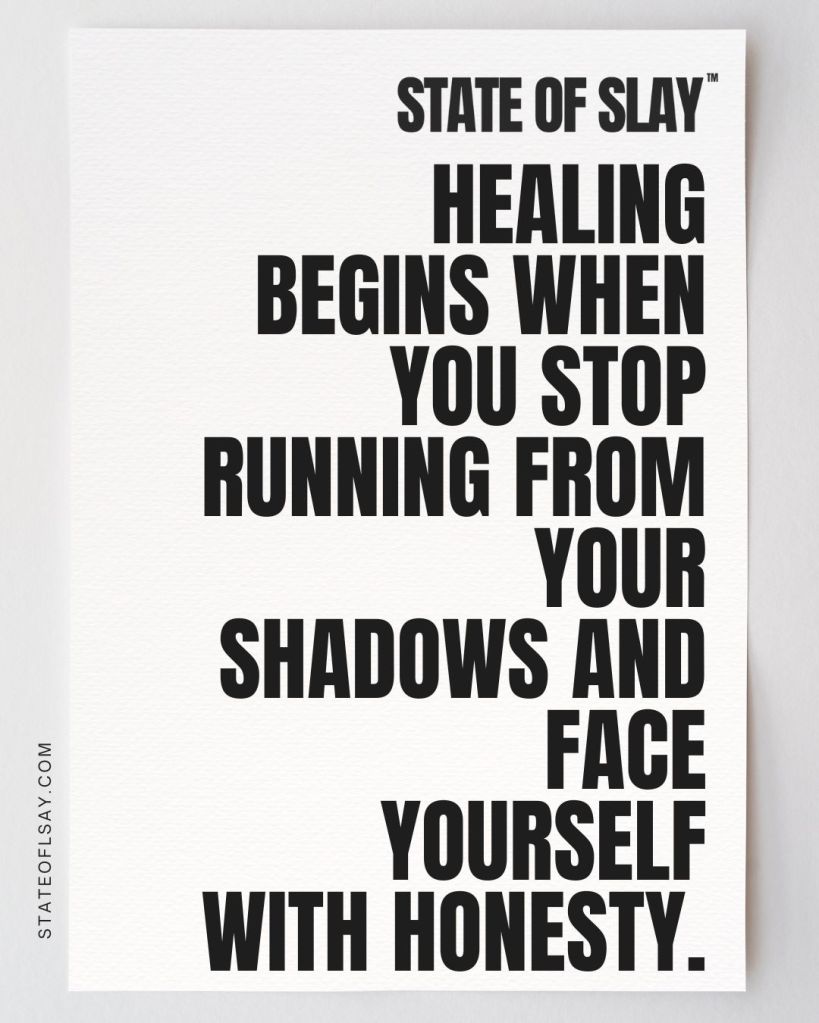
Healing doesn’t just happen in the light—it begins the moment you stop running from your shadows and decide to meet yourself in the dark.

You won’t find the light by avoiding the dark. You’ll find it by healing your way through it. The light isn’t the starting point—it’s the result. It’s the reward. The proof that you met yourself, did the work, and rose from what tried to hold you down.

This is your reminder to meet yourself where you are—your healing is the key to the light.

A black and white quote that says: "Healing begins when you stop running from your shadows and face yourself with honesty."

Accepting Kindness

We’re often quick to share kindness—offering help, lending an ear, giving generously. But receiving it? That’s where many of us stumble. We second-guess it. We deflect. We tell ourselves we haven’t earned it, that we’re not worthy. But here’s the truth: kindness isn’t something we have to earn. It’s something we all deserve—and learning to receive it is just as powerful as learning to give it.


The Tug-of-War of Worth

Before I found the path I’m on now, I wasn’t big on giving kindness freely—and when I did, it was usually with strings attached. I wanted something in return, even if it was just validation. But I also believed I didn’t deserve kindness in return. There was a constant tug-of-war in my head: I wanted more kindness in my life, but I didn’t think I was worthy of it.

As I began healing, I was encouraged to start small. Ask someone how their day was and really listen. Hold space. Offer support. Those were simple acts I could give. But when it came to receiving kindness—from compliments to genuine help—I didn’t know what to do with it. A friend told me something that changed my thinking: “If you don’t accept someone’s kindness, you’re rejecting their intention. You’re telling them they’re wrong for thinking you deserve it.”

That hit me. Hard.


Receiving Is Also Giving

So I started saying thank you. Even when it made me uncomfortable. Even when my inner critic screamed I hadn’t earned it. And you know what happened? I started to believe it. I started to see myself through the eyes of those offering kindness. And I realized: by receiving their gift, I was giving something back. I was honoring their choice to give. I was sharing a moment of connection.

Today, I practice both giving and receiving kindness. And I understand that kindness is a circle—it flows. When we shut it down, we stop the flow for everyone. But when we receive it, we keep it moving.

Let it in. Say thank you. Accept the gift. You deserve it.

SLAY on.


SLAY Reflection: Let the Kindness In

  • Do you believe you deserve kindness? Why or why not?
  • How do you show kindness to others? How do you feel when you do?
  • How do you react when someone offers you kindness?
  • What stories or beliefs might be blocking you from receiving?
  • What would it look like to accept kindness today—without guilt, without deflection?

Call to Action: Join the Conversation

I’d love to hear from you.
What’s one way you can practice receiving kindness today?
Share your story in the comments. Let’s cheer each other on.

And if you know someone who struggles to accept support, send this to them.
Sometimes, all we need is a gentle reminder that we’re worthy.

Our Dark Past Is The Greatest Possession We Have

There was a time when I thought my pain would consume me. Now, I know—it shaped me. Our darkest moments hold the power to help others find light. The only question is: are you willing to share them?


The Unimaginable Becomes a Gift

When I was deep in my darkest season, I couldn’t imagine ever looking back and seeing value in it. Survival itself felt uncertain. There was no part of me that thought these experiences would one day be considered my greatest possession. But that changed.

It wasn’t until I found recovery that I started to understand. I saw firsthand how someone else’s story could offer hope. One man’s courage to speak his truth gave me the strength to try and heal mine. His vulnerability saved my life. That was the beginning of everything.


The Power of Sharing Our Story

Early on, I didn’t believe my story held any value. I thought I needed to be “further along” to help someone else. But then, someone newer than me on this path looked at my progress with awe—and I realized we all have something to offer, no matter where we are.

Whether you’re in the thick of healing or years into your journey, someone else needs to hear what you’ve lived through. You don’t need a polished narrative or a perfect ending. Just your truth. That truth might be the very thing that keeps someone else going.


Letting Go of Shame

For a long time, I only shared the highlight reel. The idea of speaking about my pain? Terrifying. I feared judgment, labels, being seen as broken. But the truth is—I was already saying worse things to myself in silence. And pretending was exhausting.

Letting go of that fear and finally sharing my truth didn’t just help others—it saved me. The freedom that came from owning my past, rather than hiding it, was life-changing. The more I opened up, the more I connected. The more I connected, the less alone I felt.


Reclaiming the Narrative

Looking back, it’s almost shocking how much has changed. My darkest chapters no longer control me—they empower me. I’ve taken responsibility, found forgiveness, and made new choices. That transformation gave me back my power.

And maybe the most beautiful part? It allowed me to receive the light of others, too. I no longer walk alone. None of us have to. We can walk together—on our own paths, side by side—with the courage to show up exactly as we are.

There’s no greater victory than turning your pain into purpose. And no greater connection than meeting someone else in theirs.

SLAY on.


SLAY Reflection

  1. Have you found meaning in your darkest moments? What did they teach you?
  2. Is there a part of your story you’re still afraid to share? Why?
  3. Has someone else’s vulnerability ever helped you heal? What impact did it have?
  4. How can you begin to turn your past into a source of light for others?
  5. What would it feel like to release shame and step fully into your truth?

S-L-A-Y:

  • Speak your truth, even if your voice shakes.
  • Let your past be a bridge, not a burden.
  • Acknowledge your growth—and honor it.
  • You can help someone else heal by being real.

Call to Action: Join the Conversation
I’d love to hear from you.
How has your dark past shaped your present strength?
Share your story in the comments. Let’s cheer each other on.

And if you know someone who’s ready to turn their pain into power, send this to them.
Sometimes, all we need is a nudge.

Don’t Let Your Mind Bully Your Body

It was in my teens that I first remember turning against my body.

I had been a thin, athletic kid, comfortable in my skin — and then things started to change. My body began doing things I didn’t understand and didn’t want. It started drawing attention I didn’t ask for. And instead of curiosity, I felt betrayal.

I felt like my body had turned on me.

I already carried discomfort inside myself — parts of who I was that I kept hidden — and when my body began changing, it only amplified that discomfort. I started comparing myself to everyone around me. Measuring myself against them. Finding myself lacking in every direction.

Nothing ever felt good enough.

And that’s when the spiral began — not in my body, but in my mind.

My mind started bullying my body.


When Control Becomes the Goal

Looking back now, I can see it clearly.

What I was really afraid of wasn’t my body — it was not being in control.

There were so many things in my life I felt powerless over, and my changing body felt like the final betrayal. So I did what I thought would give me control back.

I tried to stop it.
Manipulate it.
Shrink it.
Silence it.

That path led to an eating disorder — one I was lucky to recover from.

It took years to heal. Years to rebuild trust with food. Years to rebuild trust with my body. And even now, there are still days I have to stay conscious and accountable with my thinking.

What makes me sad looking back isn’t my body — it’s the hatred I had for myself.

There was never anything wrong with my body.


The Voice Was the Real Problem

I see now that the damage wasn’t physical — it was mental.

The voice in my head was cruel.
Relentless.
Unforgiving.

The more I hated myself, the louder it got.

I wanted to disappear into the crowd.
Blend in.
Not be noticed.
Not be questioned.

So I tried to control myself into invisibility.

That voice told me I was the problem.
That my body was the problem.
That I had to fix it to be acceptable.

But the truth is: my body was never the enemy.

My mind was.


Learning a New Relationship

Today, I appreciate my body.

Not because it looks a certain way —
but because of what it does for me.

It carries me.
It heals.
It protects.
It supports my life.

And while I still have days where old thoughts creep in — because healing isn’t linear — I no longer live in war with myself.

I no longer punish my body for existing.

I no longer try to control it out of fear.

I no longer define my worth by how it looks.


Health Without Hate

There’s nothing wrong with wanting to feel healthy.
There’s nothing wrong with wanting to feel strong.
There’s nothing wrong with wanting to care for your body.

But when self care is driven by self hatred, it becomes harm.

We are not meant to all look the same.
We are not meant to fit one mold.
We are not meant to match one standard.

Different shapes.
Different sizes.
Different structures.
Different beauty.

Every body is valid.


Changing the Relationship, Not the Reflection

Healing doesn’t start in the mirror.

It starts in the mind.

In how we speak to ourselves.
In how we interpret our reflection.
In how we define worth.
In how we measure value.

Your body doesn’t need to be fixed.
It needs to be respected.


Your Body Is Not the Problem

Your body is not your failure.
Your body is not your enemy.
Your body is not your shame.

It’s your home.

And it deserves compassion — not cruelty.

Care — not control.
Respect — not punishment.
Safety — not shame.


SLAY Reflection

Let’s reflect, SLAYER:

S: What negative thoughts do you carry about your body?
L: Where did those beliefs come from?
A: What would change if you spoke to your body with compassion instead of criticism?
Y: How can you start practicing care instead of control today?


Call to Action: Join the Conversation

I’d love to hear from you.
What is one way you can start treating your body with more kindness today?
Share your story in the comments. Let’s cheer each other on.

And if you know someone who struggles with body shame, send this to them.
Sometimes, all we need is a nudge.