Slay Say

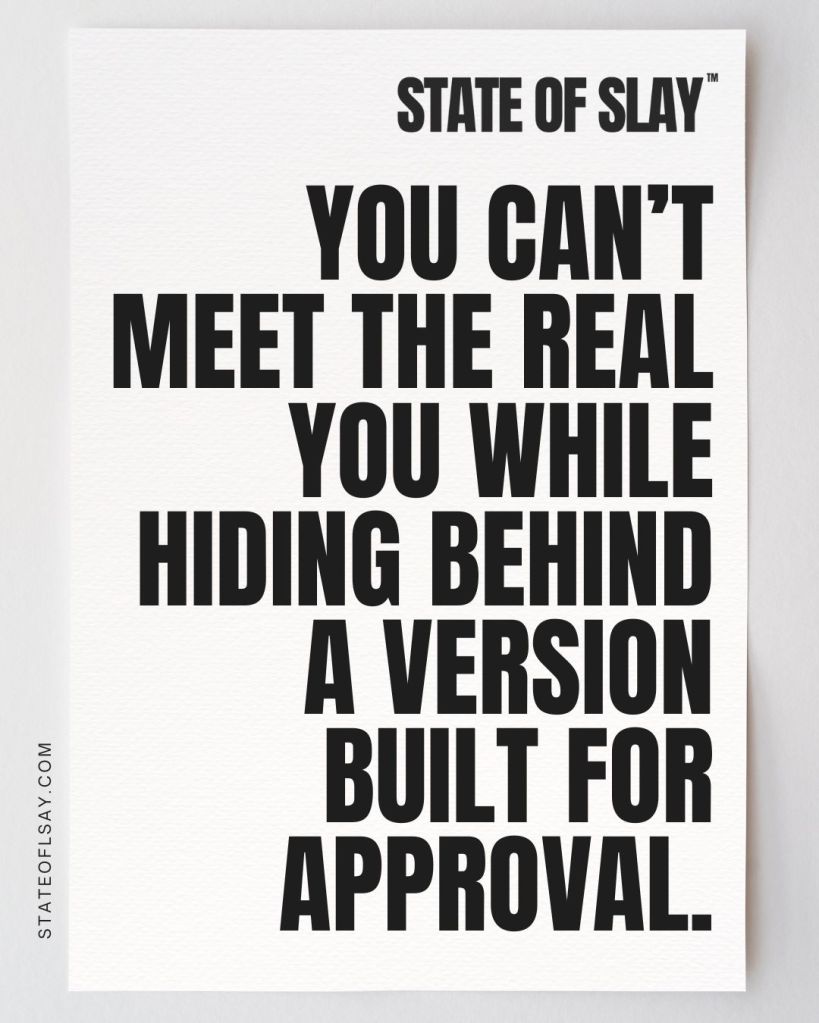
You discover who you are the moment you stop auditioning for acceptance.

We learn to shape-shift early.
To fit the room.
To earn approval.
To become what makes others comfortable—even if it costs us pieces of ourselves.

But there comes a moment when the performance gets too heavy.
When pretending feels louder than truth.
When the mask you’ve been holding starts to slip…
and underneath it is the version of you that’s been waiting for air.

Real identity isn’t found in perfection or presentation.
It’s found in the quiet courage to show up as yourself—without shrinking, without apologizing, without molding your worth around someone else’s gaze.

Stepping out of the role others expect isn’t rebellion.
It’s alignment.
It’s freedom.
It’s the first step toward a life that finally fits.

This is your reminder:
You don’t need to audition for a role that was already yours.

Slay on!

The Version of Me You Created in Your Mind Is Not My Responsibility

There comes a point in your life when you realize something deeply liberating — yet deeply uncomfortable:

You are not responsible for the version of you that someone else created in their mind.

Not the fantasy.
Not the projection.
Not the character they turned you into inside their own story.
Not the hero. Not the villain. Not the fixer. Not the savior.

You are only responsible for the real you — the complex, changing, growing human being you actually are.

But for many of us, this truth feels like rebellion. We’ve spent so much of our lives trying to manage how others see us, bending ourselves into shapes that made them more comfortable, safer, happier, or less threatened.

We’ve apologized for things we didn’t do.
We’ve shrunk to avoid being misunderstood.
We’ve over-performed to be liked.
We’ve stayed silent to stay accepted.
We’ve carried blame that was never ours to carry.

But here’s the truth:
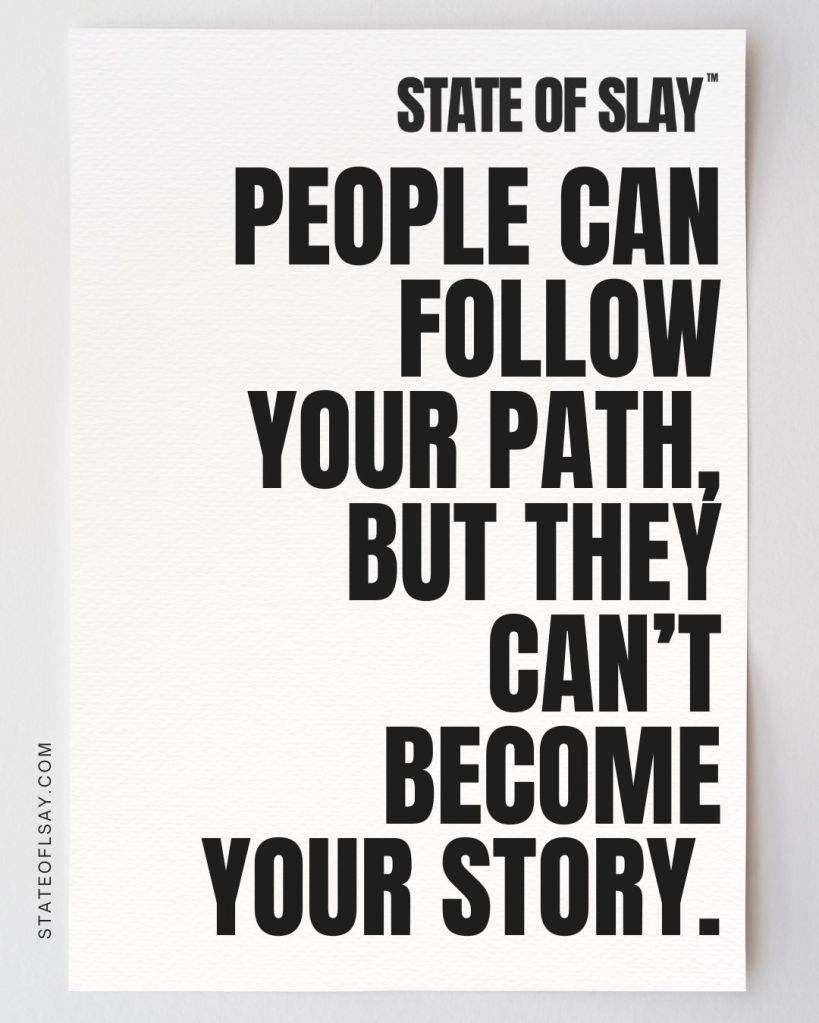
You cannot control the story someone else tells about you.
And you are no longer required to play a role you didn’t audition for.


Why People Create Versions of You

People build their own version of you for many reasons — none of which have anything to do with your worth.

Sometimes it’s because:

  • They need you to fill a role they’re afraid to fill themselves.
  • They see you through the lens of their own wounds.
  • They project their insecurities onto you.
  • They want you to stay the same so they don’t have to change.
  • They mistake your kindness for weakness.
  • They confuse your boundaries for rejection.
  • They prefer the idea of you over the reality of you.

But the version they create is theirs — not yours.

When someone builds a fantasy of you, it’s because they can’t face something in themselves.
When someone builds a villain out of you, it’s because they need a place to direct their pain.

Either way, it’s not your job to fix their story.


The Burden of Carrying Someone Else’s Narrative

Trying to live up to someone else’s imagined version of you is exhausting.

You end up:

  • performing instead of living
  • defending instead of connecting
  • proving instead of being
  • apologizing instead of growing

You shrink yourself to fit their expectations.
You become hyper-aware of their moods, their reactions, their interpretations.
You start to question your own motives, your own truth, your own voice.

It is emotional labor that was never yours to do.

You don’t need to shape-shift to avoid disappointing someone who was never seeing you clearly in the first place.
You don’t need to be responsible for the story they tell themselves.

You only need to be responsible for who you actually are.


When You Stop Carrying Their Story, Everything Shifts

The moment you stop trying to manage someone’s version of you, something miraculous happens:

You begin to breathe again.

You begin to stand taller.
You speak with more clarity.
You stop explaining yourself to people committed to misunderstanding you.
You stop negotiating your worth.
You stop shrinking so others feel bigger.
You stop apologizing for existing as you are.

People who love the real you will move closer.
People who only loved the idea of you will fall away.

And that’s how you know you’re finally aligned.


You Are Allowed to Change

One of the biggest reasons people hold you to an outdated version of yourself is because growth threatens the story they depend on.

You are allowed to evolve.
You are allowed to outgrow behaviors.
You are allowed to heal.
You are allowed to set new boundaries.
You are allowed to want better for yourself.
You are allowed to walk away from the environments that hurt you.

Your evolution is not a betrayal — it’s your responsibility.

And if someone refuses to acknowledge who you are now because they’re attached to who you used to be?
That’s their limitation, not yours.


The Freedom of Living as Your True Self

When you let go of the responsibility for other people’s perceptions, you reclaim your power.

That power sounds like:

“I’m not going to shrink to make you comfortable.”
“I don’t owe you the version of me that benefits you.”
“I won’t apologize for growing.”
“I am not available for projections.”
“My identity is not up for negotiation.”

This doesn’t make you harsh.
It makes you whole.

Because living as your truest self isn’t about being defiant — it’s about being aligned.
And when you are aligned, the right people will understand you intuitively.


What You Are Responsible For

Even though you are not responsible for the version of you people create, there are things you are responsible for.

You are responsible for:

  • your actions
  • your growth
  • your words
  • your boundaries
  • your healing
  • your truth
  • your intentions

You are not responsible for:

  • someone’s assumptions
  • someone’s projections
  • someone’s fantasies
  • someone’s insecurities
  • someone’s misinterpretations
  • someone’s made-up stories
  • someone’s expectations that deny your humanity

The distinction will set you free.


How to Release the Weight of Someone Else’s Version of You

This is the work:

1. Stop over-explaining yourself.

People committed to misunderstanding you aren’t looking for clarity — they’re looking for confirmation of their story.

2. Set boundaries around your energy.

If someone drains you because they only relate to the version of you in their head, you’re allowed to step back.

3. Stay grounded in your truth.

Write it down. Speak it. Live it.
Your truth will anchor you while others spin their own narratives.

4. Give yourself permission to evolve.

You are not obligated to stay who someone remembers you to be.

5. Accept that not everyone gets access to the real you.

Your authenticity is sacred. Not everyone gets a front-row seat.

Releasing their version of you is a reclaiming.
It’s choosing yourself over illusion.
It’s choosing truth over performance.
It’s choosing alignment over approval.


SLAY Reflection

  1. Whose version of you have you been trying to live up to?
  2. What parts of yourself have you hidden to fit someone else’s expectations?
  3. What boundaries would protect your authentic self?
  4. How do you act when you’re being the real you versus the projected you?
  5. What would it feel like to stop performing entirely?

  • S – Stand in your truth without apology
  • L – Let go of the stories others create about you
  • A – Align with who you are today, not who you used to be
  • Y – Yield to your authentic self and release the rest

Call to Action: Join the Conversation

I’d love to hear from you.
Whose imagined version of you are you finally ready to release?
Share your story in the comments. Let’s cheer each other on.

And if you know someone who feels trapped inside someone else’s expectations, send this their way.
Sometimes, all we need is permission to be who we actually are.


To Become Who You Truly Are, You Have to Let Go of Who They Told You to Be

For much of my life, I tried to be who they told me to be.

The “they” was everywhere—teachers, parents, partners, bosses, social media, society. Each one had a version of me they preferred. I wore those versions like outfits, hoping one of them would finally feel like me. But deep down, I always knew: I was playing a part written by someone else.


When You Live for Them, You Lose Yourself

Every time I molded myself to fit their expectations, I lost another piece of who I was. I became quieter when they said I was too much. I smiled when I wanted to cry. I said yes when everything inside me screamed no.

I wanted to be accepted so badly, I started rejecting myself.

Eventually, I reached a breaking point. I was exhausted. Not from being myself, but from not being myself. I had no idea who I was anymore—but I knew I couldn’t keep pretending. That was the first step.


Forget Who They Told You to Be

To find my true self, I had to unlearn the lies I’d been told:

  • That I was too sensitive.
  • That I needed to tone it down.
  • That my worth depended on being agreeable, pretty, polite, perfect.

None of that was me. It was who they needed me to be so they could be comfortable.

But I wasn’t born to make other people comfortable.

So I started letting go. I peeled back the layers of conditioning, people-pleasing, and perfectionism—and underneath, I found someone real. Someone strong. Someone worth knowing.


Becoming You Is a Brave Act

Choosing to be yourself—your real self—isn’t always easy. It might upset people. It might confuse them. It might even mean walking away from relationships or roles that no longer fit.

But becoming who you truly are is the most powerful act of self-love there is.

Every time you choose authenticity over approval, you build a life that actually feels like yours. And trust me, there is nothing more freeing than that.

You don’t have to be who they told you to be. You get to decide who you are.


SLAY Reflection

  1. Who told you who you “should” be?
  2. What roles or expectations are you still carrying that don’t feel like your own?
  3. When have you felt most like yourself?
  4. What’s one way you can show up more authentically today?
  5. What would your life look like if you stopped living for their approval?

S-L-A-Y:

  • Shed the stories that don’t belong to you.
  • Live your truth—loudly and unapologetically.
  • Acknowledge who you’ve always been beneath the noise.
  • You are allowed to become someone they don’t recognize.

Call to Action: Join the Conversation
I’d love to hear from you.
What part of yourself are you reclaiming today?
Share your story in the comments. Let’s cheer each other on.

And if you know someone who’s stuck in a role they never chose, send this to them.
Sometimes, all we need is a nudge.

Slay Say

Let the Shadows Fall Away

Not everyone is meant to walk beside you when you begin to shine.

As you step into your truth, the people who only saw your potential in pieces may start to fade. And that’s okay.
You weren’t made to shrink, edit, or filter who you are just to be accepted.

The more you show up fully—without apology—the more you create space for relationships rooted in real connection, not performance.

Let go of the need to be understood by everyone.
The right ones will never be afraid of your light.

SLAY ON.

The Stories From Our Past

Before I began my recovery journey, I lived by stories that weren’t mine. I believed I was different. Less-than. Unworthy of good things. And I made decisions from that place—choosing people and situations that reinforced the story I was already telling myself.

Even the small things stuck. A dismissive comment. A look. A joke that hit too close to home. I internalized those moments and built my identity around them. And as I kept repeating those stories to myself, I gave them power. I let them define me.

When I finally sought help for my mental health, one of the first exercises I was given was to write down all the things I believed about myself. Most were negative. Then came the harder part: asking if those things were actually true.

It turned out, most of them weren’t. They were stories I had inherited. And I had the power to release them.


Telling a New Story

Doing the work—challenging those false beliefs—wasn’t easy. But with time, support, and a lot of self-reflection, I began to rewrite the script.

I started telling myself the truth.

That I’m capable. That I’m worthy. That I’m more than enough.

The stories from my past didn’t disappear. But they no longer control me. Today, I use them as tools. When those old narratives resurface, I pause. I ask myself: Is this true? Is this helping me grow? Is this a story I want to keep?

And if the answer is no, I let it go.

Instead, I choose to tell stories of healing. Of courage. Of growth. I choose relationships that reflect the truth of who I am, not the lies I once believed.

You get to choose your story, too.

SLAY on.


SLAY Reflection: What Story Are You Living?

  • Are you holding onto any stories from childhood that no longer serve you?
  • Who or what shaped those beliefs—and are they actually true?
  • What have those stories cost you in your adult life?
  • What’s one belief you could rewrite today?
  • What story would you rather live—and what’s one small step you can take toward it?

Call to Action: Join the Conversation

I’d love to hear from you.
What’s one story from your past you’re ready to rewrite?
Share your story in the comments. Let’s cheer each other on.

And if you know someone who’s still living by an old story that isn’t serving them, send this to them.
Sometimes, all we need is a reminder that we’re the ones holding the pen.

Does Feeling Bad Feel Comfortable?

When I was living in the dark, I wasn’t happy there, but it was what I knew, and where I felt comfortable. I was torn between being in love with my sadness and wanting to let it go. I didn’t know how to let it go, and I also was afraid to, because my identity had become my sadness, like a black cloak I pulled tightly around me. That cloak got heavier and heavier as the years went on, so much so it became hard to breathe from the weight of it, but I stayed there, and I kept wearing it until the weight of it became too much for me to stand and it brought me to my knees. I’m grateful I was able to reach that point. I am grateful I made it that long. That I found the strength in me to finally lift that heavy cloak off of me and leave it behind. I almost wasn’t able to. And I think the danger of that for me is why it needed to be that heavy, so that I always remember how dark and heavy that place was, and how difficult it was for me to get out.

Sometimes we stay where we shouldn’t because it’s all we’ve ever known, or, it’s what we think we deserve, even when we may realize that we should go, we can stay stuck thinking it’s better to live in a place that we’re familiar with rather than stepping out to unknown territory. We keep ourselves locked away, or sick, and find people who feed into that sickness so we can feel okay for being there, even possibly be encouraged to stay by those with us, as it feeds into their sickness as well. It takes a lot of courage to reach for the light, to change the way we’ve been living, how we’re living and who we’re living with. But we have to believe we deserve more, or better, or something different from what we’ve had to live as our authentic selves and discover what our true potential is. Because when we live in the dark, when we hide in those places that may make us feel safe, but are places we shouldn’t be in, we lose a part of ourselves, and the longer we stay there the more we lose. We step down on those places in our heart that are meant to shine, those parts of us we’re meant to share with the world, and ourselves, we suffocate our true selves and we slowly die there, and even though it can be terrifying to let go and trust that we’re not meant to live a life in the shadows, what we gain when we do is worth every moment of fear we have to walk through to get us there. And the more we we push past that fear to find our happiness, the less we’ll put up with anything, or anyone, that causes us to feel bad, and as we do, that dark place becomes less comfortable.

We have the power to change the place we live in our hearts, we can choose to live in a place that makes us feel bad, or one that gives us joy, one that let’s our heart shine, even if the place of sadness is all we’ve known, we can still see out our own place of happy. It does take some work, and some trust that you can get to that place, but as someone who found her way to her own I can tell you, it is possible, and once you’re there the possibilities become limitless. Go find your happy place and find it within you to believe you deserve it. SLAY on.

SLAY OF THE DAY: Does feeling bad feel comfortable? Why? Have you always lived in that place? If you haven’t, how have you found yourself there? Why haven’t you left? If you have, do you want to find a better place for yourself, a happier place, a healthier place to live? What does that place look like to you SLAYER? Can you imagine it? Where can you find that place? If you can’t imagine it, if you could make it up, being realistic about it, what does it look like, feel like, where is it? Can you find it? Can you work toward it? How? What steps can you take? SLAYER we are more than what has happened to us, we are more than what we’ve been told we deserve, or who we’ve been told we are, only we get to decide that, us, so take some time and think about where you are, why you’re there, and where you want to go, because you can go there, you just have to believe you can and get to work on getting there. I believe in you SLAYER, now it’s your turn to believe in yourself, and believe you deserve more than finding a comfortable place in your sadness.

S – self L – love A – appreciate Y – you