Slay Say

Some Wounds Aren’t Loud

Just because there wasn’t malice doesn’t mean there wasn’t damage.
The ripple of someone’s behavior can still cut deep—
even when their hands never meant to cause pain.

What matters is how you felt. What you carry.
Your truth still deserves recognition.

This is your reminder to honor what happened,
even if no one else saw it.

SLAY on!

Boundaries Don’t Burn Bridges, They Protect Castles

We often think of boundaries as walls—cold, hard, unmovable. Something that keeps people out. Something that severs ties. But boundaries aren’t built to burn bridges; they’re created to protect the castles we live in: our peace, our worth, our mental and emotional well-being.

Setting boundaries doesn’t make you selfish or difficult. It makes you safe. It makes you sovereign over your own life.


Castles Require Protection

Think about what a castle is: it’s a sanctuary. A stronghold. A place where something valuable lives. And yet, without a gate, without guards, without a moat, it’s just a target.

You are the castle.

Your energy, your time, your kindness, your heart—these are the treasures inside. Boundaries are how you decide who gets access, and under what conditions. They are not about shutting everyone out. They are about making sure that those who enter are willing to honor the space, not pillage it.

If someone sees your boundary as a betrayal, they were never meant to be in your castle to begin with.


Burning Bridges vs. Building Balance

There’s a big difference between cutting someone off out of spite and setting a boundary to preserve your well-being. But not everyone will see it that way—especially those who benefited from you not having boundaries before.

Let that be a red flag.

When someone is upset that you’re taking care of yourself, it says more about them than it does about you. Your healing will threaten the dynamics that were built on your silence, your sacrifice, and your people-pleasing. And when those dynamics shift, don’t be surprised if some bridges fall down on their own.

Let them.

Not every bridge is meant to last forever. Some were only built to teach you how not to be walked on.


Boundaries Are Not Barriers to Love

It can feel scary to draw the line—especially with people we care about. We worry they’ll see us differently. That we’ll lose them. That they’ll think we don’t love them anymore. But the truth is, love that can’t coexist with boundaries isn’t really love.

It’s control. It’s codependency. It’s convenience.

Love honors the sacred. And what could be more sacred than your well-being?

Setting a boundary is not an act of war. It’s an act of self-respect. It’s saying, “I care enough about myself to choose what I allow into my life.”

Those who love you well will walk through your gates, not try to climb your walls.


You Don’t Owe Anyone Access to Your Peace

Let that sink in.

You don’t owe explanations. You don’t owe justifications. You don’t owe your energy to people who constantly drain it. You don’t owe a single brick from your castle to anyone who hasn’t proven they know how to build.

It’s not easy to maintain boundaries, especially when guilt or fear creeps in. But remember this:

Every time you choose your peace over your people-pleasing, you reinforce the walls that keep your life safe and sacred.

Protect your castle. The right people will come with open hands, not demands.


SLAY Reflection

  1. Where in your life have you struggled to set boundaries?
  2. What have you been afraid might happen if you did?
  3. How does it feel when someone respects your boundaries without question?
  4. What does your “castle” need more protection from right now?
  5. How can you reinforce your emotional boundaries with love and clarity?

S – Stand strong in your worth
L – Let go of guilt around protecting your peace
A – Ask for what you need without apology
Y – Yield only to love that respects your lines


Call to Action: Join the Conversation

I’d love to hear from you.
What boundaries have helped protect your peace?
Share your story in the comments. Let’s cheer each other on.

And if you know someone who’s afraid to set boundaries, send this to them.
Sometimes, all we need is a nudge.

You Did Nothing Wrong By Asking To Be Treated Right

There was a time in my life when I second-guessed myself. I would speak up when something didn’t feel good, and then spiral afterward—replaying the moment in my head, wondering if I was overreacting, if I made things awkward, if I should have just stayed quiet.

But here’s the truth I wish I had known sooner:

You did nothing wrong by asking to be treated right.

There is nothing wrong with saying “that hurt my feelings” or “I don’t like how that made me feel.” There is nothing wrong with saying “I deserve better than this.” Because you do. You always have.

What is wrong is how often we’re taught to feel guilty for setting a boundary. We’re told we’re too sensitive, too difficult, too much. So we shrink. We tolerate. We accept less. And with each time we swallow our truth, we chip away at the trust we have with ourselves.

Over time, we begin to question whether we even deserve what we’re asking for. We start to silence ourselves before anyone else even has the chance to.

But the voice inside you that whispers, “this doesn’t feel right”—that voice is sacred. And it deserves to be heard.

We’re often praised for how much we can endure, how quiet we can stay, how agreeable we can be. But healing isn’t about being palatable. It’s about being real.

It’s about letting go of the version of you that never got to speak up, and becoming the version who knows how to say, “I’m not okay with this.”

Because you matter. What you feel matters. What you need matters.


It’s Not Asking for Too Much

It’s not just about the person on the other end of the conversation. It’s about you. Your self-worth. Your healing. Your nervous system. The way you allow yourself to take up space and take care of yourself.

Honoring how you feel isn’t selfish—it’s self-respect.

Asking to be treated with kindness, consistency, and care is not asking for too much. It’s asking for the bare minimum. And if someone can’t meet you there, that’s not your failure. That’s their limitation.

You don’t have to convince people to do the right thing. You just have to be willing to do the right thing for yourself.

Letting people know where your lines are isn’t pushing them away. It’s giving them a clear map of how to love you.

And if they walk away? Let them. Anyone who leaves because you asked for respect was never offering it to begin with.

Protecting your peace is not dramatic. It’s necessary. Saying “no more” is not cruelty. It’s clarity. And standing up for yourself is not a betrayal of others—it’s a commitment to yourself.

When you start honoring what you know to be true, you stop seeking validation from people who never had the capacity to see you clearly.


Trust What You Know

So if you’ve ever walked away from a conversation, a relationship, or a space because your boundaries weren’t honored—let me remind you:

You did not fail.
You did not overreact.
You did not do anything wrong.

You simply chose yourself.
And that is something to be proud of.

You’re not hard to love—just hard to manipulate. And anyone who’s confused by that difference was never meant to hold your heart.

Let your purpose lead. It knows the way.


SLAY Reflection

  1. Have you ever felt guilty for speaking up about how you were treated?
  2. Where in your life are you still tolerating what doesn’t feel good?
  3. What would change if you fully trusted your feelings and instincts?
  4. Who in your life consistently respects your boundaries?
  5. How might your life shift if you believed you weren’t “too much” for simply asking for respect?

S – Speak your truth without apology
L – Let your boundaries be your guide
A – Ask for what honors your worth
Y – Yield to self-respect over people-pleasing


Call to Action: Join the Conversation

I’d love to hear from you.
What’s something you’ve asked for that made you feel proud for standing up for yourself?
Share your story in the comments. Let’s cheer each other on.

And if you know someone who’s second-guessing themselves for speaking up, send this to them.
Sometimes, all we need is a nudge.

Slay Say

NOT EVERYONE CLAPS WHEN YOU RISE

We don’t lose people when we grow—we reveal them.
Not everyone who starts the journey with you is meant to finish it beside you.
Your success may make others uncomfortable, but that doesn’t mean you should shrink.
Let go of the need for approval and keep climbing.
The ones who are meant to walk with you won’t fear your elevation—they’ll fuel it.

This is your reminder:
You don’t need universal applause to be on the right path.
Just the courage to keep going.

SLAY on!

When a Child is Shamed for Feelings, They Don’t Stop Feeling—They Stop Trusting

There’s a heartbreaking truth many of us come to learn too late:

When a child is shamed for having feelings, they don’t stop feeling. They stop trusting.

They stop trusting their emotions. They stop trusting their voice. And eventually, they stop trusting themselves.

We often teach kids—intentionally or not—that certain feelings are too much, too messy, too inconvenient. That anger is bad. That sadness is weakness. That fear is overreacting. We hush them. We roll our eyes. We tell them to “get over it” or “calm down.” But what we’re really saying is: Your feelings don’t belong here.

And that message doesn’t just sting in the moment. It stays.


The Seeds of Self-Doubt

When we shame a child’s feelings, we’re not teaching emotional regulation—we’re teaching emotional suppression.

Instead of learning how to navigate their emotions, they learn to ignore them, question them, or feel guilt and embarrassment for even having them in the first place.

They start asking:

  • “Why am I so sensitive?”
  • “What’s wrong with me?”
  • “Why can’t I just be normal?”

These questions don’t come from nowhere. They come from a world that told them, early on, that their natural responses were somehow wrong.


Unlearning the Silence

As adults, many of us carry this conditioning into our relationships, our workplaces, and our inner dialogue. We still quiet our feelings. We second-guess our instincts. We feel shame for emotions that are perfectly human.

But here’s the thing: Our feelings don’t go away just because we learned to hide them.

They find other ways to come out—through anxiety, depression, emotional outbursts, or chronic people-pleasing. The body keeps the score. The heart remembers.

Healing begins when we give ourselves permission to feel again. To validate what was once invalidated. To trust that our emotions have something to teach us, not something to be ashamed of.


Reparenting Starts With Awareness

Maybe you were that child. Maybe you’re still carrying the weight of being told to “toughen up” or “stop crying.”

Or maybe you’ve caught yourself repeating those phrases to someone else—not out of cruelty, but because it’s what you were taught.

Here’s the good news: You can stop the cycle.

You can start by:

  • Saying “I hear you” instead of “you’re overreacting.”
  • Asking “What are you feeling?” instead of “What’s wrong with you?”
  • Letting your own emotions be seen, so others feel safe showing theirs.

You don’t need to have all the answers. You just need to be a safe place.


SLAY Reflection

Ask yourself:

  • Was I shamed for showing emotion as a child?
  • How did that shape the way I express or suppress feelings today?
  • Do I trust my emotional responses—or do I second-guess them?
  • How can I begin validating my emotions, rather than hiding or judging them?
  • What would it feel like to create space for someone else to share, without judgment?

S – L – A – Y

S: See where your emotional patterns began.
L: Listen to your inner voice with compassion.
A: Allow your feelings to surface without shame.
Y: Yield to the wisdom your emotions are offering.


Call to Action: Join the Conversation
I’d love to hear from you.
Were you taught to suppress your emotions as a child—and how has that shaped your journey?
Share your story in the comments. Let’s cheer each other on.

And if you know someone who’s learning to feel again, send this to them.
Sometimes, all we need is a nudge.

Slay Say

Growth starts where ego ends

It’s not always easy to hear what we need to hear. Sometimes, the truth pokes at our pride before it frees us. But if we want to grow, we have to stop treating feedback like failure. Growth asks for humility, curiosity, and the willingness to be wrong. The most powerful people are the ones who stay open—even when it stings.

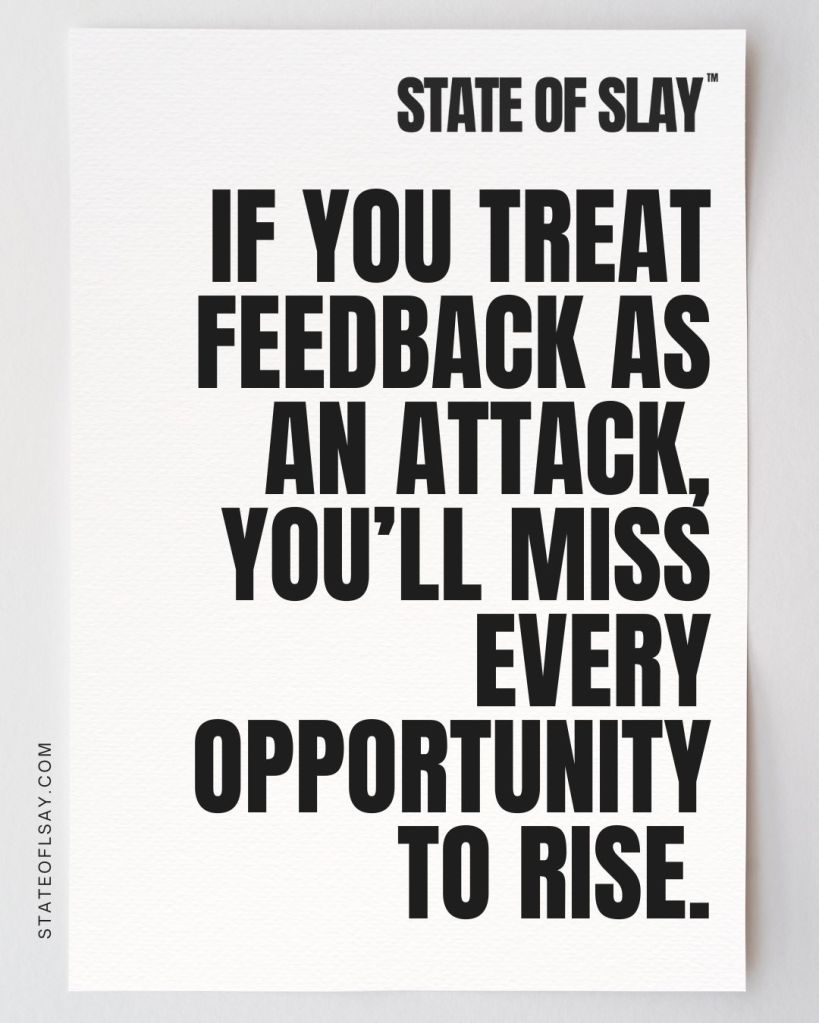
If you treat feedback as an attack, you’ll miss every opportunity to rise.

SLAY on!

Confirmation Bias

We all want to believe we’re right. That the thoughts we have are the truth. That what we fear is valid. That what we suspect about others is accurate. And so, often without realizing it, we go looking for proof. Not for the truth—but for what we already believe.

That’s confirmation bias.

And it can quietly wreck everything from our relationships to our self-worth.


What Are You Trying to Prove?

Here’s the thing about the human brain: it’s not always looking for truth. It’s looking for evidence that confirms what it already believes.

If your brain believes you’re not good enough, it will dismiss compliments and zero in on criticism.

If your brain thinks no one can be trusted, it will interpret a delayed text or a short tone as betrayal.

If you believe someone doesn’t like you, you’ll search their face and their actions for the tiniest piece of proof—and you’ll find it, even if it isn’t real.

We all do it. It’s human.

But when we act on that bias instead of reality, we reinforce the story we already believe—and miss the opportunity for connection, growth, and healing.


When I Believed the Worst

For a long time, I believed I was unworthy. That no matter how hard I tried, it was never enough. That I would always be the one left behind.

So I looked for proof.

I clung to any sign of rejection. I dismissed care or kindness because I assumed it wouldn’t last. I assumed I was being judged, even when no one was paying attention to me.

I thought I was being self-aware. I thought I was protecting myself.

But what I was really doing was building a case against myself, collecting data that wasn’t even true. And every time I gave weight to a moment of perceived rejection, I was closing a door. I was missing a chance to see that maybe the story I was telling myself wasn’t the whole truth.

And if it wasn’t the truth? Maybe I wasn’t broken after all.


How to Break the Bias

Awareness is everything.

Next time you find yourself thinking, “See? I knew it,” pause.

Ask yourself:

What am I trying to prove right now? And is this actually true—or just familiar?

Confirmation bias feels like safety. It feels like control. But really, it’s just an old loop. One you can break.

Try asking someone you trust for a reality check. Or write down your belief and then list the evidence for and against it.

Better yet, ask yourself: Would I talk to someone I love the way I’m talking to myself right now?


SLAY Reflection

Ask yourself:

  • What beliefs do I keep trying to prove?
  • Where did those beliefs come from?
  • How is confirmation bias limiting my relationships?
  • Do I trust my thoughts more than I trust what’s real?
  • What would it feel like to look for evidence of the opposite being true?

S – L – A – Y

S: Spot the belief that keeps repeating.
L: Listen for the moment you start searching for proof.
A: Ask yourself what else could be true.
Y: Yield to possibility. It’s where healing begins.


Call to Action: Join the Conversation
I’d love to hear from you.
What’s a belief you’ve spent a long time trying to prove—and what happened when you questioned it?
Share your story in the comments. Let’s cheer each other on.

And if you know someone who’s stuck in a loop of self-doubt, send this to them.
Sometimes, all we need is a nudge.

Be Your Own Fairy Godmother

Some of us grew up believing someone would swoop in and fix everything. A magical godmother. A rescuer. A sign from the universe that now is the time, that this is the moment our lives change for the better.

But here’s the truth no one tells you as a kid:

The magic wand is already in your hands.

Waiting for someone else to save you keeps you stuck. Hoping for permission to live fully delays your joy. You don’t need a fairy godmother. You just need to believe in your own power to create change, healing, and magic.

You don’t need a transformation. You need a reminder of who you already are.


I Spent Years Waiting for a Rescue

I thought love would save me. Or success. Or finally being “enough.”

I believed that if I kept trying, kept achieving, kept pleasing, eventually someone would say, “You’ve made it. You’re worthy now.”

But that moment never came—because I was looking outside of myself for something only I could give.

It wasn’t until I hit rock bottom that I realized no one was coming to save me. I had to be the one to pull myself out. I had to be the one to say, “Enough. I choose me now.”

It wasn’t a grand, glittery moment. It was quiet. Personal. But it changed everything.

When you stop waiting to be chosen, and choose yourself instead, that’s when the real magic begins.

And that decision? It didn’t come from perfection. It came from truth. From realizing that I deserved better—not someday, but right now.


Create Your Own Magic

We’ve been taught that magic looks like glass slippers and pumpkin carriages. But real magic? It’s setting boundaries. It’s speaking your truth. It’s taking the brave next step—even when your voice shakes.

It’s no longer waiting for someone to tell you that you’re ready. You already are.

It’s recognizing that you are worthy of love, rest, joy, peace, and purpose—without having to earn it.

Magic is found in the everyday moments when you show up for yourself. When you advocate for your well-being. When you care for your spirit. When you speak kindly to your reflection.

Magic is deciding not to abandon yourself again.

It’s building a life that honors your truth, your pace, your values. Not the ones someone else handed you.

You don’t need a crown. You don’t need a costume. You don’t need anyone’s permission.

You’ve had the power all along.

Let this be your reminder: You are the magic. You are the moment. You are the one you’ve been waiting for.


SLAY Reflection

Ask yourself:

  • Where in your life are you waiting for someone to rescue or choose you?
  • What would it look like to choose yourself instead?
  • What’s one area where you can take your power back today?
  • What belief about worth or magic are you ready to release?
  • How can you show up for yourself like someone who truly has your back?

S – L – A – Y

S: See where you’ve been waiting for permission.
L: Listen to what your inner voice truly wants.
A: Act from a place of self-trust, not self-doubt.
Y: Yield to your own magic—it’s been waiting for you.


Call to Action: Join the Conversation
I’d love to hear from you.
Have you ever realized you were the one you’ve been waiting for?
Share your story in the comments. Let’s cheer each other on.

And if you know someone who’s stuck waiting to be saved, send this to them.
Sometimes, all we need is a nudge.

Love on a Leash

There’s a kind of love that doesn’t feel like love at all. It looks the part—smiles, sweet words, even grand gestures—but underneath, it’s tethered to expectations, rules, and unspoken conditions. It’s love, but only if. That’s love on a leash.

Love on a leash says: “I’ll love you if you behave a certain way.” Or worse, “I’ll love you when you’re less of this and more of that.” Sometimes, the leash comes from others. But just as often? We hold the leash ourselves.

We believe we must be a specific version of ourselves to be lovable. We shrink. We twist. We contort our identities to avoid rejection, or worse—abandonment. We believe we’re only worthy of love if we’re easy to handle, always agreeable, or constantly achieving.

And over time? That leash tightens. We stop reaching. We stop expressing. We stop showing up as who we really are.


I Know That Leash All Too Well

I’ve felt it—the pull of wanting to be loved so badly that I’d trade my truth for someone else’s comfort. The tension of walking on eggshells just to keep the peace. The guilt that rises when I try to set a boundary, even a healthy one, because I fear I’ll lose the connection if I do.

But here’s what I’ve learned:

Any love that demands you abandon yourself isn’t love. It’s control.

Love shouldn’t feel like a leash. It should feel like a safe place to land.


Real Love Doesn’t Require a Performance

Authentic love sees the real you. It invites all your parts—your fire and your softness, your growth and your mess. It doesn’t flinch at your vulnerability. It honors it.

And the same goes for how we love ourselves.

When we hold ourselves to impossible standards, we put our own hearts on a leash. We tell ourselves we’ll be worthy when we’re thinner, calmer, more successful, more perfect.

But we’re worthy now. We’ve always been.

You don’t have to earn love by becoming someone else. You get to be loved for who you are.


Releasing the Leash

Letting go of love with conditions means facing our fears. It means risking disapproval. It means standing in our truth, even if someone walks away.

But it also means freedom.

It means deeper connection, greater peace, and the kind of joy that only comes from being fully known and still fully accepted.

It starts with you. How you love yourself. How you speak to yourself. What you tolerate—from others and from your own inner voice.

And maybe most importantly? It starts with the unlearning of what love was never supposed to be.

You don’t have to stay tethered. The leash can come off.

And when it does?

You’ll remember: real love doesn’t confine—it expands.


SLAY Reflection

Ask yourself:

  • Have you ever felt like love came with conditions?
  • Who’s holding the leash—someone else, or you?
  • What stories about love and worth are you still carrying?
  • How can you begin showing yourself more unconditional acceptance?
  • What kind of love do you want to give—and receive—from this point forward?

S – L – A – Y

S: Spot the conditions—where do you feel limited in love? L: Let go of outdated beliefs about what makes you lovable.
A: Affirm your worth without needing to prove it.
Y: Yield to relationships that offer real connection—not just compliance.


Call to Action: Join the Conversation
I’d love to hear from you.
Have you ever experienced love on a leash—and what helped you take it off?
Share your story in the comments. Let’s cheer each other on.

And if you know someone who’s struggling to feel seen for who they truly are, send this to them.
Sometimes, all we need is a nudge.

Slay Say

HEALING DOESN’T ALWAYS LOOK LIKE HARMONY

It can feel like you’re turning your back on everything familiar—but what if you’re turning the page instead?
Growth isn’t always gentle. Sometimes it’s loud. Sometimes it’s lonely. But choosing a new direction doesn’t mean rejecting your roots—it means rising from them.
You’re not abandoning your story.
You’re rewriting the ending.

SLAY on!