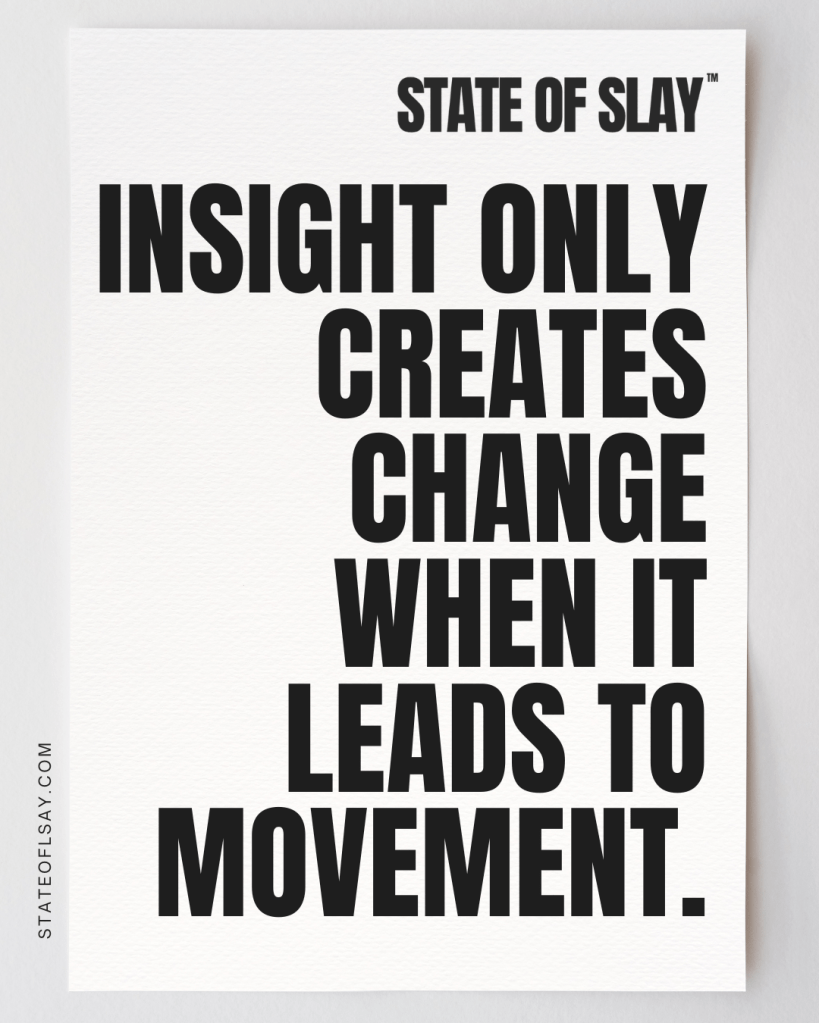
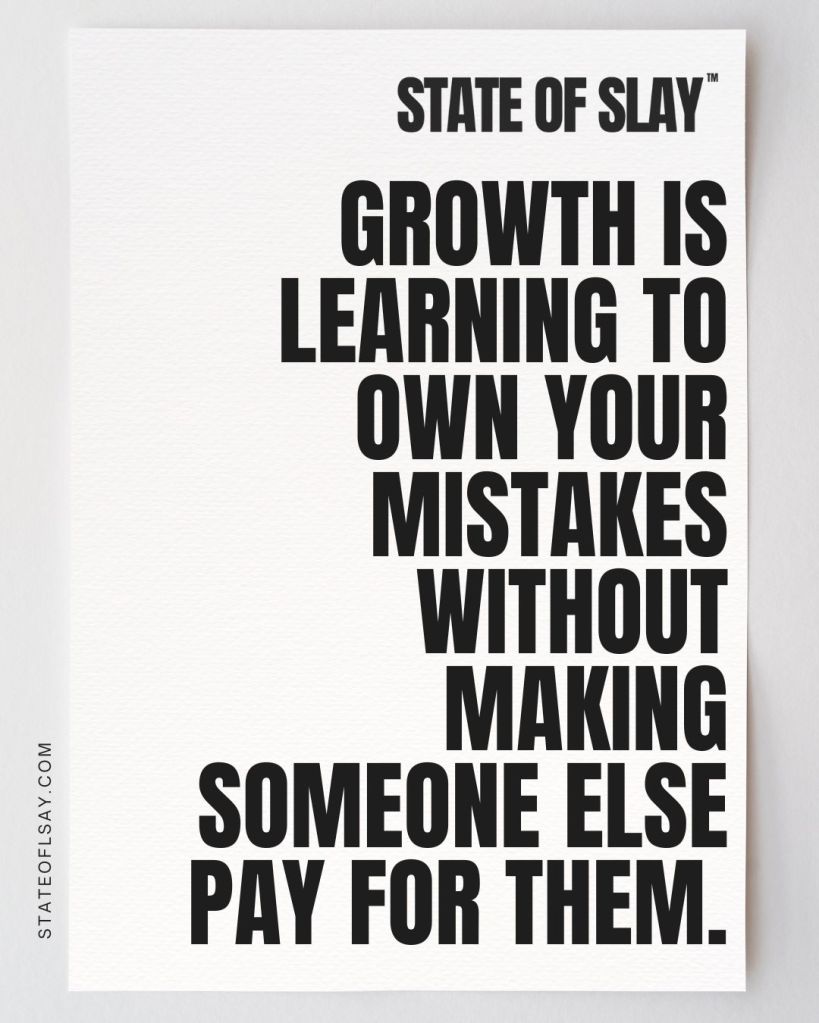
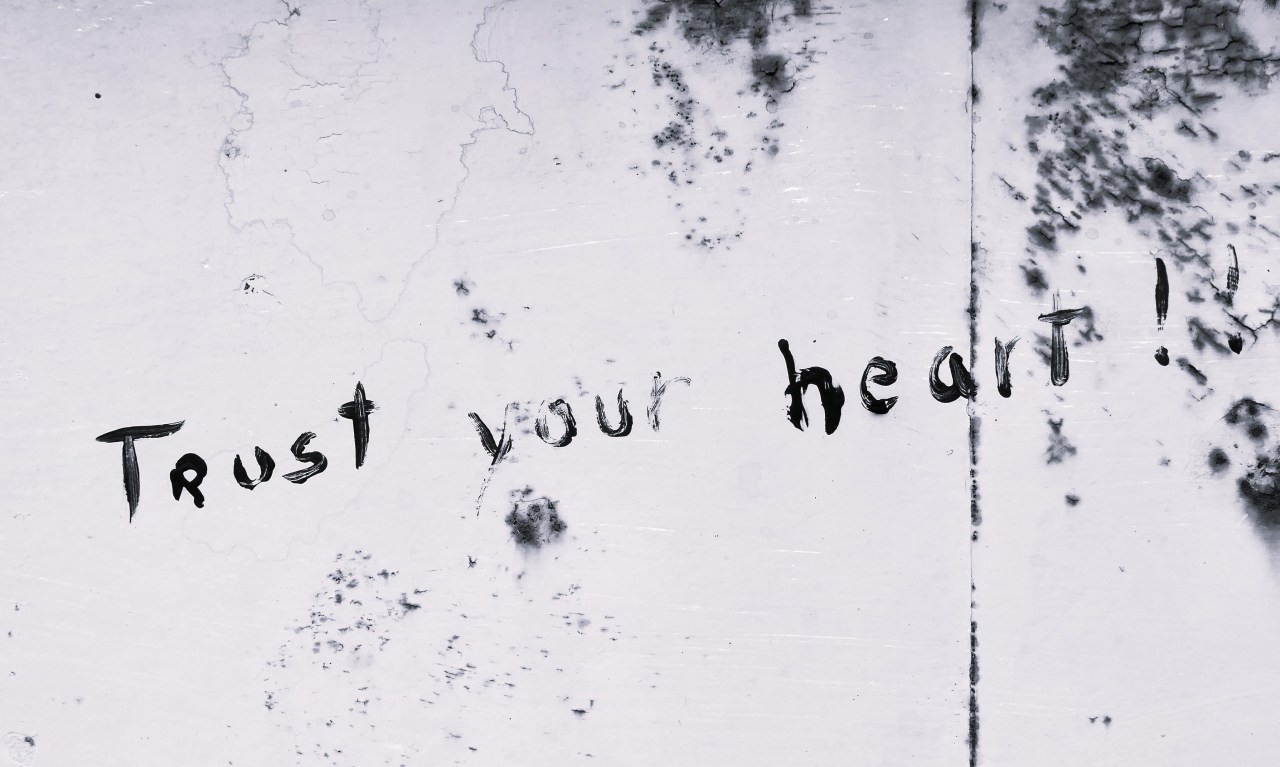
Slay Say

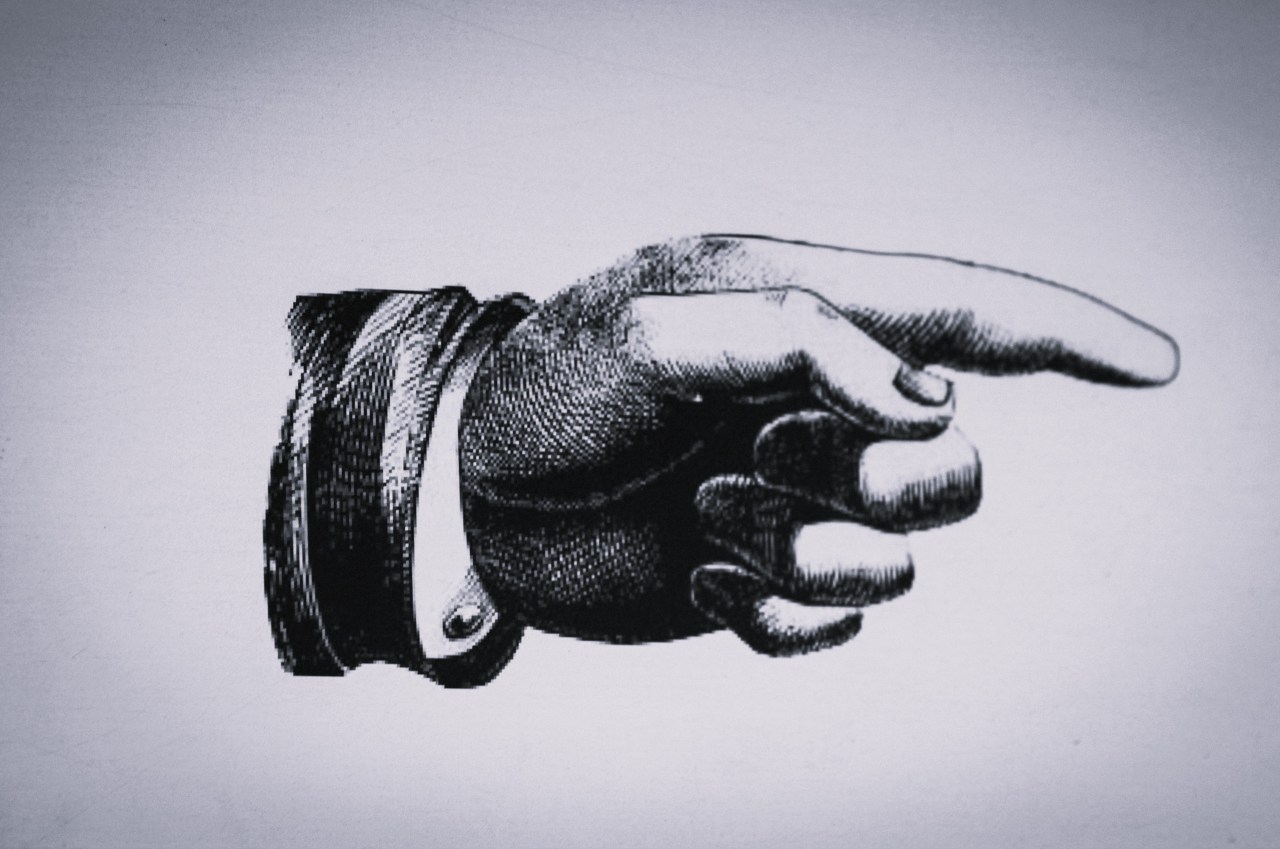
It’s easy to point outward.
To explain away patterns.
To justify habits that feel familiar, even when they keep you stuck.

But real growth doesn’t begin with perfection —
it begins with honesty.

When you stop making excuses for what drains you,
trips you up,
or keeps repeating itself,
you reclaim your power.

Not to shame yourself.
Not to criticize who you’ve been.
But to finally see yourself clearly enough to move differently.

Self-awareness isn’t harsh.
It’s freeing.
Because once you name what’s been holding you back,
it no longer gets to run the show.

This is your reminder:
You don’t grow by denying your patterns —
you grow by owning them and choosing better

Slay on!

Is There an Apology You Need to Make Today?

Sometimes, healing starts with two words: I’m sorry.

They don’t always come easily — not because we don’t mean them, but because they require vulnerability. They ask us to look at the parts of ourselves that we’d rather not see. To acknowledge the hurt we’ve caused — intentionally or not — and to face the discomfort that comes with accountability.

But here’s the truth: apologies aren’t about guilt. They’re about growth.

They aren’t about surrendering your power. They’re about reclaiming your integrity.

And when done sincerely, an apology can be one of the most powerful acts of healing — for both you and the person on the other side of it.


The Weight of What’s Left Unsaid

We all carry them — the moments that sit heavy on our hearts. The words we wish we could take back. The tone we wish we hadn’t used. The silence that lasted too long.

Maybe it’s a friend you drifted from after a misunderstanding.
Maybe it’s a parent or sibling you haven’t spoken to because pride got in the way.
Maybe it’s yourself — the hardest person of all to apologize to.

When we don’t address those moments, they don’t just disappear. They become emotional clutter — stored in our bodies, in our minds, in the quiet spaces between our thoughts.

Unmade apologies keep us stuck in old chapters, unable to fully turn the page. We replay the scenario, justify our side, or convince ourselves it’s too late to fix it. But what we’re really doing is protecting our ego instead of freeing our heart.

Sometimes the thing weighing you down isn’t what happened — it’s what’s unspoken.


What an Apology Really Means

A real apology isn’t about erasing the past. It’s about honoring the truth.

It doesn’t mean you’re weak. It doesn’t mean you’re taking all the blame. It means you’re strong enough to face your part in what happened — and brave enough to want peace more than you want to be right.

A sincere apology has three key parts:

  1. Acknowledgment.
    You name what happened and take ownership of your actions. No “if” or “but.” Just truth.
  2. Empathy.
    You acknowledge how your behavior affected the other person — without minimizing it or making excuses.
  3. Amends.
    You express what you’re doing to make it right, even if it’s simply changing your behavior moving forward.

It’s not about perfection — it’s about presence.

When you apologize with sincerity, you’re not trying to control the outcome. You’re simply clearing the energy that’s been holding you hostage.


Why It’s So Hard to Say “I’m Sorry”

Apologizing can feel like peeling off armor — especially if you’ve built a life around strength and survival.

For many of us, admitting fault triggers old wounds: shame, rejection, fear of abandonment. Maybe you grew up in a home where being wrong meant being punished. Or where vulnerability was seen as weakness.

But in truth, an apology is not a loss of power. It’s the ultimate act of strength.

It takes courage to look someone in the eye and say, “I hurt you.”
It takes integrity to say, “I wish I had handled that differently.”
It takes grace to say, “You didn’t deserve that from me.”

Every time you take responsibility for your part — without blaming, defending, or diminishing — you’re rewriting the pattern. You’re choosing growth over guilt.

And that’s how healing begins.


When an Apology Isn’t Accepted

Here’s the part that hurts — sometimes, you’ll offer a heartfelt apology, and it won’t be received.

They may still be angry. They may not be ready. They may not believe you’ve changed.

And that’s okay.

Because an apology isn’t a transaction. It’s not a guarantee of forgiveness or reconciliation. It’s a declaration of who you choose to be — regardless of how it’s received.

You don’t apologize to erase the past. You apologize to make peace with it.
You do it to honor your growth. To clear your side of the street. To free yourself from the weight of avoidance.

Whether they forgive you or not, you’ve done your part.

And that’s enough.


Sometimes the Person You Owe an Apology to Is You

We spend so much time apologizing to others, yet so little time acknowledging where we’ve betrayed ourselves.

For staying too long in situations that broke our spirit.
For silencing our needs to keep the peace.
For accepting less than we deserved because we didn’t believe we could have more.

You owe yourself an apology, too.

You owe yourself forgiveness for all the times you didn’t know better, couldn’t do better, or didn’t have the strength yet to walk away.

You don’t need to carry that guilt anymore. You’ve learned from it. You’ve grown from it.

And every time you choose to forgive yourself, you strengthen the part of you that’s still healing.


The Ripple Effect of a Sincere Apology

Apologies are energy clearings. They ripple through families, friendships, and generations.

When you take responsibility, you model accountability. When you speak truth, you give others permission to do the same.

Healing is contagious — and it often starts with one brave person choosing to break the silence.

So if there’s an apology you’ve been avoiding, ask yourself why. What are you afraid of losing — your pride or your peace?

Because one of them has to go.


SLAY Reflection

  1. Is there someone you need to apologize to — including yourself?
  2. What’s been holding you back from saying what needs to be said?
  3. How would it feel to release the guilt you’ve been carrying?
  4. What part of your pride or fear is protecting you from peace?
  5. What can you do today to clear the air and heal what’s been left unsaid?

  • S – Speak your truth with sincerity
  • L – Let go of the need to be right
  • A – Acknowledge your impact, not your intention
  • Y – Yield to humility and let healing in

Call to Action: Join the Conversation

I’d love to hear from you.
Is there an apology you need to make today — to someone else or to yourself?
Share your story in the comments. Let’s cheer each other on.

And if you know someone carrying the weight of unspoken regret, send this to them.
Sometimes, the right words at the right time can set us free.


Slay Say

Own Your Part Without Passing the Pain

True growth isn’t about being perfect—it’s about being accountable. It’s recognizing when you’ve hurt someone and taking ownership of it without turning the spotlight or the blame back on them.

Maturity is the ability to sit with discomfort long enough to say, “I was wrong,” without needing to defend, deflect, or explain it away.

This is your reminder that healing doesn’t come from shifting the blame—it comes from standing in your truth with grace.

Slay On!

What You Do When No One Is Watching

We all have moments where we wear different masks. There’s the version of us the world sees—and then there’s the version that shows up when no one else is around. Ideally, these two should be one and the same. We should move through life with consistency, acting with honor and integrity whether eyes are on us or not. But let’s be honest: that’s not always what happens.

For many years, I was someone who acted differently when I thought I could get away with it. I wore my victimhood like armor, and when life didn’t go my way, I convinced myself it owed me something in return.

I remember being at the grocery store once when the cashier forgot to ring up an item in my cart. I noticed—but I said nothing. Instead, I walked out with it and told myself it was a win. A moment of justice. But deep down, I knew better. I was raised to know right from wrong. And I knew I’d crossed a line.

That item may have been free, but the guilt wasn’t. I carried it around, letting it reinforce the story that I was a bad person. And the more I let myself slide in little ways when no one was watching, the harder it became to hold onto any sense of self-worth.

We think we’re slick. We think we’re getting away with something. But we’re not. Because even if no one else sees it, we do.


A Shift in Integrity

When I committed to recovery and started learning to love myself, I had to reckon with the person I was when no one was watching. I had to confront the choices I’d made in secret and the ways I’d let myself down. And I had to stop.

I made a promise to myself: I would always act as if someone was watching.

Because someone was. Me.

And that meant doing the right thing—even when it was hard, even when it was inconvenient, and even when no one would ever know. Especially then.

Today, doing the right thing fills me with peace. It lifts me up. It affirms the person I’m becoming. I no longer carry the weight of guilt for the sake of a cheap win. Instead, I carry the quiet confidence that comes from living in alignment with my values.

I was once told: if you do something kind and the person finds out, it doesn’t count. Because the good deed isn’t about credit. It’s about character.


The Power of Quiet Character

In a world that rewards appearances, doing the right thing quietly, consistently, and without applause is an act of rebellion. It’s also an act of self-love.

Every time you choose honesty over deception, compassion over ego, and integrity over the easy way out—you build a life rooted in trust.

The next time you find yourself in a moment of choice, ask: What would I do if someone I deeply respect were watching me right now?

Then act from that place.

Because the truth is, the person who matters most is watching. And they live inside of you.

SLAY on.


SLAY Reflection: Who Are You When It’s Just You?

  • Do you behave the same way when no one is watching? If not, why?
  • What’s the cost of getting away with something? How does it sit with you later?
  • What values matter most to you? Are you living in alignment with them?
  • What’s one recent moment where you could’ve acted differently—and chose integrity instead?
  • How do you feel when you do the right thing, even if no one notices? What does that say about the person you’re becoming?

Call to Action: Join the Conversation

I’d love to hear from you.
What does integrity look like in your everyday life—especially when no one else is watching?
Share your story in the comments. Let’s cheer each other on.

And if you know someone who’s trying to realign with their values, send this to them.
Sometimes, all we need is a quiet reminder of who we really are.

Are You Disappointed With The Results Of The Work You Didn’t Do?

It’s easy to feel disappointed when things don’t work out the way we’d hoped. But here’s the hard truth: sometimes we’re disappointed not because life let us down, but because we didn’t show up and do the work. We wanted the results, but skipped the steps it takes to earn them.

I know this because I lived it. For years, I clung to magical thinking—believing that somehow, some way, the good things I wanted would just appear. I thought if I wished hard enough or hoped long enough, the change I needed would show up without me having to actually do anything different.

Spoiler alert: it didn’t.

Wishing Isn’t Working

Looking back, I realize how much time I wasted waiting for something to happen instead of making something happen. I was stuck in the cycle of perfectionism and low self-worth—telling myself there was no point in trying if I couldn’t do it perfectly, or that I wasn’t worthy of the outcome anyway. So I stayed stuck, watching others get the results I wanted while doing nothing to change my own situation.

Scrolling through social media didn’t help. I saw people thriving, hitting milestones, sharing wins. And I wanted that. But instead of getting inspired, I got resentful. Why not me?

The truth: I hadn’t done the work. They had.

The Shift Begins with a Step

It took hitting a true bottom—emotionally, spiritually, and physically—for me to finally reach out and ask for help. I didn’t know what the path looked like, and I didn’t need to. I just had to take the first step. That single act—picking up the phone and admitting I needed support—set everything into motion.

As I walked this new path, I started to do the work. And the results came. Slowly at first, but with each effort, my life began to change. The more I invested in myself, the more I believed I was worthy of what I was building. And that belief—that self-worth—became the true result of the work I was doing.

Results Take Action

No one can do this for you. Not your friends, not your partner, not your mentor. The transformation starts with you. It might feel overwhelming to imagine all the work it takes to change your life, but you don’t have to do it all at once. You only have to do what’s in front of you. One step, one moment, one decision at a time.

Doing the work shifts your mindset. It silences the doubts and empowers you to keep going. Even when the results aren’t immediate or perfect, the effort is building something better. Something sustainable. Something real.

If you want change, you have to move. Wishful thinking might feel comfortable, but real change requires real effort. The work is where the transformation happens.

So ask yourself: Are you ready to stop hoping for results and start working for them?

SLAY on.


SLAY OF THE DAY: Time to Get Honest

  • Do you expect results from work you haven’t done?

  • Have you used magical thinking to justify inaction? How has that worked for you?

  • Can you remember a time when hard work led to a positive result? How did that feel?

  • What first step can you take today toward a goal you’ve been avoiding?

  • How might your life change if you committed to action instead of waiting for a miracle?

You don’t need to have it all figured out. You just need to start.


Call to Action: Join the Conversation
I’d love to hear from you.
What’s one thing you’ve been hoping would change without putting in the work? And what’s one step you can take today to shift that?
Share your story in the comments. Let’s cheer each other on.

And if you know someone who’s stuck in the wishing phase, send this to them.
Sometimes, we just need a reminder that we already have what it takes.

Self-Honesty

If we want to grow—really grow—there’s one non-negotiable step we can’t skip: self-honesty.
Not filtered. Not justified. Not softened for comfort. Just the raw, unfiltered truth.

For a long time, I didn’t even realize I wasn’t being honest with myself. I had an explanation for everything—why I did what I did, why it wasn’t my fault, and why I was still the one who got hurt. I wasn’t lying, I told myself—I was surviving. I genuinely believed that. I wasn’t aware of how deep my self-deception ran.

But here’s the thing about dishonesty: even when we fool others, we can never fully fool ourselves. Deep down, we know. And that knowing creates pain—a pain that grows louder the longer we run from it.


When the Lies Catch Up

Looking back, I realize how much effort it took to keep up the act. I was always spinning, justifying, defending, and denying. I wasn’t just lying to others—I was lying to myself. And even though I appeared to have control, my life was unraveling beneath the surface.

I had a story for everything, and in most versions, I was the victim. It worked—until it didn’t. Eventually, the weight of my own dishonesty caught up with me. I felt like I was being swallowed by guilt and shame, and I had to numb myself just to function.

But that small, persistent voice—the one that wouldn’t stay quiet—kept whispering the truth: You know better. You were meant for more than this.
And as much as I tried to silence that voice, it was the only part of me still fighting for the life I deserved.


The Moment That Changed Everything

The turning point came when I couldn’t run anymore. I hit a wall—a moment where the lies I’d told myself stopped working.

I was tired. I was broken. And for the first time, I was honest.

Not just with others, but with myself.

I admitted everything. The damage I’d caused. The pain I’d tried to outrun. The truth I’d buried under ego and fear. I reached out to the people I’d hurt. I owned my choices. And I made a plan to get help.

It wasn’t easy. But it was freeing.

Because the moment I took responsibility was the moment I took my power back.


The Truth Will Set You Free (But First, It’ll Break You Open)

Self-honesty is messy. It means looking at the parts of yourself you’ve tried to ignore. It means taking off the mask and seeing who’s really underneath.

And for many of us, it means accepting that we were the ones standing in our own way. That we made choices that hurt not just others, but ourselves.

But that’s also where freedom begins.

Once I saw how much of my pain was self-inflicted, I realized something powerful: If I created this mess, I can also create something better.

That truth was hard to swallow, but it was also hopeful. Because it meant I didn’t have to wait for anyone else to change. It was up to me. I had the power to break the cycle—and build something real in its place.


Self-Honesty is Self-Love in Action

We talk a lot about self-love. But the most loving thing we can do for ourselves is tell the truth—even when it’s hard. Especially when it’s hard.

Self-honesty isn’t about beating ourselves up. It’s about calling ourselves in, not calling ourselves out. It’s saying, “I know you made choices you’re not proud of. But you don’t have to keep living that story. You can change.”

And that’s what I did. I took ownership. I made amends. I learned from my mistakes. And I committed to a new way of living—one built on truth, not performance.

Was it easy? No.
Was it worth it? Absolutely.


You Can’t Heal What You Won’t Face

If something in your life isn’t working, ask yourself this:
Am I being honest about what’s really going on?

Not just honest with others. Honest with yourself.

Because if we want to live a life that feels good, not just good enough, we have to face the hard truths. We have to stop spinning stories and start taking responsibility.

It’s uncomfortable. It’s humbling. But it’s also the beginning of real change.

The life you want? It starts with telling the truth. To yourself. For yourself.


SLAY Reflection

Let’s reflect, SLAYER:

  • S: Where in your life have you been avoiding the truth?

  • L: What patterns or habits have you justified, even when you knew they were harmful?

  • A: What’s one honest conversation you need to have—with yourself or someone else?

  • Y: What would living in full self-honesty look like for you, and what would it free you to become?


Call to Action: Join the Conversation

I’d love to hear from you.
Where has self-honesty transformed your life—or where do you feel called to be more honest today?
Share your story in the comments. Let’s cheer each other on.

And if you know someone who’s struggling to face the truth, send this to them.
Sometimes, all we need is a nudge.

Selfishness Leads To Suffering

We all want peace, fulfillment, and connection—but we can’t get there by putting ourselves first at the expense of others. I learned this the hard way.


When Selfishness Masquerades as Selflessness

Selfishness, by definition, is lacking consideration for others—being concerned chiefly with one’s own personal profit or pleasure. When I was living in my illness, I often operated from a selfish place, though I wouldn’t have admitted it. In fact, I convinced myself I was doing others a favor. But my motives were always self-serving, even if I masked them in acts of kindness. And when we act with impure intentions, even if we get what we wanted, it rarely feels good for long.

The truth? That kind of gratification is short-lived. It may look shiny on the outside, but the emptiness we feel afterward speaks volumes. Selfishness, no matter how cleverly disguised, leads to suffering. For me, it did—over and over again.


Getting Honest with Myself

The moment I decided to get help was the moment I was told I had to get honest—with others and with myself. That sent me into a full-blown anxiety spiral. Honesty meant confronting the wreckage I had left behind, facing the truth that much of my pain was self-inflicted.

But as I began doing the work, I realized something: by identifying where I had been selfish, I could finally stop carrying the weight of guilt and shame. I could make amends—sometimes directly, and sometimes through my actions moving forward. The idea of a “living amends” helped me break free from the belief that I was doomed to repeat my mistakes.

We’re only doomed to repeat what we refuse to acknowledge.


The Power of Motivation

One of the most valuable tools I’ve gained over the last 14 years is asking myself, What’s your motivation? Before I act, I pause. If I’m doing something with even a sliver of expectation, I check myself.

Real kindness, real service, comes with no strings attached. When our actions are rooted in the desire to simply do what’s right—or to make someone’s day a little brighter—we find peace. But when we act from a place of ego, validation-seeking, or self-interest, suffering follows.

That doesn’t mean every decision must be self-sacrificing. It means our actions should come from truth. When you’re honest about your intentions, you create room for growth, peace, and real connection.


You Don’t Have to Be Perfect—Just Honest

Even now, I sometimes catch myself slipping into old patterns. That’s okay. Awareness is everything. The difference today is that I know how to pause, reassess, and choose a different path. I don’t pretend I have it all figured out. I just stay willing to learn—and that willingness keeps me free.

We all have the capacity to reflect, correct, and grow. The work isn’t about perfection. It’s about integrity. When your heart is in the right place, it shows.

And when we each commit to doing what’s right—not just for ourselves, but for those around us—we rise. Together.

SLAY on.


SLAY Reflection

  1. What typically motivates your actions—selfless intention or personal gain?
  2. Have you ever justified a selfish act as something noble? How did that affect you?
  3. Can you recall a time when you acted with pure intention and it brought unexpected peace?
  4. What steps can you take to check your motives before making a decision?
  5. Are there areas in your life where you can practice more self-awareness and accountability?

S-L-A-Y:

  • Start being honest about your intentions.
  • Let go of manipulative patterns masked as kindness.
  • Act with integrity, even when no one’s watching.
  • You are worthy of peace—and it starts with truth.

Call to Action: Join the Conversation
I’d love to hear from you.
What helps you check your motives before taking action?
Share your story in the comments. Let’s cheer each other on.

And if you know someone who’s working on self-awareness and growth, send this to them.
Sometimes, all we need is a nudge.

Your Apology Should Be As Loud As Your Offence

Apologizing isn’t always easy. Admitting we were wrong, or that we said or did something to hurt someone, is a humbling experience. But there comes a time when each of us must face this truth, and when we do, we should make our apology just as loud as our offense.

Too often, apologies are mumbled or whispered, offered in hushed tones or hidden behind a wall of shame. But a true apology calls for courage and clarity. It should be voiced with the same strength and presence as the offense itself.


Before the Apology

Before I started walking this path, I almost never apologized. I always found a way to justify my behavior—no matter how wrong it was. My thinking back then convinced me that not only did I not owe anyone an apology, but maybe they owed me one. But deep down, I knew better. That unspoken guilt festered and fed into the narrative that I wasn’t a good person.

Living that way kept me sick and stuck in the darkness. When I committed to getting well and living with rigorous honesty, the weight of my past came into focus. I saw the damage I had caused and realized how many apologies I owed. And not just whispered apologies—real ones, offered with the strength of my voice and the fullness of my heart.


Learning to Apologize

I learned that an apology couldn’t be self-serving. It wasn’t about making myself feel better or easing my guilt. It wasn’t about forcing the other person to forgive me. It was about owning my part—completely and honestly.

I also learned that timing and sincerity matter. Apologies should be made when we are truly ready to take full responsibility, with no excuses or attempts to share the blame. I had to keep my side of the street clean, and that included owning my part, no matter how small it seemed.

Standing up and apologizing with the same intensity as the offense wasn’t easy. But it was healing. Over time, those sincere apologies helped mend relationships and build self-respect. They also taught me to think twice before slipping back into old behaviors.


A Path to Growth

Admitting where we were wrong might feel uncomfortable, but living with the guilt and damage of unacknowledged actions is far worse. An apology should come from a sincere heart and be delivered with clarity and conviction.

When we take responsibility and apologize with strength, we show respect for the person we wronged and for ourselves. And when we can’t directly make amends, we commit to changing the behaviors that led us there.

As SLAYERS, we don’t shy away from our mistakes. We stand tall, admit when we’re wrong, and use each apology as an opportunity to grow stronger and more self-aware.


SLAY OF THE DAY:

  • Do you find it hard to apologize when you’re wrong?

  • Do you acknowledge your part, or do you place the blame on others?

  • How many times have you had to apologize for the same behavior?

  • Who do you owe an apology to today? What’s stopping you?

  • When was the last time you apologized, and how did that feel?

  • How did the other person respond? How did that change your relationship?

  • When was the last time someone apologized to you? How did that make you feel?

Use each apology as a stepping stone to becoming stronger, more self-aware, and more connected with others. SLAY on.


Call to Action: Join the Conversation

I’d love to hear from you.
What’s one apology you’ve been holding back?
Share your story in the comments. Let’s lift each other up.

And if you know someone who needs to hear this, send it to them.
Sometimes, all we need is a nudge.

You Don’t Need A New Day To Start

We love to wait for Mondays, fresh starts, or even January 1st. But here’s the thing:

You don’t need a new day to start. You just need a new moment.

Back when I was sick, I would talk myself out of the very things that would help me feel better. I set rules and parameters for when change could begin: it had to be Monday, or the first of the month, or it had to happen first thing in the morning. If I didn’t start exactly the way I imagined, I would convince myself the whole day or week was ruined.

So I waited.

I waited for the right conditions, the right mindset, the right time. I raised the bar high enough to make sure I couldn’t reach it—so I didn’t have to try.

But what I didn’t realize then was this:

Waiting to be perfect was just another form of self-sabotage.

And I was the one building the prison around me—and holding the key.


The Shift: Start Where You Are

When I hit bottom—emotionally, spiritually, and physically—I couldn’t wait for another Monday. I didn’t have that kind of time.

So I started right then. That moment.

I got honest with myself. I told the truth out loud. I reached out for help and made myself accountable. That decision became a line in the sand.

It wasn’t smooth. It wasn’t pretty. But it was real. And that was enough.

I had to shift my mindset from “all or nothing” to “learn and move forward.” If I slipped, I didn’t have to wait for a clean slate tomorrow—I was the clean slate. I could start again in that same breath, with that same heart, right where I was.


The Gift of Failing Forward

Failure wasn’t the enemy. It was part of the process.

Your setbacks don’t have to send you all the way back.

They can become the stepping stones forward.

We are meant to fall. We are meant to get back up. It’s in those stumbles that we build strength, perspective, and resilience. If we can acknowledge what happened, learn from it, and keep going—that’s growth.

And that’s what recovery taught me:

Every moment is a moment you can begin again.


Don’t Wait. Begin.

There is no magical date on the calendar that will make everything easier. There’s just right now. And then the next now.

If you want the change, the dream, the life that feels just out of reach—go after it now. Not tomorrow. Not when things settle down. Now.

Because even if you fall, you’ll fall forward. You’ll fall into wisdom. You’ll fall into growth. And you’ll rise stronger each time.

You don’t need a new day to start, Slayer. You just need to decide.


SLAY Reflection

Ask yourself:

  • Do I wait for the “perfect time” to make a change?
  • How do I react when I slip or fall short?
  • What would it feel like to simply continue on instead of starting over?
  • Do I use setbacks as punishment?
  • What would it look like to honor my growth instead?

S – L – A – Y

S: Stop waiting for a better time.
L: Learn from every step, even the stumbles.
A: Allow yourself to keep going without starting over.
Y: Yield to the truth that your next moment can be your best one yet.


Call to Action: Join the Conversation
I’d love to hear from you.
Do you wait for the “right time” to begin? What would it look like to just begin now—no matter what today looks like?
Share your story in the comments. Let’s cheer each other on.

And if you know someone who’s putting their life on pause waiting for the right time, send this to them.
Sometimes, all we need is a nudge.

Your Problem Isn’t The Problem, It’s Your Reaction To The Problem

There are so many things in life we have no control over.
But one thing we always have control over is how we react.

Before I started this journey, I didn’t believe that. I saw life as something that was constantly happening to me. I felt like I was always on the wrong side of good—piled under problems that felt too big, too unfair, and way too overwhelming to change.

What I couldn’t see at the time was that many of those problems were the result of my own choices.
And even when I wasn’t in control of what happened, I had still made a choice somewhere along the line—choosing the person, the situation, or the behavior that led me there.

It was easier to blame someone else.
But the truth? The finger I was pointing should’ve been aimed right back at me.


The Power of Radical Responsibility

When I finally got honest with myself—rigorously honestI had to take a hard look at my role in the chaos.
And it was tough.
It’s not easy to admit that you’ve been the architect of your own pain.

But with that realization came something surprising: freedom.
Because if I was the one who got myself into it…
I could be the one to get myself out.

Owning my choices gave me power.
And from there, I could start making better ones.


Every Situation Is a Choice Point

We don’t get to control what life throws at us.
But we do get to choose how we respond.

Sometimes the best reaction is not reacting at all.
Sometimes it’s walking away.
Sometimes it’s taking a breath and choosing to show up in a way that honors your values—not your emotions in the moment.

That’s how we reclaim our power.
Even in the hardest moments, we are not powerless when we’re clear on what’s best for us—mentally, emotionally, and spiritually.

We always have a choice.
And that choice becomes the difference between staying in the problem and moving toward the solution.


The Problem vs. The Solution

When I started to shift my mindset this way, life got easier.
That’s not to say I never get frustrated or upset—of course I do. But now I ask myself:

  • Did I invite this in?
  • Can I disinvite it now?
  • What choice will move me forward instead of keeping me stuck?

That’s what it means to get into the solution.

Because staying in the problem only creates more problems.
But the solution?
That’s where problems go to die.


Clearing the Path Forward

I’ve learned that when I make decisions from a place that aligns with who I am—and who I’m becoming—I stop visiting the places that pull me back into chaos.

I stop letting problems define me.
I stop reacting from fear or ego.
And I start creating space for new energy, new opportunities, and new peace to enter my life.

So when the next problem pops up—and it will—ask yourself:

What’s the right reaction… for me?

That answer will always lead you toward your highest good.


SLAY Reflection: What’s Your Reaction Telling You?

  1. Do you let problems define your mood or your day?
    How often are you reacting instead of responding?
  2. How many of your current problems are tied to past choices?
    What patterns can you begin to shift?
  3. What small choices can you make today to create fewer problems tomorrow?
    Where can you be more intentional?
  4. How can you take your power back in difficult situations?
    What boundaries or truths are you avoiding?
  5. What does the “right reaction” look like for you?
    Is it silence, compassion, honesty, or stepping away?


    Call to Action: Join the Conversation

    I’d love to hear from you.
    What’s one situation or relationship where choosing not to engage helped you protect your energy?
    Share your story in the comments. Let’s cheer each other on.

    And if you know someone who’s caught in a cycle of reacting or proving their point, send this to them.
    Sometimes, all we need is a nudge.