Slay Say

Some Wounds Aren’t Loud

Just because there wasn’t malice doesn’t mean there wasn’t damage.
The ripple of someone’s behavior can still cut deep—
even when their hands never meant to cause pain.

What matters is how you felt. What you carry.
Your truth still deserves recognition.

This is your reminder to honor what happened,
even if no one else saw it.

SLAY on!

People-Pleasing Is Manipulation in Disguise

We often think of people-pleasing as a “nice” trait. We want to be liked, avoid conflict, and make others happy. But here’s the hard truth: people-pleasing is actually a form of manipulation.

I know that might sting. It did for me when I first realized it.

People-pleasing isn’t just about kindness—it’s about controlling how people see you. It’s about shaping their perception, keeping them happy so they won’t be upset with you, leave you, or think badly of you. And while it might look selfless on the surface, underneath it’s driven by fear and control.

When you live in that cycle, you’re not actually being authentic—you’re performing. And no performance lasts forever.


The Hidden Cost of Pleasing Everyone

For years, I lived in a world of quiet performance. I wanted everyone to like me. I thought if I kept everyone happy, no one could hurt me. I said yes when I wanted to say no. I laughed at things I didn’t find funny. I took on tasks I didn’t have time for. I agreed with opinions that didn’t reflect my own.

At the time, I thought I was being “easygoing” and “kind.” What I was really doing was trading my authenticity for approval.

Here’s the problem: people-pleasing keeps you stuck in a loop of resentment. You give and give to avoid conflict, but inside you feel empty, angry, and misunderstood. And the worst part? People aren’t seeing the real you—they’re seeing the version you think they want.

People-pleasing is not generosity. It’s fear in a nice outfit.


People-Pleasing Is About Control

When I finally started doing the work on myself, I realized that my need to please wasn’t selfless—it was controlling.

I wasn’t just helping others. I was managing their reactions to me. I was trying to avoid discomfort, dodge rejection, and secure love and approval without ever having to risk showing my true self.

Here’s the truth:

  • When you say yes but mean no, you’re lying.
  • When you overextend yourself to avoid someone’s disappointment, you’re manipulating their perception.
  • When you pretend to agree just to keep the peace, you’re abandoning yourself.

It’s hard to admit, but once I faced it, I felt…free. I wasn’t “nice.” I was scared. And I was hiding behind compliance to stay safe.


Breaking the Cycle

Learning to stop people-pleasing is like building a new muscle. At first, it feels foreign. It feels risky. It even feels mean—because you’re so used to putting everyone else first.

Here’s what helped me break free:

  1. Get Honest About Your Motives
    Before saying yes, ask yourself: Am I doing this out of love and choice, or fear and control?
  2. Sit with Discomfort
    Saying no, setting boundaries, or letting someone be upset with you will feel uncomfortable. Sit in it. That discomfort is your freedom forming.
  3. Reclaim Your Voice
    When you start telling the truth—“I can’t commit to that,” “I don’t feel comfortable,” or simply, “No”—you’ll feel your power return.
  4. Detach from Approval
    Not everyone will like you. Not everyone will understand you. But people who love the real you will stay, and those who only loved the performance will fade.

The Power of Authenticity

The shift from people-pleasing to authenticity changed my life.

When I stopped performing, I discovered who actually belonged in my life. I learned that relationships built on honesty are stronger than relationships built on compliance. And most importantly, I learned to trust myself again.

When you release the need to control how others see you, you also release the constant exhaustion of managing everyone else’s feelings. You step out of manipulation and into freedom.

So the next time you feel the pull to please, pause. Ask yourself: Am I doing this out of love, or out of fear? Am I honoring myself, or abandoning myself to keep the peace?

The real you is always worth showing. And the people who are meant for you will meet you there.

Choose truth over performance. Choose authenticity over approval. Choose you.


SLAY Reflection

  1. Do you often say yes when you mean no? Why?
  2. How does people-pleasing keep you in cycles of resentment?
  3. Can you recall a time you were honest about your boundaries? How did it feel?
  4. What relationships in your life are based on performance instead of authenticity?
  5. What’s one small step you can take today to stop people-pleasing and start honoring yourself?

S – Stop and notice when you’re abandoning yourself for approval
L – Let go of the need to manage how others see you
A – Align your choices with your truth, not your fear
Y – Yield to authenticity, even when it feels uncomfortable


Call to Action: Join the Conversation

I’d love to hear from you.
Where does people-pleasing still show up in your life, and how are you working to break free?
Share your story in the comments. Let’s cheer each other on.

And if you know someone who’s struggling with saying yes when they want to say no, send this to them.
Sometimes, all we need is permission to stop performing.

Letting Go Doesn’t Mean Forgetting

There are moments in life that mark us so deeply, they carve their names into our memory. A love we lost. A chapter that closed too soon. A person who changed us forever. And when we talk about letting go, it can feel like we’re being asked to erase those parts of our story—to forget, to move on, to pretend it never meant as much as it did.

But letting go doesn’t mean forgetting. It means learning how to carry the past with you without letting it weigh you down.

There is a quiet kind of strength in remembering. In holding onto what once made your heart full, not to relive it or rewrite it—but to honor it. Letting go is not an erasure. It’s an act of transformation.


You Can Turn the Page Without Tearing It Out

I used to think that moving on meant forgetting. That in order to stop the ache, I had to pretend the past didn’t exist. But the truth is, the ache only grew louder when I tried to silence it.

Grief, loss, heartbreak—they don’t disappear just because we’re tired of feeling them. They soften when we allow them to be part of us. When we stop fighting them. When we let them shape us, instead of shame us.

The chapters that break us open are still part of our story. They don’t need to be rewritten. They need to be remembered. With tenderness. With clarity. With the understanding that they taught us something essential about who we are.

So no, you don’t need to forget. You just need to stop clutching the past so tightly that your hands aren’t free to receive what’s next.


Memory Is Not the Enemy

We’re told to move on. To get over it. To stop living in the past. And while yes, healing requires forward motion, it doesn’t require amnesia.

You can move forward and still feel. You can carry love and loss in the same breath.

Letting go is not about abandoning your memories. It’s about finding the strength to acknowledge them—even the painful ones—and still take the next step.

I had to learn how to hold space for both: the ache of what was, and the hope of what could be. And in doing that, I discovered something surprising:

The past doesn’t hold me hostage when I stop trying to run from it.

Instead, it becomes something I carry—not with regret, but with reverence.


Life Moves On, and So Can You

There’s a moment in every healing journey when you realize: you can miss what was, love who you were, and still choose to turn the page.

Letting go is not a betrayal of the past. It’s a commitment to your future.

You can bring everything you’ve learned with you. The beauty. The brokenness. The truth. All of it.

Letting go is about making peace with what no longer fits, not because it wasn’t real, but because you are growing.

So don’t rush to forget. Don’t erase what made you feel. Let the memories come. Let them stay. Just don’t let them stop you from living the life that’s waiting for you now.

Let your purpose lead. It knows the way.


SLAY Reflection

  1. Is there something in your past you’ve been trying to forget in order to move on?
  2. How might you carry it differently—with tenderness instead of pain?
  3. What have your most difficult moments taught you about yourself?
  4. Are you ready to stop running and start remembering?
  5. What would turning the page look like for you today?

S – Sit with your memories, even the hard ones
L – Let yourself feel without needing to fix
A – Accept what was, and honor how it shaped you
Y – Yield to growth—even when it hurts


Call to Action: Join the Conversation

I’d love to hear from you.
What is something from your past that you now carry with love instead of pain?
Share your story in the comments. Let’s cheer each other on.

And if you know someone who’s struggling to let go, send this to them.
Sometimes, all we need is a nudge.

Slay Say

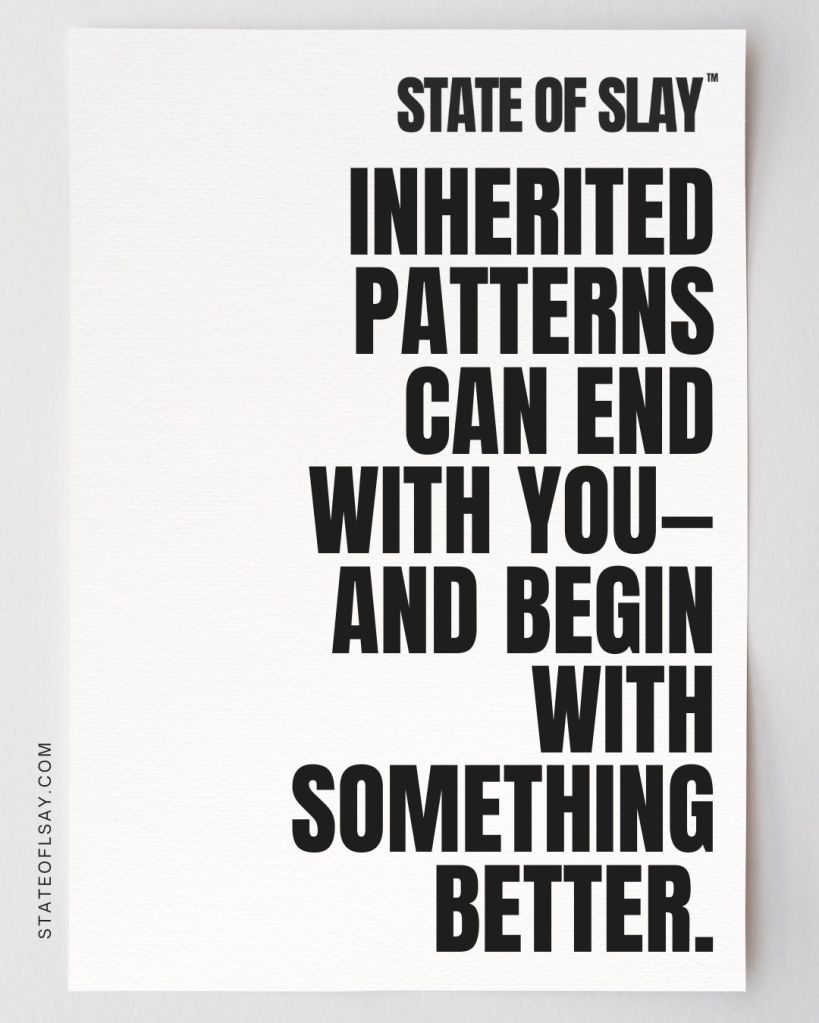
YOU GET TO BUILD SOMETHING NEW

Not everything passed down needs to be carried forward.
Cycles of hurt, silence, or survival may have paved your path—
but that doesn’t mean they have to shape your future.

You’re not here to repeat.
You’re here to restore.
To choose with intention.
To lead with clarity.
And to become the version of yourself your lineage didn’t know was possible.

This is your reminder to be the shift they never saw coming.

SLAY on!

Chase Purpose, Not People

There was a time in my life when I was constantly chasing people—their attention, their approval, their love.

I thought if I could earn it, maybe I’d finally feel like I was enough.

But no matter how much I gave, how much I bent, or how much of myself I lost in the process…
it never felt like enough.

Because it was never supposed to be.

I wasn’t meant to chase people.
I was meant to chase purpose.
And so were you.


When We Abandon Ourselves

When we get stuck in the cycle of proving our worth to others, we end up abandoning ourselves.

We ignore what lights us up.
We try to become what we think they want.
We twist. We shrink. We perform.

We lose the very parts of ourselves that were never meant to be hidden.

And the worst part?
The more we shape-shift to please, the more invisible we become—to others and to ourselves.


Purpose Doesn’t Need to Be Impressed

Purpose is steady.
It doesn’t need applause.
It doesn’t need permission.

It doesn’t ask you to chase it—only to follow.

When I started focusing on my purpose—my healing, my growth, my creativity, my peace—it all got clearer.

I could see what was aligned.
I could feel who was for me and who never was.
The people who truly belonged in my life didn’t need to be convinced. They didn’t need to be chased. They just showed up.

And not for what I could do for them.
But for who I was becoming.


Let Purpose Lead

The truth is:
You are never too much for the right people.
And you are never not enough for the path that was made for you.

So if you’re feeling left out, overlooked, or unseen—it might not be because something’s wrong with you.

It might be because you’re not meant to follow them.

You’re meant to follow you.

Let your purpose lead.
It knows the way.


SLAY Reflection

Do you ever find yourself chasing people instead of aligning with your purpose?
What does “chasing purpose” look like in your life right now?
Who in your life supports your growth without needing you to earn their love?
What’s one step you can take today to move closer to your purpose?
How might your life shift if you stopped proving yourself and started honoring yourself?

S — Show up for yourself
L — Let go of needing approval
A — Align with your purpose
Y — Yield to what feels right, not who feels familiar


Call to Action: Join the Conversation

I’d love to hear from you.
What’s something you’ve stopped chasing in order to start honoring your purpose?
Share your story in the comments. Let’s cheer each other on.

And if you know someone who’s trying to hold onto people instead of themselves, send this to them.
Sometimes, all we need is a nudge.

When a Child is Shamed for Feelings, They Don’t Stop Feeling—They Stop Trusting

There’s a heartbreaking truth many of us come to learn too late:

When a child is shamed for having feelings, they don’t stop feeling. They stop trusting.

They stop trusting their emotions. They stop trusting their voice. And eventually, they stop trusting themselves.

We often teach kids—intentionally or not—that certain feelings are too much, too messy, too inconvenient. That anger is bad. That sadness is weakness. That fear is overreacting. We hush them. We roll our eyes. We tell them to “get over it” or “calm down.” But what we’re really saying is: Your feelings don’t belong here.

And that message doesn’t just sting in the moment. It stays.


The Seeds of Self-Doubt

When we shame a child’s feelings, we’re not teaching emotional regulation—we’re teaching emotional suppression.

Instead of learning how to navigate their emotions, they learn to ignore them, question them, or feel guilt and embarrassment for even having them in the first place.

They start asking:

  • “Why am I so sensitive?”
  • “What’s wrong with me?”
  • “Why can’t I just be normal?”

These questions don’t come from nowhere. They come from a world that told them, early on, that their natural responses were somehow wrong.


Unlearning the Silence

As adults, many of us carry this conditioning into our relationships, our workplaces, and our inner dialogue. We still quiet our feelings. We second-guess our instincts. We feel shame for emotions that are perfectly human.

But here’s the thing: Our feelings don’t go away just because we learned to hide them.

They find other ways to come out—through anxiety, depression, emotional outbursts, or chronic people-pleasing. The body keeps the score. The heart remembers.

Healing begins when we give ourselves permission to feel again. To validate what was once invalidated. To trust that our emotions have something to teach us, not something to be ashamed of.


Reparenting Starts With Awareness

Maybe you were that child. Maybe you’re still carrying the weight of being told to “toughen up” or “stop crying.”

Or maybe you’ve caught yourself repeating those phrases to someone else—not out of cruelty, but because it’s what you were taught.

Here’s the good news: You can stop the cycle.

You can start by:

  • Saying “I hear you” instead of “you’re overreacting.”
  • Asking “What are you feeling?” instead of “What’s wrong with you?”
  • Letting your own emotions be seen, so others feel safe showing theirs.

You don’t need to have all the answers. You just need to be a safe place.


SLAY Reflection

Ask yourself:

  • Was I shamed for showing emotion as a child?
  • How did that shape the way I express or suppress feelings today?
  • Do I trust my emotional responses—or do I second-guess them?
  • How can I begin validating my emotions, rather than hiding or judging them?
  • What would it feel like to create space for someone else to share, without judgment?

S – L – A – Y

S: See where your emotional patterns began.
L: Listen to your inner voice with compassion.
A: Allow your feelings to surface without shame.
Y: Yield to the wisdom your emotions are offering.


Call to Action: Join the Conversation
I’d love to hear from you.
Were you taught to suppress your emotions as a child—and how has that shaped your journey?
Share your story in the comments. Let’s cheer each other on.

And if you know someone who’s learning to feel again, send this to them.
Sometimes, all we need is a nudge.

Love on a Leash

There’s a kind of love that doesn’t feel like love at all. It looks the part—smiles, sweet words, even grand gestures—but underneath, it’s tethered to expectations, rules, and unspoken conditions. It’s love, but only if. That’s love on a leash.

Love on a leash says: “I’ll love you if you behave a certain way.” Or worse, “I’ll love you when you’re less of this and more of that.” Sometimes, the leash comes from others. But just as often? We hold the leash ourselves.

We believe we must be a specific version of ourselves to be lovable. We shrink. We twist. We contort our identities to avoid rejection, or worse—abandonment. We believe we’re only worthy of love if we’re easy to handle, always agreeable, or constantly achieving.

And over time? That leash tightens. We stop reaching. We stop expressing. We stop showing up as who we really are.


I Know That Leash All Too Well

I’ve felt it—the pull of wanting to be loved so badly that I’d trade my truth for someone else’s comfort. The tension of walking on eggshells just to keep the peace. The guilt that rises when I try to set a boundary, even a healthy one, because I fear I’ll lose the connection if I do.

But here’s what I’ve learned:

Any love that demands you abandon yourself isn’t love. It’s control.

Love shouldn’t feel like a leash. It should feel like a safe place to land.


Real Love Doesn’t Require a Performance

Authentic love sees the real you. It invites all your parts—your fire and your softness, your growth and your mess. It doesn’t flinch at your vulnerability. It honors it.

And the same goes for how we love ourselves.

When we hold ourselves to impossible standards, we put our own hearts on a leash. We tell ourselves we’ll be worthy when we’re thinner, calmer, more successful, more perfect.

But we’re worthy now. We’ve always been.

You don’t have to earn love by becoming someone else. You get to be loved for who you are.


Releasing the Leash

Letting go of love with conditions means facing our fears. It means risking disapproval. It means standing in our truth, even if someone walks away.

But it also means freedom.

It means deeper connection, greater peace, and the kind of joy that only comes from being fully known and still fully accepted.

It starts with you. How you love yourself. How you speak to yourself. What you tolerate—from others and from your own inner voice.

And maybe most importantly? It starts with the unlearning of what love was never supposed to be.

You don’t have to stay tethered. The leash can come off.

And when it does?

You’ll remember: real love doesn’t confine—it expands.


SLAY Reflection

Ask yourself:

  • Have you ever felt like love came with conditions?
  • Who’s holding the leash—someone else, or you?
  • What stories about love and worth are you still carrying?
  • How can you begin showing yourself more unconditional acceptance?
  • What kind of love do you want to give—and receive—from this point forward?

S – L – A – Y

S: Spot the conditions—where do you feel limited in love? L: Let go of outdated beliefs about what makes you lovable.
A: Affirm your worth without needing to prove it.
Y: Yield to relationships that offer real connection—not just compliance.


Call to Action: Join the Conversation
I’d love to hear from you.
Have you ever experienced love on a leash—and what helped you take it off?
Share your story in the comments. Let’s cheer each other on.

And if you know someone who’s struggling to feel seen for who they truly are, send this to them.
Sometimes, all we need is a nudge.

Authenticity Is a Higher Vibration Than Joy and Love

We spend so much of our lives chasing happiness, love, and the so-called “good vibes.” But what if the real key to alignment isn’t about always being joyful or even feeling loved? What if the most powerful shift we can make is to be authentic?

Because here’s the truth: authenticity is a higher vibration than joy and love.


Prefer to listen? The Audio Blog version is available here.


The Truth About Vibration

Energy doesn’t lie. And when you’re pretending, pleasing, or performing, your vibration lowers—even if you’re smiling through it.

Joy without truth is performative. Love without boundaries is self-abandonment.

Authenticity, however, is rooted in truth. It’s grounded in presence. It’s the real you. And when we operate from that space, we emit the clearest, most powerful frequency we have. We show up aligned—and everything around us responds to that.


Real Over Perfect

There was a time when I thought I had to look happy to be happy. Smile through the pain. Be grateful when I was struggling. Be kind even when I was breaking.

But fake it ‘til you make it can only take you so far.

The day I stopped trying to be perfect and started being real—everything changed. People connected more deeply with me. My relationships became healthier. I became healthier. Because I wasn’t trying to stay high-vibe. I was trying to stay real.

And that is the vibe the universe actually responds to.


How Authenticity Heals

When we give ourselves permission to be real, we invite others to do the same. We create safety. We foster trust. We show others what it looks like to live in truth, not performance.

Authenticity says:

  • I feel this, even if it’s messy.
  • I’m not perfect, and I don’t have to be.
  • I can still be lovable, even when I’m struggling.

And that is where true love and joy can actually take root. Not in the performance of being okay—but in the truth of being whole.


Authenticity Is a Practice

Being authentic doesn’t mean sharing everything or letting your emotions run unchecked. It means showing up honestly.

It means:

  • Saying no when you mean no.
  • Speaking up when something matters.
  • Honoring your feelings without needing to justify them.

It means being clear about who you are—and being okay with the fact that not everyone will get it. Because your alignment matters more than approval.


The Frequency of Truth

Your truth has its own frequency. When you live it, you attract what’s meant for you. You repel what isn’t. You stop chasing and start receiving.

Authenticity isn’t a trend. It’s a vibration.

And the more you live it, the more powerful you become. Not because you’re trying to be powerful—but because there’s nothing stronger than someone who is fully themselves.


SLAY Reflection

  1. Where in your life are you performing instead of being real?
  2. What does authenticity feel like in your body?
  3. What would it look like to choose authenticity over approval?
  4. Have you mistaken being “high vibe” with being emotionally bypassing?
  5. What part of your truth are you ready to reclaim?

S-L-A-Y:

  • Speak your truth, even when it shakes
  • Let go of the need to be liked
  • Align with your values, not someone else’s
  • You are your most powerful when you are real

Call to Action: Join the Conversation
I’d love to hear from you.
Where in your life are you ready to get real?
Share your story in the comments. Let’s cheer each other on.

And if you know someone who’s stuck in performance mode, send this to them.
Sometimes, all we need is a reminder.

Invest In Yourself

When people talk about investments, they usually mean stocks, property, or retirement accounts. But there’s one investment that’s even more critical: you.

Your well-being—mental, emotional, and physical—is the foundation for everything else in your life. When you prioritize yourself, everything else gets better: your relationships, your career, your creativity, your peace of mind. Yet, so many of us wait until we’re completely burned out, overwhelmed, or spiraling to give ourselves the care we need.

It doesn’t have to be that way. It shouldn’t be that way.


Why Investing in Yourself Matters

The truth is, you can’t pour from an empty cup. If you’re constantly giving to others without replenishing yourself, you’re operating from depletion. Eventually, something gives.

Investing in yourself doesn’t mean spa days and bubble baths—though those are lovely. It means making consistent choices that nurture your well-being. It means saying no when something compromises your peace. It means taking the time to listen to your own needs, even if others don’t understand.

For me, investing in myself looked like finally saying yes to therapy. It looked like turning down invitations that drained me, and instead spending quiet time journaling, walking, or simply being. It looked like learning how to support myself the way I’d supported everyone else for years.

It was uncomfortable at first. I worried I was being selfish. But I realized: prioritizing yourself is not selfish—it’s survival. And over time, I saw how much better I could show up for others when I was also showing up for myself.


The ROI of Self-Investment

When you invest in yourself, you start to:

  • Build resilience
  • Strengthen your boundaries
  • Increase your capacity for joy
  • Reconnect with your purpose
  • Attract healthier relationships

And perhaps most importantly, you start to trust yourself more deeply. You become someone you can rely on. That’s powerful.


Start Where You Are

You don’t need to overhaul your life overnight. Start with one intentional choice a day. One small way to say, “I matter.” Maybe it’s drinking a full glass of water first thing in the morning. Maybe it’s taking five minutes to breathe. Maybe it’s setting a boundary you’ve been avoiding.

Whatever it is, let that choice be an act of self-respect.

Because when you invest in your well-being, you’re not just surviving—you’re building a life that supports you.


SLAY Reflection

  1. What does investing in yourself mean to you personally?
  2. What small act of self-care can you commit to today?
  3. Do you feel guilty prioritizing your well-being? Why?
  4. How might your relationships shift if you were more centered and grounded?
  5. What would change if you treated your mental health like a top priority?

S-L-A-Y:

  • Say yes to what nourishes you
  • Let go of guilt and shame
  • Act with intention, not obligation
  • You are worth the effort

Call to Action: Join the Conversation
I’d love to hear from you.
What’s one way you can invest in your well-being this week?
Share your story in the comments. Let’s cheer each other on.

And if you know someone who’s always giving but rarely giving to themselves, send this to them.
Sometimes, all we need is a nudge.

Slay Say

Love From Within

We all want to feel seen. Valued. Chosen.
But chasing validation from others can leave us emptier than before.

Because the most powerful kind of love?
The kind you don’t have to earn.
The kind you give yourself.

Let your inner voice speak with compassion.
Let your worth be non-negotiable.
Let your self-love be louder than your longing.

This is your reminder: You don’t need to be picked to belong to yourself.

SLAY on!